This site is supported by our readers. We may earn a commission, at no cost to you, if you purchase through links.
Most people assume curly-coated dogs don’t shed—and then find a clump of hair on the couch anyway. That clump isn’t a sign something’s wrong.
It’s how curly coats work: loose hairs don’t fall freely the way they do in a Labrador or Husky. Instead, they stay tangled in the curl until brushing pulls them out.
The hair still grows, still dies, and still needs somewhere to go.
Understanding that process helps you manage your dog’s coat with less frustration and more confidence—starting with the basics of how curly coat dogs and shedding actually connect.
Table Of Contents
- Key Takeaways
- Do Curly Coated Dogs Shed?
- Why Curly Coats Shed Less
- Least Shedding Curly Coat Breeds
- Seasonal Shedding in Curly Dogs
- Grooming Routines That Reduce Shedding
- Best Tools for Curly Coat Care
- Nutrition for a Healthier Coat
- Allergy and Dander Considerations
- Top 10 Curly Coat Grooming Products
- 1. CurlyWags Dog Detangling Curl Cream
- 2. Pride and Groom Curly Wavy Shampoo
- 3. Ulroyda Pet Fur Care Oil
- 4. Pride and Groom DogDays Curly Wavy Scrub Kit
- 5. BioSilk Silk Therapy Dog Detangler Spray
- 6. Skout Honor Probiotic Detangler Spray
- 7. Earth Rated Waterless Dog Shampoo
- 8. Pride and Groom Deshedding Dog Shampoo
- 9. Pride and Groom Non Shedder Shampoo
- 10. CHI for Dogs Unscented Deodorizing Spray
- Frequently Asked Questions (FAQs)
- Conclusion
Key Takeaways
- Curly coats don’t stop shedding — they just trap loose hair inside the curls until brushing or bathing releases it.
- Most curly breeds shed less because they have a single-layer coat with no dense undercoat, and their follicles cycle independently rather than all at once.
- Regular brushing, consistent bathing, and a diet rich in omega-3s and protein are your best tools for keeping shedding manageable and the coat healthy.
- "Hypoallergenic" is a marketing label, not a medical fact — curly dogs still produce dander, saliva proteins, and skin cells that can trigger allergic reactions.
Do Curly Coated Dogs Shed?
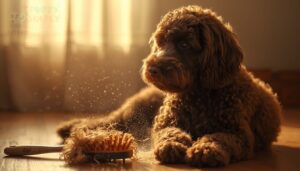
Yes, curly coated dogs do shed — just not the way most people expect. Instead of loose strands drifting onto your couch, the hair usually stays trapped in the coat until you brush it out.
Think of them as quiet shedders that keep their hair to themselves — a trait shared by many low-maintenance breeds.
Here’s what’s actually going on beneath those curls.
Why Shedding Still Happens in Curly Coats
Even curly coats shed — the hair just doesn’t fall freely to your floor.
Several factors drive this:
- Hair growth cycle naturally pushes old strands out.
- Hormonal influences can shift shedding patterns unexpectedly.
- Skin irritation from allergies or parasites loosens follicles.
- Nutritional deficiencies weaken hair structure over time.
- Environmental stressors and seasonal changes accelerate coat turnover.
Understanding the seasonal shedding pattern helps owners anticipate coat changes.
Hair Clumps Vs. Loose Strands
Curly coats don’t shed like straight-haired breeds — loose hair stays trapped in the curls, then releases as clumps during brushing or bathing.
Strand separation happens less often because curl overlap creates friction. Static build-up in dry air and humidity both affect how hair exits the coat.
| Feature | Clumps vs. Loose Strands |
|---|---|
| Appearance | Rope-like bundles vs. thin individual hairs |
| Where found | Concentrated spots vs. spread across surfaces |
| Clump formation cause | Curl friction, static build-up, humidity impact |
| Grooming release | Tool differentiation matters — slicker vs. wide-tooth comb |
| Risk if ignored | Hair mat prevention becomes harder over time |
Why “non-shedding” is a Myth
The "non-shedding" label is really a marketing misconception. Every dog follows the same hair growth cycle — growth, rest, release — and genetics only slow that process; they don’t stop it.
Every dog sheds — genetics only slow the cycle, never stop it
In curly coats, loose hair gets caught in the curls, creating a trapped hair illusion that looks like nothing fell out. But allergen persistence remains real, regardless of what the packaging promises.
How Curl Tightness Affects Visible Shedding
tight curls don’t just trap hair — they control when you see it. coil tension timing and curl density impact how shedding characteristics of curly‑coated dogs appear to you. bath-induced shedding can feel alarming, but it’s mostly trapped hair release from loosened spirals.
- tighter coils delay visible shedding
- breakage frequency rises with dry, tense curls
- Bathing separates curl clusters, releasing accumulated hair
- coat thickness affects how much hair stays hidden
Why Curly Coats Shed Less
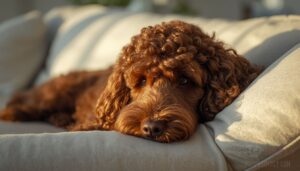
Curly coats don’t shed less by accident — there’s real biology behind it. A few key traits work together to keep loose hair from ending up on your couch or clothes.
Here’s what actually makes the difference.
Single-layer Coats and Less Undercoat
Most curly-coated dogs have a single layer coat, meaning no dense undercoat underneath.
That missing undercoat changes everything about shedding characteristics of curly-coated dogs — less fur mass means less visible loss.
Coat density impact is real: fewer layers reduce matting risk from seasonal blowouts, improve heat tolerance, and allow better skin exposure for airflow.
Insulation efficiency still works through the curls themselves.
| Feature | Double Coat | Single Layer Coat |
|---|---|---|
| Undercoat | Present | Absent |
| Shedding Volume | High | Low |
| Coat Maintenance | Intensive | Moderate |
Continuous Hair Growth Cycles
Hair follicles don’t all shed at once — that’s the key to understanding continuous hair growth in curly breeds.
Each follicle cycles independently through anagen, catagen, and telogen phases, so shedding stays spread out year‑round rather than arriving in one wave.
Key factors shaping the exogen shedding cycle in curly dogs:
- Anagen duration stays longer, delaying the telogen trigger.
- Follicle phase timing varies across the coat.
- Hormonal cycle influence can shift how many hairs enter telogen simultaneously.
- The hair growth cycle in dogs runs continuously, not seasonally.
- This pattern defines the shedding characteristics of curly‑coated dogs.
How Curls Trap Loose Hair
Think of each ringlet as a tiny net. In curly‑coated dogs, Curl Geometry creates natural catch points where loose hair snags instead of falling free.
Spiral Friction between coils slows release, while Moisture Sticking keeps strands clinging together.
This Ringlet Capture delays visible shedding — but without coat maintenance to prevent matting, trapped loose hair quietly triggers Mat Initiation, turning manageable fluff into stubborn mats of hair.
Why Seasonal Coat Loss Looks Different
Seasonal shedding in curly dogs doesn’t always look like what you’d expect.
As temperatures rise, coat density drops, and you’ll notice Curl Density Variation across the body — Regional Coat Thinning shows first near elbows and the belly.
Skin Visibility Shifts follow, along with Light Reflection Changes as shorter regrowth alters how the coat catches light.
Temperature-Induced Curl Tightening can make this look uneven week to week.
Least Shedding Curly Coat Breeds
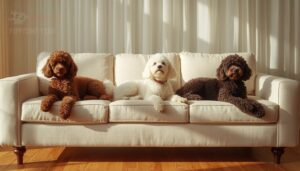
Some curly breeds shed so little that you’ll barely notice hair on your couch or clothes. The difference comes down to coat structure, growth cycles, and how tightly those curls hold onto loose hair.
Here are the breeds that consistently top the list for lowest shedding.
Poodles and Their Low-shed Coats
Poodles are one of the best examples of low-shed curly coat dogs. Their dense, continuously growing curls trap loose hair inside the coat rather than scattering it around your home.
Shedding management stays simple with regular grooming every 4–6 weeks. A balanced diet rich in omega-3s also promotes coat health.
Poodle size variations — toy, miniature, standard — share this same low-shed trait.
Bichon Frise Coat Traits
Bichon Frises have a distinctive double coat — a soft undercoat paired with a coarser outer layer that creates significant curl density variation. Loose hairs stay trapped inside rather than landing on your furniture.
Like other curly-coated dogs, regular grooming every 6–8 weeks promotes coat health and coat color brightness. Watch for staining or dull patches; those are often early skin health indicators worth discussing with your vet.
Portuguese Water Dog Shedding Patterns
Portuguese Water Dogs follow a pattern similar to the Bichon — loose hairs stay trapped in curls rather than drifting onto your couch. Genetic shedding tendencies keep visible hair loss low, but regular grooming still matters.
Water exposure, activity level, and environmental temperature effects can all shift how much loose hair you notice.
Staying consistent with brushing keeps dog coat health on track.
Curly-coated Retrievers Compared
Curly-Coated Retrievers sit in a different category. Their shedding behavior is moderate compared to Poodles or Bichons — seasonal peaks hit a few times yearly, not constantly.
Genetic variants in KRT71 shape their distinctive tight curls, which support water work efficiency during retrieving tasks. Their build and movement favor endurance, but grooming and coat care costs run slightly higher, and health issue frequency warrants regular vet checks.
Other Low-shed Curly Breeds
Beyond Retrievers, several other low-shedding breeds are worth knowing.
The Lagotto Romagnolo, Spanish Water Dog, and Irish Water Spaniel all have curly coats that trap loose hair effectively.
The Havanese, Miniature Schnauzer, and West Highland Terrier also shed minimally.
Each breed still needs a consistent coat care routine — regular brushing and trimming keep loose hair contained and coats healthy.
Seasonal Shedding in Curly Dogs
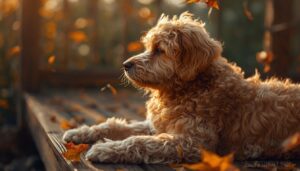
Even low-shedding curly dogs follow natural rhythms that shift throughout the year. Knowing what drives those changes helps you stay ahead of extra hair around the house.
Here’s what to expect at each stage.
Spring and Autumn Shedding Peaks
Even low-shed dogs follow a rhythm. Photoperiod hormones respond to shifting daylight, triggering a Spring Shedding Burst in March and an Autumn Shedding Wave in Fall.
Temperature Trigger signals a layer on top, telling your dog’s follicles to swap coats.
These seasonal shedding patterns in dogs mean your coat care routine needs to step up during those windows — more brushing, fewer surprises.
Puppy Coat to Adult Coat Changes
Around 12 to 16 weeks, your puppy starts its Coat Texture Change — soft baby fur gives way to denser adult curls through a Hair Cycle Shift that can last up to two years.
Growth Phase Timing varies by breed, but watch for:
- Uneven curl patterns across the body
- More clumping during brushing sessions
- Temporary texture inconsistency as Undercoat Development progresses
- Increased mat risk during Curl Pattern Evolution
Brush more during this stage.
Heat, Daylight, and Shedding Shifts
Your dog’s shedding cycle doesn’t run on a calendar — it runs on light and heat. Photoperiod Hormones shift when Daylight Length Effects kick in: longer days cut melatonin, raise prolactin, and trigger Temperature-Induced Molt. Heat Stress Impact can push this further.
| Seasonal Factor | Effect on Curly Coats |
|---|---|
| Light Exposure Timing | Signals spring molt onset |
| Temperature Regulation and Shedding in Dogs | Warmer temps accelerate clump release |
| Environmental Factors Affecting Curly Coats | Stress increases loose hair volume |
| Seasonal Factors Affecting Dog Shedding | Fall/spring peaks most visible |
When Shedding Becomes Excessive
Sudden Hormonal Fluctuations, Parasite Infestations, and Nutrient Deficiencies can all push shedding past the normal range.
If you’re finding clumps of hair more often than usual — or noticing patchy thinning, skin irritation, or Stress-Induced Shedding alongside behavioral changes — don’t wait it out.
Consult your vet for a Veterinary Skin Examination.
Managing shedding in curly-coated dogs sometimes means going beyond professional grooming to rule out deeper causes.
Grooming Routines That Reduce Shedding
Grooming is one of the most effective ways to manage shedding in curly-coated dogs. A consistent routine keeps loose hairs from building up and prevents the mats that make shedding worse.
Here’s what that routine should actually look like.
Brushing Frequency for Curly Coats
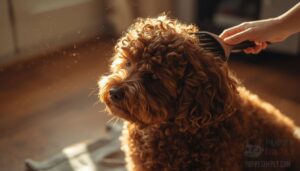
Brushing frequency depends on your dog’s curl length and coat density. Longer, tighter curls need daily brushing, while shorter curls can manage three to four times weekly.
Think of brush timing as a health monitoring habit, not just grooming.
Curly coat maintenance tips start here:
- Brush your dog’s coat daily during shedding seasons
- Increase grooming frequency when temperatures shift
- Use tool rotation—slicker brush first, then a wide-tooth comb
- Check curl length impact and adjust brush frequency accordingly
Bathing Schedules That Protect Curls
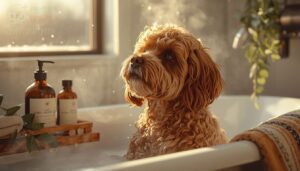
Bath your dog regularly, but let your dog’s scalp guide the schedule—not the calendar.
| Coat Type | Recommended Frequency |
|---|---|
| Dry or coarse curls | Every 7–10 days |
| Oily or fine curls | Every 3–4 days |
| Post-swim rinse | Same day as swim |
| Deep conditioning | Weekly or biweekly |
Use lukewarm water, a hydrating shampoo or conditioning shampoo, and apply conditioner after squeezing out excess water. Pre‑swim protection matters too—wet and condition before pool exposure to block chlorine. Mind your conditioner timing and post‑bath drying to keep curly coat maintenance tips working.
Trimming and Clipping Intervals
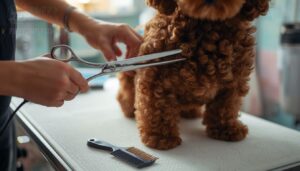
Trim your dog’s coat every 4 to 8 weeks, depending on growth rate scheduling, and how quickly curls lose their shape. Shorter clips need more frequent professional grooming appointments.
Sectioning strategy keeps finish line precision consistent across legs, torso, and face. sensitive zone safety near eyes and paws.
curly coat maintenance tips help regular grooming appointments stay on track.
Preventing Mats Before They Form
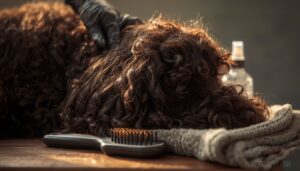
Regular trimming buys you time, but mats don’t wait for appointments. A pre-grooming inspection catches trouble early—check behind the ears, armpits, and collar line first.
Curl direction brushing with a slicker brush removes trapped hair without tightening knots. Moisture management after walks matters too: debris removal routine and good tool slip ratio keeps preventing hair mats in curly coats manageable, not overwhelming.
When to Choose Professional Grooming
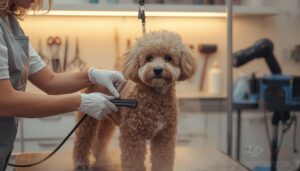
Some situations call for professional groomer expertise.
Severe matting close to the skin, persistent odor that returns after bathing, and overgrown nails are clear signs home care isn’t enough.
Post-bath drying done incorrectly can hide tangles and cause skin issues.
Keep in mind there’s often a long lead time for appointments, so book early.
Best Tools for Curly Coat Care
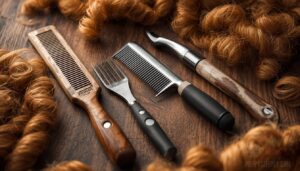
The right tools make a real difference when you’re managing a curly coat. Using the wrong brush or comb can pull at curls, cause breakage, and leave loose hair trapped where it doesn’t belong.
Here are the tools that actually work for curly coat care.
Slicker Brushes for Trapped Hair
A slicker brush is one of the most effective tools for curly coat grooming because it reaches trapped hair before matting sets in.
Pin Length Variations matter here — shorter pins suit toy breeds, while longer ones tackle thicker curls.
Look for Ergonomic Handle Design, a Self-Cleaning Mechanism for quick upkeep, Bristle Stiffness Choices matched to your dog’s coat, and the right Brush Head Size for full coverage.
Wide-toothed Combs for Detangling
After working through trapped hair with a slicker brush, a wide-toothed comb finishes the job. Teeth spacing of 8–12mm glides through curls without compressing knots.
Ergonomic grips reduce hand fatigue, and material choices like smooth plastic or wood prevent frizz.
For wet detangling tips, always start at the ends.
Portability features make these compact tools easy to keep handy for regular curly coat maintenance.
Detangling Sprays for Curl Maintenance
When your comb hits a snag, a detangling spray can make the difference.
Look for ingredient benefits like glycerin, panthenol, and silicone alternatives such as argan oil — these support moisture retention without weighing curls down. Apply about two minutes before combing for best results.
Sprays also aid mat prevention techniques and support curly coat maintenance, especially for dogs with scalp sensitivity. Skip roots to avoid buildup.
Waterless Cleaners for Quick Upkeep
Between baths, waterless cleaners help you keep your curly-coated dog’s coat fresh without stress. spray application technique matters — spritz lightly, then use microfiber wipe benefits to lift dirt and dander without scratching.
Many formulas include UV protection additives and come in eco-friendly packaging. Check the surface compatibility guide on each label to confirm safety for dog coat maintenance between regular brushing sessions.
Deodorizing Sprays Between Baths
After outdoor sessions, a deodorizing spray keeps your curly coat dog smelling fresh without a full rinse. Look for enzyme odor control formulas — they break down organic odor molecules rather than masking them.
Skin-friendly ingredients like aloe and chamomile protect sensitive skin, while a quick-dry formulation means no soggy paws. A travel-friendly bottle fits easily into your regular grooming bag.
Nutrition for a Healthier Coat
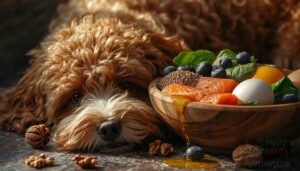
What your dog eats directly affects how their coat grows, sheds, and feels. The right nutrients can reduce breakage, support skin health, and keep shedding manageable year-round.
Here’s what to focus on.
Omega-3s for Skin and Coat Support
Omega-3 fatty acids are one of the most practical tools you have for supporting your curly-coated dog’s skin and coat health.
essential fatty acids, EPA and DHA work through EPA anti-inflammation pathways to deliver real benefits:
- Strengthen the omega-3 skin barrier to improve coat moisture retention
- Support inflammatory cytokine reduction, calming itchy, irritated skin
- Help dietary omega-3 intake reduce coat brittleness and breakage
- Improve skin health in dogs prone to dryness
- Reflect the broader impact of nutrition on dog coat health and shedding characteristics of curly-coated dogs
Protein and Hair Strength
Hair is mostly keratin — and keratin needs amino acids to stay strong. Without enough protein in your dog’s diet, hair shaft strength drops, disulfide bond health weakens, and shedding increases.
Protein deficiency impact shows up fast in curly coats.
| Nutrient | Role | Deficiency Effect |
|---|---|---|
| Amino acid supply | Builds keratin structure | Brittle, weak hair |
| Disulfide bonds | Maintain curl elasticity | Increased breakage |
| Keratin bond integrity | Enhances shaft resilience | Excess shedding |
| Omega-3 fatty acids | Reduces inflammation | Dry, dull coat |
| Biotin supplement | Strengthens follicle output | Poor coat condition |
nutrient-rich diet keeps your dog’s hair growing steadily and reduces unnecessary loss.
Vitamins and Minerals for Coat Quality
Proper nutrition goes beyond protein — vitamins and minerals quietly shape your dog’s coat from the inside out. Each nutrient plays a specific role:
- Zinc Benefits: skin cell repair and keeps shedding stable
- Biotin Role: helps keratin structure through daily dog nutrition
- Vitamin A Impact: maintains healthy skin cell turnover
- Vitamin E Antioxidant: protects follicles from oxidative damage
- Copper Pigment: helps coat color and connective tissue health
Diet-related Shedding and Brittleness
What your dog eats directly shapes how much hair ends up on your floor. Micronutrient Gaps, poor Fatty Acid Ratio, and Ingredient Intolerances can all trigger hair loss in dogs — even with consistent grooming.
| Diet Issue | Effect on Coat |
|---|---|
| Micronutrient Gaps | Brittle, fragile shafts |
| Carbohydrate Spikes | Inflammatory skin flare-ups |
| Weight Loss Stress | Accelerated shedding cycle |
| Fatty Acid Ratio imbalance | Dry, breakage-prone curls |
| Ingredient Intolerances | Flaky, irritated skin |
These factors quietly shift the shedding characteristics of curly-coated dogs, making skin health in dogs — and what fuels it — worth watching closely.
When to Ask a Vet About Food
If dog’s coat has turned brittle or shedding has picked up, it’s worth talking to your vet before changing anything. A vet consultation helps you match the right life stage diet to your dog’s actual needs.
Bring your current food label to the appointment.
- Mention any allergy-triggering ingredients you’ve noticed
- Ask about raw diet safety and nutrient-rich diet options
- Discuss medical condition nutrition if shedding follows a health change
Allergy and Dander Considerations
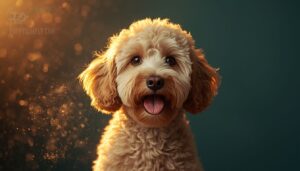
If you’ve chosen a curly-coated dog hoping to skip allergy troubles, the reality is a little more complicated than the "hypoallergenic" label suggests. Shedding less doesn’t mean producing fewer allergens — dander, saliva, and skin cells are still very much in the picture.
Here’s what you actually need to know to manage allergens living with a curly-coated dog.
Why Low Shedding is Not Allergen-free
Even with low shedding, your dog still produces skin protein shedding, saliva residue allergens, and dustborne allergen particles that settle into fabrics.
Fabric allergen transfer happens daily, quietly building a cumulative allergen load throughout your home.
Hypoallergenic claims and realities don’t always match — allergy considerations for dog owners go beyond visible fur.
Shedding versus dander are two separate issues, and dog dander reduction takes more than just choosing a curly breed.
Dander, Saliva, and Allergy Triggers
Dander and saliva are the real culprits. Proteins like Can f 1 travel on airborne dander particles, small enough to stay suspended for hours.
Saliva allergens coat your dog’s fur every time it grooms itself.
Allergen particle size matters here — the smaller the fleck, the longer it lingers in your air. These allergy considerations for dog owners apply regardless of shedding characteristics of curly-coated dogs.
How Grooming Helps Reduce Allergens
Regular grooming is one of the most effective tools for allergen management. Brushing triggers dander capture by lifting trapped particles before they scatter.
Bathing with a hypoallergenic dog shampoo drives allergen washout from the coat. Your drying technique matters too — thorough drying stops residue from resettling.
A consistent detangling routine and tool sanitation keep grooming requirements for curly-haired breeds manageable, whether you choose professional grooming vs DIY care.
HEPA Filters and Bedding Care
Grooming addresses what’s on your dog, but your home environment matters just as much for allergen management. HEPA air purifiers capture airborne allergens like dog dander allergens floating through your bedroom.
Build these three habits:
- Run HEPA air filters continuously and follow a filter replacement schedule every 6–12 months.
- hypoallergenic mattress covers and bedding allergen barriers, washing weekly at 130°F.
- vacuuming strategies with a HEPA vacuum on floors and upholstery regularly.
Bedroom humidity control, kept between 40–50%, further reduces allergen buildup overnight.
“Hypoallergenic” Curly Breed Realities
The word "hypoallergenic" is a marketing label, not a medical guarantee.
Poodles, Bichon Frise, and Portuguese Water Dogs shed less, but they still produce dander, saliva, and skin proteins that trigger reactions.
Breed Genetic Differences mean allergen levels vary dog to dog, so Owner Allergy Assessment through Allergen Exposure Testing — spending real time with a specific animal — tells you far more than any label.
Top 10 Curly Coat Grooming Products
The right products can make a real difference in how your curly-coated dog’s coat looks and feels day-to-day. Not everything on the shelf is worth your money, so knowing what actually works saves you time and frustration.
Here are ten grooming products worth keeping in your rotation.
1. CurlyWags Dog Detangling Curl Cream
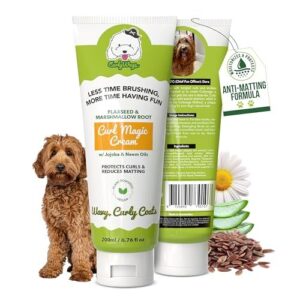
If matting is your biggest grooming headache, CurlyWags Curl Magic Cream is worth a close look.
This vegan, leave-in formula combines jojoba oil, marshmallow root, aloe vera, and flaxseed to soften curls and prevent tangles from forming in the first place.
You apply it to damp fur after bathing, working it through from ends to roots.
It’s free of sulfates, parabens, and silicones.
Many owners report going up to two weeks between sessions without noticeable mats.
| Best For | Dog owners with curly or wavy-coated breeds like poodles, doodles, and yorkies who want to cut down on brushing time and keep mats at bay between grooming sessions. |
|---|---|
| Form Factor | Leave-in cream |
| Volume | 8.78 oz |
| Sulfate-Free | Yes |
| Paraben-Free | Yes |
| Price (USD) | Not listed |
| Coat Type | Curly/wavy |
| Additional Features |
|
- Lightweight, clean formula — no sulfates, parabens, silicones, or dyes, so it’s gentle on sensitive skin
- Helps coats stay mat-free for up to two weeks when used consistently, which means fewer trips to the groomer
- Leaves fur soft and moisturized between baths without that greasy, weighed-down feeling
- Won’t do much for straight-coated dogs since it’s really designed for curly and wavy fur
- Has to be applied to a damp coat after bathing — it’s not a dry detangler or a replacement for a proper wash
- The chamomile scent is mild, but dogs with fragrance sensitivities might not love it
2. Pride and Groom Curly Wavy Shampoo
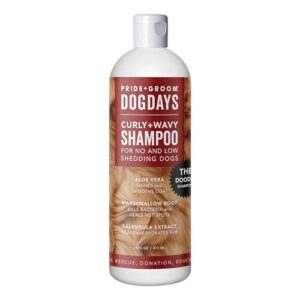
Pride and Groom’s Curly Wavy Shampoo was built with curly coats in mind — not as an afterthought. At $21 for 16 oz, it’s a plant-based, soap-free formula that cleanses without stripping the natural oils your dog’s curls depend on.
It’s tearless, paraben-free, and sulfate-free, so you can use it regularly without drying out sensitive skin.
It also helps loosen trapped dander, which matters if anyone in your home has allergies.
Professional groomers approve it, and that carries real weight.
| Best For | Doodle and poodle owners who want a gentle, natural shampoo that keeps curly coats soft, detangled, and easy to manage. |
|---|---|
| Form Factor | Rinse-out shampoo |
| Volume | 16 oz |
| Sulfate-Free | Yes |
| Paraben-Free | Yes |
| Price (USD) | $21.00 |
| Coat Type | Curly/wavy non-shedding |
| Additional Features |
|
- Plant-based and free of parabens, sulfates, and silicone — safe enough for regular baths without drying out your dog’s skin or coat.
- Deep-conditioning formula helps cut down on tangles and matting, which is a real time-saver for curly breeds.
- Tearless and hypoallergenic, so it works well for dogs with sensitive skin or easily irritated eyes.
- A 16 oz bottle goes fast if you have more than one dog, which drives up the cost over time.
- A few dogs have had reactions to the natural ingredients, so it’s worth doing a patch test first.
- It’s a shampoo only — no built-in conditioner, so heavily matted coats might still need an extra conditioning step.
3. Ulroyda Pet Fur Care Oil
Ulroyda Pet Fur Care Oil keeps things simple — and that’s actually its strength. At $8.99 for 1.7 fl oz, it blends jojoba, coconut, olive, grapeseed, and sweet almond oils with collagen to moisturize and detangle without weighing curls down.
It’s fragrance-free, alcohol-free, and pH-balanced, so it won’t irritate sensitive skin.
Apply a small amount after baths to lock in moisture and soften tight curls before brushing.
Results can be gradual, but regular use does make detangling noticeably easier.
| Best For | Pet owners with dogs or cats of any coat type—especially those with sensitive skin or scent sensitivities—who want a simple, affordable daily conditioning oil. |
|---|---|
| Form Factor | Leave-in oil |
| Volume | 1.7 fl oz |
| Sulfate-Free | Yes |
| Paraben-Free | Yes |
| Price (USD) | $8.99 |
| Coat Type | All coat types |
| Additional Features |
|
- Fragrance-free and alcohol-free, making it safe for sensitive pets, puppies, and kittens
- Blend of five natural oils plus collagen keeps fur soft, shiny, and easier to brush
- Lightweight formula works on all coat types without leaving a greasy residue
- Thin, watery consistency can make application a little tricky
- Results build gradually, so don’t expect an overnight transformation
- Not a treatment for skin conditions—it’s a coat care product, not a vet substitute
4. Pride and Groom DogDays Curly Wavy Scrub Kit
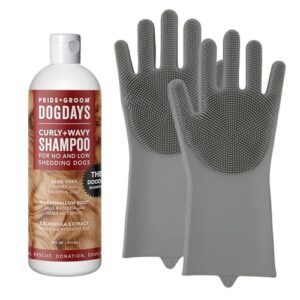
If you want to go further than oil treatment, a full wash kit covers more ground at once. The Pride and Groom DogDays Curly Wavy Scrub Kit ($38) pairs a vegan, sulfate-free shampoo with silicone scrub gloves that massage the skin and distribute lather evenly.
The gloves make rinsing faster and help calm anxious dogs during bath time. It’s hypoallergenic and latex-free, so sensitive skin stays protected. Bathe every three to four weeks for best results.
| Best For | Poodles, doodles, Shih Tzus, and other curly or wavy-coated breeds who need a gentle, thorough clean without losing their natural softness. |
|---|---|
| Form Factor | Rinse-out shampoo kit |
| Volume | Kit (shampoo + gloves) |
| Sulfate-Free | Yes |
| Paraben-Free | Yes |
| Price (USD) | $38.00 |
| Coat Type | Low/non-shedding |
| Additional Features |
|
- The silicone scrub gloves make lathering and rinsing way easier, and they’re great for calming dogs that get anxious in the bath.
- Vegan, sulfate-free, and hypoallergenic — safe for dogs with sensitive skin or allergies.
- Keeps curly coats soft and manageable without stripping natural oils.
- The one-size glove can be awkward for very small or very large hands — you might need to improvise a bit.
- The silicone ring can pop off under pressure, so handle it with care.
- Mostly designed for low-shedding breeds, so heavy shedders won’t see much hair reduction.
5. BioSilk Silk Therapy Dog Detangler Spray
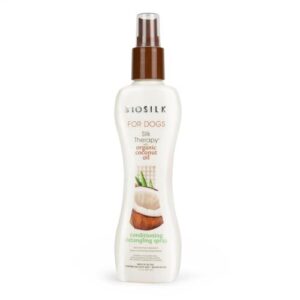
After a full scrub session, a detangling spray helps maintain that clean coat between baths.
BioSilk Silk Therapy Dog Detangler Spray ($13.99 for 7 fl oz) uses silk proteins and vitamins to soften curls and loosen knots before they tighten into mats.
The formula includes organic coconut oil, skips parabens and sulfates, and stays pH balanced for canine skin.
Spray from behind the ears to the tail, then brush through.
It’s practical, gentle, and easy to keep on hand.
| Best For | Dog owners with curly or tangle-prone breeds like doodles, poodles, and Shih Tzus who want an easy way to keep coats soft and knot-free between grooming sessions. |
|---|---|
| Form Factor | Leave-in spray |
| Volume | 7 fl oz |
| Sulfate-Free | Yes |
| Paraben-Free | Yes |
| Price (USD) | $13.99 |
| Coat Type | All coat types |
| Additional Features |
|
- Made with silk proteins, vitamins, and organic coconut oil — actually nourishes the coat instead of just coating it
- Free of parabens and sulfates, and pH balanced for dogs, so it’s gentle enough for regular use
- Straightforward to use — spray it on, brush through, done
- Won’t cut it for severe mats; if the knots are bad, you’ll still need a professional groomer
- The light fragrance, while mild, might bother dogs or owners who are sensitive to scent
- Not a stand-alone solution for thick or fast-growing coats — you still need a full grooming routine to back it up
6. Skout Honor Probiotic Detangler Spray
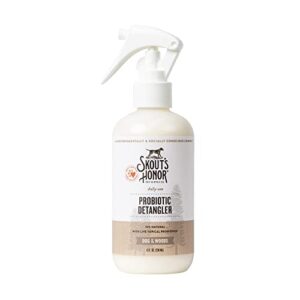
If BioSilk addresses the knots, Skout’s Honor takes things a step further by supporting your dog’s skin at the same time. The Skout’s Honor Probiotic Detangler Spray ($14.99 for 8 fl oz) combines avocado oil and omega-3s to soften curls while a live topical probiotic blend works on the skin microbiome beneath.
That means less dryness, less itching, and smoother brushing sessions. It’s 97% natural, free of parabens and sulfates, and safe for daily use on sensitive skin.
| Best For | Dogs with sensitive or dry skin that need detangling and a little extra coat care built into their daily grooming routine. |
|---|---|
| Form Factor | Leave-in spray |
| Volume | 8 fl oz |
| Sulfate-Free | Yes |
| Paraben-Free | Yes |
| Price (USD) | $14.99 |
| Coat Type | Double/long-hair |
| Additional Features |
|
- Avocado oil and omega-3s leave the coat soft and easier to brush through, especially for double-coat and long-hair breeds.
- The topical probiotic formula works on the skin microbiome, helping cut down on itching, dryness, and dandruff over time.
- 97% natural, paraben- and sulfate-free, and safe for everyday use on sensitive skin.
- The scent is strong — some dogs (and cats) aren’t fans, and there’s no unscented option.
- At $14.99, it costs more than a basic detangler, so results really depend on using it consistently.
- It’s a spray-only format, which may not suit every grooming style or coat type.
7. Earth Rated Waterless Dog Shampoo
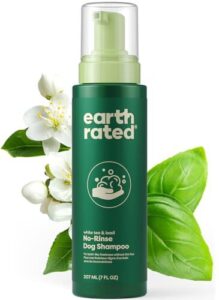
Some days, a full bath just isn’t happening. That’s where Earth Rated’s Waterless Foam Shampoo ($11.99 for 7 oz) earns its place in your kit.
You massage the foam in, towel it off, and you’re done — no rinsing needed.
It cleans, conditions, and deodorizes in one step with a light White Tea and Basil scent.
It’s free of parabens, sulfates, and alcohol, so it won’t irritate sensitive curly coats between regular grooming appointments.
| Best For | Dog owners who need a quick, fuss-free freshen-up between baths — especially for sensitive, post-surgery, or travel situations. |
|---|---|
| Form Factor | Waterless foam |
| Volume | 7 oz |
| Sulfate-Free | Yes |
| Paraben-Free | Yes |
| Price (USD) | $11.99 |
| Coat Type | All coat types |
| Additional Features |
|
- True no-rinse formula — just massage in and towel off, done in minutes
- Gentle enough for sensitive skin with no parabens, sulfates, or alcohol
- Cleans, conditions, and deodorizes all at once, so it actually pulls its weight
- Can leave a tacky residue on fine or non-shedding coats — you may need to follow up with a brush
- The dispenser has a reputation for breaking early, which is frustrating at $11.99
- Not a replacement for a real bath — heavily soiled dogs will still need the full wash
8. Pride and Groom Deshedding Dog Shampoo
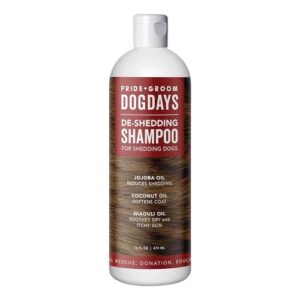
If loose hair is your main concern, Pride and Groom’s DogDays Deshedding Shampoo ($21.00 for 16 oz) is worth keeping on the shelf. It targets loose undercoat during the bath, so you’re removing hair at the source rather than chasing it around the house later.
The plant-based formula includes coconut oil, jojoba, and aloe vera to hydrate as it cleans. It’s free of sulfates, parabens, and silicone — gentle enough for sensitive curly coats without stripping natural moisture.
| Best For | Dog owners dealing with heavy shedding who want a gentle, natural shampoo that works for both single- and double-coated breeds. |
|---|---|
| Form Factor | Rinse-out shampoo |
| Volume | 16 fl oz |
| Sulfate-Free | Yes |
| Paraben-Free | Yes |
| Price (USD) | $21.00 |
| Coat Type | Single/double coat |
| Additional Features |
|
- Tackles loose undercoat right in the bath, so you’re not finding hair everywhere for days after
- Clean, natural formula — no sulfates, parabens, or silicone — so it’s safe for sensitive or reactive skin
- Lathers fast and rinses clean, which is a lifesaver when you’re bathing multiple dogs
- A 16 oz bottle goes fast in multi-dog homes, so the $21 price tag adds up quicker than you’d expect
- The essential oil scent is mild, but if you prefer totally unscented products, it might still be noticeable
- For really thick or dense coats, you’ll likely need a separate conditioner to get full detangling benefit
9. Pride and Groom Non Shedder Shampoo
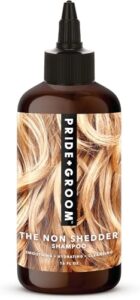
If your dog has a curly or low-shedding coat, Pride and Groom’s Non Shedder Shampoo ($32.00 for 16 oz) is built with that coat type in mind. It uses plant-based cleansers, coconut and avocado oils, calendula, and vitamin E to clean without stripping natural moisture.
The pH-balanced formula won’t irritate sensitive skin, and the cone-tip AppCap makes application easy and controlled.
It leaves a gentle, lasting scent and helps maintain curl definition with each wash.
| Best For | Dog owners with curly, wavy, or low-shedding breeds like doodles, shih tzus, or beagles who want a clean, natural shampoo that keeps the coat soft and manageable. |
|---|---|
| Form Factor | Rinse-out shampoo |
| Volume | 16 fl oz |
| Sulfate-Free | Yes |
| Paraben-Free | Yes |
| Price (USD) | $32.00 |
| Coat Type | Non-shedding |
| Additional Features |
|
- Packed with nourishing oils (coconut, avocado, jojoba) and botanicals that hydrate and add shine without harsh chemicals
- The AppCap cone dispenser makes bath time way less messy — good flow control with one hand
- Scent sticks around for a week or more, so your dog smells fresh long after the bath
- At $32 for 16 oz, it’s a splurge — especially if you’re bathing your dog often
- Won’t tackle serious mats or tangles on its own; you’ll still need a detangler or grooming tool
- The strong fragrance might be a dealbreaker for dogs or owners who are scent-sensitive
10. CHI for Dogs Unscented Deodorizing Spray
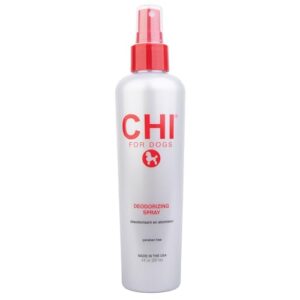
CHI for Dogs Unscented Deodorizing Spray ($9.40 for 8 oz) is a practical between-bath option for curly coats that trap odor-causing debris. It neutralizes common dog odors without added fragrance, making it suitable for dogs with scent sensitivities.
Conditioning agents like panthenol and Sodium PCA help maintain coat softness and reduce frizz after spraying.
You don’t need to rinse it out — just spray from ears to tail and brush through. It won’t replace a full bath, but it keeps your dog fresher between washes.
| Best For | Dogs with curly or thick coats and scent sensitivities who need a quick freshen-up between baths. |
|---|---|
| Form Factor | Deodorizing spray |
| Volume | 8 fl oz |
| Sulfate-Free | Yes |
| Paraben-Free | Not specified |
| Price (USD) | $9.40 |
| Coat Type | All coat types |
| Additional Features |
|
- Neutralizes odor without fragrance, so it won’t irritate sensitive dogs
- Conditions and softens the coat — no rinse needed, just spray and brush
- Compact and travel-friendly at 8 oz for under $10
- Won’t cut it if your dog rolled in something serious — a real bath is still necessary
- Some owners notice an unexpected scent despite the "unscented" label
- Ingredients aren’t fully disclosed, which may give allergy-conscious pet owners pause
Frequently Asked Questions (FAQs)
Do curly haired dogs shed a lot?
Think of a dog like a slow leak — it still drips. Curly dogs do shed, but their tight curls catch loose hair before it drifts onto your couch.
What words do dogs hear best?
Short, sharp words with strong consonants cut through noise best. Dogs respond fastest to consistent cues like "sit," "come," and "stay" — especially when paired with the same action every time.
Can curly coat dogs live in hot climates?
Yes, curly coat dogs can live in hot climates. You’ll need to keep their coats mat-free, limit midday activity, provide shade, and maintain constant access to fresh water.
Do curly coated dogs get along with other pets?
Most curly-coated dogs do well with other pets when introduced properly. Early socialization helps, especially with cats. Small animals like rodents need extra caution due to natural hunting instincts.
How long do curly coated dogs typically live?
Most curly coated dogs live 10 to 12 years, though many Curly Coated Retrievers reach 13 to 14 with good care, diet, and routine vet visits.
Conclusion
The idea that curly coat dogs and shedding have nothing to do with each other doesn’t hold up. Hair still grows, still dies, and still needs to go somewhere. The curl just changes where it ends up.
Once you understand that, grooming stops feeling like a losing battle. Right tools, a consistent routine, and good nutrition give you real control. Your dog’s coat isn’t the problem—gaps in knowledge are.
- https://www.oreateai.com/blog/the-myth-of-the-nonshedding-dog-understanding-coat-types-and-allergies/b7dc3aafe926854a548ced15e347ee61
- https://huggingface.co/datasets/fhai50032/Be-More-Specific-USER/viewer/default/train?p=1
- https://wildone.com/blogs/content/non-shedding-dogs
- https://www.caninejournal.com/non-shedding-dogs/
- https://www.dogsplanet.com/en/dog-facts/single-coat-vs-double-coated-dog-breeds/