This site is supported by our readers. We may earn a commission, at no cost to you, if you purchase through links.

The treat you grab from your pocket in that first split second after your puppy sits can make or break the lesson. Timing matters, yes — but so does what’s in your hand.
Most new puppy owners overthink flavor and underthink everything else: size, texture, calories, how fast a pup can actually chew and swallow before their brain moves on. A treat that takes fifteen seconds to eat doesn’t help anything except patience.
Knowing what makes a good treat for puppy training comes down to a handful of non-negotiable qualities — and once you understand them, picking the right one becomes straightforward.
Table Of Contents
- Key Takeaways
- Best Puppy Training Treat Qualities
- Choose Bite-Sized Puppy Treats
- Check Calories Per Treat
- Pick Soft, Chewy Textures
- Use High-Value Flavors
- Prioritize Simple Ingredients
- Consider Allergies and Sensitivities
- Match Treats to Training Situations
- Top 5 Puppy Training Treats
- Test Treats Before Training
- Frequently Asked Questions (FAQs)
- Conclusion
Key Takeaways
- Treat size and texture matter more than flavor — pea‑size, soft pieces your puppy can swallow in under three seconds, keep training momentum alive instead of killing it mid‑session.
- Keep each treat between 1–5 calories and never let treats exceed 10% of your puppy’s daily intake, trimming meal portions on heavy training days to stay balanced.
- Save highest‑value treats — liver, salmon, freeze‑dried meat — for the hardest moments like recall under distraction or learning a brand‑new cue, and rotate proteins weekly to prevent your pup from tuning them out.
- Short ingredient lists with real meat first and no artificial additives protect sensitive puppy stomachs and make it easy to pinpoint the culprit if a reaction shows up.
Best Puppy Training Treat Qualities

Not every treat will cut it when you’re trying to teach a wiggly eight-week-old to sit. The right training treat hits a specific set of marks — size, texture, calories, and flavor all working together. Here’s what to look for before you grab a bag off the shelf.
A deeper look at the best dog training treats breaks down exactly how price, ingredients, and texture affect what actually works in real training sessions.
Tiny Pea-sized Pieces
Every reward you drop during a session either keeps the game moving or kills it. Pea-sized treat pieces — roughly 2 to 3 millimeters across — are small enough that your puppy swallows them almost instantly, so you’re back to the next cue in seconds.
That speed is everything when you’re stacking puppy training rewards fast and building real momentum.
Fast Chewing and Swallowing
Size only gets you halfway there — what happens in your puppy’s mouth matters just as much. Soft, small treats compress with minimal jaw force, triggering the swallow reflex after just 3–6 chew cycles.
Saliva quickly lubricates the bolus, so consumption wraps up in under three seconds, keeping your training rhythm unbroken between cues.
Easy to Carry
When your training session moves from the backyard to the sidewalk, you need treats that travel with you — not against you. Pea-sized treat pieces measuring under 0.5 inches slip easily into a treat pouch or pocket without bulk or mess.
Here’s what makes carry-friendly treats genuinely useful:
- Scent-barrier packaging keeps snack-size pieces fresh between sessions
- Lightweight pouch designs clip to your leash without weighing you down
- Mess-free packaging means no crumbled small soft and easy to chew bits coating your hands
Safe for Frequent Rewards
Carry-friendly treats solve one problem, but what you’re putting into your puppy’s body during those back-to-back repetitions matters just as much.
Low-calorie, limited-ingredient options — think single-protein soft training biscuits with no artificial colors or preservatives — protect sensitive stomachs and reduce allergy risk while keeping sessions running smoothly.
Motivating Without Overfeeding
The trick isn’t just finding treats that your puppy loves — it’s finding ones small enough that you can reward 20 times in a session without blowing their daily calorie budget.
Aim for 1–5 calories per piece, stay under 10% of the total daily intake from treats, and trim meal portions on heavy training days to compensate.
Following a proper training calorie allocation helps keep your puppy within the recommended 10–20% range.
Choose Bite-Sized Puppy Treats
Size matters more than you’d think for training treats. The right portion keeps your puppy focused, your sessions moving, and your treat bag lasting longer than five minutes. Here’s what to know about sizing treats for your pup.
Pea-sized Treat Portions
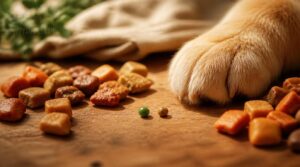
Think of a pea-sized treat as your training currency — small enough to spend freely, valuable enough to keep your puppy invested. Each piece measures roughly ¼ teaspoon in volume, which is just enough for one chewable movement.
That single-bite design is the whole point: it keeps caloric density low while preserving the reinforcement value of every reward.
Toy Breed Sizing
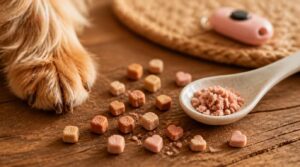
For toy breeds — those compact little dogs weighing under 10 pounds — even a standard pea-sized treat can feel oversized. Half a pea is your target: roughly ⅛ teaspoon per piece.
Their small mouths and developing teeth need soft and chewy textures that compress instantly, making each reward fast, clean, and genuinely useful inside a puppy training session.
Large Breed Sizing

Large breeds — those reaching 50 to 100 pounds at maturity — can handle slightly bigger pieces than their toy-breed counterparts, but pea-sized still wins.
Their rapid early growth makes caloric density a real concern, so keep treats at 1–5 kcal each to protect developing joints and skeletal structure without fueling too-fast weight gain.
Quick Reward Delivery

Timing is everything in puppy training — a reward that arrives within 2 seconds of a cue lands like a clear message; one that’s late lands like noise.
In puppy training, a reward within two seconds is a clear message — any later, it’s just noise
That’s why keeping a pea-sized treat ready in your hand or pouch lets you deliver it with a single motion, no fumbling, no break in flow.
Less Training Interruption
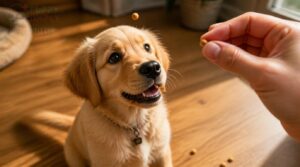
Every time your puppy stops to crunch through a large, crumbly treat, the training window slips away.
Pea-sized, fast-eating treats let you stack 3–5 repetitions inside a 10-second block, keeping the session’s rhythm intact. Smaller bites swallowed in under three seconds mean your consistent start cue lands before attention drifts — fewer interruptions, faster progress.
Check Calories Per Treat
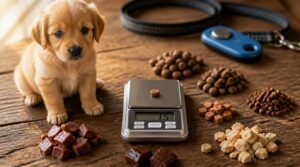
Calories matter more than most new puppy owners expect, and even tiny treats can quietly add up during a busy training day. Keeping each piece in the right calorie range protects your puppy’s weight and lets you reward freely without second-guessing yourself.
Here’s what to look for when checking the calorie count on your treats.
Aim for 1–5 Calories
Each treat you hand over during training should land somewhere between 1 and 5 calories — that’s the sweet spot for puppy training treats that let you reward generously without quietly overloading your puppy’s daily intake.
For small breeds, aim for the lower end, around 1–2 calories per piece.
Larger puppies can handle 3–5 calories while still keeping calorie control tight.
Follow The 10% Rule
Think of your puppy’s daily calories as a budget — treats are a line item, not a bonus.
Puppy treats shouldn’t exceed 10 percent of their total daily intake, so if your puppy eats 500 calories a day, that’s just 50 calories for all rewards combined across every training session.
That cap keeps calorie control tight without sacrificing a balanced reward system.
Count Daily Treat Calories
Knowing your 10% cap is one thing — actually tracking it is another. Divide your puppy’s daily treat allowance into a fixed calorie number before you start any session, not after.
- Use a mobile app to log treats alongside meals
- Weigh jerky or soft treats rather than counting pieces
- Pre-portion treats into small daily containers
- Calculate calories per piece by dividing package totals
- Flag calorie-dense options like peanut butter immediately
Adjust Regular Meal Portions
Once you know how many treat calories your puppy consumed in a session, subtract that number from their next meal. If your puppy burned through 40 kcal in treats, reduce the kibble portion accordingly — a kitchen scale makes this precise, since scoops vary.
Small, consistent reductions protect growth needs without disrupting their feeding routine.
Avoid Hidden Overfeeding
Hidden overfeeding sneaks up fast when you’re deep in a training session. Track treat intake daily — if each piece runs 3 kcal and you reward 15 times, that’s already 45 kcal before breakfast.
- Set a daily treat budget before sessions start
- Choose low-calorie, grain-free bites under 5 kcal each
- Log every treat alongside meals
- Weigh portions occasionally to catch drift
- Rotate flavors to stay motivating without increasing volume
Pick Soft, Chewy Textures
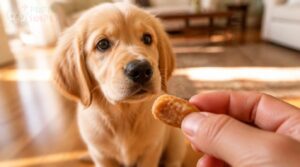
Texture isn’t just about preference — it directly affects how smoothly your training sessions flow. The right softness protects your puppy’s developing teeth, speeds up each reward, and keeps both of you in the zone. Here’s what soft, chewy treats actually do for your pup during training.
Gentle on Puppy Teeth
Puppy enamel is far more delicate than adult enamel, which means soft texture treats aren’t just a convenience — they’re a genuine safeguard.
Hard chews create friction that can cause micro-fractures in developing teeth, weakening them before they’ve even had a chance to mature.
Soft, chewy treats compress on contact, minimizing dental abrasion while still giving your pup something satisfying to bite into.
Easy to Break Apart
When a treat snaps cleanly in your fingers — without crumbling into dust — it becomes a genuine training asset.
Clean fracture lines let you split one pea-sized piece into two without fumbling, so manual portion control happens in seconds.
That elastic interior texture compresses and tears predictably, giving you consistent bite sizes and zero crumb mess mid-session.
Less Choking Risk
Soft, chewy treats are genuinely safer for puppies than hard biscuits. Pea-sized treat pieces under 5 millimeters are unlikely to fully block the airway, and soft texture treats mix with saliva to form a smooth bolus that slides down easily. Here’s what reduces choking risk most:
- Safe swallow sizes — pea-sized portions compress quickly
- Saliva interaction benefits — moist treats form safe, smooth boluses
- Texture safety checks — squeeze each piece before use
- Proper feeding posture — feed upright, in a calm setting
Minimal Crumb Mess
Nobody wants to spend post-training sessions vacuuming. That’s where pea-sized treat portions and soft texture treats earn their keep — they compress cleanly rather than shattering into dust.
Soft dog treats with stable moisture content leave almost no powdery residue on training mats, making your surface cleaning routines genuinely quick, and keeping small treats for efficiency means less mess overall.
Faster Training Repetitions
Speed is the silent engine behind every good training session. When your puppy can swallow a pea-sized treat in under three seconds, you maintain the rapid-fire rhythm that actually builds behavior.
- Soft texture treats eliminate long chewing pauses
- High-value treats eaten fast sharpen reinforcement timing
- Training session flow stays unbroken between cues
Use High-Value Flavors
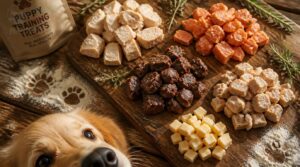
Not every treat will make your puppy stop mid-sniff and snap to attention — but the right flavor absolutely will. High-value treats tap into what your puppy finds genuinely irresistible, and knowing which ones hit hardest gives you a real edge during training.
Here are the flavors worth keeping in your pocket.
Chicken and Beef
Chicken and beef are the workhorses of the treat world — reliable, widely available, and almost universally loved by puppies.
Chicken delivers complete protein with all nine essential amino acids, while beef adds iron and a richer, meatier scent that can sharpen focus when your pup’s attention starts drifting.
Alternating between the two keeps sessions feeling fresh.
Liver and Salmon
In order to pull your puppy’s full attention — especially outdoors — liver and salmon are a cut above.
Salmon liver punches hardest here. It delivers omega-3s EPA and DHA that support your pup’s developing brain, plus meaningful vitamin D and selenium. And that fishy aroma? Distracting environments don’t stand a chance.
- High omega-3 content for brain and heart support
- Lower vitamin A than beef liver — safer for frequent rewards
- Strong scent cuts through outdoor distractions fast
- Soft and chewy texture allows rapid repetitions
- Easy to break into pea-sized pieces on the go
Beef liver is powerful too, but because it’s richer in vitamin A, rotating it carefully matters — vitamin A toxicity is a real concern if liver dominates every session. Prepare it plain, cooked through, trimmed of fat, with zero salt or spices.
Use these as your highest-value treats — saved for the moments your puppy needs the biggest reason to listen.
Peanut Butter Flavors
Liver and salmon may win outdoors, but peanut butter holds its own as a crowd-pleaser in the training room. Puppies go wild for that rich, roasted aroma — whether it’s a natural peanut purity formula or a honey roasted variety with a touch of sweetness.
Just always confirm there’s no xylitol on the label.
Strong Aroma Matters
Think of aroma as your puppy’s advance notice. Volatile scent compounds released from high-value treats — especially liver and organ meats — reach your puppy’s nose before the treat even leaves your pocket, triggering recognition before the reward arrives.
That head-start is real: aroma-driven motivation can visibly shorten the gap between your cue and your puppy’s response.
Save for Harder Cues
Not every treat needs to be your puppy’s favorite. Reserve high-value rewards — liver, salmon, real meat — for moments that genuinely demand them: recall under distraction, first attempts at a new cue, or situations where motivation is visibly slipping.
- Nail a recall near traffic
- Hold a stay with strangers nearby
- Learn a brand-new behavior
- Ignore another dog mid-walk
- Return focus after a startle
That’s your tiered reward system at work.
Prioritize Simple Ingredients
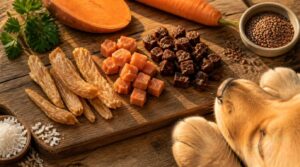
What goes into a treat matters just as much as what it tastes like. A clean, simple ingredient list tells you exactly what you’re feeding your puppy — and gives you confidence it won’t cause digestive upset or unknown reactions. Here’s what to look for when checking the label.
Real Protein First
Real protein first means the first ingredient on the label is actual meat — chicken, beef, or salmon — not a filler or by‑product.
That protein density keeps your puppy motivated, bite after bite, promotes lean muscle growth during this critical developmental window, and delivers nutrient‑rich rewards without loading up on empty calories your pup doesn’t need.
Short Ingredient Lists
A shorter ingredient list isn’t just easier to read — it’s a signal of minimalist formulation you can actually trust. When a treat contains five ingredients instead of fifteen, you can verify every component in seconds, making ingredient traceability straightforward.
That clarity builds real consumer confidence, especially when you’re managing sensitivities or simply want to know exactly what’s going into your puppy.
No Artificial Colors
The label "no artificial colors" sounds reassuring, but it’s worth understanding what it actually means.
FD&C synthetic dyes are the only colorants officially classified as artificial — so a treat can carry that clean-sounding claim while still containing beets, turmeric, or spirulina for color. Those are plant‑based pigments, not petroleum‑derived dyes, and that’s a real distinction worth knowing.
No Unnecessary Fillers
Fillers like corn, wheat starch, and unnecessary binders add bulk without adding value — and your puppy’s gut pays the price. Look for real animal protein first on the label, with a high protein-to-filler ratio and no placeholder ingredients stretching the list.
Treats built around digestible energy sources keep training clean, effective, and easy on your puppy’s stomach.
Digestible Puppy-safe Formulas
A puppy’s gut is still developing, which means digestible ingredients aren’t optional — they’re foundational. Look for formulas with small protein molecules, prebiotic gut health support, and lactose-free milk replacers:
- Limited ingredient puppy treats with a single protein source
- Low fat content that won’t overwhelm immature digestion
- Vet-approved dog snacks free from unnecessary additives
- Balanced nutrients matched to puppy nutrition and absorption rates
Consider Allergies and Sensitivities
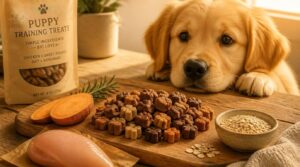
Even if you’ve nailed the size, calories, and texture, the wrong ingredient can quietly cause more harm than good. Puppies with food sensitivities often show signs you might not immediately connect to treats — digestive upset, itchy skin, or dull coat. Here’s what to watch for and how to choose smarter.
Single-protein Treats
Some puppies have stomachs that simply don’t tolerate variety.
If your pup shows itching, loose stools, or ear trouble after treats, single-protein options are worth trying first. With only one animal protein — chicken, salmon, or turkey — the ingredient list stays short, making it far easier to pinpoint what’s causing a reaction during an allergen elimination trial.
Limited-ingredient Options
Going one step further than single-protein choices, limited ingredient treats cut the formula down to only what’s necessary — one protein, one or two carbohydrate sources, and nothing extra.
That simplicity makes managing food sensitivities far more straightforward, because when a reaction surfaces, you’re not hunting through a twelve-item label trying to guess the trigger.
Avoid Known Triggers
Once you’ve narrowed the label down to a handful of ingredients, the next step is confirming no known allergens appear — even trace ones. If chicken once caused loose stools or skin reactions, rule it out entirely.
Stress and environmental noise can heighten sensitivity responses, so run early taste tests in a calm, distraction‑free space where your puppy feels safe enough to give you an honest reaction.
Watch Stool Changes
Stool tells you a lot. After introducing any new treat, watch for color or consistency shifts — loose, watery stools lasting more than two days, unusually dark or pale output, or mucus signal that something isn’t sitting right. That’s your puppy’s digestive health giving you direct feedback on whether a protein source agrees with them.
| Stool Sign | What It May Indicate | Action to Take |
|---|---|---|
| Loose or watery stools | Poor digestibility or sensitivity | Pause the treat immediately |
| Dark, tarry appearance | Possible intestinal irritation | Consult your vet promptly |
| Pale or clay-colored | Reduced bile flow | Schedule a vet check |
| Mucus coating | Gut irritation or infection | Monitor closely; vet if persistent |
| Sudden frequency increase | Dietary trigger or stress response | Remove new treat; reassess |
Rotate Carefully
Rotating your puppy’s treats isn’t just variety for variety’s sake — it’s smart allergy management. Swap proteins on a predictable cycle to keep sensory motivation high while limiting repeated exposure to any single ingredient. A simple three-step rotation:
- Week one: chicken-based training treats
- Week two: salmon or fish-based puppy treats
- Week three: beef or bison high-value treats
Minimizing inertia between switches keeps your sessions flowing without digestive disruption.
Match Treats to Training Situations
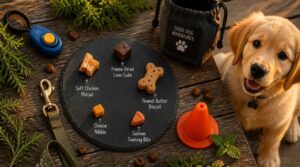
Not every training moment calls for the same treat. The right reward depends on where you are, what you’re asking your puppy to do, and how much competition you’re up against. Here’s how to match your treats to the situation so your pup stays motivated when it matters most.
Low-distraction Practice
Start in a quiet room with minimal distractions — no TV, no foot traffic, no other pets wandering through. Remove visual clutter from the space so your puppy’s attention stays on you.
Keep sessions short, deliver high-value, low-calorie soft treats immediately after each correct response, and let reward timing do the heavy lifting before you ever introduce a single distraction.
Outdoor Distractions
The moment you step outside, the training environment gets ten times harder.
Squirrels dart across paths, birds flush from bushes, wind swallows your verbal cues, and a passing cyclist can erase five minutes of focus in seconds.
That’s why high-value, strongly aromatic treats — think freeze-dried liver or salmon — become non‑negotiable outdoors.
Your puppy needs a reason that outcompetes everything else competing for its attention.
Recall Training Rewards
Recall is where the right treat can make or break your puppy’s response. When your puppy hears that cue and sprints back to you, reward immediately — even a two-second delay weakens the association.
- Use high-value, aromatic treats like freeze-dried chicken or liver
- Reward stack: quick treat followed by brief praise or play
- Keep rewards portable and pocket-ready for on-the-go recalls
Clicker Training Sessions
The clicker is only as powerful as the treat that follows it. Timing precision is everything — click the exact moment your puppy nails a behavior, then deliver a soft, chewy, pea-sized treat within two seconds. Any longer, and the association blurs.
| What the Clicker Captures | Best Treat Type |
|---|---|
| Sit behavior | Soft chicken bites |
| Eye contact | Freeze-dried liver |
| Targeting with nose | Moist salmon pieces |
| Spontaneous calm | Small peanut butter morsels |
| Paw touch | Chewy beef training treats |
Keep sessions to 5–15 minutes and practice just one or two behaviors per session — that’s enough runway for real behavior shaping without mental fatigue.
On-the-go Reinforcement
Training doesn’t stop when you leave the house — your puppy is picking up cues everywhere. Pocket-friendly, pea-sized treats let you encourage good behavior the moment it happens, whether you’re at the park, vet, or busy sidewalk.
Keep these on hand for on-the-go reinforcement:
- Freeze-dried liver or salmon — shelf-stable, intensely aromatic, holds focus amid outdoor distractions
- Soft chewy bites — travel without crumbling and break apart instantly for precise portions
- Low-calorie options (1–3 kcal) — support multiple repetitions without blowing daily limits
- Vacuum-sealed pouches — preserve freshness for weeks, no refrigeration needed
Deliver within three seconds of the correct response. That timing window is what keeps the behavior-reward loop tight, even outside.
Top 5 Puppy Training Treats
Now that you know what to look for, it’s time to put that knowledge to work. These five treats check all the right boxes — soft texture, low calories, quality ingredients, and flavors puppies actually go crazy for. Here are the top picks worth keeping in your training pouch.
1. Honest Kitchen Beef Salmon Treats
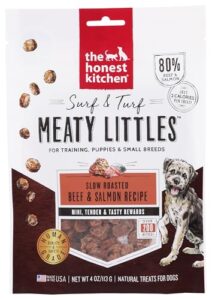
Honest Kitchen’s Meaty Littles punch well above their weight for puppy training. At just 2 calories per treat, you can run dozens of repetitions without blowing your pup’s daily calorie budget.
The beef and salmon base delivers human-grade protein with natural DHA — good news for developing puppy brains. They’re soft, break apart cleanly, and the salmon aroma is genuinely hard for dogs to ignore, even when distractions compete for attention.
| Best For | Puppy owners and small-breed dog trainers who need a low-calorie, high-reward treat they can use repeatedly during training sessions without worrying about overfeeding. |
|---|---|
| Protein Source | Beef & Salmon |
| Calories Per Treat | 2 kcal |
| Net Weight | 3.99 oz |
| Corn & Soy Free | Yes |
| No Artificial Flavors | Yes |
| Bite-Sized Format | Thin slices |
| Additional Features |
|
- Only 2 calories per treat, so you can reward generously during long training sessions without guilt
- Human-grade beef and salmon with natural DHA to support brain development at every life stage
- Soft and easy to break apart, making them perfect for tiny mouths or very small breeds
- Packaging is prone to crushing, so you may end up with crumbs and broken pieces instead of whole treats
- Low caloric density means they won’t cut it as an energy boost for highly active or working dogs
- Contains salmon, so dogs with fish allergies will need to sit this one out
2. Open Farm Beef Training Treats
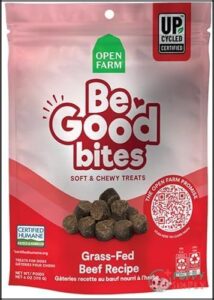
If sustainable sourcing matters to you as much as what goes into your pup’s mouth, Open Farm’s Beef Training Treats are worth a look.
The beef comes from farms that skip antibiotics and growth hormones, and Open Farm publishes traceable ingredient origins — rare transparency in pet food.
Treats are soft, easy to pinch apart, and carry a mild but appealing aroma that holds a puppy’s attention without being overpowering.
| Best For | Dog owners who prioritize sustainable, traceable ingredients and want a low-calorie soft chew for frequent training rewards. |
|---|---|
| Protein Source | Turkey |
| Calories Per Treat | Under 2.5 kcal |
| Net Weight | 5.82 oz |
| Corn & Soy Free | Yes |
| No Artificial Flavors | Yes |
| Bite-Sized Format | Small pellets |
| Additional Features |
|
- Made with humanely sourced beef — no antibiotics or growth hormones — and Open Farm publishes exactly where each ingredient comes from
- Soft, pinchable texture and a mild aroma make them easy to handle and appealing to dogs without being overwhelming
- Low-calorie and free from corn, wheat, soy, and artificial additives, so you can reward generously during longer training sessions
- Contains barley and sorghum, so they won’t work for owners following a strict grain-free diet
- The small pellet size may not be satisfying enough to hold the attention of larger breeds
- Includes citric acid and mixed tocopherols as preservatives, which could be a concern for dogs with sensitivities
3. Cloud Star Liver Training Treats
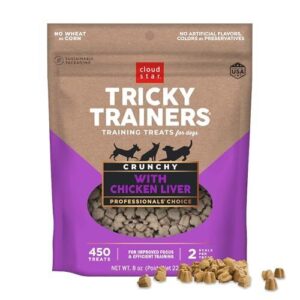
Few treats have stuck around the training world as long as Cloud Star’s Liver Training Treats — and that staying power means something. Real chicken liver sits at the top of the ingredient list, delivering a strong aroma that cuts through distraction and keeps your puppy locked in.
At roughly 2 calories per piece, you can reward generously across a full session without blowing your pup’s daily calorie budget. No wheat, corn, dairy, or soy makes these a solid pick for sensitive stomachs.
| Best For | Trainers and dog owners who run frequent or extended training sessions and want a low-calorie, allergen-friendly treat that keeps dogs engaged without overfeeding. |
|---|---|
| Protein Source | Chicken Liver |
| Calories Per Treat | 2 kcal |
| Net Weight | 8 oz |
| Corn & Soy Free | Yes |
| No Artificial Flavors | Yes |
| Bite-Sized Format | Tiny crunchies |
| Additional Features |
|
- Only 2 calories per treat, so you can reward liberally throughout long sessions without worrying about weight gain
- Real chicken liver flavor delivers a strong, enticing aroma that holds a dog’s attention even in distracting environments
- Free from wheat, corn, dairy, and soy — a great option for dogs with common food sensitivities
- The tiny size may leave larger breeds wanting more, making them less effective as a high-value reward for bigger dogs
- Contains pearled barley and oat flour, so dogs with grain sensitivities will need to sit this one out
- Only one flavor available, which could get old for picky dogs or owners who like to rotate treats
4. Full Moon Human Grade Beef Treats
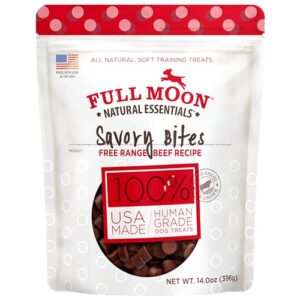
If liver-forward treats feel too pungent for your bag or pocket, Full Moon’s human-grade beef bites offer a cleaner alternative without sacrificing motivation. USDA-approved free-range beef leads the ingredient list, followed by cassava root, celery, and rosemary extract — no grains, corn, soy, or artificial anything.
The pieces break apart easily for precise pea-sized portions, making them genuinely practical mid-session. Just watch the cane sugar — fine occasionally, but worth factoring into your pup’s daily calorie count.
| Best For | Dogs with food sensitivities or allergies who need a high-value, clean-ingredient training treat that won’t upset their stomach. |
|---|---|
| Protein Source | Beef |
| Calories Per Treat | Not listed |
| Net Weight | 14 oz |
| Corn & Soy Free | Yes |
| No Artificial Flavors | Yes |
| Bite-Sized Format | Uniform bites |
| Additional Features |
|
- USDA-approved human-grade free-range beef as the first ingredient — genuinely high quality, not a marketing claim
- Grain-free, allergen-friendly formula with no corn, soy, wheat, or artificial additives makes it a safe pick for sensitive pups
- Small, uniform bite-size pieces are easy to break down further for precision rewarding during training sessions
- Contains cane sugar, so it shouldn’t be used too freely — especially for small dogs or those watching their weight
- Overconsumption can cause loose stools or stool discoloration, which is worth keeping in mind for heavy training days
- Piece size varies slightly and the treats dry out quickly if not sealed properly after opening
5. Onward Hound Soft Bison Treats
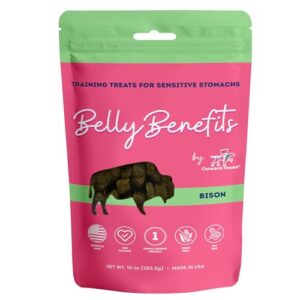
For puppies with sensitive stomachs, Onward Hound’s Belly Benefits Bison Treats are worth serious consideration. Single-source bison protein keeps the ingredient list clean — no corn, soy, or artificial anything — and each piece clocks in at just 3.5 kcal, making them genuinely session-friendly.
The soft, slightly moist texture breaks apart without crumbling, so you can halve pieces mid-session without the mess. Resealable bag, USA-made, and picky-stomach approved.
| Best For | Puppies, seniors, and small breeds with sensitive stomachs who need a low-calorie, clean-ingredient treat for frequent training or enrichment. |
|---|---|
| Protein Source | Bison |
| Calories Per Treat | ~3.5 kcal |
| Net Weight | 10 oz |
| Corn & Soy Free | Yes |
| No Artificial Flavors | Yes |
| Bite-Sized Format | Soft mini pieces |
| Additional Features |
|
- Single-source bison protein with no corn, soy, or artificial fillers — great for dogs with common food sensitivities
- At just 3.5 kcal per treat, you can reward generously during training without worrying about weight gain
- Soft, bite-sized pieces work perfectly for puzzle feeders and can be halved easily mid-session
- Contains eggs and animal fats, so dogs with those specific sensitivities will need to look elsewhere
- Premium pricing puts it above budget-friendly treat options
- Only comes in bison flavor, which may not win over particularly picky eaters
Test Treats Before Training
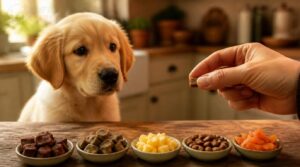
Not every treat that looks good on paper will actually work for your puppy, so it’s worth running a few quick checks before committing to it. These simple tests take only minutes but can save you a lot of frustration mid-session. Here’s what to put each treat through before it earns a spot in your training pouch.
Two-flavor Preference Test
Before buying a bag, run a simple two-flavor preference test at home. Hold a piece of chicken in one hand and liver in the other, then offer both simultaneously.
Whichever your puppy noses toward first — that’s your winner. Repeat three times, alternating hands to rule out side bias, and you’ll have a reliable palatability read in under two minutes.
Three-second Eating Test
Once your puppy picks a favorite, run one more quick test: hand over a single pea-sized piece and start counting. If they consume it in three seconds or less, that treat has earned a spot in your training pouch.
A consumption delay — hesitation, dropping it, or prolonged chewing — signals the texture or size needs adjusting before your next session.
Breakability Check
Snap one treat in half and look closely at the break. A good training treat splits cleanly, yielding pea-sized, smooth-edged pieces — no sharp fragments, no dusty crumble.
Fragment safety matters here: pieces that shatter into uneven chunks create real choking hazard prevention concerns, especially in young puppies. Soft enough to chew without resistance means the break stays predictable every time.
Pocket Mess Test
Tuck a few treats in your pocket before the session even starts. After five minutes of movement, check for residue, crumbs, or stickiness.
Training treat storage matters more than people realize — a treat that disintegrates in your pocket interrupts momentum. Soft, chewy, pea-sized pieces that stay intact signal a prototype usability winner worth trusting in real sessions.
Puppy Focus Response
The real proof? Watch your puppy’s eyes. Offer the treat, say their name once, and time how quickly they snap back to you — under two seconds means you’ve found a winner.
If they nose-dive for crumbs or lose focus mid-session, the treat isn’t pulling its weight, no matter how clean its ingredient list looks.
Frequently Asked Questions (FAQs)
Can puppies be trained without treats at all?
Yes — praise, play, and toys can all encourage good behavior. Vocal markers and enthusiastic petting work especially well for puppies who bond strongly with people, making treats entirely optional in some sessions.
At what age should treat training begin?
Eight weeks is the earliest age to start treat training — once weaning is complete and the digestive system is ready. This aligns perfectly with the critical socialization window.
How do treats affect long-term food motivation?
Used wisely, treats build lasting training motivation — but overuse of a single high-value flavor can dull a puppy’s enthusiasm. Rotating rewards and keeping portions small prevents habituation and sustains drive.
Should treats differ for rescue versus breeder puppies?
Not really — both need soft, low-calorie, high-value treats. What changes is how you use them: stress history and temperament assessment shape your reward schedule far more than where your puppy came from.
Can training treats replace part of a puppys meal?
Training treats can replace a small part of your puppy’s daily calories — but never the whole meal. Keep treats under 10% of daily intake, and reduce kibble portions accordingly to stay balanced.
Conclusion
Funny how the smallest things carry the most weight. A pea-sized morsel, gone in two seconds, is doing more heavy lifting than the fanciest gear in your training bag.
Understanding what makes a good treat for puppy training isn’t complicated once you strip it down to what actually matters — size, texture, calories, and a scent your pup can’t ignore.
Nail those four things, and every session becomes a conversation your puppy actually wants to join.
- https://www.laylopets.com/blogs/barkives/how-to-choose-the-best-training-treats-for-puppies-a-guide-for-smarter-snacking
- https://www.poochandmutt.co.uk/blogs/lifestyle/high-value-dog-treats-the-complete-guide
- https://www.smartbark.co.uk/post/top-5-puppy-treats
- https://www.lordjameson.com/blogs/news/complete-guide-to-choosing-dog-treats-for-training
- https://forthglade.com/blogs/all-blogs/best-dog-training-treats