This site is supported by our readers. We may earn a commission, at no cost to you, if you purchase through links.

Most dog owners hand over a treat the moment they think "good job"—which, by the time the thought forms, the fumbling starts, and the hand reaches the pouch, lands somewhere around two to three seconds late.
That gap isn’t a minor inconvenience.
Your dog’s brain closes its memory consolidation window in under a second, meaning the behavior you meant to mark has already faded and whatever your dog did next just got reinforced instead.
A one-second delay drops your training success rate from roughly 60% to 25%—not because your dog isn’t trying, but because timing treats for maximum effectiveness is a mechanical skill, not just a good intention.
Get the mechanics right, and your dog learns faster, holds cues longer, and generalizes better across environments.
Table Of Contents
Key Takeaways
- Your dog’s brain closes its reward window in under a second, so a two-to-three second delay—the real‑world average—drops your training success rate from 60% down to 25%.
- Use a marker word or clicker the instant the behavior happens; it bridges the gap between the moment and the treat, keeping the right association intact even when your hands aren’t fast enough.
- Treat size and texture aren’t secondary details—pea-sized, soft, quick-dissolving pieces are what keep reward delivery under one second and your training momentum unbroken.
- Don’t start fading treats until your dog hits 80% accuracy across multiple sessions, then shift to variable rewards so reliability holds without a treat in your hand every rep.
Why Treat Timing Matters

Treat timing isn’t just a detail — it’s the difference between a dog who learns fast and one who stays confused.
Getting the timing right can feel tricky at first, but understanding treat timing during dog training sessions makes the difference between a dog who connects the dots and one who’s left guessing.
Your dog’s brain links actions to rewards within a razor-thin window, and missing it even by a few seconds can silently stall your progress. Here’s why getting the timing right is the foundation of everything else.
Reward Within One Second
If you wait even one second too long, you’ve already lost the lesson. Reward timing isn’t a suggestion—it’s the difference between a 60% success rate and a 25% one.
Immediate delivery triggers dopamine release, speeding up neural pathway formation while your dog’s memory consolidation window is still open. Reward within three seconds, or you’re training the wrong move entirely. Studies reveal that immediate bonuses increase persistence in tasks, outpacing larger delayed rewards.
Build Clear Associations
Your dog’s brain is wiring a behavior reward association in real time, and you control how strong that wire gets. Each correctly timed reward fires dopamine, cementing neural pathway formation around that exact action.
Operant conditioning runs on clarity—mark the moment, deliver fast, and you’re shaping behavior with precision instead of guesswork inside that tight memory window.
Avoid Rewarding Wrong Behaviors
That same wiring works against you fast. Sit, stand, treat—and you just trained the stand-up, not the sit. This is reward misattribution, and it’s how accidental reinforcement creeps in.
Petting a barking dog, treating a shoe-grabber’s curiosity—unintended reinforcement builds bad habits inside that same timing window. Reward the correct behavior, manage triggers, and skip bribes shown before compliance.
Support Faster Learning
Catch the behavior, catch the moment. Immediate reward triggers dopamine release, burning that neural pathway faster than any repetition-heavy drill. Your dog’s memory consolidation window closes within 2–3 seconds — miss it, and you’re not reinforcing a sit, you’re reinforcing whatever happened next.
Miss the two-second window, and you’re not reinforcing the sit — you’re reinforcing whatever came next
- Rewards within one second achieve ~60% success rates
- Delays beyond three seconds derail memory consolidation
- Prompt feedback accelerates error detection and self-correction
- Tight reward latency builds durable habits faster
Use Markers to Bridge Delays
Even when your hands are moving fast, your dog’s brain is faster—and a split-second gap between the behavior and the treat can cost you the connection you’re building. That’s exactly where markers earn their place in your training toolkit. Here’s what you need to know to use them effectively.
Clicker Timing Basics

Clicker training lives or dies on timing—click late, and you reward the wrong move, not the one you wanted.
| Skill | Targets | Practice |
|---|---|---|
| Clean click precision | Behavior-reward window | No early hand moves |
| Reaction time training | 0.5-second response | Bouncing ball drill |
| Clicker charging | Marker-treat link | 10–15 reps |
Master this before chasing behavior capture timing in real sessions.
Marker Word Consistency

Your marker word is only as powerful as your consistency. Pick something short — one or two syllables — that rarely appears in everyday speech, so your dog never second‑guesses whether training is happening. "Yes" works; "good boy" doesn’t, because you say that constantly.
Once your dog reliably responds to the marker, you can start phasing out treats gradually in dog training — replacing food rewards with praise or play while keeping that high-value backup for trickier distractions.
Match tone and pitch every single time, whether you’re indoors, outdoors, or handing the leash to someone else.
Pair Marker With Treats

Building that marker-treat bond starts with marker charging: say your word, then deliver a treat within one second, every time. Repeat this 50-plus times in one sitting to cement cause-and-effect.
After 10 to 15 reps, you’ll see anticipation—ears perk, eyes lock on. That’s neural pathways forming, turning a sound into a reward signal your dog trusts instantly.
Prevent False Reinforcement

False reinforcement happens the moment your marker slips—either late, inconsistent, or missing entirely. Your dog doesn’t know you meant the sit; it only knows what it was doing when the sound arrived.
Watch for these silent training killers:
- Accidental behavior reinforcement — clicking while your dog transitions from sit to stand
- Competing environmental rewards — outside sights distracting mid-marker
- Inconsistent handler cues — variable timing breaking the behavior-reward window
Keep Handlers Consistent
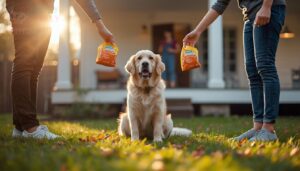
Your dog doesn’t care who’s holding the leash—it cares whether the rules stay the same.
Household handler alignment demands a unified command vocabulary, consistent hand signals, and identical marker timing from everyone involved.
One person clicking late, another skipping the word entirely, undoes weeks of marker training.
Share your shared training rules with the whole family.
Training consistency across handlers protects every second of precise reward timing you’ve built.
Choose Fast Training Treats
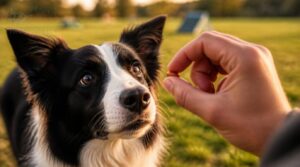
Your marker buys you a few seconds, but the treat itself still has to keep pace. The wrong size or texture turns a clean reward into a chewing delay, and that delay costs you the association you just built. Here’s what to look for when picking treats that work as fast as your timing demands.
Pea-sized Portions
Size makes or breaks your reinforcement timing. Treat size under 0.25 inches—think M&M or pea—lets your dog swallow fast, keeping the training momentum alive.
Bigger pieces? Break them into pea-sized pieces.
Small treats mean better calorie control: most run under 5 calories, supporting caloric intake limits and managing weight gain.
For toy breeds, size also prevents choking hazards during rapid-fire reps.
Soft, Quick-swallow Textures
Getting treat size right solves half the problem—texture solves the other half. Even a pea-sized chunk slows you down if your dog has to gnaw it.
Look for:
- Rapid dissolution within 0.5–1.5 seconds
- Low shear resistance for easy swallowing
- Minimal particulate matter to avoid grit
Soft, smooth textures support quick flavor release and immediate delivery, keeping treat timing tight and your training rhythm unbroken.
High-value Treat Moments
Not every rep needs your best ammo.
Save high-value treats—beef liver, novel proteins like rabbit or goat—for distraction management, reactive dog training, and emergency recall, where reward magnitude must override fear or competing stimuli.
High-aroma motivators paired with sharp marker training technique and immediate delivery create the strongest associations exactly when treat timing matters most.
Low-calorie Daily Tracking
Liver bites win fights against distraction, but they still count against your dog’s daily calorie limit.
Use a kitchen scale for accuracy, and try calorie budgeting apps for weight management math.
- Log grams daily
- Track inventory control methods
- Subtract treat calories from meals
Daily log consistency catches creep before it becomes weight gain.
Rotate Flavors Wisely
Calories aren’t the only thing to track—flavor matters too. Rotating beef, chicken, and duck prevents flavor habituation and protects against food sensitivities.
| Value | Flavor | Use Case |
|---|---|---|
| High | Liver | Recall, distractions |
| Medium | Chicken | Stay, 30-second holds |
| Low | Kibble | Sit, basic obedience |
Match reward value to difficulty. Log response times weekly to fine-tune your reward hierarchy.
Time Treats by Command

Every command has its own moment of truth, and missing it by even a beat teaches your dog the wrong lesson. Sit, stay, down, and come each demand a different release point, and your treat needs to land exactly there. Here’s how to nail the timing for each one.
Sit Reward Timing
The instant your dog’s hindquarters touch the ground, that’s your cue—not a second sooner. Mark it, then deliver the treat within one second, at the dog’s chest level, while the butt stays planted.
Wait too long, and you trigger reinforcement delay consequences, rewarding a pop-up instead of the sit. Precise timing fuels the dopamine reward loop driving real behavioral conditioning.
Stay Reward Timing
Where sit rewards a single moment, stay demands you reward in position—while your dog holds still, not after release.
Use pre-release reinforcement: treat arrives before your release command, stabilizing the hold. Build duration with progressive delay methods, adding 3-5 seconds per trial. Once mastered, shift to variable ratio schedules. This stay reward timing strengthens your behavior reward window every rep.
Down Reward Timing
Down hinges on elbow contact marking—click or say your marker word, the instant elbows hit the floor. Immediate rewards inside that one-second reward window cement shaping behavior.
Place treats between front paws for posture alignment rewards, not crooked hips.
For duration progression strategies, reward before release cue sequencing; for speed training rewards, treat timing shifts to post-release chase.
Come Reward Timing
Recall is the one cue where Distance Bridging matters most—your marker word fires the instant your dog turns toward you, not when paws hit the ground.
That’s Arrival Precision: deliver the treat within one to two seconds of arrival to lock in Recall Reliability. Mark early motion to reward Motion Rewards and momentum, but always pay the actual finish.
Reward at Body Level
Where you deliver the treat matters as much as when. Body-level delivery means rewarding calm approach, not jumping—chest height reinforces upright posture and prevents leaping.
Use placement deliberately:
- Nose contact for targeting
- Side delivery for lateral movement
- Chest for posture
- Between paws for "down"
Stay in position, reward fast—your behavior-reward window closes within seconds.
Structure Sessions for Success

Even the best timing falls apart if your session setup is working against you. Before your dog takes a single step toward that first cue, a few structural habits will determine whether your rewards land fast enough to matter. Here’s what to lock in before you begin.
Pre-portion Treats First
Before your dog sits for the first rep, your treats should already be cut, counted, and ready. Preloading micro-treats—pea-sized pieces of chicken, liver, or cheese—eliminates fumbling during the session and keeps reward delivery under one second.
It also forces you to track caloric intake upfront, so you’re not accidentally overfeeding across repetitions. Rotate flavors session-to-session to maintain novelty.
Use a Treat Pouch
Once your treats are pre‑portioned, your next move is getting them onto your body.
A quick-access training pouch clips to your belt and keeps rewards within a one‑second reach—no pockets, no fumbling. One-handed access means your other hand stays free for cues. Look for ergonomic belt fit across a range of waist sizes, breathable fabric, and a built‑in clip for your clicker.
Train Before Mealtime
Your pouch is loaded—now timing your session around meals makes those treats hit differently.
Train 30–60 minutes before mealtime, when your dog is moderately hungry but not distracted by an empty stomach. That natural hunger turns every pea-sized reward into high-value currency. Subtract treat calories from the meal afterward to keep daily caloric balance intact without skipping portions.
Keep Sessions Short
Hunger sets the stage, but session length decides whether your dog actually learns anything.
Cap training at sessions under 10 minutes—puppies need 3-5 minute bursts, adults handle 10-15. Cognitive fatigue hits fast; pushing past it invites mental burnout, not mastery. Border Collies outlast lapdogs, sure, but everyone benefits from tight session structure. Smart training load management means ending while your dog’s still asking for more.
Reduce Distractions
Short sessions mean nothing if your environment is working against you. Distraction management starts before you ever ask for a sit — begin indoors, away from noise, foot traffic, and competing smells.
As focus sharpens and 80% reliability holds, move closer to real-world distractions gradually, temporarily rewarding more frequently to keep your dog locked in.
Fade Treats Without Losing Progress

Eventually, every well-trained dog needs to work without a treat in their handler’s hand — and that change, done right, doesn’t cost you the reliability you’ve built.
The key is knowing exactly when to shift gears and how to keep motivation high once you do.
Here’s how to fade treats strategically without losing a single step of your progress.
Reward Every Correct Response
When you’re teaching a new behavior, reward every correct response — no exceptions. This is continuous reinforcement, and it’s the foundation your dog’s confidence is built on.
Each immediate reward cements the behavior-reward link before it has a chance to slip. Skip one, and you’ve introduced doubt.
Treat timing matters most here, so keep that reinforcement window tight.
Switch at Eighty Percent
Once your dog hits 80% correct responses across multiple sessions — not just one lucky run — it’s time to shift your reinforcement schedule. That’s your green light.
Measure it by counting correct answers out of 10 consecutive trials, tested across different environments with real distractions present.
Before that threshold, switching too early costs you the behavior entirely.
Use Variable Rewards
Once your dog clears that 80% threshold, stop rewarding every correct response — variable ratio reinforcement is your next tool. Deliver treats unpredictably: sometimes after one repetition, sometimes after three.
Vary the size, too. That randomized frequency keeps your dog locked in, working harder for the next opportunity rather than expecting a guaranteed payoff after every sit.
Add Praise and Play
Treats aren’t the only currency your dog values. Verbal praise and play are powerful rewards — and they’re free. Pair a bright, enthusiastic "Yes!" with a tug session or short game of fetch, and you’ve built a multi-reward schedule that keeps motivation high without adding calories.
- Use a higher-pitched, enthusiastic tone — it genuinely increases engagement
- Play rewards work at a distance, unlike treats
- Alternating praise, play, and treats prevents reward habituation
End With Success
Every training session deserves a clean exit. Before you wrap up, drop back to a command your dog knows cold — a simple sit, a quick stay.
Nail it, deliver your end-of-session treat, and close on that win. Building future anticipation starts here: leave them hungry for the next round, not drained from this one.
Frequently Asked Questions (FAQs)
Can treat timing differ between dog breeds or ages?
Yes — breed metabolism and age both affect how quickly a dog links a treat to a behavior. Puppies, small breeds, and seniors each process rewards differently, making one-size-fits-all timing a training liability.
How does treat timing change for fearful dogs?
With fearful dogs, timing is everything. Deliver the treat within one second of the dog noticing the scary trigger — the trigger must predict the reward, not the other way around.
Should timing strategies vary for distraction-heavy environments?
Absolutely — distraction-heavy environments demand tighter reinforcement rates. Reward every 4 steps instead of Use high-value treats to compete with noise. Lower other criteria simultaneously to keep your dog winning.
Can poor timing cause anxiety or confusion in dogs?
Poor timing doesn’t just slow learning — it creates unpredictable feedback loops that leave dogs guessing which behavior actually worked. That uncertainty builds reward-induced stress, and repeated confusion can trigger anxiety over time.
How does treat timing interact with punishment-based corrections?
Timing is everything: a correction without a fast follow-up reward leaves your dog guessing. Correction-reward synchronization within 1-3 seconds marks the replacement behavior, minimizing confusion and supporting real behavior modification instead of just punishment.
Conclusion
difference between a dog who nails every cue and one who keeps guessing? It isn’t breed, intelligence, or repetition count—it’s what happens inside that one-second window you’ve been reading about.
Timing treats for maximum effectiveness isn’t just good practice; it’s the entire mechanism through which your dog decides what’s worth repeating.
Get that window wrong, and effort compounds into confusion. Get it right, and every session quietly builds a dog who responds like you actually speak the same language.
- https://joyofdogsports.fi/2026/03/foundations-of-dog-training-part-1-reward-and-timing
- https://www.pawsnplaydogtraining.com/blog/should-use-treats-when-dog-training
- https://www.thrivingcanine.com/blog/training_treats
- https://themobilebarkery.com/blogs/natural-dog-treats/best-dog-treats-for-training-expert-guide-to-high-value-rewards-that-work
- https://leerburg.com/usingtreats.htm