This site is supported by our readers. We may earn a commission, at no cost to you, if you purchase through links.
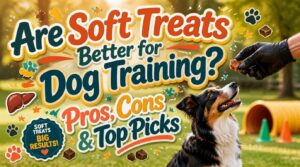
The difference between a dog that locks eyes with you mid-training and one that drifts toward every passing squirrel often comes down to what’s in your pocket. Treat texture isn’t a minor detail—it shapes how fast you can reward, how many repetitions you can run, and how well your dog stays focused when the environment fights for attention.
A soft, high-aroma piece of liver disappears in under half a second, letting you reset and cue again without breaking stride.
Crunchy options have their place, but when you’re working on tight reinforcement timing or drilling in a crowded park, texture becomes a strategic tool.
Whether soft treats are better for dog training depends on what you’re training, where you’re doing it, and what your dog finds worth working for.
Table Of Contents
- Key Takeaways
- Are Soft Treats Better for Training
- Soft Versus Crunchy Treats
- Top 5 Training Treats and Chews
- Use Treats Without Overfeeding
- Frequently Asked Questions (FAQs)
- Are soft dog treats good for training?
- Do puppies need soft dog treats?
- Are dog treats good for dog training?
- Should dogs eat small treats?
- Can treats replace meals during intense training days?
- How do allergies affect treat selection for dogs?
- Should treat types change with seasons or weather?
- Do certain breeds respond better to specific flavors?
- At what age should puppies start treat-based training?
- Conclusion
Key Takeaways
- Soft treats win for fast-paced drills because they’re gone in under half a second, keeping your timing tight and your dog’s attention on the behavior—not the chew.
- Crunchy treats aren’t just a backup; their audible snap can re-engage a mentally checked-out dog and support dental health over time, so don’t leave them out of your pouch.
- Rotating textures and flavors every few reps prevents treat fatigue before it starts, which means your dog stays motivated session after session instead of tuning you out mid-drill.
- Portion control matters as much as treat choice—keep pieces pea-sized, reward within one second, and cap treat calories at 10% of your dog’s daily intake to reinforce without overfeeding.
Are Soft Treats Better for Training

Soft treats tend to dominate most professional trainers’ treat pouches for good reason — they fit naturally into fast, repetitive sessions where timing is everything. The texture, palatability, and size all play a bigger role in training outcomes than most dog owners realize.
A treat’s chewiness and scent can make or break a training session, especially when you’re working with a picky pup — the right soft treat choices for stubborn puppies can be the difference between breakthrough and frustration.
Here’s a closer look at the specific advantages that make soft treats a go‑to choice.
Faster Reward Delivery
Ever notice how a half-second delay can break a dog’s focus mid-drill? That’s the case for soft treats.
Quick consumption means Optimizing Reward Speed, delivering rewards in under 0.5 seconds after the cue. This tightens Stimulus Association, strengthens Rapid Reinforcement Timing, and keeps Drill Momentum rolling. Minimal chewing equals Minimizing Reward Lag, so your dog stays locked onto the behavior, not the treat.
Better Focus During Drills
When you’re aiming for laser-like focus, soft treats make a difference. Quick rewards anchor attention, letting you run micro-drills with minimal session fatigue. Controlled noise and a fixed visual focal point, paired with rapid feedback loops, reinforce correct responses. Dogs stay motivated when you use high-value rewards and keep training momentum strong, even in challenging environments.
- Fast reward timing
- Reduced distractions
- Maintained motivation
Easier Chewing for Dogs
Keeping focus strong matters, but so does what happens the moment your dog takes the treat.
Soft and chewy textures require almost no effort to break down, making them ideal for dogs with worn teeth, sensitive gums, or developing puppy mouths. The higher moisture content aids swallowing, reduces choking risk in small breeds, and keeps every reward quick and comfortable.
Research shows that chewing reduces dental calculus can improve oral health in dogs.
Less Mess and Crumbling
If you’re tired of sweeping up crumbs after every training session, soft treats offer a real advantage.
With their messfree texture, they break cleanly, leave minimal debris, and reduce dust particles—especially in small spaces.
You’ll find clean surfaces easier to maintain, while quick, easy-to-break pieces keep handler hygiene high and training areas tidy, minimizing training debris.
Higher Value in Distractions
When your dog faces a crowded park or noisy street, high-aroma soft treats—think cheese or liver—cut through the chaos, grabbing attention instantly. The strong scent works as a beacon, so even when distractions spike, you can count on reliable reinforcement.
Dogs return to task faster, thanks to quick reward delivery and consistent motivation, keeping behavioral focus sharp where it matters most.
Soft Versus Crunchy Treats
Both treats have a place in your training toolkit, but knowing when to reach for one over the other makes a real difference in how fast your dog learns.
The choice isn’t just about preference — it comes down to timing, life stage, dental health, and how long your session runs.
Here’s how soft and crunchy treats each hold up across the situations that matter most.
When Soft Treats Win
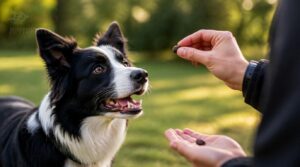
Soft treats are where rapid reinforcement speed truly shines. When you’re running high-repetition drills, a pea-sized soft bite disappears in one second flat, letting you reward your dog and move to the next cue without losing momentum.
That immediacy is everything—positive reinforcement only works when the connection between behavior and reward stays crystal clear.
When Crunchy Treats Help
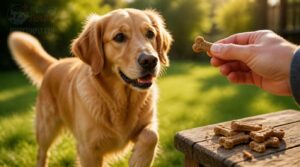
Crunchy treats aren’t just a backup option—they bring something soft treats simply can’t replicate: audible reward cues that cut through noise and snap your dog’s attention back in an instant.
Here’s when crunchy treats genuinely earn their place:
- High-distraction environments — The crisp snap acts as a secondary attention cue, reinforcing the reward moment even when competing sounds are present.
- Sensory engagement benefits — That satisfying crunch raises arousal just enough to reengage a dog that’s mentally checked out mid-drill.
- Managing training momentum — Pre-broken, uniform pieces deliver consistent, quick rewards without crumbling in your pocket.
- Reducing pocket mess — Firm textures hold their shape across variable temperatures, keeping hands and gear cleaner.
- Dental health — Regular crunchy treats support oral hygiene in dogs by mechanically reducing plaque buildup, a meaningful perk given rising periodontal concerns in adult and senior dogs.
Boosting motivation levels during a tough new command? A well-timed crunchy bite, paired with enthusiastic praise, often closes the gap faster than you’d expect.
Mixing Textures Wisely
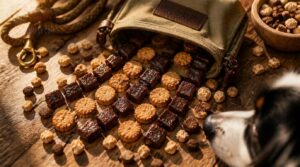
Think of your treat bag as a playlist — playing the same song on repeat kills the vibe fast.
Alternating soft and crunchy treats every 3–5 repetitions keeps your dog mentally engaged, prevents palate fatigue, and maintains training momentum without plateauing mid-session.
Variety isn’t a luxury here; it’s a deliberate strategy for sustained focus.
Preventing Treat Fatigue
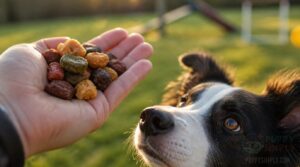
Even the most motivated dog will start ignoring rewards if every treat looks, smells, and tastes identical.
Rotating flavors weekly — chicken one week, liver the next — introduces enough sensory novelty to sustain drive. Pair that with texture alternation every 3–5 reps, and you’re actively resetting your dog’s interest before fatigue sets in, not scrambling to recover it afterward.
Dental Health Considerations
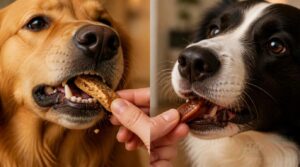
Dental health often gets overlooked in the treat conversation, but texture choices genuinely affect your dog’s mouth over time. Crunchy treats create physical abrasion against tooth surfaces, which helps scrape away some plaque — especially on molars.
Soft treats, while gentle and fast, can leave sticky residue along the gumline if they’re high in moisture or sugar content.
Top 5 Training Treats and Chews
So which treats actually earn a spot in your training pouch, and which chews hold up to real‑world gnawing?
You’ll want options that cover both ends of the texture spectrum, from fast‑eating training bait to long‑lasting chews that keep busy mouths occupied.
Here are five picks worth knowing, each suited to a different stage or purpose in your training routine.
1. ValueBull Natural Beef Cow Ears
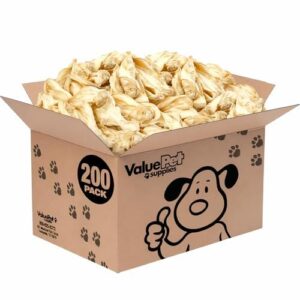
Looking for a chew that doubles as dental care? ValueBull’s cow ears are a single-ingredient chew, 100% beef, with no additives or fillers.
Oven roasted for a chewy yet sturdy texture, they resist crumbling while cleaning teeth and gums through natural chewing action.
Each ear delivers collagen, glucosamine, and chondroitin, supporting skin, coat, and joint health.
Bulk packs from 5 to 50 pounds suit multi-dog households, though you’ll want to remove silica desiccant packets before serving.
| Best For | Dog owners who want a natural, single-ingredient chew that supports dental health, joint care, and keeps their pup busy for a while. |
|---|---|
| Life Stages | All life stages |
| Artificial Additives | None |
| Primary Flavor | Beef |
| Pack Quantity | 200 ears |
| Main Ingredient | Cow ear |
| Texture/Form | Chewy chunk |
| Additional Features |
|
- 100% beef, no additives — what you see is what you get
- Naturally packed with collagen, glucosamine, and chondroitin for joints, skin, and coat
- Great for dental health — the chewing action scrubs plaque off teeth as they gnaw
- Bulk packs come with silica gel packets that need to be pulled out before serving
- Size and softness can vary, so large or aggressive chewers might burn through them fast
- At $386.99 for a bulk pack, it’s a real investment — not ideal if you’re watching the budget
2. Real Beef Air Dried Dog Food
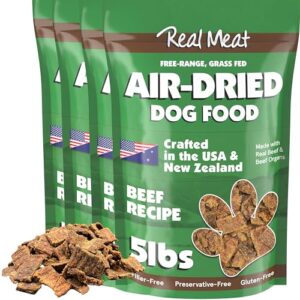
Cow ears are a long-session chew, but for high-repetition training drills, you need something you can deliver fast and often — that’s where Real Beef Air Dried Dog Food earns its place. Made from 100% grass-fed beef including muscle meat, liver, lung, and kidney, each small piece is soft enough to consume in seconds, letting you keep reward momentum without pausing the session.
Grain-free, gluten-free, and made in the USA, it fits sensitive stomachs while delivering the high-protein payoff that keeps dogs locked in.
| Best For | Dog owners who use high-repetition training drills and want a fast, protein-rich reward that works for sensitive stomachs too. |
|---|---|
| Life Stages | All life stages |
| Artificial Additives | None |
| Primary Flavor | Beef |
| Pack Quantity | 20 lb (4 bags) |
| Main Ingredient | Beef muscle & organs |
| Texture/Form | Bite-sized pieces |
| Additional Features |
|
- 100% grass-fed beef with real organ meat — muscle, liver, lung, and kidney — so you’re not feeding filler
- Small, soft pieces disappear in seconds, which keeps training momentum going without awkward pauses
- Grain-free and gluten-free, so dogs with sensitivities can handle it without issue
- Premium price tag — it’ll cost noticeably more than standard kibble or basic training treats
- Only beef protein, so it’s a hard pass if your dog has a beef allergy
- Light on fruits and veggies, so you may want to round out the diet with some added greens
3. Redbarn Lamb Lung Jerky
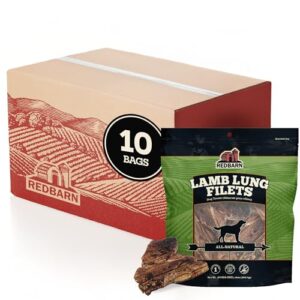
Want a chew with more texture without sacrificing speed? Redbarn Lamb Lung Jerky is a single-ingredient treat, oven-roasted into a jerky-style bite that’s chewy enough to tear into pea-to-dime-sized pieces.
It’s grain-free, gluten-free, and chicken-free, making it a solid pick for sensitive stomachs.
The fibrous texture breaks apart with minimal crumbling, and its strong natural aroma keeps focus locked in, though richer organ content means smaller portions for dogs on calorie-restricted diets.
| Best For | Dog owners looking for a single-ingredient, grain-free chew that’s great for training, daily rewards, or dogs with chicken or gluten sensitivities. |
|---|---|
| Life Stages | All life stages |
| Artificial Additives | None |
| Primary Flavor | Lamb |
| Pack Quantity | 10 bags |
| Main Ingredient | Lamb lung |
| Texture/Form | Crunchy jerky |
| Additional Features |
|
- Made from just one ingredient (lamb lung), so it’s easy on sensitive stomachs and free of grains, gluten, and artificial stuff.
- Oven-roasted into a chewy, jerky-style texture that holds up well without falling apart into crumbs.
- A solid chicken-free, rawhide alternative that works for dogs at any life stage.
- The rich organ-meat content can be too much for dogs on calorie-restricted diets or with sensitive tummies.
- Smaller pieces can be a choking risk, so you’ll want to keep an eye on your dog while they chew.
- It only comes in one flavor and costs more than treats with multiple ingredients.
4. ValueBull Natural Pork Ear Chews
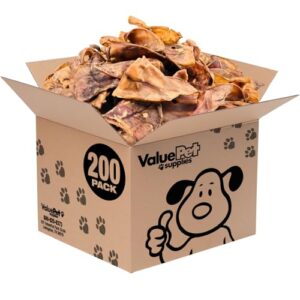
If the Redbarn jerky got your dog’s attention, ValueBull Natural Pork Ear Chews will hold it. These single-ingredient, oven-roasted pork ears deliver a bacon-like aroma that’s strong enough to cut through distractions, with a chewy, pliable texture that softens as your dog works through it — no sharp edges, no crumbling debris.
They’re high in fat, so keep portions moderate, especially for smaller dogs, and supervise aggressive chewers to prevent choking on broken pieces.
| Best For | Dogs of all life stages who need a long-lasting, natural chew — especially those prone to anxiety or dental buildup. |
|---|---|
| Life Stages | All life stages |
| Artificial Additives | None |
| Primary Flavor | Pork |
| Pack Quantity | 200 ears |
| Main Ingredient | Pig ear |
| Texture/Form | Chewy chunk |
| Additional Features |
|
- 100% pork ear, no fillers or additives — what you see is what you get
- Naturally cleans teeth and gums while keeping your dog happily occupied
- Bulk pack of 200 ears is great value for multi-dog households or frequent chewers
- High fat content means you’ll want to limit how often you hand one over, especially for smaller or overweight dogs
- Aggressive chewers can break off chunks, so keep an eye on them
- Not an option if your dog has a pork sensitivity or allergy
5. Arm Hammer Puppy Dental Kit
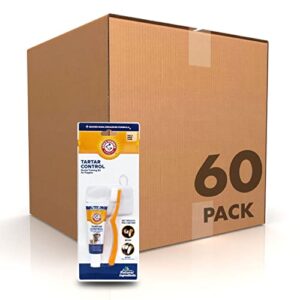
Training doesn’t end when the session does — and the Arm & Hammer Puppy Dental Kit is built around that idea.
It includes an enzymatic toothpaste with baking soda, a dual-sided toothbrush, and a silicone finger brush, giving you a gradual, low-stress path into brushing routines. The mild chicken flavor keeps most puppies cooperative, and the xylitol-free formula means you’re not introducing any toxic ingredients alongside the training process.
| Best For | New puppy owners and small-breed dog parents who want to build a brushing habit early without a vet visit. |
|---|---|
| Life Stages | Puppy & small breeds |
| Artificial Additives | Xylitol-free |
| Primary Flavor | Vanilla Ginger |
| Pack Quantity | 60-pack kit |
| Main Ingredient | Baking soda formula |
| Texture/Form | Paste & brush |
| Additional Features |
|
- Comes with both a finger brush and a toothbrush, so you can ease your pup in gradually instead of jumping straight to the hard stuff.
- The vanilla ginger toothpaste is xylitol-free, so no sketchy ingredients sneaking into your dog’s mouth during training.
- Baking soda formula actually does something — it helps knock out plaque and neutralize the bacteria causing bad breath.
- The baking soda smell is pretty strong, and some dogs want nothing to do with it.
- If your puppy is on the tinier side, the finger brush can feel a bit bulky and awkward to work with.
- Once you’re past the small-breed puppy stage, this kit starts to feel a little undersized for the job.
Use Treats Without Overfeeding
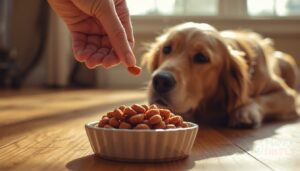
Training with treats works best when you stay intentional about portions and timing—small mistakes here add up fast. The good news is a few simple habits keep your dog motivated without tipping the calorie scale. Here’s what actually makes the difference.
Keep Bites Pea-sized
Size matters more than you’d think.
Pea-sized pieces — roughly 0.5 to 1 inch, or 2–4 mm for small breeds — let you maintain rapid reinforcement density without halting the drill.
Smaller bites minimize anticipation drift, keep your dog’s jaw relaxed across long sessions, prevent jaw fatigue, and preserve training momentum from the first repetition to the last.
Count Daily Treat Calories
Every treat has a calorie count — and that number adds up faster than most people expect. Check the packaging for kcal per piece, then multiply by how many treats you delivered in a session.
Keep the daily total under 10 percent of your dog’s caloric target, adjusting the cap whenever your dog’s weight, activity level, or food formula changes.
Reward Within One Second
Why does timing matter more than the treat itself? Because a one-second delivery window creates immediate stimulus association, linking action to reward before your dog’s mind wanders.
A one-second reward window links action to outcome before your dog’s mind moves on
Soft treats make that speed possible — quick consumption closes reinforcement gaps, crunchy chews can’t.
This sharpens cue discrimination, reduces lure reliance, and keeps reward frequency high enough to sustain training momentum.
Save Jackpots for Breakthroughs
A jackpot isn’t just a bigger treat — it’s a behavioral checkpoint marker, and using it carelessly dilutes its power.
Reserve jackpots strictly for breakthroughs:
- A first clean sit-stay in a crowded park
- Five consecutive correct responses to a new cue
- Ignoring a passing dog mid-drill
Deliver the high-value reward within two seconds of that checkpoint, paired with a distinct verbal signal, so your dog learns that impressive effort earns impressive outcomes.
Add Praise, Toys, Play
Treats alone won’t build a truly motivated dog — praise, toys, and play fill the gaps your treat pouch can’t.
Verbal praise works best when it’s specific and immediate, delivered within one to two seconds of the correct behavior. Interactive puzzle toys and short structured play breaks of 15 to 30 seconds reset focus between reps without burning energy.
| Reward Type | Best Use | Timing |
|---|---|---|
| Verbal praise | Every correct response | Within 1–2 seconds |
| Puzzle toy | Between drill sets | 15–30 second break |
| Tug or fetch | Session finale | After final rep |
Rotating across this reward hierarchy prevents treat dependency and keeps your dog’s drive sharp session after session.
Frequently Asked Questions (FAQs)
Are soft dog treats good for training?
Like a well-timed click, soft dog treats deliver rewards fast — within one to two seconds — keeping training momentum intact, reducing distractions, and making reward-based training more effective across every session.
Do puppies need soft dog treats?
Yes, puppies genuinely need soft dog treats. Their developing teeth and tender gums can’t handle hard chews safely. Bite-sized pieces with a soft texture support rapid behavior shaping while protecting delicate mouths during early training.
Are dog treats good for dog training?
Absolutely — reward-based training works because dogs repeat behaviors that earn them something valuable. A well-timed treat delivered within one second creates strong behavior association, turning dog training into a clear, fast, and motivating conversation.
Should dogs eat small treats?
Small, soft training treats work best when kept pea-sized — roughly 2–7 mm depending on breed — so each reward delivers reinforcement without adding unnecessary calories to your dog’s daily intake.
Can treats replace meals during intense training days?
Treats can technically replace meals during intense training days, but total daily calories must still match the dog’s normal intake to avoid weight gain or nutrient gaps from an unbalanced snack-heavy diet.
How do allergies affect treat selection for dogs?
Allergen triggers can quietly sabotage training. If your dog reacts to a protein, switch to limited-ingredient, novel protein treats. Always scrutinize labels during elimination diets to keep rewards allergy-safe.
Should treat types change with seasons or weather?
Yes — seasonal texture shifts matter. In cold weather, soft treats stay easy to bite, while heat calls for quick-consuming rewards that won’t slow your dog down mid-drill.
Do certain breeds respond better to specific flavors?
Breed and flavor preference do connect, but not as cleanly as you’d expect. Scent drives most of it — high-odor proteins like liver or salmon tend to motivate across breeds, though individual dogs vary considerably.
At what age should puppies start treat-based training?
Like a sponge ready to absorb everything, puppies are primed to learn as early as 8 weeks old — start simple, keep sessions brief, and let soft treats do the rewarding.
Conclusion
Like a well-timed click that marks exactly the right moment, the treat you reach for shapes every session you run.
Whether soft treats are better for dog training always comes down to context—your dog’s drive, the environment’s competing demands, and the specific skill you’re reinforcing.
Soft options deliver speed and sharper focus when it counts most; crunchy ones earn their place in between.
Match texture to the task, and your dog stays with you.
- https://www.wellnesspetfood.com/natural-dog-food/snacks
- https://www.purina.com/articles/dog/feeding/guides/when-to-choose-soft-dog-treats
- https://www.akc.org/expert-advice/training/dog-training-treats
- https://muensterpet.com/blogs/blog/treats-for-training-puppies
- https://ducktownlodge.com/best-dog-treats-for-training-cumming-ga