
This site is supported by our readers. We may earn a commission, at no cost to you, if you purchase through links.

That bag of training treats sitting on your counter might be the sneakiest source of extra calories in your dog’s diet. A single 30-minute session can deliver 1,125–1,875 calories in treats alone—sometimes more than your dog’s entire daily requirement. Most owners never see it coming, because each treat feels tiny, almost harmless.
The math, though, doesn’t care about intentions. Thirty treats at 5 kcal each adds up to 150 extra calories a day, which quietly translates to nearly a pound of fat gain every month. For a Chihuahua or a Yorkie, that’s the difference between healthy and overweight.
Training treats can absolutely cause weight gain in dogs—but a few smart adjustments protect your dog’s waistline without sacrificing progress.
Table Of Contents
Key Takeaways
- A single 30‑minute training session can deliver over 1,000 calories in treats alone, so what feels like harmless rewards can quietly push your dog past their entire daily calorie needs.
- Small dogs like Chihuahuas hit their calorie ceiling fast — even one extra treat a day can tip them into weight gain territory within weeks.
- The 10% rule is your best guardrail: treats should never exceed 10% of your dog’s daily calories, and that budget comes out of their meals, not on top of them.
- Carrying excess weight for just one year can double your dog’s arthritis risk and shave one to two years off their life, so treat budgeting isn’t just about the scale — it’s about longevity.
Can Training Treats Cause Weight Gain?

Yes, training treats can absolutely cause weight gain — and it happens faster than you’d think. A few extra calories here and there quietly snowball into real pounds on your dog’s frame. Here’s what’s actually going on beneath the surface.
The sneaky truth is that training treats and dog weight gain are more closely linked than most owners realize, especially when daily sessions add up across weeks.
Treat Calories Add Up
Here’s the truth: treat calories add up fast — faster than most owners realize. A single 30-minute training session using standard treats can deliver 1,125 to 1,875 calories. That’s not a snack; that’s practically a full day’s worth of food.
Choosing rice-grain-sized treats under 1 calorie each keeps your sessions rewarding without quietly wrecking your dog’s waistline.
Remember to follow the 10% rule when counting treat calories.
Daily Surplus Explained
Every extra treat calorie that pushes past your dog’s daily energy balance quietly banks — like debt accumulating interest. An extra 100 calories daily adds roughly 1 lb of fat in just four weeks. Unrecorded visitor treats alone can sneak in 150 weekly calories. That calorie surplus, small as it seems, compounds into real weight gain over time.
| Scenario | Daily Extra Calories | Monthly Weight Gain |
|---|---|---|
| 30 treats at 5 kcal | 150 kcal | ~0.86 lb |
| Untracked visitor treats | ~22 kcal avg | ~0.25 lb |
| 100 kcal daily surplus | 100 kcal | ~1 lb |
Small Dogs Gain Faster
Small dogs carry a hidden disadvantage — their metabolic rate burns faster, yet their calorie capacity is tiny. A 5-pound Chihuahua needs only 400–500 calories daily, so a single 20-calorie treat represents a far bigger slice than it looks.
Toy breeds can reach overweight status after just 1–2 pounds of gain — that’s alarming fast.
Hidden Visitor Treats
Your dog’s waistline might have a secret enemy — your guests. Well‑meaning visitors quietly slip treats, table scraps, and "just a little bite" snacks without telling you, bypassing your calorie tracking entirely.
Three small training treats from a guest can add 30–50 calories instantly. Post a simple "no treats, please" sign, or offer pre‑portioned low‑calorie rewards for guests to give instead.
Long-term Weight Impact
Months of sneaky extra calories don’t just nudge the scale — they quietly reshape your dog’s future health. Dogs carrying excess weight for over a year face two to three times the osteoarthritis risk, plus a lifespan shortened by one to two years. Chronic obesity also wrecks insulin sensitivity, raising diabetes odds considerably even after weight is lost.
Excess weight carried for just one year can double your dog’s arthritis risk and shorten their life
Here’s what long-term over-treating actually costs your dog:
- Osteoarthritis risk increases two to three times after 12 months of excess weight
- Lifespan can shorten by one to two years from chronic obesity
- Training endurance drops 15–20%, making obedience sessions frustratingly ineffective
- Insulin sensitivity stays impaired — diabetes risk lingers even after weight loss
- Daily treat calorie limits exist precisely to prevent these cascading consequences
Staying within your daily treat calorie limit isn’t just about the scale — it’s genuinely life-extending canine obesity prevention.
Pairing those measured portions with nutrition-optimized food for Cavalier King Charles Spaniels makes every calorie count toward a longer, healthier life.
How to Budget Training Treats
The good news is that treats don’t have to derail your dog’s health—you just need a plan. Budgeting treat calories is simpler than it sounds, and a few consistent habits make all the difference. Here’s exactly how to keep training rewards working for your dog, not against them.
Follow The 10% Rule

Think of the 10% rule as your dog’s treat speed limit — cross it, and things quietly go sideways. Veterinary guidelines are firm: treats can’t exceed 10% of daily calories.
A dog eating 400 kcal daily gets just 40 treat calories. Small dogs under 20 pounds? Often under 30.
Weight tracking apps help you stay honest.
Calculate Daily Treat Calories

Here’s the math that actually protects your dog. Start with the RER formula: 70 × (body weight in kg)⁰·⁷⁵.
A 50-pound dog weighs roughly 22.7 kg — giving you about 728 resting calories. Multiply that by an activity factor (1.6 for neutered adults), and your daily target becomes approximately 1,165 kcal.
Your treat budget? Just 116 calories.
Subtract Treats From Meals
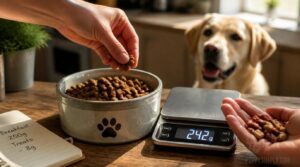
Here’s the part most owners skip: that 116-calorie budget doesn’t float on top of your dog’s meals — it comes out of them.
Subtract treats from meals, gram for gram, so kibble during training drops to match.
Check the label for calories per cup, do the math, and adjust portions.
Then watch the scale — if weight creeps up, your subtraction wasn’t enough.
Break Treats Into Pieces

Here’s a trick that instantly stretches your treat budget: break every treat into micro-pieces — roughly eraser-sized.
A single 15-calorie soft jerky strip torn into ten pieces becomes ten 1.5-calorie rewards. Same motivation, a fraction of the calories. Soft jerky and liver squares work best.
Prep a weekly batch with kitchen shears, store in labeled bags, and you’re set.
Track Every Training Session

Here’s the truth: if you’re not tracking, you’re guessing — and guessing quietly wrecks your dog’s daily treat calorie limit.
Use a training app with session logging to timestamp each session, log treat counts, and flag patterns. Multi-pet households can manage separate profiles. Export data as a PDF for your vet. Canine calorie budgeting only works when you actually record it.
Top 5 Treats to Budget Carefully
Not all treats are created equal — some pack way more calories than you’d expect for their size. These five in particular are worth keeping a close eye on, especially if your dog is in active training mode. Here’s what you need to know before you reach into the bag.
1. Greenies Chicken Pill Pockets
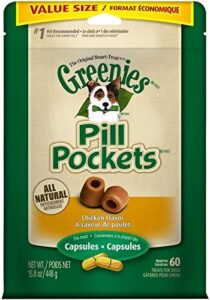
Greenies Chicken Pill Pockets aren’t just for hiding medication — plenty of owners toss them as training rewards too, and that’s where things get sneaky.
Each pocket runs about 23 calories. Doesn’t sound like much until your pup gets three or four during a session. That’s nearly 100 extra calories right there — enough to quietly add a pound of fat every month.
If you’re using these regularly, count every single one against your dog’s daily 10% treat budget.
| Best For | Dog owners who struggle to get their adult dogs to take oral medication willingly. |
|---|---|
| Grain-Free | Yes |
| Artificial Additives | None |
| Life Stage | Adult dogs only |
| Primary Flavor | Chicken |
| Fat Content | Low fat |
| Country of Origin | Not specified |
| Additional Features |
|
- The pocket design makes hiding pills or capsules quick and easy, with no wrestling required
- Real chicken flavor is convincing enough that most dogs eat the medicine without hesitation
- Low in fat, sodium, and calories, so the occasional dose won’t derail a healthy diet
- Only comes in chicken flavor, so picky dogs with a poultry aversion are out of luck
- Not suitable for puppies or senior dogs on special diets — adult dogs only
- At around 23 calories per pocket, frequent use (especially as training treats) can add up fast and eat into your dog’s daily calorie budget
2. Darford Grain Free Bacon Treats
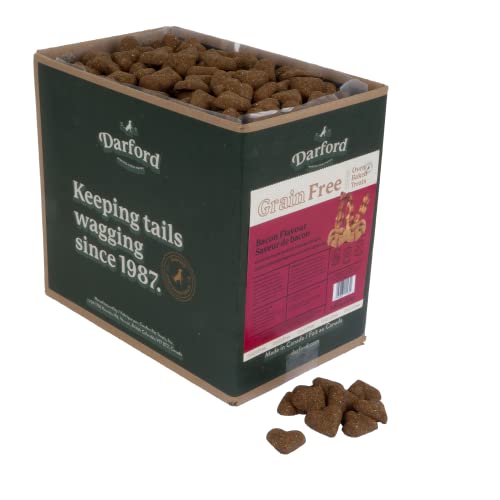
Darford Grain Free Bacon Treats are a crowd-pleaser — real bacon flavor, grain-free, no artificial anything. Dogs go crazy for them. But crunchy biscuits add up fast, especially during long training sessions.
The packaging lets you break pieces into smaller portions, which is smart — but only if you actually do it. Toss these out whole, repeatedly, and your treat budget disappears before lunch. Count every piece against that 10% daily calorie allowance, no exceptions.
| Best For | Dogs with grain sensitivities or allergies who still deserve a delicious, protein-rich treat at any life stage. |
|---|---|
| Grain-Free | Yes |
| Artificial Additives | None |
| Life Stage | All life stages |
| Primary Flavor | Bacon |
| Fat Content | Monitor portions |
| Country of Origin | Canada |
| Additional Features |
|
- 100% grain-free with no corn, wheat, soy, or artificial ingredients — great for sensitive pups
- Real bacon flavor made from natural ingredients that dogs genuinely love
- Suitable for all life stages, from puppies to seniors
- Only comes in bacon flavor, so dogs with pork allergies are out of luck
- Crunchy biscuits are calorie-dense — easy to overfeed during training sessions without careful portioning
- The 15 lb bulk box can be awkward for small households or anyone short on storage space
3. Pumpkin Sweet Potato Dog Chews
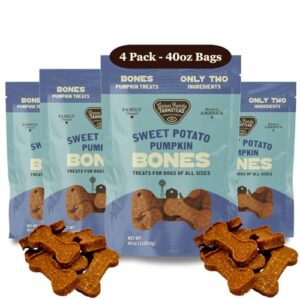
Pumpkin sweet potato chews feel like the "healthy" option — and honestly, they’re not wrong. Fiber, antioxidants, gentle on sensitive stomachs. But don’t let the veggie label fool you. Some commercial versions pack 23+ kcal per chew. At 3,670 kcal/kg, that’s no lightweight snack. Hand out four during a session and you’ve burned through nearly 100 kcal — basically your dog’s entire treat budget for the day, gone.
Stick to one or two. Better yet, cut them into thirds.
| Best For | Dogs with sensitive stomachs, weight management needs, or owners looking for a clean, vegan-friendly daily snack or training treat. |
|---|---|
| Grain-Free | Yes |
| Artificial Additives | None |
| Life Stage | All life stages |
| Primary Flavor | Pumpkin/Sweet Potato |
| Fat Content | Low fat |
| Country of Origin | USA |
| Additional Features |
|
- Simple, wholesome ingredient list — just pumpkin and sweet potato, no fillers or preservatives
- High fiber content supports digestive regularity, great for dogs with sensitive stomachs
- Antioxidants from vitamins A and C give immune health a gentle daily boost
- Calorie count can sneak up fast — easy to overfeed, especially during training sessions
- Not all dogs love the texture or flavor, so palatability can be hit or miss
- Meat-free formula won’t cut it as a protein source for highly active or working dogs
4. Honey Coated Buffalo Horn Chews
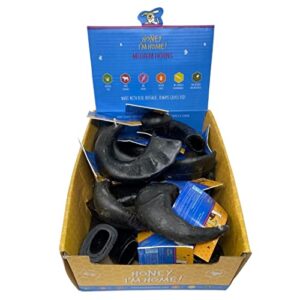
Now, buffalo horn chews — these feel practically indestructible, which is exactly the point. Long-lasting, high-protein, low-calorie by nature, and made from grass-fed water buffalo. Sounds ideal.
But that honey coating quietly changes the math. It adds sugar, extra calories per chew, and — if your dog has a honey sensitivity — a potential reaction.
These aren’t rapid-fire training treats either. One chew counts toward your dog’s daily calorie budget. Track it like any other.
| Best For | Medium to large dogs with poultry or beef allergies who need a long-lasting, durable chew that sits between tough antlers and softer bully sticks. |
|---|---|
| Grain-Free | Yes |
| Artificial Additives | None |
| Life Stage | Adult dogs |
| Primary Flavor | Honey/Buffalo |
| Fat Content | Low calorie |
| Country of Origin | Not specified |
| Additional Features |
|
- High-protein, low-calorie chew made from 100% grass-fed, humanely raised water buffalo — great for allergy-prone dogs
- Exceptionally long-lasting texture means fewer replacements and better value over time
- Honey coating is sourced sustainably and may offer minor allergy-soothing benefits
- At $129.60 per box, the price is steep and may not be realistic for everyday budgets
- The very hard texture makes these a poor fit for small breeds or dogs with sensitive teeth or dental issues
- Honey coating adds sugar and calories, and could trigger reactions in dogs with honey sensitivities or attract insects during storage
5. Yummy Combs Dental Chews
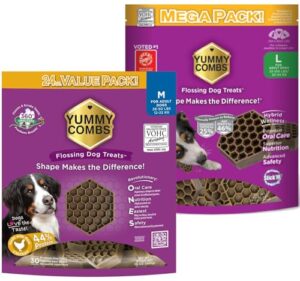
Yummy Combs take dental care seriously — and the calorie count follows suit. Medium treats deliver 69 kcal each; large ones hit 115 kcal per treat. That’s not small, especially for a dog already near their daily limit.
The upside? That honeycomb shape encourages longer chewing, slowing your dog down naturally. Clinical studies showed 26% tartar reduction and a 46% breath improvement with daily use. Worth it — but track it like a meal, not a freebie.
| Best For | Medium to large breed adult dogs whose owners want a functional dental chew that doubles as a nutritional supplement. |
|---|---|
| Grain-Free | Yes |
| Artificial Additives | None |
| Life Stage | Adult dogs |
| Primary Flavor | Chicken |
| Fat Content | Not specified |
| Country of Origin | Not specified |
| Additional Features |
|
- The honeycomb shape delivers real results — 26% tartar reduction and noticeably fresher breath with daily use
- Packed with 44% animal protein and 12 wellness nutrients that support heart, joints, skin, and gut health
- VOHC-approved and vet-tested, so you know it’s actually doing what it claims
- At $115, it’s a premium price that adds up fast when used daily
- High calorie count (69–115 kcal per treat) means you need to factor it into your dog’s daily food intake
- The slippery texture can cause dogs to gulp it down too quickly, so supervision is a must
Prevent Weight Gain While Training

Training your dog doesn’t have to be a calorie battle — it just takes a few smart swaps and a little consistency. The good news is you’ve got more tools in your toolkit than just treats. Here’s what actually works to keep training effective without the sneaky weight creep.
Choose Lower-calorie Rewards
The swap is simpler than you’d think.
Low-calorie dog training treats — like Nulo Freestyle Trainers at just 2 kcal each, or Bixbi Pocket Trainers at roughly 3 kcal — let you reward dozens of times without wrecking your dog’s calorie budget.
Baby carrots, cucumber slices, and sugar snap peas add vegetable reward variety at nearly zero caloric cost.
Use Praise and Play
Food isn’t the only currency your dog values — and that’s good news for their waistline.
Praise and play cost zero calories. Time your "yes!" or "good dog!" immediately after the behavior, every single time, so the connection sticks. Short tug sessions or a quick ball throw after success can build real motivation — no treat required.
Try Safe Whole Foods
When the treat jar feels like the only option, think again — your kitchen might already have better ones.
Baby carrots (2–3 calories each), plain cooked chicken chunks (~1.5 kcal), and cucumber slices clock in at nearly nothing. Blueberries bring antioxidants. Always skip seasoning, seeds, and anything processed.
- Carrot sticks — crunchy, low-cal, and dogs love them
- Pea-sized chicken pieces — pure protein, zero fillers
- Cucumber rounds — almost calorie-free hydration
- Blueberries — tiny antioxidant bursts, used sparingly
Monitor Body Condition
Your hands know more than the scale does. Run a rib feel test weekly — ribs should feel like knuckles under a towel, not hidden under padding.
Add a waistline visual check from above and an abdominal tuck assessment from the side.
Track your dog’s body condition score and weight trend together. This simple habit anchors real weight management for dogs.
Ask Your Veterinarian
Your vet isn’t just for sick-day visits — they’re your best weight-management ally. A quick vet consultation gives you custom calorie math: your dog’s exact treat budget based on age, weight, and metabolic rate.
- Get a written treat calorie chart
- Flag any medical dietary restrictions
- Schedule monthly weight trend checks
That vet-guided diet plan turns guesswork into a clear, manageable routine.
Frequently Asked Questions (FAQs)
What can cause excessive weight gain in dogs?
Several sneaky culprits drive excessive weight gain in dogs — overfeeding, hormonal shifts like hypothyroidism or Cushing’s disease, medication side effects, breed predispositions, age-related metabolic decline, and simply not moving enough.
Why shouldn’t you train your dog with treats?
Training with treats isn’t always the cleanest strategy. Reward timing delays and behavioral dependency risks quietly undermine progress — while excessive caloric surplus from high-calorie treats steadily chips away at your dog’s weight management.
Can you give a dog too many training treats?
Yes — you absolutely can. Too many training treats quietly push your dog past their daily calorie budget, creating a cumulative surplus that stores as body fat, even when each treat seems harmlessly small.
Which dog breeds gain weight most easily from treats?
Some breeds are wired to gain weight fast. Labradors lack a fullness signal, Pugs can’t exercise it off, and Chihuahuas hit their calorie cap with just one treat.
How often should dogs be weighed during training?
Think of your scale as a training log — it doesn’t lie. Weigh your dog monthly during active training. Puppies need checks every three to four weeks; seniors, monthly. Spot a 5% weight shift? Reassess immediately.
Do senior dogs require a stricter treat budget?
Absolutely — senior dogs need fewer calories overall, so their daily treat budget shrinks too. Muscle mass decline, slower thyroid function, and reduced activity all quietly tighten that margin, making weight management for dogs more critical with age.
Conclusion
Think of your dog’s daily calories as a budget—every treat is a withdrawal, and the overdrafts quietly show up on the scale. Can training treats cause weight gain in dogs? Absolutely. But now you know exactly how to stop it.
Swap oversized rewards for tiny pieces, lean whole foods, or a solid round of play. Keep meals adjusted. Watch the body condition score. Small, consistent choices keep your dog lean, happy, and still learning.
- https://petjope.com/blogs/dog-weight/healthy-low-calorie-treats-for-dogs-for-weight-loss
- https://www.purina.com/articles/dog/feeding/guides/how-many-treats-per-day-for-dogs
- https://www.5280vet.com/low-calorie-treat-options-for-dogs-and-cats
- https://greenjuju.com/blogs/news/high-value-dog-treats
- https://www.baxterboo.com/blog/a.cfm/5-best-dog-treats-for-training-low-calorie-high-rewards