This site is supported by our readers. We may earn a commission, at no cost to you, if you purchase through links.

Your dog sits perfectly. You say "good boy!" — two seconds later, you hand over a treat. Seems reasonable, right? Those two seconds just taught your dog that sitting has nothing to do with the reward.
Timing praise in dog training isn’t a minor detail. It’s the entire mechanism behind how dogs learn. A dog’s brain links whatever it’s doing at the exact moment praise lands — not what it did a second ago, not what you meant to reward. Miss the window, and you’re not training; you’re just handing out snacks.
The good news: once you understand how this works, your training sessions get sharper, faster, and far less frustrating for both of you.
Table Of Contents
Key Takeaways
- Your praise must land at the exact moment your dog performs the right behavior — even a two-second delay teaches the wrong thing.
- Pick one short marker word like "yes" and use it identically every time, because your dog maps a specific sound to a reward, not the meaning behind it.
- Praise only becomes powerful when it consistently predicts a reward, so always say your marker word first, then deliver the treat — order matters.
- Overusing casual praise or praising too late doesn’t just fail to teach — it actively trains your dog to ignore you.
Why Timing Praise Matters

Timing your praise isn’t just a nice-to-have — it’s the whole game. Your dog isn’t interpreting your words; they’re reading the exact moment you deliver them. Here’s why getting that timing right changes everything about how fast and how well your dog learns.
A well-timed "yes!" the instant your dog sits tells a clearer story than any word alone, and these verbal praise training techniques show exactly how to make every second count.
Clear Behavior-reward Connection
Think of praise as a snapshot — it freezes the exact moment your dog did something right and says, this is what earns the reward.
When your praise and reward arrive together consistently, your dog’s brain starts predicting the treat the instant it hears your voice. That dopaminergic feedback loop drives faster learning, deeper focus, and a dog that genuinely wants to repeat the behavior. Research suggests that reward and punishment act as distinct factors in guiding behavior.
Prevents Accidental Reinforcement
Praise lands like a spotlight — whatever your dog is doing at that exact moment gets reinforced. Wait a beat too long and you’ve just rewarded the sniff, the sit-break, or the glance away instead of the behavior you wanted.
Keeping your body still while you mark matters too. A lean or hand reach can accidentally become the signal your dog learns to watch for.
Builds Faster Learning
When your praise lands at the exact right moment, your dog’s brain gets a clean, unambiguous signal — and that triggers dopaminergic pathway activation, the same neurological reward loop that makes learning stick fast. No guesswork. No re-mapping.
That speed shows up in repetitions:
- Tighter timing means more successful trials per session
- Each clean repetition builds stronger associations faster
- Your dog needs fewer attempts to understand what earned the reward
Contingent timing effectively hands your dog a shortcut.
Strengthens Training Trust
Trust is built rep by rep. When your praise lands on time, your dog learns the game is fair — and fair games are worth playing hard.
When your praise lands on time, your dog learns the game is fair — and fair games are worth playing hard
Predictable reinforcement cycles eliminate the guesswork that makes dogs hesitant. Your dog stops second-guessing and starts performing, because your voice reliably predicts something good.
That’s how you strengthen your connection — one clean, well-timed moment at a time.
Mark The Exact Behavior
Marking the exact behavior is where good timing actually lives — and it’s simpler than you might think. A few small habits make the difference between a dog who gets it immediately and one who’s left guessing. Here’s what to do in the moment.
Praise at Behavior Moment
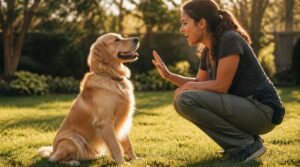
Your dog’s brain is making a behavior-reward connection the instant a correct action happens — not a second later.
That’s why landing your praise at the exact moment your dog performs the behavior is everything. Miss that window, even briefly, and the signal gets muddy. The learning lands cleanest when your words catch the behavior in real time.
Use One Marker Word

Pick one word. Stick with it.
"Yes" works. So does "good." What matters isn’t which word you choose — it’s that you use the same one every time. Your dog isn’t processing meaning the way you do. It’s mapping a specific sound to a specific outcome. Swap words randomly, and now it has multiple sounds to decode. That’s extra work with zero benefit.
Keep Your Body Still
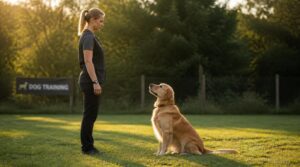
Your hands are the problem. The moment you reach toward your dog mid-marker, it reads movement as the cue — not your word.
Keeping your hands completely still until after the marker sound fires is one of those small but game-changing habits covered in depth by marker-based positive reinforcement training guides.
Keep your body locked when you deliver praise:
- Freeze your hands at your sides
- Relax your shoulders
- Soften your facial expression
- Stay square, don’t lean in
Movement breaks the signal. Stillness makes it clean.
Reward Within One Second
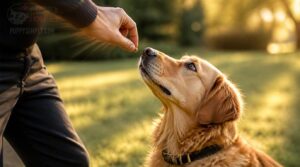
One second is your entire window. The moment your dog sits, lies down, or checks in with you, the clock starts — and it moves fast.
Deliver the treat before that second closes. Waiting longer lets your dog shift position, glance away, or sniff the ground, and suddenly you’re rewarding that instead. Tight timing = clean signal.
Avoid Delayed Praise

Late praise doesn’t just miss the mark — it actively teaches the wrong thing. When your feedback loop breaks down, your dog connects praise to whatever they’re doing right now, not what happened two seconds ago.
Watch out for these reinforcement lag risks:
- Praising after your dog has already moved away from the sit
- Saying "good boy" while they’re sniffing the ground
- Rewarding a behavior you didn’t intend to strengthen
- Letting the learning signal get diluted by poor handler timing
- Making outcomes feel unpredictable, which quietly erodes trust
Mark the behavior. Then reward. In that order, fast.
Choose Clear Praise Words
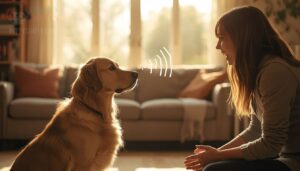
The words you use as praise matter more than most people realize. Not every "good boy" carries the same weight — and the wrong choice at the wrong moment can muddy the message your dog is trying to decode. Here’s what to keep in mind when building your praise vocabulary.
Short, Sharp Marker Words
Think of your marker word as a camera shutter — it captures one exact moment. Words like "yes" or "good" work because they’re short, staccato sounds that cut through background noise without adding verbal commentary that blurs the timing.
A single syllable is easier to deliver at speed, keeps your focus sharp, and gives your dog a clean, repeatable signal every time.
Terminal Praise Markers
A terminal praise marker — like "yes!" — does one specific job: it tells your dog the behavior is done and a reward is coming. Think of it as a green light at the end of a behavior chain.
- Signals completion clearly
- Ends task ambiguity instantly
- Triggers the reward navigation cycle
That predictable reinforcement cycle is what makes the marker so powerful — your dog learns exactly when to stop and cash in.
Continuation Praise Markers
Where a terminal marker ends things, a continuation marker keeps them going. A word like "good" during a stay tells your dog: you’re on track — don’t stop yet.
It’s a bridge cue, predicting reinforcement without ending the exercise. That ongoing feedback reduces behavior resets and keeps your dog locked in across multiple repetitions without losing momentum.
Household Vocabulary Consistency
Your marker word means nothing if your partner uses a different one. Pick one word per behavior and lock it in across everyone at home:
- "Yes" marks the moment — not "yep," "yeah," or "good job"
- "Stay" means hold position, always
- "Free" ends every exercise, every time
Consistent verbal praise only works when every trainer speaks the same language.
Avoid Confusing Nicknames
Nicknames feel affectionate, but they’re noise during training. If your dog already knows "buddy," "boo," and "baby" as everyday terms, slipping one in as a verbal praise marker muddies the signal fast. Your dog can’t reliably separate a reward cue from a pet name when they sound and feel the same.
Stick to one marker. Protect it.
Pair Praise With Rewards
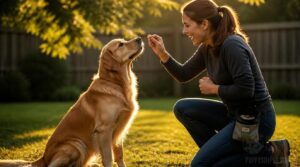
Praise on its own doesn’t mean much to a dog — it only becomes powerful when your dog learns it predicts something great. That connection doesn’t happen by accident; you build it through a simple, repeatable process. Here’s exactly how to do it.
Start With Food Rewards
Food is your most powerful training tool right now. Dogs are hardwired to work for something they genuinely want, and high-value food rewards give you that edge instantly.
Pick treats your dog goes crazy for — tiny, soft, and smelly wins every time. Repeat the praise-then-treat sequence consistently, and your dog learns fast that your marker word means something good is coming.
Add Toys or Petting
Once your dog nails food-based praise, it’s time to expand your reinforcement toolkit. Toys and petting work brilliantly as rewards — especially for dogs who get bored with treats or simply love to play. A quick tug session or enthusiastic scratch behind the ears can hit just as hard as a biscuit.
Rotate toys weekly to keep novelty alive.
Praise Before The Reward
Think of praise as the headline and the treat as the story — your dog reads the headline first. When you mark the behavior, then deliver the reward, you’re building a marker-to-reward flow your dog can predict. That sequence does the heavy lifting. Say "yes," then reach for the treat. Order matters more than most people realize.
Repeat Praise-reward Pairings
Repetition is what turns praise from background noise into a meaningful training signal. Every time "yes" is followed by a treat, your dog’s brain locks in that connection a little more.
That’s conditioned reinforcer development in action — praise gains real value through association, not magic. Three solid praise-reward pairings in a row is a solid starting point.
Fade Treats Gradually
Treats are the foundation, but you can’t carry a pocket full of chicken forever. Once your dog nails a behavior reliably, start fading slowly — drop treat frequency by roughly 20% each week.
Miss a step and reliability dips? Dial reinforcement back up. Swap in toys, petting, or a walk. Variable reinforcement keeps your dog guessing — and working.
Use Praise During Training
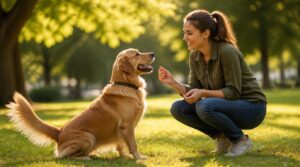
Knowing when to praise is one thing — knowing where to apply it in real training moments is what makes it stick. Each exercise has its own natural window where your timing will either build the behavior or blur it. Here’s how praise fits into the situations you’re probably already working on.
Sit and Stay Timing
Your marker word belongs at the sit moment — not one beat later. Sit and stay timing is everything.
- Bottom lands → mark instantly
- Deliver the treat within one second
- Build duration in very small steps
- Dog breaks stay → reset, don’t repeat the cue
- Nine out of ten before making it harder
Stay still — your body movement reads as a cue too.
Recall Praise Timing
Recall is where timing really proves itself.
Praise the instant your dog arrives — not when you reach for the treat, not after a proud pause. That split-second window is everything. Wait even two seconds and you’ve accidentally rewarded your dog for standing in front of you, not for coming.
Praise the arrival. Then treat.
Loose Leash Walking
Loose leash walking is timing in motion. The moment your dog drifts back to your side after tension, mark that slack instantly — "yes!" — then reward. That brief return is the behavior you’re praising.
Practice first in a quiet, fenced area. Use direction changes to keep attention on you. Praise proximity, not just forward movement.
Calm Behavior Rewards
Calm is easy to miss — it doesn’t bark or jump for attention. Watch for stillness: a relaxed body, slower breathing, four paws on the floor. The second you spot it, mark it immediately with your word, then deliver a high-value treat within one second.
- Scan for early stillness signals
- Mark the calm moment precisely
- Reward fast — within one second
- Fade treats gradually, not all at once
Intermittent rewards keep calm behavior alive long-term.
Attention and Eye Contact
Eye contact is its own behavior — and worth marking. When your dog locks eyes with you, that’s a shared attention peak. Say your marker word the instant that gaze lands on your face, then reward fast.
Direct eye contact activates approach motivation in dogs, so reinforcing it builds a dog that chooses to check in with you.
Avoid Common Praise Mistakes
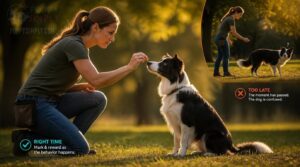
Even the most well-meaning trainers slip into habits that quietly undermine their dog’s progress. A few missteps with praise — timing it wrong, using it too loosely, or misreading what actually motivates your dog — can stall training faster than you’d expect. Here are the most common praise mistakes to watch out for.
Praising Too Late
The moment your praise lands even two seconds late, your dog has already moved on — and whatever they’re doing right now becomes the rewarded behavior, not the one you wanted.
- Your dog genuinely can’t trace praise back to a past action
- Delayed feedback quietly erodes training predictability
- Canine confusion risks multiply every time your timing slips
That’s accidental reinforcement working against you.
Rewarding Unwanted Actions
Sometimes it’s the reaction you don’t intend that teaches your dog the most. Eye contact, reaching out, talking — even saying "no" — all count as attention. And attention rewards jumping.
| Unwanted Action | Accidental Reward | What the Dog Learns |
|---|---|---|
| Jumping up | Eye contact or touch | Jumping gets attention |
| Barking | You move closer | Barking moves people |
| Lunging | Pause or distance | Lunging creates space |
| Pawing | Door opens | Pawing equals access |
| Grabbing | You stop walking | Grabbing gets results |
Instead, reward an incompatible behavior — something your dog physically can’t do while also misbehaving. Four paws on the floor. Sit. Sniff. That’s what earns the treat.
Overusing Casual Praise
Praise every little thing, and it stops meaning anything.
When your voice is constant, dogs tune it out — like background music nobody’s really listening to. That’s signal dilution in action, and it quietly kills your training precision.
Watch for these signs you’re overdoing it:
- Your dog ignores your marker word
- Praise lands before the behavior finishes
- Reward predictive power fades fast
- Arousal creeps up, focus drops
Save praise for earned moments. It hits harder that way.
Praising During Corrections
Correcting your dog and praising in the same breath sounds supportive — but the timing is everything. Praise the alternative behavior, not the mistake. If your dog stops pulling and walks nicely, that’s your moment. Say nothing during the correction itself. Wait for the shift, then mark it. That contrast is what actually teaches.
Ignoring Dog Motivation
Your dog’s behavior always has a reason. Ignoring works when attention is the reward — but not when fear, anxiety, or frustration is running the show.
Watch for:
- Extinction bursts — behavior spikes sharply before it fades
- Misread emotional states — stress and anxiety look like naughtiness
- Hidden needs — pain or arousal won’t respond to withheld praise
Frequently Asked Questions (FAQs)
Can praise timing differ across dog breeds?
Yes — breed matters. A Border Collie locks onto your cue almost instantly, while a Basset Hound may need a tighter timing window to form the same connection. Reward sensitivity and social cognition shape how fast that link sticks.
How does anxiety affect a dogs response to praise?
Anxiety blocks your dog’s ability to connect praise to the right moment. A stressed dog is too busy coping to learn. Keep sessions calm — emotional safety comes first.
Should praise change as a dog ages?
Absolutely. As dogs age, praise delivery needs to adapt. Quieter, calmer tones suit seniors who can be overwhelmed. Timing becomes even more critical when processing slows — precise, immediate praise leaves no room for confusion.
Can timing errors be corrected after bad habits form?
Yes — bad habits can be corrected, but it takes consistent new timing across many repetitions. The old association doesn’t vanish overnight; you’re basically overwriting it by reliably marking the right moment every single time.
Does group training affect how praise timing works?
Group settings divide your attention across every dog in the room. Praise timing suffers because of it — a half-second delay lands on the wrong behavior, and your dog learns something you never intended to teach.
Conclusion
Here’s what the science actually proves: praise only works when it lands on the exact behavior you want. Not after. Not close enough. Right then.
Timing praise in dog training isn’t a trick for expert handlers — it’s the foundation every session is built on. Get the timing right, and your dog stops guessing. They know exactly what earned the reward. That clarity is what turns confusing repetition into real learning — fast.
- https://www.shopkonos.com/blogs/the-bork-magazine/developing-a-marker-system-with-your-dog
- https://leerburg.com/markers.htm
- https://www.usdaa.com/news/training-tuesday-three-different-types-of-verbal-markers-in-dog-training.cfm
- https://nwaschoolfordogs.com/training-with-marker-words-a-practical-guide
- https://www.preventivevet.com/dogs/how-to-use-a-marker-word-in-dog-training