This site is supported by our readers. We may earn a commission, at no cost to you, if you purchase through links.
Every dog has a currency. Some will sprint through fire for a cube of cheese. Others couldn’t care less about food but lose their minds the moment you grab a tennis ball. Knowing your dog’s currency is the difference between training that clicks and sessions that frustrate you both.
The problem is, most people default to one reward type and wonder why results plateau. A biscuit that worked beautifully last Tuesday barely gets a sniff on a busy street corner. That’s not your dog being stubborn — that’s motivation science at work.
The best rewards for dog motivation aren’t universal. They’re personal, situational, and surprisingly varied. What follows breaks it all down: food, play, social rewards, and how to match each one to the moment.
Table Of Contents
- Key Takeaways
- Best Food Rewards for Motivation
- Best Play Rewards for Dogs
- Best Social and Access Rewards
- Matching Rewards to Training Difficulty
- Reward Tips for Better Focus
- Frequently Asked Questions (FAQs)
- What is the 7 7 7 rule for dogs?
- What is the 3 3 3 rule for dogs?
- What are the best rewards for dog training?
- How to increase motivation in dogs?
- How do rewards differ for puppies versus adult dogs?
- Can rewards help reduce separation anxiety in dogs?
- When should rewards be phased out during training?
- How do you reward a dog with food allergies?
- Conclusion
Key Takeaways
- Every dog has a unique motivational currency — food, play, or social connection — and identifying yours is the foundation of effective training.
- High-value rewards like freeze-dried meat or cooked chicken belong in tough, distracting situations, while familiar commands only need low-value treats like kibble.
- Timing is everything: rewarding within one to three seconds of the correct behavior is what wires the skill into your dog’s memory.
- Rotating rewards every two to five sessions prevents your dog from losing interest and keeps motivation consistently high across all training stages.
Best Food Rewards for Motivation
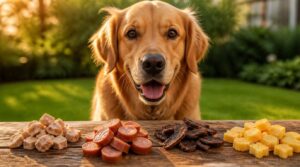
Not all treats are created equal, and that gap really matters when you’re training. The right food reward can make your dog light up and stay locked in, while the wrong one barely earns a glance. Here are the best food rewards to keep your dog motivated and excited to learn.
Understanding the essentials of positive reinforcement training can help you choose rewards that truly tap into your dog’s natural food drive.
Freeze-Dried Meat Treats
Few training treats punch above their weight like freeze-dried meat. The crisp, airy texture crunches on contact, then melts fast — dogs love it instantly. Each piece is lightweight yet packed with intact protein and amino acids, so you’re rewarding well without overfeeding.
This high quality is achieved through sublimation of frozen water to preserve essential nutrients.
Top reasons trainers reach for them:
- Naturally aromatic, making them high-value rewards in distracting settings
- Grain-free options suit food-motivated and sensitive dogs alike
- Tiny pieces — often under one gram — allow frequent reward delivery
- Long shelf life of up to 24 months unopened
- Low moisture means safer handling than fresh meat
Cooked Chicken Pieces
Freeze-dried treats are hard to beat, but cooked chicken has its own pull — it’s warm, fragrant, and feels like real food to your dog. Dogs that are food motivated respond especially well to its soft, moist texture.
Dark meat pieces stay more tender than breast cuts, especially after resting. Cook to 74°C (165°F), and store refrigerated portions within two hours.
Liver and Organ Treats
Chicken is great, but liver takes food rewards to another level. Dogs go wild for it — the smell alone is enough to snap attention back in a heartbeat.
Nutrient density makes liver stand out: it’s packed with vitamin A, B12, iron, and copper. Just keep portions small — excess vitamin A builds up over time. A few tiny cubes per session is plenty.
Cheese and Soft Snacks
Liver earns top billing, but cheese gives it a real run for its money. Soft, aromatic cheese cuts through distractions fast — string cheese, cream cheese squeezed from a tube, or tiny mozzarella pieces all work well as high-value treats. The creamy texture and rich smell hit differently than a dry biscuit ever could.
Variety keeps things interesting for food motivated dogs.
Kibble for Easy Skills
Not every reward needs to be a jackpot. For skills your dog already knows well, standard kibble sits comfortably at the bottom of the reward hierarchy — and that’s exactly where it belongs. Save the high-value treats for harder work; kibble works fine for familiar cues without overloading daily calories.
Try rehydrating a few pieces to boost aroma during practice.
Best Play Rewards for Dogs
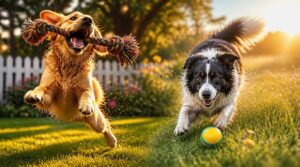
Not every dog goes wild for a treat — some would rather chase, tug, or pounce their way to happiness. Play can be just as powerful a reward as food, sometimes even more so. Here are the best play-based rewards to keep your dog engaged and excited to work with you.
Tug-Of-War Games
Tug-of-war taps straight into your dog’s natural drive. Keep rope safety in mind — check knots before play and stop if the rope frays.
For high-energy breeds, balancing tug sessions with calmer activities — like sniff walks that satisfy a naturally hyperactive dog’s curiosity — helps keep their overall stimulation healthy and well-rounded.
- Signal the start clearly
- Use steady pulling rhythm, not jerky yanks
- Let your dog win sometimes
- End with a release cue
That winning moment? Pure engagement gold for motivation.
Fetch and Chase
Few things ignite prey drive like a good fetch session. Start with short throws and build distance over time.
| Toy Type | Best Use |
|---|---|
| Lightweight ball | Fast sprints |
| Squeaky toy | Focus boost |
| Erratic disc | Tracking challenge |
| Tuggy toy | Retrieval training |
Inspect toys for damage before play. Pick grass over pavement for surface traction. In heat, keep sessions short to avoid exhaustion.
Hide-And-Seek Rewards
Hide-and-seek plays into your dog’s natural hunting instincts. When you hide and stay quiet, they work hard to find you — and that search itself is the reward.
- Start close; increase distance as skills grow
- Reward immediately when they locate you
- Vary your hiding spots to prevent predictability
- Use enthusiastic praise as the discovery payoff
Strategic patience makes every find feel earned.
Moving Toys
Some dogs barely glance at treats but go wild the moment something moves. Moving toys tap directly into that prey-drive instinct — triggering chase, pounce, and engagement without food involved.
Look for models with motion sensors that dodge furniture automatically. Remote control features let you direct the action. Most offer 60 minutes of runtime per charge, with USB recharging between sessions.
Short Play Bursts
Think of short play bursts like interval training for your dog’s brain — brief, focused, and powerful.
Here’s a simple burst structure that works:
- 5–15 second reset between each burst
- 6–12 bursts per session, totaling under 15 minutes
- High-value reward immediately after each successful response
Rotate tug, fetch, or chase to keep arousal high without triggering fatigue.
Best Social and Access Rewards

Not every dog lights up for a treat — and that’s completely fine. Some dogs are wired to respond more deeply to your voice, your touch, or simply the freedom to explore the world at their own pace. These social and access rewards can be just as powerful as any snack, and here’s how to use them well.
Verbal Praise
Your voice is one of your most powerful training tools. Say "Good sit, Max" the moment your dog gets it right — name, action, within two seconds. That timing is everything.
Match your tone to the moment: calm and steady for focused work, more upbeat for a hard-won success. Loud excitement can break focus just as fast as silence can deflate it.
Belly Rubs
Words carry weight, but sometimes your hands say more.
Belly rubs work best when you read your dog’s cues first:
- Wait for the exposed belly — that’s an invitation
- Use light, circular strokes for 5–15 seconds
- Pause briefly and watch for soft eyes or a wagging tail
- Stop if the body stiffens
Thin belly skin is highly sensitive — gentle always wins.
Sniffing Breaks
Your hands aren’t the only reward your dog craves — their nose craves action too.
A sniff break gives your dog a mental reset mid-session. Offer 15–60 seconds of free exploration every 10–30 minutes. Use a consistent cue word, keep the leash slack, and choose safe, calm spots. After sniffing, ask for one quick command to rebuild focus before moving on.
Leash Freedom
Sniffing satisfies the nose, but leash freedom satisfies something deeper — your dog’s drive to explore on their own terms.
Use a 10–20 foot long line to balance safety with independence. Key practices include:
- Start in low-distraction, familiar spaces
- Use a consistent cue before releasing slack
- Reward check-ins to build handler trust
- Monitor terrain and hazards closely
- Reel in calmly near crowds or wildlife
Greeting Trusted Dogs
Meeting another dog can be one of the richest rewards your dog experiences — but only when it feels safe and calm. Always get the owner’s okay first.
Let the dogs approach side-on, never head-to-head. Watch for relaxed body language: loose tail, soft eyes, easy breathing. A friendly sniff between trusted companions is powerful social reinforcement that deepens your dog’s confidence.
Matching Rewards to Training Difficulty
Not every reward fits every moment — and getting that match right is what separates good training from great training.
Think of your reward toolkit like a toolbox: the right tool depends on what you’re building. Here’s how to pair your rewards to the situation so your dog always stays motivated and clear on what you’re asking.
High-Distraction Settings
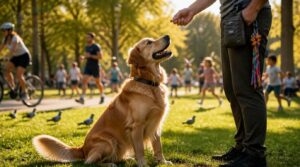
Training in a busy park is a completely different game. Visual clutter and noise above 50 decibels can cut your dog’s response accuracy by up to 12 percent.
That’s why high-value rewards — think freeze-dried meat or cooked chicken — matter most here. Sensory load management keeps canine engagement intact when novelty stimuli and multisensory distractions compete for your dog’s attention.
New Skill Practice
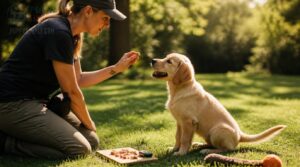
When your dog is learning something brand new, high-value rewards do the heavy lifting. Think freeze-dried meat or cooked chicken — not kibble.
Break each skill into small, measurable steps:
- Reward the first correct head turn
- Mark precise moments with a clicker
- Adjust difficulty based on real-time feedback
- Test the skill in a slightly different spot
Incremental shaping builds confidence fast.
Known Commands

Once your dog knows a cue cold, you can ease off the high-value rewards. Low-value treats work fine for practiced commands in calm, familiar settings. Kibble or a small biscuit gets the job done.
Obedience cue pairing and consistent release timing keep responses sharp without needing to pull out the good stuff every single time.
Calm Behavior Rewards

Calm is a skill worth rewarding precisely. The moment your dog holds still during a trigger — a passing jogger, a knock at the door — reward within 1–3 seconds.
- Use soft verbal praise in a low, even tone
- Offer small, easy bites that don’t spike excitement
- Designate a quiet reward zone like a mat
- Switch to intermittent reinforcement once calm is reliable
Reward Rotation
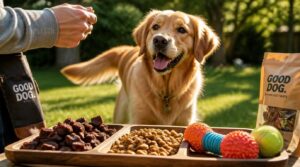
Variety keeps your dog guessing — in the best way. Swap between a high-value reward like freeze-dried meat and a low-value reward like kibble across sessions.
This managing reward predictability approach prevents habituation and sustains curiosity. Aim for rotation every 2–5 sessions to maintain novelty without disrupting your reinforcement schedule or confusing the skills you’re building.
Reward Tips for Better Focus
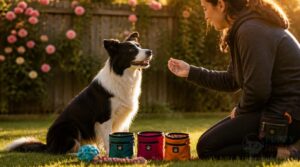
Even the best reward means nothing if it arrives too late or lands on the wrong behavior. Getting the details right — timing, tools, session length — is what separates frustrating plateaus from real progress. Here’s what actually works for keeping your dog focused and excited to learn.
Fast Reward Timing
Timing is everything. When you reward your dog within one to three seconds of the correct behavior, you trigger a dopamine reinforcement loop that wires the action into memory fast.
Even a two-second delay weakens that connection. Think of it like hitting "save" right after finishing your work — wait too long, and something gets lost. Instant feedback is what makes skills stick.
Clicker Marker Use
A clicker sharpens that connection even further. The click marks the exact moment — under 0.2 seconds — so your dog knows precisely what earned the reward, with zero guesswork.
Pair it right:
- Click first, then treat — every single time
- Only click correct behavior to protect reliability
- Start in quiet spaces before adding distractions
- Use consistent treats with each marker session
- Fade the clicker gradually as skills become fluent
Short Training Sessions
Once the clicker pinpoints the right moment, session length determines how well it sticks.
| Age Group | Ideal Session Length |
|---|---|
| Puppies | 2–5 minutes |
| Adult Dogs | 5–10 minutes |
Short bursts outperform long ones every time. Latent learning happens in the breaks — that 10-to-30-minute pause between sessions is where memory quietly consolidates. Run a quick performance check at the end, confirm what landed, and always finish on a win.
Personalized Reward Menu
Once you’ve nailed your session length, the next step is knowing what to reach for.
A custom reward menu lists your dog’s top motivators — food, toys, praise — ranked by value. Track which rewards land consistently, rotate them weekly to prevent satiation, and use a visual reward card during sessions. Match each reward to task difficulty, and you’ll never guess wrong mid-training.
Non-Food Motivators
Not every dog goes wild for treats. Some are wired for play and connection instead.
- Tug-of-war taps raw prey drive instincts
- Verbal praise builds social recognition
- Sniff breaks reward with environmental novelty
- Belly rubs encourage calm cooperation
- Chase games satisfy canine movement urges
Watch your dog’s eyes. Whatever lights them up — that’s your reward.
Watch your dog’s eyes — whatever lights them up is your most powerful reward
Frequently Asked Questions (FAQs)
What is the 7 7 7 rule for dogs?
The 7-7-7 rule describes how dogs adjust after adoption — 7 days to decompress, 7 weeks to learn routines, and 7 months to build lasting trust and predictable behavior.
What is the 3 3 3 rule for dogs?
Like a clock needing time to wind up, a new dog needs space before training clicks. The 3-3-3 rule maps 3 days to decompress, 3 weeks to learn routines, and 3 months to feel truly settled.
What are the best rewards for dog training?
The best rewards for dog training are high-value treats, play, and praise. Match the reward to the task — save boiled chicken or freeze-dried liver for tough moments, and use kibble when your dog’s already nailed a skill.
How to increase motivation in dogs?
Train before meals, try different treats, toys, and praise through trial and error, and manage distractions carefully. Match the reward to the moment, and never reward unwanted behaviors by accident.
How do rewards differ for puppies versus adult dogs?
Puppies need instant, high-value rewards delivered within one second — their learning windows close fast.
Adult dogs handle longer reward intervals and benefit from variable reinforcement, keeping familiar commands fresh without constant treat dependency.
Can rewards help reduce separation anxiety in dogs?
Yes, rewards can ease separation anxiety. Using high-value treats only at departures builds a positive link with your leaving. Frozen stuffed toys and lick mats keep dogs calm and occupied while you’re away.
When should rewards be phased out during training?
Don’t quit cold turkey — phase out rewards only after your dog hits a 9-out-of-10 reliability threshold. Then shift to intermittent reinforcement, keeping praise steady while food becomes the occasional, well-earned surprise.
How do you reward a dog with food allergies?
Food allergies don’t have to derail training. Stick to single-ingredient treats from proteins your dog already tolerates, or use small pieces of their prescription diet food as meaningful rewards instead.
Conclusion
Some dogs work for cheese. Some work for a tennis ball. Some just need a sniff of fresh grass and a kind word.
The best rewards for dog motivation aren’t found in any pet store aisle — they’re found by watching, testing, and genuinely paying attention to your dog. Match the reward to the moment, stay consistent, and training stops feeling like a chore. It starts feeling like a conversation you’re finally fluent in.
- https://braaaf.com/blogs/news/best-training-treats-for-dogs-2026
- https://dogdynamics.org/training-tips/positive-dog-training-success
- https://susangarrettdogagility.com/2018/10/reward-list-of-reinforcers
- https://www.petworks.com/articles/the-ultimate-dog-training-guide
- https://k9connoisseur.com/blogs/news/high-value-dog-training-treats