This site is supported by our readers. We may earn a commission, at no cost to you, if you purchase through links.
You grabbed a treat the second your puppy sat. He immediately stood back up, spun around, and grabbed it anyway. Sound familiar? That one-second gap between the behavior and the reward is everything in puppy training — miss it, and your pup is learning the wrong lesson entirely.
Puppies live in the present. Their brains link reward to whatever they were doing at the exact moment the treat lands, not what happened two seconds before. So if you’re a beat late, you’re not reinforcing "sit" — you’re reinforcing the wiggle that came after it.
Knowing the perfect moment to treat your puppy turns frustrating repetition into fast, reliable learning.
Table Of Contents
Key Takeaways
- Your puppy’s brain links a reward to whatever they were doing in the last second, so if you miss that window, you’re accidentally teaching the wrong behavior.
- Using a marker word like "yes" or a clicker, the instant your puppy gets it right, is what tells them exactly which action earned the treat.
- Small, soft, pea-sized treats that dissolve fast let you reward more often without blowing your pup’s daily calorie budget.
- Keeping sessions under three minutes and aiming for 10–15 treats per minute is what actually builds fast, confident learning.
Why Treat Timing Matters
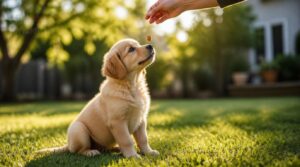
Timing a treat in puppy training isn’t just helpful — it’s everything. Your puppy’s brain connects the reward to whatever just happened in the last second, so a beat too late and you’re accidentally praising the wrong thing. Here’s what you need to know to get it right every time.
Even a one-second delay can send mixed signals, so pairing sharp timing with the right puppy training treats for senior dog owners makes every reward land exactly as intended.
Reward Within One Second
Your puppy’s brain has a memory consolidation window that slams shut in under one second. Miss it, and the treat lands on the wrong action — rewarding a sniff or a sit-break instead of the behavior you wanted. That’s misattribution, and it quietly wrecks progress.
Research shows that early bonuses boost motivation.
Reward within one second, every time.
Mark The Exact Behavior
Think of a marker — a word like "yes" or a click — as a spotlight. It freezes exactly the moment you want your puppy to remember. The marker tells them, "right there, that’s it," not a second before or after. Without that precision, your puppy’s just guessing which part of everything they did just earned the treat.
Avoid Rewarding Mistakes
Getting the marker right is half the job. The other half? Not rewarding the wrong thing. If your puppy sits, then wiggles up before the treat arrives, rewarding that wiggle teaches wiggling — not sitting. Reset instead of rewarding. Just pause, step back, and try again. No treat for the mistake. Simple as that.
Repeat Missed Reward Moments
So you missed the window — now what? Don’t stress.
Give one quick second‑chance cue, the same signal you used before, and re‑offer the treat within a few seconds.
Just once or twice, though. Too many repeats, and your puppy gets confused.
If they ignore you completely, pause for five to ten seconds, reset their focus, then try again cleanly.
Build Faster Puppy Learning
Want to know what separates a puppy that "gets it" fast from one that struggles? Reward timing and session pace.
Aim for 10–15 treats per minute during shaping, keeping each session under three minutes.
Break new skills into tiny steps, match treat value to difficulty, and your puppy builds confidence — and speed — naturally.
Best Moments to Treat Puppies
Knowing when to treat is just as important as the treat itself. There are a handful of key moments in your puppy’s day where a well-timed reward can really lock in good habits fast. Here are the best ones to focus on.
After Correct Cue Responses
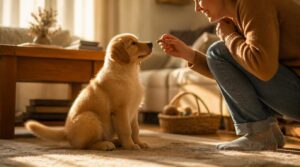
The moment your puppy sits on cue, you have exactly one second to deliver that treat — no pressure, right? That window closes fast. Here’s what "after a correct cue response" really looks like in practice:
After the treat lands, a long tug session with something like a squeaky toy built for corgi-sized enthusiasm can reinforce that winning moment and keep the energy flowing.
- Mark the behavior the instant it happens, then reward
- Use your marker signal consistently, every single time
- Match treat value to how hard the cue was for them
- Skip the reward entirely if the timing window passed
Continuous reinforcement — rewarding every correct response — builds the behavior fast in early training. Once your puppy nails it reliably, you can shift to a variable reward ratio, which actually keeps motivation higher long-term. Think of it like a slot machine: unpredictable rewards are weirdly compelling, even for dogs.
Once your puppy learns the basics, unpredictable rewards keep motivation higher than clockwork treats ever could
During Potty Success

Potty training is where reward timing gets real. The second your puppy finishes going, say your marker word and treat them — you’ve got one second before that window closes. Miss it, and you’ve accidentally rewarded them for sniffing the grass instead.
Use a high-value soft treat here. Potty success deserves the good stuff.
When Entering The Crate
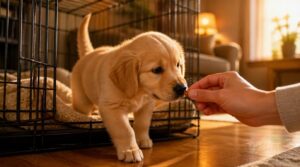
The crate is your puppy’s safe little den — and getting them inside happily starts with a treat at the door. Lure them in with a soft, pea-sized treat, let them follow it inside willingly. The second all four paws cross the threshold, mark it and reward. That instant reinforcement is everything.
Around Calm Handling Practice

Calm handling practice is one of the sneakiest good opportunities to treat your puppy. When they soften and stay still during a gentle touch, reward that exact second.
Drop a treat every three to ten seconds while they stay calm, and introduce "settle" as your marker word the moment their body relaxes.
Before Mealtime Training
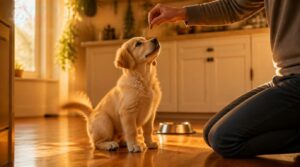
Your puppy is basically running on an empty tank before meals — and that’s your secret weapon. Pre-meal hunger motivation makes treats feel like gold, so a quick five-minute session right before their bowl goes down is prime training time.
They’re focused, enthusiastic, and ready to work. Keep it short, reward fast, and let mealtime be the payoff.
Choose and Place Treats Wisely
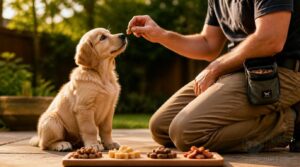
Not all treats are created equal, and where you place them matters just as much as when you give them. A few smart choices can make your training sessions way more effective. Here’s what to keep in mind when picking and delivering treats to your pup.
Use Pea-sized Soft Treats
Not all treats are created equal, and for training, pea-sized soft treats are your best friend. They dissolve fast — ideally within 1.5 seconds — so your pup swallows quickly and stays focused.
Small bites mean you can reward more often without blowing past daily calorie limits. Each piece usually carries just 1–4 calories, making frequent repetitions totally manageable.
Match Value to Difficulty
Think of treats like a salary — you don’t pay top dollar for easy work.
Kibble covers a simple "sit" at home, but high-value rewards like freeze-dried liver earn their spot when your pup is ignoring squirrels to come back to you.
Match the reward magnitude to how hard your puppy is actually working.
Place Treats for Movement
Where your treat lands matters just as much as when it drops. Place it slightly ahead of your pup’s nose during movement — not behind, not beside — so the reward pulls them forward naturally without breaking their stride.
For turns, lay treats along a gentle curve. Your puppy follows that trail, and boom — fluid movement, no stopping needed.
Reward Posture in Place
When your pup is staying still — a sit, a stand, a calm hold — deliver the treat at their current position. Don’t lure them forward. Keep it right at chest height, with a slight downward angle, so they stay put and don’t pop up or lunge. Shoulders aligned with your knees is the sweet spot you’re rewarding.
Keep Treats Quickly Accessible
A good treat pouch clips right to your belt or waistband, keeping quick-access treat delivery within arm’s reach. No digging through pockets. The reward window slams shut in under a second, so fumbling kills momentum fast.
Look for these features:
- Squeeze-to-dispense or magnetic closure for one-handed rewards
- Pea-sized soft treats that dissolve quickly
- Removable liners for easy cleanup
- Carabiner clip for leash attachment
- Breathable mesh to keep treats fresh outdoors
Top 5 Puppy Training Helpers
Good timing and the right treats are only part of the equation — having the right tools make everything click faster.
A few well-chosen products can take a lot of stress off your plate, whether you’re working on crate training, keeping your pup safely contained, or stocking up on rewards.
Here are five helpers that actually earn their spot in your training routine.
1. MidWest Pink iCrate Dog Crate
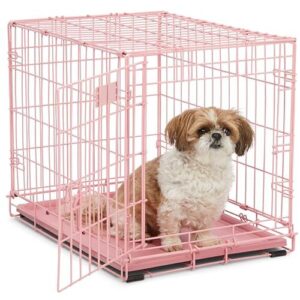
The MidWest Pink iCrate is a solid pick for crate training, and the color alone makes it feel less intimidating — for you and your pup.
It folds flat without tools, has a leak-proof tray for easy cleanup, and comes with a divider panel so you’re not buying a new crate every few months.
The slide-bolt latch keeps escape artists contained. Small breeds up to 20 lbs fit perfectly inside.
| Best For | Small-breed dog owners (up to 20 lbs) who want a stylish, travel-friendly crate for potty training or crate training puppies. |
|---|---|
| Product Type | Puppy Crate |
| Primary Use | Crate training |
| Material | Powder-coated metal wire |
| Safety Feature | Paw Block latch |
| Portability | Tool-free folding frame |
| Suitable For | Small breed dogs |
| Additional Features |
|
- Folds flat without any tools, making it easy to pack for travel or tuck away when not in use
- Leak-proof tray and rubber-footed base make cleanup simple and protect your floors
- Removable divider panel lets the crate grow with your puppy, so you won’t need to buy a new one
- Interior space can feel cramped if you want to fit a bed, pads, and bowls all at once
- The metal frame is heavier than it looks, which can be tough for anyone with limited strength
- Aggressive chewers may get their face stuck in the wire mesh gaps
2. Regalo Super Wide Baby Gate
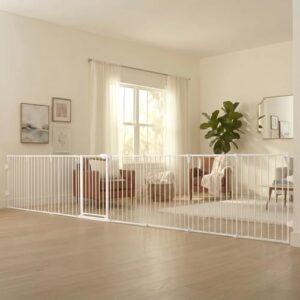
When your puppy’s zooming around the living room and you need a safe zone fast, the Regalo Super Wide Baby Gate earns its spot. It stretches up to 192 inches wide — that’s 16 feet — which is basically OMG-level coverage for open-concept spaces.
The 2-in-1 design flips from wall-mounted gate to freestanding play yard in seconds; no tools needed.
At 28 inches tall with a one-hand safety latch, it keeps curious pups contained while you grab more treats.
| Best For | Parents of toddlers (6–24 months) and small-to-medium pet owners who need to block off wide, open-concept spaces or create a flexible play area without being locked into a single setup. |
|---|---|
| Product Type | Gate & Play Yard |
| Primary Use | Containment & play |
| Material | Steel with powder coat |
| Safety Feature | One-hand safety latch |
| Portability | Accordion-style fold |
| Suitable For | Small to medium pets |
| Additional Features |
|
- Stretches up to 16 feet wide, making it one of the few options that can handle large openings, wide stair bottoms, or sprawling living rooms
- Converts quickly between a wall-mounted gate and a freestanding play yard — no tools required
- Folds flat for easy storage and travel, so it works just as well for temporary setups as permanent ones
- Only safe for bottom-of-stair use — it’s not certified for top-of-stair mounting, which limits where you can use it
- The plastic connector joints can loosen over time and may break under heavy force, so you’ll need to check them regularly
- The ~2.5-inch panel gaps are wide enough for very small children or tiny pets to squeeze through, meaning you may need to add mesh for a fully secure enclosure
3. KONG Puppy Natural Chew Toy
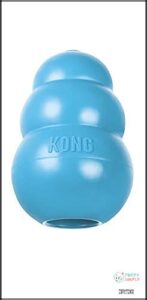
The KONG Puppy Natural Chew Toy does double duty — it soothes sore gums and keeps your pup mentally busy. Freeze treats inside the central cavity for extra teething relief, or just stuff it with kibble to slow things down during crate time.
That unpredictable bounce makes fetch way more interesting than a regular ball. Just keep an eye on smaller pups unsupervised, since the size isn’t right for every breed.
| Best For | Teething puppies of small to medium breeds whose owners want a toy that soothes sore gums, encourages mental stimulation, and doubles as a fetch toy or crate training aid. |
|---|---|
| Product Type | Chew Toy |
| Primary Use | Teething relief |
| Material | Natural rubber |
| Safety Feature | KONG satisfaction guarantee |
| Portability | Lightweight at 0.22 lb |
| Suitable For | Small to medium puppies |
| Additional Features |
|
- The soft natural rubber is gentle enough for sensitive puppy teeth while still holding up to regular chewing and play
- Stuffing the central cavity with treats, kibble, or paste keeps pups mentally engaged and makes crate time much easier
- Made in the USA and backed by KONG’s Satisfaction Guarantee, so you’re getting a trusted, quality product
- Not built for aggressive chewers — puppies with strong jaws may go through it faster than expected
- The size isn’t suitable for larger breeds and could be a choking hazard if your pup is left unsupervised
- Cleaning the inner cavity can be a bit of a hassle and may need a bottle brush or a run through the dishwasher
4. Zukes Mini Naturals Training Treats
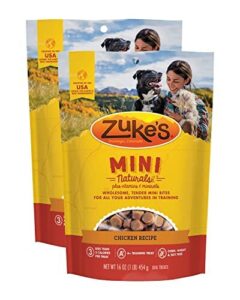
Timing your reward right means nothing if the treat itself is slow to chew. Zukes Mini Naturals dissolve almost instantly — that soft, pea-sized build fits the one-second window your puppy’s brain needs to make the connection.
Real chicken is the first ingredient, so the motivation is genuinely there.
At roughly 2 calories per treat, you can reward freely without worrying about overfeeding during a full session.
| Best For | Dog owners who train frequently and want a low-calorie, quick-reward treat that keeps sessions moving without overfeeding. |
|---|---|
| Product Type | Training Treats |
| Primary Use | Reward training |
| Material | Real chicken base |
| Safety Feature | Under 3 cal per treat |
| Portability | Resealable pouch |
| Suitable For | All breed sizes |
| Additional Features |
|
- Real chicken is the first ingredient, giving dogs a genuinely tasty motivation to stay engaged
- At under 3 calories per treat, you can reward generously throughout a full training session without guilt
- Soft, bite-size pieces dissolve fast, so there’s no waiting around between repetitions
- Texture can be inconsistent between batches — some arrive harder or more crumbly than expected
- Not an option for dogs with chicken or animal protein allergies
- Smaller or pickier large-breed dogs may find the low-calorie size underwhelming as a reward
5. Rocco Roxie Enzyme Stain Odor Eliminator
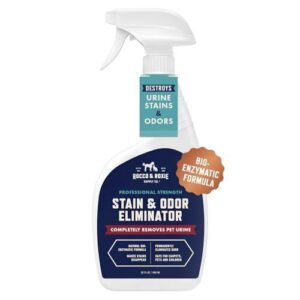
Accidents happen — that’s just puppy life. When they do, Rocco & Roxie’s bio-enzymatic formula goes after the actual source of the smell, not just the surface. It breaks down the ammonia crystals in urine at a molecular level, so your pup won’t sniff out the spot and re-mark it.
Safe around kids and pets, works on carpet, hardwood, fabric — basically everywhere training happens. Deep stains may need a second round, but it gets the job done.
| Best For | Pet owners dealing with recurring accidents, especially those with puppies or senior dogs who need a safe, effective cleaner that actually stops re-marking. |
|---|---|
| Product Type | Stain Remover |
| Primary Use | Odor elimination |
| Material | Bio-enzymatic formula |
| Safety Feature | CRI-certified, chlorine-free |
| Portability | 32 oz spray bottle |
| Suitable For | All pets and surfaces |
| Additional Features |
|
- Bio-enzymatic formula breaks down odors at the source, not just masking them
- Safe for kids, pets, and virtually every surface in your home
- Biodegradable and leaves no chemical residue or discoloration after drying
- Strong scent while wet — good ventilation is a must for sensitive noses
- Set-in or older stains may need multiple applications and a longer dwell time
- Pricier than generic alternatives, so heavy users may need to buy in bulk
Frequently Asked Questions (FAQs)
Can puppies be rewarded with praise instead of treats?
Yes, praise works well — but mostly after your puppy already knows the behavior. For brand-new skills, treats win every time. Think of praise as the reward you graduate to, not start with.
How many treats per day is too many?
Stick to the 10% rule: treats shouldn’t top 10% of your pup’s daily calories. For a 60-pound dog eating 1,200 calories, that’s just 120 treat calories — about 12 small training bites.
Should treats change as the puppy grows older?
Just like swapping out a baby’s bottle for a cup, your puppy’s treats should grow with them. Softer, nutrient-rich treats fit early stages, while textures and formulas shift as teeth and needs mature.
Can treat rewards cause resource guarding behavior?
Not usually. Treats done right actually prevent guarding. The problem starts when rewards feel unpredictable. Keep delivery consistent, use fair trades, and your pup learns that sharing pays off.
When should treat rewards be phased out completely?
Treats don’t get phased out completely — not ever, really. Even well-trained dogs need occasional food rewards to keep behaviors strong and maintain that bond with you.
Conclusion
What if one small second is the only thing standing between a confused pup and a dog who truly gets it?
The perfect moment to treat your puppy isn’t just a training tip — it’s the entire language your puppy learns to trust. Get it right, and every session builds something real. Soft treats ready, eyes on your pup, reward the instant they nail it. That one-second window is yours. Use it well.
- https://www.purina.com/articles/dog/feeding/guides/how-to-use-dog-treats-for-training
- https://www.hillspet.com/dog-care/nutrition-feeding/can-puppies-have-treats
- https://goanywheredog.com/the-best-time-to-train-your-puppy-or-dog
- https://nwaschoolfordogs.com/training-with-marker-words-a-practical-guide
- https://www.humaneworld.org/en/resources/positive-reinforcement-training