This site is supported by our readers. We may earn a commission, at no cost to you, if you purchase through links.

Most dog owners treat before or after the command based on what feels natural in the moment. That instinct is usually wrong—and it quietly sabotages training every single time.
Your dog’s brain links actions to outcomes within a two-second window. Miss that window, and the reward lands on whatever your dog happened to be doing when the treat arrived. Not the sit. Not the recall. The sniff. The glance at a squirrel. The shift of weight.
Timing isn’t a detail you can adjust later. It’s the mechanism by which dogs learn anything at all. Get it right, and commands click into place faster than most owners expect.
Table Of Contents
- Key Takeaways
- Treat After The Command
- Why Treat Timing Matters
- Use a Marker First
- Step-by-Step Treat Timing
- Timing Treats for Basic Commands
- Reward Before or After Release
- Avoid Common Treat Mistakes
- Fade Treats Without Confusing Dogs
- Practice Better Reward Delivery
- Frequently Asked Questions (FAQs)
- How do you use the ‘leave it’ command with a dog?
- Should you give your dog a treat if he changes directions?
- Should you phase out treats & rewards for your dog?
- What is a “leave it” command?
- How do high-value treats differ from standard rewards?
- Should puppies follow the same timing rules as adults?
- How does treat timing change for anxious or fearful dogs?
- Conclusion
Key Takeaways
- Your dog’s brain links reward to behavior only within a two-second window — miss it, and you’re training the wrong action.
- Always cue first, treat second: the moment your dog sees food before complying, they’re responding to the treat, not your command.
- A marker (a clicker or sharp "Yes") fired at the exact moment of correct behavior is what bridges the gap between action and reward.
- Phase treats out gradually using unpredictable reward schedules — this actually strengthens the behavior rather than weakening it.
Treat After The Command
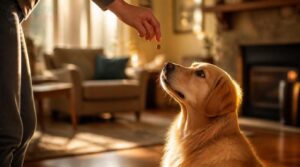
Treats work best when they follow the command, not precede it. The sequence you use shapes what your dog actually learns. Here’s what that looks like in practice.
Timing really does make all the difference — pairing rewards with the right moment is one of the core principles behind basic dog obedience training commands that actually stick.
Cue First, Treat Second
The cue comes first. Always. Before your hand moves toward the pouch, before the treat appears — your dog hears the command. That sequence isn’t flexible.
When the cue precedes the treat, your dog learns to respond to your word, not the food. The behavior earns the reward. The word triggers the behavior. That order is everything.
Maintaining cue‑marker interval consistency avoids unintentionally reinforcing unwanted actions.
Avoid Treat Bribery
Bribery happens the moment your dog sees the treat before deciding to comply. That flash of food isn’t a reward — it’s a negotiation. Your dog isn’t responding to your word. They’re responding to the food.
Hide the treat. Give the command empty-handed. Compliance earned without visible food is real obedience.
Reward The Correct Behavior
Once the treat is hidden, your next job is precision. Reward the exact behavior you want — not an approximation.
If you asked for a sit and your dog’s hindquarters barely grazed the floor, that doesn’t count. Define success clearly: full contact, complete position. No partial credit. Rewarding an almost-correct response teaches your dog that almost-correct is enough.
Keep Timing Under One Second
Precision is what separates good training from great training. Reward latency under one second is the standard. Here’s why that number matters:
- Dogs link actions to what happened just before the treat arrived.
- Immediate reinforcement closes the gap between behavior and consequence.
- Minimizing handoff delay means your hand is already moving before you consciously decide.
Why Treat Timing Matters
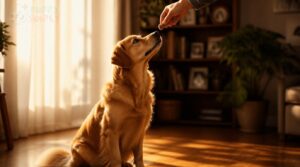
Timing isn’t just a detail — it’s the whole mechanism behind how your dog learns. Dogs connect actions to outcomes only within a very narrow window, and missing it means the lesson doesn’t land. Here’s why getting that timing right changes everything.
Timing isn’t a training detail — it’s the entire mechanism by which dogs learn
Dogs Learn by Association
Your dog doesn’t follow commands out of obedience. He follows them because his brain has linked that sound to something valuable.
This is associative learning — the mechanism driving every reliable behavior your dog has ever shown. When a command consistently precedes a reward, it becomes a predictor cue, triggering genuine anticipation before the treat even appears.
Two-second Memory Window
Your dog’s brain operates on a strict biological clock. EEG studies reveal two critical processing windows — one at 100–140 milliseconds after a stimulus, another at 240–280 milliseconds. Together, they create the two-second memory window trainers rely on.
Miss it, and dopamine drops before the association forms. The behavior and the reward simply don’t connect.
Delayed Rewards Confuse Dogs
When a reward arrives late, your dog’s brain has already moved on. Reinforcement latency matters: research shows dogs trained with even a one-second delay learn the target behavior far less often than dogs rewarded immediately.
- Memory window limits mean the behavior-reward link breaks fast
- Dopamine release timing depends on immediate association
- Delayed reinforcement rewards whatever your dog did last
Faster Learning With Quick Rewards
Quick rewards don’t just feel better — they work measurably better.
Dogs trained with sub-one-second treat delivery achieve roughly 60% correct responses versus 25% with delayed rewards. That gap comes down to nucleus accumbens activation: immediate reinforcement triggers a dopamine loop that stamps the behavior into memory before your dog’s two-second consolidation window closes.
Faster timing means fewer repetitions. Fewer repetitions means faster mastery.
Use a Marker First
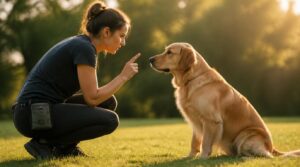
Before your hand ever reaches the treat pouch, your dog needs a clear signal that they got it right. That signal is your marker — a sharp, consistent sound or word that lands at the exact moment the correct behavior happens. Here’s how to use it well.
Say “Yes” or Click
A marker is a signal — one clean sound that tells your dog: that was it.
You have two options: a verbal marker like "Yes," or a clicker. Both work, but they’re not equal. A clicker produces a 0.1-second acoustic burst that never wavers, regardless of your mood, accent, or volume. Your voice can’t match that consistency.
Mark The Exact Moment
Think of your marker as a camera shutter. The instant your dog’s hindquarters touch the ground, click or say "Yes" — not a beat later. Your dog takes a mental snapshot of exactly what it was doing at that moment. Miss by even two seconds, and the snapshot captures the wrong frame entirely.
Precision marking is the skill that separates fast learners from confused ones. Here’s where timing breaks down most often:
- Marking while reaching for the treat pouch
- Marking after the dog starts to move out of position
- Hesitating because you’re unsure the behavior was "good enough"
- Using a delayed "Good boy" instead of an immediate neutral marker sound
- Marking inconsistently — sometimes on the sit, sometimes after
A clicker’s neutral sound cuts through ambiguity. Your voice carries emotion; the click carries none. That emotional flatness is a feature. Eliminating reward ambiguity means your dog knows exactly which action earned the consequence — no guessing required.
Treat Immediately After Marking
Precision marking means nothing if the treat doesn’t follow immediately. The click creates expectation — your dog’s brain releases dopamine the instant it hears that sound.
Break the sound-reward association even once by fumbling for your pouch, and you’ve introduced doubt. Deliver within one second. That’s the entire window you have.
Use One Consistent Marker
Your marker word carries one meaning. Only one. The moment you use "yes" to mean "good job" during a walk and as a training signal, signal overload begins. Your dog can’t tell which "yes" counts.
Pick a word or clicker. Stick to it across every session, every handler, every location.
Practice Marker Timing Daily
Consistency unlocks precision. Now you have to build the reflex.
Daily five-minute drills sharpen your reaction faster than long, infrequent sessions. Watch a training video and mark the exact moment a dog sits — no dog needed. That simulated timing practice measurably improves millisecond reaction accuracy week over week.
Use your dog’s kibble. Mark the exact moment. Reward immediately.
Step-by-Step Treat Timing
Knowing when to reward is one thing — knowing how to execute it, step by step, is what separates a dog that sometimes responds from one that reliably does. The sequence matters more than most owners realize. Here’s exactly how to run it.
Give The Command Clearly
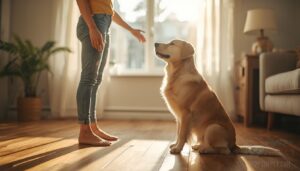
Say it once. Say it the same way every time.
Your command is the starting gun. "Sit" means sit — not "calm down," not "stop jumping." One word, one meaning. Every person in your household must use that exact word. Mixed signals create confused dogs. Pair your verbal cue with a consistent hand signal from the first repetition.
Wait for The Behavior

After the command lands, stop. Your dog needs a moment to process and respond. Don’t repeat the cue — restating it teaches them that waiting through repetitions is acceptable. Stand still. Hold your position. That pause isn’t wasted time; it’s where real learning happens. Give the behavior space to emerge.
Mark The Correct Action
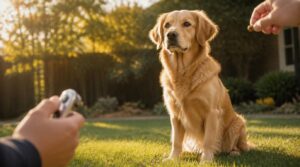
The moment your dog’s hindquarters hit the ground, your marker fires. Not a beat later.
Mark the exact moment — that instant of correct action — with a clear "Yes" or a click.
This bridges the gap between behavior and reward.
Dogs correctly associate a marker with a behavior only when it lands within one second.
Deliver The Treat Quickly
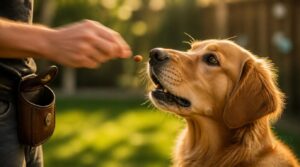
The marker fired. Now your hand has to move.
Your dog’s brain links reward to behavior only if the treat lands within one second of the mark. Pre-load small, pea-sized pieces in a magnetic-closure pouch. One pull, one treat — under 0.5 seconds. No fumbling, no missed windows.
Reduce hand-to-pouch lag by positioning the pouch at your hip, treat hand already hovering.
Reset and Repeat Calmly

Once the treat lands, stop. Don’t hover, reach forward, or repeat the cue. Return to neutral stance — hands relaxed, weight even. Your dog reads your body constantly.
If the response was wrong, turn away briefly. No treat, no reaction. Then reset: same position, same cue, clean slate.
Calm repetition builds confidence. Chaos builds confusion.
Timing Treats for Basic Commands

Every command has its own timing sweet spot — and missing it means your dog learns the wrong thing. The mechanics shift slightly depending on what you’re asking for. Here’s how to nail the moment for each basic command.
Sit: Reward Sitting
The sit sounds simple. But precision is everything here.
Mark hindquarter contact the instant your dog’s bottom touches the ground — not a half-second later. That’s your window.
- Give the "sit" cue once
- Wait for full hindquarter contact
- Mark with "yes" or a click
- Deliver the treat within one second
- Don’t reward incomplete sits
No treat before the cue. No luring. Reward stillness, not movement.
Down: Reward Elbows Down
The down is harder to time than the sit. Your reward target here isn’t the dog lying flat — it’s elbow contact with the floor.
The second those elbows touch down, mark it. Not when the hips settle. Not when the dog looks relaxed. Elbows. That’s the behavior.
| Timing | Reward Placement | Result |
|---|---|---|
| Elbows touch floor | Between front paws | Reinforces down position |
| Delayed 3+ seconds | Hand level | Dog stands to reach treat |
| Pre-movement | Nose height | Rewards anticipation, not down |
Place the treat between the front paws, on the ground. That keeps the dog anchored in position instead of rising to meet your hand.
Come: Reward Arrival
The come command rewards differently from sit or down. You’re not just marking arrival — mark the first step toward you.
- Use high-value treats like chicken or cheese
- Mark movement, rather than just full arrival
- Reward within one second of reaching you
- Increase treat value as distance grows
Stay: Reward Stillness
Stay is where timing shifts. Unlike come, you’re rewarding stillness — not movement.
The instant your dog holds position, deliver the treat while they remain in place. Rewarding before release directly stabilizes the behavior.
High-energy dogs especially need this: reward in position first, then release.
That sequence tells your dog exactly what earned the treat.
Leave It: Reward Disengagement
Leave It is the greatest test of disengagement timing. Your dog fixes on something — food, a squirrel, another dog — and you need their eyes back on you. Fast.
- Reward the instant they look away from the stimulus
- Half a second of disengagement is enough to mark
- Delayed rewards let them drift back to the distraction
- Start inside, then proof against real-world distractions gradually
Reward Before or After Release

Knowing when to reward matters just as much as the reward itself. The timing around your release cue can either lock in a solid stay or quietly teach your dog to break early. Here’s how to get it right.
Reward Stays Before Release
Rewarding a stay before you release your dog isn’t optional — it’s the mechanism that prevents breaking early. When the treat arrives while your dog holds position, the sequence becomes clear: stay → reward → release. That cause-and-effect chain sticks. Skipping it teaches your dog that breaking earns the payoff.
Release After The Treat
Once the treat lands, say your release word. That sequence — treat, then "Okay" — tells your dog the working phase is finished.
Why the order matters:
- The treat marks success
- Release signals freedom
- The dog learns position holds earn rewards
- Breaking early earns nothing
- Compliance becomes the reliable path to both rewards
Reward Movement After Release
After release, one movement earns the reward — and only one. Your dog steps away, turns back, or walks toward you. That specific action is what you pay for.
Keep your treat hand still until that movement begins. Reward close to the mouth. Short delivery. No chasing, no lunging. One clean exchange.
Match Timing to Behavior
Not every behavior earns the same timing strategy. Stillness rewards before release. Movement rewards after.
Getting that backwards disrupts the dopamine reinforcement cycle — your dog’s nucleus accumbens links the treat to whatever action occurred at delivery, not the one you intended.
Match your timing to the behavior’s structure, and your dog learns exactly what you’re asking.
Prevent Accidental Movement Rewards
Your dog can’t tell the difference between what it intended to do and what it was doing when the treat landed. If it shifts forward half a second before delivery, that shift gets reinforced. Watch for weight shifting forward — a stress signal often mistaken for eagerness. Wait for stillness. Then deliver.
Toss treats on the ground to reset position naturally and break the reach-anticipation loop entirely.
Avoid Common Treat Mistakes

Even small timing errors can undermine weeks of solid training. Most mistakes aren’t careless — they’re just habits you haven’t noticed yet. Here are the ones that quietly work against you.
Treating Before The Command
Showing the treat before you give the command is one of the fastest ways to undermine your training. Your dog stops listening to the cue — they’re watching your hand. Reward bribery takes hold quickly. The command becomes meaningless noise. What drives the behavior is the food’s presence, not your instruction.
Reaching Too Early
Moving your hand toward the treat pouch before the marker fires is a silent signal. Your dog reads it instantly. That premature motion tells them food is coming — so they stop performing and start waiting.
The behavior collapses mid-way. You reward an incomplete action. Your dog hasn’t learned the command. They’ve learned to watch you.
Rewarding The Wrong Behavior
Timing errors don’t always mean being too slow. Sometimes you fire the marker at the wrong moment entirely — catching your dog mid-rise, mid-sniff, or mid-wander.
- Rewarding incomplete actions teaches partial behaviors
- Misaligned reward cues create lasting confusion
- Accidental movement reinforcement undermines command stability
- Reward misattribution makes dogs repeat the wrong thing
What you support is what you get. Precisely.
Delaying The Reward
Marking the wrong moment is one mistake. Waiting too long to deliver the treat is another — and it quietly poisons your progress.
Your dog operates within a 2–3 second memory window. Past that, reward latency breaks the link between action and consequence. The treat arrives, but the brain can’t connect it to the sit you wanted.
Showing Treats Constantly
Delayed rewards break the action-reward link — but there’s another mistake that corrupts training even faster: waving treats in your dog’s face before they comply.
When your dog sees food constantly, it stops responding to your voice. It reacts to the treat. That’s bribe dependency, and it quietly dismantles every command you think your dog knows.
Fade Treats Without Confusing Dogs

Treats are a powerful training tool, but your dog shouldn’t need to see one to obey. The goal is a dog that answers to your cue, not the promise of food in your hand. Here’s how to reduce treat dependency without losing the progress you’ve built.
Start With Frequent Rewards
When your dog is just learning, reward every correct response. Each treat within that one‑second window builds a clear association between behavior and outcome.
Think of it as depositing trust — the more consistent the payoff early on, the faster confidence grows.
Once your dog hits 90% reliability, you can start asking for more before rewarding.
Hide Visible Food Lures
Visible treats are a crutch. Once your dog sees food before performing, you’re bribing — not training.
Hide treats at waist level in a sealed bait bag to block scent cues. Gradually shrink your hand movement from a full circle to a subtle wrist flick across three to four sessions.
- Conceal treats until the exact delivery moment
- Reduce lure size after four successful repetitions
- Rotate reward locations: hand, pocket, floor bowl
- Return one step if the dog stops responding
Use an Empty Hand
Once the lure is gone, your hand signal becomes the command. Hold your palm open — empty — and give the cue exactly as before.
Your dog doesn’t know there’s no treat yet. Respond to the gesture, not the food. That learned association transfers cleanly, keeping cues reliable at distance, in public, and without a pouch in sight.
Reward Unpredictably Later
Once your dog knows a behavior well, stop rewarding every repetition. Shift to a variable ratio schedule — reward after 7 sits, then 12, then 9. No fixed pattern.
That unpredictability is exactly what makes behaviors stick. A dog that never knows which response earns the treat keeps responding. Every time. That’s extinction resistance working in your favor.
Add Praise and Play
Treats don’t have to anchor every reward forever. As you reduce food, verbal praise and play fill the gap — but only if you’ve built their value deliberately. Say "good boy" consistently alongside treats early on, and praise alone becomes meaningful.
A quick tug session or game of fetch after a correct behavior motivates just as powerfully.
Practice Better Reward Delivery

Good timing isn’t just about knowing when to reward — it’s about being ready to deliver that reward the moment it counts. Your mechanics matter as much as your instincts. Here’s what to work on so your treat delivery never falls behind your dog’s behavior.
Pre-load Small Treats
Before your dog even sits, your treat hand should be ready. Pre-load small, soft pieces into your palm or fingers before each repetition.
This cuts handling lag to near zero, keeping your reward delivery inside that critical one-second window.
Small bites mean no chewing delay. Your timing stays clean. Your dog stays connected.
Use a Treat Pouch
Your hand speed only matters if your supply is already open. A treat pouch with a magnetic closure lets you grab rewards in under one second — no fumbling, no delay.
Wear it at your hip, not your back. That position cuts your reach time and keeps delivery inside the critical memory window.
Train in Quiet Spaces
Your treat pouch is ready. Now your environment needs to match.
A distraction-free training zone removes the biggest variable in your timing — your dog’s attention. When a car passes or a child shouts, your dog disengages. Your cue goes unheard.
Start every new behavior in a quiet area where you control the sensory input completely:
- No other animals in the space
- Low ambient noise — indoors works best
- Consistent setup each repetition
- No foot traffic interrupting focus
That consistency is what makes your timing land.
Keep Sessions Short
Your environment is quiet. Your treats are loaded. Now protect the one resource that controls everything else — your dog’s attention span.
Most dogs hit cognitive fatigue around the 10-minute mark. Puppies under 16 weeks? One to two minutes, maximum. Past that threshold, timing errors multiply and learning stalls.
| Dog Type | Ideal Session Length | Daily Sessions |
|---|---|---|
| Puppies (under 16 weeks) | 1–3 minutes | 4–5 |
| Adult dogs | 5–10 minutes | 3–5 |
| Senior dogs | 3–5 minutes | 2–3 |
End before exhaustion hits. Stop when your dog still wants more — not when focus breaks down.
Practice Without Your Dog
You’ve dialed in your pouch, your timing, your session length. Now sharpen the one variable most owners ignore — your own mechanics.
Mental rehearsal works. Before your next session, sit quietly and visualize the full sequence: command, behavior, mark, deliver. Run it 10 times in your head. Your hands get faster when your brain has already practiced the motion.
Frequently Asked Questions (FAQs)
How do you use the ‘leave it’ command with a dog?
Leave it" works best when built in layers. Start with a treat in your closed fist. Mark the exact moment your dog disengages, reward immediately with a different treat, then progress to floor and mid-air challenges.
Should you give your dog a treat if he changes directions?
Yes. When your dog changes direction on cue, reward within one to three seconds. Delayed treats break the behavioral link. Precise directional reward timing turns a single direction change into a reliable, repeatable response.
Should you phase out treats & rewards for your dog?
Phase them out gradually — never cold turkey. Swap food for praise, play, or toys. Use intermittent rewards to keep motivation high. Your dog keeps working when the outcome still counts.
What is a “leave it” command?
A "leave it" command trains your dog to disengage from any tempting object, animal, or substance on cue. It’s a safety behavior — stopping scavenging, counter surfing, and wildlife chasing before contact happens.
How do high-value treats differ from standard rewards?
High-value treats create stronger dopamine responses than standard rewards. That gap matters most when distractions compete for your dog’s attention. The right food motivators depend entirely on your individual dog’s preferences — not yours.
Should puppies follow the same timing rules as adults?
Puppies need the same rule — but less forgiveness. Their memory window is tighter, attention fades faster, and confusion sets in quicker. Match your speed to their development. Under one second. Every time.
How does treat timing change for anxious or fearful dogs?
Fearful dogs don’t follow standard timing rules. Skip the command entirely. Use a free treat protocol — the trigger appears, you treat immediately. No behavior required. Distance matters: stay below the anxiety threshold.
Conclusion
The less you rush the treat, the faster your dog learns. That’s the quiet truth behind treating before or after command—when you slow down to mark precisely and reward within that two-second window, everything accelerates.
Your dog stops guessing. Commands land cleanly. Confusion disappears.
One well-timed reward teaches more than twenty sloppy ones ever could.
Master the timing, and you don’t just train behaviors. You build a dog who trusts exactly what you’re asking.
- https://crossbonesdog.com/how-to-get-behavior-luring
- https://www.thecollarclubacademy.com/blog/the-hidden-truth-about-dog-training-with-treats
- https://clickertraining.com/food-lures-and-training
- https://www.wellnesspetfood.com/blog/7-mistakes-people-make-when-using-dog-training-treats
- https://www.thrivingcanine.com/blog/training_treats