
This site is supported by our readers. We may earn a commission, at no cost to you, if you purchase through links.

Old dogs wander. It’s one of the quieter heartbreaks of canine aging—a dog who once came reliably when called now slips out a gate and has no idea where home is. Canine cognitive dysfunction affects roughly 28% of dogs aged 11 to 12, and that number climbs past 68% in dogs 15 or older. Their world gets smaller and more confusing, but their legs still carry them surprisingly far.
A GPS tracker doesn’t stop that from happening. What it does is cut the window between "missing" and "found" from hours to minutes. For a senior dog lost in cold weather or traffic, that difference is everything.
The right dog GPS tracker for senior dog owners does more than ping a location—it accounts for arthritic necks, weak signals in rural areas, and the 2 a.m. moment when your dog isn’t where you left them. Here’s what actually works.
Table Of Contents
- Key Takeaways
- Top 10 Products Compared
- 1. Fi Series Three Smart Dog Collar
- 2. iOS Pet GPS Tracker
- 3. Tractive Smart Dog GPS Tracker
- 4. Apple AirTag 2nd Generation Tracker
- 5. Onarway Washable Dog Blanket
- 6. Senilife Senior Dog Brain Supplement
- 7. VetIQ Dog Calming Chews
- 8. Halo GPS Dog Fence Collar
- 9. Fi Series 3 GPS Dog Collar
- 10. Dogtra Pathfinder 2 GPS Collar
- Why Senior Dogs Need GPS Trackers
- GPS Features Senior Owners Need
- GPS, Bluetooth, and Microchips
- Battery Life and Charging Needs
- Subscription Costs and Value
- Best Trackers by Dog Type
- Setup Tips for Senior Dogs
- Safety Habits Beyond GPS
- Frequently Asked Questions (FAQs)
- Conclusion
Key Takeaways
- Cognitive decline affects over 28% of dogs aged 11–12 and jumps past 68% in dogs 15 and older, making GPS tracking a practical necessity rather than an optional extra for senior dog owners.
- The best trackers for senior dogs combine real-time LTE updates (refreshing every 2–5 seconds), instant geofence alerts, and a weight under 43g to avoid straining arthritic necks.
- Advertised battery life rarely matches real-world use — live tracking, cold weather, and weak cellular signals can cut runtime by 20–50%, so a weekly charging routine and a backup tracker are smart habits.
- A GPS tracker works best as part of a layered safety system alongside a current microchip, a visible ID tag, daily gate checks, and secure 6-foot fencing — because technology catches escapes faster when fewer escapes happen in the first place.
Top 10 Products Compared
Finding the right tracker for your senior dog comes down to more than just GPS signal — it’s about weight, battery life, and whether the device fits your dog’s specific needs.
If you’re just starting out, this guide to GPS trackers for first-time dog owners breaks down what specs actually matter for older, slower-moving dogs.
The ten products below cover a range of budgets, features, and dog sizes, so there’s a strong chance one of them is exactly what you’ve been looking for.
Here’s how they stack up.
1. Fi Series Three Smart Dog Collar
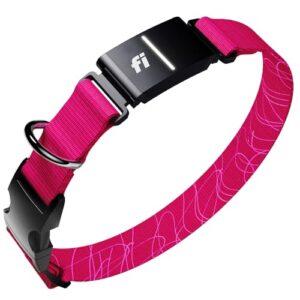
The Fi Series Three collar sits near the top of the list for a reason. It uses LTE-M and GPS to deliver real-time location updates, and when you activate Lost Dog Mode, refreshes kick in faster than once per minute. For a senior dog who can wander fast and navigate back slowly, that speed matters.
At 77 grams, it’s not the lightest option available. If your dog has arthritis or a sensitive neck, that’s worth factoring in before you buy.
| Best For | Dog owners who need reliable real-time GPS tracking and health monitoring for active, adventurous, or escape-prone dogs. |
|---|---|
| Product Type | GPS Tracker |
| Subscription Required | Yes (~$99/6 months) |
| App Compatible | iOS & Android |
| Waterproof Rating | Yes (waterproof) |
| Battery Life | Up to 7 days |
| Primary Use | Location & Health |
| Additional Features |
|
- Next-gen GPS with nationwide real-time tracking and fast Lost Mode updates — great peace of mind for dogs that roam
- AI-powered health monitoring tracks activity, rest, barking, eating, and more, helping you catch early signs of illness
- Stores vet records, insurance, and vaccination docs on-collar, so everything’s in one place for appointments or emergencies
- At 77 grams, it’s on the heavier side — worth thinking twice if your dog has arthritis or a sensitive neck
- Requires a 2.4 GHz Wi-Fi base station and an ongoing subscription (~$99 every six months after the included period)
- Collar sizes aren’t adjustable after purchase — ordering the wrong size means replacing the whole set
2. iOS Pet GPS Tracker

If the Fi Series 3’s weight gives you pause, the JOYGIEE iOS Pet GPS Tracker takes a different approach. It attaches directly to your dog’s existing collar and comes in at under 50 grams — noticeably lighter.
There’s no monthly subscription, either; it runs entirely through Apple’s Find My network.
One real caveat: it only works with iOS devices, and its reliability drops in areas with few nearby iPhones.
| Best For | iPhone users who want a lightweight, no-subscription pet tracker for dogs or cats and don’t need Android compatibility. |
|---|---|
| Product Type | Bluetooth Tracker |
| Subscription Required | No |
| App Compatible | iOS only |
| Waterproof Rating | IP68 |
| Battery Life | Up to 1 year |
| Primary Use | Pet Location |
| Additional Features |
|
- Zero monthly fees — works entirely through Apple’s Find My network at no ongoing cost
- Ultra-light and waterproof (IP68), so it handles active pets and wet weather without issue
- Year-long battery life means you’re not constantly recharging or swapping batteries
- IOS only — completely useless if you or anyone tracking your pet uses Android
- Reliability depends on nearby iPhones in the area, so rural or low-traffic zones may see spotty updates
- The magnetic collar attachment can pop loose on larger or more energetic dogs
3. Tractive Smart Dog GPS Tracker

Unlike the iOS-only option before it, Tractive works with both iPhone and Android, which immediately widens its appeal.
The tracker streams your dog’s location every few seconds via LTE cellular — no Wi-Fi, no Bluetooth range limits. You’ll get instant geofence alerts the moment your senior crosses a boundary you’ve set.
Real-world battery life runs about five days with live tracking active, shorter than advertised but workable with a simple weekly charging routine.
Subscriptions start at $5 per month on an annual plan.
| Best For | Android and iPhone users who want reliable real-time GPS tracking for a senior or high-risk dog with no range limitations. |
|---|---|
| Product Type | GPS Tracker |
| Subscription Required | Yes (monthly or yearly) |
| App Compatible | iOS & Android |
| Waterproof Rating | IPX7 |
| Battery Life | Up to 14 days |
| Primary Use | Location & Health |
| Additional Features |
|
- Works with both iPhone and Android, making it accessible to nearly any pet owner
- Streams live location every few seconds over LTE — no Wi-Fi or Bluetooth needed
- Geofence alerts, health monitoring, and activity tracking all in one lightweight, waterproof device
- Full GPS functionality requires a paid subscription (starting around $5/month)
- Real-world battery life is closer to five days with live tracking, well below the 14-day advertised figure
- Signal can drop or show inaccurate positions in dense areas, and the geofence tool struggles with small or irregular boundaries
4. Apple AirTag 2nd Generation Tracker

The Apple AirTag 2 is the lightest option here at 0.48 oz (13.6 g) — barely noticeable on a collar. Its Ultra Wideband chip gives directional arrows and distance on iPhone 15 or newer, and the speaker is roughly 50% louder than the original. There’s no subscription fee, and the CR2032 battery lasts over a year.
The catch: it’s not a true GPS tracker. Without nearby Apple devices, location goes dark.
| Best For | iPhone 15 (or newer) users who want a lightweight, no-subscription way to track keys, wallets, or pet collars within the Apple ecosystem. |
|---|---|
| Product Type | Bluetooth Tracker |
| Subscription Required | No |
| App Compatible | iOS only |
| Waterproof Rating | Not rated |
| Battery Life | 1+ year (CR2032) |
| Primary Use | Item/Pet Location |
| Additional Features |
|
- Precision Finding with directional arrows and distance makes locating items fast and intuitive on compatible devices
- 50% louder speaker makes it easy to find nearby items by sound alone
- CR2032 battery lasts over a year and is user-replaceable — no charging required
- Not a true GPS tracker; location goes dark in areas with few Apple devices nearby
- UWB Precision Finding is limited to iPhone 15 / Apple Watch Series 9 and later — older devices only get basic Bluetooth location
- No cross-platform support; only works within the Apple Find My ecosystem
5. Onarway Washable Dog Blanket

Not every product on this list tracks location — and that’s fine. The Onarway Washable Dog Blanket earns its spot as a comfort essential for senior dogs who spend more time resting between walks. Each of the four blankets measures 40 × 28 inches, made from soft polyester that’s gentle on sensitive skin. They’re machine-washable, quick-drying, and light enough to toss in a travel bag.
For arthritic dogs, familiar-smelling bedding reduces anxiety. A small but real difference.
| Best For | Small dogs, puppies, and cats whose owners want an affordable, easy-to-clean blanket for the couch, crate, or car. |
|---|---|
| Product Type | Pet Blanket |
| Subscription Required | No |
| App Compatible | None |
| Waterproof Rating | Not applicable |
| Battery Life | Not applicable |
| Primary Use | Pet Comfort |
| Additional Features |
|
- Comes as a 4-pack, so you always have a clean one ready while another’s in the wash
- Soft polyester is gentle on sensitive skin, and the quick-dry fabric makes laundry day painless
- Lightweight and foldable, making it easy to bring along on trips so pets stay comfortable in familiar bedding
- Too thin to provide meaningful warmth for large or heavy breeds
- The khaki color can look different in person than it does in product photos
- Heavy chewers may wear these out faster than expected
6. Senilife Senior Dog Brain Supplement

Senilife takes a different approach to senior dog care — instead of tracking where your dog goes, it works on why they wander in the first place. The formula combines phosphatidylserine, ginkgo biloba, and resveratrol to support brain cell function and circulation in aging dogs. Many owners report steadier daily routines within 30 days.
At $29.49 for 30 capsules, it’s straightforward to give — whole, opened onto food, or squeezed directly into meals.
| Best For | Senior dogs showing signs of cognitive decline, such as disorientation, restlessness, or sundowning behavior. |
|---|---|
| Product Type | Cognitive Supplement |
| Subscription Required | No |
| App Compatible | None |
| Waterproof Rating | Not applicable |
| Battery Life | Not applicable |
| Primary Use | Cognitive Health |
| Additional Features |
|
- Combines well-researched ingredients like phosphatidylserine and ginkgo biloba to support brain health and circulation in aging dogs
- Flexible dosing — capsules can be given whole, opened onto food, or squeezed directly into meals
- Many owners notice improvements in routine and alertness within 30 days
- Results aren’t guaranteed — some dogs show little to no noticeable change
- Capsule color and texture can vary, which may put picky eaters off
- Not formulated for cats or other pets, and shelf life can be a concern if the product is close to expiration
7. VetIQ Dog Calming Chews

When anxiety is part of the picture, VetIQ Calming Chews are worth keeping on hand. Each soft chew delivers chamomile, L-tryptophan, and theanine — a combination that helps promote relaxation without heavy sedation. Senior dogs can still settle naturally for naps or sleep. Effects kick in within 10–15 minutes, so timing them before a thunderstorm or vet visit makes a real difference.
For breeds like Dachshunds and Yorkshire Terriers, who enjoy a longer small dog lifespan of 13–16 years, managing anxiety well into their senior years makes calm, comfortable aging a real possibility.
At roughly 60 chews per bottle, consistent daily dosing is easy to maintain.
| Best For | Dogs that experience situational anxiety from triggers like thunderstorms, fireworks, travel, or grooming — especially seniors who need gentle, non-sedating support. |
|---|---|
| Product Type | Calming Chew |
| Subscription Required | No |
| App Compatible | None |
| Waterproof Rating | Not applicable |
| Battery Life | Not applicable |
| Primary Use | Anxiety Relief |
| Additional Features |
|
- Combines chamomile, L-tryptophan, and theanine for natural calming without heavy sedation
- Allergen-free with a hickory smoke and cheese flavor most dogs find appealing
- Quick onset (10–15 minutes) makes it easy to time before known stressors
- Can cause occasional stomach upset, and rare cases of blood in stool signal a possible allergic reaction
- Not strong enough to replace prescription medication for dogs with severe or persistent anxiety
- Effects vary by dog, so consistent timing and dosing may take some trial and error
8. Halo GPS Dog Fence Collar
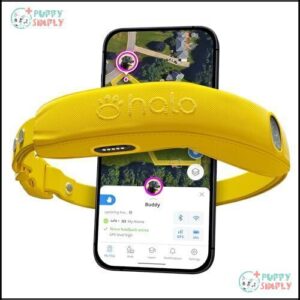
The Halo GPS Dog Fence Collar works differently from most trackers — instead of just following your dog, it actively defines where they’re allowed to go. Using dual-frequency L1/L5 GPS, it draws virtual boundaries on a map and stores them directly on the collar, so the fence stays active even without cell service.
When your dog approaches a boundary, the collar responds with sound, vibration, or optional static correction. Alerts hit your phone immediately through the Halo app.
Battery life runs up to 40 hours per charge. Subscription starts at $9.99 per month.
| Best For | Dog owners who want a wire-free containment solution with real-time tracking and the flexibility to define custom boundaries wherever they go. |
|---|---|
| Product Type | GPS E-Collar |
| Subscription Required | Yes ($9.99/month) |
| App Compatible | iOS & Android |
| Waterproof Rating | Waterproof |
| Battery Life | 40+ hours |
| Primary Use | Containment & Training |
| Additional Features |
|
- Dual-frequency L1/L5 GPS delivers more accurate location data than single-frequency collars, especially in areas with buildings or tree cover
- Virtual fence boundaries are stored on the collar itself, so the containment zones still work even when cell service drops
- 40 hour battery life and waterproof construction make it practical for active dogs and outdoor adventures
- A monthly subscription starting at $9.99 is required just to use the core fence and tracking features
- App lag and delayed fence activation have been reported, which can create inconsistency during training
- Some hardware units have issues with loose screws or tube nuts, and the proprietary magnetic charger means you’re locked into buying replacements from Halo directly
9. Fi Series 3 GPS Dog Collar
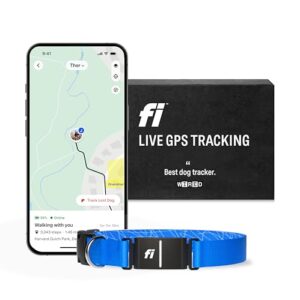
The Fi Series 3 picks up right where the Halo leaves off — but instead of containing your dog, it focuses on finding them fast. It runs on dual-band L1/L5 GPS for a quicker satellite lock, pairs that with LTE cellular coverage, and pushes location updates straight to the Fi app.
Battery life can stretch up to three months in normal use, though live tracking shortens that considerably. Subscription runs $99 per year.
| Best For | Dog owners who want reliable real-time location tracking and peace of mind when their pet escapes or wanders. |
|---|---|
| Product Type | GPS Tracker |
| Subscription Required | Yes (after year 1) |
| App Compatible | iOS & Android |
| Waterproof Rating | IP68 |
| Battery Life | Up to 3 months |
| Primary Use | Location & Health |
| Additional Features |
|
- Built-in LED flash and escape zone alerts make it easy to locate your dog quickly, day or night
- IP68 waterproof rating means it holds up through swimming, rain, and muddy adventures
- Up to 3 months of battery life with simple 10-minute setup and multi-user app access
- GPS accuracy is only within 100–300 feet, and escape alerts can lag up to 45 minutes
- Full features require a paid subscription after the first complimentary year
- Only works in the United States, and the small collar size isn’t ideal for larger dogs
10. Dogtra Pathfinder 2 GPS Collar
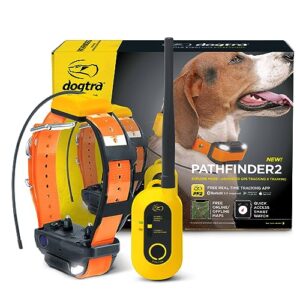
The Dogtra Pathfinder 2 is built for working dogs, but its 9-mile real-time tracking and 2-second update rate make it worth considering for senior dogs with a history of wandering far.
It tracks up to 21 dogs, includes geofence alerts with push notifications, and works offline with downloadable maps.
The IP67-rated, waterproof collar controls outdoor conditions well.
At $365.49, with no mandatory subscription, the upfront cost is steep — but there’s no monthly bill adding up over time.
| Best For | Owners of senior or working dogs that roam far, especially those who want reliable GPS tracking in remote areas without paying a monthly subscription. |
|---|---|
| Product Type | GPS E-Collar |
| Subscription Required | No |
| App Compatible | iOS & Android |
| Waterproof Rating | Waterproof |
| Battery Life | Several days |
| Primary Use | Training & Location |
| Additional Features |
|
- Real-time tracking every 2 seconds across up to 9 miles gives you a precise, near-instant read on where your dog is at all times
- Offline maps and smartwatch control mean you can monitor and correct your dog hands-free, even without cell service
- No subscription fee keeps long-term costs predictable after the initial purchase
- At $365.49 upfront, it’s a significant investment compared to basic GPS trackers
- E-collar corrections are app-based rather than dial-controlled, which can add a small but noticeable delay in response time
- Battery life may require frequent recharging during heavy daily use, which can be inconvenient in the field
Why Senior Dogs Need GPS Trackers

Senior dogs face risks that younger dogs simply don’t — and most of those risks can strike fast, without warning.
A dog with cognitive decline or hearing loss can slip out of the yard and be completely disoriented within minutes.
Here’s a closer look at the specific vulnerabilities that make GPS tracking so important for aging dogs.
Cognitive Decline and Wandering
When a dog’s mind starts to slip, the risks multiply fast. Cognitive decline in senior dogs triggers repetitive path patterns — your dog may pace the same route repeatedly, then suddenly not know how to get back. That’s where a pet GPS tracker steps in, giving you real-time location tracking before wandering turns dangerous.
Cognitive escape triggers include:
- Task-oriented wandering — heading to the garage expecting food or familiar routines that no longer exist
- Sundowner syndrome management failures during evening hours, when nighttime disorientation risks peak
- Geofence boundary crossings triggered by confusion in spaces your dog has known for years
Geofence alerts notify you the instant your dog crosses a set boundary — often the only warning you’ll get.
heat‑map analysis insights help you adjust the environment for your senior dog’s comfort.
Vision or Hearing Loss
Cognitive decline isn’t the only reason a senior dog can lose their way. Sensory decline plays an equally quiet, dangerous role.
| Condition | What It Affects | GPS Benefit |
|---|---|---|
| Cataracts | Depth perception, navigation | Real-time location tracking when dog strays |
| Glaucoma | Full vision loss risk | Instant geofence alert on boundary crossing |
| Presbycusis | High-frequency hearing | Tracks dog who can’t hear you calling |
| Ear infections | Conductive hearing loss | Monitors roaming when commands go unheard |
| Combined loss | Orientation entirely | Continuous pet safety net, day and night |
A dog with cataracts frequently bumps into furniture — senior dog wandering becomes almost inevitable outdoors. Glaucoma pressure can cause sudden, irreversible blindness. Presbycusis, starting around age 13, means your dog simply won’t hear you call. Real-time location tracking fills that gap instantly.
Nighttime Restlessness Risks
Sensory loss sets the stage — but darkness raises the stakes.
Sundowner syndrome flips a senior dog’s internal clock, causing confusion and agitation after dusk. Pacing sessions often run 5–20 minutes and spike past midnight.
- A dog circling the yard at 2 a.m.
- Whining at a gate left ajar
- Vanishing before you notice they’re gone
Geofence alerts catch that window.
Pain-driven Roaming Behavior
Pain doesn’t keep a senior dog still — it moves them.
When chronic joint pain or soft tissue soreness flares, many dogs pace to find relief. Medication cycle roaming is real: restlessness often peaks as pain medication wears off, usually every 8–12 hours. A GPS tracker with real-time tracking catches those patterns before they become escapes.
Exposure Dangers When Lost
Every minute a senior dog spends lost outside is a countdown. Hypothermia risk sets in fast in cold weather — shivering turns to confusion, then slowed movement. Heat exhaustion hits just as hard in summer. Dehydration compounds both. Wildlife predation, entrapment in brush or water — these aren’t remote possibilities.
Every minute a lost senior dog spends outside is a countdown toward hypothermia, heat exhaustion, or worse
Real-time location tracking is what cuts that countdown short.
GPS Features Senior Owners Need

Not every GPS tracker on the market is built with older dogs in mind, so the features you prioritize really do matter. A tracker that works fine for a young, healthy dog might fall short for a senior who wanders at 2 a.m. or can’t find the way back from the backyard.
Here are the five features worth looking for before you buy.
Real-time Location Updates
When your senior dog slips through a gap in the fence, every second counts. The best GPS dog trackers deliver live location updates within 2–5 seconds of capture — fast enough to track a disoriented dog before he wanders further.
Most devices update every 4–5 seconds while your dog is moving, then slow to 30-second intervals once he’s still, protecting battery life without sacrificing awareness.
Instant Geofence Alerts
A geofence is a virtual boundary you draw around your home in the tracker’s app. The moment your senior dog crosses it, alerts fire within 2–5 seconds — reaching your phone before he’s even left the yard.
You can set a simple circular boundary or a custom polygonal shape for irregular properties, keeping precision tight.
Lightweight Collar Attachment
A heavy pet tracking device strains an arthritic neck fast. That’s why device weight under 15 ounces — ideally 43g or less — matters so much for your senior dog.
Look for collars using UHMWPE or nylon-blend webbing, which keeps the pet collar attachment strong without adding bulk. A reinforced D-ring and quick-release buckle (releasing in under half a second) round out a secure, comfortable setup.
Reliable LTE Coverage
LTE cellular GPS beats Bluetooth every time — it doesn’t lose your dog the moment they round the corner. LTE-connected trackers pull location data over the same nationwide cell networks your phone uses, giving you real-time coverage across your neighborhood, rural roads, or parks.
Key coverage factors to keep in mind:
- Lower frequency bands (700–800 MHz) reach farther and penetrate fences, wood-frame homes, and dense shrubs better than higher bands
- Rural dead zones exist where tower density drops — always check your carrier’s coverage map for your specific area
- Urban signal interference from tall buildings or metal structures can cause brief location gaps even on strong networks
- Cold or stormy weather can temporarily weaken signal strength, slowing location refresh rates by a few seconds
Low-battery Notifications
A dead tracker at 2 a.m. is as useful as a paper map in the rain. Low-battery notifications catch that moment before it happens. Most trackers fire an alert when charge drops to 15–20%, delivered as a push notification, SMS, or even an audible collar buzz — whichever your charging routine demands.
GPS, Bluetooth, and Microchips
Not all tracking technologies work the same way, and for senior dogs, those differences really matter. GPS, Bluetooth, and microchips each play a distinct role — and knowing which does what helps you choose the right combination. Here’s how they stack up.
Active Location Tracking

When your senior dog wanders, every second counts.
Real-time location tracking transmits your dog’s position every 1 to 5 seconds directly to your phone, shown as a blinking dot on a live map.
Cellular signal strength affects how reliably that feed updates — weak coverage slows it down. Most trackers let you configure update intervals to stretch battery life when precision matters less.
Find My Network Limits

Apple AirTag relies on the Find My crowdsourced network — nearby iPhones pick up your dog’s tag and relay its location to you. That sounds reassuring, until you realize accuracy depends entirely on how many Apple devices are around. In a quiet suburb at 2 a.m., that network thins out fast.
Three hard limits worth knowing:
- Device count cap: Find My allows up to 32 items per account under iOS 16 or newer.
- No dedicated GPS: AirTag uses Bluetooth proximity tracking, not cellular — so real-time updates aren’t possible.
- Third-party accessory support: Compatible tags appear under the Items tab but still count toward your 32-item limit.
For a senior dog prone to nighttime wandering, passive crowd-based tracking isn’t a safety net — it’s a gamble.
Bluetooth Range Problems
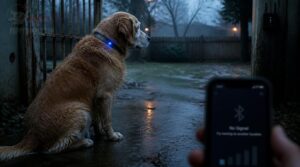
Crowd-sourced tracking has another weak point most owners don’t consider: the signal itself. Bluetooth range tops out around 10–15 meters in open conditions — and that shrinks fast.
Walls, wet bedding, metal surfaces, and even a Wi‑Fi router can cut that distance in half. Cold weather adds another 15 percent reduction.
For a wandering senior dog, that gap closes quickly.
Microchip Identification Only
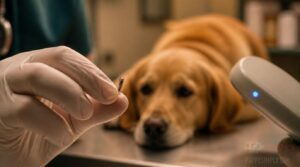
A microchip isn’t a tracker — it’s an ID. Roughly the size of a grain of rice, it uses RFID technology to transmit a 15-digit number when a scanner passes over it. That number links to a registry holding your contact details. No scan, no data. If no shelter or vet checks for a chip, it’s silent.
Why Seniors Need Both

Think of it as a layered protection method: the GPS tracker tells you where your senior dog is, while the microchip tells a stranger who they are.
Cognitive dysfunction can strike fast — a confused dog crosses a street before any alert fires. Real-time location tracking gets you moving immediately.
The microchip closes the loop if a shelter finds them first.
Battery Life and Charging Needs
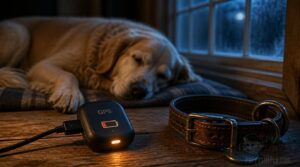
Battery life can make or break a GPS tracker when your senior dog needs round-the-clock monitoring. What manufacturers advertise and what you actually get in daily use are often two very different numbers — and cold nights or frequent location updates can drain a battery faster than you’d expect.
Here’s what you need to know before choosing a tracker and building a charging routine that keeps your dog protected.
Advertised Versus Real Use
Battery specs on the box rarely tell the full story. The Whistle GO Explore advertises 20 days, but most owners see 12–14. The Fi Series 3 claims months of life — realistic only when live GPS stays off.
Five Battery Reality Checks:
- Continuous live tracking can cut runtime to 12 hours
- Frequent updates reduce 7–10 day claims to 2–3 days
- Urban use drains batteries up to 50% faster
- Cold weather shaves another 10–20% off capacity
- Weak cellular signal forces the device to work harder, burning power faster
Live Tracking Battery Drain
When live tracking switches on, the clock starts ticking fast. Real-time location updates push battery drain up 20–40% per hour, depending on how frequently the device pings.
Drop updates from every second to every 30 seconds and you’ll reclaim hours — sometimes a full day — between charges. That single setting adjustment matters more than most owners realize.
Cold Weather Performance
Cold air is harder on GPS trackers than most owners expect. Subzero battery drain can cut usable life by 20–35% compared to normal conditions — meaning a device rated for five days might only last three in a hard freeze.
Here’s what cold weather does to your tracker:
- Battery output drops as cold reduces the cell’s ability to deliver current during rapid location updates.
- Snow signal latency can slightly delay GPS satellite fixes and slow real-time tracking responses.
- Winter geofence delays may occur if snowfall briefly obstructs the signal when your dog crosses a boundary.
- Frost hardware risks include stiffened collar bands and condensation inside seals when moving from cold to warm air.
- Thermal collar comfort matters too — lighter, well-insulated designs keep arthritic seniors comfortable without sacrificing battery stability.
A snug collar fit also helps. Antenna performance improves when the device sits flush against your dog’s neck rather than shifting around under a thick winter coat.
Weekly Charging Routines
Keeping your tracker charged isn’t complicated, but skipping it once too often is how you end up scrambling. Aim for a nightly top-up to 80% rather than a full charge — this simple habit preserves long-term battery health while keeping the device ready every morning.
Backup Tracker Planning
Even the best GPS tracker is useless if it’s dead when you need it. Keep a backup tracker on hand — a budget option like Tractive works perfectly as a spare:
- Never lose your dog during a charging gap
- Stay protected when your primary device fails unexpectedly
- Maintain real-time location tracking without interruption
Sixty seconds of preparation beats sixty hours of searching.
Subscription Costs and Value

Most GPS trackers come with a monthly or annual subscription, and the price difference between plans can add up faster than you’d expect. Knowing what you’re actually paying for — and what you’re giving up if you skip a plan entirely — makes it a lot easier to choose the right tracker for your budget. Here’s a closer look at how the costs break down.
Monthly Plan Comparisons
Not all GPS subscriptions are created equal. Tiered pricing models mean you’ll pay anywhere from $5 to $13 per month depending on how often you need live updates.
Tractive’s premium plan cuts notification latency to under 60 seconds — a meaningful difference when your dog has cognitive dysfunction.
Monthly fees without an annual commitment usually run 30–60% higher.
Annual Plan Savings
Switching from monthly to annual cuts your costs by 10–20 percent. Fi Series 3 drops to $99 per year — roughly $8.25 monthly instead of $12. That’s real money back in your pocket over 12 months.
One thing worth checking before you commit: cancellation terms. Most providers limit refunds after a short grace period, so be sure this tracker is the right fit first.
Cellular Service Requirements
Every GPS tracker on this list runs on LTE cellular networks — not Wi-Fi, not Bluetooth. That means the monthly plan you’re paying for isn’t just software access; it’s the active SIM or eSIM connection that makes real-time location updates possible.
Rural cellular coverage can be thinner, so check your carrier’s map before committing.
No-subscription Tracker Limits
The appeal of a no-subscription pet tracker is real — no monthly costs, no annual commitment. But that saving comes with trade‑offs your senior dog can’t afford.
Most budget options rely on Bluetooth crowdsourcing, which means updates only arrive when a stranger’s compatible device passes nearby. In a quiet neighborhood at midnight, that could mean waiting hours.
Lost-dog Prevention Value
Think about what a missing senior dog costs — not just emotionally, but practically. A pet GPS subscription running $5–$10 a month buys you:
- Real-time location tracking the moment your dog wanders
- Geofence alerts before a situation becomes a crisis
- Path history to trace where he’s been
- Rapid reunification using precise coordinates
Best Trackers by Dog Type

Not every senior dog has the same needs, and the right tracker often comes down to your dog’s size, health, and habits. A tracker that works perfectly for a small city dog might fall short for a large dog roaming acres of rural land.
Here’s how the top options break down by dog type.
Small Senior Dogs
Small breeds — Chihuahuas, Dachshunds, Shih Tzus — often live 12 to 16 years, which means more time to manage sensory decline, weight shifts, and dental disease. A lightweight GPS tracker like the Fi Series 3, at under 1.5 oz, won’t strain a small senior dog’s neck during daily low-impact walks.
| Feature | Why It Matters for Small Seniors |
|---|---|
| Lightweight design | Reduces neck and collar strain |
| Real-time tracking | Catches wandering from sensory decline |
Arthritic Senior Dogs
Arthritis changes how a senior dog moves through the world — and a GPS tracker won’t fix stiff joints, but it catches the pain-driven roaming that often follows.
- Use joint supplements (glucosamine + chondroitin) to reduce discomfort
- Ask your vet about NSAIDs or Adequan for lasting relief
- Try hydrotherapy to maintain muscle without joint stress
- Monitor activity drops with health-tracking collars like Whistle
Rural Senior Dogs
Living miles from the nearest vet changes everything. If your senior dog slips through a fence gap at dusk, you can’t rely on neighbors spotting them quickly.
Tractive XL GPS Dog Tracker gives you real-time location updates every few seconds, so you’re already moving before the trail goes cold — not hours later.
Escape-prone Seniors
Some senior dogs aren’t just wanderers — they’re determined escape artists. Cognitive decline strips away impulse control, so a familiar scent from a favorite walk route can pull them through an open gate before you notice.
Geofence alerts and real-time location tracking give you seconds, not minutes, to respond — and with escape‑prone seniors, that gap is everything.
Health-monitoring Needs
If your senior dog has a chronic condition, health metric tracking changes what GPS can do for you.
Trackers like Whistle Health + GPS monitor sleep patterns, scratching, and licking frequency — flagging shifts that often signal pain before visible symptoms appear. That data gives your vet something concrete to work with, not just your gut feeling.
Setup Tips for Senior Dogs
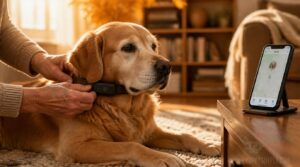
Getting your tracker up and running the right way makes all the difference — especially when your senior dog’s safety depends on it working when it matters most. A few simple steps during setup can save you a lot of stress down the road. Here’s what to do before your dog ever wears the device.
Charge Before First Use
Before anything else, charge your tracker fully — right out of the box. Most devices ship at 40–60% battery, which isn’t enough to establish accurate battery calibration. A complete initial full charge (usually 1–2 hours) helps the device read remaining life correctly from day one.
- Your alerts stay reliable when the battery indicator is accurate
- A calibrated tracker won’t surprise you with unexpected shutdowns
- Low-battery notifications only work if the baseline is set correctly
Keep the device in a cool spot during charging — charging temperature guidelines recommend 32–104°F for safe, efficient results.
Create Home Geofence
Once your tracker is charged, the next step is telling it where home is.
Open your app and set the geofence center point using your property’s GPS coordinates. Then adjust the radius — most apps let you scale in 10-meter increments — to cover your yard without flagging the sidewalk as an escape.
Test Boundary Alerts
Setting the geofence is only half the job.
Walk your dog outside the virtual fence boundary and watch how fast your app responds — under five seconds is the target for LTE connections.
Confirm exit and entry alerts both fire correctly, check that debounce settings prevent duplicate notifications, and verify the app timestamp matches the actual crossing moment.
Add Emergency Contacts
Once boundary alerts are firing correctly, turn your attention to who gets notified when they do.
Open the app’s contacts section and add at least two people — a primary caregiver and a nearby family member or neighbor. Label each one clearly so anyone glancing at the alert screen knows exactly who to call first.
| Contact Role | What to Include |
|---|---|
| Primary Caregiver | Full name, phone number, preferred contact method |
| Backup Contact | Relationship, alternate phone, response instructions |
Each entry should carry a brief note explaining what that person should do if your dog is found wandering. Location sharing settings should be configured so contacts receive a timestamped map link the moment a geofence breach triggers — not a vague notification they have to decode. Get explicit consent from each contact before saving them, and review the list whenever your household changes.
Secure Collar Attachment
After contacts are saved, check how the GPS tracker sits on the collar.
Secure collar attachment matters more for a senior dog than you might expect — a loose device can snag, spin, or fall off entirely.
Look for a rotation lock mechanism and anti-slip inserts that grip the collar material firmly, keeping the unit flush and stable all day.
Safety Habits Beyond GPS

A GPS tracker is a powerful safety net, but it works best when paired with solid habits on the ground. Senior dogs — especially those with cognitive decline or nighttime restlessness — need more than technology watching over them. Here are five practical habits that can keep your dog safer every single day.
Maintain Secure Fencing
A GPS tracker catches your dog after the fence fails — but a solid fence is what keeps that moment from happening at all.
Key fencing priorities for senior dog safety:
- 6-foot minimum height to prevent climbing
- Concrete-set posts to resist ground shift
- Powder-coated or galvanized steel for long-term durability
- Motion-sensor lighting at corners and gate approaches
Check Gates Daily
Gates are the most common escape point for wandering senior dogs — and most failures come down to a latch that wasn’t fully closed.
Check gate latches every morning and evening. Test hinges for looseness, tighten any loose screws, and confirm that electronic sensors respond within two seconds.
Log any irregularities daily so small issues don’t become costly ones.
Use Visible ID Tags
A GPS tracker tells you where your senior dog went — but a visible ID tag tells a stranger who to call.
Engraved metal tags outlast printed ones. Include your phone number and city, use high-contrast lettering, and choose a reflective tag for nighttime visibility. Attach it flat against the collar so it doesn’t flip into fur.
Update Microchip Information
A microchip is useless if the contact details attached to it are outdated. When a shelter scans your senior dog, they see a registration number — what happens next depends entirely on whether your information is current.
Use the AAHA universal lookup tool to confirm which registry holds your chip, then log in and verify:
- Your current address and phone number
- All emergency contacts, including secondary caregivers
- Any medical notes relevant to your dog’s age or condition
After any move or phone change, update immediately. Most registries offer online portals for fast self-service updates and issue a confirmation number you should save.
Monitor Nighttime Pacing
Nighttime pacing is one of the quietest warning signs aging dogs show. Cognitive decline, arthritis pain, or vision and hearing loss can all pull a dog out of sleep and into restless movement. If pacing stretches past 20 minutes on multiple nights, schedule a vet visit — that pattern rarely resolves on its own.
Your GPS tracker makes this easier to catch. Activity logs show exactly how long and how often your dog moved overnight, giving your vet real data instead of guesswork.
Frequently Asked Questions (FAQs)
Can GPS trackers work without a smartphone?
Yes, many GPS trackers work without a smartphone. Standalone units push real-time location data to a web dashboard via cellular or satellite. Some send SMS alerts directly to any phone number.
Are GPS dog trackers waterproof for outdoor use?
Most GPS dog trackers carry an IP67 or IP68 rating, meaning they can handle full submersion up to one meter for 30 minutes — enough for rain, puddles, and short swims without losing signal.
Do trackers work across international or country borders?
Borders are invisible lines — but cellular networks aren’t. Coverage gaps, roaming handoffs, and local privacy laws can delay updates or interrupt tracking entirely. Treat cross-border GPS as supplementary, not standalone.
What happens if the GPS tracker gets damaged?
A damaged tracker can fail to transmit location, trigger false alerts, or lose charge unexpectedly. Check for cracked housing or loose clips regularly. When in doubt, replace it fast.
Conclusion
Like a lighthouse cutting through fog, the right dog GPS trackers for senior dog owners give you something priceless—a way back to your dog when their mind can’t find the way home. Your senior deserves more than hope when a gate swings open.
Pick a tracker that fits their neck, your coverage area, and your budget. Set up the geofence tonight. Because when 2 a.m. comes and they’re gone, minutes are everything.
- https://www.pcmag.com/picks/the-best-pet-trackers-and-gps-dog-collars
- https://people.com/best-dog-gps-trackers-6747320
- https://www.latimes.com/veterinarians/health/diagnostics/story/pet-health-monitoring-devices-gps-wearable
- https://www.nytimes.com/wirecutter/reviews/best-gps-pet-trackers
- https://cadburycommons.com/10-wearable-gps-trackers-for-seniors