
This site is supported by our readers. We may earn a commission, at no cost to you, if you purchase through links.

Your dog sits perfectly, and three seconds later you reach for the treat.
Those three seconds cost you more than you think.
The brain’s dopamine system tags behavior as rewarding only when the reward lands within roughly two seconds of the action—miss that window, and you’ve reinforced whatever your dog did in the gap, not the sit.
Research consistently shows retention rates climb up to 30% when feedback is immediate.
Reward timing in training isn’t a minor technical detail; it’s the mechanism that determines whether your dog learns what you intend or builds a completely different habit without either of you realizing it.
Table Of Contents
- Key Takeaways
- Why Reward Timing Matters
- Best Reward Timing Window
- Rewards, Markers, and Clickers
- Reward Schedules for Better Training
- Common Reward Timing Mistakes
- Frequently Asked Questions (FAQs)
- What is an example of reward training?
- What are the 4 types of reward and punishment?
- What is reward-based training called?
- What is the reward function in AI training?
- How does reward timing differ across dog breeds?
- Can reward timing help with fear-based behaviors?
- How do you time rewards for multi-step commands?
- Does reward timing change as dogs age?
- How does distraction affect optimal reward delivery timing?
- Conclusion
Key Takeaways
- Your dog’s brain only links a behavior to its reward if the treat arrives within two seconds — miss that window, and you’ve reinforced whatever happened last.
- Using a marker (clicker or word) at the exact moment the behavior occurs bridges the gap between action and reward, boosting correct responses by up to 20%.
- Start with rewarding every correct repetition, then shift to intermittent rewards once the behavior is reliable — this makes the habit more durable, not less.
- Common timing mistakes like slow-chewing treats, inconsistent markers, and phasing out rewards too early quietly rewire what your dog thinks it earned.
Why Reward Timing Matters

Timing isn’t just a detail in training — it’s the whole message your dog receives.
A half-second off and your dog learns the wrong thing — which is why nailing that window matters so much when you’re working through basic obedience commands.
A reward that lands even a few seconds late teaches something different than you intended.
Here’s why getting the timing right changes everything about how your dog learns.
Behavior-reward Connection
When a reward arrives at the right moment, your dog’s brain does something incredible. Neurochemical triggers fire instantly, tagging the preceding action as worth repeating. That’s the foundation of operant conditioning — behavior shapes itself around what reliably produces a good outcome.
- Habit formation depends on a clear, consistent behavior-reward link
- Inconsistent timing weakens the connection between action and outcome
- Overnight consolidation locks learned associations into long-term memory
Immediate Reinforcement Benefits
Timing a reward immediately after a desired behavior does more than just feel right — it triggers a dopamine release that chemically tags the action as worth repeating. That burst narrows your dog’s focus onto the exact behavior you want.
Studies show immediate reinforcement boosts retention by up to 30% and accelerates error reduction markedly, locking learning in overnight.
Understanding the immediate reinforcement definition can help trainers apply operant conditioning principles effectively.
Motivation During Training
Dopamine hits from immediate reinforcement don’t just build skills — they fuel the drive to keep going. When your dog succeeds and gets rewarded fast, motivation compounds. Three things keep that momentum strong:
- Clear training goals so your dog knows what "right" looks like
- Visible skill progress that builds confidence through repetition
- Your encouragement — it genuinely raises effort and engagement
Dog Learning Clarity
Your dog isn’t being stubborn — they’re just working with incomplete information. When the reward arrives too late, dog memory can’t stitch the action to the outcome. The result? A confused learner offering random behaviors instead of the right one.
| What Happens | Why It Matters |
|---|---|
| Reward arrives within 2 seconds | Strong behavior-outcome link forms |
| Reward too late by 3+ seconds | Dog associates reward with wrong action |
| Consistent reinforcement timing | Learning curves steepen over sessions |
| Irregular immediate feedback | Autonomous performance drops noticeably |
| Optimized inter-trial intervals | Memory consolidation improves overnight |
Precision reinforcement closes that gap — turning every correct moment into a clear, repeatable lesson.
When done consistently, this approach builds the kind of focus you see in dogs bred for off-leash reliability — where trust replaces the need for a leash.
Best Reward Timing Window
Timing isn’t just important in dog training — it’s everything. Even a two-second gap between your dog’s action and your reward can blur the message you’re trying to send.
Here’s what getting the timing right actually looks like in practice.
Reward Within Two Seconds

Two seconds is your entire window. Once that moment passes, your dog’s brain has already moved on — and so has the learning opportunity.
Reward latency matters neurologically. When you deliver rewards immediately, frontostriatal circuits fire strongly, locking in the behavior-outcome connection. Delay beyond two seconds, and that signal weakens fast.
Keep these timing priorities in mind:
- Short reward delay (≤2 s) improves retention by up to 30%
- High-distraction scenarios demand even faster follow-through
- Age-specific timing matters — puppies need near-instant reinforcement
- Precision training drills require treats already in hand before you begin
Immediate and consistent reinforcement isn’t just good practice — it’s how real learning sticks.
Mark The Exact Behavior
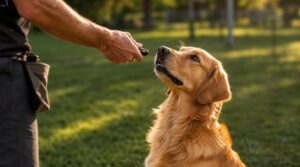
A marker signal does one job: it freezes the exact moment your dog got it right. Whether you use a clicker or a marker word, it must land on the behavior — not after.
Exclusive pairing of the marker with a single action raises correct responses by 20%. Over time, that signal becomes its own reward, building a clear connection your dog can repeat.
Avoid Delayed Reinforcement

Delayed reinforcement doesn’t just slow learning — it quietly rewires what your dog thinks it earned. When the timing of reinforcement slips past two seconds, the behavior you wanted gets misattributed to whatever happened last.
Delayed reinforcement doesn’t just slow learning — it rewires what your dog thinks it earned
- Consolidation loss worsens with delay: a 6-second gap causes significant Day 2 retention drops
- Misattributed rewards reinforce the wrong behavior — the one just before treat delivery
- Interval scaling shows a 60-second delay cuts responding by 71%
- Delay fading techniques gradually shift reward timing closer to the target behavior
Keep your reward timing precision tight. The ideal window is inherently immediate.
Use Fast Treat Delivery
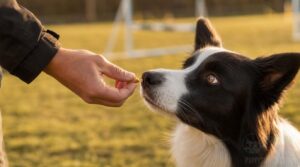
Fast treat delivery starts with handler readiness.
Have your treats accessible before the session begins — not in a bag across the room.
Treat size has a direct impact on the timing of reinforcement.
Small, soft treats get swallowed quickly, keeping your reward timing precision tight and the feedback loop short.
Slow chew time breaks the instant reward connection.
Rewards, Markers, and Clickers

Getting the reward right is only half the job — getting it there at the right moment is what actually teaches. tools you use to mark and deliver that reward matter more than most trainers realize.
Here’s what you need to know about clickers, markers, and timing your praise correctly.
Clicker Timing Basics
The clicker is only useful if it fires at the right instant. Click at the exact moment the behavior happens — not a second before, not after. A click too late marks whatever the dog did next.
Think of it like a camera shutter: you’re capturing one precise frame. Tight clicker-treat sync keeps the feedback loop clean and your dog learning fast.
Marker Word Consistency
Your marker word is only as powerful as your commitment to using it the same way, every time. Pick one word — "yes" is a solid choice — and stick with it across every session, every location, and every handler.
- Use the same word, volume, and delivery each time
- Don’t swap between "yes" and "good" mid-training
- Keep the marker separate from everyday conversation
- Never say it without following through with a reward
Unified markers build reward certainty. Your dog learns that one word means one thing, always.
Treat After Marker
Once your marker lands, the treat must follow immediately.
Reward within two seconds — that window is where the behavior-outcome link forms.
Keep treats in an accessible spot so your hand moves fast.
Consistent delivery from the same location prevents your dog from chasing your movement instead of repeating the behavior you just marked.
Praise as Reinforcement
Treats aren’t your only tool. Verbal praise works as reinforcement when it’s specific, timely, and genuine.
Saying "good sit" right after the behavior lands tells your dog exactly what earned the reward. Match your energy to your dog’s temperament — some respond to enthusiastic cheering, others to a calm "yes."
Praise the effort, not just the outcome.
Prevent Mixed Signals
Mixed signals happen when your marker word changes, your timing drifts, or different family members reward different behaviors.
Use one marker consistently. The signal only works if your dog hears the same sound every time the right behavior lands.
Family training unity matters here — everyone in the house needs to follow the same rules, or your dog learns nothing reliable.
Reward Schedules for Better Training

How you space out rewards matters just as much as when you deliver them. A smart schedule keeps your dog engaged, builds reliability, and eventually frees you from treating every single repetition.
Here’s how to structure your reward timing for lasting results.
Continuous Rewards First
In the early learning phase, reward every correct response. This is the heart of foundation training — your dog needs clear, repeated confirmation that a specific behavior earns the payoff.
Skipping rewards too soon leaves gaps in understanding. A high reinforcement rate accelerates behavior solidification and sets precise criteria before anything changes.
Switch to Intermittent Rewards
Once your dog reliably responds, it’s time to gradually reduce the frequency of rewards. This shift — from continuous to intermittent reinforcement — is where real durability begins.
The partial reinforcement effect means behaviors rewarded sporadically become harder to extinguish. Longer inter-reward intervals build motivation sustainability, keeping your dog engaged without a treat every single time.
Variable Reward Patterns
Variable rewards work because uncertainty itself drives behavior. When your dog can’t predict whether this response earns a treat, every attempt feels worth making.
That’s the engine behind variable ratio schedules — dopamine variability keeps engagement high and consistent across the session, producing steadier response rates than any fixed pattern ever could.
Building Reliable Responses
Reliable responses don’t appear overnight — they’re built layer by layer. Start with criteria progression steps: increase duration before distance, and add distraction only after both feel solid.
- Proof one distraction at a time
- Generalize across locations and handlers
- Use a clear release cue consistently
- Keep one cue paired with one behavior
- Lower criteria immediately after errors
Reducing Treat Dependence
Treats are a starting point, not a permanent crutch. Once your dog responds reliably, begin gradual treat phasing — reward every few correct responses instead of each one.
Pair praise or brief play with the marker so the marker predicts reinforcement broadly, not just food. Environmental rewards like sniff breaks or toy access sustain motivation and support long-term habit formation without constant food.
Common Reward Timing Mistakes

Even experienced trainers fall into timing traps that quietly undo good work. These mistakes are easy to miss because they often feel like the right move in the moment.
Here are the most common ones worth fixing.
Rewarding The Wrong Behavior
The trickiest timing mistake isn’t being slow — it’s rewarding the wrong behavior entirely. Here’s how it happens without you noticing:
- Your dog sits, then shifts weight — you reward the shift
- You give attention when jumping starts
- You mark after the dog moves away from position
Accidental reinforcement locks in whatever happened at reward delivery, not what you intended.
Treats Too Far Away
Where you place the treat matters as much as when you give it. Delivering treats too far away forces your dog to travel before consuming the reward, stretching the gap between behavior and outcome. That distance delay weakens the behavior-reward link.
Keep the treat close — reward right where your dog stands — so the learning signal stays sharp and immediate.
Slow Chewing Treats
A related issue hides in your treat bag. Slow chewing treats — dense chews designed for extended gnawing — can stretch a reward session to five or ten minutes. That delay erases the behavior-reward link almost entirely.
While they support dental health and digestion, save them for downtime, not active training. For training, use small, fast-dissolving treats only.
Inconsistent Marker Timing
Marker timing errors are subtler than slow treats, but the damage runs just as deep.
Inconsistent marker timing means your dog can’t build a reliable cue-reward association — they’re guessing what earned the reward. Even small handler variations, like moving your hand before you mark, teach the dog to watch your body instead of completing the behavior.
Phasing Rewards Too Early
Timing markers consistently are only half the battle. Phasing rewards too early can quietly unravel everything you’ve built.
If you reduce reinforcement before the behavior is stable, your dog doesn’t learn "this behavior pays less now" — they learn that success is unpredictable. That uncertainty triggers payoff uncertainty and opens the door to extinction bursts fast.
Frequently Asked Questions (FAQs)
What is an example of reward training?
A classic example is sit-then-treat training: you ask your dog to sit, and the moment their rear hits the floor, you deliver a reward instantly using positive reinforcement.
What are the 4 types of reward and punishment?
There are four types: positive reinforcement, negative reinforcement, positive punishment, and negative punishment. Each shapes behavioral outcomes differently by either adding or removing stimuli to encourage or reduce specific actions.
What is reward-based training called?
Reward-based training is formally called positive reinforcement training.
Rooted in operant conditioning, it’s also known as clicker training or positive behavior support — all describing the same principle: desired behavior earns a valued reward.
What is the reward function in AI training?
In reinforcement learning, the reward function is a mathematical design that assigns a numerical value to each action, using reward prediction error and temporal difference techniques to align agent behavior with intended goals.
How does reward timing differ across dog breeds?
Not all breeds respond to the same timing window. Inhibitory control and cognitive traits shape how quickly dogs form associations, so some breeds demand faster, more precise reward delivery than others.
Can reward timing help with fear-based behaviors?
Yes. Timing of these rewards matters deeply in fear-based work. When you reward calm behavior immediately, you shift your dog’s emotional state and build predictable safety signals faster.
How do you time rewards for multi-step commands?
Mark each step the instant it’s done. Reward every completed step early on, then shift to rewarding the full chain once each piece is solid.
Does reward timing change as dogs age?
Yes, it does. Cognitive decline slows processing speed in older dogs, making precise timing even more critical.
A slight delay in reward delivery creates more confusion for aging learners than it would for younger ones.
How does distraction affect optimal reward delivery timing?
Distraction compresses your window. When a dog hears a noise mid-behavior, reward timing must tighten — deliver within two seconds or the brain links the reward to the wrong moment.
Conclusion
Your dog is learning every second you train—the irony is that most mistakes happen in the seconds you think don’t matter. That tiny gap between behavior and reward is where clarity either forms or falls apart.
Reward timing in training isn’t about being faster; it’s about being precise where the brain is already listening. Close that window consistently, and you stop accidentally teaching the wrong lesson. The right habit builds itself.
- https://news.cornell.edu/stories/2018/06/its-about-time-immediate-rewards-boost-motivation
- https://pmc.ncbi.nlm.nih.gov/articles/PMC9095742
- https://vcahospitals.com/know-your-pet/using-reinforcement-and-rewards-to-train-your-pet
- https://www.michaelsdogs.com/2026/01/08/myth-busting-clicker-training
- https://www.alansk9academy.com/blogs/the-science-of-timing-why-reward-placement-matters-more-than-treat-quality