This site is supported by our readers. We may earn a commission, at no cost to you, if you purchase through links.

Roughly 40% of dogs show signs of anxiety serious enough to disrupt daily life—and for many of them, a crate isn’t a solution. It becomes the problem. An anxious dog left in a standard wire crate can bend bars, break latches, and injure themselves trying to get out, turning what should feel like a safe space into a panic trap. The right dog crates for anxious dogs work differently. They’re built to contain without confining the spirit—heavy steel, den-like enclosures, and locks that hold even under 60 pounds of desperate pressure. These nine picks change that equation entirely.
Table Of Contents
- Key Takeaways
- 9 Best Dog Crates for Anxious Dogs
- 1. Boldbone Heavy Duty Escape Proof Dog Crate
- 2. Lemberi 48 Inch Heavy Duty Crate
- 3. Oranland 48 Inch Heavy Duty Dog Crate
- 4. Rexwelten Heavy Duty Dog Crate
- 5. Heavy Duty Steel Escape Proof Dog Crate
- 6. Shushim Heavy Duty XL Dog Crate with Wheels
- 7. HMCT Heavy Duty Dog Crate
- 8. Luckup Heavy Duty Dog Kennel
- 9. ONBRILL Heavy Duty Dog Crate
- Key Features for Anxious Dogs
- Choosing The Right Crate Size
- Comfort, Cleaning, and Mobility
- Crating Dogs With Anxiety Safely
- Frequently Asked Questions (FAQs)
- What kind of crate is best for anxious dogs?
- Should you crate an anxious dog?
- What is the 3-3-3 rule for dog anxiety?
- How long should an anxious dog stay crated?
- Can crating make a dogs anxiety worse?
- What age should crate training begin?
- Are certain breeds harder to crate train?
- Should you cover a dog crate at night?
- Conclusion
Key Takeaways
- About 40% of dogs deal with anxiety that’s bad enough to disrupt daily life, and a flimsy crate can make things worse by turning into a panic trap instead of a safe space.
- The best crates for anxious dogs use heavy-gauge steel, dual locking systems, and den-like enclosed designs that help your dog feel sheltered rather than trapped.
- Crate size matters more than most owners realize — too much space can actually spike anxiety, while a snug, properly measured fit gives your dog the secure, cave-like feeling they need to settle.
- Crating only helps if you introduce it slowly, starting with short sessions and building up over days, so your dog links the crate with safety rather than stress.
9 Best Dog Crates for Anxious Dogs
Finding the right crate for an anxious dog isn’t just about size — it’s about giving them a space that feels safe and keeps them secure. Each option below was chosen with escape-proof construction and anxiety relief in mind. Here are nine crates worth a close look.
Understanding how crates support anxious dogs makes it easier to see why the right design matters as much as the right size.
1. Boldbone Heavy Duty Escape Proof Dog Crate
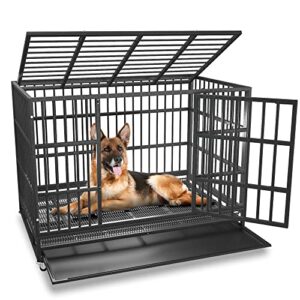
The BOLDBONE Heavy Duty Dog Crate is built for dogs that treat standard crates like a puzzle to solve. Its 20-gauge steel frame with reinforced 0.5-inch tubes holds firm against determined chewers and escape artists. Two independent slide-bolt locks on each door add redundant security, so your dog can’t paw or push their way out. At 58 lb, it’s solid but still rolls on lockable caster wheels for easy repositioning.
- Double slide-bolt latches on every door make it seriously hard to escape, even for dogs that know how to work a latch
- The removable tray and mesh floor make cleanup fast—no need to take the whole thing apart
- Lockable caster wheels let you roll it room to room (or outside) without calling for backup
- At 58 lb, getting it into place the first time is a two-person job
- It’s a big footprint—48 × 31 inches means smaller apartments or tight rooms might be a squeeze
- A few buyers have gotten units with damaged wheels out of the box, so you may need to go through customer service before it’s ready to use
2. Lemberi 48 Inch Heavy Duty Crate
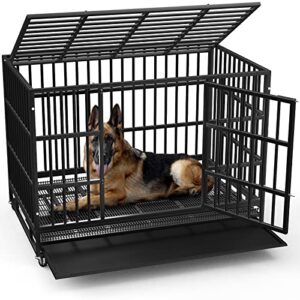
If the BOLDBONE impressed you with its slide-bolt security, the Lemberi 48 Inch Heavy Duty Crate takes a similar approach but adds a few touches that work well for larger dogs. Its 20-gauge steel frame with reinforced tubes resists bending, and the double-latch door system keeps determined escape artists contained. Lockable caster wheels mean you can roll it where you need it, then lock it in place. At 88 lb, it’s a stable, no-nonsense setup for big, anxious breeds.
- Heavy-duty 20-gauge steel with reinforced tubes means strong chewers and determined escape artists aren’t getting out
- The top door is a lifesaver for injured or anxious dogs — no awkward maneuvering through a front opening
- Lockable wheels make repositioning an 80 lb crate manageable without needing to lift it
- At nearly 82 lb, it’s a two-person job to assemble and tricky to move without the wheels engaged
- Very tall large breeds may find the interior a little cramped for standing or turning comfortably
- Some buyers have run into shipping damage on doors or hinges, so inspect it carefully when it arrives
3. Oranland 48 Inch Heavy Duty Dog Crate
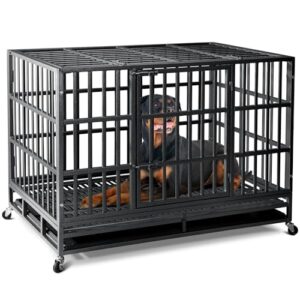
The Oranland 48 Inch Heavy Duty Dog Crate is worth a close look if your dog needs serious containment. Its 20-gauge steel frame supports up to 250 lb, making it one of the roomier options for large breeds. The double-door design gives you flexible access, and lockable caster wheels let you reposition it without a struggle. A removable ABS drainage tray keeps cleanup simple. For anxious dogs who need space without sacrificing security, this crate delivers both.
- Built tough with 20-gauge steel and reinforced piping, so even determined chewers and climbers have a hard time getting out.
- The ABS drainage tray with anti-odor grooves makes cleaning up messes way less of a headache.
- Lockable caster wheels mean you can roll it out of the way without throwing out your back.
- Assembly takes a while and might go smoother with a second set of hands—the baseplate instructions aren’t the clearest.
- Only two of the four wheels lock, which can make it feel a little wobbly on uneven floors.
- At 88 lb, it’s a beast to move without the wheels, and the steel can get noisy when your dog shifts around at night.
4. Rexwelten Heavy Duty Dog Crate
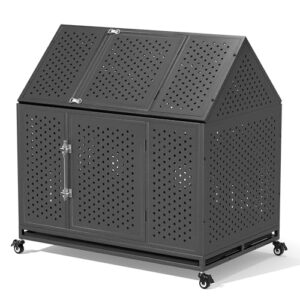
If the Oranland felt sturdy, the Rexwelten Heavy Duty Dog Crate takes the furniture angle seriously. Its sleek black powder coat blends into your living room without screaming ‘dog kennel.’ Inside, the enclosed steel panel design keeps visual stimulation low — a real win for dogs who spiral at every passing shadow. The self-locking latch engages with a firm push, and lockable 360° wheels mean you can roll it room to room without lifting a thing.
- The self-locking latch and solid steel panels make it genuinely hard to break out of, even for determined chewers.
- Lockable 360° wheels make moving it around the house a breeze — no lifting required.
- The removable plastic pan means cleanup after messy nights is quick and painless.
- The bottom metal slats aren’t exactly cozy — you’ll want to throw in a mat or bed.
- It’s big and heavy, so don’t expect to toss it in the car for travel.
- The latch can feel a little clunky until you get used to it.
5. Heavy Duty Steel Escape Proof Dog Crate
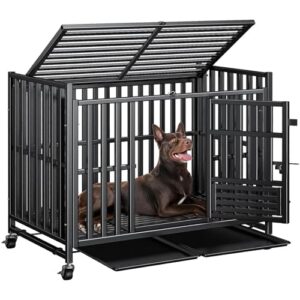
The Heavy Duty Steel Escape Proof Dog Crate is built for dogs who treat ordinary crates like puzzles to solve. Its 92 reinforced steel tubes and 400 lb load capacity make it nearly impossible to bend or break through. The dual sliding latch system sits flush against the frame, so paws and noses can’t find a grip. Three access doors — front, top, and feeding — keep daily routines simple, and two removable waterproof trays mean cleanup takes minutes.
For older dogs especially, the multi-point locking system prevents the door rattling that can startle or stress them — a detail worth exploring alongside other dog crates designed with senior comfort in mind.
- Built like a tank — 92 reinforced steel tubes and a 400 lb capacity mean most dogs aren’t going anywhere.
- Three doors (front, top, feeding) make daily care genuinely easy, especially for dogs in recovery or wearing a cone.
- Lockable swivel wheels let you move it around the house without the hassle of lifting a 53 lb steel crate.
- Hardware quality is hit or miss — some buyers have found missing screws or shaky welds right out of the box.
- The plastic trays feel a bit flimsy for the price and may warp over time.
- If something arrives damaged, return shipping falls on you, which stings when the crate itself is this heavy.
6. Shushim Heavy Duty XL Dog Crate with Wheels
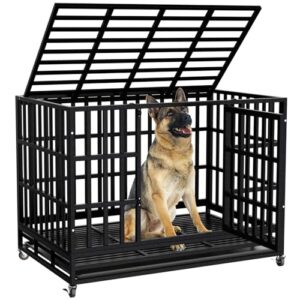
If your dog has ever turned a crate into a chew toy or a lock-picking challenge, the Shushim Heavy Duty XL was built with that dog in mind. Its 20-gauge steel frame with 0.5-inch bar spacing keeps even determined escape artists contained, while the hammered rust-resistant coating manages both indoor and outdoor conditions. Dual safety locks on the door add a reliable second line of defense. The four removable swivel wheels with brakes make repositioning easy, and the pull-out tray simplifies cleanup.
- Seriously tough build — 20-gauge steel and thick 0.5-inch bars make escape attempts pretty much futile
- Dual door locks plus a rust-resistant coating mean it works just as well in the backyard as it does in the living room
- Swivel wheels with brakes and a pull-out tray make moving it around and cleaning up after accidents genuinely easy
- The door only opens one way and sits on the long side — you can’t flip it to fit a tighter space
- It doesn’t fold, so storing it or squeezing it through a narrow doorway means a full teardown
- A few owners found the top latches a bit flimsy for seriously aggressive chewers, so you may want to reinforce them
7. HMCT Heavy Duty Dog Crate
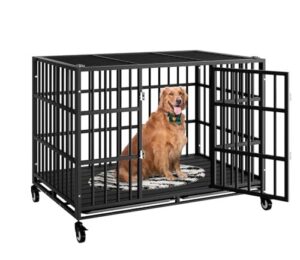
What sets the HMCT Heavy Duty Dog Crate apart is how thoughtfully it’s built for dogs who push back. Its welded steel frame with reinforced corners resists bending, even under sustained pressure from strong chewers. The multi-point door locking system includes a secondary safety latch, so determined dogs can’t pry their way out. Smooth, rounded welds protect skin and fur, while evenly distributed ventilation holes keep air moving. Locking wheels make repositioning simple, and the removable tray cleans up fast.
- Built tough — the heavy-duty steel frame holds up to 400 lb and stands up to dogs that push, chew, or throw themselves at the walls.
- Dual doors (front and top) plus a slide-out tray make daily feeding and cleanup way less of a chore.
- Four locking caster wheels let you roll it wherever you need it, then lock it in place so it stays put.
- The wheels have a reputation for breaking or losing threads earlier than they should — not great for something you’re paying $200 for.
- The latches can feel a little flimsy under serious pressure, so a determined dog might eventually find a weak spot.
- Assembly instructions are diagrams only — no step-by-step text — which can make the build frustrating if you’re not already handy with flat-pack furniture.
8. Luckup Heavy Duty Dog Kennel
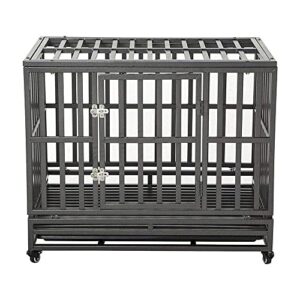
The Luckup Heavy Duty Dog Kennel is built like a small fortress on wheels. Its corrosion-resistant steel frame with welded joints holds firm against persistent chewers and escape artists. Four 360° locking casters let you roll it anywhere, then lock it in place. The slide-out tray makes cleanup quick, and dual doors give easy access. At around 57 lb, it supports medium to large dogs comfortably without feeling flimsy.
- Corrosion-resistant steel frame holds up well against chewing and persistent escape attempts
- Four locking swivel casters make it easy to move around indoors or outside, then stay put when you need it to
- Slide-out trays make cleaning fast without having to drag the whole crate across the room
- At 57 lb, it’s a two-person job to lift or reposition, especially right out of the box
- The latch hardware can bend under serious pressure, so very destructive dogs may need stronger aftermarket locks
- Floor bar gaps are wide enough for small dogs to slip their heads through, and the split tray design doesn’t handle big messes well
9. ONBRILL Heavy Duty Dog Crate
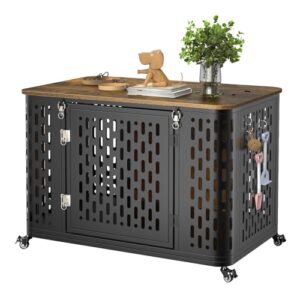
The ONBRILL rounds out this list with welded steel joints that won’t loosen over time — a real win for dogs that test every weak point. It accommodates dogs up to 100 pounds, features padlock-compatible latches, and includes a removable tray for easy cleanup. Rounded corner edges keep curious dogs safe during entry and exit. If your dog is a determined escape artist, the multiple latching points and anti-chew panels give you serious peace of mind.
To get the most out of those safety features, measuring your dog’s crate correctly ensures enough room to move without leaving space to cause trouble.
- The metal mesh and MDF combo holds up well against chewing, and the dual locks on both the top and side give you real peace of mind.
- Lockable caster wheels make it easy to roll around for cleaning or rearranging without wrestling a 55-pound box across the floor.
- The built-in divider is a nice touch — handy if you have two dogs or want to resize the space as a puppy grows.
- Assembly instructions are reportedly unclear, so budget some extra time and patience for setup.
- The locked wheels can still drift on hardwood floors, so you may find yourself nudging it back into place more than you’d like.
- The included cushion is pretty thin and stiff — most owners end up buying a separate dog bed to make it actually comfortable.
Key Features for Anxious Dogs
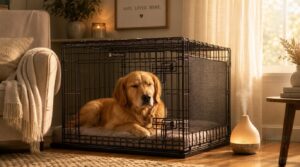
Not every crate will cut it for a dog that’s determined to escape or shut down from stress. The right one has to work on multiple levels — keeping your dog secure while also helping them feel calm enough to settle. Here are the key features worth looking for.
Escape-proof Locking Systems
An anxious dog doesn’t need a flimsy latch — it needs a system designed to hold. The best escape-proof mechanisms combine dual slide-bolt locks, self-locking latches, and paw-proof barriers that stop clever paws from reaching through. Anti-tamper bars, hidden lock tech, and emergency release mechanisms add layers of security. Real containment means every point holds, even under pressure.
- Dual latches require two separate actions to open
- Self-locking latch engages automatically when the door closes
- Anti-tamper bars resist prying and paw manipulation
- Hidden lock tech removes accessible leverage points
- Paw-proof barriers block reach-through escape attempts
Heavy-duty Steel Construction
Locking systems only hold as long as the walls behind them. That’s where 20-gauge reinforced steel earns its place. With weld integrity tested under 10,000 N of downward load, the frame won’t flex when your dog kicks, paws, or rams the door. Corrosion-resistant coatings keep joints solid in humid conditions too — because secure containment starts with metal that simply won’t quit.
Den-like Enclosed Designs
Strong walls do more than stop escapes — they change how your dog feels inside. Den-like enclosed designs mimic a cave’s natural shelter, blocking outside chaos and lowering your dog’s stress response almost immediately. Solid metal panels, privacy cover options, and welded frame construction work together to create that calm, cavelike comfort anxious dogs instinctively crave.
Den-like crates don’t just contain anxious dogs — they calm them by blocking chaos and satisfying the instinct for shelter
Safe Ventilation Holes
Even a calm, enclosed crate needs to breathe. Ideal hole sizes — usually 6 to 8 millimeters in diameter — keep air moving without giving paws or teeth a grip point. Rounded diamond-shaped air holes are especially smart: they support ventilation and airflow while discouraging escape attempts. Edges are smoothed to at least 1.5 millimeters, so curious snouts stay safe.
Chew-resistant Materials
Airflow matters, but so does what your dog does with those edges. Destructive chewers treat crate bars like a chew toy, which is why 20-gauge reinforced steel and aluminum alloy frames — often 62% thicker than standard — hold up. Surface treatments like anodizing add a hard outer layer that teeth simply can’t wear down fast.
Choosing The Right Crate Size
Getting the size right isn’t just about comfort — it’s one of the most important things you can do for an anxious dog. A crate that’s too big can actually make anxiety worse, while one that’s too small creates a whole different problem. Here’s what to know before you pick.
Measure Your Dog Correctly

Getting the size right starts with one simple step: measure your dog first. Stand your dog flat and measure from floor to withers for height, and from neck base to tail base for length. Also measure chest girth behind the front legs. Record everything in inches, noting the date so you can track growth over time. Accurate dog measurements help guarantee a proper fit for crates and accessories.
Large Breed Crate Sizing
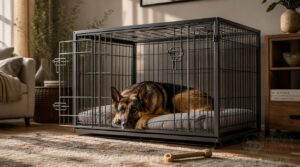
Large dogs need more room than you’d think. A 42 to 48-inch large breed dog crate gives breeds like Labs and German Shepherds proper turning space, shoulder room, and headroom needs. Aim for these fits:
- Length: 1.5x your dog’s nose-to-tail measurement
- Width: 28–30 inches for comfortable bed placement
- Height: 30–39 inches to sit and stand freely
- Door placement: front or side access based on your room layout
For high anxiety dogs, a snug but spacious fit feels safer. Extra large and escape-proof options offer security without cramping.
Puppy Divider Panels

A puppy grows faster than you’d expect, and that’s exactly why an adjustable puppy divider matters. The panel slides into preset locations along the crate bars, shrinking the interior to a snug den, then expanding as your dog grows.
| Crate Size | Recommended Divider Use |
|---|---|
| 24 inch | Newborn to 3 months |
| 30 inch | 3 to 6 months |
| 36 inch | 6 to 12 months |
| 42 inch | 12 to 18 months |
| 48 inch | 18 months and beyond |
Panel material types include coated steel wire and solid metal sheets. Installation requires no tools — just spring clips. A properly sized divider panel facilitates consistent crate training and reduces anxiety naturally.
Avoid Oversized Interiors
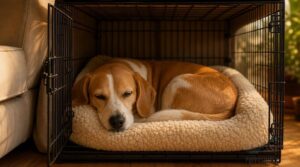
Too much space inside a crate can actually make anxiety worse. When high anxiety dogs have too much room, they lose that snug, den-like feeling that keeps them calm.
- Excess space becomes an escape hazard
- Large interiors create anxiety triggers through overstimulation
- Training obstacles increase when dogs pace or circle
- Cleaning challenges grow with more surface area
- A tight fit builds anxiety relief naturally
Weight Capacity Considerations

Weight isn’t just a number on a spec sheet — it’s a safety line. Reinforce baseplate strength matters most for large dogs that pace, jump, or throw their weight against the walls. Heavy duty metal frames handle that kinetic stress far better than standard wire. Always pick a crate rated at least 1.5 times your dog’s weight.
Comfort, Cleaning, and Mobility
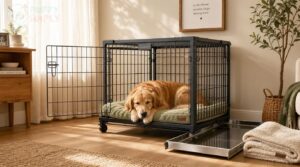
A great crate does more than keep your dog safe — it should also be easy to live with day to day. From rolling wheels to washable trays, the practical details matter just as much as the lock on the door. Here’s what to look for when comfort, cleanup, and portability are part of the picture.
Removable Cleaning Trays
A clean crate is a calmer crate. Removable steel trays slide out in seconds, so you’re not wrestling with the whole unit every time there’s a mess. Most are dishwasher safe, made from stainless steel or impact-resistant plastic that won’t warp or crack. A rimmed lip prevents spills when pulling the tray out, and replacing a worn tray extends your crate’s life without buying a whole new one.
Lockable Rolling Wheels
Moving your crate doesn’t have to mean a wrestling match. Lockable rolling wheels let you reposition even a heavy-duty unit with one hand, then click it firmly in place. The locking mechanism gives an audible snap when engaged, so you’ll know it’s secure. For high anxiety dogs, that stability matters — a shifting crate only adds stress.
Privacy Covers and Panels
Stability helps, but so does what your dog can see — or can’t. A privacy cover wraps three sides of the crate, creating a den-like environment that cuts visual noise fast. Key features worth looking for:
- Dual-sided designs with reversible finishes
- Magnetic latching for quick, rattle-free removal
- Acoustic panel tech that dampens ambient sound
- Customizable finishes to match your home
Furniture-style Crate Designs
What your dog sees matters — but so does what your guests see. Furniture-style crates blend right into your living room, looking like a rustic brown end table rather than a kennel. Many feature hidden storage solutions behind faux drawer fronts for leashes and treats. It’s a genuine dual-purpose design that keeps your home calm and your dog secure.
Travel-friendly Crate Options
Taking your anxious dog on the road is a whole different challenge. A good travel crate stays secure in the car, collapses for compact storage, and meets airline compliance standards when flying. Look for lockable caster wheels, quiet latches for noise reduction, and escape-proof latches that hold firm on bumpy rides.
Crating Dogs With Anxiety Safely

A crate can be one of the kindest things you give an anxious dog — but only when it’s done right. Before you pick a crate off this list, it helps to understand what actually makes crating safe and effective for dogs who struggle with stress. Here’s what every owner should know.
When Crating Helps Anxiety
Crating isn’t punishment — it’s a sanctuary. A den-like environment naturally calms many anxious dogs by reducing overwhelming stimuli. Here’s when it genuinely helps:
- Provides secure containment during thunderstorm anxiety relief
- Aids nighttime anxiety solutions through consistent calming rituals
- Aids puppy anxiety prevention by building early safe-space habits
- Reduces stress during absence with dog anxiety management routines
An escape-proof crate makes that refuge reliable.
Signs of Separation Anxiety
How do you know if your dog has true separation anxiety — or just bad habits? Watch for clingy behavior at home first. If your dog trails you room to room, tenses when you grab your keys, or blocks the door, that’s a red flag. Departure distress, destructive actions, house soiling, and excessive vocalization while alone all signal something deeper than boredom.
Crate Training Gradually
Once you spot those anxiety signs, the next step is a step-by-step intro — not a plunge into the deep end. Start with the crate door open for five to ten minutes. Let your dog explore freely. Then build from there:
- Close the door for one to two minutes while staying nearby
- Increase time by two to five minutes daily as your dog stays calm
- Practice multiple short sessions rather than one long stretch
This gradual routine builds real independence without added stress.
Comfort Toys and Bedding
Think of your dog’s crate as a den, not a cage — and what’s inside it matters just as much as the steel around it. Soft microfiber or fleece bedding gives anxious dogs that cozy, nest-like feel they instinctively crave. Pair it with a weighted comfort toy, which mimics a gentle hug and helps settle nerves during alone time.
When to Seek Help
Sometimes, a crate isn’t enough on its own. If your dog shows persistent symptoms — panic, self-injury, or escalating behavior — it’s time for professional consultation. Watch for:
- Severe distress that won’t settle after weeks
- Safety risks like broken teeth or bleeding
- Separation anxiety disrupting daily eating or rest
A veterinarian or dog behaviorist can help rule out medical causes and recommend behavioral therapy or canine anxiety medication.
Frequently Asked Questions (FAQs)
What kind of crate is best for anxious dogs?
For high anxiety dogs, the best option is an escape-proof, indestructible design with a self-locking latch, den-like enclosure, and solid warranty coverage — features that reduce stress and prevent dangerous escape attempts.
Should you crate an anxious dog?
Yes, but only if done right. Crating an anxious dog can help — or hurt. The key is gradual, positive introduction. Done well, it becomes a genuine safe space.
What is the 3-3-3 rule for dog anxiety?
The 3-3-3 rule maps three phases: 3 days to decompress, 3 weeks to learn routines, and 3 months to build real trust and comfort in their new home.
How long should an anxious dog stay crated?
For anxious dogs, 30 to 60 minutes is a safe starting point. Build up slowly. Most adults can handle 4 to 6 hours, but if your dog shows stress, shorten it.
Can crating make a dogs anxiety worse?
Yes — crating can absolutely make anxiety worse. Confinement stress risks are real: if your dog links the crate with being left alone, it becomes a learned panic trigger, not a safe den.
What age should crate training begin?
Start crate training at eight weeks old — right when your puppy comes home. Short 10–15 minute sessions build comfort early, preventing separation anxiety before it ever takes root.
Are certain breeds harder to crate train?
Some breeds are genuinely harder. Anxiety-prone breeds, herding dogs, and escape artist dogs often resist confinement longer. A dog behaviorist can help tailor crate training methods to your dog’s specific drives and temperament.
Should you cover a dog crate at night?
Yes, covering a crate at night can help. A den-like environment reduces visual stimuli and calms confinement anxiety. Use breathable cotton, leave one side open, and introduce it gradually.
Conclusion
Think of anxiety like a storm inside your dog—wild, loud, and looking for an exit. A flimsy crate doesn’t calm that storm; it just gives it walls to break through. The right dog crates for anxious dogs act like a sturdy shelter: holding steady until the weather passes. Once your dog learns that space means safety, not confinement, everything shifts. That shelter becomes their choice—and that changes everything.
- https://kindtail.com/blogs/kindtail-blog/top-10-indoor-dog-crates-that-blend-comfort-and-home-decor
- https://www.impactdogcrates.com/pages/high-anxiety-crate
- https://rockcreekcrates.com/blogs/news/the-best-crate-for-separation-anxiety-a-complete-guide-for-dog-owners
- https://www.forbes.com/sites/forbes-personal-shopper/article/best-dog-crate
- https://www.nytimes.com/wirecutter/reviews/best-dog-crate