This site is supported by our readers. We may earn a commission, at no cost to you, if you purchase through links.

Most dog owners click too late. That half-second window between the moment your dog does something right and when your thumb finally moves is where training either sticks or slips away. The dog’s brain links the reward to whatever happened most recently, not what you intended to mark.
Clicker timing and rewards work together as a precise cause-and-effect system, and understanding that system changes everything about how fast your dog learns. Get both elements dialed in, and you’ll see behaviors sharpen within a single session.
Table Of Contents
Key Takeaways
- Your click must land within half a second of the behavior, because your dog’s brain links the reward to whatever happened most recently—miss that window and you’re reinforcing the wrong thing.
- Charge the clicker first by pairing the sound with a treat 10–20 times, so the click carries real meaning before you ever ask your dog to learn a behavior.
- Deliver the reward within two seconds of clicking, keep treats pre-portioned and within arm’s reach, and use soft, fast-eating pieces that don’t stall the session.
- Once behaviors are solid, shift to variable reinforcement and rotate non-food rewards like tug, praise, and sniffing opportunities so motivation stays high even as treats become less predictable.
Choose and Load Your Clicker
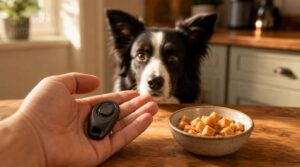
Before your dog learns a single behavior, the clicker itself needs to mean something. Think of it as programming a remote — it doesn’t work until it’s connected to the right signal.
This "charging the clicker" step is the foundation of everything, and best clicker training techniques for dogs can walk you through exactly how to do it right.
Here’s exactly how to set that foundation the right way.
Pick a Clear Marker
Your marker signal is the foundation everything else rests on. Choose a distinct sound — a clicker works best because its sharp, mechanical tone delivers clicker’s precision that verbal cues can’t always match.
Marker clarity depends on volume control: keep it consistent every single repetition.
Marker neutrality matters too, because the clicker functions as a secondary reinforcer only when it carries no emotional charge.
Pair Click Then Treat
Once your clicker carries auditory neutrality, clicker charging begins — and the rule is simple: click then reward immediately, every time. This pairing consistency transforms a neutral sound into a powerful secondary reinforcer through precise marker timing. Understanding the click then treat principle helps maintain clean training practices.
Run 10–20 repetitions, keeping your timing window tight:
- Click first, treat second — never simultaneously
- Use high-value treats your dog won’t ignore
- Keep reward latency under two seconds
- Maintain marker reinforcement across every pairing
- Stay consistent in sequence and speed
Use Pea-Sized Rewards
Treat size directly controls your session length — pea-sized portions support portion consistency and calorie management without filling your dog before the work is done. Soft treats are the best choice for texture selection because they’re consumed in under two seconds, keeping reward timing tight.
Low-value kibble works fine here; storage convenience is also important. Keep pieces pre-portioned and within arm’s reach for smooth treat delivery.
Repeat 10–20 Pairings
Run 10–20 short trials per session, keeping each signal-reward pairing tight and deliberate. Timing consistency checks matter — the handler’s positioning should remain predictable so the dog anchors the click to the reward, not to movement.
Pair the click with "Yes" if needed, but maintain that instant reward window every time.
Progress monitoring metrics are simple: clean, repeated pairings build the association fast.
Watch for Expectant Focus
Once the clicker is loaded, your dog will tell you. Watch for these signals that the signal–reward pairing has taken hold:
- Eye Contact locks onto you the moment the clicker appears
- Body Lean forward replaces hesitation — your dog steps toward the critical window
- Head Turn toward your hand signals attention reset between trials
- Anticipatory Ears perk up, showing engagement and arousal before you even move
Consistent cues and precise click timing make this focus automatic.
Click at The Exact Moment
Timing is everything in clicker training — and a fraction of a second is all it takes to either lock in a behavior or create confusion. Your dog’s brain is constantly making connections, so the click has to land at the exact right moment to build a clear picture.
Practicing this precision with low-stakes activities — like letting your dog freely explore dog puzzle feeders designed for curious, easily bored minds — builds the same calm focus that makes clicker timing click.
In clicker training, a fraction of a second decides whether your dog learns the right behavior or the wrong one
Here’s what you need to know to make every click count.
Mark Within Half a Second

Half a second is your critical window — miss it, and you’ve marked the wrong moment entirely.
Timing Consistency isn’t optional; it’s the non-negotiable variable that determines what your dog actually learns. Auditory Marker Precision means your click lands while the behavior is still happening, not after your dog has shifted weight or glanced away. Latency Measurement confirms that split-second timing builds the clearest behavioral snapshot.
| Click Timing | Learning Outcome |
|---|---|
| Under 0.5 sec | Behavior learned clearly |
| 0.5–1 sec | Associative strength weakens |
| 1–2 sec | Acquisition rate drops |
| Over 2 sec | Wrong behavior reinforced |
| Inconsistent | Confusion, slower retention |
Monitor your Clicker Hand Position — keep it close, relaxed, and ready. Error Correction starts with recognizing drift before it compounds across trials. Click within half a second, every repetition, and precise marker timing does the work for you.
Avoid Late Clicking

Late clicking isn’t a minor slip — it rewires what your dog thinks it earned. When your attention drifts to treat handling, Trainer Eye Contact breaks, and Micro‑Action Filtering collapses, leaving you clicking the wrong moment.
Clicker Readiness and Session Pace Control reduce Cognitive Load Reduction, keeping split‑second timing sharp. Inconsistent timing doubles the number of acquisition trials, so precise marker timing and clicker timing accuracy decide everything.
Practice Timing Drills

Think of timing drills as sharpening a reflex, not rehearsing a routine. Use Reflex Timing Drills like clicking a bouncing ball — millisecond accuracy only comes through deliberate repetition.
Slow‑Motion Cueing lets you isolate the exact target moment before speeding up. Keep Distraction Management tight during short trials, track your Timing Consistency Metrics.
Remember: inconsistent timing is the variable that quietly sabotages everything.
Click Once Per Behavior

One click, one behavior — that is the Single Click Rule, and breaking it costs you Reinforcement Precision. Each click functions as a marker signal that freezes a specific moment; a second click blurs the snapshot.
Micro Behavior Filtering depends on this discipline, as Error Click Avoidance and Clear Criterion Matching only hold when split-second timing is the non-negotiable variable a dog can trust.
Keep Sessions Consistent

Session consistency is the invisible architecture that makes every click land with precision. Without it, your dog isn’t reading your cues — it’s decoding chaos.
- Maintain Session Length and Trial Pacing across every repetition
- Lock in Environment Stability to eliminate confounding variables
- Use identical Cue Consistency — same word, same signal, same position
- Routine Timing anchors your dog’s expectations session to session
- Repeat short pairing sessions because short trials consolidate learning faster
Timing is the non-negotiable variable, and training consistency protects it.
Reward Quickly After Clicking

The click is only half the equation — what happens next seals the deal. Your dog’s brain is waiting for that reward, and a slow delivery breaks the chain you just built.
Here’s what to get right.
Deliver Rewards Immediately
The moment you click, the clock starts — and your dog is already reading you. Reward Flow Optimization begins with Consistent Delivery Motion: same Hand Position Consistency, same arm path, every single time.
Micro-Timing Techniques close the signal-to-reward interval before confusion creeps in. Timing is the non-negotiable variable here. A split-second timing gap and an Immediate Verbal Cue seal click timing accuracy into every repetition.
Prevent Reward Delays
Reward delays quietly undermine your reward system — even a two-second gap shifts your dog’s attention elsewhere.
Proximity positioning keeps you close enough to deliver rewards without scrambling, ensuring immediate reinforcement.
Distraction reduction protects the signal-to-reward interval from environmental noise, maintaining focus on the training cues.
A consistent reinforcement rate locks in predictable timing cues your dog depends on. To achieve this:
- Pre-package rewards before each session
- Maintain split-second timing across repetitions
- Eliminate mid-session searching or fumbling
- Control surroundings to reduce competing stimuli
- Sustain click timing accuracy through a steady delivery rhythm
Keep Treats Ready
Your treat bag is command central — and how you stock it shapes every repetition.
A Pocket Access Design with a Quick-Grab Mechanism eliminates fumbling, ensuring your hand reaches the reward before your dog loses the click’s meaning.
| Setup Element | Training Impact |
|---|---|
| Weatherproof Liners | Keeps high-value treats fresh outdoors |
| Modular Treat Compartments | Separates reward tiers instantly |
| Pre-Portioned Treat Packs | Speeds treat delivery during the loading phase |
| Pocket Access Design | Reduces grab time below one second |
| Quick-Grab Mechanism | Protects your reward system under distraction |
Use Fast-Eating Treats
Fast-eating treats maintain timing because a dog chewing for five seconds breaks the click’s message. Timing is the nonnegotiable variable.
Choose treats with a soft texture and moderate calorie density so they dissolve quickly. This ensures rapid consumption without disrupting training flow.
Flavor selection matters: low-value kibble won’t sustain focus, but high-value food rewards keep dogs engaged. Prioritize palatability to reinforce desired behaviors effectively.
Treat storage preserves freshness, while consistent portion consistency prevents delays during sessions. Both practices eliminate distractions, ensuring seamless reward delivery.
Match Reward to Effort
Not every success deserves the same payoff—that is the core logic behind Effort-Based Scaling. Your reward hierarchy should reflect how hard the dog actually worked, not just whether it succeeded. Apply Difficulty-Weighted Payoffs and Proportional Reinforcement by building Graduated Reward Tiers:
- Simple sits earn a small treat
- Complex stays earn praise plus a toy
- Novel environment tasks earn a jackpot reward
- Outstanding focus earns extended play
Build Non-Food Reward Options

Not every dog goes wild for a treat, and that’s actually good news for your training toolkit. Non-food rewards can be just as powerful — sometimes more so — when you know what makes your dog tick.
Here’s how to figure out what your dog truly values beyond the treat bag.
Test Toys and Play
Not every dog gets excited for food — and that’s where toy-based rewards become your training edge. Run short preference trials across Durable Chew Evaluation, Interactive Tug Trials, Ball Bounce Consistency, Scent Toy Longevity, and Plush Toy Noise options.
Track response speed and body language across 3–5 play sessions. The non-food rewards earning the fastest, most enthusiastic responses become your foundation for play-based reinforcement.
Try Tug or Fetch
Tug and fetch are two of the most powerful toy-based rewards you can build into your sessions. Tug develops bite release control and impulse control through pausing gameplay before the surrender cue. Fetch drives recall strengthening and chase motivation with every clean retrieve.
Rotating both creates a variable reward mix that sustains your dog’s drive without habituation killing momentum.
Add Praise and Petting
Praise and petting are underestimated social rewards that work precisely when applied with intention.
Consistent Praise Tone — short, warm, and identical every session — functions as a reliable secondary marker. Gentle Touch Timing and Petting Intensity Matching determine whether contact reinforces or distracts.
- Use one consistent verbal praise phrase immediately after every click
- Keep brief tactile affection gentle, predictable in location and pressure
- Read Body Language Consent signals: soft posture means continue, avoidance means stop
- Match petting intensity to engagement level, not excitement
Use Sniffing Rewards
Sniffing rewards tap into something your dog is already wired to love. Through Cue-Free Reinforcement, you’re simply capturing what’s natural — no command needed.
Nail Sniff Trigger Timing by clicking the moment the nose contacts your chosen scent placement, then deliver a mini treat size within a second.
Rotate variable surfaces — grass, pavement, dirt — so controlled freedom across environments becomes the reward itself.
Rank Your Dog’s Favorites
Not all rewards are equal — and your dog’s behavior will tell you exactly which ones matter most. Run short preference trials across reward categories to build a clear preference index.
- Treat Preference Test: Note approach speed and acceptance rate across treat types.
- Toy Preference Ranking: Track retrieval speed and sustained engagement.
- Praise vs Petting: Observe orientation response and relaxation rate.
Use Effort Reward Matching to assign your highest-ranked rewards to your hardest behaviors.
Fade Treats Without Losing Motivation
Fading treats doesn’t mean pulling the rug out from under your dog — it means building a reward system strong enough to stand on its own.
The goal is to shift the balance gradually, so motivation stays high even as food becomes less predictable.
Here’s exactly how to do it.
Start With Every Success
Before you fade any treat, lock in the habit of rewarding every correct response first. This is Success Stacking in action — Incremental Shaping built on Positive Momentum, where each Progress Tracking checkpoint reinforces your Behavior Chaining sequence.
Your marker signal and split-second timing anchors the primary rewards, so the reward schedule stays clear. Reliability now makes fading possible later.
Rotate Reward Types
Once every correct response earns a reward consistently, your next move is building a Session Reward Matrix — a deliberate rotation of toy or tug, sniffing opportunities, praise, and treats across repetitions. This Predictability Management strategy breaks the Reward Value Cycle before motivation drops.
Use Adaptive Preference Testing and Motivation Tracking to rotate reward options strategically:
- Switch reward types every few repetitions
- Weave in mixed rewards and non-food rewards
- Track which reward produces fastest re-engagement
- Adjust the variable reward schedule based on response speed
Use Variable Reinforcement
Once your reward rotation is running smoothly, shift into variable reinforcement schedules to lock in lasting motivation. Variable ratio schedules — where your dog cannot predict which repetition earns a reward — build powerful extinction resistance through partial reinforcement. This reward variability creates a motivation boost that keeps response rates high.
Mixed rewards under variable ratio and variable interval patterns make behavior remarkably persistent.
Add Jackpot Rewards
Beyond variable ratio schedules, intermittent jackpot rewards act like benchmark bonuses — unpredictable surges that reset your dog’s motivation entirely. This creates a tiered progression system: outstanding performance triggers an extra-large toy or extended play session, not just another pea-sized treat.
The redemption mechanic, applied selectively through variable reinforcement schedules, drives point accumulation in drive and expands your dog’s market expansion into harder tasks.
Keep Marker Timing Precise
Precise marker timing doesn’t retire when treats thin out — it becomes more critical. As rewards become sparse, split-second timing of the click carries more weight, because your dog can’t afford confusion when reinforcement is scarce.
Millisecond Monitoring, Body Positioning, and Distraction Management all affect clicker precision directly. Avoid late clicking, manage Attention Fatigue with short sessions, and practice Hand Speed Training to keep every mark razor-sharp.
Frequently Asked Questions (FAQs)
Can clicker training work for reactive or anxious dogs?
Yes, clicker training works well for reactive or anxious dogs. The clicker acts as a marker signal for calmness cues, supporting anxiety desensitization and confidence building through consistent positive reinforcement training and stress reduction.
How does marker training differ across dog breeds?
Breed clades influence the speed at which dogs respond to marker signals. German Shepherd lines demonstrate strong extinction resistance, a key factor in their training dynamics.
Asian Spitz breeds, by contrast, exhibit exceptional reversal learning variance, necessitating adjusted timing sensitivity and refined motivation hierarchy strategies to optimize their training outcomes.
When should you switch from a clicker to a verbal marker?
Switch when timing accuracy stays sharp, ensuring precise execution of behaviors.
Switch when marker consistency holds steady, maintaining clear communication with your dog.
Switch when your dog treats the verbal cue with the same reliability it gave the click, confirmed through independent trials at the same distraction level.
Can multiple handlers use the same clicker with one dog?
Multiple handlers can use the same clicker with one dog —
as long as Handler Communication stays consistent, Uniform Rewards are maintained, and each person applies identical Cue Differentiation so the dog never loses Focus Management.
How do you use clicker training for behavior modification?
Clicker counterconditioning, shaping behavior chains, and distraction management all rely on signal-reward pairing and a consistent reinforcement schedule.
Generalization training and progress assessment sharpen results, making marker training a precise behavior modification tool.
Conclusion
Like a master falconer reading the sky before releasing the bird, you now hold the instincts to shape behavior with precision. Clicker timing and rewards aren’t just tools—they’re a language your dog is already wired to understand.
Click at the right moment, deliver the reward without hesitation, and that language becomes fluent quickly. Every session sharpens the connection.
Stay consistent, trust the system. Your dog will meet you exactly where you’re aiming.
- https://www.everydogaustin.org/handouts/clicker-training-101
- https://journal.iaabcfoundation.org/does-clicker-training-lead-to-faster-acquisition-of-behavior-for-dog-owners-it-depends-on-the-behavior/
- https://k9connoisseur.com/blogs/news/clicker-training-for-dogs?srsltid=AfmBOooOIYpHdg_2gMtNSQb6n5lsJ3sdJ2FzhM2fl008Ix_ZDKXkB8g7
- https://www.standingstonekennels.com/dog-blog/3-things-you-need-to-know-about-clicker-training
- https://cloudstar.com/how-to-use-clicker-training-for-effective-dog-communication/