This site is supported by our readers. We may earn a commission, at no cost to you, if you purchase through links.

Most dogs don’t fail obedience training because they’re stubborn—they fail because the feedback comes too late. By the time you say ‘good boy,’ your dog has already moved on to sniffing the grass, and the moment is gone. A clicker changes that. It delivers a precise, consistent signal at the exact instant your dog does something right, creating a clear connection between behavior and reward.
That split-second accuracy is what makes clicker training one of the most effective methods behavioral science has produced. Master the timing, the setup, and the progression, and you’ll see results that feel almost easy.
Table Of Contents
Key Takeaways
- The clicker works because it marks the exact moment your dog gets it right — even a one-second delay breaks the connection between behavior and reward.
- Before teaching any command, charge the clicker with 10–20 rapid click-treat pairs so your dog understands the sound means something good is coming.
- Build new behaviors in layers — capture what your dog already does naturally, shape small steps toward the goal, and only add a verbal cue once the behavior is rock solid.
- Real-world reliability comes from raising distractions gradually, not all at once — start in your backyard, then expand to busier environments as your dog’s focus holds.
Use Clicker Training Step by Step

Clicker training works best when you build it on a few solid habits from the start. Before you ever ask your dog to sit, stay, or come, there are some basics worth getting right.
Understanding the full benefits of clicker training for puppies can help you see why those early habits matter so much.
Here’s what to set up before your first session.
Choose The Right Clicker
Not all clickers are created equal. A small, handheld clicker that fits your palm — ideally 20 to 30 grams — keeps handling comfortable during long sessions. Look for material durability in stainless steel or solid ABS plastic.
If your dog startles easily, a quiet clicker with adjustable pitch works better than a sharp clicking noise.
Price range starts under five euros, so there’s no reason to settle. Consider using a plastic cup target to deliver treats efficiently.
Pick High-value Treats
Once you’ve got your clicker sorted, the treat you pair it with matters just as much. High-value rewards — think small chicken cubes or liver bites — win your dog’s full attention fast. Aroma strength pulls them in, while miniature size keeps training moving. Prioritize protein content, freshness preservation, and portable packaging.
A strong food lure beats a boring biscuit every time.
Train in Quiet Spaces
Your treat game is solid — now set the stage. Where you train matters more than most people realize. Pick a designated area with minimal foot traffic, soft lighting, and sound dampening if possible — a spare room or quiet backyard corner works well.
Minimize distractions early on. A consistent shift routine into that quiet location signals your dog: learning time starts now.
Keep Sessions Short
Your quiet space is set — now protect your dog’s focus with a strict session cap. Short sessions, ideally 5–10 minutes, keep attention gauges in the green. Think bite-size drills over marathon practice.
Timer cues help you stay honest. Quick reset breaks between repetitions let your dog recharge mentally.
A smart training schedule built around brief focus training windows beats one long, exhausting session every time.
End on Success
Always finish while your dog is still winning. That’s the goal of a positive finish routine — end on a behavior your dog knows cold.
Use a success cue routine: lower the difficulty slightly, get one clean repetition, then click, then immediately treat and stop.
This final click pattern, with consistent reward timing, builds momentum carryover into your next session, keeping your dog keen and ready.
Charge The Clicker First
Before any real training begins, you need to charge the clicker — and yes, this step actually matters. Think of it as teaching your dog that the click sound means something good is coming.
Here’s how to do it right.
Click, Then Treat Immediately

The click means nothing until a treat follows — every single time. This is your reinforcement chain in action: click at the right time, then immediately treat.
Pairing that timing with the right clicker techniques for dog recall training — including varied rewards and high-value treats — turns a simple signal into a habit your dog genuinely wants to repeat.
Reward latency matters more than most people realize. Even a two-second delay muddies the message.
- Click, then immediately treat — no pausing
- Keep treat delivery speed fast and consistent
- Precise timing builds cue clarity that your dog can trust
- Timing consistency is what makes the click feel meaningful
Repeat 10 to 20 Times

Run 10 to 20 repetitions back-to-back — that’s your Counting Method for loading the clicker. Maintain a steady tempo so each click-treat pair flows without awkward pauses. Treat delivery speed matters here; slow feeding breaks focus maintenance mid-set.
Think of it as Session Chunking: one focused burst, consistent timing in training, and your dog walks away understanding exactly what that click means.
Hide Treats Before Clicking

Your treat hand gives the secret away before you even click. That’s why hidden treat placement matters — tuck it behind your back or in a pocket, using a consistent hide spot every time.
This stealth hand technique keeps your dog reacting to the sound, not your movement. Click first, then prompt treat delivery follows.
Timing and consistency here build the real association.
Watch for Expectant Responses

After a few click-treat pairs, your dog’s body language will shift — and that’s your clearest signal the association is clicking into place. Watch for these expectant responses:
- Ears perk up after the sound
- Eyes lock onto you with Expectant Eye Contact
- Weight shifts forward — a classic Intent Signal
- Offer Rate increases as the dog actively seeks the reward
That ready stance and pause timing tell you learning through association is working.
Recharge When Needed

Sometimes the clicker loses its power — your dog stops responding with that enthusiastic anticipation. That’s Click Fatigue, and it’s easy to fix. Run a Quick Recharge Routine: 10–20 rapid click-treat pairs, no behavior required. Loading the clicker this way reestablishes it as a conditioned reinforcer through positive reinforcement.
Treat Shortage Pause? Stop the session entirely until you’re restocked.
Mark Behaviors With Precise Timing
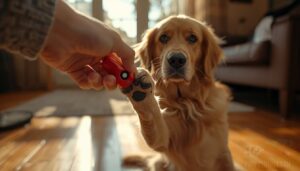
The click only works if it lands at the right moment — not a second before, not a second after. Think of it as a camera shutter: you’re capturing the exact behavior you want your dog to repeat.
Here’s what good timing actually looks like in practice.
Click During The Behavior
Timing is everything — your click needs to land during the behavior, not a beat after. That’s In-Action Marking: the Real-Time Click acts as an Immediate Behavior Mark, capturing the exact moment your dog is doing what you want. Miss it, and you’ve marked the pause instead.
- Click the instant all four paws hit the floor — not after your dog looks up at you.
- Use Momentary Click Precision to freeze the behavior in time, like a snapshot.
- Think of your clicker as a marker, not a cheerleader — one crisp click, one moment.
- For behavior shaping, click mid-movement, while the action is still happening.
- Practice your timing without the dog first — click a bouncing ball at its peak.
Reward After Every Click
Every click must be followed by a treat — no exceptions. That’s the heart of the mark and reward method. Reinforcement Consistency keeps the clicker as a marker your dog can trust.
Use Small Treat Pieces for Rapid Treat Delivery, and click then immediately treat within one second. This ensures your dog associates the click with the reward seamlessly.
Consistent Treat Timing and steady reward timing prevent reward fatigue and keep your dog locked in. This reliability maintains focus and reinforces desired behaviors effectively.
Use Only One Click
Single Click Rule and Click Consistency ensure your dog associates the clicker with one precise action, not a sequence of sounds.
Avoid Click Stacking—extra clicks confuse the signal. The One Marker Principle maintains clarity, preserving Timing Precision.
Click once, then immediately treat. That’s it—clean, clear, done.
Avoid Late Marking
A single clean click means nothing if it lands too late. Keep your eyes on your dog — not your treat pouch — so your hand positioning and eye contact strategy stay ready before the behavior happens.
Run short Timing Drills with easy behaviors to catch late clicks. Precise timing, consistency, and Treat Drop Efficiency create clear communication your dog can actually trust.
Soften Scary Click Sounds
Some dogs flinch at a sharp clicking noise — that’s your cue to adjust, not abandon the method. A quiet clicker or muffle technique keeps positive reinforcement principles intact without losing precision.
- Wrap the clicker in cloth — the muffle technique done right
- Try distance attenuation — click from farther away first
- Follow desensitization steps — progress only when your dog is relaxed
- Check hand positioning — consistent holds reduce sudden sound spikes
Once desensitizing to sound works, the clicker becomes a conditioned reinforcer your dog actually welcomes.
Teach Behaviors Using Clicker Methods

Once your dog knows what the click means, it’s time to build behaviors. There are a few different methods you can use — each one fits a different situation and learning style.
Here’s how each approach works and when to use it.
Capture Natural Good Behaviors
Your dog is already doing the right thing — you just haven’t clicked it yet. Capture good behavior by watching for a spontaneous sit or calm pause, then mark it instantly. This is observational timing at its best. No prompt is needed.
Clicker training thrives on rewarding initiatives your dog offers freely. Spot those behavioral baselines early, practice early cue detection, and let positive reinforcement do the work.
Shape Small Training Steps
Shaping works like building a staircase — one small step at a time. Instead of waiting for perfect behavior, you reward approximations that inch toward your goal. This is Stepwise Shaping in action, and it’s powered by Reinforcement Density: frequent clicks keep momentum alive.
- Start with what your dog already offers — that’s your first rung on the Approximation Ladder.
- Apply a Gradual Criterion Shift, raising your expectations only after 8–10 successful repetitions.
- Drop back a step if progress stalls — Errorless Learning means protecting confidence, not pushing through failure.
Use Food Lures Carefully
A food lure is a shortcut — not a crutch. Use it to help your dog find the right position, then click the moment the behavior happens. Stick to small treats with consistent treat size so rewards are quick and clean.
| Lure Use | What to Avoid |
|---|---|
| Short Lure Sessions | Long lure-guided sequences |
| Limit Lure Visibility | Obvious food in your hand |
| Monitor Lure Dependence | Dog waiting for food, not cue |
Stop using the lure once the behavior is reliable.
Fade Lures Into Signals
Once the lure method works reliably, it’s time to build signal predictability — gradually shrinking the lure into a clean cue.
Follow a Lure Fade Schedule: reduce hand movement step by step, keeping cue shaping consistent and signal specificity tight.
Mistake Management matters here — if your dog stalls, reintroduce the lure slightly, then fade again.
That’s how marker training turns lure-and-reward training into lasting training cues and signals.
Add Verbal Cues Later
Verbal cues come last — not first. Once your dog reliably offers a behavior, say your single cue word ("Sit" or "Look") just before they do it. That’s predictable cue placement in action. Nail your clicker timing, Reinforce every correct response, then start cue fading gradually.
- Use one single cue word per behavior
- Add verbal cues only after mastery
- Keep cue timing tight — cue, then behavior
- Fade the marker word as reliability grows
Practice in Real-Life Situations
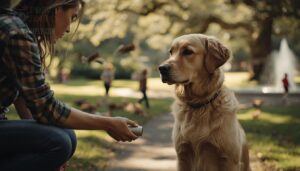
Your dog knows "sit" in the living room — but what about at the park with squirrels nearby? Real life is the final test, and that’s where clicker training either sticks or falls apart.
Real life is the final test where clicker training either sticks or falls apart
Here’s how to take everything you’ve practiced and make it work where it actually matters.
Increase Distractions Gradually
Once your dog nails a behavior at home, it’s time to test it in the real world — but don’t rush straight to the dog park. Start in your fenced backyard with low-level sensory distractions, using distance scaling to stay far from the stimulus.
Build progressive distraction levels slowly, maintaining your reinforcement zone and cue generalization until stimulus control holds across environments.
Use Leash Control Early
Once your pup can handle mild distractions, it’s time to bring the leash into the picture—and early is better. A proper puppy collar fit enables short leash handling without constant yanking. Apply gentle pressure, releasing it the moment your dog yields, to build calm leash cues from day one.
Early walk foundations depend on:
- Consistent attachment points every session
- Short sessions with immediate positive reinforcement
- Pausing when impulse control breaks down, then resuming with training consistency
Reward Calm Focus
Once the leash is doing its job, start clicking for stillness. Observe calm focus through soft posture, reduced pulling, and quiet check-in glances. Use micro-click timing at that exact moment, then follow with a high-value treat.
This reward after click pattern reinforces the desired behavior, not the surrounding chaos. Ensure treats are delivered promptly to strengthen the association.
Gradually build duration progression, staying below your dog’s arousal threshold. This prevents overwhelm and fosters sustained calm focus over time.
Phase Out Constant Clicking
Once your dog responds calmly and reliably, it’s time to phase out the clicker. Gradual click fading works best—reduce click frequency slowly by switching to a variable reinforcement schedule, rewarding every second or third correct response. This method ensures the clicker becomes a conditioned reinforcer less frequently, while your verbal marker gradually takes over.
Confidence-based training means your dog no longer needs constant clicks to perform well. The transition relies on inconsistent rewards to maintain engagement, reinforcing the behavior without dependency on the tool.
Maintain Skills With Rewards
Keeping learned behaviors sharp takes more than occasional practice — it takes a smart reinforcement plan. Reward thinning works well here: scale back treats gradually while still reinforcing accurate responses. Use variable schedules and rotating reinforcers to keep motivation fresh.
Try maintenance check-ins with these reward-based training strategies:
- Deliver high-value rewards after the click for harder tasks
- Run short sessions with intermittent reinforcement
- Shift reinforcement schedules every few weeks
Frequently Asked Questions (FAQs)
Can clicker training work for aggressive dogs?
Yes, clicker training can work for aggressive dogs through positive reinforcement and operant conditioning.
Focus on building an alternative response below the aggression threshold, using controlled exposure, and seeking professional supervision for severe cases.
What age should clicker training start?
You can start clicker training around 8 weeks old. That’s when puppy readiness, attention window, and treat motivation align perfectly.
Older dogs starting works too — operant conditioning doesn’t have an expiration date.
How many treats per session is too many?
Think of treats like a budget — spend too many, and you’re overdrawn. Aim for around 20 small, high-value treats per session to keep your positive reinforcement effective without tipping calorie budgets.
Can multiple family members train the same dog?
Absolutely — multiple family members can train the same dog.
The key is a Unified Training Plan where everyone uses Consistent Commands, a Shared Reward System, and a Turn‑Taking Protocol so no one sends mixed signals.
Does clicker training work for all breeds?
Clicker training works across breeds, but individual results vary. Temperament, food drive, and reinforcer suitability shape the pace.
Match the reward to your dog’s individual motivation, and positive reinforcement delivers.
Conclusion
Clicker training isn’t just a trick up your sleeve—it’s a whole new language between you and your dog. Once you understand how to use clicker training from charge to cue, every click becomes a conversation: clear, honest, and perfectly timed.
The method works because dogs aren’t stubborn—they just need signals they can trust. Give them that consistency, and what once felt like a battle becomes something closer to a partnership.
- https://www.akc.org/expert-advice/training/clicker-training-your-dog-mark-and-reward/
- https://bestfriends.org/pet-care-resources/guide-clicker-training-pets
- https://www.thewillingequine.com/post/clicker-training-starter-tips
- https://www.thelabradorsite.com/5-steps-to-charging-a-clicker/
- https://www.freedompaws.org/freedom-paws-blog/charging-the-clicker