This site is supported by our readers. We may earn a commission, at no cost to you, if you purchase through links.

Most dogs don’t have obedience problems—they have communication problems. They pull on the leash, ignore their name, and jump on guests because no one has clearly explained what earns them good things.
That’s where reward-based obedience training changes everything.
Rooted in the same dopamine-driven learning that shapes human behavior, it teaches your dog exactly which actions pay off.
The results aren’t just a dog who sits on command—they’re a dog who wants to listen.
What follows is a practical, step-by-step breakdown of how to make that happen.
Table Of Contents
Key Takeaways
- Dogs don’t have obedience problems—they have communication problems, and reward-based training closes that gap by making the right choices pay off.
- Timing is everything: mark the correct behavior instantly and deliver the reward within two seconds, or your dog learns the wrong lesson.
- Consistency across cues, rewards, and everyone in the household is what turns occasional compliance into a reliable habit.
- Aversive methods like shock collars suppress behavior through fear, but never teach your dog what to do instead—positive reinforcement builds both skill and trust.
What is Reward-Based Obedience Training?

Reward-based obedience training is built on a simple idea: dogs repeat what works for them. Understanding the core principles behind this approach helps you train smarter and build real trust with your dog. Here’s what you need to know before we get into the step-by-step details.
If you want to see these principles in action, basic dog obedience commands with video guidance can make the learning curve a lot shorter for both you and your dog.
Positive Reinforcement Basics
Think of positive reinforcement as a simple deal: your dog does something right, and you immediately make something good happen. That good thing — a treat, a toy toss, a cheerful "yes!" — triggers a dopamine release in your dog’s brain.
Using a clear continuous reinforcement schedule helps the dog associate each correct action with the reward. That feeling gets linked to the behavior, so your dog thinks, *do that again and good things follow.
*
Negative Punishment Basics
Positive reinforcement gets your dog doing more of what you want. But what stops unwanted behavior without using force? That’s where negative punishment comes in.
Despite the name, there’s nothing harsh about it. It simply means removing access to something your dog wants the moment an unwanted behavior happens.
- Jumping up? You turn away and withhold your greeting.
- Pushing through a door? The door closes.
- Begging at the table? The food disappears.
- Lunging on leash? Forward progress stops immediately.
Timing and consistency matter here. The removal has to happen right after the behavior — and every time — so your dog learns the connection. That predictable loss is what changes behavior.
Pair it with positive reinforcement for a replacement behavior and your dog learns both sides: what loses the reward and what earns it back.
Rewards Versus Aversives
So now you know the two humane tools: adding rewards and removing them. But what about training methods that use discomfort or fear instead?nnRewards versus aversives comes down to this: rewards make behaviors more likely; aversives make them less likely — often through stress.nn| Factor | Reward-Based | Aversive Methods |n|—|—|—|n| Reward Value | Drives enthusiastic participation | Absent or irrelevant |n| Aversive Stress | Minimal | Often elevated cortisol |n| Learning Speed | Faster, clearer | Slower, fear-driven |n| Behavioral Choice | Dog tries freely | Dog avoids or shuts down |nnHumane dog training keeps your dog willing to engage. Aversive methods can suppress behavior temporarily but rarely teach what to do instead — and the emotional cost is real.
Why Dogs Repeat Behaviors
Every behavior your dog repeats has a history of paying off. That’s the core idea behind reward-based training — dogs do what works.
- Rewards delivered close to the behavior strengthen that exact action
- Late rewards accidentally reinforce whatever happened in between
- Attention, even scolding, can accidentally reinforce unwanted behavior
- Repetition across contexts builds habit strength over time
- Boredom and under-stimulation trigger self-rewarding behaviors
Humane Training Principles
Humane training principles come down to one simple idea: your dog should feel safe enough to try. Reward-based training methods work because they replace pressure with clarity.
You set your dog up to succeed, mark the right moment, and reward it fast. Emotional safety isn’t a bonus — it’s the foundation that everything else is built on.
Emotional safety isn’t a bonus in dog training — it’s the foundation everything else is built on
Choose Rewards Your Dog Values
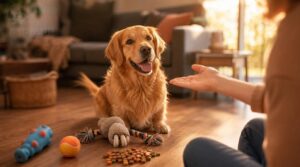
Not every dog goes crazy for the same thing—and that’s actually good news. The key is figuring out what makes your dog light up, then using that to your advantage. Here are the main reward types worth knowing about.
High-Value Food Treats
Not all treats are created equal — and your dog’s nose knows the difference. High-value food treats are your most powerful tool in positive reinforcement training.
Think freeze-dried liver, soft jerky, or small cheese cubes. These grab attention fast, especially around distractions.
Keep pieces tiny, roughly pea-sized, so reward timing stays sharp and your dog never fills up mid-session.
Toys and Play
Some dogs will drop a treat for a game of tug — and that tells you everything about toy selection as a reward.
If your dog goes wild for tug over treats, lean into that — pairing toy rewards with calm mat training techniques for easily frustrated dogs can turn that drive into real focus.
Here are three toy types worth having on hand:
- Tug toys for high-energy bursts after a great recall
- Kong-type toys stuffed with food for calm, focused work
- Squeaky or crinkle toys for sensory-driven dogs who light up at sound
Match the toy to the moment.
Praise and Affection
Your voice is one of the most underrated rewards in your toolkit.
A warm "yes!" or "good dog" — said right as your dog nails the behavior — lands harder than you might expect. Verbal praise timing matters here. Delay it by even three seconds and your dog starts guessing what earned the response.
| Praise Type | Best Moment to Use | What It Signals |
|---|---|---|
| Verbal "yes" or "good" | Exact moment of correct behavior | Marks the behavior clearly |
| Chest or side pat | Immediately after marking | Calm, earned affection |
| Sustained gentle petting | After full task completion | Deepens social bond |
Physical affection cues work best when kept brief and calm. A quick chest pat beats a full-body celebration that spins your dog into chaos. Keep touch controlled so it reinforces — not interrupts — the learning.
Consistent praise delivery also builds trust. When your tone, word choice, and timing stay predictable, your dog learns faster because the signals are clear. That predictability is the backbone of a positive relationship built on reward-based training methods.
Life Rewards
Sometimes the best reward isn’t in your treat pouch — it’s already built into your dog’s day.
Life rewards are everyday experiences your dog genuinely loves: a walk, a sniff session, a game of fetch, or simply getting to greet a friendly stranger. These fit naturally into a reward hierarchy alongside food and toy rewards.
Reward Size and Timing
Size and timing work together — get either wrong and your dog learns slower than they should.
- Treat portion should be pea-sized: small enough to repeat often, big enough to matter
- Variable rewards keep motivation high; mix low-value and high-value treats across sessions
- Delivery window is tight — reward within two seconds of your marker for clear reinforcement timing
Teach Cues Step by Step
Teaching your dog a new cue doesn’t have to be complicated — it just needs to happen in the right order. Each step builds on the last, so your dog always knows what’s expected. Here’s how to introduce cues the right way.
Start With Easy Behaviors

Think of training like building a staircase — start at the bottom step. Before asking for a full sit or stay, simplify the behavior until your dog can succeed on the first try.
Reduce distractions, distance, and duration early on. Reward those first easy attempts immediately, and keep sessions short so your dog finishes while still winning.
Use Clear Hand Signals

Hand signals work best when they’re distinct and consistent. A palm-up gesture means something different from palm-down, and your dog picks up on that quickly. Keep your wrist position steady, face your dog directly, and hold the signal long enough for them to register it — don’t flash it and pull away.
Add Verbal Cues

Once your dog reliably follows a hand signal, that’s your green light to attach a word to it. Say the cue — one time only — just before you present the signal. "Sit." Then lure. This way, the word predicts what’s coming rather than competing with it. Repeating the cue teaches your dog to tune out the first few words and wait for number three.
Use the same word every time. "Sit" can’t also mean "down" or "settle." Pick one word per behavior and stick with it across everyone in the house. Consistency across people matters just as much as your own repetition.
Once the behavior is solid, start fading the hand signal gradually. Give the verbal cue, pause briefly, and let your dog respond on their own before jumping in to help.
Mark The Correct Moment

You’ve got the verbal cue down — now you need a way to tell your dog exactly which moment earned the reward. That’s where a marker comes in.
A marker is a short, sharp signal — a click from a clicker, or a word like "yes" — delivered at the precise instant your dog performs the correct behavior. Timing is everything here. Mark too late, and you’re rewarding whatever your dog did after the behavior, not during it.
Here’s why consistent marker use matters so much:
- It removes all the guesswork for your dog
- It builds a reliable connection between action and reward
- It speeds up learning faster than praise alone
- It keeps your behavior criteria definition clear and honest
- It strengthens the marker reinforcement link every single session
Before you mark anything, decide exactly what you’re rewarding. A sit means hips fully down — not halfway. That marker placement accuracy is what separates a dog who almost sits from one who nails it every time.
Reward Within Two Seconds

Once you’ve marked the moment, the clock starts ticking. Deliver the reward within two seconds — that’s your window. Any longer, and your dog’s brain has already moved on to the next thought.
This two-second window isn’t a guideline — it’s how dog memory works. Tight, consistent timing is what makes reward-based training click.
| Timing | Dog’s Experience | Training Outcome |
|---|---|---|
| Within 2 seconds | Clear cause-and-effect | Faster learning |
| 3–5 seconds | Mild confusion | Slower progress |
| 5+ seconds | No clear connection | Behavior stalls |
Build Reliable Obedience Skills

Once your dog understands how cues work, it’s time to put that knowledge to use with real-life skills. These are the behaviors that actually make day-to-day life easier for both of you. Here’s what to work on first.
Sit, Stay, and Come
Three behaviors form the backbone of obedience: sit, stay, and come.
Teach sit first. Hold a treat near your dog’s nose, then slowly move it back over their head. Their rear naturally lowers. The instant it hits the floor, say "yes" and reward within two seconds. Repeat until it’s solid.
Once sit is reliable, add stay. Show an open palm, say "stay," then step back. Start with just two seconds before marking and rewarding. Gradually increase the duration — don’t rush it.
Come is your safety net. Kneel down, call your dog’s name, say "come," and reward the moment they reach you. Reward every return generously — this cue needs to feel like the best thing that ever happened to them.
Loose-Leash Walking
Loose-leash walking is one of those skills that transforms every walk from a tug-of-war into something you both enjoy.
The goal is simple: keep the leash in a "J" shape — slack, never taut — with your dog walking calmly at your side.
Here’s how to build it:
- Start slow. Begin in a low-distraction space like a hallway. Take just a few calm steps, mark the moment the leash stays slack, and drop the treat by your left foot to reward correct positioning.
- Turn and reset. If your dog forges ahead, turn away and walk in the other direction. When they catch up and fall into position, mark and reward immediately. This teaches them that staying with you pays off.
- Add distractions gradually. Once your dog succeeds indoors, move outside. Match your practice level to the environment — don’t expect heel-perfect walking on a busy street before it’s solid in the backyard.
Consistency matters more than precision. Use the same cue every time, reward generously during early learning, then slowly thin your reward schedule as the behavior strengthens. Positive reinforcement works because it makes the right choice feel worth repeating.
Leave It Training
Leave it" might be the most underrated cue in your dog’s entire skill set.
It teaches your dog one clear rule: ignore that, something better is coming. Whether it’s a chicken bone on the sidewalk or a squirrel darting past, you want your dog to disengage on cue — calmly and reliably.
Here’s how to build it step by step:
- Start controlled. Hold a low-value treat in your closed fist. Let your dog sniff and paw at it. The moment they pause and pull back — even slightly — mark that instant with a click or "yes" and reward with a different, higher-value treat from your other hand. That swap is the whole foundation: ignore this, earn something better.
- Progress to visual targets. Once your dog understands the fist game, place a treat on the floor and cover it with your foot. Say "leave it." The moment they disengage — look away, sit back, glance at you — mark and reward immediately, within one to two seconds. Delay that reward and the lesson blurs.
- Practice controlled drops. Drop a less-desirable treat while your dog watches. If they move toward it, calmly cover it. No scolding needed. When they back off and look at you, that’s your marker moment. Reward with something higher-value from your hand, not from the floor.
| Training Stage | What Your Dog Learns | Reward Used |
|---|---|---|
| Closed fist | Disengagement earns reward | High-value treat from other hand |
| Treat on floor | Visual target = ignore cue | Treat from your hand, not the floor |
| Outdoor temptations | Real-world generalization | High-value treat while passing item |
Generalization is where most training stalls. Dogs don’t automatically transfer "leave it" from your kitchen to the park. You have to practice with different objects — food, toys, wrappers, sticks — in different locations. Change what they see, not just where they stand.
Outdoors, walk your dog past temptations placed along a path. Reward during movement, while they’re successfully ignoring the item. This builds the habit where it counts most: in real life, not just a training session.
As your dog gets consistent, raise the difficulty gradually. Use higher-value temptations. Increase distance. Add movement. Only progress when your dog is succeeding at least eight out of ten reps at the current level. Steady progression beats rushed results every time.
Polite Door Manners
A doorway is a trigger point for almost every dog — the excitement of "outside" takes over before they even realize it.
Door positioning matters from the start. Place your dog to the side of the door path, not directly in front of it. Use a mat or consistent spot so your dog always knows where "here" means.
Threshold boundaries teach your dog that the doorway isn’t a starting gun. Keep the leash short and steady as you open the door. Your dog holds position — front paws behind the line — while you complete the full opening cycle.
Build wait duration gradually. Start with a small crack, reward calm behavior with food, then increase the opening incrementally. Use a clicker or verbal marker the instant your dog holds still rather than surging forward.
Only release with a distinct release cue — something separate from "stay" or "wait." That single word tells your dog the boundary is gone and forward movement is allowed. Deliver it once, clearly.
Leash control here is quiet, not tight. Slack leash signals to your dog that staying calm is exactly right. Tension does the opposite — it cues movement.
Practice Around Distractions
Your dog acing "sit" in the living room means nothing if she falls apart at the park. That gap is where distraction training lives.
- Start where your dog succeeds
- Raise difficulty one small step at a time
- Drop back immediately if she struggles
That’s the success threshold rule — and it works.
Prevent Common Training Mistakes

Even the most well-meaning dog owners fall into a few predictable traps that quietly slow their dog’s progress. The good news is that once you know what to watch for, these mistakes are easy to fix. Here are the most common ones to avoid.
Inconsistent Cue Words
One of the sneakiest training mistakes is using inconsistent cue words.
If you say "sit" today and "sit down" tomorrow for the same behavior, your dog isn’t being stubborn — he’s genuinely confused. Dogs don’t generalize the way we do. To them, different sounds mean different things, so cue meaning mismatch stalls progress fast.
Pick one word per behavior and stick to it.
Rewarding Unwanted Behaviors
Consistent cues matter — but so does watching what you reward without meaning to.
Accidental reinforcement is surprisingly common. Here are three ways it sneaks in:
- Your dog jumps, you push him off — that’s attention as reinforcement.
- He barks at the door, you open it — resource access just rewarded the bark.
- He chews the couch unsupervised — automatic reinforcement needs no reaction from you.
Consequence management fixes this: stop the payoff, redirect to a replacement behavior, then reward that instead.
Treat Dependency Problems
Accidental reinforcement trips up a lot of owners — and so does its close cousin: treat dependency.
If your dog only performs when food is visible, the cue hasn’t truly landed. Fix this with a Treat Fade Schedule — reward every response at first, then gradually thin to every other, then randomly. Unpredictability actually strengthens behavior over time.
Training Sessions Too Long
There’s another trap that’s easy to fall into: sessions that run too long. Dogs have short attention spans, and once focus drops, you’re not really training anymore — you’re just practicing mistakes.
Aim for three to five minutes per session, a few times a day. When your dog stays sharp, every repetition counts.
Punishment-Based Corrections
Punishment-based corrections might seem like a quick fix, but they come with real costs. Methods like shock collar use or harsh leash corrections don’t teach your dog what to do — they just suppress behavior through fear.
Research consistently links aversive methods to increased stress and weaker trust between dog and owner.
Reward-based training simply works better.
Find a Reward-Based Dog Trainer
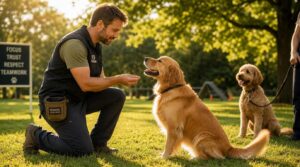
Finding the right trainer makes a huge difference in how fast your dog learns and how much you both enjoy the process. Not every trainer works the same way, so knowing what to look for helps you avoid wasted time and potential setbacks. Here’s what to check before you commit.
Ask About Training Methods
Before you book a single session, ask the trainer directly: "What methods do you use?"
A genuine reward‑based trainer will mention positive reinforcement, markers like clickers or verbal cues, and food or play rewards. They’ll describe short, focused sessions and explain how they track your dog’s progress. If the answer sounds vague or evasive, keep looking.
Avoid Shock Collars
Some trainers still reach for shock collars, but the evidence against them is hard to ignore. They can cause skin burns and pressure sores, and documented cases show tissue damage after only a few shocks.
Beyond the physical risks, dogs often develop fear, stress, and aggression-driven behavior — the opposite of what you’re after.
Reward-based training methods achieve the same results without any of that.
Look for Certifications
Certifications tell you a lot about a trainer before you ever meet them. Look for credentials from recognized bodies like the Association of Professional Dog Trainers, which requires members to use positive reinforcement methods and follow a strict ethics code. Credentials such as CGC certified or specialty designations signal that a trainer meets defined certification standards in professional dog training.
- Confirms commitment to reward-based training methods
- Requires ongoing continuing education to stay current
- Backed by credential verification through public directories
- May include specialty credentials for behavior or puppies
Watch a Class First
Think of a first session observation as a test drive before you sign up. Watch a class first to see how the trainer delivers positive reinforcement in real time — rewards, markers, and all. You’ll quickly know if the training school feels right for your dog.
Choose Humane Equipment
The right gear makes humane training easier.
A no-pull device distributes pressure evenly across your dog’s chest — no neck strain. Pair it with a clicker for precise marking.
If muzzle work is needed, choose a breathable basket muzzle that still allows panting. Skip shock collars entirely.
Good equipment helps your dog; never intimidates them.
Frequently Asked Questions (FAQs)
Can reward-based training work for aggressive dogs?
Yes, reward-based training can absolutely transform even the most reactive dog. By pairing trigger management with replacement behaviors and consistent positive reinforcement, many aggressive dogs learn to stay calm and look to you instead.
At what age should puppy training begin?
Start puppy training at 8 weeks old. That’s when learning begins — short, positive sessions focused on name recognition, basic cues, and gentle handling set the foundation for everything ahead.
How do you train multiple dogs simultaneously?
Like conducting an orchestra, training multiple dogs means one dog performs while the others wait their turn on a mat or tether — calm, settled, and ready.
Does breed affect how quickly dogs learn?
Breed absolutely plays a role. Cognitive breed differences mean some dogs lock onto human cues faster, while others prefer independent problem-solving. Breed reward responsiveness also varies, affecting how quickly a dog connects a behavior to its payoff.
Can older dogs be retrained using positive reinforcement?
Older dogs absolutely can learn new behaviors. Their senior learning curve may be slower, but with positive reinforcement training and age-related reward adjustment, they respond beautifully to patient, consistent practice.
Conclusion
The funny thing about reward-based obedience training is that it’s rarely really about the dog. It’s about you learning to communicate in a language your dog already understands.
Every treat timed right, every cue repeated consistently, every session kept short—these small choices build something bigger than a dog who sits on command. They build trust.
And a dog who trusts you doesn’t just follow instructions. That dog chooses you, every single time.
- https://www.provendogtraining.com/clicker-training-and-marker-based-systems
- https://leerburg.com/markers.htm
- https://bestfriends.org/pet-care-resources/guide-clicker-training-pets
- https://www.humaneworld.org/en/resources/positive-reinforcement-training
- https://wheresithappens.com/2024/01/28/non-food-reinforcers-for-your-dog