This site is supported by our readers. We may earn a commission, at no cost to you, if you purchase through links.
Your dog shredded another couch cushion, and you’re pretty sure it wasn’t out of spite. It was boredom talking. Dogs evolved to hunt, forage, and problem-solve for hours every day, and when that mental itch goes unscratched, chaos moves in.
Here’s the good news: challenging brain games for dogs can flip that switch fast. Studies show puzzle toy users show 42% fewer destructive behaviors than dogs left with nothing to do. That’s not a small dent, that’s a total lifesaver for your furniture and your sanity.
Ready to turn "bored and bad" into "busy and sharp"? Let’s find the right games for your pup’s brain.
Table Of Contents
- Key Takeaways
- Why Challenging Brain Games Matter
- Choosing The Right Brain Game
- Top Brain Games and Puzzle Toys
- PAW5 Dog Snuffle Mat
- 1. Starmark Everlasting Sprocket Large Dog Toy
- 2. Petsta interactive dog puzzle treat dispenser
- 3. Nina Ottosson MultiPuzzle Expert Dog Toy
- 4. StarMark Small Interactive Dog Toy
- 5. ZippyPaws Chipmunk Log Burrow Toy
- 6. Letsmeet Squeaky Snuffle Dog Toy Puzzle
- 7. Hunger for Words Talking Pet Starter Set
- DIY Scent and Search Games
- Advanced Techniques to Challenge Your Dog
- Frequently Asked Questions (FAQs)
- What is the 7 7 7 rule for dogs?
- How to challenge a dog’s mind?
- What is the 3-3-3 rule for dog anxiety?
- What are the signs my dog is bored with a brain game?
- How often should I rotate my dogs puzzle toys?
- How long should a single brain game session last?
- Are brain games safe for dogs with anxiety?
- What if my dog loses interest in puzzles quickly?
- Conclusion
Key Takeaways
- Puzzle toys and brain games significantly reduce destructive behavior, with studies showing puzzle toy users have 42% fewer destructive incidents than dogs with no mental stimulation.
- Choosing the right brain game depends on your dog’s age, size, breed, personality, and any health limitations, so match difficulty and toy type accordingly rather than picking randomly.
- Simple DIY scent and search games, like the Find It game, muffin tin challenges, and cardboard box searches, can tire out a dog’s brain as effectively as long walks using items you already have at home.
- Regular mental enrichment not only curbs boredom-driven chewing, barking, and pacing but also strengthens the bond between you and your dog through shared problem-solving and trust-building.
Why Challenging Brain Games Matter
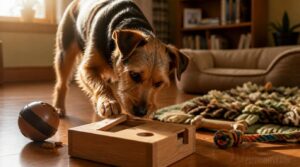
Your dog’s brain needs a job just as much as their body does. Skip that mental work, and you’ll usually see it show up as chewed shoes, dug-up flower beds, or a whole lot of barking. Here’s why brain games matter so much, and what boredom actually looks like in your pup.
Simple scent-and-search challenges can burn off that pent-up mental energy fast — these interactive brain games for puppies are an easy place to start.
Reduces Destructive Behaviors
Chewed couch cushions? Dug-up flower beds? Often it’s boredom talking. Brain games for dogs redirect that energy productively.
- Puzzle toy users show 42% fewer destructive behaviors
- Chew puzzles cut furniture damage by redirecting gnawing urges
- Scent games lower inappropriate chewing by 25%
Mental stimulation isn’t a luxury, it’s stress relief. Regular canine enrichment eases separation anxiety and keeps those jaws busy on toys, not your table legs. Engaging in scent work activities can provide deep satisfaction by activating a dog’s natural foraging instincts.
Slows Senior Cognitive Decline
Old dogs can still learn new tricks, and their brains prove it. Neuroplasticity keeps forming fresh neural connections when challenged regularly.
| Activity | Brain Benefit | Session Length |
|---|---|---|
| Name Game | Memory recall | 5 minutes |
| Scent Work | Olfactory engagement | 5 minutes |
| Puzzle Toys | Cognitive function | 5-15 minutes |
Rotating toys prevents boredom while supporting genuine cognitive decline prevention through consistent mental enrichment—twice daily for best results.
Strengthens Human-canine Bond
Here’s the sweetest part: brain games don’t just tire out that busy mind, they build real trust between you two. Working through a puzzle together sparks shared dopamine spikes, while eye contact during play releases oxytocin in you both.
Solving a puzzle together sparks shared dopamine, while eye contact releases oxytocin in you both, deepening the bond
That’s collaborative problem solving at its finest, and it pays off later—dogs who trust you at home handle vet visits with far less stress.
Signs Your Dog is Bored
Trust is easy to spot when it’s working, but boredom sends signals too, if you know where to look.
Watch for these patterns:
- Destructive chewing on furniture or shoes
- Excessive barking at nothing in particular
- Aimless pacing or circling near doors
- Attention-seeking nudging, or sudden appetite changes
Catching these early means preventing boredom before it turns into real destructive behavior problems—brain games fix this fast.
Choosing The Right Brain Game
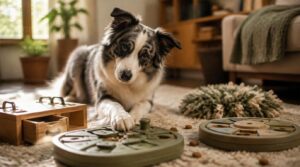
Not every puzzle toy fits every dog, and that’s okay. Before you grab the first shiny gadget you see online, think about who you’re actually shopping for. Here’s what to keep in mind before picking your dog’s next brain game.
Age Considerations
A wobbly 9-week-old puppy and a graying 10-year-old need very different brain games. Puppies build cognitive milestones fast, so short, successful challenges work best. Adults handle novel puzzles well.
Seniors need age-appropriate session length (5-10 minutes), softer surfaces, and scent-based play for sensory loss adaptation—supporting canine cognitive function while easing physical limitations and aiding senior dementia prevention naturally.
Size and Breed
Ever tried squeezing a Chihuahua’s paw onto a puzzle built for a Mastiff? Size-based safety matters as much as brainpower. Small breeds need lightweight, compact toys with tiny compartments; large dogs need sturdy, weighted designs holding at least a cup of kibble.
For a curated lineup matched to your pup’s size and chew style, this guide to the best puzzle toys for dogs by breed size makes shopping a lot less guessy.
Match breed-specific foraging instincts too: scent hounds love snuffle mats, herders chase moving parts, retrievers roll and toss for intelligence training.
Personality Type
Who’s the boss between you and your pup? That answer shapes which brain games actually work.
Confident leader dogs tackle new puzzles head-on—give them tougher challenges. Shy dogs need gradual exposure and a safe retreat option. Independent learners thrive solo with treat-dispensing toys, while social butterflies crave your active participation. Adaptable temperament dogs handle almost anything you introduce, making them perfect for varied cognitive training games and mental enrichment routines.
Health Limitations
A dog with achy joints or fading eyesight still needs enrichment—it just needs smarter enrichment.
For arthritis, skip jumping and choose stationary puzzles or snuffle mats instead. Vision or hearing loss? Scent-based games shine here, since smell doesn’t fade like the other senses. Dogs with cognitive decline benefit from calm, predictable games without sudden movements. Always check with your vet before starting new brain games.
Difficulty Level
Not every puzzle fits every dog, so match the challenge to their skill level.
Beginners need Sequential Problem Solving with just one step—nudge, lift, done. Once mastered, add layers: sliding tiles, hidden compartments, or Memory Retention Tests requiring recall after delays. Watch their Physical Manipulation Skills—if they’re pawing frantically, dial back. Introducing Time Pressure Effects later builds real intellectual challenge without overwhelming a dog still learning the basics.
Top Brain Games and Puzzle Toys
Ready to shop smarter instead of guessing? Below you’ll find eight tried-and-true picks that cover every skill level, from sniffing beginners to puzzle-solving pros. Grab your dog’s favorite treats and let’s find the perfect match.
PAW5 Dog Snuffle Mat
Picture grass your dog can dig through indoors, minus the mud. That’s this nose work mat in short. It comes in multiple sizes and uses non-toxic organic cotton for safe scent-based play.
- Standard: 18×12 inches
- Rainbow: 24.2×11.6 inches
- Wooly: 12×18 inches
- Fully machine washable for easy cleaning convenience
Adjustable foraging difficulty makes it great everyday enrichment.
1. Starmark Everlasting Sprocket Large Dog Toy
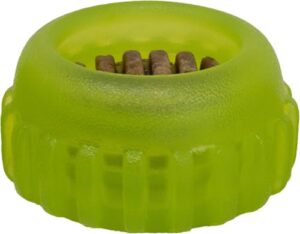
For power chewers who treat every toy like a demolition project, this one’s built to last. The dual-chamber design lets you stuff Everlasting Treats up top and kibble below, so your dog works two different challenges at once.
Made from puncture-resistant TPE, it’s dishwasher safe and freezer-friendly. Textured ridges scrub teeth while your dog gnaws, turning playtime into a dental workout too. Best for dogs over 40 pounds who need something tougher than the average bowl of kibble.
| Best For | This toy is best for large, powerful chewers over 40 pounds who need a durable, long-lasting way to stay mentally and physically engaged. |
|---|---|
| Material | Organic cotton and felt |
| Mental Stimulation | Yes |
| Easy Cleaning | Machine/hand washable |
| Scent | Unscented |
| Target Life Stage | All life stages |
| Boredom Relief | Yes |
| Additional Features |
|
- Dual-level treat system lets you combine kibble and frozen treats for varying difficulty
- Durable plastic construction holds up well against heavy chewing
- Dishwasher safe, making cleanup quick and easy
- Large size means it’s not suitable for small or medium breeds
- Treats and kibble must be manually stuffed each time before use
- Only one chicken flavored treat is included, so refills will be needed
2. Petsta interactive dog puzzle treat dispenser
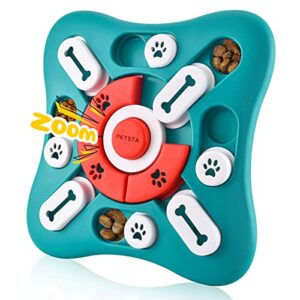
If your pup’s more puzzle-solver than power-chewer, this one’s a nice change of pace. The 16-hole treat dispenser stretches mealtime past 20 minutes, using Spin & Slide and Seek & Hide modes that mix circular and linear sliding challenges.
A built-in squeak button keeps curious noses engaged, and with no removable parts, it’s genuinely safe for solo play. At 10 x 10 x 1.3 inches and dishwasher safe, it’s easy-care and holds a 4.5-star rating across thousands of reviewers.
| Best For | dog and cat owners who want to slow down mealtime and give their pet some mental exercise through puzzle-solving rather than chewing. |
|---|---|
| Material | Plastic |
| Mental Stimulation | Yes |
| Easy Cleaning | Dishwasher safe |
| Scent | Vanilla |
| Target Life Stage | Not specified |
| Boredom Relief | Yes |
| Additional Features |
|
- 16-hole design and two play modes (Spin & Slide, Seek & Hide) keep pets engaged and stretch feeding time past 20 minutes
- Non-removable parts and anti-skid pads make it safe and stable for solo, unsupervised play
- Dishwasher safe polypropylene construction makes cleanup quick and easy
- Not suitable for aggressive chewers, since it’s built for enrichment rather than heavy chewing
- Compact 10 x 10 x 1.3 inch size may limit how much food or treats it can hold at once
- Unscented design means it may not attract pets that respond more to scent-based cues
3. Nina Ottosson MultiPuzzle Expert Dog Toy

Ready to graduate to the big leagues? The Nina Ottosson MultiPuzzle is Level 4 Expert, built for dogs who’ve already mastered Levels 1-3.
Your dog has to slide outer tiles, then spin the center wheel to align orange pieces just right, all to reach 28 hidden compartments. It’s a genuine two-step puzzle, not a one-trick toy.
Made from chew-tough, BPA-free plastic and hand washable, it delivers around 15 minutes of brain-tiring fun equal to a 30-minute walk.
| Best For | Advanced dogs who’ve mastered Levels 1-3 puzzles and need a serious mental challenge to burn off excess energy. |
|---|---|
| Material | Polypropylene |
| Mental Stimulation | Yes |
| Easy Cleaning | Dishwasher safe |
| Scent | Unscented |
| Target Life Stage | Not specified |
| Boredom Relief | Yes |
| Additional Features |
|
- Two-step interactive design (sliding tiles plus a spinning wheel) keeps sharp dogs genuinely engaged
- Delivers mental stimulation equivalent to 30 minutes of physical activity in about 15 minutes of play
- Made from food-safe, BPA-free plastic that’s also hand washable for easy cleanup
- Not suitable for beginner dogs or those who haven’t mastered earlier puzzle levels
- Difficulty must be adjusted manually rather than automatically
- Holds only 1 cup of kibble or treats, which may be limiting for larger dogs or bigger meals
4. StarMark Small Interactive Dog Toy
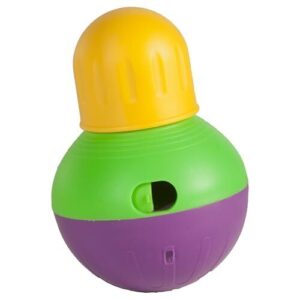
Not every dog needs an expert-level puzzle right out of the gate, and that’s exactly where this toy earns its spot.
Small dogs and beginners get two access points: a screw-off top lid and an adjustable bottom slot. Loosen the gate for easy wins, tighten it once your dog catches on.
At 6.5 inches tall and made from heavy-duty plastic, it stands up to rough play well. Just skip the funnel-free top hole loading (trust me, get a funnel) and expect some floor noise during play.
| Best For | small dogs and puzzle-toy beginners who need an easy entry point into food-dispensing play. |
|---|---|
| Material | Plastic |
| Mental Stimulation | Yes |
| Easy Cleaning | Not specified |
| Scent | Unscented |
| Target Life Stage | Not specified |
| Boredom Relief | Yes |
| Additional Features |
|
- Two adjustable access points let you control difficulty as your dog learns
- Heavy-duty plastic construction holds up to rough, enthusiastic play
- Keeps food-motivated dogs mentally engaged for 15–30 minutes per session
- Small top fill hole is tough to load without a funnel
- Bottom gate can pop open on its own, making the puzzle too easy
- Noisy on hard floors and can’t be fully taken apart for cleaning
5. ZippyPaws Chipmunk Log Burrow Toy
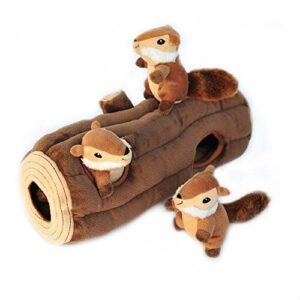
Watch your dog’s nose go into overdrive with this one. Three squeaky chipmunks hide inside an 11x6x6-inch plush log, and your dog digs them out using paws and snout alike.
Built for medium and large breeds, the log’s 100% recycled stuffing holds up surprisingly well against determined diggers.
Once the chipmunks are out, don’t stop there. Stuff the empty log with kibble or peanut butter for round two, it’s basically two toys in one.
| Best For | small and medium breed dogs, from puppies to seniors, who love sniffing out squeaky toys and need a mental workout to fight boredom. |
|---|---|
| Material | Molded plastic |
| Mental Stimulation | Yes |
| Easy Cleaning | Cannot be disassembled |
| Scent | Unscented |
| Target Life Stage | Not specified |
| Boredom Relief | Yes |
| Additional Features |
|
- Three squeaky chipmunk toys hidden inside a plush log make for satisfying hide-and-seek play
- Refillable burrow design means you can restock with new Miniz toys for repeat fun
- Machine-washable fabric keeps cleanup simple
- Not built to withstand extra tough chewers
- Housing needs regular monitoring to make sure it stays intact for refills
- Better suited to small and medium breeds rather than larger, more powerful dogs
6. Letsmeet Squeaky Snuffle Dog Toy Puzzle
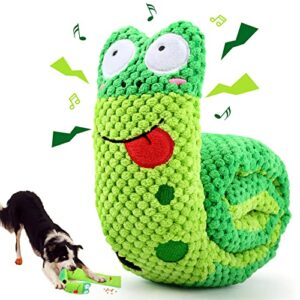
This one’s basically a shapeshifter. Roll it into a snail and Velcro it shut, and your dog has to figure out how to unroll the whole thing before reaching any of the four hidden treat pockets.
Three squeakers plus crinkle paper keep things noisy and interesting throughout. It’s built from soft, water-resistant polyester, machine washable, and light enough (100 grams) for smaller mouths to carry around.
Skip it for aggressive chewers, but for gentle gnawers and puppies, it’s a solid pick.
| Best For | Small to medium-sized dogs (and puppies or gentle chewers) who need mental stimulation through foraging-style play. |
|---|---|
| Material | Plush fabric |
| Mental Stimulation | Yes |
| Easy Cleaning | Machine washable |
| Scent | Unscented |
| Target Life Stage | All life stages |
| Boredom Relief | Yes |
| Additional Features |
|
- Four hidden treat pockets encourage sniffing, foraging, and problem-solving
- Squeakers and crinkle paper add sound and texture for extra engagement
- Lightweight, machine-washable design makes cleanup and carrying easy
- Not suitable for aggressive chewers
- Treat openings may be too small for large treats or biscuits
- Velcro and seams can wear down with heavy or frequent use
7. Hunger for Words Talking Pet Starter Set
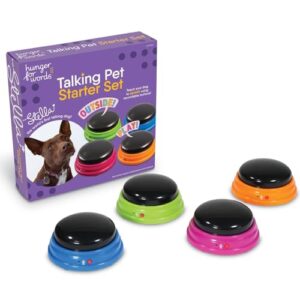
This novel tool skips squeaky toys entirely and teaches your dog to actually talk to you. The starter set gives you four paw-friendly buttons, each recordable with words like "outside" or "play," organized on nonslip hexagonal tiles by category.
Christina Hunger’s teaching guide (created by a real speech pathologist) walks you through modeling techniques, the same method used to teach Stella the famous talking dog.
Communication reduces frustration whining, and buttons are BPA-free, water-resistant, and safe for pups of any age.
| Best For | Dog owners who want to build a deeper communication bond with their pet through a structured, speech therapist-designed training method. |
|---|---|
| Material | Polyester |
| Mental Stimulation | Yes |
| Easy Cleaning | Machine washable |
| Scent | Unscented |
| Target Life Stage | Not specified |
| Boredom Relief | Yes |
| Additional Features |
|
- Includes a clear, step-by-step teaching guide from speech pathologist Christina Hunger
- Customizable recordings let you tailor words like "outside" or "play" to your pet’s needs
- Doubles as a mental stimulation and training tool that supports cognitive development
- Exterior recording buttons are easy for pets to accidentally erase
- Requires frequent battery changes and a screwdriver just to swap them out
- Smaller or lighter pets may struggle to press the buttons firmly enough
DIY Scent and Search Games
Your dog’s nose is thousands of times stronger than yours, so let’s put it to work. These games tap into natural hunting instincts using stuff you already have around the house. Grab some treats and try out these five simple scent challenges.
Find It Game
Dogs experience the world nose-first, so tapping into that sense of smell turns "hide and seek" into serious brain work. Start simple: visible treats in one hand, then hidden ones.
Progress to scent trail paths indoors, dropping bits every few inches. Say "Find It!" consistently, and reward exactly where they find it—precise reward timing builds confidence fast.
Shell Game With Cups
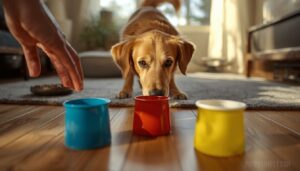
Three plastic cups and a treat—this classic tests problem-solving and scent memory. Use washable, non-toxic cups with wide bases (no tipping hazards).
- Rub treats inside for scent enhancement
- Start with one cup, then progress to three
- Shuffle slowly, increasing speed gradually
- Watch for frustration—pause if needed
- Notice if your dog reads your hands, not just their nose!
Cardboard Box Searches
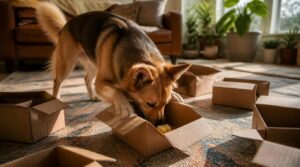
Grab a few empty shoeboxes and watch instinct take over. The right box size matters here—shoebox-sized works for most dogs, though bigger breeds need roomier options. Stick to non-toxic material safety, skip inked recycled cardboard, and add high-value treat selection like cheese in one or two boxes.
Loosely close flaps, supervise closely (managing cardboard ingestion prevents tummy trouble), and remove boxes after 3-5 minutes. This foraging-driven enrichment builds confidence fast!
Muffin Tin Challenge

Boxes tap into foraging, but a muffin tin sharpens scent-tracking. Start beginner: uncovered cups, treats visible. Cover all cups with tennis balls for intermediate scent training. Expert dogs get only 3-5 baited cups, all covered—forcing nose over eyes.
Small breeds use mini tins; large dogs get standard size. Choose non-breakable covers larger than your dog’s mouth, and supervise closely.
Hot and Cold Game
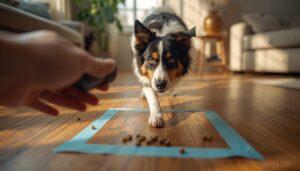
Trade tennis balls for a clicker, and you’ve got a whole new challenge. Set a 3-foot by 3-foot target zone on the floor, click the instant your dog moves toward it, stay silent otherwise.
Through successive approximation, dogs piece together the behavior step by step. Fifteen minutes of this mental stimulation can tire a dog out like a 15-mile run.
Advanced Techniques to Challenge Your Dog
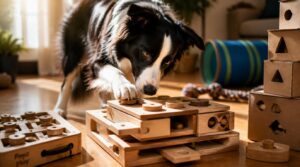
Once your dog has mastered the basics, it’s time to raise the bar. Ready for the good stuff? Here are a few tried-and-true ways to level up the challenge.
Applying The 7-7-7 Rule
Ever wonder why your dog seems fine one week and suddenly "himself" the next? That’s the 7-7-7 rule at work: 7 days for decompression, 7 weeks for routine, 7 months for full settling.
- Watching your dog finally relax
- Seeing their real personality emerge
- Building trust through patience
- Celebrating small daily wins
Layer brain games in gradually—simple puzzles first, tougher challenges as confidence grows. Trauma histories may need extra time.
DIY Agility Obstacles
Once your dog settles into routine, a backyard agility training setup gives their brain and body a real job to do.
Build PVC jumps with cups set 8 inches from the ground, space weave poles 24 inches apart, and anchor any tunnel with gravel-filled bags for safety.
| Obstacle | DIY Material | Setup Tip |
|---|---|---|
| Jump | PVC pipe, T-joints | Add sandbags for wind |
| Weave | 38-inch PVC | Space 60cm apart |
| Contact | Wood plank | Add rubber matting for grip |
Increasing Puzzle Difficulty Gradually
Mastering difficulty tiers means resisting the urge to rush. Track completion speed daily; once your dog solves a puzzle in under a minute for three days straight, bump it up.
Watch for frustration signals like pawing wildly or walking away. Consider nose vs paw preference and adjust food texture complexity (peanut butter to frozen fillings) as skills sharpen—usually 3-7 days per level.
Combining Scent and Food Games
Pair a nose work mat with hidden kibble to double the challenge—your dog’s brain lights up when olfactory motor engagement meets food rewards. This scent-based play builds real scent discrimination training skills over time.
Start indoors, then test a scent trail outside for environmental scent adaptation. This multi-sensory reinforcement combo delivers genuine stress reduction benefits, with sessions lasting up to 25 minutes of pure olfactory stimulation.
Frequently Asked Questions (FAQs)
What is the 7 7 7 rule for dogs?
Slow and steady wins the race, and that’s the heart of the 7-7-7 rule: seven surfaces, seven people types, seven sounds, and seven locations, spread across three adjustment phases, to build confident, well-socialized dogs from puppyhood through rescue transitions.
How to challenge a dog’s mind?
Mix it up: rotate puzzle toys, scent trails, and DIY brain games weekly. Combine sensory enrichment with problem-solving challenges so your pup taps different cognitive skills—this variety prevents boredom and delivers genuine mental fatigue, leaving them satisfied, not just physically tired.
What is the 3-3-3 rule for dog anxiety?
Think of it as 3 days to decompress, 3 weeks to settle into routines, and 3 months to build real trust. This adjustment timeline sets realistic expectations, helping you support trauma recovery and spot behavioral milestones instead of panicking over normal anxiety.
What are the signs my dog is bored with a brain game?
Boredom leaves clues like breadcrumbs. Watch for destructive chewing habits, repetitive pacing, or reduced food interest—these signal your pup’s checked out mentally.
Loss of curiosity and learned helplessness (giving up fast) mean it’s time to boost enrichment and mental stimulation with fresh, engaging puzzle toys.
How often should I rotate my dogs puzzle toys?
Weekly rotation works for most power chewers; moderate chewers do fine every 1-2 weeks. Watch boredom signs, not just the calendar. Keep 3-5 toys active, storing extras to preserve novelty and manage enrichment excitement long-term.
How long should a single brain game session last?
Shorter can mean smarter: a two-minute puzzle sometimes beats a twenty-minute one. Match duration to age—puppies get 1-5 minutes, adults 5-10, seniors under Stop while your dog’s still engaged, not after fatigue signs like yawning or gaze-avoidance appear.
Are brain games safe for dogs with anxiety?
Yes, with the right approach. Choose calming enrichment like lick mats or gentle scent games over complex puzzles, keep sessions short, and watch for anxiety distress signals like lip-licking or trembling—stopping before overstimulation builds, while rewarding small wins to boost confidence.
What if my dog loses interest in puzzles quickly?
Fast solving speed doesn’t mean failure—smart breeds just need more steps sooner. Try toy rotation every 2-3 days, adjust timing engagement around mealtimes, and match difficulty to your dog’s motivation levels for lasting mental stimulation.
Conclusion
Picture Bailey, a lab mix who once ate a doorframe out of pure boredom, now spending happy hours nosing through a snuffle mat instead. That’s the power of challenging brain games for dogs: they turn restless energy into focused joy.
Start small, stay consistent, and watch your dog’s confidence bloom. You’re not just saving furniture, you’re building trust, one puzzle at a time.
Give your pup’s brain the workout it craves, and watch chaos become calm.
- https://hardypaw.com/collections/dog-slow-puzzle-feeders
- https://farmtopettreats.com/blogs/word-on-the-treats/what-are-enrichment-mats-and-how-to-choose-the-right-one
- https://shopyomp.com/blogs/magazine/the-science-behind-slow-feeders-how-they-improve-your-dog-s-eating-habits
- https://houndstone.com/blogs/news/the-benefits-of-nose-work-toys-for-dogs
- https://www.bluecross.org.uk/advice/dog/behaviour-and-training/scent-work-for-dogs