
This site is supported by our readers. We may earn a commission, at no cost to you, if you purchase through links.
Most dog food bags are designed to be bought, not understood. Bright packaging, words like "premium" and "natural," and a golden retriever mid-leap—none of it tells you whether what’s inside will actually nourish your dog. The label that matters is the small print: the nutritional adequacy statement, the guaranteed analysis panel, and the ingredient list.
Knowing what to look for in dry dog food separates a genuinely balanced diet from clever marketing. The criteria aren’t complicated once you know where to look—and your dog’s long-term health depends on getting this right.
Table Of Contents
- Key Takeaways
- Check Nutritional Adequacy First
- Read The Ingredient Label
- Choose a Named Animal Protein as The First Ingredient
- Look at The First Five Ingredients
- Prefer Specific Fat Sources Like Chicken Fat or Salmon Oil
- Look for Omega-3 and Omega-6 Fatty Acids
- Choose Digestible Carbohydrates Like Oats or Brown Rice
- Look for Prebiotics, Fiber, Fruits, and Vegetables
- Avoid Artificial Colors, Flavors, and Preservatives
- Avoid Ingredient Splitting on Dog Food Labels
- Match Food to Your Dog
- Choose Puppy Kibble With DHA for Development
- Pick Adult Formulas for Maintenance and Balanced Energy
- Consider Senior Formulas for Weight and Joint Support
- Choose High-protein, Higher-fat Food for Active Dogs
- Use Weight-management Kibble for Overweight Dogs
- Consider Sensitive Stomach or Hypoallergenic Formulas
- Compare Grain-inclusive and Grain-free Diets Carefully
- Ask Your Veterinarian About Allergies or Health Conditions
- Top 5 Dry Dog Food Options
- Frequently Asked Questions (FAQs)
- Conclusion
Key Takeaways
- Before scanning ingredients, confirm the label says "complete and balanced" with an AAFCO reference—this one phrase tells you the food is designed as a full diet, not just a supplement.
- A named animal protein (chicken, beef, salmon) should anchor the first ingredient, and the first five together act as a nutritional fingerprint for what your dog is actually eating.
- Life stage matters more than marketing—puppy, adult, senior, and active-dog formulas differ meaningfully in protein, fat, and calorie density, and choosing the wrong one can quietly undermine your dog’s health over time.
- Avoid artificial preservatives like BHA and BHT, watch for ingredient splitting that disguises filler dominance, and favor named fat sources like chicken fat or salmon oil over vague terms like "animal fat.
Check Nutritional Adequacy First
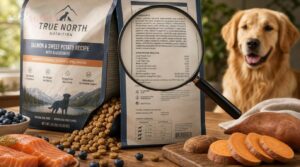
Before you even glance at the ingredient list, the nutritional adequacy statement tells you whether a food is worth your time.
Once you’ve confirmed nutritional adequacy, cross-referencing a solid dog food ingredients guide helps you decode what’s actually inside the bag.
It’s the fastest way to filter out products that won’t actually support your dog’s health long-term. Here’s what to check before anything else.
Look for “complete and Balanced” on The Label
Before anything else, flip the bag over and find the nutritional adequacy statement — that’s where complete and balanced must appear. It must comply with an AAFCO nutrient profile or feeding trial to earn the label. This regulatory claim means the food is designed as your dog’s sole diet, not a supplement, signaling nutrient balance rather than premium quality.
Look for:
- The exact phrase "complete and balanced"
- A matching life stage
- The AAFCO reference
- A guaranteed analysis panel
Confirm The Food Meets AAFCO Standards
Once you spot "complete and balanced," check how the brand substantiated that claim. AAFCO standards compliance happens in two ways: a nutrient profile comparison or an AAFCO feeding test. Both are legitimate, but feeding trials demonstrate real-world performance.
The guaranteed analysis limits on the label confirm that nutrient ranges align with the AAFCO nutrient profile. This ensures transparency in nutritional adequacy.
Ingredient naming compliance prevents vagueness, ensuring no hidden components behind ambiguous terms. This upholds clarity and trust in the product’s formulation.
Choose Adult, Puppy, Senior, or All-life-stages Formulas Correctly
Life stage nutrition isn’t one-size-fits-all. Puppy growth nutrition demands higher caloric density to fuel rapid development, while adult formulas prioritize steady maintenance.
The timing of these changes also matters—large breeds often require breed size matching to avoid orthopedic issues. Senior dog nutrition typically reduces calories for less active dogs, addressing their slower metabolism.
Pairing with health conditions and growth rate guidance ensures the chosen AAFCO nutrient profile actually fits your dog’s needs.
Check Crude Protein Levels for Your Dog’s Life Stage
Once you’ve matched the formula to your dog’s life stage, protein content deserves a closer look.
AAFCO certification sets crude protein minimums at 18% for adults and 22.5% for puppies—but these figures use dry-matter conversion, not the as-fed basis shown on the label. Moisture adjustment formulas are critical for accurate comparisons.
A protein digestibility check also helps, as meeting the minimum protein requirement doesn’t guarantee your dog fully absorbs it.
Review Crude Fat Levels for Energy and Coat Health
Crude fat does more than fuel your dog—it directly shapes coat gloss and skin barrier function through essential fatty acids like linoleic acid and omega-3s from salmon oil.
Check these fat level targets by life stage:
- Adult maintenance: minimum 5.5%
- Puppies: minimum 8.5%
- Active dogs: 15% or higher
- Weight-conscious dogs: below 10%
- Senior dogs: moderate, fiber-balanced
Higher fat increases caloric density, so adjust portions carefully to avoid unintended weight gain.
Choose Large-breed Puppy Food Carefully
Large-breed puppies grow fast—sometimes too fast for their own skeletal health. Excess calcium can disrupt normal bone development, raising the risk of developmental orthopedic disease.
Look for size-specific labeling that confirms the formula meets AAFCO’s large-breed growth standards. Meal timing and growth rate monitoring also help manage this risk.
Built-in large breed joint support nutrients like glucosamine and omega-3s further safeguard their developing bones and joints.
Read The Ingredient Label
Once you’ve confirmed the food meets AAFCO standards, the ingredient label is your next stop. It tells you exactly what’s inside the bag — and in what order. Here’s what to focus on.
Choose a Named Animal Protein as The First Ingredient
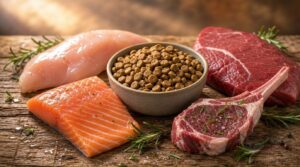
The first ingredient sets the tone for everything that follows. Look for real meat—chicken, beef, lamb, or fish—listed by species, not vague terms like "meat meal." Species specificity matters for allergen tracking, especially if your dog reacts to certain proteins.
Human-grade protein with transparent labeling tells you exactly what’s in the bag.
Look at The First Five Ingredients
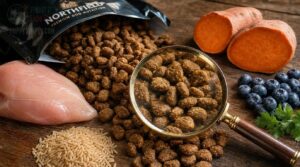
Think of the first five ingredients as a quick nutritional fingerprint. Because ingredient order reflects weight before processing, water content bias and weight shrinkage can quietly shift rankings in the finished kibble.
Watch for ingredient splitting impact and broad category spikes—both obscure what’s truly dominant. These factors demand scrutiny to avoid misinterpretation of the formula’s composition.
Additive dominance in those top spots signals a formula worth scrutinizing. Transparent labeling and careful ingredient list analysis keep your reading honest, ensuring accurate nutritional assessment.
Prefer Specific Fat Sources Like Chicken Fat or Salmon Oil
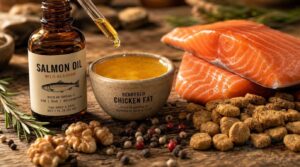
Named fat sources tell you exactly what you’re getting, while vague labels like ‘animal fat’ don’t. Look instead for:
- Chicken fat – boosts palatability enhancement and offers better oxidation resistance for shelf-life stability
- Salmon oil – delivers omega-3 fatty acids and aids a balanced omega ratio
- Species consistency – named fats make batch-to-batch comparisons reliable
- Healthy fats – specific sources help you follow sound guidelines for reading dog food labels
Look for Omega-3 and Omega-6 Fatty Acids
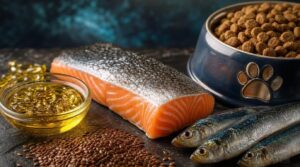
Fatty acids work as a team—omega-3 fatty acids and omega-6 fatty acids both support membrane health and drive anti-inflammatory benefits through eicosanoid signaling.
Look for EPA and DHA sources, such as fish oil or salmon oil, on the label.
A balanced ratio between omega-3 and omega-6 fatty acids matters because these healthy fats compete for the same enzymes. Skewing one too high disrupts oxidative stability and overall balance.
Choose Digestible Carbohydrates Like Oats or Brown Rice
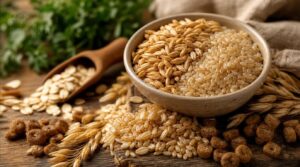
Beyond carbohydrates deserve equal attention, oats and brown rice stand out as solid grain-inclusive choices for delivering sustained energy without spiking blood sugar. When sourced through sustainable grain sourcing practices, these whole grains genuinely earn their place in a balanced diet.
Oats, in particular, offer beta-glucan effects that slow digestion, while their avenanthramide antioxidants provide an additional health benefit. Both grains contribute to soluble fiber benefits, supporting a healthy weight and overall well-being.
Look for Prebiotics, Fiber, Fruits, and Vegetables
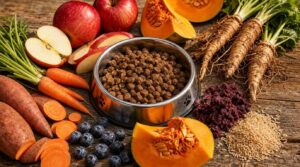
Good carbohydrates set the stage, but fiber and plant nutrients take gut health further. Prebiotic fiber for dogs—especially from inulin-rich ingredients like chicory root—feeds beneficial bacteria directly. The importance of prebiotic fiber for canine digestion is evident in stool consistency, immune response, and nutrient absorption. Look for these whole food ingredients on the label:
- Soluble fiber benefits from apples, carrots, and sweet potatoes support smooth digestion
- Vegetable prebiotic fibers from beet pulp nourish healthy gut bacteria
- Resistant starch from brown rice aids fermentation in the colon
- Fruit polyphenols from blueberries and pumpkin support immune function
- Whole food ingredients like sweet potatoes provide both fiber and beta-carotene
Avoid Artificial Colors, Flavors, and Preservatives
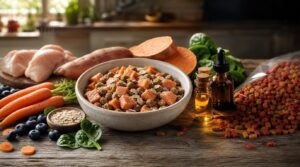
What goes into your dog’s bowl matters beyond protein and fiber. Synthetic additive risks are real—BHA, BHT, and ethoxyquin are chemical preservatives linked to organ stress.
Clean label verification means scanning the ingredient list for Red 40, artificial flavor systems, or preservative names.
Preservative-free dog food relies on natural antioxidants like tocopherols (Vitamin E) instead—a straightforward swap that improves food additive safety without sacrificing shelf life.
Avoid Ingredient Splitting on Dog Food Labels

Ingredient splitting is a quiet trick worth knowing. A brand might list peas, pea flour, and pea protein as separate entries—pulse ingredient clustering that pushes a named meat lower than it deserves. Watch for repeated base sources and split grain indicators like "corn meal" beside "corn gluten."
Multiple protein entries and processing variant clues reveal what the dog food ingredient list is actually built around.
Match Food to Your Dog

Not every dog thrives on the same food, and that’s not a flaw—it’s just biology. A working Border Collie and a senior Beagle have genuinely different nutritional needs, and the right kibble reflects that.
Every dog’s ideal diet is as unique as their breed, age, and lifestyle
Here’s how to match the formula to your dog’s specific life stage and lifestyle.
Choose Puppy Kibble With DHA for Development
DHA directly enhances puppy brain development and vision formation during critical early months. This omega-3 fatty acid is a critical nutrient not to overlook in a puppy’s diet.
When selecting a DHA source, prioritize marine vs. plant sources matters here. Kibble listing fish oil or fish meal provides superior bioavailability compared to flaxseed-derived ALA, which fails to deliver equivalent benefits.
Ensure the product meets labeling transparency confirming AAFCO standards for growth. This guarantees the food meets essential nutritional benchmarks for your puppy’s developmental needs.
Pick Adult Formulas for Maintenance and Balanced Energy
Once your dog leaves puppyhood, their energy needs shift considerably. Adult maintenance formulas are designed around metabolizable energy and calorie density matched to a normal activity level — not growth.
Look for the AAFCO adult maintenance statement, check fiber limits on the guaranteed analysis, and confirm protein digestibility through named ingredients. These steps ensure the food aligns with your dog’s nutritional requirements.
Understanding AAFCO certification for pet foods helps you match dog food calorie content to your dog’s actual energy-to-body ratio, optimizing their health and vitality.
Consider Senior Formulas for Weight and Joint Support
As your dog ages, their joints and waistline need extra attention. Senior formulas address this directly — look for a glucosamine blend, MSM support, and Collagen type II to maintain cartilage and comfort.
A calorie-controlled formula with joint-friendly minerals helps manage weight and joint health in senior dogs.
Understanding AAFCO standards for pet food ensures the formula genuinely meets senior dog nutritional needs.
Choose High-protein, Higher-fat Food for Active Dogs
Active dogs aren’t built like couch companions — their energy and nutrient needs are significantly different. A higher protein-fat ratio (think 30% protein, 15%+ fat) aids muscle repair and sustained performance fueling throughout the day.
Digestible energy from quality animal protein ensures the caloric load matches the dog’s output. High-protein diets for active and working dogs metabolize nutrients more rapidly, so the formula must keep pace with their demands.
Use Weight-management Kibble for Overweight Dogs
Obesity in dogs is more common than most owners realize — and weight management strategies for dogs through diet start with the right kibble.
Here’s what makes these formulas work:
- Calorie Targeting — Reduced calories per cup help create a safe deficit.
- Satiety Boosters — Higher fiber keeps hunger in check between meals.
- Lean Mass Maintenance — Balanced protein preserves muscle while fat drops.
- Portion Control — Measured servings prevent gradual calorie creep.
Always confirm a dog’s weight-control choices with vet guidance, especially if other health conditions are involved.
Consider Sensitive Stomach or Hypoallergenic Formulas
Some dogs just can’t tolerate common proteins like chicken or beef—and that’s where sensitive stomach and hypoallergenic dog food formulas come in. Novel proteins like venison or duck, or hydrolyzed proteins broken into smaller fragments, reduce immune triggers.
Single protein, limited ingredient recipes also simplify what your dog eats. Look for prebiotic fiber to support digestive health in dogs with sensitive stomachs.
Compare Grain-inclusive and Grain-free Diets Carefully
Grain-free isn’t automatically better. The real difference lies in carbohydrate sources—grain-inclusive diets use oats or brown rice, while grain-free formulas swap in legumes like peas or lentils.
That legume content matters: some veterinary research links high-legume diets to heart health concerns in certain breeds.
Compare fiber differences and energy density on the label before deciding which approach suits your dog.
Ask Your Veterinarian About Allergies or Health Conditions
Your vet does more than confirm what you already suspect. They will run skin infection screening, review flea allergy testing results, and may recommend a food elimination trial to isolate dog food allergens. These steps help identify specific triggers and guide targeted interventions.
If environmental triggers emerge through an environmental allergen assessment, allergen immunotherapy becomes an option. This approach addresses underlying sensitivities and reduces long-term symptoms.
Managing dog food allergies with hypoallergenic formulas works best when integrated into a broader, veterinarian-recommended plan for ideal canine nutrition. This ensures balanced dietary support while mitigating allergic reactions.
Top 5 Dry Dog Food Options
Finding the right dry dog food becomes easier when you have a shortlist worth trusting.
Each of the five options below was chosen because it holds up well against the label standards and nutritional benchmarks covered earlier. Here’s what made the cut.
1. The Honest Kitchen Chicken Oat Dog Food
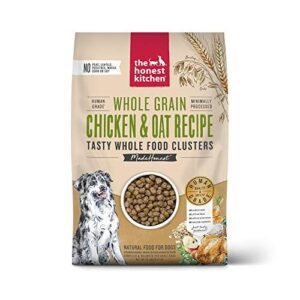
If you’re looking for something genuinely different from standard kibble, The Honest Kitchen Chicken Oat formula is worth a close look. It’s a dehydrated whole-food product made with 100% human-grade ingredients—cage-free chicken as the first ingredient, followed by chicken liver, oats, eggs, and vegetables.
Just add warm water and you have a complete, balanced meal in about three minutes. The formula meets AAFCO standards for all life stages, making it suitable for puppies, adults, and nursing mothers alike.
| Best For | Dog owners who want human-grade, whole-food nutrition without the mess of raw feeding—especially great for multi-dog households with puppies, adults, or nursing moms. |
|---|---|
| Primary Protein | Cage-free chicken |
| Omega Fatty Acids | Flaxseed & salmon oil |
| Digestive Support | Whole grains & vegetables |
| Artificial Additives | None |
| Life Stage | All life stages |
| Bag Weight | 20 lb |
| Additional Features |
|
- Made with 100% human-grade ingredients (cage-free chicken, real veggies, eggs) in a human-food facility—no fillers or mystery meals
- One formula works for all life stages, so you’re not buying separate bags for your puppy and your adult dog
- Quick to prep—just add warm water and it’s ready in about three minutes, with a lot of owners noticing better digestion and coat health
- At around $88 for a 20 lb bag, it’s a real budget commitment, especially for larger dogs
- The bag tends to leave a cup or so of powdery crumbs at the bottom, which means some waste
- Switching too fast can upset your dog’s stomach—you’ll want to mix it in gradually over a week or two
2. Nutro Ultra Adult Chicken Lamb Salmon Dog Food
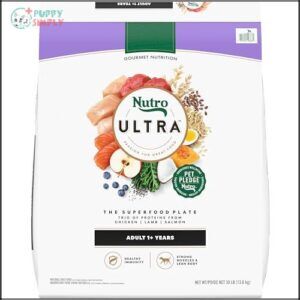
Nutro Ultra Adult Chicken Lamb Salmon is a solid choice for those seeking a traditional kibble. It brings together three animal proteins—chicken, lamb, and salmon alongside 14 superfoods like kale, blueberries, and chia seeds.
The formula includes omega-3 and omega-6 fatty acids to support coat health, while beet pulp and oats keep digestion on track.
This product is free from corn, wheat, soy, and chicken by-product meal, making it best suited for adult dogs without specific health conditions requiring a therapeutic diet.
| Best For | Adult dogs without grain sensitivities whose owners want a protein-rich kibble packed with real ingredients and superfoods. |
|---|---|
| Primary Protein | Chicken, lamb & salmon |
| Omega Fatty Acids | Fish & flaxseed |
| Digestive Support | Beet pulp & oat fiber |
| Artificial Additives | None |
| Life Stage | Adult dogs |
| Bag Weight | 30 lb |
| Additional Features |
|
- Three animal proteins (chicken, lamb, salmon) plus 14 superfoods give your dog a well-rounded nutritional boost
- Omega-3 and omega-6 fatty acids help keep coats shiny and skin healthy
- Free from corn, wheat, soy, and chicken by-product meal — a cleaner label than most mainstream kibbles
- Higher price tag can add up fast, especially if you’ve got a big dog or multiple pets
- Contains protein meals (chicken meal, lamb meal) rather than just whole fresh meats, which some owners prefer to avoid
- Not designed for dogs with specific health conditions like kidney disease or weight issues — you’d want vet guidance for those cases
3. Open Farm Grass Fed Beef Dog Food
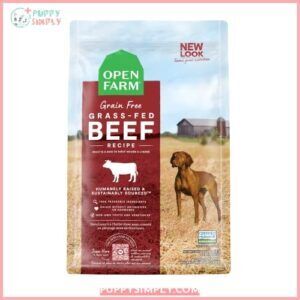
If your dog thrives on animal protein and you prioritize full transparency about its source, Open Farm Grass Fed Beef merits consideration. The primary protein is pasture-raised, grass-fed beef, traceable to humanely managed farms, with added beef liver for enhanced amino acid density.
At 30% crude protein and 14% fat, this formula supports active dogs across all life stages.
Chicory root, pumpkin, and salmon oil provide natural digestive and coat support, rounding out the recipe’s nutritional profile.
| Best For | Dog owners who want full transparency on sourcing and whose pets do well on a high-protein, beef-forward diet across all life stages. |
|---|---|
| Primary Protein | Grass-fed beef |
| Omega Fatty Acids | Fish meals & salmon oil |
| Digestive Support | Chicory root & legumes |
| Artificial Additives | None |
| Life Stage | All life stages |
| Bag Weight | 11 lb |
| Additional Features |
|
- Grass-fed beef is the star ingredient, backed by third-party ethical sourcing you can actually trace.
- Omega-3s from salmon oil, herring, and whitefish give coats a real boost while supporting digestion with chicory root and pumpkin.
- Works for puppies, adults, and seniors — small kibble size is easy on older teeth too.
- Contains legumes like peas and lentils, which some dogs are sensitive to and remain a debated ingredient in grain-free formulas.
- At $64.99 for 11 lbs, it’s a premium price that might stretch tighter budgets.
- Some buyers have noticed a fishy or off smell, which can point to oxidation if the bag isn’t stored properly.
4. Hill’s Science Diet Sensitive Stomach Skin Dog Food
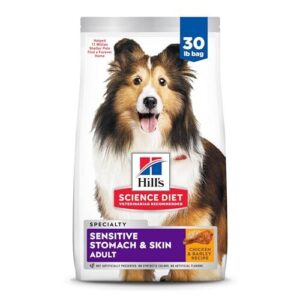
For dogs struggling with loose stools or chronic itching, Hill’s Science Diet Sensitive Stomach & Skin is worth considering. It prioritizes chicken as the first ingredient, supported by prebiotic fiber and beet pulp to promote consistent digestion.
The formula incorporates vitamin E and omega-6 fatty acids, targeting skin and coat health from the inside out. It meets AAFCO standards for adult maintenance and delivers 27 essential nutrients in one balanced formula.
Priced at $89.99 for a 30-lb bag, this is a premium option—but a solid investment for dogs with specific sensitivities.
| Best For | Adult dogs (ages 1–6) with sensitive stomachs, chronic skin issues, or known food sensitivities who need complete, balanced nutrition. |
|---|---|
| Primary Protein | Chicken |
| Omega Fatty Acids | Omega-3 & omega-6 |
| Digestive Support | Prebiotic fiber blend |
| Artificial Additives | None |
| Life Stage | Adults 1–6 years |
| Bag Weight | 30 lb |
| Additional Features |
|
- Targets three things at once—gut health, skin and coat, and immune support—so you’re not juggling multiple supplements.
- Chicken is the first ingredient, and the prebiotic fiber helps keep digestion steady and stools consistent.
- Packed with 27 nutrients including omega fatty acids and clinically backed antioxidants like Vitamins C and E.
- At $89.99 for 30 lbs, the cost adds up fast if you have a large dog or more than one pet.
- Contains chicken, soy, and grains like barley and rice—so it’s not a fit for dogs with those specific allergies.
- Only formulated for adult dogs ages 1–6; puppies, seniors, and grain-free households need to look elsewhere.
5. Royal Canin Hydrolyzed Protein Dog Food
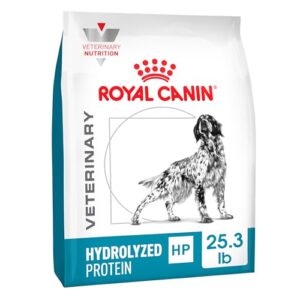
When food allergies are behind your dog’s chronic itching or digestive upset, Royal Canin Hydrolyzed Protein HP takes a genuinely different approach. It breaks soy protein down into tiny peptides the immune system simply won’t recognize as threats—reducing allergic reactions at the source.
Added EPA and DHA support skin barrier repair, while prebiotic fiber keeps digestion steady.
At $142.99 for a 25-lb bag, it’s a premium investment, but for dogs with confirmed sensitivities, it’s often the turning point.
| Best For | Dogs with confirmed food allergies or sensitivities who suffer from chronic itching, skin irritation, or digestive issues. |
|---|---|
| Primary Protein | Hydrolyzed soy |
| Omega Fatty Acids | EPA + DHA fish oil |
| Digestive Support | FOS & beet pulp |
| Artificial Additives | None |
| Life Stage | Adult dogs |
| Bag Weight | 25.3 lb |
| Additional Features |
|
- Hydrolyzed protein formula stops allergic reactions at the source, giving your dog’s immune system nothing to react to.
- EPA and DHA help repair and strengthen the skin barrier, so coats stay healthier and itching stays down.
- Prebiotic fiber keeps digestion on track, which is a big deal for dogs prone to loose stools or gut sensitivity.
- At $142.99 a bag, it’s a serious expense that adds up fast, especially for larger dogs.
- You’ll need a vet’s recommendation to get it, and it’s not always easy to find in stock.
- The kibble size can be awkward for small breeds, and switching over too fast can actually upset your dog’s stomach.
Frequently Asked Questions (FAQs)
What to look out for in dry dog food?
Think of a dog food label like a résumé—it tells you what’s inside before you commit.
Look for "complete and balanced" and ensure a named protein appears first.
Prioritize clean, recognizable ingredients your dog actually needs, avoiding unnecessary fillers or additives.
What should top 3 ingredients be in dog food?
Look for a named protein first—chicken, beef, or salmon.
Next, a specific fat source like chicken fat or salmon oil.
Third, a digestible carbohydrate such as oats or brown rice.
How much dry food should I feed daily?
Start with the label’s feeding chart—it’s your baseline. Most dogs do well split into two daily meals, but adjust by 5–10% based on body condition, activity level, and whether treats count toward daily calories.
Can I mix dry food with wet food?
Yes, you can. Just follow the feeding guidelines on both labels and adjust portions to keep total calories in check. Introduce the mix gradually to avoid any digestive upset.
How do I switch my dogs food safely?
Switch over 7 to 10 days: start with 75% old food and 25% new, then gradually shift the ratio until your dog is eating 100% new food by day
Does dry food help clean my dogs teeth?
Dry food is like a broom that never reaches the corners. It removes some surface debris, but plaque still builds at the gumline. Brushing remains essential for real dental health.
How should I store dry dog food properly?
Store kibble in an airtight container, somewhere cool and dry — below 75°F and away from sunlight. Aim to use it within one to two weeks of opening for best freshness.
Conclusion
Like a prescription written in fine print, knowing what to look for in dry dog food turns a confusing label into a clear answer. The bag’s design is meant to catch your eye—the ingredient list is meant to protect your dog. Once you understand nutritional adequacy, protein sources, and life-stage formulas, choosing confidently becomes second nature.
Your dog can’t read the label. That responsibility, and that power, belongs entirely to you.
- https://www.houndsy.com/blogs/pupdiet/what-is-the-best-dry-dog-food-on-the-market-a-comprehensive-guide-for-pet-owners?srsltid=AfmBOorb6_rYOb8IbZQL1zr_SVmQhjY-PsFW1_r2XsBZG1FtzpfrmgYb
- https://go-solutions.com/en/blog/is-grain-free-dog-food-better
- https://nowfresh.com/en-eu/blog/what-to-look-for-in-dog-food-ingredients
- https://www.spotandtango.com/blog/aafco-certified-dog-foods?srsltid=AfmBOopJVZE6InBVyRiFADFOEFbVoH-3tntcM8bOqxKJn_9v1M--Iw-u
- https://www.feedpetaluma.com/blogs/blog/aafco-dog-food-nutrient-profiles-complete-balanced-nutrition?srsltid=AfmBOorrrzuhCNGfPa_RbLA8wesPzCJMEct1DZl7H9hvT2smMvAN0Tm2