This site is supported by our readers. We may earn a commission, at no cost to you, if you purchase through links.
That bag of kibble your dog charges toward every morning went through more engineering than most people realize. Dry dog food passes through high-pressure extruders, precision die plates, vacuum coating systems, and multilayer oxygen-barrier packaging—all before it reaches your shelf. The process looks nothing like cooking a meal at home.
Understanding how dry dog food is made reveals something worth knowing: every kibble piece reflects deliberate decisions about nutrition, safety, and shelf stability. The ingredient choices, the temperatures, the moisture targets—none of these are accidental.
What follows breaks down each stage of that process clearly, so you can read a label with real context behind it.
Table Of Contents
- Key Takeaways
- Dry Dog Food is Made Through Extrusion
- Ingredients Are Selected and Sourced
- Ingredients Are Ground and Prepared
- Recipes Are Weighed and Mixed
- Dough is Preconditioned With Steam
- Kibble is Cooked and Shaped
- Kibble is Dried and Cooled
- Coatings Add Flavor and Nutrients
- Food is Tested and Packaged
- Frequently Asked Questions (FAQs)
- Conclusion
Key Takeaways
- Dry dog food goes through a precise, multi-stage manufacturing process—including high-pressure extrusion, controlled drying, and surface coating—that shapes everything from texture to how well your dog absorbs nutrients.
- The coating stage isn’t just about taste; it’s where heat-sensitive vitamins and minerals get added back in after cooking strips them away, making it essential to nutritional completeness.
- Every batch is tested for pathogens, contaminants, and nutrient levels before packaging, with multilayer oxygen-barrier bags extending shelf stability for up to two years.
- Understanding how kibble is made helps you read labels with real context—because the ingredients, temperatures, and moisture levels in your dog’s food are all deliberate choices, not defaults.
Dry Dog Food is Made Through Extrusion
Most dry dog food starts its journey in a machine called an extruder, and understanding that process can tell you a lot about what’s actually in your dog’s bowl.
Once you understand what goes into that extruder, you’ll also want to nail down how much dry dog food your dog should actually eat—because the two go hand in hand.
There’s more to it than just mixing ingredients and baking them — the method shapes everything from texture to digestibility.
Here’s what that process actually looks like, step by step.
How Most Kibble is Cooked, Shaped, Dried, Coated, and Packaged
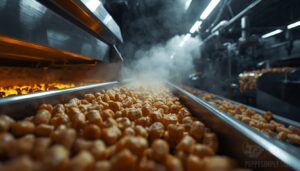
Making kibble starts with cooking raw dough under intense heat and pressure — a process called extrusion cooking. The shaped pieces are then dried to remove moisture, which facilitates waste reduction and shelf stability. The dry kibble extrusion process combines dry and wet ingredients into a dough heated under pressure before cutting into kibbles.
Once cooled, a coating of fats and palatants adds flavor. Finally, sealed oxygen-barrier bags protect freshness throughout the dry pet food production process, from factory to your shelf.
Why Extrusion is The Most Common Dry Dog Food Manufacturing Method
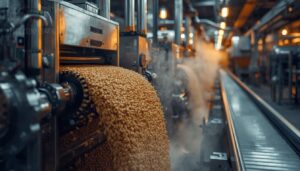
Extrusion dominates dry kibble production for good reason — it delivers production efficiency, ingredient flexibility, and expandable throughput in one continuous pass. A single extruder line cooks, shapes, and sterilizes dough simultaneously, cutting steps and cost.
That built-in efficiency means cost savings without sacrificing nutrition.
Roughly 95% of dry dog food relies on extrusion technology today, making it the clear industry standard.
Difference Between Dry Kibble and Other Dog Food Types
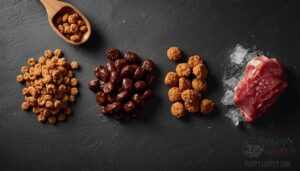
Kibble isn’t the only option on the shelf — but it stands apart in a few meaningful ways.
- Moisture content: Dry kibble sits at 8–12%, while canned dog food holds 75–80%.
- Shelf life: Dry kibble extrusion produces a product lasting 12–24 months; raw dog food requires freezing.
- Palatability factors: Wet foods often win on taste; kibble compensates with coatings.
- Feeding convenience: Dry dog food is easily portioned with no refrigeration required.
- Cost efficiency: Freeze-dried dog food costs more per serving than standard kibble.
Ingredients Are Selected and Sourced
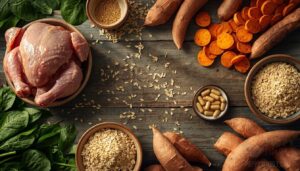
Everything in your dog’s kibble starts long before it ever reaches a factory floor. Ingredients chosen at the very beginning shape the nutrition, safety, and quality of every bag on the shelf.
Here’s a closer look at what actually goes into dry dog food.
Animal Proteins Such as Chicken Meal and Meat Meals
Chicken meal is one of the most reliable animal protein sources in dry dog food. Rendering methods remove moisture and fat, yielding a concentrated powder with a protein content of 60–70%.
Its amino acid profile promotes muscle maintenance, while its shelf stability ensures consistent formulas. Additionally, its allergen potential is generally lower than red meat alternatives.
Use of Poultry By-product Meal and Organ Ingredients
Poultry byproduct meal draws from parts like liver, kidney, and gizzard — ingredients that might otherwise go to waste. In dry kibble formulation, these animal byproduct meals deliver real sustainability benefits by valorizing surplus processing materials.
They also support amino acid balance, provide meaningful mineral enrichment for bone health, and offer cost reduction without sacrificing digestibility.
That palatability boost from organ ingredients? Your dog will notice it.
Grains, Cereals, Legumes, and Vegetables
Beyond animal proteins, the plant-based ingredients in your dog’s kibble do a lot of quiet, important work. Cereals, grains, vegetables, and legumes each bring something distinct to the formula.
- Whole grain benefits include B vitamins, magnesium, and steady energy from complex carbohydrates
- Legume protein quality from peas and lentils helps balance the amino acid profile
- Vegetable antioxidant content in carrots and spinach boosts immune health
- Fiber and digestion improve with beet pulp and whole grains
- Sustainable grain sourcing relies on certified suppliers with documented safety standards
Fats, Oils, Fish Oil, and Flavor Ingredients
Fats, oils, and flavor ingredients might seem like minor details, but they’re actually central to your dog’s nutrition and enjoyment.
Oil source selection — whether chicken fat, fish oil, or plant-based oils — shapes both energy density and palatability. Fish oil enhances Omega-3 Stability through antioxidant strategies and microencapsulation techniques that prevent rancidity.
Fat melt behavior influences kibble coating and flavor enhancement techniques, ensuring flavor coating technology delivers consistent taste your dog will accept.
Vitamin and Mineral Premixes for Balanced Nutrition
Vitamin and mineral premixes serve as the nutritional backbone of every bag of kibble. These concentrated blends deliver balanced nutrition for dogs by combining fat-soluble vitamins, B-complex vitamins, and trace minerals into one precisely measured mix.
Custom Nutrient Formulation, Encapsulation Techniques, and careful attention to Trace Mineral Bioavailability ensure Premix Stability during extrusion heat processing.
Regulatory Compliance guarantees every batch meets established AAFCO nutrient profiles, upholding rigorous quality standards.
Ingredients Are Ground and Prepared
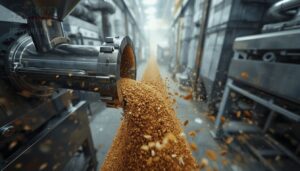
Before any mixing begins, raw ingredients go through a preparation stage that shapes how the final kibble turns out. Getting each component ground down to a consistent size isn’t just a technical detail — it directly affects texture, digestibility, and how evenly nutrients are distributed in every piece.
Here’s how that preparation process works, step by step.
Milling Grains and Vegetables Into Uniform Particles
Before grains and vegetables ever reach the mixer, they undergo milling — a critical step shaping digestibility. Particle size optimization ensures dry ingredients are ground to between 40 and 300 micrometers, enhancing nutrient accessibility during cooking. Milling equipment selection, moisture control, and real-time size analysis collectively enable energy-efficient grinding and consistent dry feed formulation.
Contaminant removal at this stage safeguards subsequent processes.
- Uniform particles enable more even cooking and better digestibility
- Moisture control during milling prevents caking and ensures steady ingredient flow
- Contaminant removal protects everything downstream
Grinding Protein Meals Into Consistent Powder
Protein meals like chicken meal undergo careful grinding to achieve consistent particle size control—typically between 50 and 200 micrometers. Heat management is critical during this process, as milling generates friction that can damage amino acids. Cryogenic grinding uses liquid nitrogen to protect these heat-sensitive nutrients, ensuring nutritional integrity.
Proper flowability optimization and dust suppression are essential to guarantee smooth movement of dry ingredients through production lines. This supports reliable dry feed formulation by minimizing disruptions and maintaining product quality.
Sieving Ingredients for Even Kibble Texture
Once ingredients are ground to a consistent powder, they pass through industrial sieves before mixing begins. Mesh size optimization determines which particle sizes move forward — screens usually range from 2 to 6 millimeters.
Ultrasonic screening prevents sticky materials from clogging the mesh, while inline safety screens catch stray fragments. These measures ensure only properly sized particles advance in the process.
Regular sieve cleaning protocols and particle uniformity verification safeguard kibble size consistency throughout every batch, maintaining strict quality control.
Removing Oversized Particles or Contaminants
Even after sieving, oversized chunks or stray contaminants can slip through. That’s where vibratory screening, magnetic separation, and air classification step in. These processes work together to ensure only properly sized particles proceed.
Magnetic separators pull out ferrous fragments, while vision inspection cameras flag misshapen pieces automatically. Coarse filtration acts as a final safeguard, catching debris like stray solids before they reach the extruder.
Together, these layers of food contamination prevention maintain consistent kibble size and ensure your dog’s bowl, safe.
Preparing Ingredients for Accurate Mixing
Once contaminants are cleared, every remaining ingredient gets carefully staged for mixing. Calibrated scales handle scale calibration down to 0.1-gram precision, supporting lot traceability from supplier to batch.
Moisture balancing adjusts inclusion rates so texture stays predictable, while clumping prevention keeps powders free-flowing.
That level of care in weighing and preparing ingredients drives batch consistency from one run to the next.
Recipes Are Weighed and Mixed
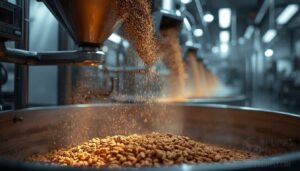
Once the ingredients are ground and ready, the real precision work begins. Every batch of dry dog food follows a carefully formulated recipe where each ingredient is measured to the exact gram.
Here’s how that weighing and mixing process actually works.
Formulating Complete and Balanced Dry Dog Food
Every kibble recipe starts with a carefully designed formulation built around Life‑Stage Nutrition — because a puppy’s needs don’t look anything like a senior dog’s.
Nutritionists map out Amino‑Acid Balance, Calorie Density, and Bioavailability Optimization alongside Functional Additives to achieve complete vs complementary pet nutrition.
This ingredient selection and sourcing process ensures nutrient balance and balanced nutrition before a single gram hits the scale.
Measuring Ingredients According to The Recipe
Once the formulation is set, precise measurement turns recipes into reality. Weighing and preparing ingredients with exactitude is the critical bridge between planning and execution.
Scale Calibration ensures accuracy through daily checks, while Digital Weight Tracking and Batch Record Logging establish Ingredient Traceability. These systems create a transparent, verifiable foundation for every batch.
A second operator verifies portions before progression, enforcing accountability. This step guarantees adherence to standards before ingredients advance in production.
- Portion Tolerance stays within ±2%
- Nutrient premixes are measured to the exact gram
- Batch testing starts here, at the scale
Blending Dry Ingredients in Industrial Mixers
Once your ingredients are weighed, they move into industrial mixers where mixer type selection matters more than you might think. Ribbon and paddle mixers move dry powders in opposite directions, achieving blend uniformity metrics of near 97 percent.
Real-time sensor control monitors torque and speed throughout, while load level optimization and particle size flow ensure every granule reaches its neighbor before cooking begins.
Adding Liquids, Fats, and Nutrient Premixes
Once the dry blend is uniform, wet ingredients enter the picture — and liquid carrier selection shapes how well everything holds together. Oils and fats act as emulsion stabilization anchors, ensuring structural integrity.
Microencapsulation techniques protect delicate vitamins and minerals from heat, safeguarding nutrient viability. Meanwhile, premix overage strategy accounts for expected losses during processing, while nutrient dispersion accuracy guarantees consistency in every serving.
These foundational steps enable advanced applications, such as spray-coated layers of kibble coating and flavor enhancement techniques, which are refined through this precise methodology.
Maintaining Batch-to-batch Nutritional Consistency
Consistency is the quiet promise behind every bag. Real-time sensor monitoring tracks moisture, temperature, and mixing speed continuously, flagging any drift before it affects your dog’s bowl.
Digital batch records timestamp each step, while ingredient lot traceability connects every batch back to its source.
A supplier audit program and statistical process control keep the nutrient profile tight, so that what’s on the label matches what’s inside.
Dough is Preconditioned With Steam
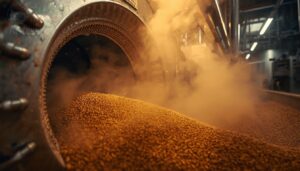
Before the dough ever reaches the extruder, it goes through a step that quietly does a lot of the heavy lifting. Steam and water are introduced in a preconditioning chamber, warming the mix and starting the cooking process early.
Here is what that stage actually involves.
Adding Steam and Water Before Extrusion
Before the dough ever reaches the extruder, it goes through a critical prep stage — the preconditioner. This is where live steam and water are introduced through valve-controlled zones, building kibble moisture content to between 15 and 25 percent. Think of it as a warm-up lap for the extrusion process.
Here’s what makes this step matter for your dog:
- Steam safety is actively monitored — controlled pressure prevents equipment damage and keeps conditions stable
- Valve control regulates steam flow across separate injection zones for even moisture distribution
- Condensate recycling redirects recovered water back into the system, supporting energy recovery and reducing waste
- Temperature balancing begins softening starches gently before the dry kibble extrusion and shaping process begins
Raising Moisture and Temperature Before Cooking
During preconditioning, moisture climbs from around 12 percent to 15–16 percent, while temperature ramps up steadily from 25°C to nearly 70°C. This Temperature Ramp Strategy protects proteins from thermal shock and facilitates Moisture Gradient Control across the feed mass, ensuring a stable environment.
Humidity Sensor Tuning and Preconditioning Cycle Timing maintain consistent conditions, directly enabling Steam Energy Savings. By optimizing these parameters, the process establishes an already-optimized foundation for the subsequent dry kibble extrusion and shaping stages.
Starting Starch Cooking Before The Extruder
Once moisture and temperature are set, the preconditioning stage begins gently cooking the starch before it ever reaches the extruder. This process initiates early gelatinization within each granule, leveraging latent heat efficiency from steam.
Water activity shifts to a range of roughly 0.85–0.90, ensuring moisture uniformity throughout the material. This consistency directly reduces energy demand inside the extruder, streamlining the entire extrusion process.
The result is a smoother, more consistent production flow during dry dog food manufacturing, enhancing both efficiency and product quality.
Monitoring Moisture With Production Sensors
Keeping that early starch cook consistent means tracking moisture every step of the way. Inline NIR moisture and dielectric sensing sensors monitor the dough continuously, feeding real-time alerts to the control system if readings drift.
Data logging captures every fluctuation, supporting quality control testing and shelf life preservation. Sensor calibration ensures accuracy, making these measurements the quiet backbone of reliable dry dog food manufacturing steps.
Improving Extrusion Efficiency and Kibble Consistency
All that moisture tracking pays off the moment dough enters the extruder. Screw configuration tuning lets you adjust shear and energy input without stopping the line, while melt pressure feedback catches inconsistencies before they reach the die. These real-time controls ensure process stability and product consistency.
Automated die swapping preserves kibble shape across runs, and particle size uniformity—built in earlier—keeps the pelletizing process smooth. This precision directly enables reducing energy consumption and waste throughout extrusion cooking and kibble shaping, optimizing efficiency at every stage.
Kibble is Cooked and Shaped
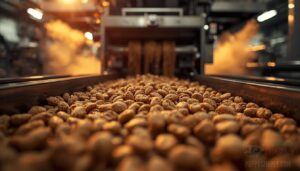
Once the dough leaves the preconditioner, it enters the extruder.
This is where kibble truly takes shape. The extruder does far more than cook; it controls texture, digestibility, and the final form of every piece your dog eats. Here’s what happens inside that machine.
How The Extruder Cooks Dog Food Dough
Once the preconditioned dough enters the extruder, the real transformation begins. The screw lobe design pushes material forward through progressive barrel heat zones, where in-barrel moisture profiling ensures even cooking throughout. This extrusion process balances energy consumption optimization with pressure drop dynamics to produce consistent results.
Here’s what happens inside:
- Dough enters the barrel and is driven forward by rotating screws.
- Barrel heat zones progressively raise the temperature above 120°C.
- Moisture and heat trigger starch gelatinization throughout the dough.
- The screw lobe design creates mechanical shear for thorough, even cooking.
- Pressure builds steadily before the dough reaches the extruder die design.
High Pressure, Heat, and Mechanical Shear
Inside the extruder, three forces work together to cook your dog’s food thoroughly and safely.
| Force | What It Does |
|---|---|
| High pressure | Drives adiabatic heating, raising dough temperature through compression alone |
| Thermal heat | Softens starch and protein networks for rapid cooking |
| Mechanical shear | Screw geometry breaks particles apart evenly |
| Pressure residence time | Ensures complete cooking before the extruder die design |
| Shear-induced reactions | Trigger Maillard-like changes that develop flavor |
Unlike extrusion and baking methods in kibble manufacturing such as industrial oven baking, this extrusion process maximizes energy efficiency naturally.
Starch Gelatinization and Improved Digestibility
When starch granules heat up inside the extruder, they absorb water, swell dramatically through granule swelling effects, and lose their rigid crystalline structure—a process called gelatinization. Controlling the gelatinization temperature range and moisture levels ensures complete starch disruption, boosting enzyme accessibility and making nutrients far easier for dogs to digest.
Precise heat processing breaks down raw starch that dogs couldn’t otherwise digest, while moisture level control prevents uneven cooking inside the barrel. These steps directly enhance carbohydrate absorption and expose more surface area to digestive enzymes.
- Degree of gelatinization directly shapes how well a dog absorbs carbohydrates
- Heat processing breaks down raw starch your dog couldn’t otherwise digest
- Precise moisture level control prevents uneven cooking inside the barrel
- Granule swelling effects expose more surface area to digestive enzymes
- Extrusion and baking methods in kibble manufacturing outperform raw feeding for starch digestibility
Forcing Dough Through Shaped Die Plates
Once gelatinized dough reaches the die plate, its journey from soft mass to recognizable kibble truly begins. The die machine forces dough through precisely shaped openings, where opening geometry, laminar flow, and pressure alignment work together to form consistent strands.
Staggered openings boost throughput without sacrificing uniformity, and plate material resists wear from abrasive ingredients.
| Die Feature | Function | Benefit |
|---|---|---|
| Opening geometry | Shapes kibble cross-section | Consistent size and texture |
| Laminar flow | Maintains smooth dough movement | Reduces irregular shapes |
| Staggered openings | Increases manufacturing extrusion technology output | Higher pet kibble production efficiency |
Food extrusion and pet kibble production depend on this precision.
Cutting Kibble Into Uniform Bite-sized Pieces
Right after the dough exits the die plate, a rotary cutter slices it into uniform pieces — and that split-second cut shapes everything that follows.
- Cutting Geometry Consistency keeps every piece the same size, within ±0.5 mm
- Rotary Cutter Precision ensures Piece Count Accuracy across high-volume runs
- Edge Fracture Prevention minimizes crumbling before drying begins
Vibratory feeders then guide cut kibble gently forward, protecting Post-Cut Moisture Control.
Why Kibble Expands After Leaving The Die
That satisfying puff isn’t accidental — it’s physics. When pressurized dough exits the die, a sudden Pressure Drop triggers Steam Flash, causing superheated water to vaporize instantly and expand the kibble’s shape.
Die Geometry controls the extent of this expansion, while the resulting porous matrix enables moisture swelling during digestion.
| What Happens | Why It Matters | What You’ll Notice |
|---|---|---|
| Pressure drops at die exit | Steam flashes and puffs kibble | Lighter, airier texture |
| Die geometry shapes flow | Controls expansion consistency | Uniform piece size |
| Porous matrix forms | Traps air inside kibble | Gentle crunch when chewed |
| Moisture swelling begins | Aids digestion after swallowing | Fuller feeling for your dog |
| Heat processing sets structure | Prevents collapse during cooling | Kibble holds its shape |
Heat processing solidifies the structure, ensuring the kibble retains its form during cooling.
Kibble is Dried and Cooled
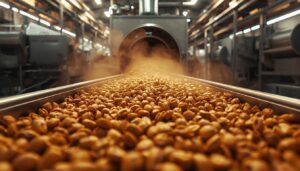
Once kibble leaves the extruder, it’s still carrying a lot of moisture — and that has to change before it’s safe to eat or store. The next few steps focus on pulling that moisture out and bringing the temperature down in a controlled way.
Here’s what happens during the drying and cooling stage.
Reducing Moisture After Extrusion
Once kibble leaves the extruder, it’s holding 20–30% moisture — far too wet for shelf stability. That’s where energy efficient drying comes in. Industrial ovens using airflow uniformity principles move hot air across every piece evenly, pulling moisture down to around 8–10%.
Sensor calibration protocols and moisture mapping techniques keep the process on target, while heat exchanger recovery cuts energy waste without compromising dry extruded results.
Why Low Moisture Helps Prevent Spoilage
Once moisture drops below 10%, something important happens — water activity falls to a level where most spoilage organisms simply can’t survive. Low water activity drives microbial suppression naturally, without relying on heavy preservatives in pet food. It also slows lipid oxidation, protecting fats from going rancid and supporting nutrient stability over time.
When moisture drops below 10%, spoilage organisms cannot survive, naturally preserving kibble without heavy preservatives
Here’s what low moisture quietly does for your dog’s food:
- Acts as a natural pest barrier, making dry dog food inhospitable to storage insects
- Prevents microbial contamination in pet foods by eliminating the water films bacteria need
- Maintains shelf stability and moisture retention so nutrients reach your dog’s bowl intact
Forced-air Drying in Commercial Pet Food Plants
After achieving a safe moisture threshold, the air-dried result is achieved using large-scale food processing equipment that moves heated air across a continuous conveyor bed. These forced-air dryer systems employ a multi-pass configuration to treat kibble in stages, supported by sensor integration that continuously tracks temperature and moisture levels throughout the process.
Heat recovery systems recapture exhaust heat, significantly improving energy efficiency, while the design ensures airflow uniformity—guaranteeing every piece dries evenly. This eliminates hot spots and ensures consistent, predictable outcomes.
Cooling Kibble Before Fat Coating
Once the dryers finish their work, your kibble isn’t ready for coating just yet. It needs to cool down first — and that happens inside a dedicated cooling tunnel that uses airflow optimization to bring surface temperature below 30°C steadily and safely.
Here’s what proper cooling actually does:
- Promotes moisture equilibration between the kibble core and surface
- Establishes a stable surface for consistent fat adhesion
- Prevents fat from penetrating too deeply into the kibble structure
- Ensures manufacturing line equipment applies coatings evenly across every piece
Moisture Checks Before Final Processing
Before fat coating begins, manufacturers verify that moisture sits within a tight window. Three core methods work together to achieve accuracy:
| Method | Purpose |
|---|---|
| Inline NIR sensors | Real-time surface moisture monitoring |
| Gravimetric drying | Validates batch moisture against calibration reference standards |
| Dielectric moisture meters | Measures electrical properties during drying |
Moisture trend logging flags high moisture content early, protecting pet food safety regulations and quality control for your dry dog food.
Coatings Add Flavor and Nutrients
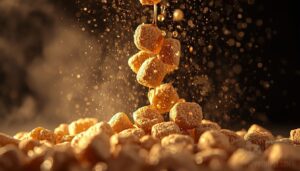
Once the kibble is dry and cooled, it’s ready for one of the most important finishing steps in the whole process. This is where flavor, scent, and key nutrients get added back in — right on the surface of each piece.
Here’s what that coating stage actually involves.
Spraying Fats and Oils Onto Cooled Kibble
Once kibble is fully cooled, it enters a rotating drum where vacuum spray technology draws a fine fat emulsion into the surface pores of each piece.
Nozzle geometry selection and spray flow rate work together to guarantee every kibble gets an even, consistent coat.
This spray-coated layer is your dog’s first flavor signal — and post-coat cooling locks it in place.
Adding Palatants for Better Smell and Taste
After the fat layer sets, palatants are applied—and this is where your dog’s nose takes over. These natural aroma boosters, including hydrolyzed proteins, yeast extracts, and liver hydrolysates, trigger a genuine appetite response. Spray-coated onto each piece, they transform plain kibble into something your dog actually wants.
Here’s what makes palatants work:
- Hydrolyzed proteins deliver savory, meat-like aromas
- Yeast extracts add rich umami depth
- Encapsulated flavor technology preserves aroma during storage
- Palatant safety assessment ensures compatibility with vitamins and minerals
Applying Dry Flavor or Nutrient Coatings
Once the liquid layers settle, a dry powder coating finishes the job. Using coating sensor automation, manufacturers verify even coverage across every piece.
Electrostatic spraying distributes charged particles uniformly, ensuring no kibble gets left behind.
Encapsulated flavor release activates when your dog chews, extending taste perception.
Nutrient chelation methods bind trace minerals directly into the coating, while moisture-resistant coating protects freshness throughout shelf life.
Replacing Heat-sensitive Nutrients Lost During Cooking
High heat during extrusion causes heat-induced nutrient loss through protein denaturation and enzyme inactivation — so post-extrusion fortification puts those nutrients back where they belong.
Stabilized vitamins and microencapsulated minerals are applied in the coating stage to restore what cooking stripped away. Here’s what goes back in after cooking:
- Vitamin encapsulation protects A, D, E, and K during coating
- Stabilized vitamins resist breakdown during shelf storage
- Microencapsulated minerals — zinc, iron, calcium — are calibrated to AAFCO targets
- Antioxidant carriers shield sensitive fats from oxidation
- Vitamin and mineral supplementation ensures complete nutrient preservation in every bag
Improving Palatability for Feeding Acceptance
Palatant optimization extends beyond ingredients to enhance how dogs experience every meal. Aroma boosters intensify scent as they approach the bowl, while texture tuning ensures each bite is crunchy without harshness.
Flavor synergy between the kibble coating and natural protein digestibility fosters consistent acceptance.
Even the feeding environment matters, as routine and placement significantly influence a dog’s willingness to eat.
Food is Tested and Packaged
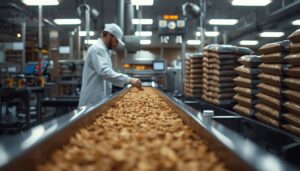
Before that bag ever lands on your shelf, the food goes through a serious round of checks. Every batch is tested, scanned, and verified to make sure what’s inside is safe and nutritionally complete.
Here’s what that final stage actually looks like.
Quality Control During Dry Dog Food Production
Quality control doesn’t happen at the end of the line — it runs through every single step. Real-time Monitoring, Statistical Process Control, and HACCP Audits work together to catch problems before they reach your dog’s bowl.
Three checkpoints keep things tight:
- Mycotoxin Screening on incoming grains
- Contaminant testing throughout mixing and extrusion
- Traceability Systems linking every batch to its ingredients
Manufacturing hygiene and food safety regulations aren’t optional — they’re the foundation.
Microbial Testing and Nutrient Analysis
Once the batch clears contamination checkpoints, it moves into lab testing. This phase employs Pathogen Screening via Rapid PCR to detect Salmonella and Listeria within hours. Microbial Load Trends are monitored over time to identify process drift early, ensuring consistent safety standards.
Nutrient analysis rigorously validates Vitamin Stability, Amino Acid Profiling, and mineral levels post-extrusion. This confirms the product meets labeled specifications, guaranteeing what’s listed on the bag aligns with what’s actually in the bowl.
Metal Detection and Safety Checks
After nutrient analysis confirms what’s in the bowl, physical safety checks begin. Metal detection systems screen the entire product stream, using Multi‑coil Redundancy to ensure a single fault won’t halt production.
Traceability Logging captures critical details for every detected event:
- Time and line position
- Detector Calibration settings at that moment
- Sensitivity level applied for False Alarm Reduction
- Batch ID for Regulatory Compliance audits
FDA and food safety standards mandate this documentation.
AAFCO Nutrient Profile Compliance
Once physical safety checks are complete, every batch still has to prove its nutritionally sound status. AAFCO establishes two life stage profiles—growth and adult maintenance—and mandates that dog food meets both minimum and maximum mineral limits to qualify as "complete and balanced."
Manufacturers validate compliance through laboratory analysis methods or feeding trial validation, ensuring nutritional adequacy. These processes incorporate bioavailability considerations, which guide ingredient selection and quality control in pet food production.
FDA-related Pet Food Safety Requirements
Beyond AAFCO compliance, the Food and Drug Administration sets the legal backbone for everything on that bag. Under cGMP compliance rules and HARPC controls, manufacturers must document every step — from supplier verification to finished product.
Here’s what FDA-related pet food safety regulations and compliance actually cover:
- Labeling standards for accurate ingredient and species identification
- Recall protocols when safety and nutritional standards aren’t met
- Manufacturing codes of practice for sanitation and facility design
- Foreign supplier verification requirements for imported ingredients
- Hazard controls addressing biological, chemical, and physical risks
Packaging in Sealed Oxygen-barrier Bags
Once kibble clears testing, it moves into multilayer bags built from barrier layer materials like EVOH and polyethylene — each layer performing a specific function. These materials form the foundation of the packaging system.
Oxygen scavenger technology actively reduces residual air to near-zero levels, while moisture vapor management prevents humidity intrusion. Together, these mechanisms create an environment hostile to spoilage, ensuring long-term preservation.
Seal integrity testing verifies every closure is airtight, confirming the packaging’s effectiveness. This rigorous process ensures compliance with packaging regulatory standards, ultimately protecting your dog’s food for up to two years.
Storage, Warehousing, and Distribution to Retailers
Once sealed, your dog’s food travels through a carefully managed distribution network built to protect every bag. Palletization Standards keep loads stable during transit, while Warehouse Temperature Control holds storage between 15 and 25°C — preserving product shelf life for up to two years.
Inventory Traceability tracks every lot, and Cross-Docking Operations accelerate high-demand shipments. These measures ensure efficient movement and accountability throughout the supply chain.
Route Optimization ensures packaging material integrity remains intact from facility to retailer shelf, safeguarding quality until the product reaches its final destination.
Frequently Asked Questions (FAQs)
What is the best dog food for congestive heart failure?
When your dog’s heart is struggling, the gentlest gift you can give is a low sodium, taurine supplementation-rich, omega‑3 enrichment dry dog food—always chosen with your vet’s guidance.
What dog food is 100% made in the USA?
Finding dry dog food that’s 100% made in the United States isn’t simple.
FTC labeling rules require domestic ingredient percentages to be verified, and true American Made Certification means tracking full supply chain traceability.
How long does dry dog food last once opened?
Once opened, dry dog food usually lasts four to six weeks.
Airtight storage and temperature guidelines — ideally 50–70°F — protect against rancidity, odor, and nutrient loss.
Batch size affects how quickly you cycle through a bag.
Can dogs develop allergies to kibble ingredients?
Yes, your dog can develop allergies to kibble ingredients. Common protein allergens like chicken, beef, and lamb are frequent triggers.
These allergies often cause itching, ear infections, or digestive upset after repeated exposure.
How do manufacturers ensure kibble is safe to recall?
Manufacturers build recall readiness into every production stage.
Ingredient traceability links each batch to its source, ensuring origin accountability.
Microbial testing catches contamination early, preventing widespread issues.
Tamper-evident labels enable fast lot identification during recalls.
Compliance audits maintain strict adherence to safety regulations.
Does kibble nutrition change based on a dogs age?
Kibble nutrition does change with age. Puppy protein levels are higher to support growth, while adult formulas adjust fat balance for maintenance.
Senior formulas further refine nutritional profiles, modifying calcium ratio, fiber, and joint antioxidant blends to address the needs of aging dogs.
Conclusion
Behind every bag is the full picture of how dry dog food is made—ingredient selection, precise mixing, high-pressure extrusion, controlled drying, and safety testing that happens long before the bag reaches your hands. That process isn’t incidental; it’s the foundation your dog’s daily nutrition rests on.
When you understand what each stage actually does, reading a label stops feeling like guesswork. You’re not just feeding your dog—you’re making an informed choice every single time.
- https://ankura.com/insights/dry-pet-food-manufacturing-process-overview-operational-improvement-opportunities/
- https://www.purinainstitute.com/faqs/how-pet-food-is-made
- https://www.allaboutdogfood.co.uk/articles/extrusion-explained-how-kibble-is-made-and-what-it-means-for-your-dog
- https://pmc.ncbi.nlm.nih.gov/articles/PMC8621379/
- https://www.ukpetfood.org/pet-care-advice/other-advice/how-pet-food-is-made/different-pet-food-processing-methods.html