This site is supported by our readers. We may earn a commission, at no cost to you, if you purchase through links.
The pet food aisle has more than 150 dry puppy food options in the average big-box store. That number sounds helpful until you’re standing there, bag in hand, trying to decode a label that reads like a chemistry textbook. Most new puppy owners pick whatever looks trustworthy—a friendly breed photo, a clean package, a familiar brand name. But packaging tells you almost nothing about what’s actually inside.
What matters is the nutritional profile, the AAFCO statement, and whether the formula matches your puppy’s size and growth stage. This guide cuts through the noise so you can choose dry food for puppies with confidence.
Table Of Contents
Key Takeaways
- Always check the bag for an AAFCO "complete and balanced" statement for growth — without it, the food wasn’t built for a puppy, no matter how good the packaging looks.
- Your puppy’s breed size changes everything: small breeds need calorie-dense, small-bite kibble, while large breeds require controlled calcium levels (0.8–1.2% dry matter) to protect their developing bones and joints.
- The nutrition label tells the real story — check crude protein (minimum 22.5%), fat levels (15–22% dry matter), and always convert to a dry matter basis to compare brands fairly.
- Match meal frequency to your puppy’s age (four meals daily at 2–3 months, dropping to two by 6–12 months), measure by calories rather than cups, and transition new foods gradually over seven days to avoid digestive upset.
Choose Puppy Food Step-By-Step
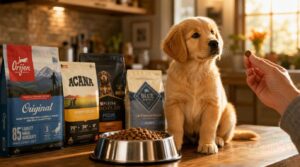
Picking the right dry food doesn’t have to feel overwhelming.
A quick look at dry dog food options for indoor dogs can help you spot the key differences before you commit to a bag.
A few simple steps can narrow things down fast and keep you confident in your choice.
Here’s exactly where to start.
Match Puppy Life Stage
Your puppy’s nutritional needs shift fast, from neonatal nutrients at birth through weaning diet and into those high-calorie growth spurts between 8 and 16 weeks. Every phase demands something different. Growth stage diet labels exist for exactly this reason — they follow life stage feeding guidelines built around puppy growth nutrition.
Match the food to where your puppy actually is right now. Select a breed and size specific diet to support healthy development.
Confirm Breed Size
Once you’ve matched the life stage, size is your next checkpoint. Breed Size Charts take the guesswork out of this. A Great Dane and a Chihuahua are both puppies — but their energy needs by breed size couldn’t be more different.
Use your pup’s Adult Weight Forecast to guide breed-specific feeding choices, since large-breed skeletal growth and small-breed puppies’ mouth size compatibility both depend on getting this right.
Check Calorie Density
Once you’ve nailed breed size, calorie density deserves a hard look. Labels list energy as kcal per cup, but cup weight variance between brands makes that comparison slippery. Fat-driven energy matters here — fat delivers 9 kcal per gram versus 4 for protein or carbs.
Moisture influence drops density in wetter foods. Always convert to kcal per gram for a reliable energy density comparison before setting your puppy’s portion size.
Compare Daily Feeding Cost
Cost sneaks up on you — especially when cup price variations swing from $0.15 to $0.60 per cup. Calorie cost ratio matters: a calorie-dense formula often requires fewer cups daily, making it budget-friendly.
- Small breeds: ~1.5–2 cups daily
- Medium breeds: ~2–3 cups daily
- Large breeds: ~3–4.5 cups daily
Bulk buying savings significantly reduce your per-cup cost.
Ask Your Veterinarian
Your vet knows things a label can’t tell you. Before committing to any kibble, bring your questions—covering Weight Monitoring, Food Intolerance Signs (like vomiting or itchy skin), and Medication Interactions that affect feeding guidelines for puppies.
| What to Ask | Why It Matters | What to Watch |
|---|---|---|
| Activity Calorie Needs | Prevents over- or underfeeding | Weight trends weekly |
| Shift Scheduling | Reduces digestive upset | Stool consistency daily |
| Nutritional adequacy statement fit | Confirms vet-recommended diet | Energy and coat quality |
Veterinary nutritionists agree: vet input shapes smarter choices.
Check AAFCO Growth Standards

Before you spend a single dollar on kibble, check the bag for an AAFCO growth statement — it’s the first real sign the food was built for a puppy, not just marketed to one. That small label detail tells you a lot about whether the formula actually meets your pup’s developmental needs.
Here’s what to look for.
Growth Statement Matters
Every bag of puppy kibble should carry an AAFCO ‘complete and balanced’ statement for growth or all-life-stages. Think of it as the food’s report card. Without it, you’re guessing.
Every puppy kibble bag needs an AAFCO complete and balanced statement — without it, you’re just guessing
This label confirms the formula meets energy density needs and aids bone development through proper calcium phosphorus ratio levels — critical for large breed skeletal growth during these early months.
Feeding Trials Versus Analysis
There are two ways a brand can prove AAFCO compliance: feeding trials or nutrient profile analysis.
Feeding trials offer real-world relevance — they measure bioavailability evidence in live dogs, not just on paper.
Lab testing limitations mean a solid nutrient profile analysis can’t confirm actual absorption.
Trial sample size is small, and endpoints limitations exist, but feeding trials remain the stronger standard.
Large-breed Wording
Large breed puppies need labels that speak their language. Look for Growth Stage Language like ‘large-breed growth formula’ or Breed-specific Terminology calling out dogs 70 lbs or more at adulthood — AAFCO has required this since 2016.
Good labels also include Progression Age Guidance, Overfeeding Warnings, and Energy Density Phrasing to support obesity prevention in large breeds through calorie density for puppies.
Calcium-phosphorus Ratio
Think of calcium and phosphorus as construction partners — they only work well together in the right ratio. AAFCO standards require a 1:1 to 2:1 ratio for puppy nutrition, with calcium sitting between 1.2% and 1.8% dry matter.
Bone development impact is real: imbalanced mineral balance calculations can stress growing skeletal tissue.
Large breeds have breed-specific targets — check labels carefully using basic ratio monitoring tools.
Avoid Supplemental-only Foods
If a label reads "for intermittent or supplemental feeding only," put it back on the shelf. That phrase means the food hasn’t met AAFCO standards for complete and balanced nutrition.
Supplement-only products risk energy deficiency, calcium overload, and nutrient imbalance that disrupt healthy growth. They also create feeding plan confusion and often carry supplement mislabeling issues. Your puppy needs a verified nutritional adequacy statement—nothing less.
Read The Nutrition Label
The nutrition label is where the real story lives. Once you know what to look for, it takes less than a minute to spot a solid formula from a mediocre one. Here are the five numbers worth checking every time.
Protein Minimums
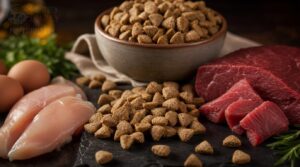
Every kibble bag shows a crude protein percentage, but that number tells only part of the story. AAFCO standards require at least 22.5% protein for growth-stage foods — yet the minimum requirement versus actual content can differ.
Protein digestibility and amino acid balance matter just as much as protein percentage. Poor-quality protein sources will not support your puppy’s development, no matter how high the number appears.
Healthy Fat Levels
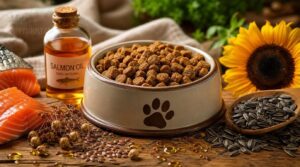
Fat plays a crucial role beyond fueling your puppy’s energy: it transports fat-soluble vitamins and supports brain development through omega-3 fatty acids like DHA from salmon oil. Most high-quality kibbles contain approximately 19% fat, a balanced middle ground for nutritional needs. Prioritize options with diverse oil sources to maintain a healthy essential fatty acid ratio, while ensuring proper fat oxidation control prevents trans fat formation.
Key considerations for optimal fat content include:
- Saturated fat limit: Maintain total fat between 15–22% dry matter
- Omega fatty acids: Seek labels listing both fish oil and plant-based oils
- Balanced oil sources: Combine fish oil with sunflower or flaxseed oil for ideal pairing
Always verify that formulations avoid trans fats through rigorous oxidation management.
Calories Per Cup
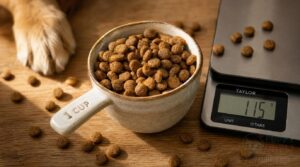
Once you’ve checked fat levels, look at calorie content. Dry food ranges from 250 to 500 calories per cup — that’s a wide gap for portion energy calculation. Higher protein blends often land toward the top. Keep in mind batch-to-batch differences can shift energy density slightly.
Use the label’s calorie figure to scale feeding guidelines to your puppy’s actual weight.
Dry Matter Basis
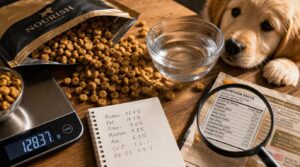
Calorie counts only tell part of the story. To truly compare brands, you need dry matter analysis — a simple moisture conversion that strips water from the equation.
- DM calculations reveal true protein ratio and mineral concentration
- Nutrient density numbers shift considerably once moisture is removed
- Use this formula: DM% = 100 minus the label’s moisture percentage
That is how macronutrient balance becomes clear across different foods.
Carbohydrate Estimates
Carbohydrates do not appear directly on most labels — you calculate them. Label math works by subtracting protein, fat, moisture, fiber, and ash from 100. That leftover number is your carbohydrate estimate.
Here’s the catch: starch vs. sugar, fiber contribution, and ash effect all shift that figure. Higher ash means fewer carbs on paper, not in the bowl. Use dry matter analysis to keep your macronutrient balance honest.
Match Food to Breed Size

Not all puppy food is created equal — and breed size is one of the biggest reasons why. A Great Dane puppy and a Chihuahua puppy have very different needs regarding kibble size, calcium levels, and calorie density.
Here’s what to look for based on how big your dog will grow.
Small-breed Kibble Size
Kibble size isn’t just a convenience — it directly affects how well your small breed puppy actually digests its food. Small breed puppies need a bite diameter of 6 to 10 mm for jaw comfort and chewing duration long enough to trigger proper saliva production.
- Smaller pieces support nutrient absorption through thorough mastication
- Dry kibble texture should be firm yet gentle during teething
- Texture softness matters for weaning puppies adjusting to solid food
- Small breed metabolism demands calorie-dense kibble in compact portions
Large-breed Calcium Control
Large breed puppies can’t regulate calcium absorption — so their diet must manage it. Excess calcium raises osteochondrosis risk and contributes to hip dysplasia later in life.
Controlled calcium formulas target 0.8–1.2% dry matter to ensure proper mineral balance between calcium and phosphorus. This supports healthy bone growth without overloading the skeletal system. Essential monitoring of calcium levels is non-negotiable.
Giant-breed Growth Pace
Giant breeds don’t just grow big — they grow long. Your Great Dane or Mastiff puppy won’t reach full size until 18–24 months, with peak skeleton development phase happening in the first nine months.
Average daily gain rises fast, then slows. That’s why phase-specific feeding and controlled calorie intake matter — overfeeding during early growth curve checkpoints can quietly compromise orthopedic health in large breed dogs.
Joint-support Nutrients
Big dogs carry a heavy load on their joints from day one. That’s why breed-specific kibbles include glucosamine and chondroitin — two nutrients that directly support joint development and help reduce hip dysplasia risk.
MSM comfort ingredients, omega-3 fatty acids, and Vitamin C collagen support and round out the joint nutrient ratios.
Together, glucosamine sources and chondroitin benefits work as a team, not solo acts.
Portion Size by Weight
Cups lie. Grams tell the truth. Use a kitchen scale for every meal — gram-based guidelines beat scooping every time.
Since your puppy’s growth rate changes weekly, adjusting portions weekly keeps energy density calculations accurate.
Active weight tracking means tweaking feeding guidelines as your pup gains weight, ensuring nutrient density and protein content in puppy food actually match their needs.
Compare Ingredients and Additives
Once you’ve checked the nutrition label, it’s time to look closer at what’s actually inside the bag.
The ingredient list tells you a lot about quality — and a few key additives make a real difference in how well your puppy grows. Here’s what to look for.
Named Animal Proteins
The protein source listed first on the label matters more than you might think. Chicken, beef, lamb, eggs, and salmon each bring a distinct amino acid profile and vary in allergen potential.
Chicken tops digestibility charts, while salmon adds DHA from salmon oil as a bonus.
If your puppy shows sensitivity, novel protein sources like lamb offer lower allergen exposure without sacrificing protein quality.
DHA for Brain Development
Salmon, listed first, delivers more than just protein — it brings DHA from salmon oil directly into your puppy’s diet. DHA enhances neural membrane integrity, myelin synthesis, and synaptic plasticity during the brain’s fastest growth window.
Think of omega-3 fatty acids as the scaffolding behind cognitive, brain, and eye development. Look for dry puppy foods confirming a 0.05% EPA + DHA minimum — your puppy kibble should show that on the label.
Probiotics for Digestion
Beyond brain support, gut health for puppies matters just as much. Look for named probiotic strains like Bacillus coagulans or Lactobacillus — strain specificity determines whether you get real bowel regularity and gas reduction, or nothing at all.
Survival efficacy matters also; spore-forming strains reach the intestines alive. Strong probiotics also reinforce the gut barrier, lowering digestive irritation from the inside out.
Prebiotic Fiber Sources
Probiotics need fuel to do their job — that’s where prebiotic fiber comes in. Look for these three on the label:
- Chicory Inulin / Fruit FOS – fermented by gut bacteria to feed bifidobacteria
- Dairy GOS / Resistant Starch – reach the colon intact as microbial nourishment
- Oat Beta-Glucan / vegetable prebiotics – whole grain dietary fiber in pet food that promotes stool consistency
Omega-3 and Vitamin E
Two nutrients work as a team here — omega-3 fatty acids feed your puppy’s skin health and brain, while vitamin E prevents rancidity by slowing oxidative damage to those fragile oils.
| Nutrient | Role |
|---|---|
| DHA/EPA | Brain, coat, immune system support |
| ALA (plant) | Limited conversion to DHA/EPA |
| Vitamin E (tocopherol) | Oxidative stability, rancidity prevention |
| Combined effect | Skin health + antioxidants working together |
Check that your label lists both.
Choose for Special Needs
Not every puppy fits the same mold, and their food shouldn’t either.
Some pups have sensitive stomachs, food allergies, or specific dietary needs that a standard formula just won’t address. Here’s what to look for when your puppy needs something a little different.
Sensitive Stomach Formulas
Some puppies just have touchy tummies — and that’s okay. Sensitive stomach formulas use hydrolyzed proteins to break down protein bonds before digestion even starts, making the whole process easier.
Low lactose levels reduce gas and fussiness, while a gentle fat blend with beta-palmitate benefits stool consistency.
Added probiotics, prebiotics, and digestive enzymes keep the gut balanced and feedings calmer.
Limited-ingredient Diets
When your puppy experiences persistent scratching or digestive upset, limited ingredient diets are worth considering. These formulas follow a Core Protein Focus—using a single named meat like lamb or salmon—paired with a Single Carb Source, such as sweet potato. This Minimal Ingredient List simplifies elimination trials, helping pinpoint food allergens causing issues in dogs.
The streamlined approach supports elimination trial-ready feeding by reducing potential irritants. Many formulas also adopt a Natural Preservative Approach, promoting long-term digestive health for puppies. This combination of simplicity and targeted nutrition addresses both immediate symptoms and ongoing wellness.
Grain-inclusive Options
Whole grains are not the enemy — they are workhorses in many well-formulated dry puppy foods. Grain-inclusive formulas deliver steady energy and digestive assistance through ingredients your puppy’s gut can actually use.
- Brown Rice Benefits: Soluble fiber steadies digestion and energy release
- Oat Fiber Effects: Beta-glucan promotes stool firmness and coat health
- Barley Energy Source: A reliable secondary grain with bone-assisting manganese
- Quinoa Protein Profile and Millet Mineral Content: Supply complete amino acids, magnesium, and iron
Always check the label for protein percentage — it should meet AAFCO’s 22.5% minimum.
Grain-free Considerations
A grain-free diet isn’t automatically better or worse than alternatives. However, risks emerge when starch alternatives like peas or lentils dominate formulas, potentially raising Cardiac Risk Factors that warrant discussion with your vet.
Focus on Ingredient Transparency, Palatability Boosters, and Thirst Management, as higher fat content in grain-free options increases water needs. Prioritize fresh water access and monitor protein percentages, which often exceed AAFCO minimums in grain-free diets.
| Feature | Grain-Free | Grain-Inclusive |
|---|---|---|
| Starch Alternatives | Peas, potatoes | Brown rice, oats |
| Protein Percentage | Often higher | Meets AAFCO minimum |
| Cardiac Risk Factors | Monitor closely | Lower concern |
| Palatability Boosters | Animal fats, salmon | Varied proteins |
| Thirst Management | Fresh water critical | Standard hydration |
Allergy-friendly Proteins
Some puppies react to common food allergens in dogs like chicken or wheat without warning. Protein allergen mapping helps you identify the right starting point.
- Choose single-source proteins — chicken, lamb, or salmon
- Try novel proteins like venison or rabbit
- Consider hydrolyzed protein diets for immune-sensitive pups
- Request a veterinary protein trial to confirm triggers
- Ask manufacturers about cross-contact control practices
Top 5 Dry Puppy Foods
All the label-reading and breed-size matching comes down to one practical question: which bags actually deliver?
These five dry puppy foods consistently meet AAFCO growth standards, earn strong marks on ingredients, and cover a range of budgets and needs. Here’s what made the cut.
1. The Honest Kitchen Puppy Dry Chicken Food
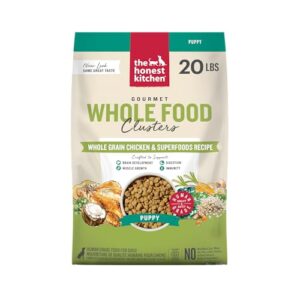
The Honest Kitchen Puppy Dry Chicken Food earns its spot at the top for good reason. Every ingredient meets human-grade standards — no fillers, no feed-grade shortcuts. A veterinary nutritionist formulated this recipe, ensuring enhanced protein, DHA for brain development, and double the probiotics of most competing brands.
It’s also suitable for large-breed puppies. The main tradeoff? About $93 per 20-lb bag. If budget allows, it’s hard to beat.
| Best For | Puppy owners — especially those raising large breeds or nursing dogs — who want a clean, vet-formulated diet and don’t mind paying a premium for it. |
|---|---|
| Bag Weight | 20 lb |
| DHA Added | Yes (fish oil) |
| Price | ~$93.00 |
| Life Stage | Puppy & Nursing Dogs |
| Probiotics | Yes (Bacillus coagulans) |
| Grain-Free | No (oats, barley) |
| Additional Features |
|
- Every ingredient is human-grade, made in a human food facility with zero fillers or feed-grade shortcuts
- Vet-formulated with extra protein, DHA, and double the probiotics to support brain, muscle, and gut health
- Flexible feeding — crumble it, soak it, or mix it with broth for puzzle toys, training treats, or meal toppers
- At around $93 for a 20-lb bag, it’s one of the pricier options on the market
- The texture is crumbly and dusty, so it can get messy and may need added moisture to work well in bowls or toys
- Contains oats and barley, so it’s not a great fit for dogs with grain sensitivities or allergies
2. Open Farm Puppy Ancient Grains Dog Food
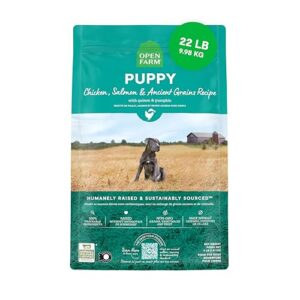
If budget is a concern but you still want premium quality, Open Farm Puppy Ancient Grains is worth a look for $71.99 for 22 lbs.
Around 90% of its protein comes from chicken, salmon, whitefish, and herring — solid sources for muscle growth and brain development.
Ancient grains like oats, quinoa, and millet replace legumes and potatoes, making it a smart pick for sensitive stomachs.
Chicory root and salmon oil round out the gut and coat support.
| Best For | Puppy owners who want high-quality, legume-free nutrition with traceable ingredients and don’t mind paying a premium for it. |
|---|---|
| Bag Weight | 22 lb |
| DHA Added | Yes (salmon oil) |
| Price | ~$71.99 |
| Life Stage | Puppy (all breeds) |
| Probiotics | No (prebiotic only) |
| Grain-Free | No (ancient grains) |
| Additional Features |
|
- 90% animal-derived protein from chicken, salmon, whitefish, and herring supports strong muscle growth and brain development in puppies.
- Ancient grains like oats, quinoa, and millet make it a solid choice for pups with sensitive stomachs or legume sensitivities.
- Added salmon oil, chicory root, and turmeric cover gut health, coat shine, and inflammation — all in one bag.
- At $71.99 for 22 lbs, it’s on the pricier end and might not work for every budget.
- The larger, harder kibble can be tough for very small or young puppies to chew through.
- Not a fit for dogs with chicken or fish allergies, since those proteins are front and center here.
3. Blue Buffalo Puppy Dry Food Chicken Brown Rice
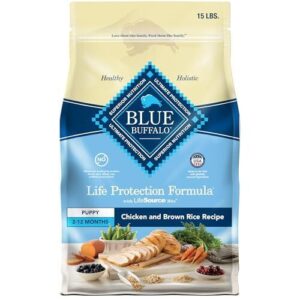
Blue Buffalo Life Protection Formula Puppy features real deboned chicken as the primary ingredient, with no poultry by-products. Brown rice, oatmeal, and barley provide steady energy, avoiding corn, wheat, or soy. This foundation supports healthy growth and digestion in puppies.
The formula includes signature LifeSource Bits, delivering a targeted antioxidant blend to boost immune development during critical early months. DHA and ARA further enhance brain and eye health, addressing key developmental needs.
Priced at $44 for a 15-lb bag, it costs more than average options. However, the ingredient quality justifies the premium, offering superior nutrition for growing puppies.
| Best For | Puppy owners who want a high-quality, whole-food kibble that supports brain development, immune health, and steady growth from 8 weeks to 12 months. |
|---|---|
| Bag Weight | 15 lb |
| DHA Added | Yes (DHA/ARA) |
| Price | ~$44.00 |
| Life Stage | Puppy (8wk–12mo) |
| Probiotics | Yes (supplemental) |
| Grain-Free | No (brown rice, oatmeal) |
| Additional Features |
|
- Real deboned chicken is the first ingredient, with no poultry by-products — solid protein you can feel good about.
- DHA, ARA, and LifeSource Bits cover brain development, eye health, and immune support all in one bag.
- Skips corn, wheat, and soy while using digestible grains like brown rice and oatmeal — a nice middle ground for grain-tolerant pups.
- At around $44 for 15 lbs, it’s pricier than most standard puppy foods on the shelf.
- Not grain-free, and contains legumes — could be a problem for puppies with grain or legume sensitivities.
- Multiple protein sources and additives like garlic and yeast may trigger reactions in dogs prone to food allergies.
4. ACANA Puppy Grain Free Dry Dog Food
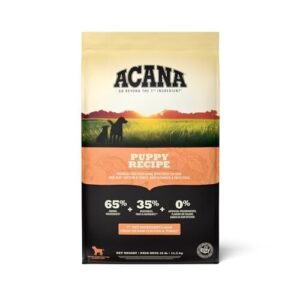
If Blue Buffalo leans on grains for steady energy, ACANA takes the opposite road. This grain-free formula packs 65% high-quality animal ingredients — free-run chicken, turkey, eggs, and flounder — leaving little room for fillers.
That fish-forward protein mix also delivers EPA and DHA to support your puppy’s developing brain.
A multi-strain probiotic blend keeps digestion on track, too. At $78.99 for 25 lbs, it’s a premium pick, but the ingredient density backs up every dollar.
| Best For | Puppies with grain sensitivities whose owners want a high-protein, nutrient-dense diet without corn, wheat, soy, or potato. |
|---|---|
| Bag Weight | 25 lb |
| DHA Added | Yes (fish oil/flounder) |
| Price | ~$78.99 |
| Life Stage | Puppy (baby-age) |
| Probiotics | Yes (multi-strain blend) |
| Grain-Free | Yes |
| Additional Features |
|
- 65% animal ingredients means real protein takes center stage — great for muscle growth and a healthy coat.
- EPA and DHA from fish oil and flounder give developing brains a solid nutritional foundation.
- The probiotic blend supports digestion and can help keep stool volume down.
- At $78.99 for 25 lbs, it’s a bigger ongoing expense than most conventional puppy foods.
- The strong fishy smell is a lot — some owners (and picky pups) may not love it.
- Multiple proteins plus legumes means higher allergy risk for dogs with sensitive stomachs.
5. Instinct RawBoost Puppy Dry Dog Food
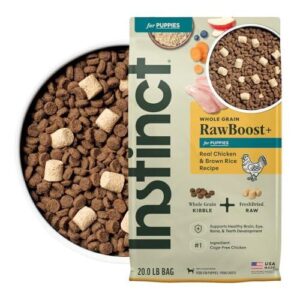
Instinct RawBoost stands out by blending crunchy dry food with freeze-dried raw chicken pieces in every scoop. Cage-free chicken leads the ingredient list, and the formula skips corn, wheat, soy, and artificial preservatives entirely.
DHA aids brain and eye development, while Bacillus coagulans keeps digestion steady.
At $69.99 for 20 lbs, it’s a premium option, but that raw-boost texture makes it a real win for picky eaters.
| Best For | Puppies of all breed sizes whose owners want a protein-rich, grain-inclusive diet with a raw food boost — especially great for picky eaters. |
|---|---|
| Bag Weight | 20 lb |
| DHA Added | Yes (DHA enriched) |
| Price | ~$69.99 |
| Life Stage | Puppy (all breeds) |
| Probiotics | Not specified |
| Grain-Free | No (barley, oatmeal, rice) |
| Additional Features |
|
- Cage-free chicken is the first ingredient, with no corn, wheat, soy, or artificial preservatives
- Freeze-dried raw chicken pieces add texture and make it way more appealing to fussy pups
- DHA, calcium, and phosphorus support brain development, vision, and strong bones as they grow
- Contains whole grains like barley and oatmeal, so it’s not a fit for grain-sensitive dogs
- At $69.99 for 20 lbs, it costs more than most standard dry puppy foods
- Some buyers have had issues with shipping conditions affecting product quality on arrival
Feed and Store Kibble Safely
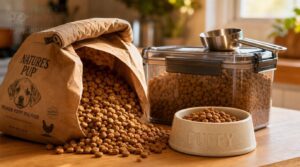
Getting your puppy’s food right doesn’t stop at choosing the bag. How you feed and store that kibble matters just as much as what’s inside it.
Here’s what to know before you scoop.
Meals by Puppy Age
Your puppy’s meal schedule isn’t one-size-fits-all — it shifts as they grow.
| Age | Meals Per Day | Breed Notes |
|---|---|---|
| 2–3 months | 4 | All sizes; weaning schedule ends |
| 3–6 months | 3 | Feeding milestones shift here |
| 6–12 months | 2 | Large breed puppies may need longer |
Follow these feeding guidelines closely. Meal frequency shifts naturally with growth, so age-specific portions keep energy steady without overloading developing systems. Keep treat calorie limits tight — they’re extras, not replacements.
Measure by Calories
Cups alone can mislead you — calorie conversion is your most reliable tool. Check the label’s kilocalories-per-cup value, then use it for precise energy budgeting based on your puppy’s weight and a dog’s growth rate.
- Calculate daily calories from the label
- Divide by meals for portion size
- Make portion adjustments if weight monitoring shows gain or loss
Metabolic rate differences between breeds make this critical.
Transition Foods Slowly
Switching foods too fast is a recipe for an upset stomach. Follow a ratio increment plan: start at 75/25 old-to-new for three days, then ease to 50/50 by day seven.
Use texture adjustment steps for sensitive stomach pups — moisten kibble early on.
Run daily digestive tolerance checks, maintain a consistent feeding routine.
Do a nutrient consistency review at each stage.
Store in Airtight Containers
Once that bag is open, the clock starts ticking. Transfer dry puppy food into airtight containers with rubber gaskets and locking latches.
Material choices matter: glass, metal, or opaque plastic all block light and moisture.
Follow environmental guidelines by keeping containers off floors and away from humidity.
A solid cleaning routine and smart portioning hacks protect food preservation and shelf-stable freshness.
Monitor Recalls Regularly
Even the best puppy food can get pulled from shelves overnight. Set up dog food recall alerts through the FDA and CPSC — both post notices with lot numbers and affected batch codes.
Sign up for Recall Alert Setup emails from your retailer too.
Keep a simple Recall Documentation Log with your bag’s batch code tracking info. It takes five minutes and protects your pup.
Frequently Asked Questions (FAQs)
Can puppies eat adult dog food temporarily?
Adult dog food is safe short-term, but nutrient shortfalls are real. Puppy kibble aids growth and development that adult formulas don’t.
Get vet approval fast and switch back to an AAFCO-compliant, complete and balanced life stage formula.
How do I know my puppy is thriving?
Watch for appetite consistency, steady weight progression, and coat shine. A thriving puppy shows energy playfulness, healthy stool appearance, and age-appropriate growth development — clear signs digestive health and immune system support are working.
When should puppies switch to adult food?
Timing depends on breed size and dog growth rate. Small breeds finish growing around 9–12 months; large breeds need 18–24 months. Watch your puppy’s Body Condition Score and ask your vet.
Are homemade puppy diets nutritionally complete?
Rarely, rarely do homemade diets truly deliver. Without precise portion math and careful ingredient variability control, most fall short of complete and balanced AAFCO-compliant nutrition your puppy needs to thrive.
How does spaying or neutering affect puppy nutrition?
Spaying or neutering triggers a hormonal impact that causes metabolic slowdown and appetite increase.
Adjusted feeding — roughly 30% fewer calories — helps prevent obesity while still meeting AAFCO nutritional standards for protein and small-breed energy needs.
Conclusion
A puppy’s first year of nutrition works like a blueprint—get the foundation right, and everything built on top of it holds. Now that you know how to choose dry food for puppies, you’re not guessing in that aisle anymore.
You’re reading labels, matching breed size, checking AAFCO statements, and asking the right questions. That knowledge turns an overwhelming shelf into a manageable decision. Your puppy’s healthiest years start with what’s in that bag.
- https://www.redbarn.com/blogs/pet-nutrition/the-ultimate-guide-to-high-protein-puppy-food?srsltid=AfmBOookiB8dJyXjcRhVusVc7doUGBNBymvSC4lK2qFWhClBGuHrFJFi
- https://www.akc.org/expert-advice/nutrition/choosing-healthy-dry-dog-food/
- https://vcahospitals.com/know-your-pet/feeding-growing-puppies
- https://palapets.com/blogs/raw-feeding/puppy-protein-needs-how-much-protein-do-puppies-need?srsltid=AfmBOoqRWCGynAt2c9fg3NwiP5wVKNdk_l3bPBly2LVFG8-DBrZ4r_Ay
- https://www.petmd.com/dog/nutrition/What-Is-AAFCO-and-What-Does-It-Do