
This site is supported by our readers. We may earn a commission, at no cost to you, if you purchase through links.

A carrier that looks roomy on the shelf can still leave your dog hunched and miserable at 30,000 feet. Most owners size by weight limits printed on the box, then wonder why their dog paces or won’t lie down. The truth is simpler than the label suggests.
What size travel carrier does my dog need comes down to your dog’s actual body, not the breed chart or the bag’s marketing copy. A carrier that fits lets your dog stand, turn, and stretch out without touching a single wall.
Get the measurements right, and the rest falls into place.
Table Of Contents
- Key Takeaways
- Choose a Carrier Slightly Larger Than Your Dog
- Measure Your Dog for Carrier Fit
- Confirm Enough Space for Comfortable Movement
- Use Size Charts as Starting Points
- Match Carrier Types to Dog Size
- Follow Airline Carrier Size Rules
- Check Under-Seat Fit Before Flying
- Avoid Common Carrier Sizing Mistakes
- Frequently Asked Questions (FAQs)
- What size carrier for dogs on plane?
- Is a 20 lb dog considered small or medium?
- Can a 30 lb dog fit in a carrier?
- What size travel crate for 20 lb dog?
- How often should I replace my dogs carrier?
- Can I use one carrier for multiple dogs?
- What carrier features help reduce travel anxiety?
- Are washable carrier liners better than disposable pads?
- How do I clean and maintain a carrier properly?
- Conclusion
Key Takeaways
- Skip the weight label on the box and measure your dog’s actual body—length, height, and width—since two dogs of the same weight can need very different carrier sizes.
- Add extra room beyond your dog’s measurements: 2-4 inches in length, 2-3 inches of headroom, and 2 inches of width so your dog can stand, turn, and stretch without touching the walls.
- Before flying, confirm your carrier meets your airline’s specific size and weight rules, since cabin, cargo, domestic, and international policies all differ.
- Test the fit at home first by letting your dog sit, turn, and lie down inside the carrier, since a hands-on check catches problems that measurements alone can miss.
Choose a Carrier Slightly Larger Than Your Dog
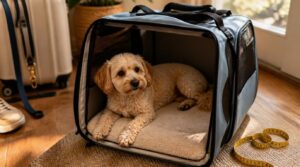
A carrier that’s too snug can make travel stressful for your dog. Sizing up gives your dog room to breathe, shift, and settle in. Here’s what to check before you buy.
Measure nose to tail, add a few inches, then check this dog crate sizing guide for travel to match the fit to your trip.
Internal Dimensions Matter Most
When you shop for a carrier, ignore the box dimensions printed on the outside. Internal dimensions are what your dog actually lives in.
Compare these against your dog measurement before buying:
- Interior length for stretching
- Interior height for standing
- Interior width for turning
- Padding thickness
- Mesh panel coverage
Validating size accuracy this way ensures proper fit, not guesswork.
Add Two to Four Inches
Once you measure your dog’s length, don’t stop there. Add two to four inches for slack.
| Dog Size | Add |
|---|---|
| Small | 2 in |
| Medium | 3 in |
| Large | 4 in |
This tolerance covers packing, padding, and awkward angles, not just carrier dimensions on paper.
Allow Two to Three Inches Overhead
Length isn’t the only gap to check. Your dog also needs overhead clearance so its head never brushes the roof.
Do a Headroom Measurement: floor to the top of the head, standing naturally. A properly sized carrier gives two to three inches above that point. Run this Ceiling Space Test sitting and standing, so your dog can sit comfortably without pressing the top panel.
Add Two Inches of Width
Height and length aren’t the whole picture. Your dog’s shoulders and hips need room too.
Find the widest point across your dog’s body, then add two inches of width to that number. This gives shoulder movement space, hip room improvement, and chest comfort allowance. Your dog can hold a natural posture without pressing against carrier walls on either side.
Prioritize Fit Over Weight Labels
A weight tag on a carrier tells you almost nothing about how your dog will actually fit inside it. Two ten-pound dogs can have completely different body shapes.
That’s why body measurements guide your decision, not the number on a label. Use your dog’s actual carrier dimensions to sit comfortably, turn around naturally, and lie down without feeling cramped.
Measure Your Dog for Carrier Fit
Guessing your dog’s size never ends well. A few simple measurements give you real numbers to work with. Here’s exactly what to measure, and how to do it right.
Measure Nose to Tail Base
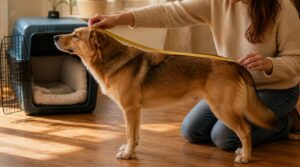
A dog’s body length sets the whole carrier fit. Use a flexible tape from nose tip to tail base, not the tail tip. Keep your dog standing naturally, head level, spine straight. Don’t compress the spine. Record twice for accuracy, to the nearest 1/8 inch. This is your true baseline for correct sizing.
For proper carrier dimensions, add 4 inches to your length measurement as recommended in standard sizing guidelines. Add 4 inches to length is a key step for ensuring adequate space in both home and travel carriers.
Measure Floor to Tallest Point

Stand a rigid tape at your dog’s shoulder, straight up from the floor to the tallest point of the head or ears. This Tall Point Measurement guards against a lid pressing down on sensitive ears.
Add 2-3 inches for a proper Headroom Clearance Check. Run this Vertical Space Verification against any Dog Crate Size Chart by Breed Weight before buying.
Measure The Widest Body Point
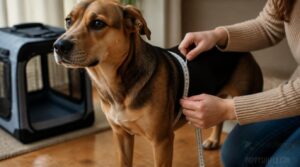
A dog’s ribcage, not the belly, usually marks the widest point. Locate widest point at the last rib, then wrap flexible tape snugly around for torso circumference.
Compare to carrier girth, adding room for movement clearance. Broad-chested breeds face real side compression risk if you skip this step before buying a dog carrier.
Keep Your Dog Standing Naturally

A slouched or sitting dog throws off every number you take. Natural standing posture keeps the spine straight and legs square, giving you a true read on length and height.
Skip bulky clothing or thick collars during this check. A carrier feels unstable when built on bad measurements, so get your dog calm, alert, and standing before you measure your dog’s length or height.
Use a Flexible Measuring Tape

A rigid ruler won’t bend around your dog’s ribs, so grab a flexible measuring tape instead.
Check the hook for looseness and confirm markings stay legible before you measure your dog’s length and height. Pull snug, not tight, staying within the tape’s elastic limit.
Store it flat, away from sunlight, and compare results against a Dog Crate Size Chart by Breed Weight alongside your dog’s weight.
Confirm Enough Space for Comfortable Movement
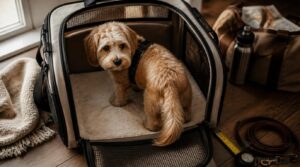
Getting the measurements right is only half the job. Your dog also needs room to move once inside the carrier. Here’s what to check before you call it a good fit.
Sitting Without Top Contact
When your dog sits up tall, its head shouldn’t brush the ceiling. Do a head clearance check: two to three inches above the skull is ideal.
Watch ear space allowance and neck position comfort. Flattened ears or a bent neck mean the top panel gap is too small. After measuring your dog’s height, confirm shoulder height fit too.
Turning Around Without Obstruction
After sitting comes rotating. Picture your dog spinning like a compass needle inside the carrier, unhindered, a full circle with room to spare.
- Smooth interior lining with no snags
- Rounded corners instead of sharp edges
- Zippers tucked away from the turning path
- A flat, non-slip floor for stable pivots
If a carrier sags excessively or your dog shows difficulty turning around, size up.
Lying With Legs Extended
Rotating is one test. Lying down flat is another.
Your dog needs room to stretch both front legs forward without folding them underneath. Six inches of floor clearance beyond body length gives hips and knees room to fully extend.
Cramped space causes difficulty lying down comfortably. Watch for tucked legs or restless shifting. That’s your sign the carrier’s too small.
Moving Without Wall Pressure
A good carrier stays quiet during a walk. Watch your dog’s hips and shoulders for wall contact as you move.
Shoulder movement clearance matters most when your dog shifts posture. If your dog slides around while walking, the carrier’s too roomy or poorly placed.
Keep it level. A natural standing position with smooth posture shifts means you’ve measured your dog correctly.
Small and Oversized Carrier Signs
Once you measure your dog and confirm carrier fit, labeling matters too, especially for oversized carriers on flights.
- Sign visibility standards: legible from 3-6 meters
- Oversized label placement: top or side, facing out
- Sign durability requirements: weatherproof, crack-resistant material
Reflective sign features help in dim cargo holds. Carrier sign compliance gets checked pre-flight, so confirm yours is intact.
Use Size Charts as Starting Points

Breed weight charts give you a helpful starting point. They’re not a guarantee of fit, since every dog’s build is different. Here’s how common breeds usually size up.
Toy Breed Carrier Examples
A Chihuahua under 6 pounds needs about 12-15 inches of interior length. Pomeranian carrier size and Yorkie carrier dimensions follow similar ranges.
| Breed | Interior Length |
|---|---|
| Chihuahua | 12-14" |
| Yorkie | 13-15" |
| Pomeranian | 14-15" |
Toy carriers cap weight limits near 8 pounds. Always measure your dog’s length, height, and weight before buying.
Small Breed Carrier Examples
Once your dog crosses the 6 to 12 pound mark, small breed interior measurements shift a bit. Shih Tzu size guide ranges call for 14-16" length.
| Breed | Interior Length |
|---|---|
| Shih Tzu | 14-16" |
| Pomeranian crate dimensions | 15-16" |
| Mini Poodle | 15-17" |
Check your dog’s weight and always measure your dog’s length before choosing.
Medium Breed Crate Examples
Twenty-five to fifty pounds covers a lot of ground. A Beagle carrier size or Springer Spaniel dimensions often lands near 30 x 19 x 21. Border Collie crate fit runs similar, sometimes needing extra medium breed clearance.
| Breed | Interior Size |
|---|---|
| Beagle | 30 x 19 x 21 |
| Border Collie | 30-34" L |
| Springer Spaniel | 30-36" L |
Adjustable crate padding helps fine-tune snugness.
Large Breed Crate Examples
Big dogs need big real estate. A Labrador Retriever fits an XL crate at 42 x 28 x 30, while a German Shepherd needs similar room. Great Danes require Giant crates, 54 x 35 x 45.
| Breed | Interior Size |
|---|---|
| Labrador Retriever | 42x28x30 |
| German Shepherd | 42x28x30 |
| Great Dane | 54x35x45 |
Adjustable dividers help puppies grow into their space.
Measurements Override Breed Estimates
No breed chart knows your dog’s actual body. A Dog Crate Size Chart by Breed Weight is a starting point, not gospel.
| Method | Basis | Accuracy |
|---|---|---|
| Breed chart | Average weight | General |
| Measurements | Your dog’s body | Precise |
Individual body proportions vary widely. Always measure your dog’s length, height, and weight, then confirm with a real-world comfort test before buying.
Match Carrier Types to Dog Size

The right size only works if the carrier style fits your dog’s body type too. Soft-sided, hard-sided, backpacks, slings, and crates each handle weight and movement differently. Here’s how to match the type to your dog.
Soft-Sided Carrier Fit
Soft-sided carriers work best for dogs up to 25 pounds. Mesh panels on multiple sides boost airflow, so measure your dog before buying.
Check interior padding thickness for joint support, and look for a removable washable liner. Try a carrier compression test—squeeze the sides gently to confirm your dog still has room without wall pressure.
Hard-Sided Carrier Fit
Hard-sided carrier fit suits dogs who paw at soft walls or won’t settle in a collapsing crate. Check ventilation panel placement on the sides and front for airflow, and test door lock security before travel.
Interior padding thickness should cushion elbows. Confirm handle adjustability range fits your grip, and pick a floor mat that’s removable for easy washing between trips.
Backpack Weight Distribution
Backpack carriers work best when your dog rides close to your spine, not swinging off your back.
Check Hip Belt Load Transfer, Shoulder Strap Padding, and Load Lifter Function before buying.
A dog who shifts around ruins Center of Gravity Balance fast:
- Sore shoulders after short walks
- A pack that sways with every step
- Straps digging into your collarbone
- Constant readjusting mid-trip
Sternum Strap Stability and adjustable straps solve this for real pet owner convenience.
Sling Size Limitations
Sling carriers work only for small, calm dogs on short trips.
Check sling width comfort against your dog’s girth to prevent pressure points. Measure your dog’s length and height first, then check your dog’s weight against sling limits.
Confirm sling-carrier compatibility and inspect stitching durability before use. Poor carrier weight distribution causes sagging, uneven load, and discomfort fast.
Large Dog Travel Crates
Once your dog tops 50 pounds, sling and backpack options fall away fast. Look for 1.0 to 1.5 cubic feet per 50 pounds of body weight, with ventilation on at least 60 percent of surfaces.
- Reinforced corners for crash resistance
- Breathable mesh panels for airflow
- Secure safety clips rated for weight
Measure your dog before choosing an airline-approved carrier.
Follow Airline Carrier Size Rules
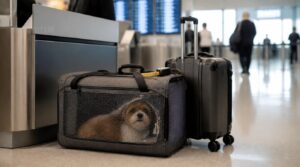
Airlines don’t leave carrier size up to guesswork. Each one sets its own rules, and those rules can make or break your travel day. Here’s what you need to check before you book that flight.
Cabin Versus Cargo Requirements
Where your dog rides changes everything about size. Cabin space limits mean your carrier must fit under the seat, so aircraft layout matters more than you’d think.
Cargo crates follow different rules entirely. They’re built to airline-approved pet carrier standards with sturdy sides and real ventilation, since pet safety in the belly of the plane depends on it.
Combined Dog and Carrier Weight
Weigh your dog before you weigh options. Cabin travel usually caps combined dog and carrier weight near eight kilograms, and that total includes the empty carrier itself.
- Check your dog’s weight on a home scale first
- Weigh the empty carrier separately
- Add both for your true travel total
- Confirm limits with your airline before booking
- Consider cargo if you exceed cabin thresholds
Domestic Versus International Policies
Flying overseas? Your dog’s carrier faces tougher rules. International flights often enforce stricter limits, like 16" × 10" × 8", versus more flexible domestic standards.
| Policy Type | Typical Size Limit |
|---|---|
| Domestic | 16–18" L range |
| International | 16" × 10" × 8" |
| Cargo hold | IATA-compliant only |
| Combined weight | 15–20 lbs cabin |
Always confirm carrier size compliance before booking international pet travel.
Standing, Turning, Lying Requirements
Every airline agrees on one rule: your dog must stand, turn around, and lie down inside the carrier. No exceptions.
Every airline agrees: your dog must be able to stand, turn around, and lie down inside the carrier, no exceptions
Check head clearance while standing, full turning space without wall contact, and leg extension while lying flat. Watch for smooth posture transitions and true movement freedom.
Measure your dog’s length and height first, then check your dog’s weight against your airline-approved pet carrier’s listed limits.
Confirm Current Airline Limits
Rules change often, so don’t trust last year’s memory. Airline seat dimensions and cabin baggage weight limits shift by carrier and route.
Before booking, check your airline’s current pet policy for:
- Under-seat clearance check for your exact carrier
- Cabin baggage weight caps
- International flight restrictions on pet travel
- Carrier size verification steps at check-in
- Fees for in-cabin dog carriers
Confirm size compliance close to your travel date.
Check Under-Seat Fit Before Flying

Passing airline size rules on paper doesn’t guarantee your carrier fits under an actual seat. Real planes vary more than you’d expect, and a snug fit isn’t something you want to discover mid-flight. Here’s what to check before you ever get to the gate.
Aircraft Seat Space Differences
Since no two planes are built alike, under-seat space can shrink or grow depending on aircraft and seat layout. Seat pitch varies from 28 to 34 inches, and width from 16 to 22 inches, which changes clearance below.
| Cabin Class | Under-Seat Height | Typical Pitch |
|---|---|---|
| Economy | 6-9 in | 28-31 in |
| Premium | 8-11 in | 34-38 in |
| Business | 10+ in | 38-60 in |
Premium cabin seats simply give your dog more breathing room.
Bulkhead and Exit Row Restrictions
That extra legroom in bulkhead and exit rows comes at a cost: no under-seat storage. You’ll need overhead bins instead, which airline regulations don’t always permit for pets.
Exit rows carry passenger responsibilities during emergencies, so airlines often restrict who sits there. Combined with variable boarding priority, these rows rarely suit dogs in a carrier. Pick a standard seat instead, and confirm your carrier size fits before booking.
Soft Carriers Compress More Easily
Soft-sided carriers squeeze into tight spots better than hard cases. Flexible fabric panels bend around your foot space, giving quick storage space savings under any seat type.
Compression recovery speed matters too. Good pressure distribution design lets the fabric bounce back fast, keeping your dog comfortable. Moisture resistance features protect against spills. Still, measure your dog’s length and height first, plus check your dog’s weight, for real pet travel safety.
Airport Carrier Fit Inspections
Gate agents check that your airline-approved pet carrier fits under the seat, with secure zippers and vents.
They confirm your dog can stand, turn around, and lie down without pressing on mesh walls.
Bring proof you measured your dog’s length and height, plus checked your dog’s weight. Carriers failing inspection may need a size upgrade, sometimes for a fee.
Test and Acclimate Before Travel
Before flight day, run a gradual exposure plan at home. Start with short carrier sessions, then let daily outings increase over five to seven days, with rest days for recovery.
Track comfort level daily, and adjust plans based on climate. Measure your dog’s length, height, and weight first. Watch for a dog struggling to stay balanced before you fly.
Avoid Common Carrier Sizing Mistakes
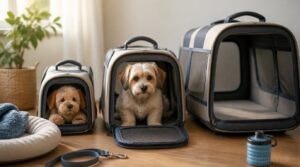
Even careful owners slip up when picking a carrier. Small errors in judgment can lead to a cramped, unsafe ride for your dog. Here are the mistakes you’ll want to sidestep.
Using External Carrier Dimensions
That listing on the box isn’t your dog’s real space. External vs internal sizing trips up a lot of owners, since carrier walls, seams, and padding eat into usable room.
Always check internal measurements against your dog’s length and height first.
- Confirm interior floor space, not box dimensions
- Account for padding thickness
- Verify seat clearance compatibility
- Test actual under-seat space
Choosing by Weight Alone
A number on a scale doesn’t tell you the whole story. Two ten-pound dogs can have completely different shapes, which means weight limits misleading by themselves.
Check your dog’s weight, but treat it as one data point, not the deciding factor. Actual fit priority always wins. Breed vs weight comparisons fail the same way. Trust internal sizing and real measurements over any label.
Buying The Largest Allowed Carrier
Bigger isn’t safer. Buying the max-allowed carrier "just in case" often backfires.
Airline seat compatibility fails when carrier size exceeds under-seat space, even within weight limit considerations. Measure your dog’s length and height first. Confirm your dog can stand, turn around, and lie down inside true carrier internal space before buying. An airline-approved pet carrier should fit your dog, not the maximum rulebook allowance.
Measuring With Bulky Clothing
A puffy winter coat can throw off every number you take. Fabric bulk adds false inches, so measure your dog’s length and height in a light layer, not a parka.
If bulky clothing is unavoidable, subtract 2-4 cm as a rough bulk adjustment. Then check your dog’s weight and recheck with a flexible tape for accuracy.
Skipping a Home Fit Test
A chart can’t tell you if the fit actually works. Before you fly, test the carrier at home. Let your dog step in, turn, sit, and lie down.
- Watch for wall pressure
- Check head clearance
- Confirm easy in-and-out movement
Don’t push the size limits based on measurements alone. A hands-on check catches what numbers miss.
Frequently Asked Questions (FAQs)
What size carrier for dogs on plane?
The smallest carrier is often the safest one. Most airline-approved pet carriers run about 18 by 11 by 11 inches, fitting under-seat clearance. Measure your dog’s length and height first, then check your dog’s weight against carrier limits.
Is a 20 lb dog considered small or medium?
Your 20 lb dog sits right on the border. Weight vs height and breed standards both matter here, so check your dog’s weight and height, not just the number, for the most accurate practical classification.
Can a 30 lb dog fit in a carrier?
Yes, a 30 lb dog fits a medium to large carrier with interior dimensions near 24-30" long. Measure your dog’s length and height, check your dog’s weight, and confirm airline-approved pet carrier compliance before booking travel.
What size travel crate for 20 lb dog?
Think Goldilocks, not guesswork. A 30 to 36 inch crate fits most 20 lb dogs. Measure your dog’s length and height, add clearance, and check your dog’s weight against airline limits before booking.
How often should I replace my dogs carrier?
Plan on replacing every 3 to 5 years, sooner with rips, stiff zippers, or cracked corners. Watch for odors, mold, or your dog’s growth outgrowing the fit. Re-measure your dog’s length and height, and check current airline compliance rules.
Can I use one carrier for multiple dogs?
Picture two Chihuahuas booked on the same flight, owners hoping to save space with one crate. Most airlines say no. Separate crates are standard, each sized to your dog’s measured length, height, and weight.
What carrier features help reduce travel anxiety?
Quiet interior design and adjustable ventilation panels ease sensory overload.
Soft interior padding, secure gear points, and expandable space options support canine comfort.
These features work together to lower dog anxiety during travel, keeping your pet calm and secure.
Are washable carrier liners better than disposable pads?
Washable liners often win on cost savings and environmental impact, using breathable, easy-to-clean fabric for canine comfort.
Disposables suit travel convenience, but proper carrier ventilation and hygiene practices make washable options a safe, sustainable everyday choice.
How do I clean and maintain a carrier properly?
Wash fabric liners with mild detergent, wipe hard surfaces, and disinfect interiors weekly. Air dry components fully. Choose easy-to-clean fabric and absorbent bedding, then run a monthly inspection to keep your dog’s crate fresh and durable.
Conclusion
Picture your dog stepping off the plane calm, not trembling. That’s what proper sizing buys you.
Once you know what size travel carrier your dog needs, every other decision gets easier: the type, the brand, the airline rules.
A tape measure tells you more than any chart ever will.
Skip the guesswork, measure your dog, test the fit at home, and travel day becomes routine instead of a gamble.
Your dog deserves that peace of mind.
- https://www.cfr.org/education/learn/reading/what-relationship-between-domestic-and-foreign-policy
- https://www.e-ir.info/2009/05/16/what-is-the-relationship-between-domestic-and-foreign-policy-should-they-even-be-distinguished/
- https://study.com/academy/lesson/domestic-vs-foreign-policy-definition-differences-policymaking.html