This site is supported by our readers. We may earn a commission, at no cost to you, if you purchase through links.
Watch a Labrador shake off after a swim—water flies everywhere, but thirty seconds later the coat barely looks damp. That’s not a coincidence.
Certain dogs carry what amounts to a built-in wetsuit, engineered over centuries of retrieving waterfowl in icy lakes and working alongside fishermen in the North Atlantic.
The secret lives in a surprisingly intricate coat architecture: layered fibers, skin oils that rival commercial waterproofing sprays, and curl geometry that slows moisture before it ever reaches the skin.
Knowing which water resistant dog fur types actually work—and why—changes how you care for your dog after every swim.
Table Of Contents
- Key Takeaways
- Best Water-Resistant Coat Types
- Double Coats That Shed Water
- Oily Coats With Water Repellency
- Curly Coats Built for Wet Weather
- Top Water-Loving Breeds
- Webbed Feet and Strong Swimmers
- Coat Features That Improve Buoyancy
- Grooming Water-Resistant Fur
- Health Risks After Water Exposure
- Frequently Asked Questions (FAQs)
- Conclusion
Key Takeaways
- A water‑resistant coat works through three layers of biology working together—oily guard hairs, a dense insulating undercoat, and curl geometry that forces moisture to take the long way in.
- Breeds like the Chesapeake Bay Retriever and Newfoundland weren’t just built for water by accident—centuries of selective breeding fine‑tuned their coats, body fat, webbed feet, and even their instincts for cold‑water endurance.
- Grooming isn’t just about looks; strip those natural oils with harsh shampoo, or skip the post‑swim dry, and you’re quietly dismantling the waterproofing your dog was born with.
- Trapped moisture under a thick coat is a fast track to hot spots, yeast infections, and ear problems—so drying the hidden spots (armpits, toes, ear canals) matters just as much as the obvious ones.
Best Water-Resistant Coat Types
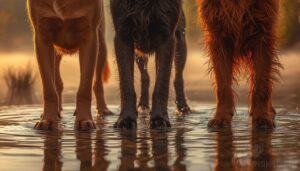
Not all dog coats are created equal — some are basically built-in rain jackets. A few specific coat types stand out for keeping your dog comfortable and dry in the water. Here’s what makes them work so well.
If you want to see which specific coat types actually hold up in a downpour, the best dog rain coats ranked by real-world performance breaks it down without the guesswork.
Double Coats and Their Insulating Undercoat
Think of your dog’s double coat as nature’s own layering system — a soft, downy undercoat sitting right against the skin, topped by tougher guard hairs above.
The undercoat’s Air Pocket Insulation traps warmth even when things get soggy.
Undercoat Density Variation shifts with each Seasonal Shedding Cycle, fine‑tuning your dog’s Thermal Regulation Mechanism through smart Layer Interaction Dynamics — no settings required.
This practice can lead to a skin cancer risk increase for the dog.
Oily Guard Hairs That Bead Off Water
Your dog’s skin glands are quietly doing something impressive — coating every guard hair with natural oils. That Oil Film Thickness determines how well water beads up and rolls off rather than soaking in.
Lipid Composition Variation even shifts with seasons, so your dog’s waterproof coat actually self-adjusts. Higher Droplet Contact Angle means water can’t cling — it just slides away, keeping that thick oily double coat doing its job.
Curly Coats That Slow Moisture Absorption
Beyond oils, curl geometry impact is doing real structural work. Those tight ringlets in curly-coated dogs — think Curly-Coated Retriever — create a tortuous path that slows moisture diffusion delay dramatically.
Air pocket trapping between coiled fibers keeps the skin drier longer.
Fiber flexibility effects mean water shakes off more easily, too.
It’s geometry working like a built-in umbrella for water-resistant double coats.
Dense Coats That Trap Warm Air
Density is the secret sauce here. All those tightly packed fibers in a thick coat create thousands of tiny air pockets — Air Pocket Density does its quiet job, keeping warmth locked close to the skin.
The outer coat barrier blocks wind before it can steal that heat away.
Seasonal Undercoat Growth naturally boosts Thermal Loft Maintenance, heading into winter, so your dog’s built-in insulation stays reliable without much help from you.
Double Coats That Shed Water
Some dogs don’t just tolerate water — they’re basically built for it. A double coat is the secret behind how breeds like Labs and Newfoundlands shake off a swim like it’s nothing.
Here are the standout examples worth knowing about.
Labrador Retriever Coat Structure
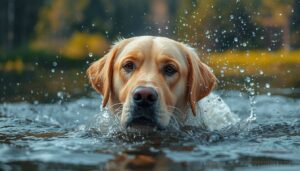
The Labrador Retriever’s double coat is basically a built-in wetsuit. Your Lab’s outer layer — short, dense, and slightly coarse — acts as the first shield, while the soft undercoat insulation traps warm air underneath.
Oil‑producing glands keep the water-repellent coat doing its job year‑round, even through the seasonal shedding cycle.
- Coarse outer hairs bead water off instantly
- Dense undercoat locks warmth close to the skin
- Oil gland production refreshes water resistance naturally
- Skin microbiome balance stays healthier when coat layers work together
Chesapeake Bay Retriever Weatherproof Coat
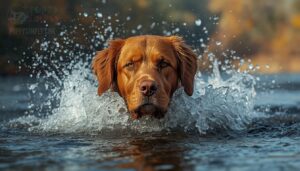
If the Lab’s coat is a wetsuit, the Chesapeake Bay Retriever’s is a dry suit. That woolly undercoat — packed with undercoat air pockets — blocks cold water from ever reaching the skin.
Oil production genetics push natural oils straight through the harsh outer layer, creating water-resistant double coats that shed water almost on contact.
The seasonal shedding cycle refreshes this system automatically, making grooming considerations for water-loving dogs surprisingly manageable.
Newfoundland Cold-water Protection
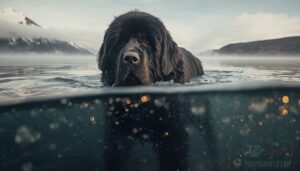
Think of a Newfoundland as a walking survival suit. Their double coat — dense undercoat plus oily guard hairs — delivers serious cold water insulation. That waterproof fur traps air close to the skin, slowing heat loss even in icy conditions.
Their cold shock adaptation goes beyond the coat, too:
- Lung capacity enables longer swims without fatigue
- Metabolic heat production keeps core temperature stable
- Body fat insulation adds a natural thermal buffer
- Thermoregulatory behavior — they pace themselves instinctively
- Water-resistant double coats shed water fast, preserving loft
Why Undercoats Help in Icy Water
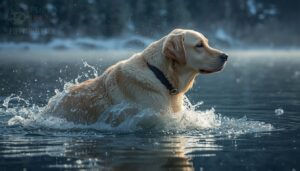
Here’s what makes an undercoat genuinely impressive — it’s not just fluff.
That dense layer creates Air Pocket Insulation right against the skin, acting as a Thermal Buffer Layer that slows heat loss even when icy water hits the outer coat.
Slower Water Penetration buys precious time, reducing Skin Chill while the Heat Retention Mechanism keeps your dog’s core stable. Double coat insulation, in short, works like a wetsuit you never have to put on.
A double coat insulates like a wetsuit you never have to put on
Oily Coats With Water Repellency
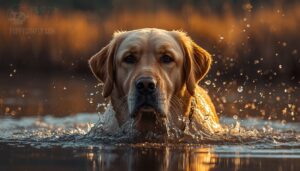
Some dogs don’t just shed water—they repel it before it even soaks in, thanks to natural oils their skin produces. It’s a built-in waterproofing system that certain working breeds have relied on for centuries.
Here’s a closer look at how that oily coat protection actually works across a few standout breeds.
Natural Skin Oils and Coat Protection
Your dog’s skin isn’t just skin—it’s a working factory. Those oil-producing glands churn out sebum constantly, building an occlusive lipid layer across every hair shaft. This promotes lipid barrier function, thermoregulation support, and sebum antimicrobial activity all at once:
- Repels water before it reaches the undercoat
- Blocks bacteria and fungi that thrive in dampness
- Maintains oil balance management for healthy, waterproof fur
Water Resistance in Working Breeds
Working breeds weren’t built for swimming by accident—centuries of selective breeding fine-tuned every detail.
Their water-resistant double coats rely on a precise Oil Production Cycle, where skin glands continuously coat each strand in hydrophobic fiber structure, beading water right off.
That Thermal Regulation Mechanism keeps your dog warm even when soaking wet, making cold retrieves surprisingly manageable for breeds engineered to do exactly that.
Chesapeake Bay Retriever Oily Fur
Chesapeake Bay Retriever takes oily fur to another level. Those oil-producing glands work overtime, running a near-constant Oil Production Cycle that keeps the double coat naturally slick and water-resistant.
It’s why bathing too often is a mistake — you’ll strip the Skin Microbiome Balance that makes this whole system work. Stick to a Coat Maintenance Schedule that respects the coat’s chemistry.
Portuguese Water Dog Coat Texture
Portuguese Water Dogs take a different approach than the Chesapeake. Their water-resistant coat comes in two textures — tight curls or loose waves — and both work through smart Oil Distribution Mechanics, spreading natural oils evenly across each strand.
Curl Geometry Hydrodynamics slows water from reaching the skin, while Wave Pattern Flexibility keeps the coat adaptive.
Skip regular brushing, though, and matting undoes everything.
Curly Coats Built for Wet Weather
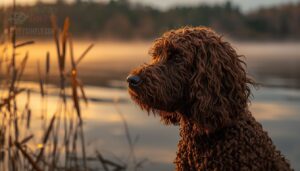
Curly coats are basically nature’s rain jacket — tight, oily, and surprisingly smart at keeping water out. Breeds like the Irish Water Spaniel and Portuguese Water Dog have coats that were built, quite literally, for a soaking.
Here’s what makes these curly coats so good at what they do.
Tight Curls and Moisture Resistance
Tight curls aren’t just cute — they’re engineering. The coil geometry of curly-coated dogs creates natural barriers that slow water penetration, thanks to surface tension working against straight-line absorption.
Each curl loop traps air and forces moisture to travel a longer path inward. Keep curl separation intact through regular grooming, and add drying airflow post-swim, because compressed, matted curls lose that water-repellent coat advantage fast.
Irish Water Spaniel Coat Advantages
The Irish Water Spaniel takes curly‑coat science seriously. Those dense ringlets aren’t random — each one facilitates ringlet insulation by trapping air close to the skin, while oil‑producing glands manage oil distribution across the water‑repellent texture automatically.
Here’s what makes their double coat genuinely impressive:
- Firm outer ringlets slow water absorption at the surface
- dense waterproof undercoat manages thermal regulation underneath
- Gentle shedding keeps your furniture manageable
- The water‑repellent coat sheds dirt along with moisture
- Light maintenance makes grooming considerations for water‑loving dogs far less overwhelming
Portuguese Water Dog Grooming Needs
All that swimming comes at a cost — grooming considerations for water-loving dogs like the Portuguese Water Dog are real.
Their water-repellent double coat needs weekly brushing, post‑swim drying, and bathing every four to six weeks using products that protect skin pH balance.
Coat conditioning, smart tool selection, and a professional trim schedule keep tangles from taking over.
How Curls Reduce Water Saturation
When a curly coat hits the water, it doesn’t just sit there soaking — it actually works against saturation. Tight curls create micro pocket ventilation between strands, trapping air and slowing how quickly moisture reaches the skin.
Curl airflow dynamics, combined with fiber angle effect and surface tension disruption, give water-resistant curls natural evaporation pathways.
For curly-coated dogs, that’s just smart biology.
Top Water-Loving Breeds
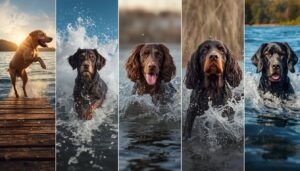
Some dogs don’t just tolerate water—they were practically built for it. Centuries of selective breeding gave certain breeds the coats, instincts, and physical traits to thrive in rivers, bays, and open ocean.
Here are six breeds that truly love getting wet.
Labrador Retriever
Few dogs love water quite like the Labrador Retriever — and their coat is built for it. That dense, water-resistant double coat sheds water fast, while the insulating undercoat keeps them warm even in cold lakes. Their friendly temperament and training ease make them ideal family dogs.
- Double coat repels water naturally
- Post swim drying prevents hot spots
- Exercise requirements are high — daily swims work perfectly
- Family compatibility is hard to beat
Chesapeake Bay Retriever
The Chesapeake Bay Retriever is basically a tank in dog form — built for brutal cold-water endurance that most breeds simply can’t handle. Their water-repellent double coat has a distinctly oily texture that sheds icy water almost instantly.
Weighing up to 80 pounds with a protective temperament, they’re serious working dogs.
Their historical retrieval role in freezing bay waters shaped everything about them — grooming considerations for water-loving dogs included.
Newfoundland
If any breed was born for cold water, it’s the Newfoundland Dog. Their water-resistant double coats combine a plush undercoat for thermal regulation with oily guard hairs that channel water away from skin.
Large body mass adds natural buoyancy, while webbed paws make every stroke efficient.
Factor in seasonal shedding, their rescue work legacy, and grooming considerations for water-loving dogs become especially important here.
Portuguese Water Dog
Portuguese Water Dog practically has saltwater in its DNA. Portuguese fishermen relied on these dogs for water retrieval training, herding fish, and hauling nets—a Historical Fisherman’s Role that shaped everything about how they’re built.
Their water resistant coats come in curly or wavy textures, powered by oil-producing glands that naturally repel moisture. No double coat structure means less shedding, though grooming considerations for water-loving dogs still apply.
Energetic Playfulness and a Family Friendly Temperament make their exercise requirements genuinely fun to meet.
Irish Water Spaniel
Where the Portuguese Water Dog thrives on salty chaos, the Irish Water Spaniel is its curly-coated cousin from the Irish countryside. Breed origin traces to the 1830s Ireland—Justin McCarthy’s dog Boatswain basically launched the whole lineage.
What sets them apart for water-loving families:
- Water-resistant double coats with tight curls that slow moisture absorption
- Natural oils keeping the water-repellent coat functional, swim after swim
- Energetic Temperament that makes exercise requirements genuinely enjoyable
- Problem-solving that responds well to training
- Family Compatibility with a mild reserve around strangers—grooming considerations for water-loving dogs included.
American Water Spaniel
Smaller than its spaniel cousins, but just as fearless in the water, the American Water Spaniel brings a lot of energy to a compact frame.
Its water-resistant double coat—curly or wavy, always that rich liver or chocolate brown—manages cold, wet conditions without fuss.
Historical hunting role aside, this breed’s energetic temperament means exercise requirements are real.
Budget time for grooming considerations for water-loving dogs, especially post-swim drying.
Webbed Feet and Strong Swimmers
A great coat only tells part of the story — the body underneath matters just as much. Some breeds are practically built like little swimming machines, with physical traits that make them genuinely hard to beat in the water.
Here’s what sets the strongest swimmers apart.
Breeds With Webbed Paws
Not all dogs are built equally regarding water — and paw webbing evolution plays a bigger role than most people realize. Aquatic paw morphology, shaped by webbing development genetics, gives certain breeds a serious edge in the water.
- Chesapeake Bay Retriever — prominent front-paw webbing for powerful paddling in marshy terrain
- Newfoundland — large, paddle-like webbed feet built for cold coastal endurance
- Portuguese Water Dog — strong webbed paws designed for rough water and fishing tasks
Better Propulsion in Water
Webbing is just part of the equation. What really drives a dog through water is how the whole body works together — think sleek body shape, tail wave mechanics, and propulsion stroke timing all clicking at once.
Water-resistant double coats and thick oily coats reduce drag, while aquatic retrieval instinct keeps the dog focused.
It’s natural fin geometry optimization, no engineering degree required.
Strong Hindquarters for Swimming
Think of hindquarters as your dog’s engine room. Hip Extension Power drives the hind leg backward, pushing water — and the body forward.
Knee Flexion Timing shapes each kick’s sweep, while Core Stability Integration keeps the spine aligned so nothing’s wasted. That Thigh Tail Timing and Propulsion Rhythm? It’s what separates a strong swimmer from a splasher.
- Hip extension generates the main push
- Knee flexion controls kick efficiency
- Core stability keeps propulsion on-axis
Large Bodies That Support Steady Movement
With a big breed like the Newfoundland, sheer size actually works in their favor. A wider stance lowers the center of mass, improving Base Support and keeping movement steady through choppy water.
Their Joint Alignment channels force efficiently through each limb, while Muscle Stabilization prevents mid-stroke wobble.
Add Traction Grip from webbed feet and smart Momentum Braking during turns—their water-resistant double coats, cold water endurance, and water rescue capabilities make it all click.
Coat Features That Improve Buoyancy
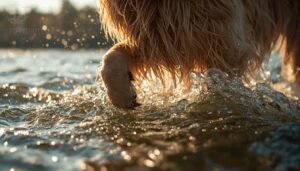
dog’s coat does more than keep them dry—it actually helps them stay afloat. The way fur traps air, sheds water, and holds its structure all plays into how long a dog can swim comfortably.
Here’s what’s really going on beneath all that fluff.
Thick Fur and Trapped Air
That thick coat isn’t just for looks — it’s basically a personal life vest. Fur loft creates air pocket retention between hairs, and those pockets are your dog’s thermal barrier efficiency in cold water. Here’s what’s happening beneath the surface:
- Insulation loft dynamics keep warm air locked close to skin
- Airflow resistance slows heat escape through dense layers
- Microclimate stability maintains body temperature even when the outer coat gets soaked
Water-resistant double coats in double-coated breeds do exactly this — thick water-resistant coats trap an insulation layer that cold water can’t easily defeat.
Dense Undercoats and Flotation Support
Your dog’s dense undercoat does something quietly impressive — it buoys them up. Air pocket retention between undercoat fibers creates natural flotation support, working alongside insulation heat retention to slow buoyancy loss rate in cold water.
In double-coated breeds, water penetration pathways are longer, so the insulation layer stays drier longer.
That undercoat volume impact? It’s basically a built-in swim aid.
Guard Hairs and Water Shedding
Guard hairs are your dog’s first line of defense — and the science behind Guard Hair Microstructure is surprisingly clever. These coarser outer hairs channel water away through Surface Tension Effects, letting it bead and roll off instead of soaking inward.
In water-repellent, double-coated breeds, this Shedding Mechanics system keeps the undercoat drier longer — a real grooming challenges reducer after every swim.
How Coat Texture Affects Endurance
Coat texture quietly determines how long your dog can keep going. In double-coated breeds, that layered structure slows the Heat Loss Rate by trapping air even when partially wet — a real advantage for Stamina Preservation on cold, soggy days.
Hydrophobic fur also speeds up Skin Drying Speed, supporting Energy Conservation and Movement Flexibility, so your dog stays comfortable and active instead of burning calories just staying warm.
Grooming Water-Resistant Fur
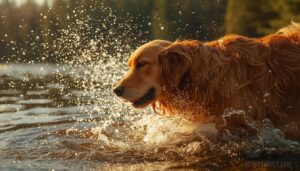
That impressive coat does a lot of work — but it doesn’t maintain itself. A consistent grooming goes a long way toward keeping your water-loving dog healthy and comfortable.
Here’s actually matters after a swim.
Brushing to Prevent Matting
With double-coated breeds, brush frequency really matters—aim for at least weekly, daily if your dog has curly or long fur. Tool selection is equally important; slicker brushes and wide-tooth combs work best for water-resistant coats.
Hit problem areas like ears, armpits, and collar zones first. Detangling sprays loosen stubborn knots before they worsen.
Always include quick skin checks—wet fur hides irritation fast.
Drying Thoroughly After Swims
Brushing addresses the matting, but drying after a swim is where most people slip up.
Start with towel blotting—press and hold, don’t rub.
Then let airflow drying do the rest; a fan works great.
Warm temperature safety matters too, so skip the high heat.
Always do hidden damp checks under the armpits and between toes—your drying time targets aren’t met until the skin feels dry, not just the fur.
Bathing Without Stripping Natural Oils
Drying done right sets you up — but bathing can quietly undo all of it.
Your dog’s oil-producing glands work hard to keep that water-repellent coat doing its job, and over-bathing strips that away fast.
Stick to mild cleansers, lukewarm water, and targeted rinsing on dirty spots only.
Hard water mitigation helps too — mineral buildup dulls the coat.
Skip the post-bath moisturizer unless your vet recommends one.
Ear Care After Water Exposure
Bathing protects the coat — but your dog’s ears need their own post‑swim routine.
Water sitting in the ear canal is basically a welcome mat for ear infections. Here’s what actually helps:
- Head Tilting Position — tilt each ear downward for Ear Canal Drainage, letting gravity do the work
- Ear Drying Techniques — towel the outer ear gently; use a low‑heat dryer if needed
- Post‑Swim Ear Drops — only when the eardrum is intact and no infection is present
Watch for Veterinary Red Flags: pawing at ears, head shaking, or any discharge after wet conditions.
Health Risks After Water Exposure
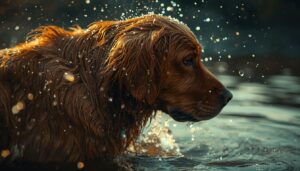
Even water-resistant coats have their limits — and wet fur that stays wet is basically a welcome mat for skin problems. Your beautiful, protective coat can actually work against them if you’re not careful after a swim.
Here’s what to watch for.
Hot Spots From Trapped Moisture
Hot spots are basically your dog’s skin throwing a tantrum—and trapped moisture is usually the culprit. With water-resistant double coats, the root zone stays damp long after the surface looks dry.
Don’t forget skin fold management around collars and leashes—collar leash drying matters more than most owners realize. Check bedding moisture control too, since damp spots breed friction hotspot prevention failures fast.
Yeast and Bacterial Skin Problems
Trapped moisture doesn’t just cause hot spots—it throws your dog’s skin microbiome balance completely off. Moisture-driven yeast thrives in those warm, damp folds, while barrier breach bacteria sneak in through irritated or softened skin.
Watch for these signs:
- Yeast scaling symptoms: redness with flaky, peeling edges
- Pus formation infection: swelling that signals bacterial skin infections
- Skin fold dermatitis in curly-coated breeds
- Interdigital dermatitis between wet, webbed toes
Yeast infections and skin infections need different fixes—so spotting the difference early matters.
Ear Infections in Floppy-eared Breeds
Floppy ears are basically nature’s moisture trap — and after swimming, that’s a problem. Poor ear canal aeration means water lingers, warmth builds, and microbial growth factors kick in quickly.
| Warning Sign | What It Means |
|---|---|
| Head shaking | Water or irritation inside |
| Discharge/odor | Active ear infection |
| Redness/scratching | Allergic ear inflammation |
Floppy ear flushing with a vet-approved solution after every swim helps clear debris before trouble starts.
Preventing Coat Damage in Wet Dogs
Think of your dog’s coat like technical outdoor gear — it needs proper care to keep performing. After every swim, focus on paw moisture management and undercoat air circulation first, since these spots hide dampness the longest.
Pat dry, then use gentle detangling tools once mostly dry.
A water-repellent coat or protective raincoat usage between swims reduces how often post‑swim grooming disrupts your dog’s natural coat maintenance balance.
Frequently Asked Questions (FAQs)
Do dogs inherit more from mother or father?
Neither parent wins — your dog inherits equally from both.
Maternal Gene Dominance and Paternal Trait Contribution share the stage, with Allele Inheritance Patterns, Sex-Linked Traits, and Epigenetic Parental Effects shaping every puppy together.
Can diet affect a dogs coat oil production?
Yes, absolutely.
Protein quality and omega-3 supplementation directly fuel oil-producing glands, while calorie balance and gut microbiome influence and keep skin secretions steady. Food allergies can quietly disrupt natural oil gland secretion too.
At what age does water resistance fully develop?
There’s no single magic age — water resistance builds gradually.
Most dogs develop a solid waterrepellent coat between 12 and 24 months, once undercoat development age peaks and guard hair growth reaches full, consistent coverage.
Can shaving a water-resistant coat damage it permanently?
Shaving can permanently alter your dog’s coat texture and density—sometimes the regrowth never fully matches the original.
You risk insulation reduction, texture alteration, and heat retention loss, especially with double-coated water dogs.
Conclusion
Studies show water-resistant dog fur types can repel up to 80% of surface moisture within seconds of leaving the water—a feat most technical fabrics still can’t match.
That natural engineering only holds up when you maintain it properly: brush regularly, dry thoroughly, and skip the harsh shampoos that strip protective oils.
Respect the coat your dog was built with, and it’ll keep doing its job season after season, swim after swim.
- https://www.maddogtailwaggers.com/general-1
- https://digital.groomertogroomer.com/issue/march-2024/a-deeper-dive-into-defining-the-double-coat/
- https://www.superiorcare.pet/blogs/news/double-coated-dogs-grooming-care-guide
- https://pmc.ncbi.nlm.nih.gov/articles/PMC9788630/
- https://vetexplainspets.com/what-type-of-coat-does-a-labrador-have/