
This site is supported by our readers. We may earn a commission, at no cost to you, if you purchase through links.

Your dog grabs the leash the second you clip it on, and by the end of the block it looks like it survived a paper shredder. Sound familiar?
Leash chewing isn’t random destruction. It’s communication — your dog telling you something specific about how they feel in that moment. A teething puppy mouthing everything in reach, an anxious adult self-soothing through rhythmic jaw movement, an overstimulated dog redirecting frustration it can’t release — these are different problems wearing the same behavior.
Knowing why your dog chews the leash is the only way to actually fix it. The cause shapes the solution, and getting that wrong means cycling through leashes indefinitely.
Table Of Contents
- Key Takeaways
- Dogs Chew Leashes for Stimulation
- Anxiety Can Trigger Leash Chewing
- Excitement Makes Leash Biting Worse
- How to Stop Leash Chewing
- When Leash Chewing Needs Help
- Frequently Asked Questions (FAQs)
- Why does my dog hold his leash in his mouth on walks?
- Do puppies grow out of leash biting?
- How to stop lead ragging?
- Can diet affect my dogs chewing behavior?
- How does age influence leash chewing frequency?
- Are certain dog breeds more prone to chewing?
- Does time of day affect leash chewing intensity?
- Can medications or supplements help reduce chewing urges?
- Conclusion
Key Takeaways
- Leash chewing is always communicating something specific — teething pain, anxiety, boredom, or frustration — and misreading the cause means every fix you try will miss the mark.
- Anxiety-driven chewing looks identical to excitement-driven chewing on the surface, but the triggers differ completely, so watch for stress signals like lip licking and freezing versus arousal cues like lunging and body stiffening.
- The fastest behavioral fixes — teaching "leave it," rewarding loose-leash moments, and redirecting to a chew toy — only stick when you apply them consistently before the habit becomes entrenched.
- Persistent chewing that doesn’t respond to redirection, or chewing accompanied by vomiting and appetite loss, warrants a vet or certified behaviorist visit, not another replacement leash.
Dogs Chew Leashes for Stimulation
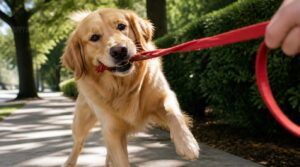
Leash chewing usually isn’t random — your dog is telling you something about what’s missing in his day. Whether he’s cutting teeth, under-stimulated, or just burning off restless energy, the trigger matters for finding the right fix. Here are the most common reasons dogs chew leashes for stimulation.
When the urge to chew is strong, redirecting him to indestructible dog toys built for heavy chewers can satisfy that drive without sacrificing another leash.
Puppy Teething Pain
Between 3 and 6 months, your puppy’s gums become red and swollen as adult teeth push through — and the leash is simply the closest thing to bite. You may notice increased drooling, irritability, or even a dip in appetite because chewing hurts.
Redirect immediately with appropriate chew toys; that alone can dramatically reduce how often the leash becomes a target. This period often involves common puppy teething symptoms that require patience and care.
Curiosity and Exploration
Teething explains a lot — but not everything. Older puppies and adult dogs chew leashes simply because their mouths are their primary investigative tool. When your dog spots something interesting across the street, the leash becomes the nearest chewable object within reach.
Dogs confirm what they smell by mouthing surfaces, mixing saliva with material to gather more sensory detail — a habit that makes the leash an oddly satisfying target during walks.
Bored Walking Routes
Same route, same smells, same nothing. When your dog trots the same block every morning, the walk stops delivering anything worth paying attention to — and the leash becomes the only interesting thing within reach.
Switching your route, even partially, resets that sensory flatline. A different street, the opposite side of the road, or simply reversing direction gives your dog genuinely new cues to process.
Unused Daily Energy
A new route helps, but route variety alone won’t cut it if your dog simply hasn’t moved enough that day. Pent-up physical drive needs somewhere to go — and when it doesn’t, the leash becomes the outlet.
Dogs often chew more intensely after long rest periods. Shorter, frequent activity sessions distributed through the day do more to reduce restlessness than one longer walk ever will.
Lack of Enrichment
Without enough mental stimulation, your dog’s brain goes looking for work — and the leash is right there.
- Scent puzzles address sensory enrichment gaps
- Food toys replace simple bowl feeding
- Rotating items restore sensory novelty
- Chew outlets let dogs practice mouthing safely
- Activities must match individual motivation needs
Canine enrichment only works when your dog actually engages with it — ignored toys don’t count.
Anxiety Can Trigger Leash Chewing

Not every dog chews the leash out of boredom or excess energy — sometimes, anxiety is the real driver. When your dog feels stressed or overwhelmed, chewing becomes a way to cope, much like nail-biting in people. Here are the anxiety-related triggers worth knowing about.
Dogs prone to anxiety on walks may benefit from gear designed to reduce tension—no-pull harnesses for city walks and crowded sidewalks can help keep reactive moments from escalating into full-blown stress spirals.
Stress During Walks
Some dogs chew the leash not out of mischief, but because the walk itself feels overwhelming. Watch for stress signals like panting, lip licking, or sudden freezing — these tell you your dog’s arousal is climbing past what they can handle.
When safe escape options disappear, chewing becomes the fastest self-soothing tool available. Keeping routes consistent early on reduces that tension considerably.
Fear of Surroundings
What happens when the outside world feels genuinely threatening? Environmental triggers — traffic, crowds, sudden noises — can overwhelm a dog unused to them.
Five common fear triggers:
- Loud or unpredictable traffic
- Unfamiliar people or animals
- Sudden movements nearby
- Strong, unknown scents
- Busy, confined spaces
Avoidance patterns deepen fast, and leash chewing becomes their quickest coping tool.
Separation-related Tension
Some dogs chew their leash specifically because it carries your scent, making it a familiar anchor when you’re gone. Chewing usually begins soon after you leave and worsens with longer absences — a clear sign of separation distress rather than misbehavior.
The leash functions almost like a transitional object, and rhythmic jaw movement provides genuine physical calming when nothing else is available.
Self-soothing Behavior
Chewing isn’t random — it’s your dog regulating emotional arousal the only way available in that moment. Rhythmic jaw movement delivers consistent sensory input that steadies rising tension before it peaks.
Leash chewing is not misbehavior — it is your dog steadying rising tension the only way available
Each episode that brings relief gets repeated. That’s why leash chewing becomes habitual: the behavior works, so the dog files it away as a reliable coping routine whenever boredom or anxiety builds on walks.
Overwhelming Environments
Some urban walks offer no predictable rhythm — just a continuous stream of traffic noise, unfamiliar scents, quick-moving strangers, and other dogs pulling at the edge of sight.
When sensory input stacks up faster than your dog can process it, the leash becomes the nearest available outlet. That repetitive biting isn’t defiance — it’s pressure finding the only exit available.
Excitement Makes Leash Biting Worse

Excitement can flip a calm walk into chaos faster than you’d expect. When your dog’s arousal spikes — whether from spotting another dog or pulling hard against the leash — that energy has to go somewhere, and the leash is right there. Here’s what’s actually driving the biting in those high-energy moments.
Seeing Other Dogs
The moment your dog spots another dog down the block, something shifts. Visual fixation locks in, scent trails sharpen the signal, and the leash suddenly becomes the nearest target for all that blocked energy.
Watch for these arousal cues:
- Body stiffening while staring at the distant dog
- Nose working overtime as scent drifts closer
- Sudden lunging forward against the leash
- Frantic circling or spinning in place
- Teeth finding the leash before you can redirect
Blocked interaction frustration drives this — your dog wants to approach but can’t.
High-energy Greetings
Seeing another dog triggers arousal, but greetings with people can push it even higher. Loud voices, quick movements, and leaning in all spike your dog’s excitement fast. That escalating arousal needs somewhere to go — and the leash is right there.
When you react to the biting, even by pulling away, you’ve just started a game. Calm, predictable greetings keep that cycle from forming.
Frustration From Pulling
Pulling adds its own layer. When your dog can’t reach what they want — a smell, another dog, a patch of grass — restricted movement goals build fast, and the leash becomes the nearest thing to act on.
- Straining toward a scent
- Movement just ahead
- Handler tightening the leash
- Stops breaking momentum
- High-value distractions nearby
That tension makes leash chewing almost inevitable.
Redirected Arousal
Pulling frustration can tip into something sharper. When your dog is highly activated by a trigger but can’t reach it, that arousal has to go somewhere — and the leash is always within reach.
Think of it as sensory spillover. The energy builds, options disappear, and your dog’s mouth finds the nearest outlet. Changing distance or route before arousal peaks is your most effective reset.
Tug-game Reinforcement
Some dogs learn fast that grabbing the leash starts a game. If you’ve ever pulled back or laughed, you’ve accidentally taught that leash contact equals tug.
Short, structured play cycles with a designated toy — where you control when play starts and stops — redirect your dog’s focus and replace the leash with a better outlet.
How to Stop Leash Chewing
Good news: leash chewing is one of the more fixable habits you’ll deal with as a dog owner. The key is responding consistently and swapping bad habits for better ones before they get entrenched. These five approaches will give you a clear starting point.
Teach “leave It”

Start with your fist closed around a treat and let your dog sniff without getting it. The instant they pull back, mark and reward with a different treat. That contrast is key — the leash becomes the thing they leave, not chase.
Practice in quiet spaces first, then gradually introduce the distraction of the leash itself on walks.
Practice “drop It”

Once the leash is in your dog’s mouth, "drop it" needs to work fast. Say the cue once, then immediately offer a high-value treat — reward within one second of release, not before.
A marker word like "yes" tells your dog the exact moment they got it right:
- Say "drop it" once, clearly
- Offer the treat as the mouth opens
- Mark the release with "yes" instantly
- Never reward while they’re still chewing
Hand signal consistency matters just as much as the verbal cue.
Reward Calm Walking

Calm walking doesn’t reward itself — you have to catch it happening. Walk at a steady, controlled pace on a low-distraction route, and the moment the leash goes slack, deliver a small treat quickly and quietly.
No excited talk, no sudden moves. Loose leash equals reward; that’s the only equation your dog needs to learn.
Redirect With Chew Toys

Carry a durable rubber toy in your treat pouch before the walk begins. The moment your dog’s mouth moves toward the leash, offer the toy calmly and pair it with quiet praise — timing matters more than anything here.
Stuffable toys filled with treats hold attention longest. Rotate a small set weekly so novelty doesn’t wear off, and always check toys for wear before heading out.
Avoid Leash Jerking

Jerking the leash when your dog bites it usually makes things worse, not better. Leash corrections increase anxiety, turning walks into something tense rather than rewarding. Best Friends Animal Society warns these methods can physically harm your dog and escalate pulling behavior.
A front-clip gear distributes pressure more evenly and reduces the urge to correct sharply — pair it with calm redirection instead.
When Leash Chewing Needs Help

Most leash chewing is manageable at home, but some situations genuinely call for outside help. If your dog’s chewing is getting worse despite your best efforts, it’s worth knowing what to watch for. Here’s when it’s time to take things further.
Persistent Destructive Chewing
Some dogs never outgrow occasional leash biting — it hardens into a habit cycle that repeats daily. Watch for these signs the behavior has crossed into persistent territory:
- Chewing resumes seconds after redirection
- No interest in substitute chew alternatives
- Scent-driven fixation on familiar leash fabric
- Toy rotation hasn’t shifted the target
At that point, standard fixes alone won’t break the pattern.
Possible Dental Discomfort
Not every chewing urge is behavioral. Sometimes your dog’s mouth is the problem — dentin hypersensitivity, cracked tooth pain, or a dental abscess infection can make biting and tugging feel oddly relieving, the way pressure counters a toothache.
Gum inflammation and jaw joint discomfort follow the same logic. If standard redirection isn’t working, schedule a canine dental health exam before assuming it’s purely habit.
Swallowed Leash Pieces
Dental pain may drive the chewing, but what gets swallowed is a separate problem entirely. Nylon, leather, and woven fabric can all form gastrointestinal blockages, and long strands risk becoming linear foreign bodies that tether intestinal segments together.
Watch for vomiting, appetite loss, or absent stools. Veterinary costs for obstruction treatment can reach $3,000, so prompt assessment matters.
Trainer or Behaviorist Support
When obstruction risk is on your radar, persistent leash chewing deserves equal attention from a professional dog trainer or behaviorist. They’ll assess the emotional drivers behind the behavior — anxiety, frustration, boredom — then build custom support plans around your dog’s specific triggers and your routine.
Handler coaching, progress tracking, and gradual canine behavior modification give you a clear, structured path forward.
Safer Walking Equipment
Switching to chew-proof leash materials removes the immediate problem while you work on behavior. Pair that with a front-clip body gear to reduce pulling tension, which is often what triggers biting in the first place.
A quick spritz of bitter deterrent spray on the leash adds another layer. If walks happen near dusk, clip on an LED light for visibility.
Frequently Asked Questions (FAQs)
Why does my dog hold his leash in his mouth on walks?
When your dog grabs the leash mid-walk, it’s usually oral exploration or overstimulation — the leash carries scent cues, offers texture, and triggers an attention-seeking cycle that quickly becomes habit.
Do puppies grow out of leash biting?
Some puppies do, but not all. Teething resolves by 24 weeks, yet behavior rehearsed daily can stick. Without training and managed trigger exposure, leash biting often outlasts the teething phase entirely.
How to stop lead ragging?
Swap a spare lead onto the collar, scatter treats on the ground, and stay calm — your energy is contagious. Toy redirection and loose-lead rewards resolve most cases fast.
Can diet affect my dogs chewing behavior?
Yes, diet plays a role. Soft or sticky foods leave residue that drives oral restlessness, while kibble that demands chewing helps satisfy that urge before a walk begins.
How does age influence leash chewing frequency?
Age shapes this more than most owners realize. Teething discomfort phases peak between 3–6 months, adolescent impulse control weakens around 7–12 months, and adult habit formation can lock in leash chewing long after the root cause fades.
Are certain dog breeds more prone to chewing?
Yes. Breeds like Boxers, Bulldogs, and Siberian Huskies carry stronger gnawing instincts and more powerful jaws, making leash chewing more likely — especially when combined with high energy, boredom, or separation stress.
Does time of day affect leash chewing intensity?
Yes — time of day matters. Morning arousal spikes and evening energy bursts both increase chewing intensity. Inconsistent walk timing raises frustration, while post-meal walks or earlier play sessions can noticeably reduce it.
Can medications or supplements help reduce chewing urges?
In some cases, yes. If anxiety is the main driver, a vet may consider SSRIs or calming supplements, but these work best alongside behavior modification — never as a standalone fix.
Conclusion
Picture two dogs, same leash, same sidewalk — one chewing from boredom, one from fear. Same behavior, completely different fix.
That’s exactly why understanding the cause matters more than swapping out gear. When you ask why does my dog chew his leash, you’re already asking the right question. Read the behavior, address the root, and the leash stays intact.
Consistent, calm training does what replacement leashes never will — it actually solves the problem.
- https://www.dogcharming.com.au/blog/please-stop-chewing-and-tugging-the-lead
- https://www.metrowestvetclinic.com/site/blog/2023/10/14/dog-chewing-problems
- https://playfulpack.com/news-and-blog/seven-effective-dog-boredom-solutions-for-happy-engaged-pups
- https://www.aspca.org/pet-care/dog-care/common-dog-behavior-issues/destructive-chewing
- https://www.zoetispetcare.com/blog/article/dog-leashes