This site is supported by our readers. We may earn a commission, at no cost to you, if you purchase through links.

The wrong leash doesn’t just make walks uncomfortable—it can turn a routine stroll into a tug-of-war you didn’t sign up for. A toy poodle on a 10-foot retractable line will wrap herself around every lamppost in sight, while a 90-pound Lab on a fraying 4-foot nylon strip is one squirrel away from dragging you across the street.
Leash choice runs deeper than most people expect. Size, material, walking environment, and your dog’s training level all pull in different directions—sometimes literally. Getting it right means calmer walks, better control, and a safer experience for both of you.
Here’s how to cut through the options and find the leash that actually fits your dog.
Table Of Contents
- Key Takeaways
- How to Choose a Dog Leash
- Choose The Right Leash Material
- Pick The Best Leash Length
- Match Leash Width to Size
- Compare Dog Leash Types
- Choose Based on Training Level
- Select Leashes by Activity
- Check Safety and Comfort Features
- Top 5 Dog Leashes
- Maintain and Replace Dog Leashes
- Frequently Asked Questions (FAQs)
- Conclusion
Key Takeaways
- Match your leash length and width to your dog’s size and strength — a 4‑foot, ¼‑inch strap suits a toy breed, while a large dog needs at least a 6‑foot, 1‑inch‑wide leash to stay safely under control.
- Your walking environment shapes your leash choice as much as your dog does — busy city sidewalks call for a short 4‑foot lead with reflective stitching, while trails and recall training need 15–30 feet of room.
- Leash material isn’t just about looks — nylon dries fast and handles most conditions well, leather molds to your grip over time, and chain resists chewing but adds fatigue on longer walks.
- Inspect your leash regularly for frayed fibers, bent clips or cracked leather and replace it the moment damage appears — a weakened leash is a safety risk that gives no warning before it fails.
How to Choose a Dog Leash

Picking the right leash comes down to a few key factors that are easy to overlook when you’re standing in the pet store aisle. Your dog’s size, your walking environment, and even your local laws all play a role in what’s actually going to work for you. Here’s what to keep in mind before you buy.
If you have a Yorkie or similar small breed, grooming needs factor into your routine too — check out this guide to the best shampoos for Yorkie puppies to keep their coat healthy between walks.
Start With Your Dog’s Size
Your dog’s size shapes every leash decision you’ll make.
Consider the dog size categories guide when matching leash length to breed.
- Toy breeds need 4-foot leashes to avoid tangling underfoot
- Medium dogs do well on 5–6 foot leads
- Large breeds handle 6–8 feet comfortably
- Giant breed puppies should start short, then gradually extend length
Broader chests and longer strides also affect how much leash tension you’ll feel.
Match Leash to Walking Location
Where you walk shapes your leash choice almost as much as dog size. Busy urban sidewalks call for a 4–6 foot leash to keep your dog close and pedestrians safe. Beaches demand stainless steel hardware to resist rust from salt spray.
| Location | Leash Length | Key Feature |
|---|---|---|
| Urban sidewalks | 4–6 ft | Reflective stitching |
| Parks & trails | 6–8 ft | Corrosion-resistant clip |
| Beach/waterfront | 6–8 ft | Stainless steel hardware |
Consider Training Level
Your dog’s training level matters just as much as its size. A 4–6 ft leash keeps puppies close during early socialization cues, while a long-line gives recall-focused dogs room to practice distance.
Pullers need sturdier training tools with controlled handling.
Service and therapy dogs follow standardized protocols with short leashes for precise, predictable control.
Check Local Leash Laws
Before you buy, check what your local municipality requires. In Germany, rules vary widely — Berlin limits leashes to one meter in pedestrian zones and two meters in parks.
Key rules to confirm:
- Leash length limits by location
- Breed-specific muzzling requirements
- Seasonal wildlife protection rules
- Public transport leashing rules
- Fines, which can reach €1,500
Local signage is your clearest guide.
Prioritize Comfort and Safety
Comfort isn’t a luxury — it’s what keeps you in control. A comfort grip handle with ergonomic padding reduces hand fatigue on long walks and helps you hold firm if your dog lunges. Shock-absorbing sections soften sudden pulls, protecting both your wrist and your dog’s neck.
Comfort keeps you in control — ergonomic grips and shock-absorbing leashes protect both your hands and your dog
Check the clip, too. Secure clip mechanisms rated to resist sudden force prevent accidental releases. Reflective stitching adds visibility after dark.
Choose The Right Leash Material
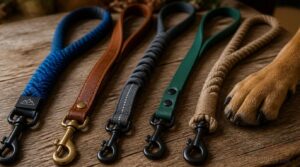
The material your leash is made from affects everything — how it feels in your hand, how long it lasts, and how well it holds up to your dog’s habits. Each option has real trade-offs worth knowing before you buy. Here’s how the most common materials stack up.
Nylon Leashes
Nylon leashes dry fast, resist mildew, and the nylon weave delivers real tensile strength — heavy-duty nylon tape aids up to 150 pounds of pull. That’s why nylon dog leash options suit most budgets and breeds.
- UV resistance keeps color and strength intact after extended sun exposure
- Zinc alloy clips resist rust and jamming through years of regular use
- Material longevity reaches a year or more with proper care
- Cleaning methods are easy — hand-wash with dog shampoo or machine-wash in a mesh bag
Leather Leashes
Few materials age as gracefully as leather. A flat leather leash or braided leather leash starts firm, then softens into a comfortable grip shaped by your hand over time — that’s the patina at work.
Full-grain leather resists abrasion well, and latigo leather controls daily tension without fraying.
Riveted, stainless steel hardware stays secure under sudden pulls, while burnished edges keep your palm irritation‑free.
Cotton Leashes
Cotton leashes are a natural fiber option that feel gentle on your hands and your dog’s coat.
- Soft texture reduces hand chafing
- Biodegradable and eco-friendly
- Stays cooler than synthetics in heat
- Hand-wash with mild soap; air dry only
- Absorbs moisture — dries slowly after rain
They wear faster than nylon, so inspect stress points near the clip regularly.
Chain Leashes
Chain leashes look tough — and they’re tough. Stainless steel or alloy links resist bending under heavy pulls, with most rated to handle 150–250 pounds depending on link gauge.
That said, they’re heavy, can injure a dog’s mouth if chewed, and offer poor training feedback. A padded or leather-wrapped handle helps with grip, but fatigue sets in fast on longer walks.
Weather and Durability
Your leash takes a beating from the elements year-round. UV exposure fades and weakens fabric after months outdoors, while rain accelerates rust on uncoated metal clips. In coastal or snowy areas, salt spray corrosion hits hardware fast.
Choose a weather-resistant leash material — UV-stabilized nylon or stainless steel hardware — and store it away from heat and direct sunlight when not in use.
Pick The Best Leash Length
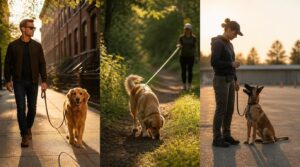
Leash length affects how much freedom your dog has and how much control you keep — and getting that balance right matters more than most people realize. The best length depends on where you’re walking, what you’re training, and sometimes even what the law allows. Here are the main leash lengths and when each one makes sense.
4. foot City Leashes
A 4-foot leash is built for city life, keeping your dog within arm’s reach when sidewalks get tight.
- Maintains urban walking control at crossings and doorways
- Reflective stitching boosts nighttime visibility for drivers and pedestrians
- Secondary D-ring adds a spot for compact leash accessories like waste bag dispensers
That shorter span — exactly 48 inches — also reduces tangling near traffic.
6. foot Everyday Leashes
Where the 4-foot keeps your dog close, the 6-foot lead opens things up — enough slack for sniffing without losing control.
| Feature | Benefit |
|---|---|
| Padded handle | Reduces hand fatigue on long walks |
| Reflective stitching | Improves dog walking safety at dusk |
| Bolt snap clip | Inspect monthly for bending or stiffness |
That standard leash length suits suburban sidewalks, loose-leash training, and everyday durable pet gear needs.
Short Traffic Leads
When precision matters most, short traffic leashes — usually 6 to 12 inches — give you a level of control that a 6-foot leash simply can’t match. Think of it as your dog’s city mode.
Padded hand grips and quick-release clips keep walks safe near traffic.
Service dogs rely on these for urban heelwork training and high-distraction management without drift.
Long-line Training Leashes
Where the short traffic lead ends, the long-line training leash begins. These run from 15 to 50 feet, with 30 feet being the most practical choice for recall training distance.
- Biothane is waterproof and rinses clean after muddy sessions
- Always attach to a dog vest, not a collar
- Keep the line beside your dog’s body to prevent tangling
- Shorter 15-foot options suit dogs new to long line leashes
Public Leash-length Limits
Most municipalities cap leash length at six feet in public spaces — and that limit applies to the leash itself, not just how much slack you’re holding. Retractable leashes can get flagged even when locked short, since enforcement targets maximum reach.
Rules vary by city, so check your local ordinances before heading out to avoid fines.
Match Leash Width to Size
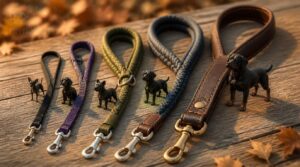
Leash width might not be the first thing you think about, but it makes a real difference in how well you can control your dog — and how long the leash actually holds up. The right width depends mostly on your dog’s size and strength. Here’s what to look for across different dogs.
Toy Breed Leash Width
Tiny dogs need a leash that doesn’t fight them. For toy breeds, ¼ to ½ inch width keeps things light and manageable on crowded sidewalks.
- Dogs under 8 lbs do best with ¼ inch width
- Narrow straps reduce trachea pressure during sudden pulls
- Lightweight hardware fits small collar rings without added bulk
- Slim leashes won’t catch on furniture or accessories indoors
For dogs up to 12 lbs, ⅜ inch balances durability with comfort.
Medium Dog Leash Width
Most medium dogs — usually 30 to 55 pounds — need a ⅝ to ¾ inch leash width. That range keeps the leash strong without digging into your hand on longer walks.
| Width | Dog Weight | Best Use |
|---|---|---|
| ½ inch | 20–30 lbs | Casual walkers |
| ⅝ inch | 30–45 lbs | Daily neighborhood walks |
| ¾ inch | 45–55 lbs | Strong pullers |
For dogs that pull aggressively, choose ¾ inch to reduce snap risk.
Large Dog Leash Width
Large dogs over 50 pounds need at least a 1-inch wide leash — anything narrower risks snapping under sudden lunges.
Five reasons width matters for big breeds:
- Breaking strength increases with wider webbing
- Spreads pull force to reduce grip fatigue
- Reinforced stitching resists fraying under heavy use
- Heavy-duty clips stay secure during strong pulls
- Thicker material discourages destructive chewing
German Shepherds and Labradors do best with 1-inch nylon or leather.
Strong Puller Considerations
Dogs that pull hard need more than just a wide leash — they need the full package.
A 1-inch heavy-duty leash with a padded ergonomic handle spreads force across your palm instead of concentrating it on your fingers.
Pair that with bungee shock absorption to soften sudden lunges and heavy-duty hardware like a locking carabiner to keep the clip from popping open mid-walk.
Chewing and Breakage Risks
If your dog chews the leash, replace it immediately — a single bite can weaken nylon fibers or splinter leather, creating a failure point you won’t notice until the leash snaps.
Metal chain segments can crack under aggressive gnawing, and synthetic coatings may peel to expose inner materials.
Redirect chewing with appropriate toys, and choose a chew-resistant leash with reinforced stitching and strong hardware.
Compare Dog Leash Types
Not every leash works the same way, and the right type really depends on how and where you walk your dog. Each design comes with its own strengths, so knowing what’s out there helps you make a smarter pick. Here are the five main leash types worth considering.
Standard Flat Leashes

Most dog owners reach for a standard flat leash without a second thought — and for good reason. These 4–6 ft nylon or leather leashes give you direct, one‑handed control on busy sidewalks. Nylon versions wash easily and resist water; leather softens over time, but needs conditioning.
A padded handle reduces fatigue on longer walks, and reflective stitching keeps you visible after dark.
Retractable Leashes
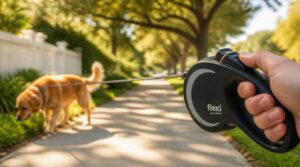
Retractable leashes extend anywhere from 16 to 26 feet with a push of a button, giving trained dogs room to sniff and explore. A reliable brake system and locking mechanism let you shorten the cord fast in traffic.
Even so, retractable leash drawbacks are real — the cord encourages pulling and can cause rope burn. A tangle-free retractable design and proper weight rating matching keep things safer.
Hands-free Leashes

If retractable leashes trade control for freedom, hands-free leashes trade your grip for something more — momentum.
Hands-free jogging with your dog clips the leash to a padded waist belt, keeping both hands available while staying tethered. Cross-body balance and bungee segments absorb sudden lunges without yanking your stride.
Five reasons runners choose them:
- Jogging ergonomics keep posture natural
- Waist-pack security holds the tether stable
- Bungee sections soften sharp pulls mid-run
- Reflective stitching improves nighttime visibility
- Built-in grips restore quick control instantly
Double-handle Leashes
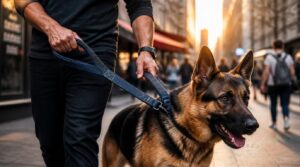
Where hands-free leashes free your grip entirely, double-handle leashes give you two strategic points of control instead.
The near-collar handle lets you rein in your dog instantly when another dog appears or traffic gets close. Dual-grip control also means smoother training redirection — gradual pressure rather than a sharp jerk. Padded grips and stress-point reinforcement keep both grips comfortable under tension.
Dual-dog Couplers
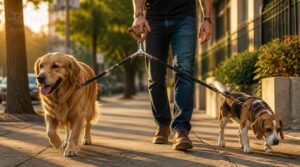
Walking two dogs at once is easier with a dual-dog coupler — a short splitter that connects both leads to a single handle. A central swivel keeps lines from tangling as your dogs move independently.
Each side adjusts separately, so you can space a larger dog away from a smaller one without one dragging the other off course.
Choose Based on Training Level

Your dog’s training level matters just as much as their size when picking the right leash. The wrong choice can actually make training harder — or even undo progress you’ve already made. Here’s what works best at each stage.
Puppies and Beginners
Young puppies and beginner dogs do best on 4–6 ft nylon or cotton leashes — soft enough to prevent leash-burn when they dart unexpectedly. Cotton is especially gentle during early loose-leash sessions.
Keep training sessions short, around 3–5 minutes, and reward calm, focused attention. A lightweight leash lets your puppy focus on learning, not fighting the weight pulling at their collar.
Loose-leash Walkers
Once your dog consistently walks with slack in the leash, a standard 6‑ft nylon leash gives them just enough freedom without losing control. Use a focus cue — a word or hand signal — to recenter attention before distractions strike, not after.
Reward calm positioning often, then gradually phase treats out, keeping verbal praise to lock in the habit.
Dogs That Pull
A dog that pulls isn’t being stubborn — it’s responding to prey drive triggers like joggers or cyclists with forward momentum it can’t yet control.
That’s why gear matters as much as training: a front-clip vest redirects pulling force to the chest, reducing pulling force without discomfort. Pair it with impulse control training to build the focus your dog needs before distractions hit.
Dogs That Chase
Chasing isn’t disobedience — it’s predatory drive firing at full speed the moment a squirrel bolts or a jogger passes.
Control starts before the trigger hits:
- Practice "watch me" and "leave it" drills daily
- Use a 6-ft training leash for controlled exposure
- Reward calm responses to movement with high-value treats
- Schedule walks during quieter times to limit temptations
Recall training is your safety net when impulse control isn’t enough yet.
Service and Therapy Dogs
Service and therapy dogs aren’t your average walking companions — their leash needs reflect their jobs.
Service dogs use short 4-ft nylon or leather leashes for precise control in public spaces where legal access rights apply. Therapy dogs rely more on calm temperament, but a standard flat leash suits most facility visits well. Leash safety and secure clip hardware are non-negotiable — no retractables, no decorative tassels.
| Dog Role | Recommended Leash |
|---|---|
| Guide or mobility service dog | 4-ft leather or nylon |
| Psychiatric service dog | 4-ft nylon, padded handle |
| Therapy dog | 6-ft standard flat leash |
| Facility dog | 4–6-ft nylon |
| Emotional support dog | 6-ft nylon or cotton |
Select Leashes by Activity

The right leash for your morning neighborhood stroll probably isn’t the right one for a trail run or a recall training session in the park. Your activity shapes what you actually need — the length, the style, and even how much control you want in your hand. Here’s how to match your leash to what you and your dog are actually doing.
Daily Neighborhood Walks
Most neighborhood walks cover 0.5 to 2 miles, so a 6-foot nylon leash does the job well — enough freedom for your dog to sniff around without losing control.
Morning routes tend to be quieter, which helps dogs stay focused.
Carry waste bags, watch for crosswalks, and stick to shaded paths when it’s warm.
Busy Urban Walks
City sidewalks — often just 1.5 to 2.5 meters wide — leave little room for error. A 4-foot leash keeps your dog close through crowded crosswalks and past busy transit hubs, where pedestrian density spikes and distractions multiply fast.
Skip retractable leashes here. You can’t react quickly enough when a bus pulls in or a cyclist cuts the curb. Reflective stitching helps after dusk.
Running and Hiking
Trail runs demand a hands-free leash — a bungee leash clipped to a waist belt absorbs sudden lunges mid-stride.
Before any outdoor adventure with your dog:
- Do active warmups — hip circles and leg swings
- Bring water; hydration strategies mean sipping every 15–20 minutes
- Follow trail etiquette: yield to uphill hikers
- Carry GPS for navigation safety
- Match trail footwear to the terrain
Recall Training
A long training leash — usually 15 to 30 feet — gives your dog room to roam while keeping you in control.
Use high-value rewards the moment your dog returns to you, and keep your recall cue consistent every session.
Start in a low-distraction yard, then gradually introduce real‑world distractions as reliability builds.
Walking Multiple Dogs
Walking two or more dogs at once means your gear needs to work harder. An adjustable coupler connects both leashes to a single handle, reducing tangles and keeping your pack aligned.
Match leash length to your route — shorter in crowds, longer in open spaces. Pace with the slowest dog and use front-clip harnesses on pullers to maintain control without the chaos.
Check Safety and Comfort Features

Once you’ve nailed down length and material, it’s time to look at what the leash actually feels like in your hand — and how well it keeps your dog secure. A few key features can make a real difference on everyday walks, especially with strong pullers or low-light conditions. Here’s what to look for.
Padded Ergonomic Handles
A leash that hurts your hand won’t stay in it for long. Padded ergonomic grips distribute palm pressure evenly, so you’re not white-knuckling through a 45-minute walk. Closed-cell foam cushioning resists moisture, while contoured palm shapes and raised ridges guide your fingers into a natural hold — reducing hand fatigue without requiring a tighter grip.
- Closed-cell foam dries fast
- Textured surfaces improve wet-hand grip
- Wider lower sections support your palm heel
- Removable inserts let you customize cushioning level
Reflective Stitching
After dark, your dog becomes nearly invisible to drivers — and that’s where reflective stitching earns its place. Tiny microprismatic beads woven into the thread bounce light straight back toward its source, making a leash glow in headlights from a distance.
Most reflective leashes for visibility hold their brightness through 10+ wash cycles, so the safety doesn’t fade with the novelty.
Shock-absorbing Sections
A sudden lunge from your dog sends a jolt straight up your arm — a shock-absorbing section cushions that impact before it reaches you.
These segments use viscoelastic polymer damping to absorb and dissipate pull energy:
- Reduces peak force during sudden tugs
- Minimizes handler fatigue on long walks
- Maintains damping performance in wet conditions
- Survives thousands of compression cycles without cracking
Pull control feels noticeably smoother with one fitted correctly.
Secure Leash Clips
The clip connecting your dog’s leash to its collar is a small piece of hardware that carries a lot of responsibility.
A secure metal clip — whether a spring-loaded snap, auto-locking design, or screw-gate variant — prevents accidental release mid-walk.
Check that it matches your dog’s collar hardware and test it regularly by opening and closing it roughly 20 times.
Avoid Decorative Hazards
Some leashes look fun with tassels or charms — but those extras can turn into pet safety hazards fast.
Avoid leashes with:
- Tassels that dogs can chew off and swallow
- Decorative cords that fray and cause leash wear or mouth injury
- Small ornaments that break into sharp or ingestible pieces
- Attachments with loose hardware that detach unexpectedly
Stick to clean, functional designs your dog can’t dismantle.
Top 5 Dog Leashes
Once you know what features matter most for your dog, finding the right leash comes down to matching those needs to a solid product. The five options below cover a range of styles, sizes, and uses — so whether you’re training a puppy or jogging with a seasoned walker, there’s something here for you. Here are the top picks worth considering.
1. Max Neo Double Handle Reflective Leash
The Max Neo Double Handle Reflective Leash is built for large or strong dogs that need real control on walks. Its two neoprene-padded hand grips — one near the clasp, one about 18 inches back — let you shorten your grip instantly in traffic or crowds without fumbling.
The 1-inch heavy-duty nylon webbing holds up under strain, and reflective stitching on both sides catches headlights at night. Every purchase also donates a leash to a U.S. dog rescue.
| Best For | Owners of large or strong dogs who want better control and comfort on walks, especially at night or in busy areas. |
|---|---|
| Leash Length | 6 ft |
| Material | Nylon webbing |
| Clasp Type | Gunmetal bolt snap |
| Weight | 6.4 oz |
| Dog Size Fit | Large/strong breeds |
| Primary Use | Daily walks |
| Additional Features |
|
- Two padded handles let you quickly shorten your grip in tight situations without losing control
- Reflective stitching on both sides keeps you and your dog visible on night walks
- Every purchase donates a leash to a U.S. dog rescue, so you’re helping another dog get adopted
- At 6.4 oz, it’s heavier than minimalist leashes, which may feel like overkill for small breeds
- The fixed handle positions might not work perfectly for every handler’s preferred grip style
- The metal bolt-snap clasp can be tricky to operate with just one hand
2. PetSafe Nylon Dog Leash
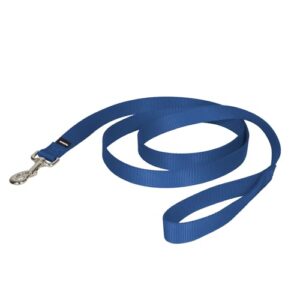
The PetSafe Nylon Dog Leash takes a simpler approach than the Max Neo — no double handle, no reflective trim, just a reliable everyday leash for routine walks. The 6 ft length and 1-inch width suit most medium to large dogs, and the nickel-plated zinc alloy bolt snap clicks on and off quickly.
Nylon dries fast after rain and withstands regular washing well. Just check it periodically for fraying, since aggressive chewers can work through nylon faster than leather.
| Best For | Owners of medium to large dogs who want a no-fuss, affordable everyday leash for routine walks and basic training. |
|---|---|
| Leash Length | 6 ft |
| Material | Nylon webbing |
| Clasp Type | Nickel-plated zinc alloy snap |
| Weight | 4.8 oz |
| Dog Size Fit | All sizes |
| Primary Use | Daily walks |
| Additional Features |
|
- Quick-clip bolt snap makes attaching and removing the leash a breeze
- Dries fast and holds up well to regular washing
- Lightweight and comfortable to hold during daily walks
- Determined chewers can gnaw through nylon fairly quickly
- Picks up dirt and stains more visibly than leather or other materials
- Fixed 6 ft length can feel awkward with very small dogs or in tight spaces
3. Andromeda Adjustable Hands Free Leash
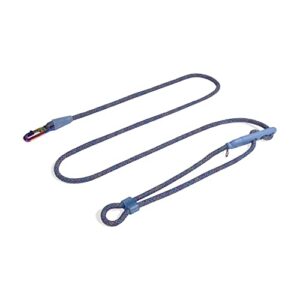
If hands-free walking sounds appealing, the Zee.Dog Andromeda is worth a look. It adjusts from around 3 ft to 7 ft 10 in, switching between waist, crossbody, long-lead, and tether modes without removing the leash.
The built-in E.Zee Lock lets you clip the dog to a bench or post mid-walk — handy at coffee shops or transit stops.
That said, the thin rope isn’t ideal for strong pullers, and the rubber end cap can loosen over time.
| Best For | Owners who want a versatile, hands-free option for calm or small-to-medium dogs, especially those dealing with wrist or hand pain. |
|---|---|
| Leash Length | 7 ft 10 in |
| Material | Nylon rope |
| Clasp Type | Anodized metal hook |
| Weight | Not listed |
| Dog Size Fit | Small to medium |
| Primary Use | Hands-free walking |
| Additional Features |
|
- Switches between four modes (crossbody, waist, long leash, tether) without unclipping your dog
- Built-in E.Zee Lock makes it easy to secure your pup to a bench or post mid-walk
- Reflective segment adds visibility for early morning or evening walks
- Thin rope can cause rope burn and isn’t suited for strong pullers or large dogs
- The plastic adjuster can be stiff and awkward to use on the go
- Rubber end cap on the leash tip tends to loosen and may need to be glued down
4. Tug Retractable Dog Leash
Where the Andromeda keeps things manual, the Tug Retractable Leash automates the slack. Its 16 ft nylon tape extends and retracts with a one-handed thumb brake, so you can slow your dog mid-stride without fumbling. The 360° tangle-free inlet keeps the tape from binding when your dog circles you on the trail.
That said, retractable leashes aren’t for every dog. If yours hasn’t mastered loose-leash walking yet, the free-roaming cord can strengthen pulling habits fast.
| Best For | Dog owners who want freedom of range on walks while keeping reliable one-handed control over a well-trained, non-aggressive dog up to 55 lbs. |
|---|---|
| Leash Length | 16 ft |
| Material | Nylon tape |
| Clasp Type | One-hand brake lock |
| Weight | Not listed |
| Dog Size Fit | Up to 55 lb |
| Primary Use | Extended roaming |
| Additional Features |
|
- The 360° tangle-free inlet and heavy-duty retraction coil keep things smooth even when your dog is circling or changing direction
- One-hand thumb brake lets you pause, slow, or lock the leash instantly without breaking stride
- The included bite-resistant lead adds extra length and a layer of protection against chewers
- Not a great fit for dogs still learning leash manners — the free-roaming cord can actually reinforce pulling
- The retraction mechanism has been known to jam or fail after about a year of heavy use
- The 360° inlet can trap mud and debris in wet conditions, so it needs occasional cleaning to stay functional
5. Hi Kiss 30ft Nylon Training Leash
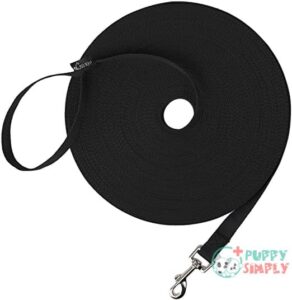
When distance is the point, the Hi Kiss 30ft nylon leash gives you room to work. At 30 feet with ¾-inch reinforced webbing and a nickel-plated swivel snap, it’s built for recall drills, open-field exploration, and backyard obedience practice with medium to large dogs.
Keep one thing in mind: the swivel snap can deform under extreme loads, and heavy chewers will wear through the nylon fast. For focused training sessions, though, it’s hard to beat the reach.
| Best For | Owners training medium to large dogs who need room for recall drills, open-field exploration, and off-leash obedience work in parks, trails, or the backyard. |
|---|---|
| Leash Length | 30 ft |
| Material | Nylon webbing |
| Clasp Type | Nickel-plated swivel snap |
| Weight | 5.29 oz |
| Dog Size Fit | Medium to large |
| Primary Use | Training and recall |
| Additional Features |
|
- 30 feet of reach gives dogs plenty of room to roam while keeping you in control
- Lightweight and easy to coil, so it travels well for hikes, camping, and agility sessions
- Reinforced stitching and a swivel snap help prevent tangling during active movement
- The swivel snap can deform under heavy pulling from very strong dogs
- Nylon webbing is prone to fraying if stitching fails or the leash gets repeatedly snagged
- Not a good fit for heavy chewers, who can damage the nylon quickly
Maintain and Replace Dog Leashes

A good leash doesn’t last forever, but with the right care, it can go a long way. Knowing when to clean, condition, and swap out your leash is just as important as picking the right one in the first place. Here’s what to keep an eye on.
Inspect Frays and Clips
Run your fingers along the full length of the leash — any fuzzing or exposed inner fibers mean the material has weakened and can snap under tension. Pay close attention to stress zones near the handle and clip attachment, where wear concentrates fastest.
Check the clip spring closes firmly with no hesitation, and look for rust or visible cracks in the metal body.
Clean Nylon Leashes
Fill a bowl with lukewarm water and a small amount of pet-safe soap, then soak the nylon leash for 5–10 minutes before scrubbing with a soft bristle brush. Rinse thoroughly — soap residue attracts dirt and can irritate your dog’s nose or paws.
- After saltwater exposure, rinse immediately to stop salt from crystallizing in the webbing
- Air dry in shade to prevent UV fiber damage
- Store completely dry to block mold growth
Condition Leather Leashes
Leather needs more care than a quick rinse. Every 2 to 3 months, apply a thin, even layer of dedicated leather conditioner — never over-soak it, as excess product weakens stitching.
Before full application, test on a small hidden spot to check color stability. After rain, let it dry at room temperature first, then condition to prevent cracking.
Replace Damaged Leashes
A worn leash is a safety risk waiting to happen. Replace yours when you spot any of these signs:
- Fraying that covers more than half the leash width
- Bent or rusted clasps that won’t snap shut cleanly
- Unraveling stitching at the handle join
- Deep cracks or separating layers in leather
After swapping in new hardware, recheck the connection after 24 hours of regular use.
Store Leashes Properly
Where you stash your leashes matters more than you might think. Hang them on individual hooks in a dry, temperature-controlled spot — away from direct sunlight, which fades colors and weakens fibers over time.
Before storing, wipe each leash down and let it air dry completely. A small desiccant pack in your storage bin keeps humidity from quietly doing damage between walks.
Frequently Asked Questions (FAQs)
What words do dogs hear best?
Dogs don’t care about your vocabulary. Short, sharp commands like sit, come, and stay land best — one or two syllables, crisp consonants, consistent tone. That’s what cuts through noise and sticks.
Can I use the same leash indoors and outdoors?
Yes, you can. A single leash works indoors and outdoors if it fits your dog well and the hardware holds up to weather. Inspect the clip regularly for wear.
How do I transition my dog between leash types?
Switching leashes overnight can feel like handing your dog a completely foreign object. Start with indoor acclimation first — let them wear the new leash at home before any outdoor session begins.
Are color or pattern choices purely aesthetic?
Not entirely. Reflective stitching improves low-light visibility, and high-contrast colors help handlers spot clips faster. Color-coded parts also reduce errors when walking multiple dogs.
What age should puppies start leash training?
Between 8 and 12 weeks is the ideal window — puppies are in their social learning peak, so early exposure to a leash builds calm, confident habits before outdoor walks begin.
Can leashes help manage dog-to-dog aggression?
A leash won’t cure aggression, but it gives you real control. You can limit proximity, guide quick turns, and de-escalate tension before it builds — making every encounter safer and more manageable.
Conclusion
The right leash is the handshake between you and your dog—it sets the tone before you even reach the sidewalk. Knowing how to choose a dog leash means weighing size, material, length, and your dog’s behavior as a whole picture, not separate checkboxes.
A good match makes walks feel smooth.
Inspect it regularly, replace it when it wears out, and trust that small decisions like this quietly shape every walk you’ll ever take together.
- https://www.nytimes.com/wirecutter/reviews/best-everyday-dog-leash
- https://news.orvis.com/dogs/long-vs-short-dog-leashes-choose
- https://www.consumerreports.org/home-garden/pet-supplies/best-dog-leashes-a3957057656
- https://www.rayallen.com/the-ultimate-guide-to-best-dog-leash-leads-lines-for-k9-working-dogs
- https://www.fordogtrainers.com/blog/types-of-dog-leashes