This site is supported by our readers. We may earn a commission, at no cost to you, if you purchase through links.

Most dog owners spend months repeating the same commands, wondering why their dog looks confused or distracted. The problem usually isn’t the dog—it’s the feedback gap between what the dog does right and when the owner responds. Dogs learn in split seconds, and a reward delivered three seconds late teaches something entirely different from what you intended.
Marker training closes that gap with a precise signal that tells your dog, "That exact thing—right there—earned your reward." Once your dog understands the marker, your training sessions get shorter, clearer, and far more productive.
Table Of Contents
- Key Takeaways
- What is Marker Training?
- Why Marker Training Works
- Choose Your Dog’s Marker
- Pick Effective Reinforcers
- Charge The Marker Correctly
- Teach Basic Marker Exercises
- Add Cues and Commands
- Build Advanced Marker Skills
- Use Rewards Strategically
- Fix Marker Training Problems
- Frequently Asked Questions (FAQs)
- Conclusion
Key Takeaways
- Your marker only works if it lands within one second of the behavior—miss that window, and you’ve accidentally taught your dog the wrong thing.
- Charging the marker first isn’t optional; without 30–50 quick sound-and-treat pairings, the click or "yes" means nothing to your dog.
- Don’t attach a cue word until your dog hits the behavior reliably around 80% of the time—naming it too early just creates confusion.
- Once behaviors are solid, switch from rewarding every repetition to a variable schedule, since unpredictable rewards actually build stronger, more lasting responses.
What is Marker Training?

Marker training is one of the clearest ways to communicate with your dog — it tells them exactly what they did right, at the exact moment they did it. Before you start clicking or using a cue word, it helps to understand what a marker actually is and how it works. Here’s what you need to know.
(https://puppysimply.com/what-are-pointers-bred-for/), giving you a precise, consistent way to mark the exact behavior you want your dog to repeat.
Marker Meaning for Dogs
Think of a marker as a split-second signal that tells your dog, “Yes — that exact moment is what I want.” It’s a bridge between behavior and reward, creating a behavioral contract, your dog can trust. When that marker sound lands within one second of the right action, your dog learns to connect what it just did to what comes next.
Understanding a consistent audible marker helps guarantee the reward follows the signal reliably.
Clicker Versus Marker Word
Your marker choice comes down to two options: a clicker or a verbal marker like "yes." A clicker delivers a mechanical, perfectly consistent sound every time, while your voice naturally shifts in tone and speed.
For pinpointing fast, precise moments, the clicker’s 100–200 millisecond signal wins.
That said, a verbal marker travels with you everywhere — no equipment needed.
Why Timing Matters
Choosing your marker is just the first step — knowing when to use it is where real training happens.
Precision Timing separates effective marker training from guesswork. Your dog’s brain links the marker to whatever behavior occurred at that exact moment. Miss the critical timing window of about one second, and you’ve accidentally marked the wrong thing.
- Immediate Marker delivery tells your dog exactly which movement earned the reward
- Zero Delay prevents your dog from connecting the marker to the wrong action
- Consistent Rhythm builds faster understanding over fewer repetitions
- Rapid Delivery sharpens your dog’s decision-making across every session
Late marking is one of the quietest training mistakes — your dog doesn’t argue, they just learn the wrong lesson.
Late timing teaches the wrong lesson — your dog never argues, they just quietly learn what you accidentally marked
Marker as a Promise
Every marker you give your dog is a commitment. When you mark a correct behavior, your dog expects a reward — and that expectation is the engine driving all marker training progress.
Break that promise even once, and your dog starts doubting the signal. Treat the marker like a handshake: firm, honest, and always followed through.
Why Marker Training Works

Marker training isn’t just a trendy technique—there’s real science behind why it works so well. Understanding the "why" will make you a more confident, effective trainer from day one. Here’s what’s actually happening in your dog’s brain when you use a marker.
Operant Conditioning Basics
B.F. Skinner figured this out in the 1930s: behavior that gets rewarded happens more often. That’s operant conditioning in short.
When you mark and reward your dog’s sit, you’re using positive reinforcement — adding something good to strengthen that behavior.
Over time, your dog isn’t just obeying. They’re actively choosing actions that work.
Instant Feedback Benefits
Timing is everything in marker training. When you mark a behavior, the instant it happens, your dog’s attention is still locked on that exact moment — making the connection between action and reward crystal clear.
This instant feedback eliminates guesswork, speeds up learning, and keeps your dog engaged, motivated, and genuinely enthusiastic to try again.
Conditioned Reinforcers
Fundamentally, a conditioned reinforcer is any neutral signal — a click, a word, a tone — that gains real motivational power through repeated pairing with food or another primary reward.
Your clicker doesn’t start out meaningful to your dog. Charging your marker builds that meaning. Once established, even your verbal marker alone can sustain focused behavior between treats.
Faster Dog Learning
Here’s a fact that might surprise you: marker-trained dogs complete tasks 30–60% faster than dogs trained with food alone. That’s not a small edge — that’s a different game entirely.
When clean timing feedback pairs with strong reinforcers, your dog stops guessing and starts connecting dots precisely. Short mini sessions repeated throughout the day compound that speed, turning gradual progress into genuine training acceleration.
Choose Your Dog’s Marker

Not every dog reacts to the same signal, and that’s perfectly normal. The right marker depends on your dog’s senses, your training environment, and what you can deliver consistently. Here’s a look at the main options so you can pick what fits best.
Verbal Marker Words
A single word can change everything. Your verbal marker — a short, consistent word like "yes" — tells your dog the exact moment they got it right.
Choose one word and stick with it. Marker word choice matters less than consistency: say it the same way every time, and your dog will learn to trust it completely.
Clicker Marker Options
A clicker gives you something a verbal marker can’t — a perfectly consistent sound, every single time. Your voice naturally shifts with mood or stress; a clicker doesn’t. That consistency is exactly what builds your dog’s trust fast.
Clicker body styles vary more than most trainers expect. Box clickers use a hinged metal plate for a sharp, reliable click. Paddle-style clickers activate with one finger push, keeping your other hand free for leash or treat delivery. Wrist-strap clickers eliminate the frustration of dropping your marker mid-session — a small detail that protects your timing window.
Sound level matters, too. Loud clickers cut through outdoor noise, while soft clickers suit dogs that startle easily. Matching sound level to your dog’s sensitivity isn’t optional — it directly affects how well they learn. A marker that causes stress stops teaching immediately.
For durability, rust-resistant metal clickers hold up through rain and outdoor sessions without losing that crisp, consistent sound. Keychain and clip-on designs keep your clicker within reach the moment a behavior happens — because a marker delivered one second late is a missed opportunity.
Visual Markers for Deaf Dogs
For deaf dogs, a visual marker replaces the clicker entirely. The hand flash technique — opening a closed fist into a flat palm, then returning — signals "correct" the instant the behavior happens.
A thumbs up signal works equally well when you want something simpler to spot.
Keep your marker hand within your dog’s line of sight so the connection between behavior and reward stays crystal clear.
Tactile Marker Signals
Some dogs can’t hear a clicker or see a hand signal — and that’s where tactile marker signals come in. A brief, consistent touch or vibration delivered the instant your dog performs the correct behavior, works just like any other marker cue.
The key is vibration consistency: same location, same strength, every single time.
Matching Marker to Environment
Your environment shapes everything. A clicker that works beautifully indoors can get swallowed by wind, traffic, or competing sounds outside.
That’s why outdoor marker selection matters — switch to a loud button clicker or a clear verbal marker when noise rises.
Reduce distance first, then reintroduce distractions gradually as your dog locks onto the marker reliably.
Pick Effective Reinforcers
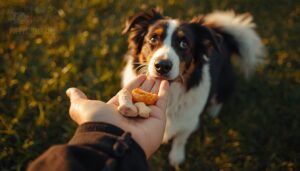
The marker means nothing on its own — what comes after is what your dog actually works for. Choosing the right reinforcer is just as important as your timing, because a lukewarm reward gets lukewarm effort. Here’s what actually motivates dogs and how to use each one well.
High-value Dog Treats
Not all treats are created equal — and in marker training, treat value is everything. Your dog needs to feel like they’ve hit the jackpot every time they hear that marker.
Choose soft, small, high-value treats built from real meat like chicken, beef, or salmon:
- Single-protein options reduce allergy risk for sensitive dogs
- Soft, chewy textures allow fast swallowing between repetitions
- Rotating flavors prevent boredom and maintain motivational value
Watch your portions — five to fifteen small pieces per session keeps energy up without overfeeding.
Toy Rewards
Some dogs couldn’t care less about food — but the moment you pull out their favorite tug toy, they’re locked in. Toy rewards work especially well for high-drive breeds where play is a stronger motivator than treats.
| Toy Type | Best Use |
|---|---|
| Tug toy | Drive-building, recall rewards |
| Squeaky rubber toy | Marker timing reinforcement |
| Fetch toy | Energy outlet mid-session |
| Puzzle toy | Extended focus training |
| Plush toy | Calm, low-stress reward moments |
Deliver the toy immediately after your marker — the same 0.5-second rule applies as with treats. Rotate toys every one to two sessions to keep novelty high and inspect each one daily for cracks or loose parts.
Praise and Affection
Not every dog works for food — some light up the moment you look at them and say "good." Verbal praise and gentle touch can be just as powerful when delivered with consistency.
Use a calm, warm tone right at the moment of success. Brief eye contact paired with a soft scratch strengthens your training bond over time.
Safe Treat Delivery
How you deliver a treat matters just as much as which treat you choose. Keep these three essentials in mind:
- Portion consistency — small, uniform pieces let your dog swallow quickly and stay focused.
- Hand hygiene — clean hands prevent contamination and keep your dog safe.
- Safe placement — deliver rewards low and close, so your dog never jumps or strains.
Charge The Marker Correctly
Charging the marker is the foundation everything else builds on — skip it, and your dog won’t understand what the click or word actually means. Think of it as making an introduction: you’re teaching your dog that this sound always leads to something good. Here’s exactly how to do it right.
Marker-treat Pairing Steps

Think of charging your marker as teaching your dog a simple equation: marker sound = reward coming.
Start with 30–50 quick pairings — click or say "yes," then immediately deliver a small treat. No behavior required yet. You’re simply building the association.
Keep treat delivery tight, aiming for that one-second window, so your dog learns the marker itself is the meaningful signal.
Short Charging Sessions

Keep your charging sessions short and focused — two to three minutes at most. Your dog’s attention is a limited resource, and burning through it early helps no one.
Run a quick burst of marker-treat pairings, then stop while your dog is still engaged. That momentum carries into your next session, making every repetition count.
Signs Your Dog Understands

Watch your dog’s eyes — they tell you everything. The clearest sign charging is working is immediate orientation: your dog snaps toward you the moment they hear the marker, before your hand even moves toward the treat. That instinctive pivot means the marker now predicts something valuable.
You’ll also notice reward anticipation — a subtle lean forward, perked ears, or a quickened breath right after the click or verbal cue.
Common Charging Mistakes

Even after spotting those positive signals, it’s easy to slip into habits that quietly undo your progress.
Overusing the marker is one of the most common pitfalls — clicking for every small movement dilutes its meaning. On the flip side, under-marking small wins leaves your dog guessing.
Both extremes break the behavioral contract you’ve worked hard to build.
Practicing Trainer Timing

Your own reaction speed is the variable most trainers overlook. Before your dog even enters the session, practice precision clicks alone — click the moment a pen hits the floor, or tap your clicker each time a ball bounces. These simple timing drills sharpen your hand-eye coordination inside that critical timing window:
- Click the instant the behavior completes, not after
- Reset and repeat when your timing drifts
- Practice in silence before adding distractions
Teach Basic Marker Exercises

Your marker is charged, your dog is tuned in, and now it’s time to put that foundation to work. Basic exercises are where everything clicks — where your dog starts to understand that their choices drive the rewards. Here’s where to begin.
Marking a Sit
Marking a sit is one of the simplest ways to show your dog exactly how marker training works in practice. The moment your dog’s rear touches the floor, that’s your window — deliver your clicker or verbal cue instantly.
Exact marker timing is everything here.
A late mark rewards whatever your dog does next, not the sit itself.
Teaching Eye Contact
Once your dog is nailing the sit, it’s time to build something deeper — voluntary eye contact. This is where real focus begins.
Hold a treat near your face and wait. The moment your dog’s eyes meet yours, mark and reward instantly. That split-second timing is everything.
- Start in a quiet, low-distraction space
- Keep early sessions under two minutes
- Reward each glance, not just a long stare
- Gradually increase duration before marking
- Track successful bouts across three consecutive sessions
Consistency across sessions turns occasional glances into a reliable focus habit.
Building Engagement
Engagement isn’t something you wait for — it’s something you build, rep by rep. Set your dog up to win often by training in a low-distraction space first.
Mark every glance, every step toward you. That high success rate is what turns curiosity into consistent attention. Keep sessions short, stay still, and let the reward do the talking.
Adding Simple Cues
Once your dog reliably offers a behavior, it’s time to name it. This is where cue association begins — you attach a word or gesture to something your dog already does confidently.
- Introduce the cue before the behavior starts, not after
- Keep your cue word consistent every single time
- Use one cue per session to avoid confusion
- Mark and reward correct responses immediately
- Test understanding with cue-only trials before adding distractions
Reward Placement Tips
Where you deliver the treat matters just as much as when you deliver it. Reward placement shapes the behavior itself.
Always bring the treat to your dog’s nose level at the exact spot the behavior happened — this is treat alignment with the marker moment. If your dog has to move to reach the reward, that movement becomes part of what they’re learning.
Add Cues and Commands

Once your dog is nailing a behavior consistently, it’s time to give that behavior a name. Adding cues the right way makes all the difference between a dog that responds every time and one that only listens when it feels like it. Here’s how to do it step by step.
Train Behavior First
Think of a cue as a label — and you can’t label something that doesn’t exist yet. That’s the heart of the Behavior First Rule: teach the action through marker training and positive reinforcement before attaching any word to it.
- Use your clicker to capture the exact behavior you want
- Repeat the behavior through behavior shaping until it’s fluent
- Resist saying "sit" or "down" during early training sessions
- Enter the Cue Independence Stage only after the action is solid
- Reach the Reliability Threshold before any cue is introduced
Action Before Cue removes confusion entirely. Your dog learns the movement first — the word comes later, as a reference, not a lesson.
Add Cue at Consistency
Once your dog is hitting the behavior reliably — around 80% accuracy — that’s your green light to attach a cue. Say the word clearly, just once, right before the behavior happens.
Cue timing is everything here. Mark the correct response immediately, then reward.
Keep your word, tone, and volume identical every single repetition. Consistency is what makes the cue meaningful.
Use Gestures Before Commands
Gestures speak before words do. Always deliver the gesture first, then follow with your verbal command.
This "look first, then ask" sequence gives your dog a reliable visual anchor before sound arrives.
Keep the hand movement distinct, consistent in height and direction, and brief.
If your dog reacts to the gesture alone, mark and reward immediately — the gesture has done its job.
Fade Unnecessary Prompts
Once your dog reacts to a gesture reliably, it’s time to fade the extra help. This means systematically reducing your prompt — not dropping it randomly.
Use a prompt hierarchy: start by making your hand signal smaller, then slower, then barely noticeable. Your dog learns to respond to the cue itself, not the size of your movement.
Fix Ignored Commands
Even after fading prompts, some dogs still ignore a cue. Usually, the cue hasn’t fully predicted the reward consistently enough.
Go back to basics: deliver the cue once, wait, and mark the first correct attempt immediately. If your dog is distracted, reduce the distraction level first.
Repeating cues teaches delay — one cue, one chance, one reward.
Build Advanced Marker Skills

Once your dog has the basics down, it’s time to push further and see what’s really possible. Expert marker skills open up a whole new level of communication between you and your dog. Here’s what to work on next.
Shaping Small Steps
Shaping complex behaviors starts with one simple rule: only reward progress. You’re not waiting for ideal outcome — you’re rewarding each small step that moves your dog closer to the goal. Set clear criteria for what earns the marker right now, then raise the bar gradually as your dog succeeds.
Chaining Multiple Behaviors
Once your dog is nailing individual behaviors, chaining multiple behaviors together is the next logical step. Behavior chaining links a sequence of actions — each one triggered by completing the step before it.
You have two solid approaches here: forward chaining builds from step one forward, while backward chaining starts at the final step and works backward, so your dog always finishes with a win.
Marker Training Recall
Recall is where marker training truly earns its place. The key is recall timing precision — mark the moment your dog is actively returning to you, not after they’ve arrived and wandered off again.
That split-second window defines what gets reinforced. Honor the marker promise: every click or "yes" must be followed by a reward, or the behavior weakens fast.
Obedience and Agility Uses
Marker training bridges obedience and agility training beautifully.
Start Line Control improves when your dog learns to wait for your cue instead of bolting. Contact Zone Precision sharpens through clear reinforcement timing — your dog knows exactly when they’ve hit the zone correctly.
Directional Cueing and Obstacle Entry Training both rely on fast, consistent markers to reward correct choices before momentum carries your dog past them.
Generalizing New Locations
Your dog’s training doesn’t truly stick until it holds up somewhere new. Location variability is what separates a dog that performs in your living room from one that responds reliably anywhere. Start generalizing by moving through three stages:
- Low-distraction spots like your driveway
- Quiet sidewalks with mild foot traffic
- Busier parks with gradual distraction integration
Keep reward timing consistent throughout.
Use Rewards Strategically

Knowing when and how to reward your dog is just as important as the marker itself. Once your dog starts hitting behaviors consistently, it’s time to get smarter about how you reinforce them. Here’s how to use rewards strategically to keep your dog sharp, motivated, and working hard.
Jackpot Rewards
Think of a jackpot reward as your dog’s "wow" moment — a noticeably bigger payoff that makes the marker feel like a real promise worth chasing.
Deliver it immediately after the marker when your dog nails an impressive performance. Rotate between high-value treats, toys, or praise-plus-play combos to keep the surprise alive and your dog’s motivation consistently strong.
Variable Reward Levels
Not every correct sit deserves the same paycheck — and that unpredictability is actually a training tool.
Use tiered treat sizes: small, medium, and large. Before each session, set a reward probability table — say, 50% small, 30% medium, 20% high-value treats. Your dog stays motivated because the marker always means something’s coming, just never exactly how much.
Intermittent Reinforcement Timing
Once a behavior is solid, you don’t need to reward it every single time — and that’s actually where the real strength-building begins.
Variable ratio schedules work by reinforcing after an unpredictable number of correct responses, keeping your dog engaged because the reward feels like a moving target. Aim for roughly every two to five marked successes before delivering a treat.
Reducing Food Rewards
Scaling back food rewards doesn’t mean pulling the rug out from under your dog. The Gradual Reduction Plan starts simply: cut treats into micro treats — tiny pieces that still feel like a win but use far fewer calories per session. Same marker, smaller bite, same satisfaction.
From there, apply the Reward Ladder System by reserving food for harder behaviors while paying easier, well-practiced ones with praise or a quick tug game instead.
Keeping Marker Value
Your marker’s value isn’t fixed — you either protect it or erode it over time.
Consistent Marker Delivery is the foundation: same sound, same moment, every time.
Pair that with immediate reward timing and clear behavior criteria, and your dog stays locked in, trusting every click or "yes" like a promise kept.
Fix Marker Training Problems

Even experienced trainers run into snags—marker training isn’t always smooth from day one. Most problems come down to a few predictable patterns that are easy to fix once you know what to look for. Here are the most common issues and how to correct them.
Late Marker Timing
Late marker timing quietly unravels even solid training. When your click or "yes" arrives even a second too late, your dog samples whatever just happened — not the sit, not the eye contact, but the fidget or the turn that followed.
That split-second timing window is everything. Practice your reaction speed separately, clicking when a pen drops, until the marker lands right on target.
Overusing The Marker
Timing isn’t the only trap waiting for you here. Overusing the marker is just as damaging — and easier to fall into than you’d think.
- Reward predictability drops when markers outpace treats
- Precision targeting weakens; "almost right" starts looking correct
- Engagement decline follows as your dog stops monitoring you closely
- Timing consistency suffers when marking becomes habitual
Use your marker deliberately. Every click should mean something.
Under-marking Small Wins
The opposite problem is just as sneaky. Under-marking small wins starves your dog of the feedback it needs to learn.
When you only mark polished, complete behaviors, your marker frequency drops too low to build a clear cause-and-effect link.
Mark partial success early. Reward the attempt, then raise criteria progression speed gradually — or your dog stops trying altogether.
Dog Loses Focus
Even the most engaged dog will drift when the environment outcompetes you. Distraction management starts before you even give a cue — set up where you can win.
- Shorten your session when focus drops early
- Adjust handler positioning — move closer to reduce competing stimuli
- Wait for attention recovery before marking anything
- Restart in a lower-distraction environment to rebuild momentum
Anxiety During Training
Sometimes anxiety during training is easy to miss — a quick lip lick, repeated glancing away, or sudden disengagement.
Marker overload is often the trigger: when you mark too many behaviors too fast, your dog can’t process what the signal means.
Slow your pace, shorten sessions, and keep reward delivery consistent to rebuild calm, confident focus.
Frequently Asked Questions (FAQs)
Can marker training work for aggressive dogs?
Yes, marker training can work for aggressive dogs — but only with threshold management, high-value rewards, and professional supervision. Safety distance and behavior substitution are essential parts of any responsible training protocol.
How young can puppies start marker training?
Puppies can start as early as 8 weeks. That developmental window—roughly 6 to 16 weeks—is pure gold for basic marker training exercises and short, focused training sessions.
Does marker training differ across dog breeds?
The core principles stay the same across every breed, but how you apply them shifts. A Jack Russell needs a sharper, higher-pitched "yes," while a Labrador responds better to a calmer tone.
How long until marker training shows real results?
Most dogs show early gains within the first two to three sessions. Consistent timing and a solid reinforcement schedule make all the difference in how fast real training progress clicks into place.
Can multiple trainers use the same marker system?
Ironically, the more trainers involved, the simpler the rules must be. Yes — multiple trainers can share one marker system, as long as everyone uses the same word, timing, and reward every time.
Conclusion
Old training methods left dogs guessing and owners frustrated—marker training techniques for dogs flip the situation entirely. The marker doesn’t just speed up learning; it builds a shared language your dog trusts. You’re no longer hoping your dog understands.
You know the exact moment understanding happened, because you created it. Every click or word becomes a small promise kept. Keep your sessions short, your timing sharp, and that bond will speak louder than any command ever could.
- https://www.guidedogs.com/resources/client-resources/guide-dog-class-lecture-materials/clicker-techniques-part-two
- https://www.simpawtico-training.com/marker-training
- https://www.shadybrookvet.com/puppy-and-kitten-center/clicker-training-basics
- https://sitmeanssit.com/how-to-clicker-train-a-dog-the-professional-guide-to-precision-and-attention
- https://bestfriends.org/pet-care-resources/guide-clicker-training-pets