This site is supported by our readers. We may earn a commission, at no cost to you, if you purchase through links.

Most dog owners assume the answer is obvious—treats win, end of discussion. Neuroscience complicates that assumption.
fMRI research has demonstrated that verbal praise activates the caudate nucleus, the brain’s reward center, with measurable intensity, sometimes rivaling the neural response triggered by food.
That finding reframes the food rewards versus praise debate entirely, shifting it from a question of which method works to one of when each method works best.
Your dog’s learning history, confidence level, and the training environment all influence which reinforcer actually drives behavior in any given moment.
Getting that calculation right separates trainers who see steady progress from those stuck repeating the same commands indefinitely.
Table Of Contents
- Key Takeaways
- Food Rewards Vs Praise Explained
- Which Reward Trains Dogs Faster?
- When Food Rewards Work Best
- When Praise Works Better
- Balancing Treats and Praise
- Frequently Asked Questions (FAQs)
- What is the difference between praise and rewards?
- Do dogs prefer treats or praise?
- What is the difference between praise and recognition?
- Can praise replace treats for aggressive dogs?
- How does breed affect reward preference in training?
- Do puppies respond differently to praise than adults?
- Can dogs develop anxiety when rewards are removed?
- Should reward type change during illness or stress?
- Conclusion
Key Takeaways
- Your dog’s brain assigns reward value by context, not by type—fMRI research shows verbal praise can activate the same neural reward pathways as food, sometimes more strongly.
- Food rewards are your sharpest tool when teaching new behaviors or working in high-distraction environments, because their sensory immediacy cuts through uncertainty and competing stimuli faster than social reinforcement can.
- Praise earns its keep once a behavior is established, and pairing it with treats from the start lets you fade food gradually while keeping performance reliable through intermittent reinforcement.
- No single reward strategy fits every dog—genetics, confidence level, training history, and even hunger state all shift which reinforcer actually drives behavior in a given moment, so you need to read your dog, not follow a formula.
Food Rewards Vs Praise Explained

Before you can choose the right reward, you need to understand what each one actually does in your dog’s brain and body. Treats and praise aren’t interchangeable—they work through different mechanisms, and dogs don’t respond to them the same way. Here’s what sets them apart.
Knowing which reward clicks with your dog at the right moment is the real skill—much like the nuanced approach covered in this guide to balancing treats and praise in dog training.
Treats as Primary Rewards
In teaching new behaviors, food rewards function as your most direct lever for change. A treat delivers an immediate, tangible consequence that a dog can connect to the exact action it just performed — no ambiguity, no delay. Research shows that delivering a treat [within one second](https://www.luckypremiumtreats.com/blogs/news/the-psychology-of-dog-treat-rewards-timing-value-and-motivation) maximizes dopamine release.
| Factor | High-Value Treats | Standard Kibble |
|---|---|---|
| Sensory Appeal | Strong smell and flavor | Mild, familiar scent |
| Motivation Impact | Accelerates new learning | Adequate for low-distraction practice |
| Portion Control | Pea-sized pieces recommended | Easier to use freely |
Calibration and delivery methodsmatter enormously here. Using the highest-value treats too often reduces their contrast effect, so cycling treat types maintains your dog’s attention. Always adjust portion size to avoid weight gain and obesity over time.
Praise as Social Reinforcement
Where food rewards speak to instinct, praise speaks to relationship. Dogs are deeply social animals, and verbal praise activates genuine reward pathways in the brain — not as a consolation prize, but as a primary signal of approval from someone they trust.
A notable fMRI study revealed that most dogs showed stronger caudate nucleus activation to praise than to treats, suggesting their brains process social affirmation with considerable neurological weight. That’s not a small finding — it means "good dog," delivered with the right tone and timing, can compete directly with food as a motivator.
An fMRI study found that most dogs’ brains respond more strongly to praise than treats
| Praise Factor | What It Signals | Training Impact |
|---|---|---|
| Tone of Voice | Emotional approval | Strengthens social bond |
| Specificity | Exact behavior targeted | Clarifies what to repeat |
| Timing | Immediate feedback | Sharpens associative learning |
Specificity matters more than most handlers realize. "Good sit" outperforms a vague "good boy" because it functions as informational feedback — your dog learns precisely which action earned approval. That clarity accelerates learning, particularly for dogs already familiar with a command.
Individual variability is real, though. Some dogs are genuinely praise-dominant, responding to your voice with the same intensity others reserve for chicken. Identifying where your dog falls on that spectrum shapes everything that follows.
Recognition Versus Reinforcement
Understanding the difference between recognition and reinforcement mechanism matters more than most handlers expect. Saying "good dog" after your dog sits can mean two very different things depending on how your dog processes it — either as a true reward that drives repetition, or simply as acknowledgment that doesn’t reliably increase the behavior.
Why Dogs Respond Differently
No two dogs are wired the same way. Individual preference profiles — shaped by genetics, early experiences, and handler history — means your dog’s brain genuinely assigns different value to treats versus praise.
Neural reward pathways in the caudate nucleus activate differently depending on past learning impact and motivation fluctuations driven by hunger, stress, or competing stimuli.
Your handler energy influence matters too.
Which Reward Trains Dogs Faster?
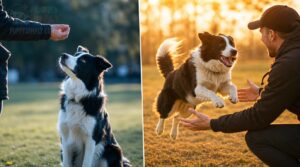
Speed comes down to more than just what’s in your hand — it depends on the behavior, the dog, and the moment. Some rewards cut through distractions fast; others build the kind of confidence that sticks long-term. Here’s what actually shapes how quickly your dog learns.
The right gear matters too — a no-pull harness for first-time dog owners can remove frustration from the equation and let you focus on what’s actually teaching your dog.
New Command Learning
When your dog encounters a command for the first time, immediate reinforcement is what locks the behavior in place. A reward delivered within one second of the correct response gives your dog a clear signal: that action, right there, is what earned the outcome.
Here’s what drives faster new command learning:
- Tight reward timing prevents your dog from associating the treat with the wrong movement.
- A consistent marker word like "yes" bridges the gap between behavior and reward.
- Narrow criteria early — reward only close approximations before raising the bar.
- Short sessions preserve attention and end on a successful repetition.
Food rewards accelerate this process because they deliver an unambiguous, high-motivation signal that cuts through uncertainty. In early dog training, when your dog has no frame of reference for a new cue, positive reinforcement through food gives desired behaviors a concrete, repeatable consequence — one your dog can actually work toward.
High-value Treat Advantages
Not all treats are created equal, and that gap in value matters more than most trainers expect. High-value treats like cooked chicken or cheese trigger scent-driven focus almost instantly — their intensity cuts through distraction before you’ve even asked for a behavior. That immediacy is what makes them such reliable motivation consistency tools, particularly when your dog is still building confidence with an unfamiliar skill.
Reward density maximization comes down to portioning. Small, soft pieces deliver instant gratification repeatedly without slowing the session or pushing your dog’s caloric limit. Each bite is consumed in seconds, which keeps attention sustainability high and lets you reinforce correct responses one after another. That rhythm — attempt, reward, attempt, reward — is what drives training efficacy during rapid acquisition phases.
Praise for Known Behaviors
Once a behavior is fully learned, shifting to praise often sustains performance just as reliably as food. Behavior-specific praise — saying "good sit" rather than a vague "good boy" — tells your dog exactly which action earned the reward.
That precision, delivered in a warm, enthusiastic tone, keeps cue-linked praise meaningful and prevents the flat, generic acknowledgment that dogs learn to tune out.
Distraction-level Differences
The environment your dog trains in changes everything. A quiet living room is one thing — a park full of squirrels, strangers, and other dogs is another entirely.
Here’s why distraction level shifts the food-vs-praise equation:
- Strong novel smells pull a dog’s nose away from verbal cues faster than from a visible treat.
- Reward competition intensifies when dogs are hungry or highly aroused — food usually outranks praise in those moments.
- Attention resets faster with food because the dog actively anticipates the next bite rather than passively waiting for social approval.
- Distance weakens praise — subtle verbal cues get lost in noise, while treat delivery gives the dog a concrete visual target to orient toward.
- Consistent reward backing under distractions prevents dogs from learning that disengaging is easier than staying on task.
In high-distraction settings, food rewards maintain behavioral focus more reliably because they combine scent, sight, and anticipation into one powerful signal. Praise alone can’t always compete with what’s happening across the field.
Timing Affects Results
Timing is the silent variable that determines whether your dog is actually learning what you think you’re teaching.
In operant conditioning, the gap between behavior and consequence directly controls habit formation. A treat delivered even two seconds late can reinforce whatever your dog did most recently — a head turn, a shift in weight — rather than the intended action.
| Timing Factor | Food Reward | Praise |
|---|---|---|
| Delivery speed | Slight handling delay | Near-instant verbal |
| Marker timing impact | Clicker bridges the gap | Voice IS the marker |
| Window narrowing effects | Narrower with practice | Naturally precise |
Delay weakens learning because the stimulus-response link loses clarity. Praise, spoken the moment the behavior completes, often arrives faster than a hand reaching into a treat pouch — making it surprisingly powerful for reinforcement schedule precision. Consistency boosts training regardless of reward type, but your trial pacing influence matters: rushing or slowing between repetitions shifts which behavioral moment gets reinforced, creating unintended patterns your dog quietly learns instead.
When Food Rewards Work Best

Food rewards aren’t always the right tool, but in certain situations, they’re hard to beat. Knowing when to lean on treats can make the difference between a frustrated training session and a real significant advance. Here’s when food rewards tend to work best.
Early Training Stages
When a dog is just beginning to learn, food rewards outperform praise almost every time. The reason is straightforward: a novel behavior needs a clear, immediate consequence, and food delivers that signal with little ambiguity.
Keep treat size small — a pea-sized piece eaten in seconds keeps the dog engaged without filling it up.
Difficult Behavior Changes
Changing an established behavior is harder than teaching something new. When a dog has practiced one response for months, rewriting that pattern demands high-value treats — not kibble, but chicken, cheese, or liver — to compete with the pull of the old habit. Food clears through emotional arousal in ways social reinforcement simply can’t match under stress.
- Deliver treats immediately after each correct response so the dog connects the new behavior to the reward without ambiguity.
- Lower your criteria first — reward small approximations before raising the bar, preventing frustration-driven disengagement.
- Watch for stress signs like lip licking, freezing, or turning away; these signal the difficulty exceeds the dog’s current threshold.
- Avoid criterion shifting mid-session, as changing what you reward mid-training triggers confusion and slows behavior modification.
- Keep sessions short to maintain motivation when competing incentives or emotional arousal are already taxing the dog’s focus.
Training consistency matters most here. If you reward the correct response one trial and ignore it the next, you’re not building a new pattern — you’re prolonging the old one.
High-distraction Environments
A busy park, a crowded sidewalk, a bustling farmers market — these settings flood your dog’s senses simultaneously. Visual distractions, competing scents from grass and wildlife, and overlapping sounds all activate foraging and scanning instincts that pull attention away from your cues.
At that level of arousal, praise rarely cuts through. High-value food rewards anchor your dog’s focus when the environment itself is working against you.
Low-confidence Dogs
For low-confidence dogs, food rewards do more than reinforce behavior — they signal safety. A tucked tail, pinned ears, or a dog freezing mid-step are all stress signals telling you the environment feels threatening.
High-value treats cut through that fear response by giving your dog something concrete and predictable to orient toward, making the situation feel manageable rather than overwhelming.
Fast Motivation Boosts
When motivation stalls, high-value treats act like a reset button. A novel piece of cooked chicken mid-session can sharpen focus almost immediately, especially when paired with reward timing that lands right after the correct behavior.
Keep sessions short, end on wins, and your dog stays hungry — literally and figuratively — to try again.
When Praise Works Better

Treats aren’t always the right tool for the job. Sometimes your voice and attention are exactly what your dog needs — and in certain situations, praise actually does the heavier lifting. Here’s when leaning on verbal rewards makes more sense than reaching for your treat pouch.
Strengthening Your Bond
Praise does something treats simply can’t — it tells your dog that you are the reward. When you deliver calm, well-timed verbal affirmation immediately after a correct behavior, you’re reinforcing the human-animal bond itself, not just the action. Your voice, posture, and eye contact together signal safety and approval, which deepens trust over repeated sessions.
Four ways praise strengthens your bond:
- Consistent praise phrases help your dog recognize a reliable "you got it right" signal tied directly to your voice.
- Relaxed body language paired with verbal praise tells your dog the interaction is safe, reducing anxiety and increasing offered behaviors.
- Immediate social reinforcement after success keeps your dog oriented toward you rather than scanning the environment for food.
- Ending on praised success closes each session on a positive emotional note, raising motivation for the next one.
Dogs are profoundly social, and praise over food activates that wiring at a neurological level — research shows caudate activation to owner praise rivals or exceeds food reward responses in most dogs. Matching your praise to what your individual dog values most, whether that’s a warm tone, gentle touch, or focused attention, makes every session a trust-building moment.
Public Training Situations
Public environments test your dog’s focus in ways a quiet living room simply can’t replicate. Competing stimuli — cyclists, strangers, other dogs — can capture attention faster than any treat delivery, making reward timing especially critical.
When you’re managing a leash, watching triggers, and cueing simultaneously, fumbling for food breaks your rhythm entirely. A well-timed verbal marker keeps session pacing tight without the logistics.
Weight-control Concerns
Treat portioning and calorie management deserve serious attention when weight control is already part of your dog’s care plan. Training sessions that rely heavily on food rewards can quietly tip daily caloric intake past healthy limits, raising obesity prevention concerns.
Substituting praise as a nonfood alternative reduces that risk while discouraging begging behaviors that often follow overreliance on treats.
Food-restricted Dogs
When your dog follows a veterinarian-prescribed diet plan, adding extra treats during training sessions isn’t a minor detail — it can compromise the entire restriction protocol.
Instead, use portions from the scheduled daily ration as reinforcers, keeping caloric intake within approved limits.
Praise becomes especially valuable here, delivering meaningful reward without disrupting the diet’s nutritional balance or triggering hunger-driven fixation.
Maintaining Learned Commands
Once your dog has mastered a command, praise becomes one of the most reliable tools for keeping that behavior sharp over time. Intermittent reinforcement — rewarding correct responses some of the time rather than every time — sustains performance without creating treat dependence.
Verbal affirmation, delivered with consistent reward timing, signals competence and maintains the behavior without adding calories or interrupting the flow of real‑world situations.
Balancing Treats and Praise
Neither treats nor praise works best in isolation — the real training gains come from knowing how to use both together. Getting that balance right takes a little strategy, but it’s more straightforward than most people expect.
Here’s how to build a reward system that keeps your dog motivated and engaged over the long haul.
Start With Food Rewards

When you’re building a new behavior from scratch, food rewards are your most reliable entry point. High-value treats like cooked chicken or soft meat pieces deliver an immediate, sensory-clear signal that the correct behavior just occurred. That certainty matters early on, when your dog hasn’t yet formed strong associations with specific cues.
Keep portions bite-sized to sustain many repetitions without slowing momentum or overloading calories.
Add Praise Immediately

Once you’ve delivered the treat, don’t wait — layer praise on top immediately. That pairing is what begins shifting your dog’s brain toward valuing your voice as a reward in its own right. Research shows verbal praise activates the caudate nucleus with intensity comparable to food cues, meaning the social signal carries genuine neurological weight.
- Say the behavior name right as you praise: "Good sit" beats a vague "good boy"
- Match your tone to the moment — an upbeat voice makes the praise neurologically distinct
- Deliver both rewards together early, so praise inherits some of the treat’s established value
- Keep it consistent across every repetition, every handler, every day
When praise consistently follows correct behavior at the same moment the treat does, your dog starts reading both signals as confirmation. That overlap is the foundation for eventually leaning on your voice alone.
Fade Treats Gradually

Once praise is running in tandem with food, the next step is pulling back on treats — not all at once, but methodically.
Reward frequency tapering means reducing treat delivery in small increments, such as rewarding four out of five correct responses before dropping to three. If accuracy slips, go back a step and reward every correct response for a few days before fading again.
Use Intermittent Rewards
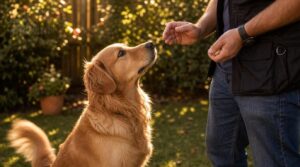
Tapering treats in fixed steps is a solid start, but the real staying power comes from intermittent reinforcement — rewarding some correct responses, not all of them.
- Variable ratio schedules keep your dog engaged because each repetition could still earn a reward
- Unpredictability builds extinction resistance, so behavior persists even when rewards become rare
- Intermittent rewards sustain long-term motivation more effectively than continuous reinforcement
Prevent Reward Dependence
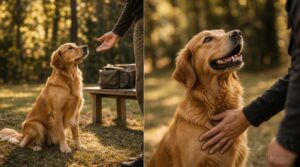
Intermittent schedules reduce how often rewards appear, but they don’t fully protect against reward dependence — the pattern where your dog performs only when treats are visible or expected.
Variety switching across reinforcers (treats, praise, play, petting) teaches your dog that multiple cues lead to reinforcement, so no single reward controls behavior.
| Strategy | Purpose |
|---|---|
| Motivation calibration | Adjust reinforcer strength to match your dog’s current engagement level |
| Location generalization | Practice in varied environments so behavior isn’t tied to one familiar setting |
| Cue-only responses | Reward after the cue, not during visible treat preparation, to build internal drive |
Meal independence matters too — training at varied times, using small portions separate from full meals, prevents your dog from treating food rewards as predictable substitutes for feeding time.
Frequently Asked Questions (FAQs)
What is the difference between praise and rewards?
The difference is simple: praise is social feedback — a word or tone that tells your dog it did well. A reward is something tangible, like a treat or toy, that creates a direct incentive to repeat the behavior.
Do dogs prefer treats or praise?
Most dogs, when given a choice, lean toward their owner’s voice. In an Emory University fMRI study, 13 of 15 dogs showed equal or stronger neural responses to praise than to food.
What is the difference between praise and recognition?
Praise tells your dog "well done." Recognition goes further — it signals exactly what worked, reinforcing the specific behavior that earned the reward, so your dog understands what to repeat.
Can praise replace treats for aggressive dogs?
Wouldn’t it be nice if you could just say "good boy" and watch aggression melt away? Praise alone can’t replace treats for aggressive dogs — high-value treats remain essential during early behavior modification.
How does breed affect reward preference in training?
Breed reward profiles aren’t uniform. Retrievers lean toward food; herding breeds often chase toys or play. Your dog’s ancestral role shapes what motivates them most — individual differences always matter beyond breed norms.
Do puppies respond differently to praise than adults?
Yes — puppies process praise differently than adults. Their developing neural reward pathways make them more sensitive to social reinforcement, with shorter attention spans demanding immediate feedback to lock in associations effectively.
Can dogs develop anxiety when rewards are removed?
Yes, dogs can develop anxiety when rewards are removed. Reward omission often triggers frustration, extinction bursts, and behavioral distress — especially when the dog has built strong expectations around a consistent reinforcement pattern.
Should reward type change during illness or stress?
Ironically, the moment your dog needs training consistency most — during illness or stress — reward sensitivity drops. Stay flexible: match reward type to their current state, not your routine.
Conclusion
Picture two dogs learning the same recall command—one responding only when a treat appears, the other, turning the moment your voice rises with warmth.
Both learned. learned better.
food rewards versus praise debate dissolves once you recognize that your dog’s brain doesn’t rank reinforcers in absolutes—it ranks them by context.
Master that context, and every training session becomes a precise conversation, not a negotiation with a pocket full of biscuits.
- https://study.com/academy/lesson/reward-systems-employee-behavior-intrinsic-extrinsic-rewards.html
- https://chacodogtraining.com/the-role-of-treats-vs-praise-in-dog-training
- https://opened.cuny.edu/courseware/lesson/61/student
- https://packleaderdogs.com/the-positive-reinforcement-only-propaganda
- https://pmc.ncbi.nlm.nih.gov/articles/PMC2731358