
This site is supported by our readers. We may earn a commission, at no cost to you, if you purchase through links.

Your dog’s nose processes smells 40 times better than yours—which means every hike is basically a buffet of distractions waiting to yank you off a ridge.
A standard leash manages that fine on flat sidewalks.
On a rocky switchback with a 60-pound dog locked onto a squirrel scent, it’s a different problem entirely.
The right dog leash for hiking keeps you balanced, your hands free for trekking poles, and your dog close enough to matter.
Ten picks cover everything from bungee shock absorption to floating water lines, with the specs you need to choose without second-guessing.
Table Of Contents
- Key Takeaways
- 10 Best Dog Leashes for Hiking
- 1. iYoShop Hands Free Bungee Dog Leash
- 2. SHINE HAI Dual Bungee Hands Free Leash
- 3. WANFIRE Hands Free Dog Leash
- 4. Tuff Mutt Hands Free Waist Leash
- 5. Laqibak Adjustable Hands Free Dog Leash
- 6. Ruffwear Roamer Bungee Dog Leash
- 7. Tuff Pupper Hands Free Dog Leash
- 8. LANNEY Hands Free Dog Leash
- 9. Taglory Rope Dog Leash
- 10. Vivifying Floating Long Dog Leash
- Choosing The Right Hiking Leash
- Best Leash Types for Trails
- Best Length for Trail Control
- Hiking Safety Tips for Dogs
- Frequently Asked Questions (FAQs)
- Conclusion
Key Takeaways
- Hands-free waist leashes with bungee sections are the smartest pick for active hikers — they absorb sudden lunges and keep your hands free for trekking poles on tough terrain.
- Material matters more than most people think: nylon handles abrasion and dries fast, while biothane is the go-to for water-heavy trails since it wipes clean in seconds.
- Leash length should match your trail — keep it 3–6 feet on narrow switchbacks for tight control, and save the longer lines for open meadows where your dog can roam safely.
- Retractable leashes don’t belong on trails — the cord can snap or tangle, the lock jams under pressure, and you lose real control the moment wildlife shows up.
10 Best Dog Leashes for Hiking
Not all leashes are built for the trail, and the wrong one will remind you of that fast. These ten stood out for how they handle real hiking conditions — pulling, scrambling, water crossings, and everything in between.
Whether you need everyday reliability or trail-ready durability, this guide to leashes for large dogs breaks down what actually holds up when your dog decides to sprint after a squirrel mid-hike.
Here’s what made the cut.
1. iYoShop Hands Free Bungee Dog Leash
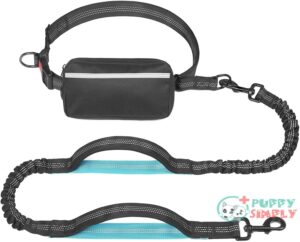
The iYoShop Hands Free Bungee Dog Leash is a solid trail companion for hikers who want their hands back. At 9.6 oz, it’s not ultralight, but you’re getting a lot for the weight — dual shock-absorbing bungee sections, two padded grips, reflective stitching, and a removable zippered pouch for your phone and treats.
The adjustable waist belt fits 27 to 48 inches, and the heavy-duty metal clip grips dogs up to 120 lb.
Worth considering for moderate hikes.
| Best For | Dog owners who jog or hike and want their hands free without sacrificing control or storage. |
|---|---|
| Material | Nylon |
| Weight | 9.6 oz |
| Reflective Elements | Stitching and piping |
| Shock Absorption | Dual bungee sections |
| Handle Type | Dual padded handles |
| Metal Hardware | 2-in heavy-duty clip + D-ring |
| Additional Features |
|
- Dual bungee sections absorb sudden lunges, so you’re not getting yanked off your feet mid-run
- Two padded handles make it easy to switch between hands-free mode and close control in tight spots
- Reflective stitching plus a removable pouch with room for treats, keys, and bags — everything in one kit
- The plastic buckle has a reputation for cracking under heavy, repeated stress
- Longer leash can tangle around your legs, especially if you’re on the shorter side
- The pouch runs small — bigger phones like the iPhone 12 are a tight squeeze
2. SHINE HAI Dual Bungee Hands Free Leash
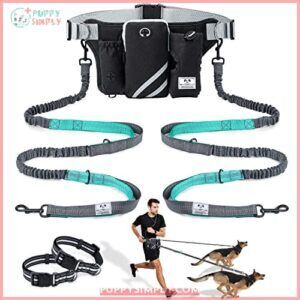
If hiking with two dogs is your reality, the Dual Bungee Hands Free Leash was built with you in mind.
At $29.99, it gives you two 72-inch bungee lines, an adjustable waist belt, reflective stitching, and a fanny pack with phone pockets and a poop bag dispenser — all in one system.
Each leash supports dogs up to 75 lb. The dual bungees absorb pull from both sides, which your lower back will appreciate on longer climbs.
| Best For | Dog owners who run, hike, or bike with two dogs and want their hands completely free without juggling extra gear. |
|---|---|
| Material | ABS Plastic / Nylon |
| Weight | 9.6 oz |
| Reflective Elements | Reflective stitching |
| Shock Absorption | Dual bungee sections |
| Handle Type | Two integrated handles |
| Metal Hardware | ABS plastic hardware |
| Additional Features |
|
- Dual bungee lines take the jolt out of sudden pulls, which is a real win if your back gives you trouble
- Built-in fanny pack covers the essentials — phone, treats, poop bags, water bottle — no extra bag needed
- Reflective stitching and a free matching collar make early morning or evening walks a lot safer
- The 72-inch leash might feel short if your dogs like to roam or have a lot of energy to burn
- Dogs close to the 75 lb limit can put some serious strain on the belt, especially if they’re strong pullers
- The water bottle pocket only fits standard sizes, so your big hiking bottle probably won’t work
3. WANFIRE Hands Free Dog Leash
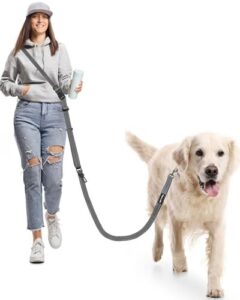
Solo hikers get a different kind of freedom with the WANFIRE. Where the SHINE HAI splits attention between two dogs, this one focuses everything on you and yours.
It adjusts from 5.9 ft to 9.5 ft, clips to your waist, and doubles as a car seat belt — no extra gear needed. The 360° rotating aluminum alloy clip supports spinning, lunging dogs without tangling. Dual foam supports cushion sudden pulls. Reflective stitching keeps you both visible on early‑morning starts.
| Best For | Solo walkers, joggers, and hikers who want a hands-free leash that pulls double duty as a car safety strap. |
|---|---|
| Material | Nylon / Polyester |
| Weight | 10.23 oz |
| Reflective Elements | Double-sided tape |
| Shock Absorption | Not specified |
| Handle Type | Dual neoprene foam pads |
| Metal Hardware | Aluminum alloy lock, 300kg rated |
| Additional Features |
|
- Adjusts from 5.9 to 9.5 ft and converts between waist belt, shoulder strap, or handheld — one leash, lots of options
- The 360° rotating aluminum alloy clip handles spinning and lunging without tangling or twisting
- Built-in car seat belt buckle means safe rides without buying separate gear
- Padding placement can feel off for broader shoulders or larger frames, which gets uncomfortable fast
- The car buckle feels a bit flimsy to some users — worth watching if your dog is a strong puller
- Even at full length, 9.5 ft might not give enough slack for relaxed, roaming-style walks
4. Tuff Mutt Hands Free Waist Leash
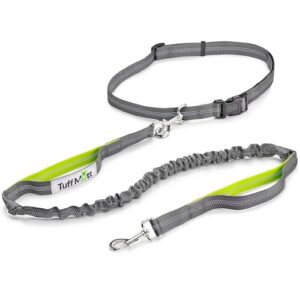
The Tuff Mutt takes a simpler approach than the WANFIRE’s multi-function setup — and sometimes simpler is exactly right.
Clip it to your waist, and the bungee section stretches from 4 to 5 feet, absorbing those sudden surges without yanking your core out of alignment.
The sliding D-ring moves side-to-side smoothly, so your dog can switch flanks without tripping you.
Reflective stitching on both the belt and leash performs well on low-light trails.
At $25.97, it’s solid value.
| Best For | Runners, hikers, and casual walkers who want a no-fuss hands-free leash that handles everyday pulls without breaking the bank. |
|---|---|
| Material | Nylon webbing |
| Weight | 8.78 oz |
| Reflective Elements | Full-length stitching |
| Shock Absorption | Single bungee segment |
| Handle Type | Dual handles |
| Metal Hardware | Sliding D-ring |
| Additional Features |
|
- The bungee absorbs sudden lunges well, so you’re not constantly bracing against your dog’s momentum
- The sliding D-ring lets your dog move naturally side-to-side without tangling your legs
- Reflective stitching on both the belt and leash is a genuine safety win for early morning or evening outings
- The belt can slip loose under sustained, heavy pulling — bigger dogs may wear it out faster than expected
- Small-waisted users might find the D-ring’s range of motion limited once the strap is cinched tight
- The leash runs longer than most people expect, which can feel unwieldy with large, energetic dogs in tight spaces
5. Laqibak Adjustable Hands Free Dog Leash
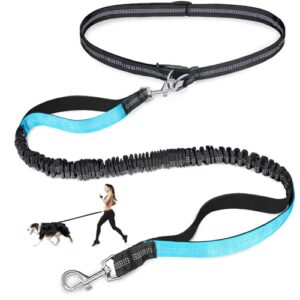
Some leashes just show up ready to work.
The Laqibak adjusts from 4.2 to 6.7 feet, with a bungee section that absorbs sudden lunges without rattling your hips. The heavy-duty nylon webbing is rated to 250 pounds — more than enough for larger breeds.
A 360-degree swivel clip keeps tangles manageable on winding terrain. Reflective stitching stays visible after washing, which matters on early morning starts.
It also ships with a two-year warranty, so you’re covered if anything gives out on the trail.
| Best For | Runners, hikers, and active dog owners who want their hands free while keeping their pup close and under control. |
|---|---|
| Material | Nylon |
| Weight | 10.86 oz |
| Reflective Elements | Stitching on leash |
| Shock Absorption | Elastic bungee segment |
| Handle Type | Dual padded handles |
| Metal Hardware | D-ring clip |
| Additional Features |
|
- The bungee section does real work — it absorbs sudden pulls so you’re not getting yanked mid-stride.
- Reflective stitching makes early morning or evening walks a lot safer without any extra effort.
- Two padded handles give you quick options: one near the belt for distance, one near the collar when you need tight control fast.
- The D-ring clip has a reputation for breaking early — sometimes on the very first use, which is a pretty rough introduction.
- The belt tends to loosen during activity, so expect to stop and readjust more than you’d like.
- If your waist is on the larger end of the range (think 38 inches or above), the fit can feel uncomfortably snug.
6. Ruffwear Roamer Bungee Dog Leash
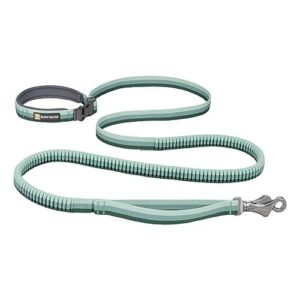
Ruffwear built the Roamer for people who actually move. At 5.76 oz, it won’t weigh down your pack, and the adjustable length — 5.5 to 7 feet — gives you real flexibility on the trail.
Unlike retractable options, the Roamer keeps you in control—especially if your dog is still working on leash pulling habits.
The Wavelength bungee webbing absorbs sudden pulls cleanly, so your hips aren’t taking the hit every time your dog spots a squirrel.
The Talon Clip swivels to prevent tangles, and the waist strap keeps everything snug without digging in on longer climbs.
| Best For | Runners, hikers, and bikers who want their hands free without giving up control of a strong or high-energy dog. |
|---|---|
| Material | 100% Polyester |
| Weight | 5.76 oz |
| Reflective Elements | Not specified |
| Shock Absorption | Wavelength bungee webbing |
| Handle Type | Traffic handle only |
| Metal Hardware | Aluminum uniloop + Talon clip |
| Additional Features |
|
- The bungee webbing soaks up sudden lunges, so you’re not getting yanked off balance on the trail.
- Works three ways — handheld, waist-mounted, or tethered to a post — so it adapts to whatever your outing looks like.
- At under 6 oz, it’s light enough to forget it’s in your pack.
- The plastic Talon clip has a reputation for breaking or popping open at the worst moments.
- Seven feet of leash gets awkward fast in tight city spaces or busy sidewalks.
- It’s pricier than a basic leash, which stings if all you need is a quick neighborhood walk.
7. Tuff Pupper Hands Free Dog Leash
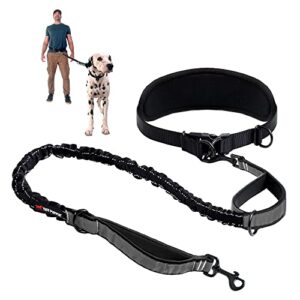
At $29.96, the Tuff Pupper punches well above its price point. The padded waist belt adjusts from 24 to 50 inches, so it fits most people without fuss.
Two control grips — one at the hip, one near your dog — let you shift from hands-free hiking to close-contact control in seconds.
The bungee core absorbs sudden lunges cleanly, and the full-width 3M reflective stitching makes evening walks genuinely safer.
One heads-up: the plastic belt clip has been known to fail under stress.
| Best For | Runners, hikers, and dog owners with strong pullers who want a hands-free setup that keeps them safe after dark. |
|---|---|
| Material | Nylon / Polyester |
| Weight | 16.96 oz |
| Reflective Elements | 3M stitching and piping |
| Shock Absorption | Dual bungee sections |
| Handle Type | Two padded handles |
| Metal Hardware | Stainless-steel attachments |
| Additional Features |
|
- Bungee core soaks up sudden lunges, so you’re not getting yanked off balance
- Full-width 3M reflective stitching makes low-light walks and road-side runs much safer
- Two detachable handles give you quick control when you need to switch from hands-free to traditional leash mode
- The plastic belt clip has a reputation for breaking under stress
- The bungee stretch can feel too loose for owners who prefer a firm, responsive lead
- The buckle can snag and be tricky to reposition, which makes on-the-fly fit adjustments a hassle
8. LANNEY Hands Free Dog Leash
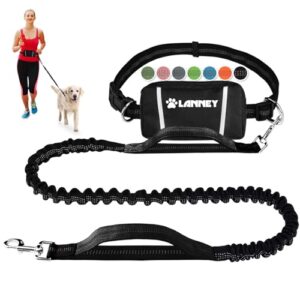
At just $13.99, the LANNEY is hard to argue with. Anti-tear nylon, 360° rotating metal clasps, and a bungee section that supports dogs up to 130 pounds — solid specs for the price.
The adjustable waist belt fits up to a 51-inch waist, and dual padded neoprene supports you to snap from free-roam to close control fast.
The built-in pouch holds your phone, treats, and waste bags without adding a separate pack.
Fair warning: the pouch bounces noticeably at a full run.
| Best For | Budget-conscious dog owners who want a hands-free leash for walking, jogging, or hiking with a medium to large dog. |
|---|---|
| Material | Anti-tear Nylon |
| Weight | 11.2 oz |
| Reflective Elements | Not specified |
| Shock Absorption | Single bungee section |
| Handle Type | Dual neoprene handles |
| Metal Hardware | 360° rotating metal clasps |
| Additional Features |
|
- Great value at $13.99 — solid nylon build with 360° rotating clasps and reinforced stitching
- Bungee section absorbs sudden pulls, which is easier on your back and your dog’s neck
- Dual handles make it simple to switch from hands-free mode to close control in a hurry
- The pouch bounces around at faster running speeds, which can get annoying quick
- The leash extends to 76 inches — too much slack for busy sidewalks or tight trails
- Only comes in black, so there’s no room to pick a style you actually like
9. Taglory Rope Dog Leash
Sometimes the simplest setup is the right one.
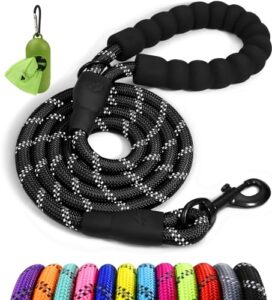
The Taglory Rope Dog Leash is a straightforward 6-foot rock-climbing-grade rope with a padded foam handle, reflective threads woven throughout, and a 360° swivel clasp that keeps things tangle-free when your dog cuts corners on the trail.
It weighs 6.7 oz — manageable, not featherlight. The built-in bag dispenser is handy.
Just know it has some stretch under hard pulls, so it’s best suited for dogs that don’t constantly test the limits.
| Best For | Dog owners with medium to large, moderately strong pullers who walk or hike in low-light conditions and want a durable, comfortable leash for everyday use. |
|---|---|
| Material | Nylon rope |
| Weight | 6.7 oz |
| Reflective Elements | Woven throughout rope |
| Shock Absorption | None |
| Handle Type | Single foam-padded handle |
| Metal Hardware | Zinc-alloy swivel clasp |
| Additional Features |
|
- Padded foam handle cuts down on hand fatigue during long walks
- Reflective threads woven throughout make night walks noticeably safer
- 360° swivel clasp keeps the leash from twisting when your dog changes direction
- Noticeable stretch under hard pulls makes precise control trickier
- Actual length can run a few inches short of the stated 6 feet
- The built-in bag dispenser feels flimsy and tends to break with regular use
10. Vivifying Floating Long Dog Leash
Water hikes are their own animal — and most leashes aren’t built for them.
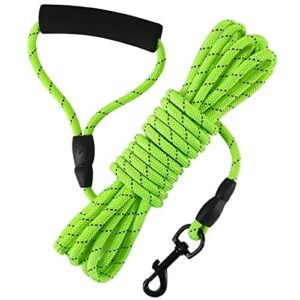
Vivifying Floating Long Dog Leash is 20 feet of polypropylene rope that actually floats. Drop it in the lake, and it stays visible. It weighs 6.74 oz, has a padded cotton handle for extended grip comfort, and a 360° rotating clasp that keeps the line from knotting mid-swim. Reflective stitching helps in low light, too.
Best pick if your trail ends at the water.
| Best For | Dog owners who love water adventures — swimming, paddleboarding, or kayaking — and want a leash that keeps up. |
|---|---|
| Material | Polypropylene rope |
| Weight | 6.74 oz |
| Reflective Elements | Woven throughout rope |
| Shock Absorption | None |
| Handle Type | Single padded cotton handle |
| Metal Hardware | 360° rotating metal clasp |
| Additional Features |
|
- Floats on water, so it stays visible and easy to grab if you drop it mid-swim
- Padded cotton handle makes long training sessions or hikes way more comfortable on your hands
- 360° rotating clasp cuts down on annoying tangles and line twists during active play
- Reflectivity is decent but not great under streetlights — better in daylight than at night
- The stitching might not hold up long-term for strong, determined pullers
- Not the best fit for large, aggressive chewers or dogs that constantly yank on the leash
Choosing The Right Hiking Leash
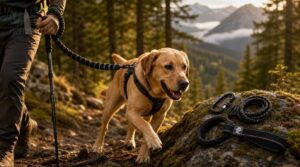
Not all leashes are built for the trail — and the wrong one will make itself known fast. A few key factors separate a leash that works hard from one that just looks good on the rack.
Here’s what to check before you buy.
Consider Leash Material and Durability
Material makes or breaks a hiking leash faster than you’d think. Nylon wins on abrasion resistance and dries quickly after muddy creek crossings.
Biothane is your go-to waterproof dog leash — it shrugs off water, resists UV degradation, and wipes clean in seconds.
For extreme chewers, consider a stainless steel chain durability for virtually indestructible strength. Check the strength rating before buying.
A durable leash material with smart durability and weight considerations keeps pack load reasonable without sacrificing toughness on rough terrain.
Check Handle Comfort and Grip
Handle comfort matters more than you’d think after mile three. A contoured ergonomic shape and textured surface keep your grip steady when your dog lunges at a squirrel.
Look for:
- Shock absorbing padding to cushion sudden pulls
- palm rest design that spreads pressure evenly
- adjustable grip size for gloved or bare hands
An ergonomic leash design with padded grips makes the difference between a sore hand and a happy finish.
Compare Clip Security and Strength
A good grip means nothing if the clip fails.
Stainless steel snap hooks and screwgate carabiners handle 200–350 lbs — enough for most breeds. Look for a secondary lock mechanism to prevent trail-snag releases. Carabiner safety mechanisms with rope strength testing behind them are worth the extra gram or two. Check for wear indicator systems before every trip; corrosion creeps up quietly on older clips.
Balance Leash Weight and Pack Load
Weight adds up fast. A leash under 6 oz — lightweight leash design at its best — barely registers on your pack.
Heavier options quietly throw off your center of gravity. Tuck the leash near your hip belt integration point to support clean load transfer mechanics.
weight distribution strategies and pack leash sync keep everything balanced, so you and your dog move naturally together.
Look for Reflective Trail Visibility
Once the sun dips below the ridge, visibility drops fast. That’s when reflective safety features for leashes earn their keep.
Look for:
- Reflective stitching or reflective strips that catch your headlamp beam settings without fading after rain
- High contrast colors paired with reflective gear integration along the length
- Reflective tape placement near the clip, where light hits first
Reflective dog leashes aren’t optional after dusk — they’re just smart.
Decide if Bungee Stretch Helps
Bungee stretch isn’t for every dog, but if yours lunges at squirrels mid-trail, an elastic stretch leash makes a real difference. The shock absorption and pull force reduction protect both your wrists and your dog’s joints — especially on rocky terrain where sudden yanks are common.
Look for a durable bungee with trail terrain compatibility, and inspect the cord regularly. Bungee maintenance is simple: rinse, dry, store out of direct sun.
Best Leash Types for Trails
Not all leashes belong on a trail — type you pick changes everything about how your hike actually feels. Some designs give you more freedom, others give you more control, and a few are better left in the car.
Here’s a breakdown of what works and what doesn’t when the path gets real.
Hands-free Leashes for Active Hikers

A handsfree dog leash changes the game when you’re scrambling over roots or when trekking poles are your lifeline. Here’s what makes them trail-ready:
- Waist Belt Comfort keeps fatigue low on long climbs
- Rotating Ring Anti-Tangle stops leash chaos mid-stride
- Quick Release Mechanism lets you detach fast in emergencies
- Belt Size Adjustability fits waists from 28 to 51 inches
- Handheld Detachable Mode converts instantly for crowded sections
Reflective safety features for low light add peace of mind at dusk.
Rope Leashes for Rugged Terrain

Rocky trails demand a leash that won’t quit.
Kernmantle rope and braided construction handle serious abrasion — think jagged granite, wet roots, pine branches.
Stainless hardware won’t corrode after a creek crossing.
Cold-weather flexibility keeps the rope from stiffening mid-hike.
| Feature | Why It Matters | Best For |
|---|---|---|
| Polypropylene rope | Sheds mud and water fast | Wet trails |
| Anti-snag design | Glides past branches cleanly | Dense forest |
| Nylon webbing core | Absorbs sudden tugs smoothly | Strong pullers |
Standard Leashes for Everyday Control
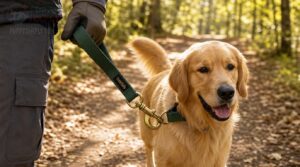
Not every trail calls for specialized gear. A standard dog leash — usually 4 to 6 feet — gives you reliable, close control without overcomplicating things.
Look for solid clip swivel design, brass hardware for corrosion resistance, and a padded handle to ease grip fatigue.
Core construction method matters too: 600D to 1200D nylon endures daily abuse well. Follow basic maintenance care guidelines — rinse, dry, done.
Long Training Leashes for Open Space

Wide-open meadows and off-trail fields are where long training leashes earn their keep. Running 15 to 50 feet, they let your dog sniff, explore, and work on recall — without cutting them loose entirely.
- Choose nylon or biothane coating for easy cleaning after muddy miles.
- Look for a non-tangle swivel clip to prevent line chaos mid-hike.
- Confirm a load rating of at least 300 lbs for larger breeds.
- Pick a UV-resistant finish to prevent material breakdown over seasons.
Top picks like the Leash Boss Long Trainer Leash and Ruffwear Slackline Leash both offer adjustable leash length — useful when trails narrow unexpectedly. Extendable dog leashes for hiking work best in open terrain where tangling isn’t a concern.
Floating Leashes for Water Hikes
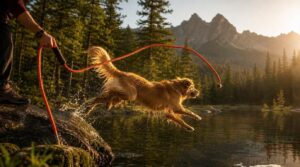
Some trails end at the water’s edge — and that’s exactly where a floating long dog leash earns its spot in your pack.
Built with buoyancy materials like NBR foam and water-resistant leash coatings, these lines stay visible if dropped mid-swim.
Corrosion-resistant hardware won’t rust after repeated dunks, and swim-optimized grips keep your grip even when wet.
| Feature | Why It Matters | What to Look For |
|---|---|---|
| Buoyancy Materials | Keeps leash on the surface | NBR foam or coated rope |
| Quick Release Clips | Emergency detachment | High-load rated, locking |
| Modular Length Sections | Adjust reach shore-to-water | Removable add-on segments |
Durable waterproof materials for hiking leashes mean no mold, no stink, and no swollen grips by mile three.
Slip Leads for Skilled Handling
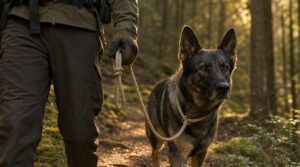
Slip leads work differently from floating leashes — instead of hardware, the loop does the work. Loop tightening feedback gives you instant communication when your dog pulls, making the Mendota Slip Lead a favorite for experienced handlers.
Anti-slip textures reduce neck friction, and a stopping mechanism design prevents over-tightening.
Quick release safety lets you detach fast.
Neck pressure management matters, so skilled handling is non-negotiable here.
Why Retractable Leashes Are Risky
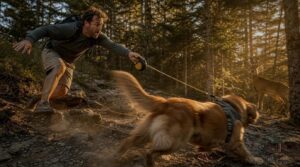
Retractable leashes look convenient, but they’re genuinely dangerous on trails. That long cord creates real Control Loss — you can’t react fast when wildlife appears.
Cord Whipping can lacerate skin if the line snaps. Mechanical Failure jams the lock mid-lunge.
Rough terrain turns Terrain Hazards into trip wires.
Worst of all, sudden stops concentrate force on your dog’s throat, risking Neck Injuries.
Best Length for Trail Control
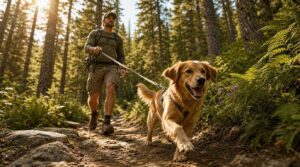
Leash length changes everything on the trail — the wrong choice can mean scrambling for control at the worst moment. It’s not just about how much slack you give your dog; it’s about matching that length to where you’re hiking and what you’re up against.
Here’s how to get it right.
When 3 to 6 Feet Works Best
For most trail situations, 3 to 6 feet hit the sweet spot. That leash length and control strategies like switching from a hands‑free leash option to a short handle mid‑stride become second nature fast.
- Steep incline control stays solid — your dog can’t drift when the rope is taut at your hip
- Narrow trail navigation gets easier; less slack means fewer snags on roots and brush
- Dog recall timing sharpens because shorter distance makes corrections instant
An adjustable length leash earns its keep here, letting you dial in hands‑free shift without breaking pace.
When Longer Lines Make Sense
Open meadows and wide forest paths are where extendable dog leashes for hiking actually earn their keep. A longer adjustable length leash—think 15 to 20 feet—gives your dog an Extended Sniffing Range without reduced frequent stops killing your momentum.
You’ll notice Improved Obstacle Clearance near stream crossings too. Handsfree leash options for hikers with a central traffic handle keep Better Group Coordination and Enhanced Safety Margin locked in.
Matching Leash Length to Trail Conditions
Every trail demands something different from your leash.
Narrow trail spacing calls for a 3–4 ft line; steep switchback safety depends on keeping your dog close.
Wet mud handling and rocky ledge precision both favor 4–6 ft for steady control.
Open meadow freedom is where a longer adjustable length hiking dog leash finally breathes.
Match leash length to the terrain — it’s basic trail safety for dogs.
Managing Wildlife, Crowds, and Tight Paths
Wildlife, crowds, and tight paths each demand a shorter hold. Keep your dog within 3–6 ft near buffer zones, nesting areas, and busy trailheads — one-way flow trails and bottleneck signage exist for a reason.
Hands-free leash options for hikers with adjustable length help you react quickly when managing dog behavior around wildlife. Quiet trail policies aren’t suggestions; they protect everyone.
Using Traffic Handles for Quick Control
A traffic handle is your emergency brake. Positioned 12–24 inches above the clip, it lets you shorten the leash instantly — no fumbling, no repositioning.
Good handle placement and ergonomic grip mean force distribution stays even during abrupt stops, so neither you nor your dog takes a hard jolt.
Run quick stop training before your first crowded trail. And always do a safety inspection of connection points before heading out.
Pairing Leash Length With Harness Fit
Leash length and gear fit are a team — get one wrong and the other suffers.
- Chest Clip Alignment: Keep the sternum strap centered; it controls pull direction.
- Front Clip Short: A 4–5 ft leash redirects pulling effectively.
- Back Clip Long: 6–8 ft gives exploration room without chaos.
- Y-Gear Tension: Balance tension evenly to prevent strap shift.
- Step-In Friction: Standard leash length reduces chest plate chafing.
Hiking Safety Tips for Dogs
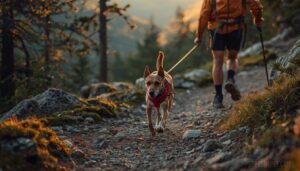
Great leash only gets you so far — the rest is preparation. Before you hit the trail, there are a few safety basics every dog owner should have covered.
What actually matters when you’re out there with your dog.
Essential Gear for Dog Hiking Trips
Before you hit the trail, check your kit. Essential gear for dog hiking trips goes beyond just a leash.
Pack a portable first-aid kit, trail treat pouches, and a GPS collar tracker so you’re never guessing your dog’s location.
Dog backpack packs let your pup carry their own load.
A dog cooling vest helps on warm days.
Water, Bowls, and Trail Hydration
Hydration sneaks up on dogs faster than most people expect. Aim to offer water every one to two hours — sooner on hot days.
Collapsible silicone bowls weigh under two ounces and disappear into any pocket. Hydration bottle attachments let you manage one-handed fills without stopping. For sketchy water sources, portable water filtration keeps things safe. Clip-on carabiner bowls attach right to your pack.
ID Tags and Microchip Checks
Before you hit the trail, check your dog’s identification tag and make sure the microchip registration is current. Tag Durability matters out here — worn or rusted tags become unreadable fast.
Keep these basics locked in:
- Pair a readable identification tag with a microchipped collar always
- Store Contact Updates in your microchip database before each season
- Attach tags to a Backup Collar in case the main one slips
- Understand that Portable Scanner access stays with vets and shelters, not trail strangers
- Prioritize microchip and ID tag importance for outdoor dogs — both layers protect against separation
Microchip identification alone won’t help if the registry shows your old number.
Safe Pacing for Senior Dogs
Older dogs aren’t slow — they’re just smarter about effort. Start every hike with a Gradual Warm‑up, letting your dog sniff and shuffle before picking up pace. Build in Sniff Breaks; they’re natural Rest Interval Timing that prevents overexertion. Watch for limping or heavy panting — those mean stop now.
| Senior Dog Pacing Tips | Why It Matters |
|---|---|
| Gradual Warm‑up start | Protects stiff joints early on |
| Sniff Breaks every 10–15 min | Built-in rest without forcing stops |
| Terrain Slope Management | Flat routes reduce leg and heart strain |
| Heart‑Rate Monitoring via breath | Rapid panting = dial back immediately |
| Rest Interval Timing | Prevents fatigue from compounding mid-trail |
A hands‑free leash with an adjustable waist belt keeps your hands ready if your dog needs steadying on roots or rocks. Pair it with lightweight dog accessories — padded grips included — so neither of you carries extra burden.
Heat, Visibility, and Weather Awareness
Pacing your senior dog well is only half the job. Weather can undo a great hike fast.
Watch for Heat Stress Signs — excessive panting, drooling, slowing down. When you spot them, find shade immediately and offer water every 15–20 minutes.
Smart Weather Forecast Planning and gear choices help too:
- Schedule hikes at dawn or dusk to dodge peak heat
- Use a Cooling Vest on climbs over 75°F
- Build in Shade Break Scheduling every 20–30 minutes
- Choose a water‑resistant leash with reflective safety features for leashes when visibility drops at dusk
Reflective Gear Tips and lightweight dog accessories round out your weatherproof dog hiking setup — keeping heat exhaustion prevention simple and practical.
Monitoring Pulling, Fatigue, and Behavior
Reading your dog’s body language mid-trail is one of the most underrated skills a hiker can develop. Watch for fatigue indicators like drooping ears, a slower gait, or frequent yawning — these show up well before your dog hits empty.
Your dog signals fatigue long before quitting — learn to read drooping ears and slow gaits before the trail does it for you
Pull tension trends shift too: consistent leash slack often means it’s rest break time.
A hands-free leash with bungee shock absorption technology helps absorb sudden surges, making dog behavior control and dog health monitoring during long hikes much more manageable.
Frequently Asked Questions (FAQs)
Should my dog wear a leash on hiking trails?
Yes, and in most parks it’s the law.
Leash regulations and regional restrictions vary, but trail etiquette standards, wildlife interaction risks, and owner liability concerns make keeping your dog leashed the safest, smartest call.
How do I handle dog poop on trails?
Pick up every deposit with a waste bag, tie it off, and clip it to your pack until you hit a trash can.
Leave No Trace means pack it out — no exceptions.
Can dogs share a leash on the trail?
Two well-trained dogs can share a leash — but only if they walk calmly side by side.
A dual clip design with even tension distribution keeps both dogs balanced and prevents tangling.
How do I clean my hiking leash?
A quick rinse goes a long way. For rope leash cleaning, scrub with mild soap and a soft brush, then air dry fully.
Nylon webbing care is just as simple — soak, rinse, hang.
Should puppies use different leashes than adults?
Puppies need shorter leashes — three to four feet — with chew-resistant materials, adjustable length growth, and front-clip collar compatibility.
Size-specific hardware and quick-release safety clips matter most when they’re still learning the ropes.
Are hiking leashes safe for reactive dogs?
Think of a reactive dog like a loaded spring — calm until something trips the wire.
Yes, hiking leashes can be safe, but only with the right setup and Trigger Distance Management built into every walk.
How often should I replace my hiking leash?
Plan on replacing your leash every 12 to 18 months. Check for fraying, clip corrosion, and sun-bleached color monthly. Wet climates or heavy pullers shorten that window fast.
Conclusion
It’s no coincidence that the best trail days happen when your gear stops fighting you. The right dog leashes for hiking quietly remove the variables—yanked arms, fumbled poles, a scramble on loose rock—so what’s left is just you, your dog, and the trail ahead.
Pick the leash that matches how you actually hike, not how you imagine you do. Everything else falls into place the moment you clip in and go.