
This site is supported by our readers. We may earn a commission, at no cost to you, if you purchase through links.
Finding a dried, shriveled tick on your dog can stop you cold—especially when you’re unsure if it’s dead, alive, or something else entirely. A dead tick doesn’t just fall off on its own. Its mouthparts contain backward-facing barbs that stay anchored in the skin long after the tick itself has died, meaning removal still matters even when the threat seems gone.
Knowing what you’re looking at, how to get it out cleanly, and which warning signs to watch for afterward keeps your dog safe from complications that can quietly develop beneath the surface.
Table Of Contents
- Key Takeaways
- What is a Dried Dead Tick?
- Can Dead Ticks Stay Attached?
- Why Ticks Die on Dogs
- Dead Tick Versus Live Tick
- Are Dead Ticks Dangerous?
- Remove a Dried Dead Tick
- Clean The Bite Area
- When to Call a Vet
- Tick-Borne Diseases in Dogs
- Prevent Future Tick Bites
- Frequently Asked Questions (FAQs)
- Is it safe to have an engorged dried dead tick on my dog?
- What happens if a tick dies on a dog?
- What does a dead embedded tick look like on a dog?
- Can a dead tick look like a scab?
- What if a tick is embedded and dead?
- Are dead ticks contagious?
- Is there any danger in leaving a dead tick on a dog?
- What are the symptoms of tick-borne illness in dogs?
- Are there any home remedies to remove dead ticks from dogs?
- What is the best way to prevent ticks from attaching to dogs?
- Conclusion
Key Takeaways
- A dead tick stays firmly attached because its barbed mouthparts and cement-like saliva anchor it in place even after death, so you must still remove it carefully using fine-tipped tweezers with a steady, straight-up pull.
- Disease risk doesn’t disappear when the tick dies — pathogens like Lyme, Ehrlichiosis, and Rocky Mountain Spotted Fever may have already been transmitted during feeding, so monitor your dog closely for signs like fever, lethargy, or limping in the following days.
- Clean the bite site with 70% isopropyl alcohol or diluted chlorhexidine after removal, then check for any dark plug left behind — retained mouthparts can trigger swelling, infection, or a foreign body reaction under the skin.
- Your best long-term defenses are a vet-approved preventative (collar, spot-on, or oral chew), daily tick checks focusing on ears, neck folds, and armpits, and keeping your yard mowed short to cut off tick questing zones.
What is a Dried Dead Tick?
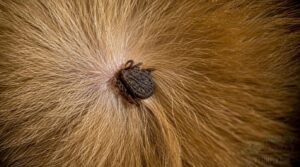
A dried dead tick doesn’t look quite like what most people expect. It goes through some visible changes that can make it easy to be confused with other things on your dog’s skin.
Because dried ticks often mimic the flaky patches covered in this guide to common dry dog skin conditions, knowing what each one actually looks like can save you a lot of second-guessing.
Here’s what to look for.
Dead Tick Appearance
A dead dried tick looks noticeably different from a live one. The body shrinks, losing its plump shape and taking on a flattened silhouette with a brittle exoskeleton that crumbles easily.
You’ll often notice a silvery pale hue replacing the darker tones of a living tick.
The curled ventral legs stay stiff and tucked under — your clearest identification clue.
Skin Tag Vs Tick
Once you spot something odd on your dog’s skin, owner anxiety kicks in fast. Is it a skin tag or a dead tick? Growth rate is your first clue—skin tags grow slowly and stay stable, while a dry tick or dead, dried tick was once actively feeding.
Check these differences:
- Surface Consistency: Skin tags feel soft; a dead, dried tick feels brittle.
- Location Preference: Ticks favor ears and thin-skin areas.
- Diagnostic Magnification: A magnifying glass reveals legs for tick identification.
Scab Vs Tick
Scabs and dried dead ticks can look surprisingly similar at first glance. The movement test clears up confusion fast: gently prod the spot. A dead tick shifts slightly, while a scab stays flat against the skin.
Surface feel also distinguishes them: scabs have a thin, flaky crust, whereas a dried dead tick retains a distinct oval body shape.
The healing timeline offers further insight. Scabs gradually loosens as skin repairs itself, unlike the static presence of a tick remnant.
Engorged Dried Ticks
An engorged tick that dies on your dog tells a different story than one that never fed. Its abdomen swells into a tight blood sac — sometimes several times its original size — and that shape often stays visible even after death. Residual blood leakage into the bite site can cause local irritation.
Environmental drying gradually shrinks and darkens it, but it stays larger than an unfed dead tick.
Unfed Dead Ticks
An unfed dead tick never got its blood meal, so its energy reserves ran out fast. You’ll find it small, flat, and dark — not swollen. Dehydration rate and temperature sensitivity speed its decline off-host, causing cuticle hardening that leaves a dry, papery shell.
That off-host encounter happens when your dog brushes through tall grass.
Follow tick removal steps and seal it in a zip lock bag.
Can Dead Ticks Stay Attached?
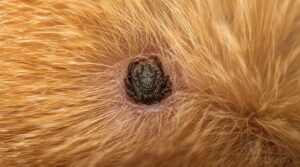
Yes, a dead tick can absolutely stay attached to your dog’s skin. The mouthparts act like tiny anchors, and death doesn’t loosen their grip.
Here’s what you need to know about why ticks cling on even after they’ve died.
Embedded Mouthparts
Think of a tick’s mouthparts like a tiny grappling hook. The hypostome—a tube-like structure with rows of backward-pointing barbs—creates barbed anchoring deep in your dog’s skin.
A tick’s hypostome drives backward-pointing barbs deep into skin like a grappling hook that only grips tighter
This anchoring is reinforced by saliva cement from the tick’s feeding process, enabling a firm grip.
When removed carelessly, mouthpart fragmentation often leaves embedded pieces behind, triggering an immune reaction.
Using the right tick removal tool or tweezers is critical to prevent such complications.
Attached After Death
Yes, a dead tick can absolutely stay stuck to your dog’s skin. Even after death, residual cement and saliva sealant from the tick’s feeding process maintain a post‑mortem grip at the attachment site. Tissue stiffening makes the embedded tick look almost locked in place.
Don’t mistake that firm hold for a live tick — proper tick removal technique and wound disinfection still apply.
Why Ticks Cling
Ticks are built like tiny grappling hooks — and that’s not an exaggeration. Several physical systems work together to keep them locked in place:
- Curved claw grip and pad adhesion proteins anchor tick legs to skin and fur on contact
- Barbed hypostome anchor digs backward into tissue, resisting any outward pull
- Ratchet mouthpart action drives tick mouthparts progressively deeper during the tick attachment period
- Questing leg extension helps ticks transfer from vegetation to your dog before attachment even begins
That layered design is exactly why careful tick removal technique matters.
Bite Site Irritation
Even after you remove a dry tick, the bite site can stay irritated for days. Here’s what you might notice:
| Symptom | What It Means |
|---|---|
| Redness and itching | Histamine response to bite proteins |
| Localized edema | Normal swelling as skin heals |
| Itch scratch cycle | Scratching worsens skin irritation |
| Discharge or crust | Watch for bacterial colonization |
Monitor healing duration closely — any signs of infection need prompt post-removal wound care.
Why Ticks Die on Dogs
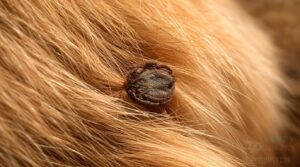
Ticks don’t always die on their own — something pushes them over the edge. Most of the time, it’s something you’re already doing to protect your dog.
Here are the most common reasons a tick ends up dead while still attached.
Tick Preventatives
Most tick preventatives work by introducing active ingredients — like fipronil, permethrin, or oral isoxazolines — that attack a tick’s nervous system after contact or feeding.
Dosage safety is critical, as antiparasitic medication is weight-based; incorrect dosing reduces protection. Resistance management requires occasional rotation of product classes to maintain effectiveness.
Application timing and extended coverage windows, typically 30–90 days, determine the duration of protection for your dog.
Flea and Tick Collars
Collars like Seresto take a different approach than oral medications — active ingredient release happens continuously through the collar itself, spreading acaricidal chemicals across your dog’s coat. Fit safety matters here: a loose collar won’t deliver full coverage.
Most offer a coverage duration of seven to eight months, but replacement timing is firm. Proper fit ensures the chemicals distribute effectively, maintaining protection throughout this period.
Water resistance keeps protection steady through rain and puddles. This reliability explains why a dead tick found on your dog is already dried out — proof the collar’s active ingredients worked before the tick could pose a threat.
Spot-on Treatments
Spot-on treatments work differently from collars — you apply them directly to your dog’s skin, usually between the shoulder blades, where active ingredient absorption carries the medication across the body.
- Water resistance keeps protection steady after bathing
- Application site preparation means parting fur to reach bare skin
- Dose interval timing runs monthly or every three months
- Multi-pet safety requires keeping cats away until dry
- A dead tick on your dog signals the treatment worked
Oral Tick Medications
Oral medications take a different approach altogether. These chewable tablets use isoxazoline dosing to work from the inside out — ticks die after feeding begins.
Weight-based dosing matters here, so match the chew size to your dog’s current weight. Some run on a 12-week schedule, others monthly.
Watch for adverse reaction signs like vomiting or lethargy after giving any oral tick preventatives.
Scratching or Grooming
Your dog’s own grooming can also kill a tick. Hind-leg scratching and licking versus biting target different itch zones — legs rake the neck and ears, while the tongue reaches lower spots. These grooming behavior cues can crush or dislodge an attached tick.
But repeated scratching risks self-induced skin damage, complicating the tick removal process later.
Dead Tick Versus Live Tick
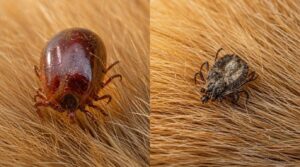
Telling a dead tick apart from a live one isn’t always obvious, especially when you’re parting thick fur in bad lighting.
But there are a few reliable signs that make the difference pretty clear once you know what to look for. Here’s what to check.
Color Differences
Color is one of the clearest clues in any tick identification guide. A live tick’s pre‑feed hue runs brown to reddish‑brown, but a dead tick or dry tick fades to dull tan or gray — the drying tone shift happens as moisture leaves the body. Post‑feed shade can look dark brown or near‑black.
Bite site tint and tick species both affect color, so never rely on color alone.
Leg Movement
Leg movement is your fastest reality check. A live tick curls and stretches its legs in response to touch — that’s proprioceptive feedback in action, driven by hip flexion, knee extension, and ankle dorsiflexion working together. A dried dead tick? Its legs stay rigidly curled inward, locked and still.
Before you grab tweezers to pull back and start tick removal, poke it gently — no movement confirms it’s dead.
Body Texture
Touch tells you a lot. A dried dead tick has a seed-like hardness — firm, fixed, and oddly rigid against the skin. Its wrinkled matte shell contrasts sharply with a live tick’s smooth, taut surface.
You’ll often notice fur clumping around the site, and an embedded dot texture where the mouthparts anchor in.
Run your finger across it — that crusty scaly edge confirms what you’re dealing with.
Size and Shape
Size alone can tip you off. A live, engorged tick has a noticeable abdominal bulge — almost balloon-like — while a dried dead tick shrinks and stiffens into something much smaller.
- Unfed dead ticks stay flat, compact, with a narrow mouthpart tip up front
- Previously fed dried dead ticks retain a wider shape despite shrinkage
- Leg spread stays fixed, framing the dead dried tick’s outline like spokes on a wheel
The oval contour or teardrop silhouette depends on the tick species and whether it fed before dying.
Attachment Strength
A dead tick can actually grip tighter than a live one. The longer a tick feeds, the firmer its anchor becomes — saliva compounds cement the mouthparts in place, and that bond doesn’t vanish when the tick dies.
A dried dead tick may feel ‘welded’ to your dog’s skin. Use fine-tipped tweezers or a tick removal tool for safe, clean extraction.
Are Dead Ticks Dangerous?
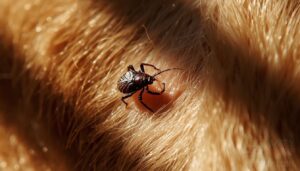
A dead tick sounds like a problem solved — but it can still cause trouble for your dog.
Even after it dies, the bite site and any leftover parts deserve attention. Here’s what you need to watch for.
Infection Risk
Even a dried dead tick can leave the door open for infection. Once the mouthparts break the skin, bacteria from your dog’s coat, your hands, or dirty tools can enter that small wound and take hold.
- Bacterial contamination increases with delayed healing in older or immunocompromised dogs
- Secondary abscess formation may require antibiotic therapy if the tick infection risk goes unmanaged
- A dried dead tick left uncleaned raises disease transmission risk at the bite site
Skin Inflammation
Beyond infection risk, the bite site itself can become inflamed. Your dog’s immune system sends cells rushing to the area—that’s immune cell infiltration at work—causing redness, heat, swelling, tenderness, and itch signaling from irritated nerve endings.
Barrier disruption can follow, leaving skin raw or crusted. Watch for these signs of infection after any tick bite or tick removal.
Disease Transmission Risk
That inflammation from the previous section is your dog’s body reacting to the bite site — but a separate concern is whether a tickborne pathogen transferred before the tick died. Here’s what shapes that infection risk:
- Feeding Duration matters most — attachment time drives transmission, not whether the tick is alive or dead when you find it
- Pathogen Viability varies by disease — Rocky Mountain spotted fever can transmit in as little as 2 hours, while Lyme usually needs 24–48 hours
- Regional Prevalence affects your odds — not every tick carries a tickborne pathogen, and zoonotic disease rates differ by location
- Host Immune Response may limit exposure — but don’t count on it as protection against vectorborne disease
If infection is confirmed, clinicians often start first‑line doxycycline treatment promptly.
Allergic Reactions
Beyond disease risk, some dogs develop an allergic reaction to tick bites — even from dead ones. Tick saliva triggers IgE Sensitization, where Mast Cell Degranulation floods the area with chemicals. That Histamine Release causes the classic Wheal Flare — a raised, red bump surrounded by irritated skin.
In rare cases, Anaphylaxis Risk is real. Watch for sudden facial swelling or labored breathing after tick removal.
Leftover Tick Parts
Incomplete tick removal can leave behind more than you’d expect. A leg fragment, cement-like residue called residual cement, or a broken tick head can all stay embedded. Your dog’s skin treats these like splinters — triggering a foreign body reaction with redness and swelling. In stubborn cases, granuloma formation may develop.
Use fine-tipped tweezers or a tick removal tool and follow a careful tick removal protocol — your dog’s healing timeline shrinks considerably when nothing’s left behind.
Remove a Dried Dead Tick
Removing a dried dead tick takes the right approach — rushing it or using the wrong technique can leave mouthparts stuck in your dog’s skin.
The good news is that with a few simple tools and steady hands, you can get it out cleanly and safely.
Here’s exactly how to do it, step by step.
Gather Removal Tools

Before you touch anything, gather your supplies — rushing in empty-handed makes the job harder. You’ll need fine-tipped tweezers or a dedicated tick grabber (also called a tick removal tool or tick-picking tool), a pair of nitrile gloves, alcohol wipes, and a sealable container like a small vial or Ziploc bag.
Having everything within reach before you start keeps the process clean and controlled.
Part Your Dog’s Fur

Gently part your dog’s fur using the Finger Separation method — spread the coat with two fingers, working in small inspection zones across the body. Directional Brushing along the hair’s natural growth line reveals the skin underneath. Pay close attention to mat-prone spots, as matting prevention keeps hidden areas visible.
- Part the hair behind the ears
- Check armpits and groin folds
- Separate fur along the neck and tail base
Grip Near Skin
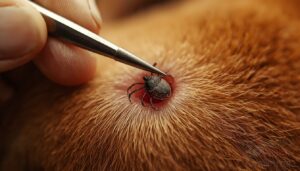
Once you’ve parted the hair and located the tick, position your fine-pointed tweezers as close to the skin as possible—this is where mouthpart leverage matters most. Gripping near the base gives you better force distribution and reduces sideways pull.
Steady your dog first, then pull back the surrounding fur to keep your grip clean and your tension controlled before you move.
Pull Straight Upward
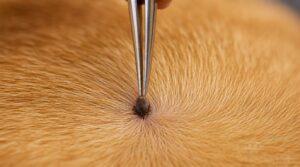
Once the tweezers are set, apply steady upward pressure using the Vertical Pull Technique — a straight upward motion directly away from the skin. This helps Align Force Vector with the mouthparts, which eliminate lateral wobble that snaps them off. Don’t jerk or twist.
Slow, continuous steady upward pressure throughout the tick removal process gives fine-tipped tweezers the best chance to pull back the tick cleanly intact.
Avoid Squeezing Tick
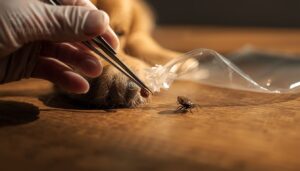
Never squeeze the dead tick’s abdomen—that’s where the real risk lies. Pressing down can force fluids and bacteria directly into your dog’s skin.
Instead, use fine-tipped tweezers to grip the tick as close to the skin as possible, near its mouthparts. Apply a steady, upward pull, maintaining gentle handling throughout the process.
Once removed, dispose of the tick safely by placing it in a zip-lock bag.
Clean The Bite Area

Once the tick is out, the bite area needs some attention — and it is simpler than you might think. A few quick steps will help prevent infection and keep your dog comfortable.
Here’s what to do right after removal.
Disinfect The Skin
Once the tick is out, disinfecting the bite site is your first line of defense against skin infection. Use a two-phase prep approach for best results:
- Antiseptic Selection: 70% isopropyl alcohol or 3% hydrogen peroxide both work well
- Swab Application: Wipe the area thoroughly, then allow proper alcohol contact time before drying
- Drying Protocol: Let it air-dry completely before applying a pet-safe antibiotic ointment
That’s solid post-removal wound care.
Check for Mouthparts
Once the skin is dry, check your dog’s wound carefully before moving on. Look for a tiny dark dot—that’s pinpoint residue detection in action. Run a fingertip across the site for barb feel assessment and firmness palpation. A hard, anchored point signals the hypostome is still embedded.
| What You See | What It Means |
|---|---|
| Tiny dark plug | Retained mouthpart likely |
| Surface crust only | Cement crust evaluation — normal healing |
| Firm, anchored bump | Hypostome depth check needed |
| Soft, movable skin | Mouthparts likely clear |
Apply Pet-safe Antiseptic
Once you’ve confirmed the bite site is clear, it’s time to protect it. Apply one of these pet-safe options:
- Diluted chlorhexidine solution — chlorhexidine dilution matters; never use it full-strength
- Povidone iodine dabbed gently using soft gauze
- 70% isopropyl alcohol for quick disinfection
- A veterinary-approved antibiotic ointment like Neosporin sparingly
- Always follow label-driven dosage and prevent lick access immediately after
Watch for Swelling
After applying antiseptic, keep watching the bite site for 24 to 48 hours. Normal healing shows slight pinkness fading within a day. However, if swelling persists beyond this timeframe, or if you observe a temperature rise, skin tightness, or pain/sensitivity when touched, these are early infection signals.
Mobility issues—such as limping near a joint—indicate a serious concern. In such cases, it’s time to call the vet promptly.
Save The Tick
Once swelling looks stable, don’t toss that dead tick. Saving it contributes to tick biodiversity research and helps your vet confirm species identity if symptoms appear later. Here’s how:
- Use your tick-picking tool to transfer it carefully
- Drop it into a zip-lock bag
- Add a damp cotton ball to preserve it
- Label it with the date and bite location
Public awareness and research funding depend on documented samples like yours.
When to Call a Vet

Most of the time, removing a dead tick at home and watching the bite site closely is all you need to do.
But there are moments when your dog’s symptoms are telling you something more serious is going on. Here are the signs that mean it’s time to call your vet.
Redness or Discharge
A little redness right after removal is normal — your dog’s skin is simply reacting to the bite. Watch how it changes over the next 24 to 72 hours. If the redness spreads or worsens, this signals possible infection.
Use this discharge type guide: clear serous fluid means irritation; yellow, green, or pus-like purulent discharge means call your vet now.
Limping or Lethargy
If your dog starts limping or showing lethargy within 24 to 48 hours of a tick bite, don’t wait. A pain-induced limp, sudden onset lameness, or systemic fatigue can signal tick bite symptoms tied to serious infections.
These signs—such as joint inflammation and neuromuscular weakness—may indicate diseases like Ehrlichiosis or Anaplasmosis. These are not minor issues; they require immediate veterinary attention.
Call your vet the same day if you observe these symptoms. Prompt action is critical to preventing severe complications.
Fever After Tick Bite
Fever in dogs after a tick bite can appear within days — sometimes before you’d expect it. That rising temperature is one of the clearest fever warning signs that tickborne diseases like Lyme disease or Ehrlichiosis are active.
Watch for these fever severity indicators alongside temperature changes:
- Shivering, weakness, or loss of appetite
- Panting without physical activity
- Lethargy that worsens by the hour
Call your vet immediately.
Embedded Tick Head
Sometimes tick removal leaves something behind. When you pull the body free but the hypostome cement has anchored the mouthparts deep in the dermis, head retention becomes the real concern.
Palps folding during removal often signals incomplete extraction. Watch for a bump with a dark center — that’s a foreign body reaction forming.
Poor post-removal wound care worsens it. Call your vet; dried dead tick head fragments need professional removal.
Multiple Ticks Found
Finding multiple dead or dried ticks on your dog indicates they likely crossed an environmental hotspot—a patch of tall grass or brush thick with questing ticks. This suggests a high-risk exposure area.
Cluster detection matters: one tick almost always signals others hiding nearby. However, stage variation complicates this, as tiny unfed ticks are easily missed during inspections.
Conduct a full inspection routine and consult your vet promptly. The risk of co-infection rises sharply with multiple bites, making professional evaluation critical.
Tick-Borne Diseases in Dogs
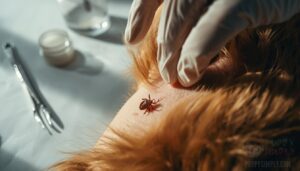
Even a dead tick can leave behind more than just a bite mark — some carry pathogens that were already transmitted to your dog before it died. Knowing the warning signs of tick-borne illness can help you catch a problem early, before it becomes serious.
Here are the key diseases to watch for.
Lyme Disease Signs
Lyme disease can quietly develop after a single tick bite — and the signs don’t always appear right away. Watch your dog for:
- Lethargy, loss of appetite, and muscle aches
- Joint pain, stiffness, or reluctance to move
- Severe headache-equivalent signs like sensitivity and disorientation
- Facial nerve palsy, vision changes, or cutaneous infection near the bite
Early detection matters.
Ehrlichiosis Symptoms
Another tick-borne concern worth knowing: ehrlichiosis. If your dog picked up a dead tick or you’ve just finished tick removal, watch for symptoms starting 5 to 14 days later.
Canine ehrlichiosis often causes fever, persistent fatigue, and muscular aches.
Severe headache-equivalent signs, neurological confusion, and gastrointestinal upset — nausea, vomiting, diarrhea — are also possible.
Early treatment makes a real difference.
Rocky Mountain Spotted Fever
Rocky Mountain Spotted Fever is caused by Rickettsia rickettsii, transmitted via the brown dog tick.
Symptoms—fever, rash on wrists and ankles, fatigue—typically manifest 2 to 14 days after a dead tick or live tick bite.
The disease occurs throughout the entire U.S., with cases peaking seasonally in spring and summer.
Prompt tick removal significantly lowers the risk of disease transmission.
Babesiosis in Dogs
Babesiosis is another serious concern after a tick bite. Caused by Babesia parasites — called merozoites — it invades your dog’s red blood cells, triggering anemia.
Watch for pale gums, dark urine, and lethargy as key anemia indicators.
Transmission requires at least 48 hours of attachment, so prompt tick removal matters.
Pregnant dogs face added risks, as Babesia can pass to unborn puppies.
Anti-Babesia therapy requires veterinary diagnosis.
Prevent Future Tick Bites

Once the tick is gone, the real goal is making sure it doesn’t happen again.
A few consistent habits go a long way toward keeping your dog protected all season.
Here’s where to start.
Daily Tick Checks
Think of a daily tick check as your dog’s invisible shield. After every outdoor trip—especially through grass or brush—run your hands slowly over both sides of the body using Fur Layer Palpation to feel for small bumps.
Consistent Check Timing and a Post-Play Inspection routine, paired with a simple Documentation Log, make regular tick checks second nature.
Check Ears and Neck
Ticks love hidden spots — and your dog’s ears and neck are prime real estate. During tick checks, slow down at these areas.
- Ear Edge Inspection: Part the fur along the ear rim and check the Ear Canal Visual area for dark specks or dried dead tick remnants.
- Neck Fold Examination: Separate skin folds carefully; a dried tick can resemble a stuck scab.
- Collar Line Check and Lymph Node Palpation: Remove the collar, feel for bumps, and note any swelling — it may indicate a bite site requiring tick removal.
Use Vet-approved Preventatives
Daily tick checks help catch problems, but they’re no substitute for a solid preventative.
Ask your vet about products like Seresto, a tick prevention collar known for ingredient safety and steady release. Whether you choose spot-on treatments or oral chews, correct dosage and proper application techniques matter.
A quick compatibility check and resistance management discussion during preventative veterinary care keeps your tick preventatives working effectively.
Maintain Your Yard
Your yard is one of the most overlooked tools in tick population management. A few consistent habits dramatically cut tick habitat:
- Rake leaf litter removal area regularly and bag debris tightly
- Adjust mowing height and trim edges near fences and shrubs
- Control soil moisture by watering deeply but less often
Shrub pruning, clutter control, and basic environmental sanitation keep ticks from settling in.
Avoid Tall Grass
Tall grass is where tick questing happens — ticks climb blade tips and wait for your dog to brush past. Keeping grass below a 3–4 inch grass height threshold disrupts that cycle.
| Action | Why It Helps |
|---|---|
| Mowing frequency (weekly) | Cuts off tick questing zones |
| Trim yard edges and paths | Removes tick habitat corridors |
Tick-repellent mulch along borders adds another layer to your tick prevention plan.
Frequently Asked Questions (FAQs)
Is it safe to have an engorged dried dead tick on my dog?
Even a dried dead tick carries lingering risks — pathogen retention from prior feeding.
Prolonged inflammation at the bite site persists as a concern.
Leftover tick residue scent may signal the risk of reattachment by other ticks.
What happens if a tick dies on a dog?
When a dead tick stays attached, the bite site can trigger an immune reaction and risk of bacterial superinfection.
This may slow bite site healing, and even pathogen persistence remains possible if the tick fed for long enough.
What does a dead embedded tick look like on a dog?
A dead embedded tick usually appears as a firm, rubbery lump with a central dark plug where the mouthparts anchor in.
Nearby, you might observe a silvery white bump, a tucked leg silhouette, or slight skin irritation in dogs.
Can a dead tick look like a scab?
A dried dead tick’s dark, crusty surface and flat shape can closely mimic a scab.
Check for leg visibility, hardness, and spot persistence to tell them apart.
What if a tick is embedded and dead?
An embedded dead tick still needs removal. The tick head and mouthparts left behind trigger inflammation and tissue reaction.
Professional removal options exist if you are unsure — post-extraction care and monitoring prevent scar tissue formation.
Are dead ticks contagious?
A dried dead tick can’t spread tickborne disease through new bites — post‑mortem transmission doesn’t happen. The real pathogen survival concern is what occurred while it was alive and feeding.
Is there any danger in leaving a dead tick on a dog?
Leaving a dead tick on your dog carries real risks. Bacterial colonization can set in at the bite site, chronic irritation may develop, and delayed disease monitoring becomes harder without prompt tick removal and post-removal wound care.
What are the symptoms of tick-borne illness in dogs?
Tick-borne illness hits fast. Watch for lethargy in dogs, fever, weight loss, episodes of diarrhea, skin bruising, and neurological tremors.
Lyme disease, Ehrlichiosis, Anaplasmosis, and Rocky Mountain spotted fever can also cause kidney bleeding.
Are there any home remedies to remove dead ticks from dogs?
Skip olive oil, apple cider vinegar, baking soda paste, honey coating, aloe gel, essential oils, and herbal sprays.
No DIY removal methods or natural remedies work reliably, and most make pet grooming and the safe removal harder.
What is the best way to prevent ticks from attaching to dogs?
The best prevention sounds simple enough: use a vet-approved preventive consistently, check your dog daily, and keep your yard trimmed.
Together, these three habits stop most ticks before they ever get the chance to bite.
Conclusion
What separates a minor inconvenience from a serious health risk? Often, it’s just how quickly you act. A dried dead tick on a dog’s skin still demands the same careful removal and monitoring as a live one—because the mouthparts stay behind, and disease risk doesn’t vanish with the tick’s heartbeat.
Check your dog daily, remove anything suspicious cleanly, and don’t wait for symptoms that worry you. Your dog can’t advocate for themselves—but you can.
- https://www.consumerreports.org/health/outdoor-safety/how-quickly-can-an-attached-tick-make-you-sick-a6286230428/
- https://www.morrisanimalfoundation.org/article/tick-borne-diseases-info-for-pet-owners
- https://web.uri.edu/tickencounter/species/dog-tick/
- https://hersheyvet.com/blog/tick-borne-diseases-in-dogs/
- https://www.infuzemd.com/tick-removal-techniques/