This site is supported by our readers. We may earn a commission, at no cost to you, if you purchase through links.
That eight-week-old puppy shredding your couch cushion isn’t being bad. His brain is bored stiff, and chewing is the only outlet he’s got.
Puppies are wired to work for their food, sniff out problems, and solve little puzzles all day long. Skip that mental workout and you get zoomies at 9 PM, nonstop barking, or a shoe collection with holes in it. The fix isn’t more walks (though those help) — it’s interactive brain games for puppies that tire out the mind, not just the legs.
Below, you’ll find real toys, DIY tricks, and easy games that turn "problem puppy" into a calm, confident thinker.
Table Of Contents
- Key Takeaways
- Best Interactive Brain Games for Puppies
- Top 8 Puppy Brain Game Toys
- 1. PAW5 Dog Snuffle Mat for Slow Eating
- 2. Starmark Everlasting Sprocket Large Dog Toy
- 3. Petsta interactive dog puzzle treat dispenser
- 4. Nina Ottosson MultiPuzzle Expert Dog Toy
- 5. StarMark Small Interactive Dog Toy
- 6. ZippyPaws Chipmunk Log Burrow Toy
- 7. Letsmeet Squeaky Snuffle Dog Toy
- 8. Hunger for Words Talking Pet Starter Set
- DIY Puppy Enrichment Games
- Choosing Puppy Brain Games
- Benefits of Puppy Mental Stimulation
- Frequently Asked Questions (FAQs)
- What games stimulate puppies brain?
- What is the 7 7 7 rule for dogs?
- What can I do to mentally stimulate my puppy?
- How do you say "I love you" in dog speak?
- How often should puppies play brain games weekly?
- Can brain games replace daily walks entirely?
- What age can puppies start puzzle toys?
- How long should each brain game session last?
- Are brain games helpful for anxious or shy puppies?
- Conclusion
Key Takeaways
- Puppies chew, bark, and act out mainly because their brains are bored, so mental workouts like scent games and puzzle toys matter as much as physical exercise.
- Nose-driven games such as snuffle mats, hide-and-seek, scent trails, and muffin tin puzzles tap into natural foraging instincts and build focus while slowing down fast eaters.
- Choosing the right brain game means matching difficulty, size, and toy durability to your puppy’s age, breed, chewing habits, and personality to keep them challenged without frustrating them.
- Regular mental stimulation (2-3 sessions weekly) builds confidence, supports obedience training, strengthens your bond, and calms behavior, but it works alongside walks rather than replacing them.
Best Interactive Brain Games for Puppies
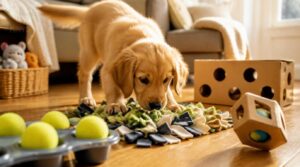
Puppies are born detectives, and their noses want a job. The good news? You don’t need fancy equipment to give them one. Here are five games that put those instincts to work.
Start with a classic like hiding treats around the room for your puppy to sniff out, a simple way to turn mealtime curiosity into a confidence-building brain workout.
Snuffle Mat Treat Hunts
Bury a few treats in the fleece folds and watch your pup’s nose take over. A snuffle mat turns mealtime into scent work, tapping into natural foraging instincts.
Mix textures and depths for variety, start shallow, then progress difficulty as skills grow.
These mats also function as effective slow feeders to help prevent sickness from rapid eating.
Wash it gently to keep fibers fresh, and always practice portion control so this enrichment doesn’t turn into overeating.
Hide-and-seek With Owners
Hide-and-seek puts you in the game, not just the treats. Say "Find!", let your puppy sit and wait, then hide somewhere visible nearby—behind a couch, a doorway. Call them in, praise big when they find you.
This builds bond strengthening through recall practice and trust. Keep spots safe, cues consistent, and rounds short for lasting engagement.
Scent Trail Games
Once your pup’s nailed hide-and-seek, let their nose lead. Scent trail games turn nose work training into a treasure hunt—drop kibble every step or two, indoor carpet or grass, keeping trails short at first.
- Start with 2-3 step trails
- Use fresh, food-safe scents
- Add turns as skills grow
- Log time and length
Fresh scents work best; fading fast means fewer distractions.
Muffin Tin Puzzles
Grab a muffin tin from your kitchen drawer and you’ve got a budget puzzle toy ready to go. Tuck treats under some cups, leave others empty — your puppy learns to sniff, not guess.
| Setup | Difficulty |
|---|---|
| All cups filled | Beginner |
| Half filled | Intermediate |
| Distractors added | Expert |
Always supervise, use bite-sized treats, and wash the tin after each round.
Go-find-it Treat Searches
Teach a simple "find it" cue, then let your puppy’s sense of smell take over. Start easy — treat in plain sight — before graduating to scent trail challenges around safe, obstacle-free rooms.
Reward every success immediately; that reinforcement builds persistence fast. Rotate hiding spots so puppies rely on scent-based play, not memorized routines, sharpening true nose work skills over time.
Top 8 Puppy Brain Game Toys
Sometimes the best brain game isn’t a game you invent yourself, it’s one you buy off the shelf. The right toy does the thinking for you, built to challenge your puppy’s nose, paws, and patience all at once. Here are eight standouts worth adding to your pup’s toy box.
1. PAW5 Dog Snuffle Mat for Slow Eating
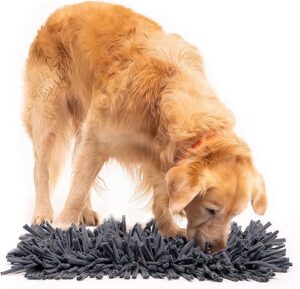
Mealtime becomes a hunting expedition with this one. The PAW5 Wooly Snuffle Mat uses dense, grass-like fabric fibers to hide kibble, forcing your puppy to sniff and dig instead of inhaling their food in ten seconds flat.
That slower pace helps prevent bloating and gulping, while giving their brain a solid workout. It’s handmade from safe, non-toxic materials, machine washable, and works well for brachycephalic breeds too. Just skip it for giant breeds or aggressive chewers.
| Best For | Fast-eating dogs of small to medium size who need mealtime slowed down and could use some extra mental stimulation along the way. |
|---|---|
| Material | Organic cotton |
| Mental Stimulation | High |
| Cleaning Method | Machine/hand washable |
| Scent | Unscented |
| Target Life Stage | All life stages |
| Boredom Relief | Yes |
| Additional Features |
|
- Slows down eating to help prevent bloating and gulping
- Made from safe, non-toxic, organic materials that are machine washable
- Provides mental stimulation that helps reduce boredom and anxiety
- Not suited for giant breeds or dogs with very large appetites
- No non-skid backing, so aggressive eaters may push it around
- Thick fabric can take a while to fully air dry after washing
2. Starmark Everlasting Sprocket Large Dog Toy
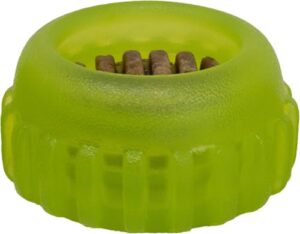
For power chewers over 40 pounds, this sprocket-shaped puzzle earns its keep. The interlocking teeth create variable resistance as your dog gnaws and rolls it, while textured ridges pull double duty on dental cleaning.
Stuff it with chicken-flavored Everlasting Treats or kibble, then move the placement around each session to keep things challenging. It’s dishwasher safe, resists cracking, and holds its shape through serious chew sessions—exactly what you want for a dog who treats every toy like a demolition project.
| Best For | Large, powerful chewers who need a tough, long-lasting puzzle toy to stay mentally engaged and satisfy heavy gnawing habits. |
|---|---|
| Material | Plastic |
| Mental Stimulation | High |
| Cleaning Method | Dishwasher safe |
| Scent | Vanilla |
| Target Life Stage | Not specified |
| Boredom Relief | Yes |
| Additional Features |
|
- Durable plastic construction holds up to aggressive chewers and resists cracking
- Dual-level treat system lets you adjust difficulty and keep dogs mentally stimulated
- Dishwasher safe, making cleanup quick and easy
- Large size makes it suitable only for bigger breeds, not smaller dogs
- Requires manual stuffing with treats or kibble each time to work as intended
- Heavier at 12.4 ounces, which may not suit dogs that prefer lighter toys
3. Petsta interactive dog puzzle treat dispenser
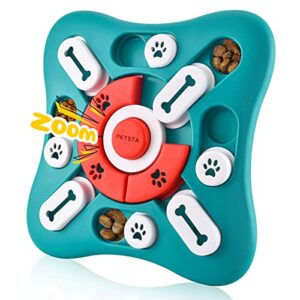
Sixteen holes, three difficulty modes, one seriously busy puppy. The Spin & Slide and Seek & Hide layouts combine a circular orbit with a linear path, so your pup has to sniff, paw, and think through each session instead of just pawing randomly.
The squeak button resets attention mid-play, and non-removable parts keep things safe. It’s dishwasher safe and stretches feeding time past 20 minutes—good for pups who inhale meals in seconds flat.
| Best For | dog and cat owners looking to slow down mealtime and give their pet some mental exercise through sniffing, pawing, and puzzle-solving. |
|---|---|
| Material | Polypropylene |
| Mental Stimulation | High |
| Cleaning Method | Dishwasher safe |
| Scent | Unscented |
| Target Life Stage | All pets |
| Boredom Relief | Yes |
| Additional Features |
|
- Three play modes (Spin & Slide, Seek & Hide) with 16 holes keep pets engaged and mentally stimulated
- Dishwasher safe and built with non-removable parts for easy cleaning and safety
- Anti-skid pads and a squeak button help keep play stable and attention-grabbing
- Not suitable for aggressive chewers, since it’s made for enrichment rather than heavy chewing
- Polypropylene construction may not hold up as well as more durable materials over time
- Fixed hole design offers less customization than adjustable-difficulty puzzle feeders
4. Nina Ottosson MultiPuzzle Expert Dog Toy

Four mechanisms, one puzzle, zero shortcuts. The MultiPuzzle Expert earns its Level 4 badge with sliding tiles, a spinning wheel, and locking pegs working together, not separately.
Your pup slides green tiles, spins the center wheel, and manipulates orange pegs in sequence before treats appear. Skip Level 3 puzzles first, this one demands that foundation.
Made from BPA and phthalate-free plastic, it’s dishwasher-safe for easy cleanup. Reserve it for confident, motivated dogs ready for real cognitive work, and always supervise play.
| Best For | This puzzle is best for confident, experienced dogs who have already mastered Level 3 challenges and are ready for advanced mental stimulation. |
|---|---|
| Material | Plastic |
| Mental Stimulation | High |
| Cleaning Method | Wipeable |
| Scent | Unscented |
| Target Life Stage | Advanced dogs |
| Boredom Relief | Yes |
| Additional Features |
|
- Combines sliding tiles, a spinning wheel, and moving sliders for varied, engaging play
- Made from food-safe plastic free of BPA, PVC, lead, and phthalates
- Doubles as a slow feeder, helping fast eaters pace themselves during meals
- Not suitable for beginner dogs or those without prior puzzle experience
- Difficulty levels must be adjusted manually rather than automatically
- Small 1-cup capacity may require refilling for larger or hungrier dogs
5. StarMark Small Interactive Dog Toy
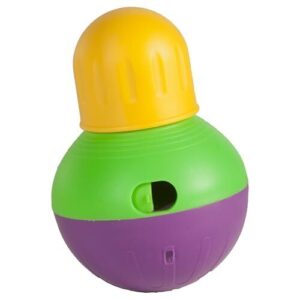
Not every puzzle needs to be a brain-buster to earn its spot in your toy bin.
The StarMark Small Interactive Dog Toy is built from tough, chew-resistant rubber-like material with a hollow center for hiding kibble or treats. Your pup engages it with mouth, nose, and paws, rolling and nudging to release rewards while raised textures add sensory interest.
Check for wear regularly, size treats appropriately, and rinse after each session. Simple, safe, and great for reinforcing patience during shorter training moments.
| Best For | Small to medium, food-motivated dogs who need mental stimulation and slower mealtimes, including determined chewers. |
|---|---|
| Material | Molded plastic |
| Mental Stimulation | High |
| Cleaning Method | Not fully disassembled |
| Scent | Unscented |
| Target Life Stage | Not specified |
| Boredom Relief | Yes |
| Additional Features |
|
- Heavy, impact-resistant plastic holds up well against rough play and aggressive chewers
- Adjustable dispensing gate lets you customize difficulty for different kibble sizes
- Dual openings (top lid and bottom slot) offer flexible filling and dispensing options
- Narrow top fill hole makes loading tricky without a funnel or similar tool
- Bottom door can pop open on its own, making the puzzle less challenging than intended
- Solid plastic build is noisy on hard floors, tough for tiny dogs to carry, and can’t be fully taken apart for cleaning
6. ZippyPaws Chipmunk Log Burrow Toy
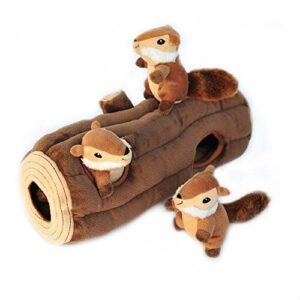
Some pups need a hunting story, not just a chew toy. The ZippyPaws Chipmunk Log Burrow plays into that instinct with a plush log housing three squeaky chipmunks tucked into multiple burrow openings.
Your puppy sniffs, digs, and extracts each critter, getting a squeak payoff for every successful "catch." Machine-washable and refillable with other Miniz sets, it’s low-mess fun.
| Best For | small to medium breed dogs of any age, especially food- and puzzle-motivated pups who love a good hunting game. |
|---|---|
| Material | Plush fabric |
| Mental Stimulation | High |
| Cleaning Method | Machine washable |
| Scent | Unscented |
| Target Life Stage | All life stages |
| Boredom Relief | Yes |
| Additional Features |
|
- Taps into natural foraging instincts with three squeaky chipmunks to find and "catch"
- Machine-washable and refillable with other ZippyPaws Miniz sets for long-term use
- Great mental stimulation that helps curb boredom during longer play sessions
- Not built for extra tough or aggressive chewers
- Seams and housing need regular checks to make sure the burrow stays intact
- Best suited for light-to-moderate chewing, so it may not last with rougher play styles
7. Letsmeet Squeaky Snuffle Dog Toy
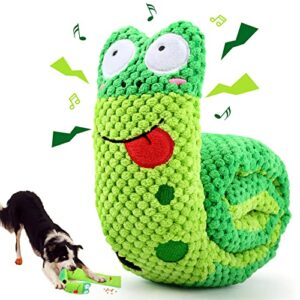
If your pup loves a good hunt but you want less mess, this one’s a nice middle ground. It combines a snuffle mat surface with three built-in squeakers, so sniffing out hidden treats comes with a fun sound payoff.
The plush shell stays gentle on baby teeth, and a rope segment adds tug-of-war options. It’s machine washable and fits small to large breeds—just skip it for aggressive chewers, since seams can wear down over time.
| Best For | Small to medium-sized dogs who love foraging and sniffing games but aren’t heavy or aggressive chewers. |
|---|---|
| Material | Polyester |
| Mental Stimulation | High |
| Cleaning Method | Machine washable |
| Scent | Unscented |
| Target Life Stage | Not specified |
| Boredom Relief | Yes |
| Additional Features |
|
- Hidden treat pockets encourage natural foraging instincts and mental stimulation
- Integrated squeakers keep pets engaged and entertained during play
- Soft, machine-washable plush fabric makes cleanup and gentle chewing easy
- Not suitable for aggressive chewers, as seams and Velcro can wear down
- Treat openings may be too small to fit larger treats or biscuits
- Only designed for small to medium dogs, so it’s not ideal for larger breeds
8. Hunger for Words Talking Pet Starter Set
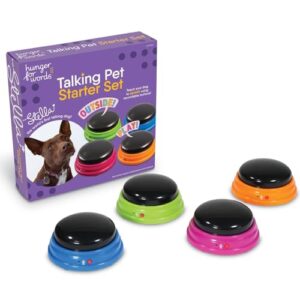
Squeakers are fun, but what if your dog could actually tell you what it wants? This kit lets you record four buttons with words like "outside" or "play," using speech therapist Christina Hunger’s step-by-step guide.
It’s a genuine cognitive workout, not just a gadget. Consistent word association builds real communication skills over time. Just watch battery life and keep the exterior recording button away from curious paws so your hard work doesn’t get erased.
| Best For | Dog or cat owners who want to teach their pet to communicate basic needs like going outside or playing, and who enjoy hands-on training projects. |
|---|---|
| Material | Plastic |
| Mental Stimulation | High |
| Cleaning Method | Wipe clean |
| Scent | N/A |
| Target Life Stage | Not specified |
| Boredom Relief | Yes |
| Additional Features |
|
- Comes with a step-by-step guide from speech therapist Christina Hunger to help you get started
- Four customizable buttons let pets request specific things like "outside" or "play"
- Doubles as a mental workout for your pet, building real communication skills over time
- The exterior recording button is easy for pets to accidentally press and erase
- Each button needs 2 AAA batteries (not included), meaning frequent replacements across four buttons
- Audio can sound inconsistent or tinny depending on how the recording was made
DIY Puppy Enrichment Games
You don’t need a shopping cart full of puzzle toys to keep your puppy’s brain busy. Grab a few items you already have lying around the house, and you’re set. Here are five easy DIY games worth trying first.
Cardboard Tube Treat Puzzles
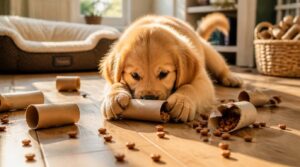
Got empty toilet paper rolls? You’ve got a free puzzle toy. Fold one end, drop in kibble, fold the other.
Vary difficulty by using multiple tubes, blocking openings, or mixing treat sizes. Always trim rough edges first and supervise chewing. Recycle torn tubes afterward.
Simple, cheap enrichment that seriously engages your puppy’s brain and nose.
Layered Container Challenges
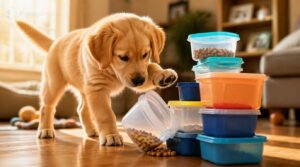
Grab a few clean plastic containers and stack them like building blocks, treats tucked between layers. Your puppy has to knock, unstack, or nudge each one aside to reach the prize underneath.
This stacking challenge builds patience and problem-solving. Vary container sizes for difficulty, and always supervise for safety. Great low-cost mental stimulation that mimics real foraging instincts.
Towel-wrapped Kibble Rolls
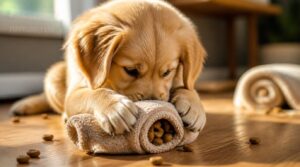
Rolling kibble into a towel turns snack time into a scent-work session. Tuck treats along a dry towel, roll snugly, fold the ends in—burrito style.
- Sniffing, nudging, gentle licking
- Building focus, not frustration
- Wiping away boredom fast
- Bonding over a simple game
Watch for overstimulation, wash towels after, and adjust tightness to raise or lower difficulty.
Chair Weave Courses
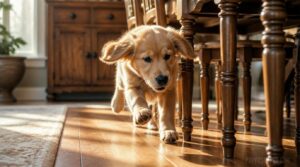
Borrow a trick from furniture restoration: set up dining chairs in a line and let your pup weave between the legs like a slalom course. This mirrors traditional cane patterns used in frame restoration—purposeful, precise movement.
| Skill Built | Real-World Payoff |
|---|---|
| Weaving | Agility & focus |
| Obstacle navigation | Obedience confidence |
Always supervise for tool safety training around any props nearby.
Safe Indoor Obstacle Paths
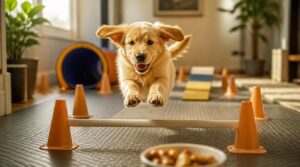
Think of your hallway as a mini dog agility course. Lay down non-skid flooring, space obstacles with clear turns, and add visual boundary cues like tape or cones. Start straight, then add curves gradually—that’s real progression training. On rainy days when the hallway course is off, keep her brain busy with puzzle toys that boost mental stimulation instead.
Finish with treats for solid reward sequencing. This simple obstacle course delivers genuine mental stimulation, turning your living room into a confidence-building enrichment activity.
Choosing Puppy Brain Games
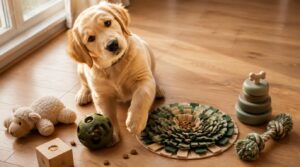
Not every brain game fits every puppy, and that’s okay. The right pick depends on a few key traits your pup already has. Here’s what to weigh before you grab that next toy.
Puppy Age and Patience
A ten-week-old pup and a six-month-old teether need totally different brain games. Younger puppies, still inside their socialization window, do best with short, 2-5 minute bursts. Older ones, deep in teething, need patience-friendly puzzles.
- Match difficulty to attention span
- Watch for frustration, not just boredom
- Shorten sessions during teething peaks
- Build on small wins
- Respect energy cycles between play and rest
Breed Size and Strength
A Great Dane puppy and a Chihuahua puppy don’t just look different—their bodies need different games entirely.
Growth rate management matters most for large and giant breeds prone to rapid, joint-stressing growth spurts. Muscle fiber types also vary, affecting endurance versus burst strength in games. Prioritize joint health maintenance with low-impact puzzle toys, and always use proper handling equipment safety gear, since breed lifespan tradeoffs often hinge on early musculoskeletal care.
Puzzle Difficulty Level
Body size sets the stage, but puzzle difficulty decides whether your pup actually learns anything.
Start with easy, single-mechanic toys, then add sliders or lids as skills grow—that’s Sequential Mechanic Mastery in action. Watch for solved-too-fast boredom or frustrated walk-aways; both signal it’s time to adjust. Good cognitive training games use Adaptive Difficulty Pacing and quick Feedback Reward Systems, keeping mental stimulation challenging without tipping into defeat.
Chewing Habits and Safety
Puzzle difficulty matters, but what your pup actually chews on matters more. Choose safe texture selection over hard, brittle chews to prevent dental fractures. Inspect toys often, replace worn ones, and supervise closely to avoid choking.
- Skip rocks and hard bones
- Choose puppy-rated chews
- Watch for small pieces
- Rotate short chewing sessions
- Clean toys regularly for hygiene
Food Motivation and Personality
Once safety’s covered, think about what actually gets your pup excited. Reward value shifts with personality: novelty seekers explore new flavors eagerly, while anxious pups stick to familiar kibble. Watch satiation too—a full belly kills motivation fast.
Match treats to temperament, whether that’s cheese for the bold or gentler rewards for cautious learners, and rewardbased learning sticks.
Benefits of Puppy Mental Stimulation
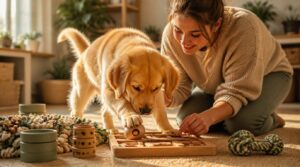
Brain games aren’t just fun and games, they actually change your puppy from the inside out. The payoff shows up in behavior, confidence, and how close you two become. Here’s what you can expect once puzzle time becomes part of your routine.
Reduces Boredom Chewing
A bored puppy chews. That’s just the truth, and puzzle toys give that energy somewhere productive to go.
Purposeful chew tasks channel teething anxiety into constructive chewing habits, while reward-based play triggers endorphin release that calms the urge to gnaw furniture.
- Fewer shredded shoes
- Calmer evenings
- Less guilt leaving the house
- A puppy who’s genuinely tired, not just wired
Builds Puppy Confidence
Watch a puppy solve a snuffle mat for the first time — that little tail wag afterward? That’s earned confidence, not luck.
A puppy’s first solved snuffle mat, tail wagging, is earned confidence, not luck
Every solved puzzle teaches "I can figure this out," which carries into Sensory Exposure Benefits and Socializing New Faces too. Brain games for dogs build the same self-assurance obedience training relies on, one small win at a time through consistent canine enrichment.
Supports Obedience Training
Puzzle-solving and obedience work run on the same fuel: focus and impulse control. A puppy who’s learned to wait out a treat-dispensing toy already has the patience for sit-stays.
Brain games sharpen the "look at me" response distraction training depends on. That carryover makes clicker training clicks faster, leash responsiveness improves, and command consistency sticks — because a mentally tired puppy is a teachable one.
Strengthens Your Bond
Working through a puzzle side by side turns into real connection. When you kneel down for a scent trail game or cheer a muffin tin win, that’s a positive reinforcement bond forming through mutual problem solving.
- Shared training routines build trust
- Verbal cue consistency deepens understanding
- Physical affection techniques after wins seal the moment
This is brain training for dogs that feeds the heart, too.
Encourages Calmer Behavior
A tired brain settles a wound-up puppy faster than a tired body ever will.
Sniffing games trigger parasympathetic activation, slowing heart rate and breathing. Pair that with routine predictability, calm praise, and low-stimulation settings, and you’ve built real arousal management.
Puppies with steady mental stimulation chew less, bark less, and settle into rest without a fight — enrichment doing quiet, powerful work.
Frequently Asked Questions (FAQs)
What games stimulate puppies brain?
Like a scavenger hunt for the senses, the best games mix olfactory instinct development with problem-solving.
Snuffle mats, scent trails, and muffin tin puzzles spark natural foraging behaviors, sharpen focus, and deliver real mental stimulation—often more tiring than a jog.
What is the 7 7 7 rule for dogs?
The 7-7-7 rule exposes puppies to seven surfaces, objects, locations, people, and challenges by seven months old.
This structured approach builds cognitive development through surface variety training, object rotation, and socialization diversity—laying groundwork for confident, well-adjusted adult dogs.
What can I do to mentally stimulate my puppy?
Try snuffle mats, scent trails, and go-find-it searches to spark olfactory stimulation.
Rotate puzzle toys, hide-and-seek, and muffin tin games daily. This variety helps cognitive development, prevents mental fatigue, and keeps your puppy’s brain genuinely engaged, not just busy.
How do you say "I love you" in dog speak?
Slow blink at your pup with a soft gaze — it boosts oxytocin and signals trust. Pair it with a warm tone, gentle touch, and relaxed body language. That combo, layered into daily brain games, speaks louder than words ever could.
How often should puppies play brain games weekly?
More isn’t always better here—mental fatigue is real. Aim for 2 to 3 sessions weekly, 5-15 minutes each, adjusted by age-based frequency and breed energy. Track progress, alternate game types, and pull back if your pup seems stressed or overwhelmed.
Can brain games replace daily walks entirely?
No, they can’t. Cardiovascular benefits and joint development only come from real movement, while sensory exposure and dual task training happen outdoors. Puppies need both: walks build bodies, brain games build minds—balance them for true dog enrichment.
What age can puppies start puzzle toys?
Six weeks for early weaning puzzles, eight weeks for easy reveals, twelve for hidden rewards. Match developmental stage timing to skill, keep session length guidelines short, and prioritize teething toy safety to avoid frustration and injury.
How long should each brain game session last?
Aim for 10 to 20 minutes, adjusted for age-based timing. Young pups do 5-10 minutes; older ones handle 20- Watch for frustration signs like yawning, and increase duration incrementally, 2-5 minutes weekly, running 2-5 sessions per week.
Are brain games helpful for anxious or shy puppies?
Funny how the "scaredy-cat" pup often turns bold once sniffing takes over.
Yes — calm, low-pressure games promote stress reduction, build confidence, and support separation anxiety relief, turning nervous energy into confident, calm exploration through small, winnable challenges.
Conclusion
A tired mind settles like a still pond, calm and clear. That’s the goal behind every snuffle mat, muffin tin, and cardboard puzzle you’ve patiently tried today.
Interactive brain games for puppies aren’t extra credit—they’re the main lesson, shaping a dog who thinks before he chews and settles before he barks.
Start small, stay consistent, and watch that wild little troublemaker grow into a confident, focused companion for life. Your couch cushions will thank you.
- https://www.akc.org/expert-advice/lifestyle/do-it-yourself-cognitive-dog-toys-for-home
- https://www.nylabone.com/dog101/brain-games-for-dogs
- https://www.vegask9adventures.com/10-easy-dog-mental-stimulation-games-you-can-do-at-home
- https://dogsinc.org/blog/ask-the-trainer/canine-enrichment
- https://www.purina.co.uk/articles/dogs/behaviour/play/brain-games-for-dogs