This site is supported by our readers. We may earn a commission, at no cost to you, if you purchase through links.
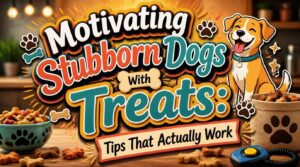
Your dog knows exactly what "sit" means. He’s done it a hundred times. But the moment a squirrel bolts across the yard, you might as well be speaking Martian.
That’s not stubbornness — that’s a motivation gap. And the good news is, it’s fixable.
Motivating stubborn dogs with treats isn’t about bribing your way to obedience. It’s about speaking your dog’s language clearly enough that listening becomes the obvious choice. The right treat, delivered at the right moment, carries more information than a five-minute lecture ever could.
Get the details right, and even the most strong-willed dogs start showing up for training.
Table Of Contents
Key Takeaways
- What looks like stubbornness is usually a motivation gap — close it by delivering a high-value treat within two seconds of the desired behavior, and your dog gets a clear, unmistakable signal about what just worked.
- Not every dog is wired the same, so test different reward types — food, toys, praise, scent games — and let your dog’s own response tell you which one actually drives them.
- Match treat value to task difficulty: save your most irresistible rewards (liver, freeze-dried salmon, cheese) exclusively for high-distraction moments so the payoff stays meaningful and the exclusivity keeps your dog choosing you over the chaos.
- Short sessions before mealtime, tiny treat pieces, and easy early wins stack the deck in your favor — once your dog is reliably performing a behavior, shift to intermittent rewards to make obedience stick for the long haul.
Why Treats Motivate Stubborn Dogs
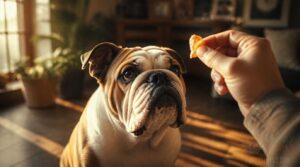
Before you can fix the problem, it helps to understand what’s actually going on in your dog’s head. Treats work because they give dogs instant, unmistakable feedback — but how well they work depends on a few key factors. Here’s what’s really driving the disconnect, and how rewards can change the game.
Working with experienced dog trainers can help you master the timing and technique that make treat-based rewards actually click for your dog.
Stubbornness Versus Confusion
What looks like stubbornness is often just a dog mid-confusion. When your dog ignores a cue, it may not be defying you — it might be misreading mixed signals, responding to the wrong gesture, or simply unsure what earns the reward this time.
Distinguishing refusal from confusion changes everything. One needs patience; the other needs clarity.
Food as Clear Feedback
Once you’ve ruled out confusion, food becomes your most reliable teaching tool — not a bribe, but clear feedback.
A treat landing within two seconds tells your dog exactly which action worked. That timing accuracy is everything. Miss it, and you’ve rewarded the wrong behavior.
Food rewards signal:
- The exact moment of success
- Which behavior earned the reward
- How strongly that behavior matters
- That consistency pays off
Building Trust Through Rewards
Consistent rewards do something deeper than teach behaviors — they build trust. When your dog predicts that correct actions lead to predictable reward outcomes, they relax into training instead of guessing.
That reliability is the foundation of your bond. Every well-timed treat says: this is safe, this makes sense. Repeated enough, positive reinforcement transforms a hesitant dog into a confident one who genuinely wants to engage.
Every well-timed treat builds trust until a hesitant dog becomes one who genuinely wants to engage
Motivation Differs by Dog
Not every dog is wired the same. A retriever might do anything for a piece of chicken, while a sighthound barely glances at it — breed drive differences are real. Your dog’s individual preference hierarchy matters more than any general rule.
Recognizing breed-specific motivation can help release your dog’s full potential.
Five motivational drivers worth testing:
- High-value food — liver, cheese, cooked meat
- Scent-based rewards — freeze-dried proteins
- Toy rewards — tug or fetch
- Physical praise — play and affection
- Nose work — scent-tracking games
Watch what your dog chooses. That’s your answer.
Choose High-Value Training Treats
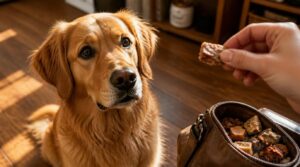
Not all treats are created equal, and with a stubborn dog, that difference really matters. The right treat can turn a dog that tunes you out into one that’s locked in and ready to work. Here are the best high-value options to keep in your training pouch.
Moist, Smelly Treats
Think of scent as your dog’s headline — it grabs attention before anything else does. Moist, aromatic treats work because they’re impossible to ignore, even in a distracting environment.
| Treat Type | Why It Motivates |
|---|---|
| Liver-based moist treats | Intense meaty aroma, irresistible palatability |
| Cheese-infused soft treats | Fatty acids melt fast, linger on the nose |
| Fish-flavored moist treats | Omega acids intensify when warmed by mouth heat |
| Deli-style meat pieces | Dense aroma, perfectly bite-sized for repetitions |
| Sausage-style training treats | Amino acids release strong scent during chewing |
With 60–80% moisture content, these treats disappear in seconds — meaning more reps, faster. Store them in airtight containers, refrigerate between sessions, and rotate scents regularly to prevent scent fatigue.
Cooked Meat and Liver
Few treats rival cooked chicken liver for raw motivation. Cook it to 160°F internally — the only reliable way to destroy Salmonella and Campylobacter. Watch for myoglobin color shifts as your timing guide.
Once your pup is hooked on this high-value reward, you’ll have a powerful tool for tackling common Shih Tzu training challenges like excessive barking.
- Slice thin to minimize shrinkage
- Pull it when color shifts from red to dull brown
- Pat dry to preserve texture and reduce cooking loss
- Refrigerate immediately after cooling
Cheese in Tiny Pieces
Cheese punches well above its weight in training sessions. Tiny pieces release flavor fast — the increased surface area floods the mouth with aroma almost instantly, which keeps your dog locked in.
Cut it small enough that your dog barely has to chew. Quick reset, next rep. That’s the rhythm that builds real obedience.
Freeze-dried Protein Rewards
Freeze-dried treats are the closest thing to a cheat code in your training kit. The lyophilization process skips heat entirely, which means proteins stay intact and that rich, meaty aroma stays locked in — exactly what pulls a distracted dog back to you fast.
Single-ingredient options like chicken or salmon keep things clean and potent. Store them cool and sealed to protect scent intensity.
Avoid Slow Crunchy Biscuits
Hard biscuits might seem harmless, but they silently kill your training rhythm. While your dog is crunching away, the reward window closes — that critical two-second connection between behavior and payoff is gone.
Crunchy treats also release almost no scent, so motivation drops fast. Swap them for soft, moist alternatives that disappear quickly, smell irresistible, and keep the session moving.
Match Treats to Training Difficulty
Not every treat deserves a spot in every training moment. Just like you’d save your best wine for a special occasion, your dog’s favorite rewards should be working hardest where it counts most. Here’s how to match what’s in your pouch to what you’re asking your dog to do.
Low-value Kibble Rewards
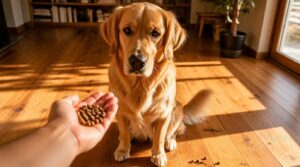
Kibble isn’t glamorous, but it earns its place. For easy tasks in calm settings, plain kibble works fine — especially when your dog is hungry before a meal.
Keep it effective with these tips:
- Store kibble sealed to preserve freshness and aroma
- Train before meals for hunger-driven engagement
- Keep pieces tiny to manage calories
- Rotate brands occasionally
- Pair every piece with praise
Medium-value Soft Treats
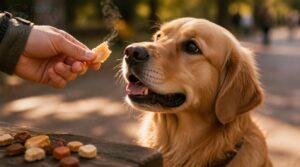
Kibble covers the basics, but when you step up to slightly harder tasks or mildly busier environments, soft treats earn their keep. They release aroma fast — within seconds — which pulls a distracted dog back into focus.
They’re gone in one bite, keeping your feedback loop tight. Rotate flavors regularly so your dog stays curious, not bored.
High-value Breakthrough Rewards

Soft treats handle everyday repetitions well. But some moments demand more — a first "down-stay", a recall past a squirrel, a sit when chaos erupts nearby. That’s when game-changing rewards earn their name.
Reserve your most fragrant, irresistible options for exactly these situations:
- Tiny liver pieces
- Cooked chicken shreds
- Freeze-dried salmon
- Small cheese cubes
Strong scent cuts through distraction fast, giving your dog a clear reason to choose you over the environment.
Save Favorites for Distractions
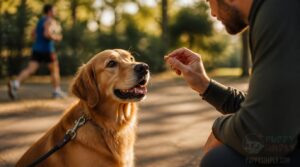
Those special treats you just stocked? Don’t spend them freely.
Reserve favorites exclusively for moments when distractions are actively present — a passing dog, a rustling bush, a jogger. The instant your dog shifts focus back to you despite the chaos, that’s when the good stuff appears.
This exclusivity rule keeps the reward meaningful. Dogs learn fast: harder moments earn better outcomes.
Rotate Treats Often
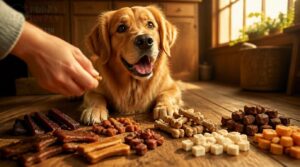
Keeping the same treat every session is a slow way to lose your dog’s attention. Dogs habituate fast — what thrilled them on Monday can feel boring by Wednesday.
Rotate treat types across sessions to preserve that novelty spark. A switch in scent alone can reset motivation mid-slump. Mix textures, flavors, and values. Keep your dog genuinely guessing.
Time Rewards for Better Results
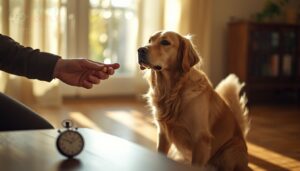
Timing is everything in dog training — even a second or two of delay can leave your dog wondering what exactly earned that treat. The good news is that a few simple habits can tighten your timing and make every reward land with real clarity. Here’s what actually counts:
Reward Within Two Seconds
Timing is everything. Your dog’s brain links a reward to whatever behavior just happened — so if you wait too long, you’re accidentally reinforcing the wrong thing.
Reward within two seconds of the desired behavior. That tight window is what builds a clear cognitive link between the action and the treat, keeping your training momentum strong and confusion low.
Treat in Correct Position
Where you deliver the treat shapes what your dog learns. Keep it at nose level, right at the target spot, so the dog connects position with reward.
- Deliver treats at nose level each rep
- Maintain hand motion stability throughout
- Use the same target spot consistently
- Gradually tighten precision criteria
- Reduce accidental movement cues
That’s target spot consistency working in action.
Use “yes” or Clicker
Think of a marker — whether a clicker or the word "yes" — as a snapshot. It freezes the exact moment your dog got it right, before you even reach for the treat.
But neither works out of the box. You have to load the marker first by pairing it with rewards repeatedly. Click, treat. "Yes," treat. Do that enough times, and the sound itself becomes meaningful — the signal, not the reward.
Keep Treats Easily Reachable
Your hand is already moving before the treat leaves the pouch — and that half-second gap is enough to confuse your dog about what they actually earned.
A waist-level treat bag cuts that lag dramatically. Positioned on your dominant side with a magnetic closure, you’re drawing and delivering in one fluid motion, no fumbling, no broken eye contact.
Avoid Accidental Hand Cues
Your reach can become a command without you ever intending it. Dogs are wired to read body movement, so when your hand swings toward your treat pouch before they’ve committed to the behavior, that motion quietly becomes the real cue — not your voice.
Deliver after the behavior, not during. Still hands. Clear signals.
Structure Short Successful Sessions

Even the best treats won’t do much if your training sessions are a chaotic mess. How you set things up matters just as much as what you’re rewarding with. These five simple adjustments will make every session work harder for you and your dog.
Train Before Mealtime
Hungry dogs are paying dogs. Train before mealtime, and you’re working with natural appetite instead of fighting against it.
- A pre-meal session means your dog’s nose and attention are already on high alert
- Hunger sharpens focus more reliably than any trick
- Appetite drops fast after eating — timing matters
- Even a light snack beforehand blunts motivation
- Consistent pre-meal timing builds a reliable training rhythm
Use that hunger. It’s free motivation.
Keep Sessions Brief
Once appetite is on your side, don’t squander it by training too long. Dogs hit a focus ceiling fast — usually around 5 to 15 minutes — and past that point, you’re not building skills, you’re burning through motivation.
Watch for slowing responses or hesitation. That’s your cue to stop. Shorter sessions keep energy high and leave your dog wanting more.
Start With Easy Wins
Short sessions only work when your dog is actually succeeding inside them. That’s why every session should open with behaviors your dog already knows — easy wins that get the reward loop moving fast.
- Ask for a reliable "sit" or "down" first
- Reward quickly and repeat two or three times
- Then introduce the harder behavior you’re working on
Building confidence early makes the tougher stuff feel far less intimidating.
Reduce Distractions First
Once your dog is winning early, don’t let the environment steal that momentum. A barking neighbor, a phone buzz, or visual clutter near the training spot can break focus instantly.
Start every session in a quiet training zone — doors closed, devices silenced, movement minimal. Distance from triggers matters too. If your dog keeps glancing away, you’re simply too close to whatever’s competing for their attention.
Use Tiny Treat Pieces
Treat size matters more than most people realize. Cut everything into pea-sized pieces — small enough to swallow quickly, big enough to register as a win.
- Keeps total calories in check without sacrificing repetitions
- Prevents satiation before your session ends
- Speeds up rapid reinforcement between behaviors
- Easy to carry and deliver without breaking stride
Tiny pieces mean more practice, more feedback, faster learning.
Use Treats Without Bribing

There’s a fine line between using treats as a training tool and accidentally teaching your dog to wait you out until food appears. The goal is to get your dog working for the reward, not because they see it — and that shift makes all the difference. Here’s how to use treats the smart way so they build real obedience instead of dependence.
Lure, Then Reward
Luring isn’t bribery — it’s a teaching tool. The sequence matters: request first, then show the treat to guide movement, then reward after the behavior happens. That order keeps your dog responding to the cue, not just chasing food.
Timing and consistency are everything here. Reward within two seconds, while your dog is still in the correct position, and the lesson lands.
Fade Visible Treats
Once your dog reliably performs a behavior, start hiding the treat. Gradual fading techniques keep the training cue strong while reducing hand dependency.
- Give the cue
- Delay showing the treat by one second
- Mark with "yes" the moment they comply
- Reward immediately after
If they hesitate, reintroduce the visible treat briefly. Reducing hand cues this way builds real, lasting responses.
Pair Treats With Praise
Saying "yes" the moment your dog complies isn’t just cheerleading — it’s information. When you pair verbal praise with treats consistently, your voice starts carrying real reward value on its own.
Over time, that means you can deliver a treat less often while praise keeps the behavior strong. Same upbeat tone every time. That consistency is what makes it stick.
Add Play Rewards Too
Some dogs light up for a toy the way others light up for liver. If your dog is one of them, play is a reward — use it.
A quick tug game loop or short fetch toss right after a correct behavior hits harder than any treat. Keep it brief, then return to work. Play earned, not given freely.
Switch to Intermittent Rewards
Once your dog reliably knows a behavior, stop rewarding every single rep. Intermittent reinforcement actually makes trained behaviors stick longer — the unpredictability keeps dogs engaged, because the next treat might be this time.
Use a variable ratio schedule: reward after two reps, then five, then one. That mystery builds persistence. If performance dips, reward more often briefly, then taper back down.
Fix Common Treat Training Problems

Even the most consistent training plan hits a few snags — and that’s completely normal. Most treat-related problems have a simple fix once you know what to look for. Here are the most common ones and how to handle them.
Dog Ignores Treats
When your dog snubs treats mid-session, don’t assume defiance. Something else is usually going on. Here are five reasons it happens:
- Environmental stress triggers — loud or unfamiliar spaces shut down appetite fast
- Overstimulation thresholds — other dogs or crowds compete harder than food
- Hunger level impact — a full dog has little reason to work
- Hidden dental pain — chewing hurts more than the treat is worth
- Sudden appetite changes — unexpected refusal warrants a vet check
Understanding their motivation means recognizing when food simply can’t win.
Dog Gets Frustrated
Frustration sneaks up fast. When your dog can’t figure out what earns the reward, you’ll notice lip licking, pacing, or sudden stillness — early stress signals worth catching before they escalate.
Pause. Lower your criteria. Ask for something simpler, reward generously, then stop the session.
Clear, consistent timing does more than any treat upgrade — it removes the confusion driving the frustration.
Dog Only Obeys Sometimes
Sometimes it’s not stubbornness — it’s inconsistent cue timing or accidental owner signals teaching your dog that waiting pays off. If you’ve ever relaxed or stepped closer after a miss, your dog noticed.
Reward value shifts matter too. When competing smells win, your treat loses. Raise the stakes, sharpen your timing, and consistency in commands will follow.
Progress Feels Too Slow
Slow progress usually means the steps are too big. When your dog fails repeatedly, you’re both getting fewer rewarded repetitions — and that’s what actually builds behavior.
Shrink the challenge:
- Lower the difficulty until your dog succeeds easily
- Increase repetition rate with tiny treat pieces
- Rebuild canine confidence by shaping smaller steps
- Analyze success gaps to find where momentum broke
Short wins stack fast.
Owner Loses Patience
Winning the repetition game means nothing if you’re running on empty. Emotional fatigue quietly kills training sessions — your tone sharpens, your timing slips, and the dog feels it.
Sleep, stress, and realistic expectations matter more than most owners admit. When progress stalls, take a breath, shorten the session, and call it a win. Patience isn’t endless — protect it like a resource.
Frequently Asked Questions (FAQs)
Can treats help with leash reactivity in dogs?
Yes. Treats are one of the most effective tools for leash reactivity. By pairing high-value food with trigger exposure, you can shift your dog’s emotional response from panic to calm anticipation.
How do allergies affect treat choices during training?
Allergies can quietly derail your training sessions. If your dog reacts to chicken or dairy, swap to a novel protein like lamb or salmon. Watch for itching, sneezing, or treat refusal — those are signs to reassess.
Should puppies and senior dogs be trained differently?
Ancient Romans swore by repetition — and they were onto something. Puppies need shorter, faster sessions because their attention evaporates quickly. Senior dogs need gentler pacing, clearer hand signals, and extra patience as senses fade.
How many treats per day is too many?
Treats should stay under 10% of daily calories — all extras included. Watch for weight gain or skipped meals. When in doubt, ask your vet. Tiny pieces stretch your treat budget further.
Conclusion
What if your dog’s "stubbornness" has simply been waiting for the right signal all along? Motivating stubborn dogs with treats works because it turns training into a language both of you actually speak.
Pick high-value rewards. Time them well. Keep sessions short and set your dog up to win. The squirrel will still bolt across the yard — but this time, your dog just might look back at you first.
- https://ducktownlodge.com/best-dog-treats-for-training-cumming-ga
- https://aplaceforpaws.com/blogs/news/what-motivates-dogs-training-rewards
- https://news.orvis.com/dogs/dog-training-tips-motivators-and-reinforcement
- https://www.onefurallpets.com/blogs/news/positive-dog-training-methods-every-pet-parent-should-know
- https://www.thrivingcanine.com/blog/training_treats