This site is supported by our readers. We may earn a commission, at no cost to you, if you purchase through links.

Most dog owners hand over a treat the moment their dog looks at them expectantly—and call it training.
It isn’t.
That small, well-meaning gesture is closer to a vending machine transaction than a learning moment, and it’s quietly sabotaging your dog’s ability to actually understand what you want.
Giving treats too early mistakes the reward for the relationship, turning a motivated learner into a dog who performs only when food is visible.
The neuroscience here matters: your dog has a three-second window to link a behavior to its reward.
Miss it—or jump it—and the lesson dissolves.
Timing isn’t a minor detail.
It’s the whole game.
Table Of Contents
Key Takeaways
- Your dog has a 3-second window to connect a behavior to its reward — miss it, and the lesson simply doesn’t stick.
- Showing the treat before the behavior turns training into a bribe, teaching your dog to wait for food rather than respond to your cue.
- Rewarding an incomplete action reinforces the wrong behavior, so always wait for the full movement before delivering the treat.
- Treats are calories first — keep them under 10% of your dog’s daily intake and size portions according to your dog’s weight, not your instinct.
Myth: Early Treats Always Help

Most dog owners assume that offering a treat early in training builds enthusiasm and speeds things up. It sounds logical — but the science says otherwise. Here’s where that thinking actually breaks down.
In fact, the science of treat timing in dog training shows that even a two-second delay can blur the connection between behavior and reward.
Bribing Versus Rewarding
Wave a treat before your dog sits, and you’re bribing, not rewarding. Bribing breeds transactional behavior: your dog performs only when food appears.
- Compliance drops without visible treats
- Voluntary repetition declines fast
- Cortisol rises under bribe-based pressure
- Lure dependence deepens over time
Reward timing decides everything: cue, action, then food. That’s positive reinforcement, building intrinsic motivation with consistent reward-based training.
Research indicates that shock collars are no more effective than reward‑based training effectiveness for recall.
Partial Behavior Reinforcement
Rewarding a half-finished "sit" doesn’t reinforce sitting — it reinforces the incomplete action. That’s partial behavior reinforcement, and it’s one of the quietest saboteurs in training.
Variable ratio schedules work, but only after the full behavior is mastered. Reward too early, and you’re building a behavior chain that ends at the wrong link every time.
Cue Confusion Risk
Partial reinforcement muddies the water — but cue confusion takes it further. When you use the same word for two different behaviors, your dog doesn’t generalize; they guess. Overlapping verbal signals collapse meaning fast.
Dogs learn the most recently reinforced cue. Without distinct, consistent commands, their compliance depends on context, not understanding — and that’s a fragile foundation.
Waiting for Food
Cue confusion sets the stage — but visible food creates a different trap. When your dog sees the treat before performing, they wait for the food, not the command.
The treat becomes a bribe. Reward misattribution happens instantly: your dog learns "treat appears, then I act" — reversing the sequence entirely and quietly dismantling your precision timing.
Lost Training Focus
Here’s what most owners miss: treats don’t just bribe — they hijack attention.
Once your dog’s nose locks onto food, cognitive overload kicks in. Distractions compound it. Their focus drifts completely away from your cues, triggering behavioral drift nobody plans for.
Build intrinsic motivation instead — respond to you, not the treat. That’s the whole game.
Treat Timing Mistakes

Timing a treat sounds simple — but the details are where most handlers slip up. Small errors in when you reward can quietly undo weeks of solid training. Here are the five most common treat timing mistakes to watch for.
A tool like a clicker can help sharpen your timing dramatically — understanding when to start clicker training with your dog makes those critical reward moments far more precise.
Rewarding Before Completion
Think of a promise you never finished making — that’s what a mistimed reward looks like to your dog.
Reward before completion, and you’ve reinforced the partial action, not the intended behavior.
Dogs develop a "good enough" mentality fast. That’s sloppy behavior patterns forming in real time.
Always wait for the full movement before the treat.
Delaying The Reward
Waiting too long is just as damaging as rewarding too soon. Delay beyond 3 seconds, and the dopamine release tied to the correct action fades — your dog simply can’t link the treat to what it just did. That reward latency kills skill acquisition fast, adding 20–30% more repetitions per second lost.
Delay a reward beyond 3 seconds, and your dog simply cannot connect the treat to what it just did
Timing the reward to the exact moment isn’t optional. It’s the whole game.
Missing The Memory Window
The memory window isn’t forgiving. Your dog’s brain has roughly 0–3 seconds to link a behavior to its reward — miss that, and the dopamine reward pathway fires for the wrong action entirely.
Here’s what memory interference actually costs you:
- Synaptic connections weaken beyond 3 seconds, requiring far more repetitions
- Distractions shrink the prime association window to just 1 second
- Delayed rewards activate different brain regions, creating neural association gaps
- Missed windows demand 30% more sessions to reach the same reliability
Memory consolidation timing is non-negotiable. Reward the exact moment — or start over.
Reinforcing Unwanted Movement
Every treat you hand over mid-movement is teaching your dog the wrong lesson. If your dog shifts, stands, or jumps right before the reward lands, you’ve reinforced that movement — not the behavior you wanted.
| What You Intended | What You Actually Reinforced |
|---|---|
| Sit stays | Partial rise before treat |
| Down position | Wiggle toward your hand |
| Calm greeting | Jump for the reward |
| Focus on cue | Lunge toward the treat |
The Premack Principle explains this perfectly: more probable behaviors win. Jumping gets attention faster than sitting, so jumping becomes your dog’s default strategy. Attention reinforcement works the same way — any response to unwanted movement, even accidental eye contact, strengthens it. Reward the correct behavior only while your dog holds the position completely.
Inconsistent Handler Timing
Your dog doesn’t care that you’re tired. Mood-driven errors are real — handlers who are stressed or distracted deliver rewards inconsistently, breaking predictable reward intervals that dogs depend on.
- Agree on one timing standard across all household members
- Skip sessions when emotionally off
- Use a marker word to lock the exact moment
Multi-handler synchronization is non-negotiable. Inconsistency teaches nothing.
Health Risks From Early Treating

Treats aren’t just a training tool — they’re food, and too many of them carry real health consequences. When timing goes wrong and treats pile up throughout the day, your dog’s body pays the price. Here’s what you need to watch out for.
Extra Daily Calories
Treats add up faster than you think.
Each small biscuit carries 20–40 kcal, and handing one out every few minutes quietly pushes your dog past the 10% daily calorie limit — the threshold that protects a healthy body condition score.
Exceed it consistently, and excess caloric intake starts accumulating in ways your eyes won’t catch until the joints already feel it.
Puppy Weight Gain
Those extra treat calories hit puppies harder than adult dogs. Growth plates — the soft cartilage zones where bones lengthen — are still open until 12–18 months, sometimes 24 in giant breeds. Excess weight compresses them prematurely.
Labrador puppies just 10% over target weight by five months face a threefold arthritis risk before they’re even fully grown.
Digestive Upset
Too many treats too fast are a gut punch — literally. Rapid treat intake overwhelms your dog’s digestive system, triggering vomiting or diarrhea within hours.
Vomiting beyond 24 hours needs a vet. For puppies, even two episodes risk dangerous dehydration fast.
Watch for dry gums and sunken eyes — those are red flags.
Unsafe Treat Ingredients
What you grab off the shelf matters as much as when you deliver it. Xylitol — found in sugar-free peanut butter — triggers dangerous hypoglycemia within 30 minutes. Chocolate contains theobromine, toxic at just 20 mg per kilogram. Even one raisin can push a small dog toward kidney failure.
| Ingredient | Risk |
|---|---|
| Xylitol | Rapid hypoglycemia, liver failure |
| Chocolate | Seizures, cardiac arrhythmia |
| Grapes/Raisins | Acute kidney failure |
Poor Portion Control
Size is the whole game. A dental chew for large breeds can hit 700 calories — nearly a small dog’s entire daily allowance.
Your 10% treat budget means a 5‑lb Yorkie gets just 18 calories from treats daily. Break large treats into pieces. Always weigh portions against your dog’s weight-based calorie limit, not guesswork.
Better Reward Delivery
Knowing when to reward is only half the battle — how you deliver that reward matters just as much. Small adjustments in your technique can sharpen your dog’s response and make every training session count. Here’s what actually works.
Use a Marker Word

Think of a marker word as a camera shutter — it freezes the exact moment your dog does something right. Say "Yes!" or "Good!" in a bright, sharp tone, the instant the behavior happens.
Then follow with a treat. Charge it first: repeat the word-then-treat sequence 10–15 times until your dog’s ears perk at the sound alone.
Try Clicker Training
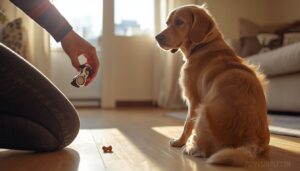
The clicker is a step up from a marker word — more precise, more consistent. Its clean, emotion-free sound works like a photograph: it captures the exact moment your dog succeeds.
Charge it first:
- Click, then treat — repeat 10–15 times
- Keep your treat hand hidden until after the click
- Aim for 8–10 clicks per minute during shaping
- Deliver the treat within one second, always
Preload Small Treats
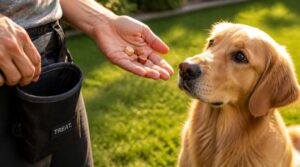
Speed is everything once your marker fires. Hand-to-pouch lag — that fumbling half-second between click and delivery — can quietly break the behavior-reward link your dog is building.
Preload three to five small, bite-sized treats directly into your palm before each rep. Wide-mouth pouches with magnetic closures cut retrieval time under one second, keeping your reward delivery precise and your training flow uninterrupted.
Reward in Position

Reward in position means the treat only lands when your dog’s body — feet, hips, full alignment — matches the exact posture you want. Not almost there. Exactly there.
Deliver the treat at the target spot, same side, every time. Consistent delivery location keeps your dog oriented and still. If they break before the treat arrives, reset. No reward for "almost.
Keep Sessions Short

Five minutes is plenty. Dogs don’t have long attention spans, and the moment yours disengages, you’re not training — you’re rehearsing mistakes.
Short sessions, ideally 5–10 minutes, keep focus sharp and timing accurate. Stop while your dog is still succeeding. That’s how you protect training momentum and walk into the next session already ahead.
Smarter Treat Habits

Timing and portion control get you halfway there — habits carry you the rest of the way. Once the mechanics click, the real work is building a treat routine that’s sustainable for your dog’s health and your training goals. These five adjustments make that easier.
Match Treat Value
Not every treat deserves equal billing. Match treat value to task difficulty—kibble or carrot pieces work fine for a reliable "sit," but freeze-dried meat or cheese is your currency for recall in a busy park.
High-value treats carry intense aromas that cut through distractions. Save them deliberately, or you’ll spend your best rewards on the wrong moments.
Rotate Praise and Play
Treats aren’t your only tool—and leaning on food alone is a trap. Rotate praise and play into every session. Verbal praise costs zero calories. A quick tug game delivers physical stimulation and joy. Alternate these every two to three minutes, and your dog stays curious, not desensitized.
Variable rewards build durability that food alone never will.
Reduce Food Lures
Food lures work fast — until they don’t. Once your dog learns to wait for visible food before moving, the cue means nothing without it. That’s lure dependency, and it stalls real training.
Fade the lure after three to five clean reps. Move your hand without food, then reward from a hidden pocket. Timing is everything here.
Track Treat Calories
Hiding treats worked — now make sure you’re not quietly overfeeding.
Weigh treats using a kitchen scale. Most training pieces run 2–8 calories each, but repetition adds up fast.
- Log each treat’s calorie count daily
- Keep treats below 10% of total calories
- Reduce meal portions when treats increase
A simple spreadsheet manages this in minutes.
Adjust by Dog Size
Size changes everything. A 5-lb Chihuahua gets roughly 20–30 treat calories daily — one small biscuit could nearly max that out. A 60-lb Lab can handle up to 150.
Always break larger treats into pea-sized pieces for any dog during training. Softer textures work best for puppies. Match the portion to the dog, not your generosity.
Frequently Asked Questions (FAQs)
Can stress affect how a dog responds to treats?
Yes — stress reduces treat motivation greatly. A stressed dog may ignore even high-value rewards, disrupting the behavior-reward connection and making positive reinforcement training far less effective than you’d expect.
Do treats work differently for rescue dogs?
Rescue dogs often experience stress-induced food refusal early on. Until trust is built, treats may not register as rewards at all. Pairing consistent cues with calm delivery helps anxious dogs connect food to safety.
Should treat rewards change as dogs age?
Absolutely — treat needs shift with age. Puppies need soft, small pieces to protect developing teeth. Seniors need low-calorie, joint-supporting options as metabolism slows. Match texture, size, and calorie count to your dog’s life stage.
How does breed temperament influence treat motivation?
Breed temperament shapes how your dog values a treat. Arousal-driven breeds grab faster; stress-reactive dogs disengage. Match reward value to your dog’s drive, or motivation quietly disappears.
Can treats interfere with a dogs appetite for meals?
Treats can absolutely disrupt your dog’s appetite. High-fat, calorie-dense treats satisfy hunger before mealtime arrives, causing meal refusal. Keep treats below 10% of daily calories to protect regular feeding patterns.
Conclusion
Think of your dog’s brain like a camera shutter—timing is everything, and a blurry photo teaches nothing worth keeping.
Giving treats too early mistakes a bribe, leaving your dog guessing instead of truly learning.
Lock in the marker, shrink the treat, match the reward to the exact moment.
Do that consistently, and you’re not just training a dog—you’re building a partnership that doesn’t need food to hold its shape.
- https://www.thecollarclubacademy.com/blog/the-hidden-truth-about-dog-training-with-treats
- https://www.wellnesspetfood.com/blog/7-mistakes-people-make-when-using-dog-training-treats
- https://www.akc.org/expert-advice/training/common-dog-training-mistakes
- https://www.venturedogtraining.com/post/10-common-mistakes-to-avoid-in-positive-reinforcement-training
- https://pupford.com/blogs/all/21-common-dog-training-mistakes