This site is supported by our readers. We may earn a commission, at no cost to you, if you purchase through links.

Most dog owners training a new "sit" or "stay" don’t realize they’ve already blown past their dog’s daily treat budget by 10 a.m. A handful of biscuits here, a few jerky strips there—it adds up faster than you’d think, especially with small dogs whose entire treat allowance might cap out around 20 calories.
The 10% rule gives you a concrete ceiling: treats should never exceed 10% of your dog’s total daily calories, no matter how enthusiastic the training session gets.
Get that number wrong consistently, and you’re not just rewarding good behavior—you’re quietly building toward weight gain, begging habits, and a dog who turns their nose up at dinner.
Knowing exactly how many treats a dog can have during training means calculating your dog’s actual daily calorie needs first, then working backward from there.
Table Of Contents
- Key Takeaways
- Dogs Can Have 10% Treat Calories
- Calculate Your Dog’s Treat Limit
- Count Treats by Treat Size
- Dog Size Changes Treat Amounts
- Age and Activity Matter
- Choose Low-Calorie Training Treats
- Use Kibble During Training
- Reward Without Overfeeding
- Watch for Too Many Treats
- Adjust Treats Safely Over Time
- Frequently Asked Questions (FAQs)
- Conclusion
Key Takeaways
- Treats should never exceed 10% of your dog’s daily calories — calculate that number first (RER: 30 × weight in kg + 70, then multiply by your dog’s activity factor), and everything else follows from there.
- Small and toy breeds hit their treat budget after just a couple of bites, so cutting treats into pea-sized pieces isn’t optional — it’s the only way to fit enough repetitions into a training session without blowing the day’s calories before lunch.
- Using your dog’s regular kibble as training rewards is the easiest calorie hack available — it costs nothing extra, keeps nutrition balanced, and completely sidesteps the math headache of tracking separate treats.
- Once your dog nails a cue 8–9 times out of 10, start fading treats gradually using a variable reward schedule, and swap in praise, play, or life rewards (like opening the door or a quick game of tug) so good behavior sticks without the daily calorie cost.
Dogs Can Have 10% Treat Calories

Training treats can win your dog over fast, but it’s easy to go overboard without realizing it. There’s actually a simple number to keep in mind so you don’t accidentally turn training time into a calorie free-for-all. Here’s what you need to know before you start filling your treat pouch.
A good rule of thumb: treats should make up no more than 10% of your dog’s daily calories, which adds up faster than most owners expect.
Quick Daily Treat Rule
If you want a quick rule of paw, here it is: keep dog training treats under 10% of daily calories, with meals covering the rest. That’s the 10% cap, the foundation of smart calorie counting for dogs.
This daily treat calorie limit isn’t arbitrary — it’s the simplest gut-check for weight management before you even pull out a treat pouch. Following the 10% treat rule ensures treats stay within the recommended calorie budget.
Why Calories Matter
That 10% cap isn’t random — every treat calorie affects your dog’s body just like meal calories do:
- Metabolic energy shifts
- Blood sugar spikes
- Nutrient density balance
- Gastrointestinal health risks
- Joint strain from weight gain
Skipping this math invites real dog obesity prevention failures, not just a chunkier pup.
Training Treats Versus Snacks
Not all rewards earn their keep the same way. Training treats are small, soft, and built for speed — perfect for fast repetition and precise reward timing differences.
Snacks are bigger, chewier, and meant for lazy enjoyment, not for quick cues.
Rotate flavors to keep motivation level variance in check, watch texture training impact on chewing speed, and always practice ingredient safety awareness before tossing anything your dog’s way.
Avoid Replacing Balanced Meals
Here’s the catch with snacks and training treats both: they can quietly bully real food out of the picture. Stuffing your dog full of extras before dinner risks nutrient dilution — missing minerals like calcium and phosphorus that plain chicken just doesn’t supply.
Puppies especially need that balance for growth. Watch for reduced meal appetite; it’s an early warning sign your daily calorie intake math has gone sideways.
Calculate Your Dog’s Treat Limit
Okay, time for a little math—don’t worry, nothing scarier than long division. You’re about to turn your dog’s daily calorie needs into an actual treat budget, step by step. Grab a calculator (or your phone, we don’t judge) and let’s break it down.
Find Daily Calorie Needs
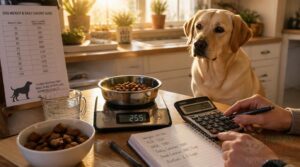
Before you count treats, you need a baseline number: your dog’s daily calorie needs. Start with RER (resting energy requirement): 30 × weight in kg + 70. Weigh in pounds? Divide by 2.2 first.
Then multiply by an activity factor:
- Neutered adults: ×1.6
- Puppies under 4 months: ×3
- Weight loss dogs: ×1
Use The 10% Formula

Once you know your dog’s DER (daily energy requirement) from Calculating RER and Managing DER, multiply it by 0.10. That’s your daily treat calorie limit—the famous "10% rule."
A 400-calorie dog gets 40 for treats; a 250-calorie dog gets 25.
This single step sets your calorie ceiling, simplifying calorie counting while protecting balanced nutrition.
Divide by Treat Calories
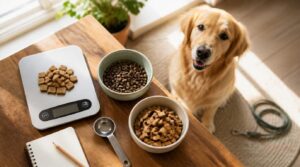
With your daily treat calorie limit in hand, the last step is simple math: divide that number by the calories per treat.
- 30 kcal ÷ 3 kcal = 10 treats
- 24 kcal ÷ 2 kcal = 12 treats
- Round 6.8 down to 6 treats (always round down)
- Mixing types? Add totals together (10 one-kcal + 4 three-kcal = 22 kcal)
For irregular treats, weigh them—a kitchen scale beats guessing every time.
Example for Small Dogs

Picture a 10-pound dog needing 300 calories daily. Small breed metabolism means a tight daily treat calorie limit—just 30 calories.
Toy breed math gets stricter: a 5-pound pup might get only 20 calories total.
That’s why dog treat portion size matters; calorie density impact pushes low‑calorie training treats and tiny reward sizing, measuring micro‑treats on a scale to support dog weight management.
Example for Large Dogs
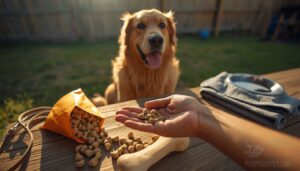
Now flip the script: an 80-pound dog burning 1,600 calories daily gets a 160-calorie treat budget—room for 80 two-calorie rewards. That’s large breed math at work.
Give one 60-calorie chew after a walk, and you’ve still got 100 calories left for training treat budgeting. Big dog portions forgive more mistakes, but calorie density of treats still drives smart dog weight management.
Count Treats by Treat Size

So you’ve got a calorie budget for the day—now what? Treats come in wildly different sizes, and that changes everything about how many your dog actually gets. Here’s how to make the math work in real life, one bite at a time.
Check Calories Per Treat
That treat bag label is hiding the real math. Flip it over before training, because calories per treat vary wildly — soft training treats run 1-3 kcal, biscuits hit 5-10, jerky tops 30.
Decoding label terms means checking "kcal per treat" (piece counting) versus "kcal per kg" (comparing density).
Skip this, and you’ll blow your daily treat calorie limit fast.
Break Treats Into Pieces
Now grab a knife. Snapping one treat into four pieces turns a 100-count bag into roughly 400 rewards, which means maximizing reward repetitions without buying more bags.
| Treat Size | Pieces | Calories Each |
|---|---|---|
| Whole | 1 | 3 kcal |
| Halved | 2 | 1.5 kcal |
| Quartered | 4 | ~1 kcal |
Smaller bits mean faster chewing, better training tempo, and tighter portion control all session long.
Use Pea-sized Rewards
Pea-sized rewards are the sweet spot for rapid reward cycles. Something roughly the size of — well, a pea — gets swallowed in a single bite, so your dog snaps back to attention almost immediately.
That fast re-engagement keeps your training tempo tight, your repetitions high, and your total daily treat calorie limit surprisingly easy to manage.
Avoid Oversized Training Bites
Now, the flip side of pea-sized treats is the oversized bite — and it quietly wrecks your session. Here’s what one chunky reward actually costs you:
- Chewing time eats into reps — 3 seconds per chew × 20 rewards = a full minute lost
- Eye contact breaks while your dog hunts floor crumbs
- Caloric density spikes fast — one 4 kcal treat burns 13% of a small dog’s daily budget
- Training pace slows on recall and shaping drills
- Treat limit hit early, leaving nothing for the hard stuff
Cut big treats into four pieces instead.
Dog Size Changes Treat Amounts

Here’s the part where math meets reality: a Great Dane and a Chihuahua are not playing the same game. Body size changes how many calories your dog burns just existing, which means it changes their treat budget too. Let’s break down what that looks like across the size spectrum.
Small Dogs Need Fewer
Small dogs hit their daily treat limit fast — sometimes after just two or three bites. A 7-pound Yorkie eating 190 calories daily has a treat budget of roughly 19 calories.
That’s gone in an instant with most store-bought biscuits.
Toy breed metabolism runs efficiently, meaning even tiny calorie surpluses add up quickly, so every treat genuinely counts.
Toy breed metabolism is so efficient that even tiny calorie surpluses add up fast—every treat genuinely counts
Large Dogs Tolerate More
Big dogs get a bigger slice of the treat pie — not because the rules are different, but because their daily caloric intake is simply higher.
A 90-pound dog burning around 1,800 calories a day has a 180-calorie treat budget, which can stretch to 60 small rewards at 3 calories each.
More reps, happier dog, same healthy math.
Toy Breed Caution
Toy breeds are basically working with pocket change regarding treat budgets. A 6-pound dog may only have 15–22 kcal for treats daily — one standard biscuit can blow that instantly.
Cut soft treats into pea-sized pieces, watch for hypoglycemia signs like trembling or wobbling, and stick to plain chicken or low-calorie options to stay safe.
Giant Breed Portioning
Giant breeds get a bigger treat budget in raw calories — but don’t let that fool you. Their GI sensitivity means overloading sessions with full-sized treats can still cause loose stool fast.
- Cut treats to pea-sized pieces
- Stay within the 10% daily calorie limit
- Swap treats for meal kibble portions
- Recalculate as your dog grows
Age and Activity Matter
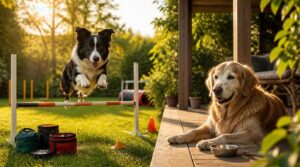
Your dog’s age and how active they are play a bigger role in treat limits than most people realize. A senior couch potato and a young agility dog have very different calorie budgets, even if they weigh exactly the same. Here’s how each life stage and activity level changes the treat math.
Puppies Need Careful Balance
Puppies are basically growing at warp speed, which means their nutritional needs are surprisingly fragile. Most of their daily calories need to come from complete, balanced puppy food — not treats.
A small puppy eating 200 calories a day only has a 20-calorie treat budget, which vanishes fast. Stick to tiny, low-calorie rewards and adjust portions as your puppy grows.
Senior Dogs Need Fewer
Older dogs slow down in more ways than one. Their metabolism dips as they lose lean muscle with age, and many sleep 14 to 18 hours daily — leaving little room to burn extra calories.
A senior dog on 400 kcal per day only gets a 40-calorie treat budget, so every bite counts more than before.
Active Dogs Burn More
If your dog is running agility drills, hiking rocky trails, or doing back-to-back training sessions, their daily calorie limit rises dramatically. An active adult dog may need1.8to2.0times their resting energy— meaning more treat calories are available without guilt.
Cold weather and rough terrain push that number even higher.
Sedentary Dogs Need Limits
The flip side of an active dog’s calorie freedom? The couch potato tax. When your dog’s daily routine is mostly napping, the daily caloric intake drops fast — sometimes to just 300–400 kcal — which shrinks the treat budget to 30–40 kcal total.
Here’s what that actually looks like in practice:
- One 20 kcal biscuit wipes out two-thirds of a 30 kcal treat budget before training even starts.
- Thirty 1 kcal pieces fit comfortably into a 30 kcal budget — thirty 3 kcal pieces don’t.
- Low-calorie training treats like Zuke’s Minis (2.3 kcal each) stretch further than standard biscuits.
- Portion control for dogs matters most on low-activity days when calories aren’t being burned off.
A few slow days in a row can quietly push your dog toward dog obesity if you’re still rewarding at the same rate as an active week. Adjust down when the zoomies disappear.
Medical Conditions Affect Calories
Medical conditions completely rewrite the treat math.
A hypothyroid dog burns fewer calories than the formula suggests, so the same treat routine quietly causes weight gain.
Diabetic dogs need glucose stability, meaning sugary or high-carb treats can throw off insulin timing.
Dogs with pancreatitis, kidney disease, or heart conditions each have specific restrictions — always run your treat choices past your vet first.
Choose Low-Calorie Training Treats
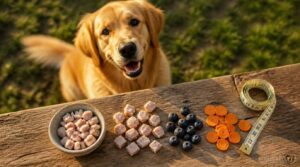
The good news is that picking the right treat makes the whole calorie-math thing way easier. Some options let you reward your dog dozens of times without blowing the daily budget — no spreadsheet required. Here are a few worth keeping on hand during training sessions.
Soft Treats for Quick Rewards
When you’re running rapid repetitions, soft treats win every time. They’re small, easy to swallow, and — unlike crunchy biscuits — don’t leave your dog chewing while you’re already ready for the next behavior.
Tear one piece into several pea-sized rewards to stretch your budget. The stronger aroma also helps in distracting environments. Just reseal the bag after each session.
Low-calorie Commercial Options
Good news: the pet aisle actually delivers here.
Low-calorie commercial treats — like Zuke’s Mini Naturals at about 2.3 kcal each — let you reward dozens of repetitions without blowing your daily treat-calorie limit.
Always check the calories per treat on the label, not just the "light" claim on the front, since treat calorie content varies wildly between brands.
Plain Cooked Chicken
Plain cooked chicken is basically the ideal training treat — cheap, healthy, and dogs lose their minds for it.
- ~1.5–2 kcal per pea-sized piece (about 1 gram)
- Cook to 165°F internally — no exceptions
- No onion, garlic, or skin — just plain breast meat
- Refrigerate and use within 3–4 days
One ounce gives you 20–30 tiny rewards.
Carrots and Blueberries
Carrots and blueberries are two of the best low-effort, low-calorie training treats you can grab straight from your fridge. Carrots deliver beta-carotene and fiber — and cutting them small keeps calories nearly negligible. Blueberries pack anthocyanin antioxidants, though their natural sugar adds up faster, so keep portions tiny.
| Treat | Calories | Preparation Tip |
|---|---|---|
| Baby carrot piece | ~1–2 kcal | Raw or cooked |
| Single blueberry | ~1 kcal | Whole or halved |
| Blended carrot | ~1 kcal | Better beta-carotene release |
Safe Fruit and Vegetables
A handful of fruits and vegetables makes surprisingly effective training treats.
Apple flesh is safe once you remove the stem, core, and seeds — those seeds contain amygdalin, which releases cyanide when digested.
Cucumber is roughly 95% water and only 15 calories per 100g, so it’s especially invigorating mid-session.
Plain pumpkin adds fiber without fat, and green beans clock in at just 31 calories per 100g.
Use Kibble During Training

Here’s a trick that might change how you think about training rewards: your dog’s kibble is already sitting in the bag, ready to work for you. Using pieces of its regular food during training sessions is one of the easiest ways to reward good behavior without adding a single extra calorie to their day.
Here’s how to make it work.
Set Aside Meal Portions
Before you pour that morning scoop, pull out your dog’s full daily food allotment first — then set aside the training portion before anything hits the bowl. If your dog eats 1 cup daily and you’re reserving a quarter-cup for training, subtract that exact amount from their meal.
No bonus kibble, no eyeballing. Same food, same calories, just redistributed.
Try The Baggie Method
Drop a small piece of freeze-dried liver or a pinch of cooked chicken into a sealed bag with your dog’s measured kibble. Shake it for a few seconds.
The kibble picks up that meaty smell, making plain food suddenly interesting — no extra calories added. Overnight in the fridge intensifies the scent even more.
Prevent Extra Calories
Using kibble as training treats is the simplest way to prevent extra calories from sneaking in — because you’re pulling directly from your dog’s measured daily food portion, not adding on top of it. Nothing gets added to the total. Kibble keeps your daily treat calorie limit intact without any math headaches.
- Reserve a portion of your dog’s measured daily kibble before filling the bowl
- Avoid calorie-dense snacks by defaulting to kibble during low-distraction training sessions
- Track how much kibble you’ve used to stay consistent with canine obesity prevention
- Reduce the evening meal slightly if you’ve used extra treats that day
Keep Meals Nutritionally Balanced
Keeping calories in check is only half the equation. The other half? Making sure your dog’s complete nutrient intake doesn’t quietly erode.
When treats replace too much kibble, you risk nutrient dilution — where micronutrients like zinc, copper, and vitamin D get crowded out. AAFCO-approved complete foods are formulated deliberately; swap too much out, and that balance quietly unravels.
Reward Without Overfeeding

Treats are a excellent training tool, but they don’t have to be the only one in your pocket. Once your dog starts getting the hang of a command, you can start mixing in other types of rewards to keep things fresh — and keep the calorie count in check. Here are some easy ways to reward your dog without overfeeding.
Use Praise and Petting
Not every reward needs to come with calories. Petting and verbal praise work surprisingly well as training reinforcers — research shows dogs actually prefer petting over vocal encouragement alone.
- Time the touch right after correct behavior
- Use calm, gentle hand movements
- Pick a consistent spot your dog loves
- Pair touch with a short praise phrase
- Stop immediately if your dog signals discomfort
Add Play Rewards
A quick game of tug or a five-second chase session can be just as rewarding to your dog as a treat — and it burns calories instead of adding them.
Play as a reward connects with something deeply motivating for most dogs.
Try tossing a ball twice after a solid "stay," or whipping out a tug rope for a quick win.
Reward With Favorite Toys
Your dog’s favorite toy is already doing half the work — you just have to use it strategically. Dogs naturally work harder for a toy they already love, whether that’s a tug rope, a squeaky plush, or a tennis ball. Keep that toy out of reach between sessions so it stays exciting when it appears as your reward.
Use Life Rewards
Here’s something trainers lean on heavily but rarely explain: life rewards cost zero calories.
The Premack Principle basically says a behavior your dog already wants to do — sniffing the yard, bolting through the door, greeting your neighbor — can reinforce a behavior you want, like a sit.
Control the access, deliver it instantly, and you’ve got a powerful, calorie‑free reinforcer.
Fade Treats Gradually
Once your dog nails a cue roughly 8 or 9 times out of 10, that’s your green light to start fading treats — but gradually, not cold turkey. Swap from rewarding every repetition to rewarding some, unpredictably.
That variable reinforcement schedule actually keeps behavior stronger than any fixed pattern. Slow, steady fading beats a dramatic snack retirement speech.
Watch for Too Many Treats

Even when you’re doing everything right, too many treats can sneak up on you — and your dog usually shows the signs before the scale does. Knowing what to watch for makes it easy to course-correct before small habits become bigger problems. Here are the key red flags to keep on your radar.
Weight Gain Signs
Weight gain sneaks up on dogs, the same way it sneaks up on us — gradually, and often invisibly until it’s obvious.
Start by running your hands along your dog’s ribs. You should feel them easily under a thin layer of tissue. Firm pressure needed to find ribs is a red flag.
Check from above, too — a healthy waist narrows behind the rib cage. If that narrowing looks more oval than hourglass, or the belly no longer tucks upward from the side, your dog’s body condition score may have quietly climbed past the ideal 4–5 range.
Soft fat pads near the tail base or a thickening around the loin are other early signs worth catching before they compound.
Reduced Meal Appetite
If your dog is suddenly turning up their nose at dinner, treat overload is often the culprit.
Watch for these classic signs:
- Sniffing the bowl, then walking away
- Eating half a meal and losing interest
- Refusing regular kibble but still taking hand-fed treats eagerly
Even low-calorie training treats stack up — 20 tiny rewards can quietly consume half your dog’s daily calorie limit before dinner even arrives.
Loose Stool or Vomiting
Too many treats — especially rich, fatty ones like cheese or bacon — can send your dog’s gut into full revolt. High-fat treats trigger loose stool or vomiting within hours.
Switching treats suddenly makes things worse.
Watch for mucus-streaked or bloody stool, dry gums (a dehydration red flag), or repeated vomiting.
Those warrant a vet call, not a wait-and-see approach.
Begging Increases
If your dog is suddenly working the room like a seasoned con artist — staring, pawing, whining, following you from the kitchen to the couch — treat overload may be the trigger.
Handing out rewards outside planned sessions teaches your dog that persistence pays. Even one accidental scrap resets the whole pattern and keeps the begging alive.
Body Condition Changes
Beyond the begging, your dog’s body starts telling its own story. Run your hands along the ribcage — rib palpation is your first clue. At a healthy weight, you’ll feel ribs easily under light pressure. If finding them feels like digging for buried treasure, extra treat calories are likely showing up as fat.
Check the waistline and abdominal tuck from above and the side. A disappearing waist or a belly that hangs rather than tucks upward signals trouble. Feel for soft fat pads over the shoulders or tail base too. A quick weekly body check catches these shifts early — before the scale even budges.
Adjust Treats Safely Over Time

Getting your dog’s treat routine dialed in isn’t a one-and-done thing — it takes a little ongoing attention as your dog grows, trains, and changes. The good news is that small, simple adjustments keep everything on track without overhauling your whole approach.
Here’s what to watch and tweak as you go.
Track Daily Treat Counts
Keeping a simple daily treat log is one of the easiest habits you can build. Jot down each treat immediately — type, count, and calories — rather than guessing later.
If you break a treat into pieces, record partial calories (half a treat = half the calories).
Switch brands? Recalculate using the new label. Multiple people feeding your dog? Everyone logs their share.
Weigh Your Dog Regularly
Your treat log is only half the picture.
Weigh your dog monthly — or every two weeks if they’re on a new training program — to catch slow creep before it becomes a real problem.
A 5% weight change (just half a pound on a 10-pound dog) is your signal to reassess how many treats are going into that daily rotation.
Recheck Treat Labels
Your scale habit is a solid start — but don’t forget to flip the bag over too.
Recheck treat labels every time you open a new bag. Recipes change, fat content rises, and a label that once read 2 kcal per piece might now quietly say 5.
- Check kcal per treat, not just per kilogram
- Ingredients are listed by weight before processing — fat near the top means more calories
- A packaging refresh doesn’t guarantee the same formula
- Photograph the lot code and date before tossing the bag
Reduce Meals When Needed
If treats are eating into your dog’s calorie budget, trimming the meal side of the equation is the cleanest fix. Reduce kibble slightly to offset treat calories — not eliminate meals.
The simplest approach: set aside a handful of kibble before filling the bowl, use those pieces as training rewards, and serve the rest.
Total daily calories stay identical. No math spiral required.
Ask Your Veterinarian
Your vet isn’t just for sick visits — they’re your sharpest tool for daily treat calorie limits and medical condition screening. Dogs with diabetes, kidney disease, or heart issues need treat choices that don’t clash with their care.
- Watch for emergency warning signs after new treats
- Confirm prescription diet compatibility before adding rewards
- Request allergy ingredient review if symptoms flare
Frequently Asked Questions (FAQs)
How many treats is a dog allowed?
Think of treats like a 10% calorie budget — your dog gets a small daily allowance based on total needs. A 400-calorie diet allows just 40 treat calories per day.
How do training treats affect dogs with food allergies?
For dogs with food allergies, even one wrong treat can trigger itching, ear infections, or digestive upset. Stick to single-ingredient rewards that match your dog’s approved diet.
Should treat frequency change during different training phases?
Yes, treat frequency should shift with each training phase — high at first, then lower as skills solidify, rising again in new environments, and becoming unpredictable during maintenance.
Can multiple trainers in a household cause treat overload?
Absolutely — and it’s one of the most common causes of accidental daily caloric intake spills. When three people each hand out a few treats, those calories stack fast without anyone realizing it.
Conclusion
Treat your dog’s snack budget like a paycheck—spend it wisely, and everyone wins.
Knowing how many treats a dog can have during training isn’t about being stingy; it’s about making every reward count.
pea-sized piece of chicken lands just as hard as a jumbo biscuit when your timing is right.
Stay inside that 10% ceiling, swap in praise and play, and you’ll build a dog who listens because they want to—not just because you’re holding the bag.