This site is supported by our readers. We may earn a commission, at no cost to you, if you purchase through links.

Timing is everything in dog training—mess it up by even half a second, and your dog learns something completely different from what you intended. A clicker solves that problem. That sharp, consistent sound marks the exact moment your dog does something right, which is something your voice rarely does as reliably.
After years of training dogs professionally, I’ve tested enough clickers to know that not all of them are worth your money. The best clicker for dog training fits your hand, produces a consistent sound, and holds up through hundreds of repetitions.
These nine picks do exactly that.
Table Of Contents
- Key Takeaways
- 9 Best Clickers for Dog Training
- 1. PetSafe Clik-R Dog Training Clicker
- 2. Educator Audible Dog Training Finger Clicker
- 3. CRMADA Box Training Clickers
- 4. Ruconla Dog Training Clicker Set
- 5. Karen Pryor i-Click Dog Training Clicker
- 6. StarMark Pro Training Clicker
- 7. StarMark Black and Yellow Training Clicker
- 8. Starmark Pro Training Quicker Dog Clicker
- 9. Downtown Pet Supply Training Clickers
- How Dog Training Clickers Work
- Choosing The Right Clicker
- How We Reviewed Clickers
- Clicker Training Tips for Dogs
- Frequently Asked Questions (FAQs)
- Conclusion
Key Takeaways
- Timing your click within 0.2 seconds of the behavior is what makes clicker training actually work — a late click teaches your dog the wrong thing.
- Not every clicker fits every dog or trainer, so match your pick to your environment, your dog’s sound sensitivity, and how you naturally hold things.
- Noise-sensitive or anxious dogs need a softer clicker — models like the Karen Pryor i-Click or the Educator Finger Clicker with adjustable baffles exist exactly for that reason.
- Short, frequent sessions beat long ones every time — puppies top out at five to ten minutes, and even adult dogs do best when you quit before they’re bored.
9 Best Clickers for Dog Training
After testing dozens of options, these nine clickers stood out for their sound consistency, build quality, and real-world usability. Some shine indoors, others are built for the chaos of outdoor training — and a couple are specifically designed for handlers with mobility challenges. Here’s what made the cut.
If you train on the move, pairing your clicker with one of these best dog harnesses for jogging keeps your hands free and your dog safe during every session.
1. PetSafe Clik-R Dog Training Clicker
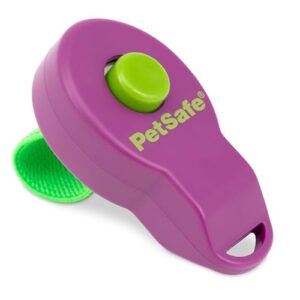
The PetSafe Clik-R is one of my top picks for beginners, and it’s easy to see why. That finger band design keeps it snug in your hand so you’re never fumbling mid-session. The click is clear and consistent — short enough that your dog hears exactly what they earned. It’s lightweight, affordable, and widely available.
One heads-up: noise-sensitive dogs may startle at first, and the finger band runs a bit snug on larger hands.
| Best For | Beginners who want a simple, reliable clicker for training dogs, cats, or other animals at home or on the go. |
|---|---|
| Sound Type | Crisp and consistent |
| Material | Plastic |
| Weight | 41g |
| Color Options | Not specified |
| Animal Compatibility | Dogs, cats, birds, horses |
| Dimensions | 5.91 x 1.97 x 1.97 in |
| Additional Features |
|
- Finger band keeps it secure in your hand so you’re never scrambling to grab it mid-session
- Clear, consistent click makes it easy for your pet to understand exactly what they did right
- Lightweight and compact — toss it in your pocket and it’s ready for walks or travel
- The finger band isn’t adjustable, so it can feel uncomfortably snug on larger hands
- The click can get lost in noisy environments, making outdoor sessions trickier
- The sharp sound may startle noise-sensitive pets, especially at first
2. Educator Audible Dog Training Finger Clicker

The Educator Audible Finger Clicker is a smart step up if you want something more hands-free. The adjustable Velcro strap keeps it right on your finger, freeing your other hand for treats or leash management.
Sound levels are adjustable via three internal baffles — handy for noise-sensitive dogs or quiet indoor spaces.
At just 0.352 ounces, hand fatigue isn’t a concern. It’s bulkier than some models, but that soft-touch surface makes it comfortable during long sessions.
| Best For | Trainers who want hands-free convenience and adjustable sound control for noise-sensitive dogs at any life stage. |
|---|---|
| Sound Type | Clear and consistent |
| Material | Plastic |
| Weight | 0.06g |
| Color Options | Purple |
| Animal Compatibility | Dogs, cats, other animals |
| Dimensions | Not specified |
| Additional Features |
|
- Velcro finger strap keeps it secure so your hands stay free for treats and leash handling
- Three internal baffles let you dial in the right sound level for your dog and environment
- Featherlight at 0.352 oz, so long training sessions won’t wear out your hand
- Bulkier profile than slimmer, more compact clicker options
- Pricier than basic budget clickers on the market
- High resonance can be disruptive in quiet spaces like offices or apartments
3. CRMADA Box Training Clickers
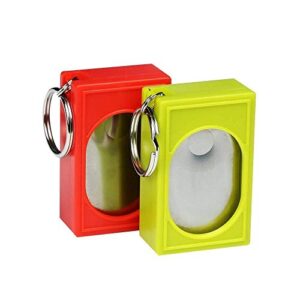
If you need a loud, no-frills clicker, CRMADA’s box-style design delivers. The metal click plate produces a sharp, high-pitched sound that cuts through barking and outdoor noise — exactly what you need at the park or on a busy trail.
The split key ring clips right to your leash, so it’s always within reach. Build quality feels solid for the price, and the two-color pack lets you assign different cues per dog.
| Best For | Trainers working with multiple pets or in noisy environments who want a simple, reliable clicker at a budget-friendly price. |
|---|---|
| Sound Type | Adjustable, gentle click |
| Material | Plastic |
| Weight | 0.352 oz |
| Color Options | Teal |
| Animal Compatibility | All animals, all life stages |
| Dimensions | 5 x 1.25 x 0.8 in |
| Additional Features |
|
- Sharp, high-pitched click cuts through outdoor noise and distractions
- Two-color pack makes it easy to assign different cues for different pets
- Ergonomic box design fits comfortably in your hand during long training sessions
- The loud click can startle noise-sensitive pets
- Metal components may feel thin or flimsy to some users
- Sound volume and clicking smoothness can vary between units
4. Ruconla Dog Training Clicker Set

If four clickers for the price of one sounds like a good deal, the Ruconla set is worth a look. Each unit is compact — around 2.5 inches long and under an ounce — with a crisp, sharp click and adjustable wrist strap for hands-free handling.
The ABS plastic shell holds up well to daily use, and the button responds consistently even with damp hands. Great pick for multi-dog households or keeping backup clickers in your car, bag, and pocket.
| Best For | Multi-dog households or anyone who wants backup clickers on hand across different spots and situations. |
|---|---|
| Sound Type | Distinct auditory signal |
| Material | ABS and metal |
| Weight | 15g |
| Color Options | Red, Lime Green |
| Animal Compatibility | Dogs, cats, birds, reptiles |
| Dimensions | 2.00 x 1.26 x 0.47 in |
| Additional Features |
|
- Four clickers in one pack — great value, and you can stash them anywhere
- Compact and lightweight, so they’re easy to carry or clip on with the wrist strap
- Consistent button response, even with wet or damp hands
- The loud click can be a problem in quiet spaces like apartments or offices
- Results still depend on your pet’s personality — some animals just don’t respond to clicker training
- No volume control, so it’s one-size-fits-all when it comes to sound
5. Karen Pryor i-Click Dog Training Clicker
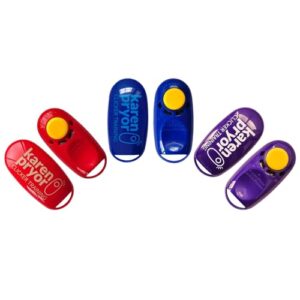
The Karen Pryor i-Click is the one I reach for when training noise-sensitive or anxious dogs. It’s compact, palm-friendly, and requires almost no finger pressure — a real plus if you’re dealing with arthritis or mobility issues.
Its quieter click is especially handy for sound-sensitive pups — pair it with solid technique from this step-by-step clicker training guide for dogs and you’ll see the difference fast.
The click itself is soft and consistent, clear enough indoors without startling a reactive pup. At just 0.81 ounces, it disappears in your hand. The attachment loop is thin, so skip the heavy keychain — but for everyday training, it’s hard to beat.
| Best For | Trainers working with noise-sensitive or anxious dogs, or anyone dealing with arthritis or limited hand mobility. |
|---|---|
| Sound Type | Loud audible click |
| Material | ABS plastic |
| Weight | 0.52 oz |
| Color Options | Black, Red, White, Blue |
| Animal Compatibility | Dogs, cats, birds, horses |
| Dimensions | 2.48 x 1.22 x 0.70 in |
| Additional Features |
|
- Soft, consistent click that won’t startle reactive or sound-sensitive animals
- Ergonomic design works with your palm, fingers, or even chin — great for limited mobility
- Featherlight at 0.81 oz and compact enough to pocket and forget it’s there
- Click can get lost in loud outdoor settings or windy environments
- Attachment loop is flimsy — don’t trust it on a heavy keychain
- Slightly bulky for small keychain attachments
6. StarMark Pro Training Clicker
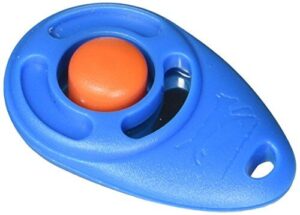
The StarMark Pro Training Clicker is a solid workhorse — nothing flashy, but it gets the job done. The raised button gives you a confident, tactile click every time, even mid-sprint during recall training. It’s made from durable high-impact plastic with a stainless steel click mechanism, so it holds up to daily use without losing sound consistency.
One known issue is button sticking over time. Worth keeping in mind, but for most trainers, it remains a reliable everyday tool.
| Best For | Dog owners and trainers who want a hands-free, versatile clicker that works for dogs of any age — from wiggly puppies to senior pups. |
|---|---|
| Sound Type | Low-volume, soft click |
| Material | Plastic |
| Weight | 0.81 oz |
| Color Options | Multicolor |
| Animal Compatibility | Dogs and horses |
| Dimensions | 2 x 1 x 1 in |
| Additional Features |
|
- The raised button makes it easy to click confidently, even when you’re moving fast
- Foot-activated design frees up your hands during training sessions
- Consistent sound profile works great for group classes where dogs need a clear, distinct cue
- No wrist strap included, so it’s easier to misplace
- The sound is different from a standard square clicker, which might throw off dogs already trained on one
- Some users have reported defective units or wrong quantities arriving at their door
7. StarMark Black and Yellow Training Clicker
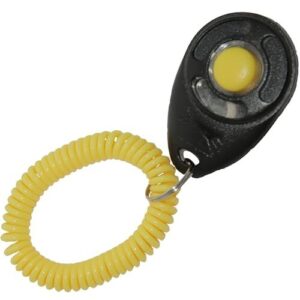
Think of this as the Pro Clicker’s more eye-catching sibling. The black and yellow design is easy to spot in a training bag, and the raised tactile button makes quick, accurate clicks smooth — even with gloves on or long nails. Sound is sharp and consistent without that jarring metallic ring that can spook sensitive dogs. The included yellow wristband keeps it handy during walks.
Watch out, though — some users report the button cover detaching with heavy use.
| Best For | Trainers who work with gloves or long nails and want a clicker that’s easy to spot and grab on the go. |
|---|---|
| Sound Type | Loud and consistent |
| Material | Vinyl and rubber |
| Weight | 1.44 oz |
| Color Options | Blue and Purple |
| Animal Compatibility | Dogs, all life stages |
| Dimensions | 1 x 5 x 6.75 in |
| Additional Features |
|
- Raised button makes clicking fast and accurate, even with gloves on
- Consistent, sharp sound helps your pet learn the signal quickly
- Yellow wristband keeps it close during walks or outdoor sessions
- Button cover can pop off with heavy, repeated use
- Click volume might be too intense for noise-sensitive pets
- Some units arrive defective and won’t click at all
8. Starmark Pro Training Quicker Dog Clicker
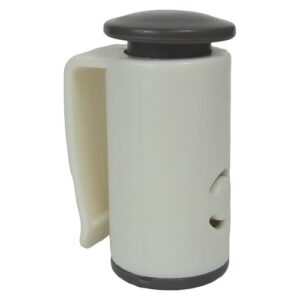
Speed is the whole selling point here. The raised dome button is built for fast, precise clicks — fewer misfires, more accurate timing. That matters when you’re trying to capture a split-second behavior. The cylindrical grip sits comfortably in your palm through long sessions, and the stainless steel mechanism keeps the sound consistent click after click.
The belt clip is handy, but you won’t find a keyring or wrist loop here. Simple tool, solid performance.
| Best For | Dog owners and trainers who want fast, accurate click timing during positive reinforcement training sessions. |
|---|---|
| Sound Type | Consistent click |
| Material | Plastic with stainless steel |
| Weight | Not specified |
| Color Options | Black and Yellow |
| Animal Compatibility | Dogs and pets |
| Dimensions | Not specified |
| Additional Features |
|
- Raised dome button makes it easy to click quickly and precisely, so you never miss the right moment
- Cylindrical body is comfortable to hold during long training sessions
- Built-in belt clip keeps it hands-free and within reach when you need it
- No keyring or wrist loop, so attachment options are pretty limited
- The clip may not work well with certain extendable hooks
- Sound volume and size are fixed, so it might not suit everyone’s preference
9. Downtown Pet Supply Training Clickers
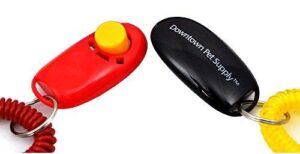
Budget-friendly doesn’t have to mean flimsy — and Downtown Pet Supply makes a decent case for that. These come in a two-pack with a large, palm-friendly button that’s easy to press repeatedly without finger fatigue. The wrist strap keeps it handy during walks or active sessions.
The click is crisp and audible in most home or yard settings. That said, the smooth plastic finish can feel slippery, and the cord is fragile. Solid for beginners, but not built for heavy daily use.
| Best For | Beginners and casual trainers looking for an affordable, easy-to-use clicker for basic dog or cat training at home. |
|---|---|
| Sound Type | Standard click |
| Material | Not specified |
| Weight | 1 oz |
| Color Options | White |
| Animal Compatibility | Dogs |
| Dimensions | 1.3 x 1.5 x 2.5 in |
| Additional Features |
|
- Comes in a two-pack, so you always have a backup on hand
- Large button is easy to press repeatedly without tiring your fingers
- Wrist strap keeps it secure and within reach during active sessions
- Loud click may startle or stress noise-sensitive animals
- Smooth plastic finish can feel slippery in sweaty or wet hands
- Build feels lightweight and may not hold up to heavy daily use
How Dog Training Clickers Work
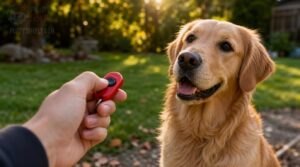
A clicker works because dogs learn to connect the sound with something good happening — fast. Once that connection clicks (pun intended), the sound becomes a precise communication tool between you and your dog. Here’s what you need to know about how that process actually works.
Marker Sound Basics
A clicker works because the sound itself is the message. That sharp, distinct sound cuts through barking, traffic, and backyard chaos — your dog hears it clearly, every time.
Here’s what makes a great marker sound:
- Sound Consistency keeps your dog from getting confused
- Auditory Clarity helps the signal stand apart from background noise
- Volume Calibration ensures it’s audible without startling sound-sensitive dogs
- Pitch Adjustment sharpens noise masking in busy environments
Click and Treat Timing
Timing is everything in clicker training. The click should land the instant the behavior happens — not a second later. Research shows delays beyond 0.2 seconds weaken the association. Your dog can’t connect a late click to the right moment.
In clicker training, a split second is the difference between clarity and confusion
Then deliver the treat within 0.5 seconds of clicking. That tight window is what makes the whole system work. To maintain this precision, avoid unintentional secondary markers like premature hand movements.
Positive Reinforcement Benefits
Once timing clicks into place, what really drives results is the science behind it. Positive reinforcement tells your dog, "Yes, that exact thing you did earned this reward." Repeated consistently, that message builds confidence and trust fast.
Studies show reward-based training cuts impulse-barking by 60% through behavior modification. Your dog isn’t just obeying — they’re genuinely partnering with you.
Puppies Versus Adult Dogs
Puppies and adult dogs aren’t just different sizes — they’re wired differently.
Puppies run on burst energy, with 60 to 90 minutes of daily activity split into short windows. That means 5 to 10-minute clicker sessions work best.
Adults can handle 15 to 30 minutes. Match your session length to your dog’s stage, and training results improve fast.
Sensitive Dog Considerations
Some dogs need a softer approach — full stop. Noise sensitivity is real, and a sharp click can startle rather than signal.
That’s why a soft clicker or adjustable-tone clicker makes all the difference. Pair a gentle click with gradual exposure, keep training sessions short, and respect treat tolerance.
Sound-sensitive dogs learn just as well — they just need a little more patience.
Choosing The Right Clicker
Not every clicker works for every dog — or every trainer. The right one depends on a few key factors that are easy to overlook until you’re mid-session and frustrated. Here’s what to keep in mind before you pick.
Sound Volume and Pitch
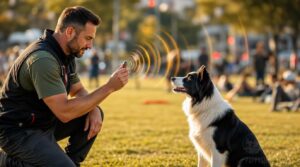
Sound is the whole point of a clicker, so getting the volume and pitch right actually matters. Most clickers land somewhere between 78 and 85 decibels — loud enough to be clear, not so loud they spook a sensitive dog.
Here’s what to keep in mind:
- Loud environments need louder clicks — outdoor training with traffic or crowds can drown out softer models.
- High-pitched, sharp tones cut through background noise better than low, dull ones.
- Adjustable volume settings let you dial down for anxious dogs indoors.
- Sound consistency matters — a clicker that fades or drifts confuses your dog over time.
- Metal builds produce brighter tones than plastic, which affects perceived pitch clarity.
Match the sound intensity to your environment and your dog’s sensitivity.
Button Pressure and Feel
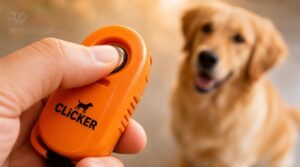
Button feel is easy to overlook — until you’re mid-session and your finger’s aching.
Actuation force commonly runs between 0.3 and 1.0 Newtons. Lighter pressure means faster clicks and less fatigue. Deeper button travel depth slows your timing down. You want a crisp tactile feedback and quick snapback speed so every press feels intentional, not accidental.
Wrist Straps and Keyrings
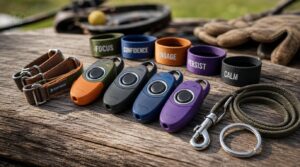
A good wrist strap or keyring keeps your clicker ready without hunting through pockets mid-session.
- Elastic fabric bands stretch comfortably over clothing layers
- Nylon wrist straps resist moisture and stay lightweight
- Lobster clasp lanyards clip fast to belt loops or harnesses
- Metal key rings anchor ring clickers to your gear bag
Colorfast, stainless hardware resists rust and looks sharp longer.
Plastic Versus Metal Build
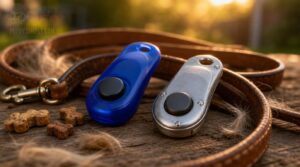
Plastic clickers weigh under 50 grams, making them ideal for long sessions. Metal construction delivers louder, crisper clicks and stronger durability. For grip comfort, plastic wins. For weather resistance and longevity, a stainless steel clicker holds up better outdoors.
| Feature | Plastic | Metal |
|---|---|---|
| Weight Comparison | Under 50g | Heavier |
| Sound Volume | Quieter | Louder |
| Durability Test | Decent | Excellent |
Indoor and Outdoor Training

Where you train matters just as much as how you train.
Indoors, keep your training space clear — at least two meters in all directions — with a non-slip floor and consistent lighting.
Outdoors, start low-distraction, then gradually add noise and movement. For open spaces, a louder CRMADA box clicker carries better.
Short sessions — three to five minutes — work everywhere.
How We Reviewed Clickers
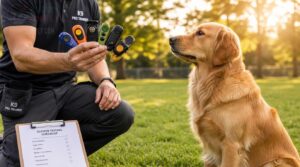
Picking the best clicker isn’t guesswork — it takes real testing. I put each model through five key areas to see how it actually performs when you’re out there working with your dog. Here’s exactly what I looked at.
Sound Consistency Testing
Sound consistency is the foundation of effective clicker training. A click that varies even slightly in tone or timing can confuse your dog.
Here’s what I measured in every model tested:
- Frequency variance limits stayed between 430–520 Hz across repeated presses
- Amplitude consistency range held within 0.5 dB across 50 consecutive uses
- Latency stability metrics showed under 3 ms jitter per trigger
- Clicker volume stayed within a 6–9 dB window at one meter
- Temperature impact testing confirmed under 1 dB shift across ±10°C swings
Environmental noise tolerance also held strong indoors and out — so your auditory cues stay sharp regardless of setting.
Ease of Use
A click that’s consistent means nothing if the clicker itself fights you during a session. Ease of use comes down to whether the tool disappears in your hand — or distracts you from it.
Every model got tested on quick activation and low effort press. A light 1.5 to 3.0 newton press matters more than you’d think. Fumbling mid-session breaks timing, and timing is everything.
Clear feedback, comfortable grip, and a big button kept sessions smooth. Compact builds with finger clicker options and handy attachment points made the whole experience feel smooth — exactly how it should be.
Durability and Materials
Ease of use only gets you so far if a clicker falls apart after a few weeks. That’s where durable materials matter.
Key things that held up best:
- Stainless steel clickers resisted rust even after rainy sessions
- Impact resistance ratings protected against drops from 1.5 meters
- Weather seal performance kept internals dry across humid conditions
Material longevity, corrosion protection, and ergonomic durability separate lasting tools from disposable ones.
Portability During Walks
A clicker that survives your living room means nothing if it’s a hassle to carry outside. That’s why portability during walks mattered a lot in our testing.
The best models had lightweight construction under one ounce, a single-finger press button, and either a wrist strap or lanyard clip so your hands stay free when your dog needs you.
Value for Money
Portability gets you out the door — but value keeps you coming back. With dog training clickers, cost performance ratio matters more than brand names. A midrange clicker with consistent sound and solid durability often outlasts a cheap backup that fails in a month.
Warranty value impact is real too. Models offering one to three years of coverage quietly save you money long-term.
Clicker Training Tips for Dogs

Having the right clicker is only half the battle — knowing how to use it is what actually gets results. A few simple habits can make the difference between a dog who gets it fast and one who stays confused. Here’s what works.
Building Clicker Association
Think of the clicker as a camera — it freezes the exact moment your dog does something right. Before anything else, you need to build that association.
Start with treat pairing: click once, then immediately offer a treat. Repeat this 10–20 times across short training sessions. No behavior required yet. You’re simply teaching your dog that the sound means something good is coming.
Here’s what makes clicker training stick:
- Timing precision matters most — click the instant the behavior happens
- Always follow the marker with a reward within 0–2 seconds
- Keep training sessions brief to prevent fatigue
- Practice cue consistency so the sound stays meaningful
- Use generalization practice in new environments to reinforce learning
Once your dog reliably perks up at the click, the association is solid. From there, a reinforcement schedule — rewarding every correct response early on — builds lasting confidence and focus.
Teaching Basic Commands
Once you’ve built that association, it’s time to put the clicker to work on the commands that matter most.
| Command | Clicker Cue Moment | Key Training Aid |
|---|---|---|
| Sit Training | Click the instant hips touch ground | High-value treats |
| Come Recall | Click when dog reaches your feet | Long leash |
| Stay Duration | Click after each successful pause | Distance increments |
| Down Position | Click when elbows hit the floor | Hand signal paired |
Shaping New Behaviors
Shaping new behaviors is where clicker training truly shines. Instead of waiting for a perfect finish, you reward small steps toward it — that’s micro step progression at work.
- Break the behavior into tiny, observable pieces
- Click and treat within one second of each correct step
- Raise criteria only after three to five reliable repetitions
- Generalize the behavior across locations and handlers
- Log each session to track when to advance
Cue consistency matters throughout — pair every step with the same word or signal so your dog builds a clear mental map.
Reducing Unwanted Barking
Barking doesn’t disappear overnight — but a clicker gives you a precise tool to interrupt and redirect it. Pair clicker training with a firm, consistent "quiet" cue right after a bark, then click and reward the silence immediately.
Environmental management helps too: block window views and use white noise to reduce triggers before they escalate.
Common Clicker Mistakes
Even experienced trainers slip up here. Early or late clicking is the most common error — the click has to land at the exact moment of the correct behavior, not before or after. Reward gaps kill the association fast, so always follow a click with a treat.
Watch for treat overuse and cue reliance too, or your dog won’t work without the clicker.
Frequently Asked Questions (FAQs)
Can clicker training work for aggressive dogs?
Yes — clicker training works for aggressive dogs. Paired with desensitization and counterconditioning, short sessions and consistent rewards can reshape reactive behavior. Professional supervision keeps early trigger exposure safe and effective.
How long does a clicker training session last?
Most clicker training sessions last five to ten minutes. Puppies do best with just one to three minutes. Short, daily sessions beat one long weekly grind every time.
At what age should clicker training stop?
There’s no finish line. Clicker training never has to stop — not with a senior companion, not ever. Adapt the frequency and method to your dog’s health, and the learning never ends.
Can multiple dogs be trained simultaneously with clickers?
You can train multiple dogs at once — but only if each dog has distinct clicker sounds and individual reward types. Use station separation methods to keep focus sharp and sessions short.
Do cats or other pets respond to clicker training?
Funny enough, clicker training isn’t just a dog thing. Cats, birds, rabbits, and even ferrets respond well — cats especially benefit from stress reduction and faster learning through positive reinforcement and precise marker sound timing.
Conclusion
Picture your dog sitting perfectly, eyes locked on you, tail still, waiting. That moment didn’t happen by accident—it happened because your timing was exactly right. That’s what a good clicker gives you: precision.
Finding the best clicker for dog training means finding one that fits how you train, where you train, and how your dog responds. The nine options here cover every need. Pick the one that fits, and let the real training begin.
- https://www.petsmart.com/dog/training-and-behavior/clicker-training/top-paw-training-clicker-73305.html
- https://www.sciencedirect.com/science/article/abs/pii/S0168159118302211
- https://pmc.ncbi.nlm.nih.gov/articles/PMC7906040/
- https://www.petmd.com/dog/training/4-hand-signals-dogs-you-can-teach-your-pup