This site is supported by our readers. We may earn a commission, at no cost to you, if you purchase through links.
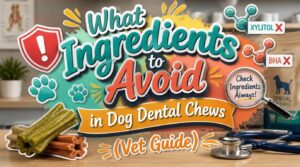
Most dog owners grab a bag of dental chews thinking they’re doing something good for their dog’s teeth. And they might be—but some products on store shelves contain ingredients that cause more harm than a little plaque ever would.
Xylitol, a sweetener listed as E967, can trigger liver failure in dogs. Synthetic preservatives like BHA and ethoxyquin raise real cancer concerns with repeated exposure.
Knowing what ingredients to avoid in dog dental chews isn’t paranoia—it’s the difference between a product that cleans teeth and one that quietly damages your dog’s health.
Table Of Contents
- Key Takeaways
- Check Every Dental Chew Label
- Avoid Xylitol in Dog Chews
- Skip Artificial Preservatives
- Avoid Artificial Colors
- Watch Sugars and Syrups
- Limit Starchy Fillers
- Avoid Low-Quality Proteins
- Be Careful With Chemicals
- Avoid Dangerous Chew Textures
- Choose Safer Dental Chews
- Frequently Asked Questions (FAQs)
- Conclusion
Key Takeaways
- Xylitol (also listed as E967) is one of the most dangerous ingredients in dog dental chews, capable of triggering rapid blood sugar crashes, seizures, and fatal liver failure even in small amounts.
- Synthetic preservatives like BHA, BHT, ethoxyquin, and TBHQ extend shelf life but carry real risks — including cancer links, liver damage, and hormonal disruption — with daily cumulative exposure being the main concern.
- Starchy fillers like corn starch, wheat flour, and rice flour, along with added sugars and corn syrup, actively feed plaque-forming bacteria in your dog’s mouth, working directly against the chew’s dental purpose.
- Your safest shortcut is choosing a VOHC-sealed chew with a short, recognizable ingredient list, the right size for your dog’s weight, and moderate calories — then treating the label like a prescription, not packaging.
Check Every Dental Chew Label
Before you hand your dog that dental chew, take thirty seconds to read the label — it tells you more than the packaging ever will. Knowing what to look for makes the difference between a chew that helps and one that quietly causes harm. Here’s what to check before you buy.
If you have a puppy, the stakes are even higher — dental chews safe for puppies breaks down exactly which ingredients and sizes to avoid at each stage of development.
Ingredient List Order
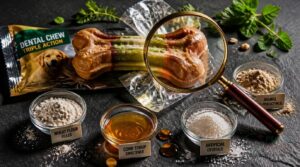
The ingredient list on any dental chew works on a simple rule: ingredients appear by descending weight. Whatever’s listed first is present in the greatest amount. So if a harmful filler or sweetener sits near the top, your dog is getting a lot of it. Start there — the top three ingredients tell you most of what you need to know.
You should also check for mandatory prepacked information to guarantee the label is complete.
Hidden Additive Names
Knowing where an ingredient sits in the list is just the start. The harder challenge is recognizing it at all.
Manufacturers often use synonym names or E-codes — xylitol, for example, is also labeled as E967. BHA, BHT, and ethoxyquin may hide under functional group terms. "Natural flavors" can mask several undisclosed compounds entirely.
“Natural” Marketing Claims
Once you’ve spotted an unfamiliar name, the next challenge is the claim wrapped around it. "Natural" on a label doesn’t mean every ingredient is natural. Manufacturers often highlight plant-derived components while quietly including synthetic preservatives like BHA or BHT.
A product can be labeled "free from artificial additives" and still contain processed synthetic compounds — the claim just isn’t regulated tightly enough to stop it.
Calorie and Serving Size
Calories matter more than most owners expect. Dental chew labels list calories per chew and per serving — check both. A single chew for a large dog can carry over 70 calories. Feed two daily, and that adds up fast against your dog’s daily calorie budget.
Watch especially for corn syrup or added sugars, which inflate calorie density without any nutritional return.
Veterinary Approval Signs

A VOHC seal — issued by the Veterinary Oral Health Council — is one of the few trustworthy signals on a dental chew label. But don’t just spot the logo and move on. Match the exact product name on the package to the council’s published approval list. If the names don’t align, that mark means nothing.
Avoid Xylitol in Dog Chews

Xylitol is one of the most dangerous ingredients you’ll find in a dog dental chew — and it shows up more often than you’d think. Even a tiny amount can trigger a serious, fast-moving reaction in dogs. Here’s what you need to know about why it’s so harmful.
Also Listed as E967
Xylitol doesn’t always show up by name. In EU-manufactured or EU-distributed products, it may appear as E967 — its official food additive code. That single code hides a substance that’s genuinely dangerous for dogs.
When you’re scanning a dental chew label, searching only for "xylitol" isn’t enough. Check for E967 too.
Rapid Blood Sugar Drops
Even a small amount of xylitol — this sugar alcohol — can trigger rapid insulin release, sending your dog’s blood sugar plummeting within 30 to 60 minutes of eating. Unlike corn syrup or sucrose, which cause gradual glucose spikes, xylitol drives postprandial hypoglycemia fast.
Watch for shaking, confusion, or extreme lethargy — those are the warning signs that something is seriously wrong.
Seizure Risk
When blood sugar drops fast, the brain is first to suffer. Xylitol-induced hypoglycemia can trigger seizures within an hour of ingestion — especially in dogs with underlying neurological sensitivities or conditions.
Multiple additives in one chew, including artificial preservatives like BHA, BHT, or ethoxyquin, can compound metabolic stress, making a seizure response more likely and harder to manage.
Liver Failure Danger
Xylitol doesn’t just drop blood sugar — it can destroy your dog’s liver within days. Once liver cells start failing, toxin accumulation overwhelms the body because the liver can no longer filter waste from the bloodstream.
- Hepatic encephalopathy causes confusion and disorientation as toxins reach the brain
- Clotting factor deficiency leads to uncontrolled internal bleeding
- Portal hypertension creates fragile veins that can rupture
- Infection susceptibility increases as immune regulation collapses
Compounding this, artificial preservatives like BHA, BHT, and ethoxyquin add chronic metabolic stress that can accelerate liver deterioration over time.
Emergency Vet Situation
If your dog eats a chew containing xylitol, treat it as a medical emergency — don’t wait for symptoms. Call the clinic before you leave so staff can prepare.
On arrival, triage teams assess airway, breathing, and neurological status immediately. Emergent cases receive treatment within 15 minutes, and rapid blood work confirms hypoglycemia or liver involvement fast.
Skip Artificial Preservatives

Preservatives keep dental chews shelf-stable, but some of the most common ones carry real health risks with regular use. A few specific chemicals show up again and again on ingredient labels, and they’re worth knowing by name. Here’s what to watch for.
BHA and BHT
BHA and BHT are synthetic antioxidants added to fat-containing chews to prevent rancidity. You’ll spot them on labels as "butylated hydroxyanisole" or "butylated hydroxytoluene."
Both are linked to cancer and liver damage in animal studies. They offer no dental benefit — just shelf life. If you see either name, put the product back.
Ethoxyquin
Ethoxyquin flies under the radar on most labels, but it’s worth knowing exactly what it is. Chemically a quinoline compound (C14H19NO), it was originally developed as a pesticide and rubber stabilizer before entering animal feed as a lipid preservative.
Here’s why that should concern you:
- Its metabolite, ethoxyquin quinone imine, is flagged as potentially genotoxic.
- The manufacturing process leaves behind p-phenetidine impurities — a known irritant.
- Regulatory bodies like EFSA couldn’t confirm its safety for animals or consumers.
- Chronic exposure is linked to liver, kidney, and thyroid effects.
- It offers your dog zero dental benefit — only extended shelf life.
If you see "ethoxyquin" or "EQ" on an ingredient list, that chew doesn’t belong in your dog’s mouth.
TBHQ
TBHQ — short for tert-butylhydroquinone — is another synthetic antioxidant you’ll find slipped into processed pet products. Its only job is to slow fat oxidation and extend shelf life. It won’t change the flavor or smell of a chew, making it easy to overlook. But TBHQ can alter red blood cells and raise reticulocyte counts in dogs.
| TBHQ Detail | What It Means |
|---|---|
| Full name | Tert-butylhydroquinone (E319) |
| Primary function | Slows fat oxidation in fats and oils |
| Common in | Fried snacks, frozen foods, pet chews |
| Regulatory status | Permitted additive — tightly dose-controlled |
| Dog safety concern | Linked to red blood cell changes |
Propyl Gallate
Propyl gallate works by donating hydrogen atoms to free radicals, stopping oxidative chain reactions that turn fats rancid. It’s freely soluble in fat, which means it absorbs readily into fatty chew ingredients.
What’s concerning is its link to reproductive hormone disruption in dogs — a risk that grows quietly with repeated, long-term exposure.
Chronic Exposure Concerns
The real danger with artificial preservatives isn’t a single chew — it’s months of daily exposure. Cumulative toxin load builds quietly: BHA, BHT, ethoxyquin, TBHQ, and propyl gallate accumulate through repeated ingestion, straining liver and kidney function over time.
- Gut microbiome shift — preservatives alter bacterial balance, worsening digestion
- Kidney function decline — repeated filtering of these compounds stresses renal tissue
- Allergy sensitivity build — chronic exposure can trigger recurring skin or ear issues
- Dental plaque persistence — residues feed oral bacteria daily
- Endocrine disruption — hormone pathways face ongoing interference
Avoid Artificial Colors
Artificial colors in dog dental chews serve one purpose — making the product look appealing to you, not your dog. Red 40 and Yellow 5 are the most common offenders, and neither one belongs in something your dog chews daily. Here’s what you need to know about each.
Red 40
Red 40, also called Allura Red AC, shows up in dog dental chews purely for looks — it makes a product appear more appealing to you, not your dog. It’s a petroleum-derived synthetic dye with no dental benefit.
Check labels for "Red 40," "FD&C Red No. 40," or "Allura Red AC," and skip any chew listing it.
Yellow 5
Yellow 5 — also called tartrazine or E102 — is another synthetic azo dye that appears in some dental chews purely for color. It has no dental cleaning function whatsoever.
- Listed as FD&C Yellow No. 5 in the US
- Derived from a synthetic chemical process, not plants
- Added only to make chews visually appealing to you
- Can trigger adverse reactions in sensitive dogs
- Provides no nutritional or oral health benefit
On the label, look for "Yellow 5," "tartrazine," or "E102" and avoid any chew that lists it.
Allergy-like Reactions
Both Red 40 and Yellow 5 can trigger allergy-like reactions in sensitive dogs — affecting the skin, digestive system, and even the airway. You might notice itching, hives, facial swelling, vomiting, or sudden respiratory distress shortly after your dog chews a treat containing these dyes.
When multiple systems are involved, treat it as a vet emergency.
Unnecessary Visual Appeal
Here’s an uncomfortable truth: those vibrant colors in your dog’s dental chew serve you, not your dog. Bright color gradients, shiny foil packaging, and cartoon character appeal are all designed to catch your eye at the shelf — not to benefit your pet’s teeth.
- Artificial colors like FDC dyes add zero dental value
- Blue 2 and similar dyes exist purely for visual marketing
- Glossy texture distraction shifts focus away from the ingredient list
- Seasonal shelf displays rotate colors to trigger impulse purchases
- Artificial ingredients including artificial flavors mask low-quality formulations
Dogs can’t see those colors. You’re the only one being sold to.
Those vivid colors in your dog’s dental chew aren’t for your dog — they’re for you
Better Dye-free Options
Dye-free dental chews rely on natural color sources — meat, liver, or vegetables — so expect muted, uneven tones and batch color variation between packages. Check for clear label claim verification: the ingredient panel should list specific named components, no FDC dyes, no Blue 2, no artificial colors and flavors. That transparency is the real quality signal.
| Feature | Dye-Free Chew | Standard Chew |
|---|---|---|
| Color source | Natural ingredients | Synthetic FDC dyes |
| Ingredient clarity | Named components | Vague colorant terms |
| Nontoxic dog treats | Higher likelihood | Not guaranteed |
Watch Sugars and Syrups

Sugars and syrups have no business being in a dental chew — yet they show up more often than you’d think. Some are obvious, like corn syrup, but others hide behind less familiar names. Here’s what to watch for on the label.
Corn Syrup
Corn syrup is a refined sugar made by hydrolyzing cornstarch into glucose-rich syrup. It’s added to chews for soft texture and sweetness — not nutrition. That carbohydrate load feeds oral bacteria, speeding up plaque buildup on your dog’s teeth.
- Derived from corn starch through acid or enzyme processing
- Contributes excessive sugars with no nutritional benefit
- Fuels plaque-forming bacteria in your dog’s mouth
- Promotes blood sugar spikes and insulin resistance
- Sometimes flavored with molasses in darker formulations, masking it as natural
Skip chews listing corn syrup among the first few ingredients — it’s one of the more harmful ingredients in pet treats, and better sweetener alternatives simply don’t belong in dental chews at all.
Added Sweeteners
Corn syrup isn’t the only sweetener to watch. Sugar alcohols like sorbitol and maltitol appear in many dental chews, often blended together to mask aftertastes. Some show up as syrups rather than powders, making them harder to spot.
Check for multiple sweetener entries across the ingredient list — "sugar free" doesn’t mean sweetener free.
Blood Sugar Spikes
When a chew is loaded with refined sugars, corn syrup, or sugar alcohols, a rapid glucose rise follows digestion. Portion size effect matters too — larger servings deliver more carbohydrates, creating a bigger spike. Chews with little to no fiber digest faster, since fiber slows absorption and blunts peak blood glucose.
Stress hormone impact can worsen this further during anxious moments.
Obesity Risk
Blood sugar spikes don’t exist in isolation — calorie accumulation follows right behind them. Every chew adds to your dog’s daily energy intake, and treat frequency is often underestimated.
- Refined sugars and low-quality fats raise energy density
- Filler ingredients add calories without nutrition
- Excessive sodium increases water retention and weight
- Poor portion control leads to energy imbalance
- Snack-seeking behavior drives canine obesity
Plaque-feeding Sugars
Most dental chews marketed as healthy still contain fermentable sugars that feed plaque bacteria directly. Corn syrup, molasses, and added syrups are all free sugars — once inside your dog’s mouth, cariogenic bacteria like Streptococcus mutans ferment them into acids that drop plaque pH and erode enamel.
The more frequently your dog chews, the more acid attacks repeat.
Limit Starchy Fillers
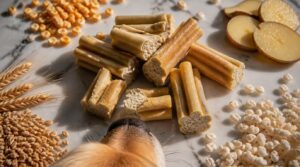
Starchy fillers are one of the sneakiest problems in dental chews, and they show up more often than you’d think. They don’t clean teeth — they actually feed the bacteria that cause plaque and tartar buildup. Here are the main ones worth watching for on the label.
Corn Starch
Starch is often the first thing that pads out a chew’s weight without adding value.
Corn starch — a fine, powdery filler derived from the corn kernel’s endosperm — is almost pure carbohydrate. Its gel-thickening and film-forming properties make it useful for texture, but those same qualities mean it coats teeth and feeds plaque-forming bacteria directly.
Rice Flour
Rice flour is another starchy filler worth scrutinizing. It’s largely carbohydrate by weight, contributing to high glucose availability that feeds plaque-forming bacteria — much like corn starch does.
- Acts as a binding agent in gluten-free chew formulas
- Adds calorie density without meaningful nutritional benefit
- Quality varies markedly by milling process and variety
- Bland flavor makes it easy to overlook on labels
Wheat Flour
Wheat flour is one of the most common fillers in dog dental chews — and one of the least useful. It’s mostly refined starch and gluten protein, with the bran and germ stripped away during milling. What remains fuels oral bacteria, adds unnecessary calories, and offers your dog almost nothing in return.
Maize Flour
Maize flour is basically corn repackaged as a filler. It’s roughly 77% carbohydrates, most of which is starch that breaks down quickly into glucose — exactly what oral bacteria thrive on.
It’s low in fiber and offers little nutritional return, making it a cheap bulking agent that quietly works against your dog’s dental health.
High-carb Grain-free Fillers
Grain-free" sounds cleaner, but the carb load often stays the same. Tapioca, peas, lentils, and potato starch are common replacements that still spike blood glucose and feed oral bacteria.
When several starches are blended together, the total carbohydrate content adds up fast — especially in larger chews. Always check serving calories, not just the marketing claim on the front.
Avoid Low-Quality Proteins

Not all protein sources are created equal, and some of the ones found in dental chews are worth a closer look. Manufacturers often cut costs by using ingredients that sound fine on paper but raise real concerns in practice. Here’s what to watch for.
Unnamed Animal By-products
Unnamed animal by-products lack ingredient transparency — the label hides what’s actually inside the chew. Without species sourcing details, it could contain organs, offal, or skin from various animals.
Watch for these warning signs:
- "Animal byproducts" or "meat byproducts" with no species named
- "Animal meal" listed without sourcing or processing details
- No indication of heat treatment or rendering safety
- Wide nutrient variability between different production batches
Questionable Meat Meal
Meat meal" sounds more defined than unnamed animal byproducts, but the gap is smaller than you’d think. Label transparency rarely extends to the rendering process, leaving species, tissue source, and quality unverified. Meat meal variability between batches can shift digestibility, protein concentration, and allergen load — making allergen identification difficult if your dog has known food sensitivities.
| Concern | What It Means | What to Watch For |
|---|---|---|
| Rendering Process | High heat degrades protein bioavailability | No sourcing or process details on label |
| Digestibility Concerns | Lower absorption than whole muscle meat | Soft stools or increased stool volume |
| Allergen Identification | Unknown species blocks elimination diets | "Meat meal" listed without species name |
| Meat Meal Variability | Batch differences alter firmness and nutrition | Inconsistent chew texture or odor |
| Harmful Ingredients | Low-quality inputs may enter the mix | Vague groupings like "meat and bone meal" |
Rendered Fats
Rendered fats follow a similar pattern. The rendering process melts animal fat, strains out solids, and leaves a shelf-stable fat product — but the starting materials aren’t always clean cuts. Fats from diseased or spoiled tissue can enter the mix.
Since fat is roughly 90% fatty acids, poorly sourced rendered fats add energy-dense but low-quality calories to your dog’s dental chew.
Corn Gluten Meal
Corn gluten meal is a byproduct of corn starch manufacturing — and its résumé doesn’t exactly scream "quality protein." Despite containing roughly 60–70% crude protein, it’s a plant-based filler that your dog’s system doesn’t process as efficiently as animal protein. It’s also highly insoluble in water, which affects how it behaves in moist chew formulations.
What’s more surprising? The same ingredient is used as a weed control agent and soil nitrogen source in agriculture. That context alone should give you pause when you spot it on a dental chew label.
Soy Sensitivity Concerns
Soy shows up in dental chews as soy protein, soybean meal, or simply "vegetable protein." For sensitive dogs, even small amounts can trigger vomiting, diarrhea, or skin reactions. Severe cases may involve anaphylaxis.
Cross-contamination on shared equipment adds another layer of risk. If your dog has reacted before, check every label carefully — soy hides under multiple names.
Be Careful With Chemicals
Some dental chews go beyond bad ingredients — they carry chemicals that don’t belong anywhere near your dog’s mouth. A few of these show up even in products marketed as "clean" or "safe." Here’s what to watch for on the label.
Chlorhexidine Irritation
Chlorhexidine shows up in some dental chews and oral rinses, often marketed as a germ-fighting ingredient.
The problem? It can cause local skin redness, itching, and burning right where it contacts tissue. Repeated exposure raises the risk of allergic contact dermatitis, and in rare cases, swelling or anaphylaxis.
For dental chews your dog chews daily, that’s a real concern.
Peroxide-based Ingredients
Some dental chews use peroxide-based chemicals as antimicrobial agents — hydrogen peroxide, benzoyl peroxide, or sodium percarbonate being the most common. Each carries a different oxidizing strength and irritation potential.
| Ingredient | Key Risk |
|---|---|
| Hydrogen peroxide | Reactive oxygen species irritate sensitive oral tissue |
| Benzoyl peroxide | Residual oxidizers cause stronger contact irritation |
| Sodium percarbonate | Moisture activation triggers unpredictable peroxide release in saliva |
Stabilizer impact matters too — stabilized formulas stay active longer, raising daily exposure risk for your dog.
Denatured Alcohol
You might see "alcohol denat." on a dental chew label and assume it’s harmless. It isn’t. Denatured alcohol is ethanol mixed with toxic additives — including methanol, which causes blindness and death — to prevent drinking.
These aren’t trace contaminants. If your dog swallows it, the industrial solvents and denaturants absorb directly, making this ingredient genuinely dangerous in pet products.
Sodium Hexametaphosphate
Sodium hexametaphosphate (SHMP) is primarily an industrial water softening agent — used in boilers, detergents, and metal finishing — not a dental health ingredient.
Its chelating properties slow tartar hardening on teeth, but it doesn’t remove plaque or support gum health. You’re basically getting an industrial dispersant with a dental claim attached.
Sodium Tripolyphosphate
Like SHMP, sodium tripolyphosphate (STPP) is an industrial chemical that’s found its way into pet dental products. It binds metal ions and retains moisture in processed meats — useful in a factory, not in your dog’s mouth.
Studies show STPP can decrease iron levels in the liver, spleen, and bones with repeated exposure.
Avoid Dangerous Chew Textures
Ingredients aren’t the only thing worth scrutinizing on that label — texture matters just as much. The wrong chew can crack a tooth, trigger a choking episode, or slide through your dog’s gut without doing anything useful. Here’s what to watch out for.
Hard Antlers
Hard antlers sound natural, but that doesn’t make them safe. After velvet shedding, the antler becomes a fully calcified, dead bone structure — dense, rigid, and unforgiving. Its mineral and collagen matrix is tough enough for male deer to clash antlers during competition.
Your dog’s teeth weren’t built for that kind of force. The result? Fractured teeth and emergency vet visits.
Bones and Hooves
Bones and hooves carry the same risk. Hooves are dense, keratinized structures — built from the same tough fibrous protein that forms nails and claws. That material isn’t digestible, and large fragments pose a choking hazard.
Cooked bones splinter. Raw bones crack teeth. None of these belong in your dog’s mouth as a dental chew.
Very Hard Nylon
Nylon chews might seem like a safe, synthetic middle ground — no splinters, no sharp edges.
But very hard nylon is engineered for industrial wear resistance, with tensile strength exceeding 80 MPa. That’s closer to a machine part than a chew toy. The hardness can fracture your dog’s teeth just as easily as a bone.
Rawhide Choking Risks
Rawhide is one of the most common choking hazards in pet safety conversations — and for good reason. When a dog bites off a chunk, that piece can lodge in the throat before you can react. Round shapes like knots break off as single intact pieces, making swallowing large segments far more likely than with flat strips.
What makes it worse is swelling in the stomach. Swallowed rawhide can expand up to four times its original size, turning a manageable piece into a serious airway obstruction or digestive blockage. Always match chew size to your dog’s size, and avoid detachable shapes entirely.
Overly Soft Chews
Soft chews might seem like a gentler option, but plaque removal efficacy drops sharply when texture lacks real abrasion. A chew that compresses under your dog’s bite isn’t scraping surfaces — it’s smearing.
That choking hazard is real too, since soft pieces break apart fast and get gulped before prolonged chewing happens. Check labels for glycerin, which adds softness but feeds oral bacteria.
Choose Safer Dental Chews

Now that you know what to avoid, the next step is finding something that actually works. A few practical factors can help you narrow down the right dental chew for your dog. Here’s what to look for.
VOHC-approved Products
The VOHC Seal is your most reliable shortcut when choosing dog dental chews. It’s awarded only after controlled trials demonstrate real plaque and tartar reduction — not just fresh breath or whitening claims.
- Confirms evidence-based plaque control
- Requires separate plaque and tartar trial data
- Covers gingivitis documentation too
- Bars non-qualifying shapes from seal use
- Prevents misleading marketing misuse
Correct Dog Size
Picking the right size chew matters just as much as avoiding xylitol or synthetic preservatives.
Weight-based sizing guides how thick and durable a chew should be — smaller dogs need thinner, softer chews to avoid choking hazards, while larger dogs need sturdier ones. Always match the label’s weight range to your dog’s current adult weight.
Simple Ingredient Lists
A shorter ingredient list is almost always a better sign. When you can read and recognize every item on the label — real protein sources, named fats, a handful of functional additives — that’s ingredient list transparency working in your favor.
If the list runs twenty lines deep with synthetic preservatives, artificial sweeteners, and vague by-products, put it back on the shelf.
Moderate Calories
Calories in dental chews add up faster than most owners expect. A moderate-calorie chew fits your dog’s daily budget without crowding out real nutrition. Watch for glycerin, refined sugars, and low-quality fats — all quiet calorie contributors.
- Stick to label serving sizes and adjust for your dog’s size and activity level
- Split chews only if calories are recalculated proportionally
- Reduce frequency if your dog gains weight
Vet-recommended Choices
A vet-recommended dental chew does more than taste good — it’s built with purpose. Look for the VOHC seal, which confirms independent testing for plaque or tartar control. Match the chew to your dog’s size, check for ingredient purity, and follow daily feeding limits. Simple ingredients, clean formulas, and proper sizing make all the difference.
| Feature | What to Look For | Why It Matters |
|---|---|---|
| VOHC Seal | Accepted for plaque/tartar control | Confirms tested effectiveness |
| Size Match | Small, medium, or large label | Reduces choking and ensures proper chewing |
| Ingredient List | Short, recognizable ingredients | Avoids harmful fillers and toxic additives |
| Feeding Limit | Daily serving printed on label | Prevents excess calories and overuse |
Frequently Asked Questions (FAQs)
How often should dogs receive dental chews?
Most adult dogs benefit from one dental chew daily. Plaque hardens into tartar within three days, so consistency matters. Adjust for your dog’s size, age, and daily calorie budget.
Can puppies safely use adult dental chews?
Most adult dental chews aren’t safe for puppies. They’re too hard for developing teeth, too large for small throats, and often contain harmful additives a puppy’s digestive system can’t handle.
Do dental chews replace regular tooth brushing?
No, dental chews don’t replace brushing. Chews miss surfaces your dog skips while chewing. Only a toothbrush reaches the gumline consistently. Use chews as a supplement, not a substitute.
Are homemade dental chews a safer alternative?
Homemade dental chews aren’t automatically safer. Batch variability, ingredient errors, and sizing inconsistencies can introduce real risks — sometimes worse than store-bought options without veterinary oversight.
Can dental chews worsen existing gum disease?
Yes, they can. The wrong chew can accelerate gum disease by missing subgingival plaque, adding irritant ingredients, or causing mechanical trauma to already-inflamed tissue.
Conclusion
One dog presented to my clinic with sudden, unexplained liver failure. The culprit? A dental chew grabbed right off a supermarket shelf—xylitol, buried deep in the fine print.
Knowing what ingredients to avoid in dog dental chews won’t just protect your dog’s teeth; it protects everything else too. Labels are small, but the decisions they hold are significant. Read them like you’d read a prescription—because for your dog, that’s exactly what they’re.
- https://www.skipperspetproducts.com/blogs/news/ingredients-to-avoid-in-dog-treats
- https://pupford.com/blogs/all/dog-treat-ingredients-avoid
- https://www.4-legger.com/blogs/fetch-the-dog-blog/the-hidden-dangers-lurking-in-pet-dental-products
- https://wearethecure.org/top-10-dog-food-ingredients-to-avoid-why
- https://kabo.co/blogs/the-doggo-times-blog/a-close-look-a-doggie-dental-treats