
This site is supported by our readers. We may earn a commission, at no cost to you, if you purchase through links.

A training collar introduced the wrong way can undo weeks of progress—and leave your dog more anxious than when you started. Most people assume the collar does the work, but the introduction itself sets the foundation for everything that follows.
A dog that learns to associate the collar with calm, predictable experiences will respond to it as a training tool; one that meets it through confusion or discomfort may resist it entirely.
Matching the right collar means matching the right collar to your goal, fitting it correctly, and moving through a deliberate sequence that builds your dog’s confidence at every stage.
Table Of Contents
- Key Takeaways
- Choose The Right Training Collar
- Measure Your Dog’s Neck
- Let Your Dog Inspect It
- Fit The Collar Correctly
- Start With Short Wear Sessions
- Use The Lowest Setting First
- Pair Collar Use With Commands
- Watch for Stress Signals
- Increase Training Gradually
- Prevent Problems and Injuries
- Frequently Asked Questions (FAQs)
- How to introduce a dog to a training collar?
- What is the 10 minute rule for dogs?
- What is the hardest thing to train a dog to do?
- What is the 3 second rule in dog training?
- Can I use a training collar on any age dog?
- How long until my dog fully adapts to it?
- Should I use the collar for every training session?
- Can two dogs in one household share a collar?
- When should I stop using the collar altogether?
- Conclusion
Key Takeaways
- Matching the collar type to your specific training goal—not just your dog’s size or breed—sets the foundation for effective, low-stress training from day one.
- Deliberate introduction sequence (sniff first, fit correctly, activate last) builds your dog’s trust in the equipment and prevents the anxiety that undoes weeks of progress.
- Dog’s body language is the most reliable feedback tool you have—scratching, tail tucking, or treat refusal mean you stop immediately and scale back, not push through.
- Gradual progression—shorter sessions, lowest stimulation, familiar environments first—isn’t optional—caution; it’s the method that makes the collar a reliable training tool rather than a source of stress.
Choose The Right Training Collar

Not all training collars work the same way, and picking the wrong one can slow your progress or stress your dog out. The best choice depends on your specific training goal, your dog’s temperament, and how they respond to different types of feedback.
If you’re unsure whether a collar is safe for your dog, it’s worth understanding how training collars can affect your dog’s health and comfort before committing to one.
Here’s what you need to know before buying.
Match Collar Type to Your Training Goal
Before you buy anything, get clear on what you’re actually trying to solve. Choosing the right training collar for your dog starts with your goal, not the product.
- Leash Pulling → martingale or front-clip safety vest
- Recall Distance → remote e-collar
- Barking Control → citronella or ultrasonic
- Boundary Training → remote or GPS-enabled collar
Anxiety sensitivity matters too—match the tool to the problem.
Many collars offer adjustable stimulus settings for fine‑tuned training.
Compare Vibration, Ultrasonic, Citronella, and E-collars
Once your goal is clear, the collar type should follow logically. Each option works through a different sensory stimulation pathway, so Dog Sensitivity Compatibility is everything.
| Collar Type | Best Use |
|---|---|
| Vibration collar | Noise-sensitive dogs needing tactile cues |
| Ultrasonic | Indoor bark deterrent mechanism |
| Citronella collar | Scent-averse dogs, no electrical stimulus |
| Ecollars | Distance recall, Training Reliability outdoors |
Environmental Suitability matters—ultrasonic excels indoors, while ecollars handle open spaces better.
Pick Adjustable Stimulation Levels
Not all collars are built equal—adjustable stimulation levels give you real control.
Look for these features when comparing options:
- Intensity Step Granularity – tap up or down one precise increment at a time
- Ramp Up Controls – gradually increase stimulation rather than applying full intensity instantly
- Intensity Lock Safety – prevents accidental changes after you adjust the settings
- Program Mode Presets – store distinct intensities for different training scenarios
- Feedback Delay Timing – built-in pauses that stabilize output during movement
Always start on the low setting, monitor your dog’s response closely, and trust gradual introduction over guesswork.
Consider Your Dog’s Temperament and Sensitivity
Adjustable settings only work if you match them to the dog in front of you. A reactive dog and an introverted one need completely different starting points.
If your dog shows noise sensitivity, low handling tolerance, or carries baggage from prior experiences, begin more slowly than you think necessary.
Monitor your dog’s response at every step — stress threshold drops quickly, and positive reinforcement fills the gap.
Choose Durable, Waterproof Materials
Material selection isn’t just about aesthetics — it determines how long your collar holds up in the field.
Look for nylon PU coating for water resistance, a polycarbonate shell that won’t crack under pressure, and stainless steel hardware that resists rust and corrosion.
Sealed seams and TPU lamination keep moisture out, while neoprene padding protects your dog’s skin and reflective stitching adds visibility on early-morning walks.
Measure Your Dog’s Neck

Getting the measurement right is the foundation of everything that follows. A collar that’s too tight causes discomfort, and one that’s too loose won’t work the way it should.
Here’s exactly how to measure your dog’s neck so you get a fit that’s safe and effective from day one.
Use a Flexible Tape Measure
A flexible tape measure is your most reliable tool for accurate neck circumference readings. Read the measurement at eye level to avoid parallax error, and apply consistent tension without pulling so tight that the material stretches.
Engage the locking mechanism to hold your reading steady, then record it immediately. Follow the two-finger rule to finalize your collar fitting guidelines with confidence.
Measure on Bare Fur, Not Over Thick Coat
Thick fur deceives even experienced handlers. When you measure over a dense coat, fur compression impact kicks in the moment your dog starts moving — the hair flattens, the collar shifts, and bare skin contact becomes inconsistent.
Seasonal coat changes compound this further, especially in double-coated breeds.
Always part the fur and measure against the skin directly to guarantee accurate measurement techniques for canine neck size and avoid skin pinching.
Leave Two-finger Space for Comfort
Once you’ve measured against bare skin, apply the two-finger rule: slide two fingers under the collar — if they fit snugly without extra slack, your fit is correct.
This gap ensures movement freedom, helps proper contact point alignment, and prevents pressure distribution from concentrating on one spot.
It’s your first line of defense for skin irritation prevention and overall collar safety guidelines.
Recheck Fit After Weight or Coat Changes
A collar that fits perfectly last month may not fit the same dog today. Weight Change Tracking and Seasonal Coat Adjustment aren’t optional — they’re part of proper fitting of dog training collars.
Recheck whenever you notice:
- Collar Rotation Assessment: the collar spins freely during a head-turn test
- Contact Point Re‑evaluation: stimulation contact has shifted toward the throat
- Skin Redness Inspection: redness or matting appears after removal
- Visible seasonal coat shift requiring collar size adjustment
Add Extra Room for Puppies and Double Coats
Puppies and double-coated dogs need more than the standard two-finger rule. For puppies, build in an extra 2-inch buffer to support puppy growth and allow Puppy Size Adjustment as they mature.
With double coats, add 1–2 inches for coat thickness and Coat Heat Management — a dense undercoat needs Airflow Comfort to prevent overheating.
Choose an Adjustable Collar Length with adjustable width to handle any seasonal coat shift.
Let Your Dog Inspect It
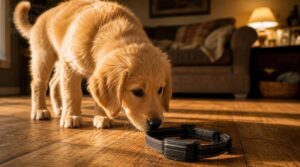
Before you ever put the collar on your dog, let them get comfortable with it on their own terms. Dogs are naturally curious, and a little sniff-and-look session goes a long way toward building trust.
Here’s how to make that first introduction count.
Show The Turned-off Collar First
Before your dog ever wears it, the collar needs to be a non-event. That’s the foundation of every effective pre-session ritual — controlling the environment so the first impression stays neutral.
Run a quick Remote Safety Check and confirm Idle Mode Confirmation before presenting it:
- Keep stimulation off and the device inactive
- Hold the remote away from your dog
- Check the receiver shows no active signal
- Move slowly, staying relaxed to reinforce Owner Calmness
- Present the collar briefly in a familiar, quiet space
Environmental Control turns gradual introduction of a training collar from stressful to smooth.
Let Your Dog Sniff and Look at It
Once the collar is confirmed inactive, place it on the floor and step back. This is the Scent Curiosity Window — the brief stretch where your dog samples, processes, and categorizes it as safe.
Let Leash Space Management work in your favor by keeping the leash loose so your dog can sniff and explore the collar at their own pace, supporting gradual acclimation through Predictable Calm Exposure.
Pair The First Exposure With Treats
Once your dog voluntarily sniffs or glances at the collar, that’s your cue — reward your dog immediately.
Treat Timing is everything here; a delayed treat loses the connection.
Use high-value treats that vanish quickly, keeping Treat Consistency and Treat Selection steady across every session.
This builds positive associations through gradual exposure, letting positive reinforcement and the right Treat Motivation Fit do the heavy lifting.
Keep The First Introduction Brief
One to two minutes is enough for a first meeting. Brief Exposure works in your favor here — when you keep this Quick Introduction short and end on a relaxed note, your dog retains a positive association rather than building resistance.
- Stop before curiosity fades into discomfort
- Choose Low Distraction surroundings for Rapid Acclimation
- Repeat short training sessions daily across several days
- Follow this step-by-step process for calm behavior
Stay Calm and Relaxed During The Setup
Your dog is reading you the entire time — slow movements, a soft voice tone, and calm body language signal that nothing alarming is happening.
Keep your breathing steady, reduce unnecessary gestures, and choose a consistent routine your dog already recognizes.
Treat pairing timing matters here: reward calm behavior the moment it appears.
Introduce the collar gradually, and patience and consistency will do the rest.
Fit The Collar Correctly
Once your dog is comfortable sniffing the collar, it’s time to actually put it on — and how you do this matters more than most people realize. A poorly fitted collar can cause discomfort, escape attempts, or even injury, no matter how well-designed the collar itself is.
what to check before you buckle anything in place.
Place The Collar in The Proper Position
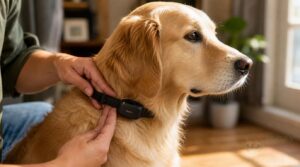
Positioning matters more than most owners expect. For proper fitting of dog training collars, high neck placement is the standard — sit the collar just below the ears, not down near the throat.
This keeps contact point alignment consistent and avoids throat pressure during corrections. Apply the two-finger rule, confirm even collar height on both sides, then run a quick skin check routine before every session.
Keep Flat Collars From Twisting
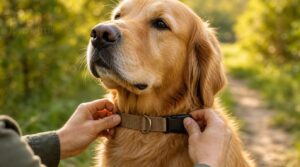
A twisted flat collar can undo everything good positioning accomplishes. Look for collars with a twist‑resistant weave and balanced buckle design — these features keep the strap lying flat against the neck.
- Use a centered D‑ring to distribute leash force evenly.
- Apply even tension adjustment on both sides when sizing.
- Check collar rotation detection after every few minutes of walking.
- Follow collar placement best practices for flat and martingale collars — strap parallel to the neck, never diagonal.
- Build a regular untwisting routine before each session.
These collar adjustment tips make proper fitting of dog training collars consistent and reliable.
Set Martingale Loops to Tighten Only When Needed
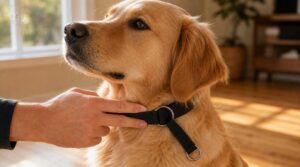
The martingale’s real power lies in its restraint — it tightens only as far as the Control Loop Length allows, then stops. Once the two rings meet, that’s your Guardrail Calibration at work: no further pressure, no choking risk.
| Fit State | What It Means |
|---|---|
| Collar loose at rest | Correct baseline fit |
| Rings nearly touching | Approaching Ring Contact Timing limit |
| Rings meeting fully | Maximum tightness reached |
| Rings overlapping | Collar too small — resize immediately |
Apply the two-finger rule during Tension Threshold Adjustment: snug enough to stay, loose enough to breathe. This is how Pressure Distribution Monitoring prevents injury — proper collar measurement ensures the loop distributes force evenly around the neck, never at a single pressure point.
Position E-collar Contact Points Correctly
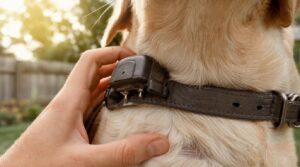
The contact points are only effective when they actually touch skin — fur doesn’t conduct stimulation. Position the receiver slightly to the side of the trachea, never directly over the windpipe, and wiggle it into the coat to seat the points firmly.
- Contact Point Alignment: points must press against skin, not hover over fur
- Point Length Selection: short-haired dogs need shorter points; thick or double coats require longer ones
- Coat Trimming Guidance: trim hair around the contact area if needed
- Receiver Rotation Prevention: the strap must be snug enough that the receiver doesn’t shift when your dog moves
Check That The Collar is Snug but Not Tight
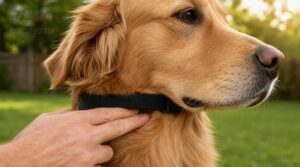
The two-finger test is your simplest fit verification routine: slide two fingers between the collar and your dog’s neck circumference — snug means they fit; tight means they don’t.
Run a twist detection method by checking the collar lies flat.
Then do a movement fit reassessment after your dog walks, confirming that the pressure distribution check and comfort clearance gauge stay consistent.
| Fit Signal | What It Means |
|---|---|
| Two fingers slide in easily | Correct snugness — safe to proceed |
| Can’t fit two fingers | Too tight — loosen immediately |
| Fingers slip through loosely | Too loose — adjust before activating |
Start With Short Wear Sessions

Once the collar is fitted, the next step is getting your dog comfortable actually wearing it. That means starting small — just a few minutes at a time — before building up to longer sessions.
Here’s how to make those first wear sessions go smoothly.
Begin With 5–10 Minutes at a Time
Keep your first sessions short and positive — five to ten minutes is the right ceiling for a gradual collar introduction process. Consistent session timing builds a predictable routine, your dog can trust, reducing stress before it starts.
Monitor your dog’s response throughout, and use an owner observation log to track reactions. Break interval planning matters just as much as training session duration; low-stress cueing only works when your dog isn’t already worn out.
Let Your Dog Wear It Unactivated First
Once your timing is dialed in, inactive collar familiarization becomes the next piece of the puzzle. Let your dog wear the collar unactivated for five to ten minutes, building comfort with training equipment at their own pace.
Your owner voice tone stays relaxed throughout — no sharp commands, no hovering.
Log each session in your session timing log so the gradual collar introduction process stays consistent and measurable.
Watch How Your Dog Moves and Reacts
Once the collar is on, your job shifts from fitting to reading. Monitor your dog’s response closely — dog body language tells you more than any timer will.
Watch for these behavioral cues:
- Ear Position shifting backward signals discomfort
- Tail Wagging slowing or dropping indicates uncertainty
- Body Lean away from you means hesitation
- Mouth Gestures like lip‑licking shows stress
- Skin Reactions near the collar suggest irritation
Positive reinforcement training works best when you catch these dog stress signals early.
Remove The Collar Before Discomfort Starts
Reading your dog’s body language is only half the equation — acting on its the other. The moment you notice early discomfort signs like scratching at the collar, stiff movement, or pulling away, remove the collar immediately. Don’t wait for symptoms to escalate.
Prompt removal is your primary quick stop guideline, and it’s what keeps training collar safety intact from the very first session.
Repeat Short Sessions Daily
Daily repetition is where real tolerance building happens. Keep each session to the same short window — this gives you a reliable observation window to monitor your dog’s response without pushing limits.
Consistent commands, consistent reinforcement timing, and consistent duration all stack together over time.
That’s how the step‑by‑step process gains traction.
Track small wins in a log so progress tracking stays honest and momentum stays visible.
Use The Lowest Setting First

Once your dog is comfortable wearing the collar, it’s time to actually turn it on — and that starts lower than you might think. The settings you use in these first sessions can make or break your dog’s trust in the process.
Here’s what to keep in mind as you begin.
Start With The Mildest Stimulation
Think of the lowest setting as your baseline sensitivity test — a check of how your dog perceives the collar’s signal before you build on it. Starting there keeps anxiety out of the equation.
- Set the remote to level 1, the minimum output
- Activate only in a quiet intro environment, free of distractions
- Keep your owner emotional state calm and neutral
- Let collar weight habituation happen before adding stimulation
- Use positive reinforcement framing throughout — never correction-first
Pair Each Activation With a Treat
Every activation needs an immediate reward — that’s the foundation of reward-based training. The moment your dog feels the stimulation, deliver a small treat before the sensation fades from memory.
| Treat Timing | High Value Treats | Consistent Delivery |
|---|---|---|
| Activate, reward instantly | Use soft, smelly treats | Same hand, every rep |
| No pauses mid-repetition | Matches novelty of gear | Builds clear expectation |
| Under 2-second window | Motivates sensitive dogs | Prevents handler variation |
| Pre-load treats beforehand | Small size, quick to eat | Treat pouch at waist |
| Repeat reward frequency each set | Rotate if interest drops | Keep posture predictable |
Reward your dog using positive reinforcement and reward techniques every single activation during early pairing — this consistent delivery locks in the connection between collar signal and good things.
Keep Sessions Under 10 Minutes
Ten minutes is your ceiling — not your target. Timer use keeps you honest when your dog looks fine, but fatigue is already setting in. Set it before you begin, and when it goes off, stop.
Session breaks reset focus better than pushing through. As you monitor your dog’s response during this step-by-step process, shorter windows make Stress Cue Detection far easier.
Use Tone or Vibration Before Stronger Modes
Tone and vibration are your first rung on the Escalation Ladder — not a formality. Before reaching any stronger mode, give your dog a clear Response Window by using tone modes or vibrate modes as an initial cue.
- Cue Timing matters: Activate Tone Frequency first, then pause.
- Vibration Patterns signal, not punish — pair each with positive reinforcement.
- Escalate only if ignored, never preemptively.
Stop if Your Dog Seems Startled or Fearful
Your dog’s body language never lies — a sudden freeze, tucked tail, or refusal to take treats mean the session ends now. Use this quick reference to monitor your dog’s response and reset with confidence.
| Fear Body Language | Calming Techniques | Session Reset |
|---|---|---|
| Tail tucking, freezing | Pause all stimulation | Return to unactivated wear |
| Excessive panting | Speak softly, stay still | Shorten duration by half |
| Lip licking, yawning | Offer high-value treats | Move to familiar environment |
| Avoidance, cowering | Remove collar calmly | Skip one full training day |
| Trembling, slow motion | Practice known commands only | Seek professional guidance |
Anxiety monitoring isn’t optional — it’s the foundation of ethical collar introduction. Addressing discomfort or fear in dogs early, through positive reinforcement and reward techniques, keeps trust intact. Introduce the collar gradually, and never hesitate to contact a certified trainer when dog anxiety escalates beyond simple session resets.
Pair Collar Use With Commands

Once your dog is comfortable with the collar and responding calmly to low-level stimulation, it’s time to connect that experience to real commands. This is where training actually starts to take shape.
Here’s how to pair collar use with commands in a way that builds trust and gets results.
Give a Known Command Before Activation
Before you activate the collar, your dog must already know the command you’re using. Cue word selection matters — sit, stay, and heel work well because they have a clear finish point.
Give the cue first, then activate only if your dog doesn’t respond. Activation timing consistency is everything: the cue-to-activation sequence must follow the same pattern every session, so your signal clarity never wavers.
Reward The Correct Response Right Away
The moment your dog complies, reward your dog immediately — not after a pause, not after you’ve repositioned. Immediate Marker Timing is what closes the loop: say "yes" or click, then deliver a small, soft treat within seconds.
This Fast Reinforcement Loop is what reward‑based obedience training is built on. Reward Timing Precision tells your dog exactly which behavior earned the payoff.
Keep Cue-and-correction Timing Consistent
Once that reward lands, the next rep demands the same rhythm. Cue Timing and Response Interval must stay locked — same Hand Consistency, same Leash Pressure, same Session Structure every time.
If your correction drifts earlier or later, the training feedback loop breaks.
Consistent training builds a clear training cue association, and positive reinforcement only reinforces behavioral correction when the timing never wanders.
Practice Sit, Stay, Come, and Heel
With your timing locked in, build on that foundation by practicing the four core commands — each one demands its own Cue Consistency and Body Language:
- Sit — hand low, reward the moment the dog’s hips drop
- Stay — open palm, extend Distance Progression one step at a time
- Come — sweep your arm inward, reward every successful recall
- Heel — orient your body consistently, dog aligned to your leg
Reward Timing stays non-negotiable across all four.
Begin in Low-distraction Settings First
Before your dog can succeed with collar commands in the real world, they need to succeed in a quiet, distraction-free area first. Start with a Quiet Room Setup — no visitors, no TV, no pets nearby — so your dog’s attention stays on you.
Use this progression table to guide your Gradual Outdoor Exposure through each environment:
| Training Stage | Environment | Key Condition |
|---|---|---|
| Stage 1 | Indoor quiet room | Minimal People, Controlled Sound |
| Stage 2 | Backyard or enclosed space | Low foot traffic, no off-leash dogs |
| Stage 3 | Quiet neighborhood spot | Consistent Timing, short sessions |
| Stage 4 | Moderate outdoor area | Leash control, manageable distractions |
| Stage 5 | Busier public settings | Full command reliability required |
Monitor your dog’s response at each stage before advancing. Rushing this stepbystep process undermines everything you’ve built.
Watch for Stress Signals

Your dog can’t tell you when something feels wrong — but their body will. Stress signals show up early and clearly if you know what to look for.
Watch for any of these signs during training sessions.
Look for Scratching, Licking, or Avoidance
Your dog’s body tells the truth before the training session falls apart. Skin irritation signs show up as scratching patterns that circle back to the collar line, or a licking frequency that targets the exact contact point.
Monitor your dog’s response for these five red flags:
- Scratching at the collar site immediately after placement
- Licking or chewing focused on the underside of the neck
- Self-Grooming Behavior that appears out of character post-activation
- Avoidance Posture when you reach for the collar
- Visible redness signaling signs and symptoms of poorly fitted collars
These signals drive dog stress reduction and protect dog comfort before irritation escalates.
Notice Tail Tucking, Freezing, or Panting
Beyond scratching and avoidance, watch for deeper fear signals that stack fast.
A Tail Tuck Alert — tail pulled tight under the body — combined with a Freezing Response Cue tells you your dog feels unsafe, not confused.
Panting Anxiety Sign matters too, especially when the environment isn’t hot.
These Body Language Stack cues demand you monitor your dog’s response and pause immediately for dog stress reduction.
Stop if Your Dog Seems Anxious
When anxiety surfaces, stopping immediately isn’t a failure — it’s the most effective training decision you can make.
Stopping when your dog shows anxiety is not failure — it is the most effective training decision you can make
Threshold pausing protects your dog’s welfare and keeps future sessions productive.
Anxiety detection matters: once your dog crosses into distress, learning stops entirely.
- Trust early stress cues — they’re your calmness check before panic sets in
- Call a safety timeout the moment engagement turns fearful
- Addressing discomfort or fear in dogs through ethical considerations keeps positive reinforcement working long-term
Return to Easier, Shorter Sessions
Think of stepping back as stepping forward.
When stress signals appear, reset your training sessions to 5–10 minutes in a quiet, distraction‑free area, letting your dog wear the collar unactivated again. Monitor your dog’s response closely, and use positive reinforcement — reward timing matters here.
Introduce the collar gradually through gentle introduction, building calm atmosphere and incremental duration before raising session frequency or difficulty.
Reassess Fit if Irritation Appears
Skin redness that stays after the collar is removed is your first signal to stop and reassess.
Check both sides of the neck for raised patches, hair loss, or a visible pressure mark — these are classic signs and symptoms of poorly fitted collars.
Apply the two-finger rule again, reposition the contact points through deliberate collar repositioning steps, and monitor your dog’s response over 24 to 48 hours before resuming.
Increase Training Gradually

Once your dog is comfortable with the basics, it’s time to build on that foundation—slowly and with intention. Rushing this stage is one of the most common mistakes owners make, and it can undo weeks of solid progress.
Here’s how to raise the bar the right way.
Extend Wear Time Slowly Over Days
Building wear time through a consistent daily routine is the backbone of patience-based progress. Extend each session by 10–15 seconds using small session extensions, and only when your dog stays relaxed.
Monitor your dog’s response and comfort closely — if stress signals appear, pull back.
This step-by-step dog training guide approach, using incremental time increases and adaptive duration planning, makes familiarizing your dog with the collar sustainable.
Raise Difficulty Only When Your Dog Stays Calm
Once your dog’s wear time is steady, calmness assessment becomes your checkpoint before every next step. Don’t increase difficulty until your dog shows relaxed posture, easy attention, and willingness to take treats.
- Raise only one gradual difficulty step at a time
- Use reward synchronization — treat the moment calm behavior appears
- Apply distraction management before adding new environments
- Trigger stress triggered regression by reverting to easier sessions immediately if anxiety surfaces
Move From Home Practice to Outdoor Settings
Once your dog completes home sessions without hesitation, moving outdoors is your logical next step—don’t underestimate the shift. Distraction management becomes critical here.
Choose a quiet distraction-free area first, like a fenced yard, where you control the safety perimeter. Weather adaptation matters too; heat and wind affect your dog’s response.
Reward timing outdoors must stay sharp—treat immediately, before any distraction wins.
Add Leash Walks and Supervised Play
Leash walks are your next proving ground. Start with loose leash walking in low-traffic areas, using leash direction changes to interrupt pulling and reinforce check-ins.
Weave in impulse control games during short play session timing breaks, applying supervised play rules to keep arousal manageable.
Monitor your dog’s response carefully—positive reinforcement and reward techniques should anchor every walk and play session.
Track Progress in a Training Log
A training log turns guesswork into a clear record of what’s actually working. Track session duration metrics, stimulus level trends, and cue reward timing after every session so you can spot stress signal patterns before they become setbacks.
Review your log weekly—progress review frequency matters as much as repetition. This data drives smart training plan development and keeps your training consistency honest.
Prevent Problems and Injuries

Even the best training plan can unravel if you overlook the basics of collar care and safe use. A few simple habits go a long way toward keeping your dog comfortable, healthy, and free from unnecessary stress.
Here’s what you need to stay on top of.
Clean The Collar Regularly
A dirty collar doesn’t just smell—it shortens the equipment’s life and risks your dog’s skin health. Collar maintenance matters more than most owners realize.
- Rinse after walks in rain or mud immediately.
- Weekly deep clean with mild soap and warm water.
- Air dry fully before reattaching—never put on a damp collar.
- Odor prevention: wipe down every few days in warm weather.
- Specific material care: leather gets a damp cloth only; silicone tolerates warm soapy water.
Consistent collar maintenance and durability go hand in hand.
Inspect Skin for Redness or Sores
Every few days, part your dog’s fur where the collar sits, and run a quick Skin Integrity Assessment.
Look for red marks, swelling, or raw patches, then press gently on any redness for a Redness Blanching Test—spots that don’t blanch need immediate attention.
Perform a Heat Moisture Check for warmth or dampness, and use Color Variation Detection under good lighting, since darker coats can mask early sores.
Never Leave The Collar on Unsupervised
An unattended collar is a hazard you can’t control. Crate safety guidelines exist for a reason—crate bars alone create serious snag points.
Without you present, breakaway mechanisms can’t compensate for panic, and battery failure risks mean unexpected activations go unchecked.
For nighttime collar removal and alone time, take it off. This single habit covers skin irritation prevention and lets you monitor your dog’s comfort consistently.
Avoid Over-correction and Harsh Stimulation
More corrections don’t mean faster results — they usually mean more confusion. A Low Intensity Baseline is where every session should begin, and Gradual Intensity Ramp means moving up only when your dog shows zero stress at the current level.
- Use Signal Timing Precision: activate immediately after the unwanted behavior, never before or well after.
- Apply Positive Reinforcement Pairing: follow every correction with a treat or praise.
- Practice Ethical Training Methods by stopping if your dog freezes, tucks its tail, or turns away.
- Keep Monitoring Dog’s Response During Training — subtle avoidance counts as feedback.
- Maintain Trainer Emotional State: your tension transfers, so stay steady and deliberate.
Ask a Vet or Trainer for Help When Needed
Some problems don’t belong on your training log — they belong in a professional’s office. If you notice sudden behavioral shifts, signs of pain, or skin reactions that won’t resolve, veterinary guidance and a dog health assessment come first.
For persistent obedience gaps, seek a certified professional dog trainer.
Medical red flags and behavioral assessment concerns both signal that professional guidance protects your dog’s welfare.
Frequently Asked Questions (FAQs)
How to introduce a dog to a training collar?
Introducing a training collar starts with patience and positive reinforcement timing.
Let your dog sniff it first, pair each step with rewards, and monitor your dog’s response closely before any activation.
What is the 10 minute rule for dogs?
The 10-minute rule keeps training sessions short to match your dog’s attention span. You rotate through 10 minutes of training, 10 of play, and 10 of rest — then repeat the cycle as needed.
What is the hardest thing to train a dog to do?
The hardest thing to train a dog to do is impulse control under distraction — off-leash reliability, generalization across environments, and timing consistency demand more repetition and behavior modification than almost any other behavioral challenge.
What is the 3 second rule in dog training?
Timing is everything—yet it’s the detail most trainers rush past.
The 3 second rule means you deliver feedback within three seconds of the behavior, so cause and effect stay crystal clear to your dog.
Can I use a training collar on any age dog?
Not every dog is ready for a training collar. Most manufacturers recommend waiting until at least 6 months old, when a dog’s mind and body can handle stimulation safely.
How long until my dog fully adapts to it?
There’s no single magic date when your dog "arrives."
Most dogs hit their Comfort Threshold within three weeks, but full Adaptation Phases—where Behavioral Indicators stabilize—usually complete around the three-month mark.
Should I use the collar for every training session?
No — collar isn’t meant for every session. Use it during focused training phases, then rely on positive reinforcement strategies as your dog’s reliability grows.
Handler consistency and ethical usage matter more than frequency.
Can two dogs in one household share a collar?
Sharing one collar between two dogs isn’t recommended.
Cross‑dog transfer of bacteria, mismatched fit, snag hazards, and tag accuracy issues each create real safety risks—give every dog its own properly fitted collar.
When should I stop using the collar altogether?
Think of the collar as training wheels—once your dog rides steadily on their own, you take them off.
Stop when consistent recall holds, stress is absent, and you’ve hit a zero activation streak.
Conclusion
Some dogs won’t take to a training collar overnight—and that’s not failure, it’s the process working as intended. Learning how to introduce a training collar to your dog is less about the tool itself and more about the trust you build around it.
Each short session, each calm pairing with a reward, lays another brick in that foundation. Stay consistent, watch your dog closely, and the collar becomes something they wear with confidence, not resistance.
- https://www.youtube.com/channel/UC-TFajjG5CMAmUrJG1ONtKQ
- https://americascanineeducator.com/dog-training/off-leash-training/
- https://www.laylopets.com/blogs/barkives/understanding-the-5-fs-of-fear-in-dogs-recognizing-fear-responses-in-dog-behavior-signs-and-triggers
- https://pupguide.net/four-fear-responses-in-dogs/
- https://www.purina.co.nz/care-and-advice/dog/behaviour-and-training/helping-a-frightened-dog