This site is supported by our readers. We may earn a commission, at no cost to you, if you purchase through links.
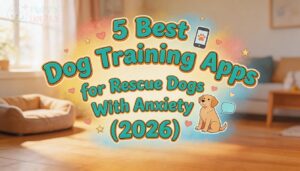
Most rescue dogs carry invisible luggage—fear responses baked in long before they ever met you. About 40% of shelter dogs show signs of anxiety, serious enough to interfere with learning, which means standard training advice often backfires on them. Push too fast, and a fearful dog shuts down completely.
The good news: dog training apps for rescue dogs with anxiety have caught up to what behavioral science actually recommends—short sessions, positive reinforcement only, and gradual exposure built around the individual dog. Five apps do this better than the rest, and knowing which one fits your dog’s specific situation saves you weeks of trial and error.
Table Of Contents
Key Takeaways
- Bubbas is the strongest pick for separation anxiety, offering a structured two-week decompression protocol, household sync tools, and AI coaching tailored to trauma histories — not just basic obedience.
- About 40% of shelter dogs show anxiety severe enough to disrupt learning, so standard training advice often backfires — apps built around short sessions, positive reinforcement, and gradual exposure work far better for rescues.
- No single app fits every dog: Woofz adapts daily plans to mood and breed, GoodPup offers live trainer video sessions, and Dogo delivers the best value at $9.99/month for budget‑conscious owners.
- If your rescue shows escalating fear, aggression, or no improvement after weeks of consistent effort, an app isn’t enough — a certified behaviorist with a proper behavior assessment is the right next step.
Best Apps for Anxious Rescue Dogs

Finding the right app for an anxious rescue dog isn’t just about features — it’s about finding something that actually fits how your dog learns and where they’re struggling most.
A quick look at dog training apps reviewed for busy pet owners can help you match the right tool to your rescue dog’s specific triggers and learning pace.
These five apps each bring something different to the table, from structured anxiety plans to live trainer sessions. Here’s how they stack up.
Bubbas: Best for Separation Anxiety Routines
Bubbas is built around one core idea — rescue dogs need more time, not more pressure. The program follows a two‑week decompression protocol to gently ease anxiety.
Here’s what makes it stand out:
- Decompression Phase before any departure exercises begin
- Micro Separation Steps starting with brief indoor door closures
- Bonding Integration woven into every daily plan
- Rescue-specific AI adapting to trauma-informed timelines
- Calm Return Indicators tracked as real progress milestones
Dogo: Best for a Large Lesson Library
Not every anxious dog needs a rigid routine — some just need options.
Dogo’s Extensive Trick Catalog covers over 100 skills, sorted by age and difficulty through Age-Based Lesson Sorting, making it one of the best dog training apps for anxious dogs.
Step-by-step video lessons are downloadable for Offline Video Access, and Continuous Content Updates keep the library fresh.
You can even build User-Curated Playlists for targeted dog anxiety management.
Woofz: Best for Personalized Daily Plans
Dogo gives you a library, Woofz hands you a schedule. Its daily plan pulls from your dog’s breed, age, and anxiety profile to build Breed-specific Routines with Micro-session Timing — each session under ten minutes.
Adaptive Mood Adjustments tweak activities based on how your dog is doing that day. Family Role Assignment keeps everyone consistent, and Reinforcement Placement Guidance removes the guesswork around separation anxiety.
Puppr: Best for Clicker-based Training
Where Woofz organizes your day, Puppr sharpens the moment of learning.
Its Built-in Clicker delivers a clean marker sound without extra equipment — useful when your rescue dog is easily overwhelmed.
Pack Difficulty Ratings let you start slowly and build steadily. Three things stand out:
- Video Cue Demonstrations show exact timing
- Mastery Badge System tracks progress
- Trainer Video Review catches technique gaps
GoodPup: Best for Live Trainer Support
When nothing else quite cuts through, live video sessions with certified trainers make the difference.
GoodPup connects you weekly with a real coach who studies your dog’s separation anxiety, adjusts cues in real time, and reviews your home videos between calls.
| Feature | Details |
|---|---|
| Real-time Cue Adjustment | During live sessions |
| Weekly Video Review | Trainer-reviewed home footage |
| Trainer Scheduling Flexibility | Multiple time zones supported |
| Progress Dashboard Insights | Visual goal tracking |
How We Scored Each App
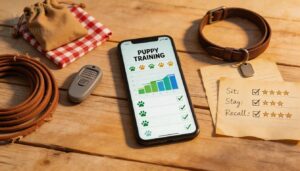
Not all training apps are built the same, and for a rescue dog with anxiety, the difference really matters. We scored each app across six key areas that speak directly to what anxious dogs actually need.
Here’s what we looked at.
Separation Anxiety Support
Separation anxiety can unravel weeks of progress if an app doesn’t address it directly.
That’s why comparing how top dog training apps for kids and families handle separation-specific lessons — from Pupford’s free modules to Puppr’s full paid library — can save you a lot of backtracking.
We scored each app on whether it offers structured desensitization plans, Calm Departure Cues, and Gradual Alone Time protocols.
We also looked at Reward Timing Strategies, Environmental Sound Masking support, and behavior problems tracking.
Bubbas leads here with individualized guidance built specifically around anxiety—not just basic obedience.
Daily Plan Clarity
A clear daily plan isn’t just helpful — it’s the backbone of anxiety recovery.
We scored each app on whether its structured daily plans use Time-blocked Tasks, Objective Labels, and Color-coded Schedules so anyone in the household can follow along.
Visual Cues, an End-of-Day Summary, and individualized guidance all factor in.
Bubbas and Woofz lead here with step-by-step plans built around progress tracking.
Household Consistency Tools
One anxious dog, three caregivers, zero coordination — that’s a recipe for behavior problems fast.
Household consistency tools let everyone stay on the same page without daily check‑in calls.
We scored each app on:
- Shared Calendar Sync across all family devices
- Role Permissions for editing vs. viewing plans
- Automated Reminders that fire within the same daily window
- Visual Cue Cards marking transitions between activities
- Environment Reset Steps before each session
Bubbas leads here, with full household sync built specifically around separation anxiety and training consistency.
Progress Tracking and Milestones
Progress tracking turns guesswork into evidence. Each daily log captures mood, triggers, and session duration automatically — that’s Daily Log Automation doing the heavy lifting.
Key Point Visualization shows exactly how far your dog has come.
| Feature | What It Measures |
|---|---|
| Progress Trend Analytics | Week-over-week anxiety shifts |
| Reward Badges | Key Point achievements hit |
Trainer Feedback Loops tie everything together with custom guidance.
Coaching Depth and Trainer Access
Not all coaching is created equal — depth matters when your rescue dog’s trust is on the line. Here’s what strong trainer access actually looks like:
- Tiered Guidance Steps that build progressive exposure milestones session by session
- Real-time video coaching with certified trainers via live video sessions
- Trainer annotation tools for reviewing your technique
- Unlimited messaging access for between-session questions
- AI coach delivering custom guidance and progress tracking daily
Rescue-dog Relevance and Ease of Use
Rescue-dog relevance goes hand in hand with usability. An app built for anxious dogs needs an intuitive interface, a quick setup guide, and accessible tutorials that don’t overwhelm a first-time rescue owner.
Offline mode matters for low-connectivity homes, and low battery demand keeps sessions going.
We also checked whether behavioral modification tools and custom guidance for separation anxiety integrated smoothly with progress tracking.
Features Rescue Dogs Need Most

Rescue dogs don’t come with a clean slate, and the right app needs to meet them where they’re at.
Not every feature matters equally — some are nice to have, but a few are genuinely non‑negotiable for anxious dogs with trauma histories.
Here’s what to look for before you commit to any app.
Step-by-step Desensitization Plans
For an anxious rescue dog, the order of things matters enormously. Apps like Bubbas use hierarchy construction to rank triggers from least to most distressing, then build step‑by‑step plans around precise timing intervals and calm cue training.
Built-in stopping rules halt sessions if stress spikes. AI coach personalization and maintenance sessions keep separation anxiety progress from sliding back — think desensitization and counterconditioning with tailored guidance baked in.
Positive Reinforcement Only
Every app on this list uses positive reinforcement only — no shock, no harsh corrections, no fear. That matters deeply for rescue dogs already carrying invisible weight.
Every app here uses positive reinforcement only — because rescue dogs carry enough invisible weight already
- Deliver treats within 1–2 seconds of the behavior
- Rotate reward variety — treats, praise, play — to sustain motivation
- Match treat selection to what actually excites your dog
- Keep cue consistency across every family member
- Apply non-aversive methods through every desensitization and counterconditioning step
AI Personalization for Anxiety Triggers
Good timing cues alone won’t calm a dog whose triggers shift daily. That’s where AI-powered coaching in pet apps steps in.
Using Flexible Trigger Mapping, an AI coach builds individualized guidance around your dog’s specific anxiety patterns — doorways, strangers, sounds.
Real-time Mood Adjustment, Contextual Exposure Scheduling, and Adaptive Reward Timing keep sessions calibrated to your dog’s readiness, not a fixed script. Privacy‑First Data controls protect what’s collected.
Trigger Logging and Mood Tracking
Tracking what sets your dog off is just as important as training. These tools give you a clear picture over time:
- Trigger Tagging lets you label events like doorbells or strangers, and note intensity
- Mood Scale Visualization uses 1–10 ratings and color coding for quick pattern recognition
- Contextual Activity Logging ties mood dips to walks, rest, or noise levels
- Wearable Data Integration pulls in movement and heart rate as stress signals
- Trend Dashboard Insights reveal peak anxiety windows and separation anxiety patterns
That data becomes your roadmap for behavior tracking, progress tracking, and milestones, and real pet mental health improvement.
Multi-user Syncing for Family Consistency
Consistency is the backbone of anxiety recovery — and that’s nearly impossible when three people are running three different routines. Multiuser support fixes this. With Real-time Data Sync, every household member sees the same plan the moment it updates. Family Role Permissions keep kids from accidentally overwriting sessions, while a Conflict Resolution Workflow flags overlapping edits.
| Feature | What It Does | Why It Matters |
|---|---|---|
| Shared Calendar Integration | Coordinates daily sessions across all users | Prevents missed or doubled training |
| Cross-Device Notifications | Sends reminders to every device at once | Keeps owner engagement high |
| Family Role Permissions | Controls who can edit or approve entries | Protects plan integrity |
Choosing a multiuser training platform for families means your dog hears the same cues, every time, from everyone — which is exactly what progress tracking and milestones in pet apps need to mean something real.
Short Daily Sessions for Overwhelmed Dogs
Overwhelmed dogs don’t need longer sessions — they need smarter ones. Here’s a simple Micro Training Structure that works:
- Run 3–5 minute blocks, 2–4 times daily per Session Frequency Guidelines
- Target one trigger per session using step‑by‑step plans
- Use Low Stress Rewards immediately after calm responses
- Apply Environmental Noise Management with soft music or white noise
- Close with Calm Cue Integration to reinforce a settled state
Pricing, Trials, and Device Support
Before you download anything, it’s worth knowing what each app actually costs and whether it runs on your phone. Price gaps between these apps are bigger than you’d expect, and the fine print on free trials isn’t always obvious.
Here’s what you need to know before committing.
Monthly Vs Yearly Subscription Costs
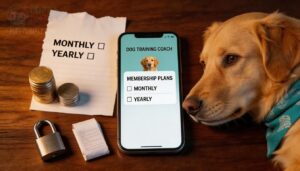
Paying monthly feels safer, but the Annual Savings Rate adds up fast. Yearly plans generally cut your effective cost by 10–30%, with Billing Transparency varying by app.
| App | Monthly | Yearly |
|---|---|---|
| Bubbas | $19.99 | $69/yr |
| Woofz | $22.99 | $69.99/yr |
| Dogo | $9.99 | $29.99/yr |
Commitment Risk is real — Prorated Refunds aren’t guaranteed — but the Cash Flow Impact of one upfront payment often beats monthly subscription model costs over time.
Free Trials and Free Tiers

Most apps give you 7 days free — enough to test core features like desensitization plans and progress tracking.
Bubbas offers a 7-day free trial; Woofz gives you 3. Dogo has a limited freemium tier if you’re not ready to commit.
Watch for auto-billing: cancel 24–48 hours early to avoid charges. Credit card requirements apply to most extended trials.
Live Coaching Vs Self-guided Value
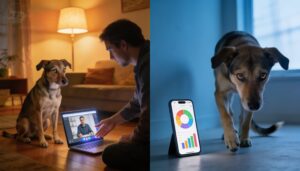
Live trainer video sessions cost more — GoodPup runs about $30 per week — but the accountability differences are real. A coach watches your dog react in the moment and adapts instantly.
Self-guided apps like Dogo or Woofz offer stronger cost efficiency and flexible scheduling, but progress tracking and milestones depend on your follow-through.
For anxious rescues, custom guidance and adaptability speed often justify the higher price.
IPhone-only Vs IOS and Android
Device access matters more than you’d think.
Bubbas is iPhone-only, so Android users are out from the start — no workarounds. Dogo, Woofz, and Puppr run on both iOS and Android, giving you flexibility.
hardware uniformity and consistent update cadence mean smoother performance, but cross-platform apps still deliver solid separation anxiety support regardless of what’s in your pocket.
Hidden Limits in Freemium Plans

Free tiers sound generous until you hit the wall. Many freemium plans cap usage — sometimes as low as 1,000 actions monthly — then lock core features behind Feature Paywalls.
Ad-Driven Monetization creeps in too, cluttering the interface mid-session.
Renewal Auto-Charges catch owners off guard, and Limited Support Access means help is slow when your anxious dog needs consistency now.
Read the fine print first.
Which Apps Fit Tighter Budgets

Budget doesn’t have to mean bare-bones. Bubbas offers a Free Starter Plan covering core separation anxiety routines — up to five sessions weekly at no cost. Dogo’s 14-day free trial unlocks most lessons before any subscription plan kicks in. Puppr’s freemium tier covers clicker basics well.
For the best Price-per-Feature Ratio on Low-Cost Subscriptions, Dogo’s $9.99 monthly beats most.
Which App Fits Your Dog?

No two rescue dogs are quite the same, and the right app really comes down to what your dog needs most right now.
Whether you’re dealing with a dog who panics the moment you leave or one who’s still figuring out that humans are safe, there’s an option here that fits.
Here’s how each app stacks up for different situations.
Best Pick for Separation Anxiety
If your dog falls apart the moment you grab your keys, Bubbas is built for exactly that. Its timer transitions guide you through pre-departure, absence, and return phases with real structure — not guesswork.
- Calming cues and distraction activities reduce stress at the door.
- Progress checkpoints track daily routine consistency over time.
- Environmental tweaks like white noise and crate comfort are built into setup.
- Family coordination stays smooth with household sync tools.
Best App for Fearful New Rescues
Fearful new rescues need structure before anything else. Woofz earns the top spot here — its mood checks and Gradual Exposure Plans adapt daily based on how your dog is actually responding, not a fixed schedule.
| Feature | Why It Helps Fearful Rescues |
|---|---|
| AI-powered coaching | tailored guidance for noise reactivity |
| Calming Sound Integration | reduces startle responses gradually |
| Safe Space Design tips | builds predictable home environments |
| Adopter Education Modules | readies new owners for trauma-informed care |
| Veterinary Guidance Integration | flags when professional support is needed |
Best Choice for Multi-person Households
When your whole family is involved in your dog’s care, mixed signals can undo weeks of progress. Bubbas stands out as the top multiuser training platform for families — its Shared Calendar Integration, Unified Progress Dashboard, and Cross-Device Sync keep everyone on the same page.
- Family Role Permissions let each caregiver access relevant sessions
- Collective Reminder System prevents missed routines
- Household consistency improves measurably when everyone follows the same cues
Best Option if You Want Trainer Feedback
GoodPup is your best bet when you want real eyes on your dog’s progress. Through Live Video Review and Trainer Annotation Tools, certified professional dog trainers pinpoint exact moments to praise or redirect.
Session Recap Summaries keep you on track between contacts, while Feedback Frequency Options let you choose weekly or biweekly check-ins.
Trainer Messaging and Real-time Chat Guidance deliver custom guidance and behavior analysis whenever questions arise.
Best App for Budget-conscious Owners
Dogo delivers the most value if budget is a concern. At $9.99/month with no hidden fees, it covers noise reactivity and separation anxiety basics through a clean, Simple UI Design.
The free tier includes core lessons, and a free trial lets you test it first.
Budget Alerts and Expense Tracking Integration help you stay on track without overspending on cost and pricing of dog training subscriptions.
When an App is Not Enough
Apps have real limits. If your rescue shows aggression, extreme fear, or isn’t improving after weeks of consistent effort, a Behaviorist Assessment and Hands-On Management become essential.
Emergency Protocols during storms or meltdowns, Family Cue Training across all household members, and a Hybrid Coaching Model pairing Live trainer video sessions vs. self‑guided apps can bridge the gap that professional dog trainers and a behavioral therapist provide.
When to Work With a Certified Behaviorist
Some dogs need more than an app can offer.
If your rescue shows Severe Aggression Signs, Escalating Fear Behaviors, or stays Unresponsive to Training after consistent effort, it’s time to call in professional dog trainers or a behavioral therapist.
Always get a Medical Rule-out Needed vet check first. Then Verify Behaviorist Credentials carefully — real behavior modification requires proper behavior assessment tools and certified trainers.
Frequently Asked Questions (FAQs)
Can training apps replace real-world socialization?
No app in the world can replicate a muddy paw print on your jeans.
Virtual Interaction Limits are real — Physical Cue Transfer and Environmental Generalization Challenges mean real-world socialization remains irreplaceable.
How long until anxious rescue dogs show progress?
Most anxious rescue dogs show a behavioral shift timing of 2 to 6 weeks. Realistic owner expectation management matters — improvement benchmarks depend on consistency, adaptation speed, and your dog’s recovery phase duration.
Do training apps work for older rescue dogs?
Yes, mostly.
Carefully chosen apps can help older rescues, but cognitive decline considerations, mobility constraints, and sensory impairments shape how fast they respond.
Match the app’s pace to your dog, not the other way around.
Should I train my rescue dog alone first?
Start solo, yes. Short five-to-ten-minute sessions build calm focus without overwhelming your dog. Gradual departure practice — leaving briefly, returning quietly — teaches independence. Safety precautions matter: remove triggers, keep routine steady.
Can two dogs in one home use the same app?
Think of it like a family calendar — one account, two dogs, no chaos.
Most platforms support separate profiles with individualized alerts, dual dog metrics, and cross-dog scheduling to keep household consistency intact.
Conclusion
Imagine guiding your anxious rescue dog through a maze of triggers and fears, one gentle step at a time. With the right dog training apps for rescue dogs with anxiety, you can transform overwhelming situations into manageable moments.
These five apps offer customized support, helping you and your dog build trust and confidence. By choosing the right fit, you’ll open a journey of healing, patience, and love, changing your dog’s life—and yours—forever, one short session at a time.