This site is supported by our readers. We may earn a commission, at no cost to you, if you purchase through links.

Watch a dog with anxiety long enough, and a pattern emerges—the pacing, barking at nothing, the shoe that didn’t survive the afternoon. Around 40% of dogs exhibit anxiety severe enough to disrupt daily behavior, yet owners often cycle through frustrating fixes with no lasting success.
Puzzle feeders have quietly shifted that conversation. By transforming mealtime into a mental workout, they leverage dogs’ innate drive to work for food. This approach taps into natural instincts, offering a fresh alternative to conventional methods.
Their effectiveness hinges on how you use them—and understanding why they work. When implemented thoughtfully, puzzle feeders address anxiety by redirecting energy and fulfilling a dog’s need for purposeful engagement.
Table Of Contents
Key Takeaways
- Puzzle feeders ease dogs’ anxiety by tapping into natural foraging instincts and giving restless minds a purposeful task, but they work best as part of a broader approach rather than a standalone fix.
- The calming effect is real science — working for food triggers dopamine release and lowers cortisol, which is why a puzzle feeder can do more for your dog’s nerves than a regular bowl ever could.
- Matching the right difficulty to your dog’s confidence level matters more than most owners realize; too easy breeds boredom, too hard breeds frustration, and either can make anxiety worse.
- When anxiety shows up as panic, self-injury, or sudden behavioral changes, puzzle feeders aren’t enough — those signs call for a vet, not a toy.
Yes, Puzzle Feeders Can Ease Anxiety
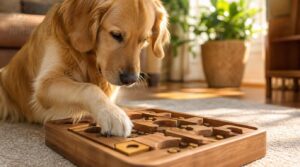
Puzzle feeders won’t cure anxiety on their own, but they genuinely help — and the science backs that up. They work by giving your dog something meaningful to focus on, which calms the nervous system in ways a regular bowl simply can’t.
Think of it as mental exercise — and finding the right puzzle feeder for dogs home alone makes all the difference in how well it actually works.
Here’s what’s actually happening when your dog works for their food.
Mental Stimulation Reduces Stress
When your dog’s mind is busy, there’s simply less room for anxiety to take hold. Puzzle feeders aid stress reduction by activating attention diversion—keeping focus locked on a task rather than circling worry. This cognitive enrichment triggers neurochemical regulation, releasing calming brain chemicals.
The problem-solving benefits and sensory engagement work together, making mental enrichment one of the most practical tools in canine anxiety management. Regular mental stimulation reduces cognitive decline and supports overall well-being.
Food Rewards Encourage Calm
Food rewards do more than satisfy hunger—they activate your dog’s brain reward circuits, which naturally promote stress reduction for dogs. Palatable reinforcement, especially low-volume treats delivered through treat dispensing toys, creates a positive reward association that builds calm over time.
Timing consistency matters here: when flavor calming and reward-based training overlap with predictable puzzle feeder use, pet anxiety management becomes noticeably more achievable.
Helps Anxious Dogs Refocus
Beyond calming the reward system, puzzle feeders work as a practical attention anchor. When your dog starts showing early stress signals, introducing a feeder gives them something concrete to do—focused nose work and task switching pull attention away from the trigger and toward the toy.
This sensory grounding and calming cueing, built through regular behavioral enrichment and dog mental exercise, can interrupt the anxiety cycle before it escalates.
Not a Complete Cure
Puzzle feeders offer temporary relief, not a permanent fix. They ease anxiety and stress in the moment but fail to address underlying triggers or teach dogs new coping skills. Severe cases often exceed their effectiveness entirely.
Puzzle feeders soothe anxiety in the moment but cannot heal its roots
Think of them as one piece of the puzzle: Behavior modification, professional intervention, and consistent training are needed to complete the picture.
How Puzzle Feeders Calm Dogs

Puzzle feeders don’t just keep your dog busy — they work with your dog’s natural instincts to actually shift their mental and emotional state.
The calming effect isn’t magic; it comes down to a few specific things happening during and after each session.
Here’s a closer look at how they do it.
Redirects Anxious Energy
When anxiety has your dog pacing or scanning the room, a puzzle feeder gives that nervous energy somewhere useful to go. Instead of fixating on a stressor, your dog shifts into task-based distraction — nose-focused tasks, manipulative play, and structured work sessions that demand attention.
These energy-channeling games turn restless arousal into calm, focused effort, offering real stress reduction through mental enrichment rather than just keeping your dog busy.
Encourages Natural Foraging
Sniffing out hidden kibble is what dogs were built to do. Puzzle feeders tap directly into your dog’s natural foraging instincts by combining scent exploration, textured surfaces, and scattered bite distribution into one engaging activity.
Multi-step challenges and adjustable difficulty keep your dog searching and problem-solving, which delivers genuine mental stimulation and meaningful anxiety relief without requiring anything complicated from you.
Slows Stressful Eating
When anxiety takes over, many dogs eat like they’re in a race — heads down, gulping fast. Puzzle feeders interrupt this pattern through Gradual Reward Dispensing and Bite-Size Regulation, transforming chaotic meals into calmer experiences.
Here’s how structured feeding delivers measurable anxiety relief:
- Eating Pace Modulation reduces stress-triggered gulping by enforcing pause-and-reach moments.
- Slow feeders prevent frantic "grab and swallow" cycles common in fast-eating dogs.
- Smaller, spaced rewards keep dogs task-focused rather than urgency-driven.
- A structured Calm Feeding Ritual lowers post-meal agitation.
- Puzzle feeders naturally extend mealtime, supporting stress reduction for dogs prone to anxious eating.
Builds Predictable Routines
Dogs thrive on knowing what comes next. When you use puzzle feeders at the same time each day — same Calm Setting, same Sequence Order — you’re building a habit your dog can count on. Routine Timing and Shift Cues tell your dog, "this is that calm part of the day."
Caregiver Consistency reinforces it. Part of a routine, puzzle feeders genuinely help reduce anxiety over time.
Supports Independent Confidence
There’s something quietly powerful about watching a dog figure things out on its own. Puzzle feeders support Independent Problem‑Solving by giving your dog clear Mastery Feedback — every treat released confirms, "you did that."
This Task Ownership builds real confidence through achievement. With no need to wait for your cue, dogs engage in Self‑Motivated Exploration, fostering independent thinking.
Confidence Building happens naturally, one solved puzzle at a time, as dogs take charge of their own learning.
Anxiety Behaviors They May Reduce
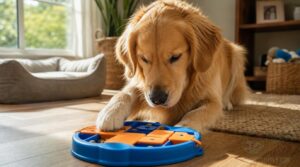
Puzzle feeders won’t fix every anxious behavior, but they can take the edge off several common ones. The key is knowing which behaviors tend to respond well, so you can set realistic expectations.
Here are five that owners most often see improvements with regular feeder use.
Excessive Barking
Excessive barking is often your dog’s loudest cry for help. Trigger Identification matters here — barking usually ties to specific moments, not random ones. Dog puzzle feeders support anxiety and stress reduction by giving your dog something purposeful to do instead.
- Visual Blockades limit window triggers
- Calm Backgrounds lower environmental arousal
- Anti-Bark Training reinforces quiet behavior
- Health Screening rules out pain-driven barking
Daily feeder sessions can cut barking by roughly 35%, meaningfully improving dogs’ mental health and stress alleviation in dogs and cats alike.
Destructive Chewing
While barking is often outward distress, destructive chewing is anxiety working through your dog’s mouth. Fear-triggered chewing targets doors, frames, and furniture — not random mischief.
Puzzle feeders address this through environmental enrichment and mental stimulation, redirecting that energy toward behavioral enrichment toys.
Targeted chew training, chew toy rotation, and material safety all matter here. Consistent puzzle feeding aids destructive chewing prevention by keeping anxious minds genuinely occupied.
Pacing and Restlessness
Pacing is your dog’s nervous system stuck in overdrive — cortisol and adrenaline are up, and the body can’t settle. That’s where puzzle feeders genuinely help.
The mental stimulation they provide promotes neurochemical balance, triggering dopamine release while promoting HRV improvement and cortisol reduction.
By addressing environmental triggers with structured slow feeding and calming techniques, restlessness often noticeably decreases.
Compulsive Licking
Some dogs lick compulsively as a stress indicator — it’s self-soothing gone into overdrive. Allergy triggers, dermatitis risk, and gastrointestinal discomfort can feed this loop, so ruling out medical causes matters first.
Behavioral interventions like puzzle feeders and lick mats support canine anxiety reduction by redirecting that urge productively.
Watch for these signs your dog needs help:
- Licking the same spot for minutes without stopping
- Skin that looks red, raw, or thinning
- Licking that continues even when you call their name
Mild Separation Distress
Separation distress hits differently than other anxiety signs — it’s less about what your dog does and more about when they do it. Puzzle feeders help through cue conditioning and temporal distraction: pair your calm departure with a food puzzle, and your dog starts associating "owner leaving" with something rewarding instead.
| Strategy | What It Does | Why It Helps |
|---|---|---|
| Calm Departure + Puzzle | Cue Conditioning | Links leaving with a positive event |
| Environment Scenting (snuffle mat) | Temporal Distraction | Occupies attention during peak distress |
| Post-Feeding Relaxation | Stress Management | Dog settles naturally after mental stimulation |
Best Puzzle Feeder Types
Not all puzzle feeders work the same way, and the right one can make a real difference for an anxious dog.
Some engage the nose, some keep paws busy, and others slow down eating in ways that genuinely help.
Here are five types worth knowing about.
Snuffle Mats

A snuffle mat is one of the simplest tools for calming an anxious dog. Its layered foraging design hides kibble within fleece strips, encouraging natural nose-led searching that reduces stress hormones like cortisol.
Treat placement matters—tuck pieces deeper as your dog’s confidence grows. This progression maintains engagement and reinforces positive behavior over time.
Choose a size suited to your dog’s breed, prioritize non-toxic materials, and ensure mat maintenance to keep sessions safe and hygienic.
Slow Feeder Bowls

Slow feeder bowls work by forcing your dog to eat around ridges, bumps, and maze-like design patterns—turning mealtime into gentle mental stimulation. That alone can help reduce anxiety tied to rushed eating.
Material durability matters: stainless steel and BPA-free plastic hold up well over time.
Match size suitability to your dog’s breed, and prioritize easy cleaning maintenance.
Many bowls also offer adjustable difficulty through removable inserts.
Treat Dispensing Toys

Unlike static bowls, treat dispensing toys rely on release mechanisms that reward movement — your dog nudges, rolls, or bats the toy to control the treat flow rate. This interactive feeding loop provides great mental stimulation and can reduce anxiety by keeping your dog genuinely focused.
- Chew-resistant designs for heavy chewers
- Adjustable treat flow rate openings
- Low noise level for sensitive dogs
Sliding Puzzle Boards
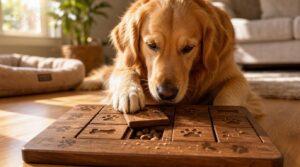
Sliding puzzle boards take treat-finding to a new level. Your dog uses their nose and paws to slide tiles across a grid, uncovering hidden kibble underneath. The tile mechanics are simple, but the mental stimulation is real — and that focused problem-solving quietly lowers stress hormones like cortisol.
Material choices matter: look for sealed wood or sturdy plastic, and start with easy difficulty scaling before working up.
Lick Mats

Lick mats might look simple, but don’t underestimate them. Spread peanut butter, mashed banana, or pumpkin puree across the textured surface, and your dog settles into a focused licking session that genuinely facilitates stress reduction for pets.
Texture varieties — from smooth soother patterns to complex buddy designs — affect engagement time.
Prioritize material safety by choosing food-grade silicone or natural rubber, sized appropriately for your dog.
Cleaning methods are easy: most are dishwasher safe.
Choosing The Right Difficulty

Picking the right difficulty level can make or break your dog’s experience with a puzzle feeder. Too easy and they’ll lose interest; too hard and frustration kicks in fast.
Find that sweet spot and keep things moving in the right direction.
Start With Simple Puzzles
Think of a puzzle feeder like a first day at school — you don’t hand a new student complex calculus. Start with low barrier designs that offer quick reward feedback so your dog builds confidence fast. Keep sessions brief, around 10–15 minutes.
Here’s a simple progression:
- Lick-based starters
- Single-nudge dispensers
- Two-step slides
- Gradual barrier addition
Match Your Dog’s Confidence
Every dog brings a different confidence level to the puzzle. Skill Scaling isn’t one-size-fits-all — Motivation Mapping helps you individualize the challenge. Use this table to match Individualized Difficulty to your dog’s profile:
| Dog Profile | Confidence Cueing | Recommended Level |
|---|---|---|
| Timid, food-shy | Gentle encouragement | Easy |
| Moderately anxious | Success Frequency focus | Medium |
| Bold, food-motivated | Mental stimulation variety | Medium-Hard |
| Senior dog | Low-impact engagement | Easy-Medium |
| Separation anxiety history | Behavioral improvements first | Easy |
Confidence through achievement builds steadily when puzzle feeders meet your dog where they are.
Avoid Frustration Signs
Watch your dog closely during puzzle time. If they’re whining, pawing aggressively, or walking away, that’s your cue to step in. These stress signals mean the difficulty is too high.
Monitor frustration cues like lip licking or rapid panting — both point to rising cortisol. Reward calm attempts, not frantic ones.
Patience is key to gradual skill building.
Increase Challenge Gradually
Once your dog solves easy puzzles reliably, it’s time to move up — slowly. Stepwise complexity means changing just one thing at a time, like variable access size (smaller openings) or a cue reduction strategy (hiding treats less visibly). This kind of incremental barrier keeps dogs’ mental health intact without spiking stress hormones like cortisol.
- Move from 1-step to 2-step puzzles only after consistent success
- Shrink treat openings gradually, don’t jump to sealed compartments
- Introduce progressive reward timing — delays, not instant releases
- Use customizable challenge settings if your feeder allows it
Patience is key to real cognitive enrichment for pets.
Rotate Toys Often
Keeping the same puzzle out every day leads to boredom faster than you’d expect. A simple rotation schedule — swapping toys every few days — brings back novelty timing that reignites curiosity.
Toy storage resets scent renewal, so a returned feeder smells fresh and interesting again.
Engagement variety, whether sliding panels or adjustable dispensing settings, keeps mental stimulation alive and prevents boredom hassle-free.
Safety and Durability Tips

A good puzzle feeder only works well if it’s safe and built to last. Before you settle on one, there are a few practical things worth checking.
Here’s what to keep in mind.
Choose Non-toxic Materials
What your dog chews on matters as much as what they eat from it. Look for: BPA-free plastics, food-grade silicone flexibility, or stainless steel hygiene-focused designs — all proven safe for repeated contact.
Wood finish safety depends on nontoxic coatings and food-safe sealants.
Glass durability makes it easy to sanitize.
Choosing durable materials with verified material safety keeps every session a genuinely safe chew.
Avoid Loose Small Parts
Small parts that break off or detach mid-session are a real hazard, especially for anxious dogs who chew more intensely when stressed. Look for secure seam construction and detachable fastener elimination in whatever you choose.
Durable material selection matters too — BPA-free plastics and nontoxic coatings hold up longer.
A stability base design keeps the toy from sliding, which reduces impact-related cracking.
Make routine wear inspection a habit before every session.
Supervise First Sessions
Even the calmest dog can feel thrown off by something new. That’s why supervision timing matters — stay in the room and keep a quiet environment for that first session. Watch for early frustration signs and use gentle guidance if needed:
- Place initial food placement near the feeder opening
- Pause if anxious dogs show repeated digging or whining
- End on a success to protect dogs’ mental health
Match Chewing Strength
Not every feeder suits every dog — and chewing strength is a big reason why. A solid Bite Force Assessment helps you match your dog to the right Resistance Level Grading.
Size-Strength Pairing matters too: larger dogs need chew-resistant designs with a high Material Durability Index.
Proper Chew Power Calibration keeps puzzle toys helping dogs mentally without sparking frustration that spikes stress hormones like cortisol.
Clean After Feeding
After each feeding, rinse your puzzle feeder right away — dried food in grooves is far harder to remove than fresh residue. Wash all separate components with mild soap, scrub textured seams, then rinse thoroughly again.
Air drying fully prevents moisture buildup inside channels.
BPA-free plastics and refillable toy designs hold up well to this routine, extending toy durability without compromise.
Using Feeders in Daily Routines

Building a routine around your dog’s puzzle feeder doesn’t have to be complicated. A few small, consistent habits can make a real difference in how calm and settled your dog feels each day.
Here are some simple ways to work the feeder into your daily schedule.
Replace One Meal Daily
Start simple: swap out one meal a day for the puzzle feeder. Consistent meal timing keeps your dog’s hunger patterns steady, and controlled portion size ensures you’re not adding extra calories — just redistributing them.
This calorie redistribution strategy also makes daily progress tracking straightforward. You’ll notice changes in pacing or stress hormones like cortisol without guessing what caused them.
Use Before Alone Time
Timing matters more than most owners realize. Give your dog the puzzle feeder right before you leave — this departure cue pairing turns your pre-leave routine into a signal for calm, not worry. Consistent engagement timing helps your dog settle before anxiety peaks:
- Use a low-noise delivery
- Keep sessions 10–20 minutes
- Leave while they’re still engaged
Duration calibration and mental stimulation together make puzzle feeders a practical separation anxiety treatment.
Pair With Calm Spaces
Where your dog eats matters as much as what they eat. Set up a dedicated spot with soft lighting, textured flooring, and low visual clutter.
Add gentle music or a gentle soundscape in the background. A lavender scent diffusing nearby and comfortable resting spots nearby further enhance the environment.
These elements work together to lower stress hormones like cortisol, transforming the feeder into a truly calming activity rather than just mealtime.
Keep Sessions Short
Once your dog’s calm space is set, think of puzzle feeder sessions like a short coffee break — brief, focused, and done before restlessness creeps in. Aim for ten to fifteen minutes.
Early stress detection matters here: watch for whining or frantic pawing, and end the session cleanly.
Brief timing cues and quick reward bursts keep mental stimulation effective and stress hormones like cortisol low.
Reward Relaxed Behavior
Once the session wraps up, your job isn’t quite finished. Reward-based training works best when you catch the calm moment while it’s still happening — say a quiet "yes," then deliver a small treat immediately. That marker consistency tells your dog exactly what earned the reward.
Stay relaxed yourself; low arousal handling and quiet positioning help keep stress hormones like cortisol from creeping back up.
When Puzzle Feeders Aren’t Enough

Puzzle feeders are genuinely helpful, but they have limits. Some dogs struggle with anxiety that runs deeper than any toy can reach, and pushing through without the right support can make things worse.
Here’s when it’s time to look beyond the feeder.
Severe Separation Anxiety
Some dogs go far beyond everyday nervousness. When your dog shows attachment cues like shadowing you room to room, or displays predictive vigilance at the sound of your keys, puzzle feeders alone won’t resolve that.
Severe separation anxiety involves genuine physiological stress, with chronic cortisol elevation and avoidance behavior that mental stimulation can’t fully address.
These dogs need more than enrichment.
Panic or Self-injury
Some warning signs go well beyond general anxiety. If your dog shows panic triggers like sudden frantic escape attempts, self-injury cues such as compulsive scratching or self-biting, or other unexplained risk red flags, puzzle feeders aren’t the right coping mechanism.
Elevated stress hormones—cortisol especially—require real behavioral therapy for dogs and proper safety planning with your vet.
Sudden Behavior Changes
Sometimes a sudden shift in your dog’s behavior isn’t anxiety at all. Pain signals, neurologic issues, medication side-effects, and sensory changes can mimic stress — but puzzle feeders and behavioral enrichment won’t fix them. Watch for:
- Abrupt aggression or disorientation
- Sudden sleep disturbances or restlessness
- Unexplained sensitivity to touch
- Rapid mood shifts after medication changes
Stress hormones like cortisol spike fast when something is medically wrong.
Need Veterinary Guidance
A puzzle feeder is a tool, not a diagnosis. If your dog’s anxiety feels bigger than any enrichment can handle, a veterinarian can run a full medical assessment — ruling out pain evaluation concerns, reviewing medications, and providing a behavioral diagnosis that actually fits your dog.
| When to Call Your Vet | What They Assess |
|---|---|
| Anxiety despite enrichment | Stress hormones, cortisol levels |
| New or worsening symptoms | Dog’s mental health and illness |
| Post-medication behavior shifts | Medication review and adjustment |
| Ongoing compulsive behaviors | Animal behavior therapy referral |
Monitoring response over time is how real progress gets measured.
Combine With Training
Training makes the feeder work harder for your dog. Reward-based training and behavioral therapy for dogs pair naturally with puzzle feeders when you follow a clear structure for dog mental health and stress reduction for pets:
- Use consistent Cue Timing before each session.
- Practice Gradual Exposure, starting easy.
- Apply Reinforcement Consistency — calm behavior earns access.
- Prioritize Calm Handling during setup.
- Build Alone-Time Pairing through short, predictable departures.
Frequently Asked Questions (FAQs)
What is the 3-3-3 rule for dog anxiety?
Rome wasn’t built in a day."
"The 3-3-3 rule maps a newly adopted dog’s Decompression Phase, Routine Establishment, and Trust Building across three days, three weeks, and three months — setting realistic Progress Benchmarks for Expectation Management throughout the adjustment.
What actually helps dogs with anxiety?
Calming Music, Aromatherapy Scents, Pressure Wraps, Structured Exercise, and Behavioral Desensitization work together to support dog mental health. These approaches help lower stress hormones cortisol and reduce destructive behavior by providing consistent mental stimulation and engagement through tools like Puzzle feeders.
Do senior dogs benefit from puzzle feeders too?
Yes, senior dogs benefit greatly. Puzzle feeders support cognitive longevity, memory preservation, and sensory enrichment while accommodating arthritic joint care through low-impact designs.
They aid weight management by encouraging slower, more deliberate eating, which also reduces digestive strain.
These tools keeps dogs’ mental health strong well into old age, fostering engagement and reducing boredom-related behaviors.
How long before puzzle feeders show results?
Most dogs show an Initial Adaptation Period of a few sessions, but Visible Change Timeline for anxiety relief usually spans 2–4 weeks of daily use with properly matched difficulty.
Are puzzle feeders suitable for all dog breeds?
Most breeds can benefit, though one size rarely fits all.
Match the puzzle to your dog’s Chewing Power, Breed Mouth Size, Senior Mobility, and Foraging Instincts for real stress relief for dogs.
Can puppies use puzzle feeders safely?
Puppies can use puzzle feeders safely when you choose age-appropriate puzzles made from nontoxic materials. Always run a quick toy inspection checklist before each session, supervise closely, and start simple.
Conclusion
A puzzle feeder is a small key—one that unlocks something dogs carry quietly inside them: the need to work, search, and earn. Do puzzle feeders help with dog anxiety? For many dogs, yes—not by erasing fear, but by giving restless minds somewhere purposeful to land.
Used consistently, they shift mealtime from a passive moment into meaningful engagement. That daily shift, small as it seems, can gradually change how your dog moves through the world.
- https://www.dogdrop.co/blog/puzzle-feeders-science-mental-stimulation-dogs
- https://www.petcircle.com.au/discover/benefits-of-puzzle-feeders?srsltid=AfmBOoqio716s_fcM8pSEQ1Xc-3TxTkqL2sR1mVgQwJBj5ymnhqj--Wb
- https://thepuzzlefeeder.com/blogs/news/boost-your-dogs-health-and-happiness-with-puzzle-feeders?srsltid=AfmBOoowvrJNmCOEq-EFsUGvq_5eM97AlpuEzYMSwE_Kja0W9yjs9Smj
- https://www.rover.com/blog/are-puzzle-toys-good-for-dogs/
- https://vcahospitals.com/know-your-pet/feeding-the-mind-and-body-interactive-feeders-for-dogs-and-cats