This site is supported by our readers. We may earn a commission, at no cost to you, if you purchase through links.

Watch a dog hesitate at the bottom of the stairs long enough, and you start to understand what’s actually happening in their body. On hardwood or tile, each step asks their paws to grip a surface that offers almost nothing—and for dogs with arthritis, post-surgical joints, or simply the awkward proportions of a large breed, that’s not a small ask.
The best stair treads for dogs close that gap between a slippery surface and a confident stride, offering the kind of traction their paws were built to use. The right tread material, backing, and sizing make a measurable difference—here’s how to find the one that fits your dog and your stairs.
Table Of Contents
- Key Takeaways
- Top 7 Stair Treads for Dogs
- Why Dogs Need Stair Treads
- Best Materials for Dog Traction
- Non-Slip Backing Options Compared
- Choosing The Right Tread Size
- Installation Tips for Safer Stairs
- Cleaning and Maintenance Needs
- How to Pick The Best
- Frequently Asked Questions (FAQs)
- What is the best flooring for stairs for dogs?
- How long do stair treads last?
- Are stair treads easy to remove?
- Are there stair treads specifically designed for dogs?
- Can stair treads be used on outdoor stairs?
- How often should stair treads be replaced?
- Can stair treads damage hardwood or laminate floors?
- Whats the best tread thickness for large dogs?
- Do stair treads work on curved staircases?
- Are there waterproof options for outdoor stairs?
- Conclusion
Key Takeaways
- Matching the tread material to your dog’s specific needs — plush carpet or wool for arthritic joints, rubber or vinyl for firm grip — makes a bigger difference than any single product feature.
- The backing matters as much as the surface: a tread that slips, curls at the edges, or leaves sticky residue can create the exact hazard you’re trying to prevent.
- Proper installation comes down to three non-negotiables — a spotlessly clean stair, a completely dry surface, and firm edge pressure — because even the best tread fails if the prep is skipped.
- Size your treads carefully — at least 10 inches deep and 8 inches wide — since a tread that’s too short leaves your dog’s paws without a stable landing zone, especially on descent.
Top 7 Stair Treads for Dogs
Not every stair tread is built with your dog’s joints and paw grip in mind — but these seven are. Each pick balances real traction, practical durability, and something your floors can actually live with. Here’s what made the cut.
Better grip underfoot also means fewer slip-related interruptions during play, which matters if you’re using dog puzzle toys for advanced learners to keep your pup mentally engaged.
1. Brakki Bullnose Non Slip Carpet Stair Treads
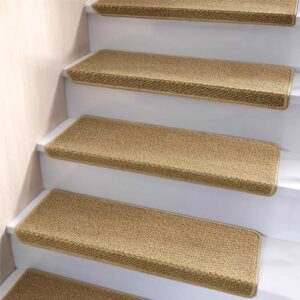
The Brakki Bullnose Stair Tread is a solid choice if your dog struggles with slippery steps. Its self-adhesive backing grips wood, marble, and brick without tape or glue — and leaves no residue behind. The bullnose edge design wraps over each stair lip, reducing tripping risk and protecting against daily wear.
At 29.5 x 9.5 inches, the soft polypropylene surface gives paws real grip while staying gentle on nails. Just make sure each stair is clean and fully dry before pressing it down.
| Best For | Pet owners, elderly folks, or families with young kids who need safer footing on slippery wood, marble, or brick stairs. |
|---|---|
| Material | Polypropylene |
| Dimensions | 9.5″ x 30″ |
| Backing Type | Padded non-slip |
| Cleaning Method | Hand wash cold |
| Installation Method | Peel and place |
| Surface Compatibility | Hardwood stairs |
| Additional Features |
|
- Self-adhesive backing sticks firmly without tape or glue — and peels off without leaving residue
- Polypropylene surface is easy to clean, either by vacuuming or a quick hand wash
- Bullnose edge design wraps the stair lip to cut down on tripping and protect against daily wear
- Peeling the protective adhesive film off can be frustrating and may tear if you’re not careful
- May not sit flush on heavily rounded bullnose edges
- The beige color can read more caramel depending on lighting or which way the pile falls
2. Beige Non Slip Linen Stair Treads
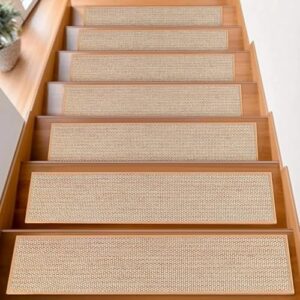
If you want a tread that blends into your home while still protecting your dog, the Beige Non-Slip Linen Stair Treads are worth a close look. Each 8 x 30-inch tread uses natural linen and chenille — soft underfoot, breathable, and gentle on paw pads.
The peel-and-stick backing grips wooden stairs without tools or residue. They’re machine washable, too. Just make sure your stairs are clean and fully dry before pressing them down.
| Best For | Pet owners, families with young kids, or anyone with elderly relatives navigating wooden stairs who want a simple, no-fuss safety upgrade. |
|---|---|
| Material | Polyester |
| Dimensions | 28″ x 9″ |
| Backing Type | TPE non-skid |
| Cleaning Method | Machine washable |
| Installation Method | Peel and stick |
| Surface Compatibility | Wood and hardwood |
| Additional Features |
|
- Peel-and-stick install means no tools, no hassle — just clean the stairs and press them down
- Machine washable and soft underfoot, which is a win for bare feet and paw pads alike
- Natural linen and chenille blend looks clean and understated in most home styles
- Corners can start to lift over time, especially in busier spots on the staircase
- Adhesion really depends on how clean and dry your stairs are before you apply them
- High-traffic steps may show wear faster than you’d hope
3. Non Slip Carpet Stair Treads Brown
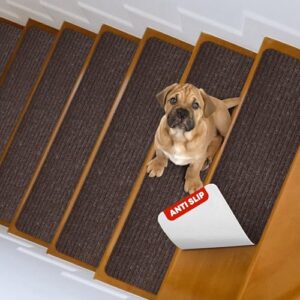
If your stairs are darker wood, the Non-Slip Carpet Stair Treads in Brown are a practical match. Each 8 x 30-inch piece uses a three-layer build — woven polyester on top, a nonwoven buffer in the middle, and a TPU non-skid bottom — so your dog gets cushioning and grip in one step.
The reusable adhesive repositions cleanly, and the stain-resistant surface vacuums or machine-washes easily. Just clean and dry each stair before pressing the tread down.
| Best For | Renters or pet owners with darker wood stairs who want a safe, easy-to-clean solution that won’t damage their floors. |
|---|---|
| Material | Polypropylene |
| Dimensions | 29.5″ x 9.5″ |
| Backing Type | Integrated adhesive |
| Cleaning Method | Vacuum or hand wash |
| Installation Method | Self-adhesive backing |
| Surface Compatibility | Wood, marble, brick |
| Additional Features |
|
- Three-layer build gives solid grip and cushioning — good for dogs, kids, and older adults
- Reusable adhesive repositions cleanly without leaving residue behind
- Stain-resistant and easy to clean — just vacuum or toss in the wash
- Corners can lift if the stair surface isn’t completely clean and dry before application
- Heavy pet scratching may cause the material to fray over time
- Machine washing can gradually wear down the adhesive backing
4. Pure Era Plush Bullnose Stair Treads
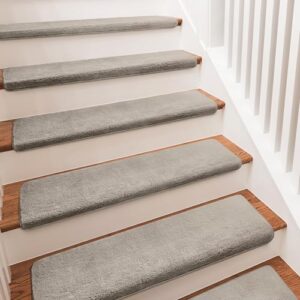
If your dog needs more than just grip, the Pure Era Plush Bullnose treads add real cushioning to every step. Each 9.5 x 30-inch piece features a 1-inch ultra-plush polyester pile — soft enough to absorb joint impact on the way up or down. The self-adhesive bullnose edge wraps the stair nosing for added stability and a clean finish.
Installation is straightforward: clean, dry, press. They’re washable, reusable, and available in neutral tones that blend easily into most home décors.
| Best For | Pet owners and families with young kids who want softer, safer stairs without sacrificing style. |
|---|---|
| Material | Linen and rubber |
| Dimensions | 8″ x 30″ |
| Backing Type | Non-adhesive rubber |
| Cleaning Method | Machine washable |
| Installation Method | Non-adhesive placement |
| Surface Compatibility | Wood, tile, marble |
| Additional Features |
|
- That 1-inch plush pile is genuinely thick — good cushioning for older dogs or pets with joint issues
- Self-adhesive bullnose edge makes installation dead simple and looks clean once it’s on
- Washable and reusable, so one muddy paw situation won’t ruin them
- Hand wash only, so cleaning 14 pieces after a messy week takes real effort
- The bullnose edge protrudes slightly instead of wrapping fully — not ideal if you want a flush look
- Only works if your stairs are wider than 30 inches and deeper than 9.5 inches, so measure first
5. Non Slip Rubber Stair Treads
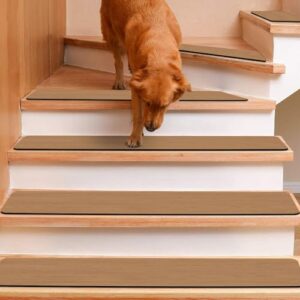
Rubber treads are the go-to choice when grip is non-negotiable. These 30 x 8-inch treads feature a suede-like top surface that cushions bare paws and a non-adhesive rubber backing that holds firm without damaging your floors or leaving residue behind.
The low-profile 0.2-inch thickness won’t catch under doors, and you can trim them with scissors for a custom fit. One note: hand-wash only — machine cycles can break down the layered materials over time.
| Best For | Households with elderly family members, young kids, or senior pets who need extra traction on indoor stairs. |
|---|---|
| Material | Linen and chenille |
| Dimensions | 8″ x 30″ |
| Backing Type | Self-adhesive |
| Cleaning Method | Machine washable |
| Installation Method | Peel and stick |
| Surface Compatibility | Wooden staircases |
| Additional Features |
|
- Non-adhesive rubber backing grips without damaging floors or leaving sticky residue
- Suede top is soft underfoot and absorbs water quickly
- Easy to trim with scissors for a custom fit on any stair shape
- Can shift on very smooth surfaces if used without additional adhesive
- Not safe to machine wash — hand wash only or the layers may break down
- Surface texture tends to collect pet hair and debris, making cleanup a bit tricky
6. LifeGrip Transparent Non Slip Stair Treads
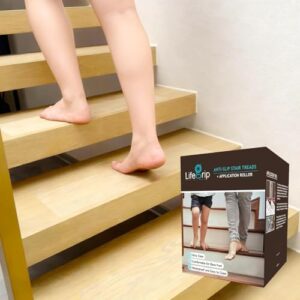
If keeping your floors visible matters to you, LifeGrip’s transparent treads are worth a close look. Made from EVA with a PET base layer, they stay clear without yellowing — so your hardwood or tile shows through.
If you have an older dog or one with joint problems, transparent treads like these pair especially well with advice on keeping dogs safe on stairs.
An 80-grit aluminum oxide surface gives paws reliable grip on ascent and descent, and the waterproof adhesive holds on wood, tile, and laminate without leaving residue.
Each 4 x 30-inch tread is trimmable, and the glow-in-the-dark stripe adds visibility for nighttime trips.
| Best For | Homeowners with kids, elderly family members, or pets who want stair safety without hiding their floors. |
|---|---|
| Material | Polyester and TPU |
| Dimensions | 8″ x 30″ |
| Backing Type | Reusable TPU adhesive |
| Cleaning Method | Vacuum or machine wash |
| Installation Method | Peel and stick |
| Surface Compatibility | Wood, laminate, vinyl |
| Additional Features |
|
- Crystal-clear EVA material keeps your hardwood or tile fully visible — no ugly rubber strips covering up your floors
- Glow-in-the-dark stripe is a genuine safety win for late-night trips to the kitchen or bathroom
- Waterproof adhesive works across a wide range of surfaces, indoors and out
- Once they’re down, they’re down — peeling and reattaching isn’t really an option
- Extreme weather can wear on the adhesive over time, so outdoor use is a bit of a gamble
- Surfaces need to be spotlessly clean and dry before installation, or the grip won’t hold properly
7. Non Slip Wool Carpet Stair Treads
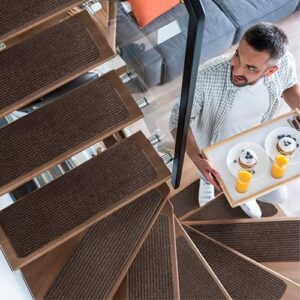
Wool has a quiet way of making every step feel more secure. These treads use a natural wool pile that springs back after each step, preserving grip over repeated use — which matters a lot for dogs climbing stairs daily.
The self-adhesive PVC backing holds firm on sealed hardwood without leaving residue, and the surface is machine washable. At 8 x 30 inches, they fit standard stairs well and stay gentle on bare paws in colder months.
| Best For | Households with dogs, young kids, or elderly family members who need a little extra grip on hardwood stairs. |
|---|---|
| Material | Polyester |
| Dimensions | 9.5″ x 30″ |
| Backing Type | Self-adhesive |
| Cleaning Method | Hand wash only |
| Installation Method | Self-adhesive backing |
| Surface Compatibility | Hardwood and marble |
| Additional Features |
|
- The wool pile bounces back after repeated use, so the grip holds up over time
- Self-adhesive backing sticks well to sealed hardwood and peels off clean — great for renters
- Machine washable and easy to vacuum, so keeping them clean isn’t a hassle
- The wool texture picks up lint, pet hair, and fuzz pretty easily
- Edges can wear down faster on stairs that see heavy daily traffic
- They may arrive folded and need some time to flatten out before they sit properly
Why Dogs Need Stair Treads
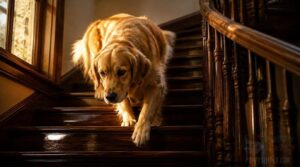
Dogs aren’t built for slick hardwood or tile stairs — their paws just don’t grip the way we assume they do. Whether your dog is young and clumsy, older and stiff, or simply nervous about the climb, the right stair tread can make a real difference. Here’s why adding them matters.
The right stair tread gives dogs the grip and confidence their paws simply can’t find on slick hardwood alone
Prevent Slips and Falls
Every stair becomes a risk when your dog’s paws can’t find grip. Nonslip stair treads for dogs increase surface friction between paw and step, cutting slip risk considerably — especially on smooth wood, tile, or marble. This is essential because wet or oily surfaces can cause a loss of traction.
- Paw grip enhancement on textured surfaces holds even with wet or muddy paws
- Edge rounding benefits prevent toe-catching on sharp stair nosings
- Moisture barrier solutions stop water from weakening adhesion underneath treads
- Weight distribution design spreads impact evenly across each step
- Surface friction testing ensures treads meet the 0.6 Static Coefficient of Friction standard for residential stair safety
Support Senior Dog Mobility
Senior dogs often lose confidence on stairs long before they lose strength. As joints stiffen from arthritis or hip dysplasia, each step demands more from already-stressed muscles.
Nonslip stair treads for dogs cushion that impact directly — orthopedic foam cores handle paw pressure relief, while weight distribution layers spread load evenly, protecting vulnerable hips and elbows with every climb.
Help Anxious Stair Users
Some dogs don’t need a physical reason to freeze at the top of the stairs — anxiety alone can turn a familiar route into a standoff.
Nonslip stair treads give anxious dogs a concrete reason to trust each step, because visible traction and a stable, cushioned surface replace uncertainty with reliable footing.
Protect Injured Joints
If anxiety can freeze a dog on the stairs, joint pain can make every step genuinely hurt. For a dog with arthritic or injured joints, each descent multiplies impact load — and bare, slick stairs offer zero cushioned impact absorption.
A well-padded tread distributes that force more evenly, acting like a weight distribution technique built into each step.
Reduce Stair-climbing Stress
Physical stress doesn’t stop at sore joints. Stair climbing also triggers real psychological tension — but here’s the good news: rhythmic stepping naturally encourages endorphin release, gently lowering heart rate and easing anxiety with each controlled ascent.
Gentle pacing on a cushioned, nonslip surface builds stress resilience over time, turning a stressful climb into something your dog can actually feel steady doing.
Best Materials for Dog Traction
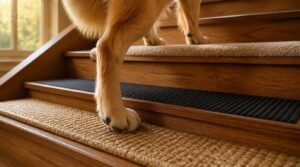
Not every material grips a dog’s paws the same way, and that difference really matters on a slippery staircase. The right surface does more than look nice — it gives your dog the confidence to climb without hesitation. Here’s how the most common tread materials stack up for traction, comfort, and real-world use.
Carpet for Paw Grip
Carpet is one of the most effective materials for paw traction on stairs. Textured loop pile designs create an irregular surface that gives paws something real to grip — especially helpful on smooth hardwood or tile steps.
High twist yarn resists claw damage and maintains surface uniformity, while pile density above 80 oz/sq yd distributes your dog’s weight evenly for confident footing on every step.
Wool for Soft Support
Wool brings something carpet alone can’t always offer — genuine softness beneath sensitive paws. High-density wool fibers naturally cushion impact, making each step gentler on arthritic or recovering joints.
Wool also regulates moisture without feeling wet, absorbing up to 30% of its weight. Its textured surface enhances pet comfort and non-slip traction, while remaining a durable, eco-friendly choice for stair treads.
Rubber for Firm Traction
Rubber is the go-to when your dog needs firm, reliable grip on every step. Compounds hardened to around 60–70 Shore A maintain steady contact with wood, tile, or laminate — even on cold mornings.
Carbon black reinforcement resists nail scratches and daily wear, while wet grip performance actually improves with moisture, keeping your dog sure-footed when paws aren’t completely dry.
Vinyl for Visible Stairs
Vinyl shines on open, visible staircases where looks matter as much as safety. Color contrast patterns and edge nosing sharpen step definition — helping your dog recognize each riser clearly.
Microtextured embossing builds grip without disrupting the clean surface. UV-resistant finishes prevent fading, and waterproof vinyl protection guards against spills. Customizable visual options let you match your décor without compromising traction.
Jute and Natural Fibers
Natural fibers like jute bring something genuinely useful to the table — sustainable, nontoxic traction without harsh synthetics near your dog’s paws. Jute’s tensile strength reaches up to 300 MPa, so it holds up underfoot without flattening fast.
- Absorbs moisture without feeling damp immediately
- Biodegradable and safe for pets and floors
- Naturally textured surface offers reliable nonslip grip
Non-Slip Backing Options Compared
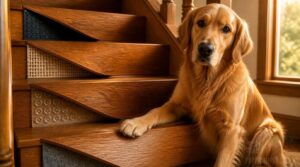
The tread on top gets a lot of attention, but what’s underneath matters just as much. A backing that slips — or leaves sticky residue behind — can undo all the traction your dog needs. Here’s how the most common backing types stack up.
TPE Backing Grip
TPE backing grip is one of the quieter workhorses in dog stair safety — flexible, durable, and surprisingly thoughtful in design. It controls temperature resistance from -20 to +60°C, stays UV-stable near windows, and can include antimicrobial additives to limit odor.
Textured patterns improve paw contact, while edge stability prevents corner lifting — giving your dog confident, secure footing on every step.
Rubber Backing Stability
Regarding stair safety for dogs, rubber backing holds its own in a way few materials can match. It maintains consistent friction across wood, tile, and painted treads — even under the shifting weight of an active dog mid-stride.
- Manages temperature changes from cold mornings to warm afternoons without losing grip
- Resists edge curling, keeping the tread flat against the stair
- Tolerates mild detergent cleaning without degrading traction
- Performs reliably under active movement loads during ascent and descent
Peel-and-stick Adhesion
Peel-and-stick stair treads for dogs work through pressure-sensitive acrylic adhesive — no tools, no heat, just firm contact. Before applying, clean and fully dry each stair surface, since dust or moisture breaks the bond immediately.
Acrylic-based backings handle humidity and light exposure better than rubber-based alternatives, which can degrade faster. TPR self-adhesive backing bonds securely without floor residue when applied correctly.
Residue-free Removable Designs
Not every floor-friendly design relies on sticky adhesive. Residue-free removable designs use low-tack bonding, electrostatic adhesion, or reusable fabric grip to hold treads securely — then release cleanly without leaving marks.
That matters on painted wood or laminate, where adhesive transfer can stain. Repositionable coatings support multiple placements, and magnetic mounting solutions offer instant removal with zero surface contact.
Adhesive-free Tread Options
Adhesive-free treads skip the glue entirely, relying instead on a Friction Fit System — textured rubber or mesh backing that grips your stair surface through pressure alone. A Rubber Gripper Design holds firm without bonding to the wood, so removal stays residue‑free and your floors stay unmarked.
- Edge Lip Stability catches the stair nose for a secure fit
- Mesh Airflow Benefits reduce moisture trapped beneath the tread
- Biodegradable Tread Options in jute or sisal offer nontoxic material choices
Choosing The Right Tread Size
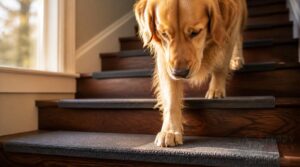
Getting the size right matters more than most people realize — a tread that’s too short leaves paw placement unstable, while one that’s too wide can buckle or shift underfoot. Before you buy, a few quick measurements will save you a lot of guessing. Here’s what to check before choosing your treads.
Measure Stair Depth
Before choosing stair treads for dogs, grab a tape measure and start at the nosing — the front edge of each step. Extend it horizontally to where the tread meets the riser below. Residential staircases commonly require at least 10 inches of tread depth for safe footing.
| Measurement Step | Detail |
|---|---|
| Starting point | Front nosing edge |
| End point | Back edge at riser |
| Minimum safe depth | 10 inches residential |
| Overhang adjustment | Measure to deepest point |
| Consistency check | Variance under 3/8 inch |
Repeat this depth consistency check on every step — uneven depths increase trip risk for both pets and people.
Check Tread Width
Once you’ve confirmed stair depth, shift your tape measure to the side — now you’re measuring tread width, the horizontal span from edge to edge.
For dogs, aim for at least 8 inches of usable flat surface. Medium and large breeds do better with 9 to 12 inches, giving their paws a stable, full-contact landing on every step.
Consider Bullnose Edges
Not all stair treads end the same way — and that edge matters more than most people realize.
Bullnose carpet stair treads feature a rounded front edge, with radius sizes commonly ranging from ¼ to ½ inch, softening the step-off point for your dog’s paws.
- Reduces claw snagging on sharp corner seams
- Enhances senior dog traction and stability
- Encourages slower, steadier descents for arthritic joints
- Blends pet safety with design cohesion
Choose Low-profile Designs
Thickness quietly shapes how safe your stairs feel for a dog. Low-profile treads — usually under 1 inch thick — sit flush against hardwood stairs without creating a raised lip that disrupts your dog’s gait.
Bullnose edge benefits include a naturally rounded front that guides paw placement toward the tread’s center, reducing missteps on descent.
Trim for Custom Stairs
Trimming a precut stair tread to fit an oddly shaped or narrow staircase takes about two minutes with a sharp utility knife — and it’s often the step that makes the difference between a tread that shifts and one that stays put. Trimmable edges let you match the exact footprint of each step, keeping self-adhesive backings flush and secure.
Installation Tips for Safer Stairs
Even the best stair tread won’t do much if it shifts under your dog’s paw mid-step — and that comes down to how well you install it. A few careful steps before you ever press a tread down can make the difference between a secure grip and a hazard waiting to happen. Here’s what to do to get it right.
Clean Stairs First
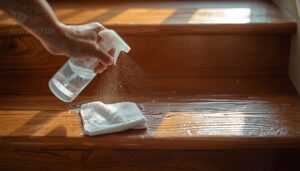
Before you press a single tread down, the surface beneath it needs to be genuinely clean. Clear loose debris first — dust, pet hair, and grit can scratch wood finishes and prevent self-adhesive backings from bonding properly. Work top to bottom, so you’re not dragging dirt back onto areas you’ve already prepped.
Use a mild, pH-neutral cleaner — something non-toxic and residue-free — wiping down each step thoroughly. Soap film left behind creates slippery surfaces and weakens adhesion over time.
Dry Surfaces Completely
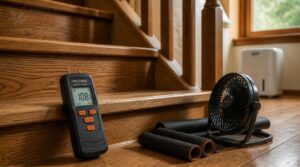
Moisture is the silent enemy of self-adhesive backings. Even surfaces that look dry can hold hidden dampness — especially after cleaning.
Let each step air dry completely at room temperature before moving forward. If you’re working in a humid space, run a fan or dehumidifier to keep relative humidity below 50%. Confirm dryness with a moisture meter before applying any non-slip backing.
Align Each Tread Carefully
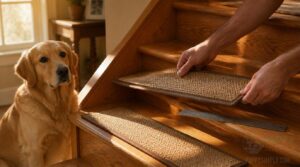
Placement isn’t just cosmetic — a misaligned tread creates uneven weight distribution that can destabilize a dog mid-step. Center each tread on the stair run before committing, and align edges flush with the riser below. Use a straightedge to confirm a flat surface.
For peel-and-stick stair treads, mark alignment guides first — repositioning self-adhesive backings risks losing grip.
Press Edges Firmly
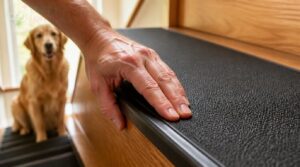
Once each tread is aligned, run your fingers firmly along every edge — this is where edge compression does its real work. Pressing the border flat maximizes adhesive contact between the TPR self-adhesive backing and the stair surface, eliminating air pockets that quietly weaken the bond over time. A firm press also prevents edge lift, which can snag a dog’s claws mid-step.
Test Grip Before Use
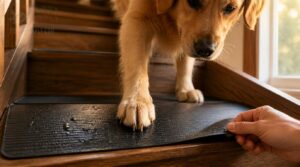
After pressing every edge flat, don’t skip the final step: testing. Run a quick Edge Press Test by tugging each corner — nothing should lift. Walk the stair firmly to confirm staircase grip holds under real pressure. Try it on a damp step, too, because moisture resistance matters most when paws come in wet.
- Tug each corner firmly — no lifting means adhesive cure is complete
- Stomp the center to confirm uniform traction across the full tread
- Wet the surface lightly to verify paw grip holds under moisture
Cleaning and Maintenance Needs
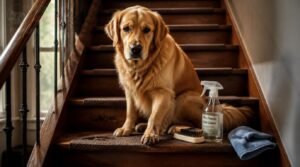
Keeping your stair treads clean isn’t just about looks — it directly affects how well they grip and how long they last.
A little routine care goes a long way, especially with dogs tracking in dirt, hair, and the occasional muddy paw print. Here’s what you need to know to keep them working like new.
Vacuum Pet Hair Weekly
Pet hair builds up on stair treads faster than you’d expect — especially during shedding season.
Stick to a weekly vacuum schedule to cut visible fur by up to 60 percent. Use high suction with a pet hair attachment for embedded fibers in low pile carpets. A rotating brush improves pickup, and emptying the dustbin right after keeps allergens from cycling back onto the stairs.
Spot-clean Muddy Paw Prints
Mud happens — usually right after a walk, right on the treads.
For carpet mud cleanup, let the mud dry first, then follow these steps:
- Apply a stain remover and let it dwell
- Blot with a clean white cloth — never scrub
- Rinse with warm water and blot dry
- Air dry completely to prevent fiber staining
Machine-wash Washable Treads
Some treads are machine washable — and that’s a genuine gift when you’re managing pet hair, tracked-in grime, and repeated use. Durable polyester and polypropylene fabrics hold their shape through multiple wash cycles, staying colorfast and stain resistant without fading.
Use a gentle cycle with mild detergent, and skip fabric softener, which breaks down the fibers that keep slip resistance intact.
Air-dry After Washing
Once the wash cycle is done, always air dry — never run machine washable stair treads through the dryer. Heat degrades the nonslip fibers and can warp the rubber backing your dog depends on.
Most treads dry within 6 to 12 hours, though wool blends may need up to 18. Lay them flat, in a shaded spot, to protect both pet safety and the tread’s shape.
Restore Sticky Backing Gently
Over time, even the best self-adhesive backings lose their grip — usually from dust, pet hair, or residue buildup. Before reaching for new treads, try a gentle restore. Wipe the adhesive backing with a soft cloth and mild soap, rinse lightly, then pat dry. Avoid harsh solvents — they degrade the material fast.
Once dry, pre-warm the tread slightly to improve adhesive flow, then press firmly from center to edges, rolling out air pockets as you go. A quick grip test at each corner confirms the peel and stick bond is holding before your dog takes the stairs again.
How to Pick The Best
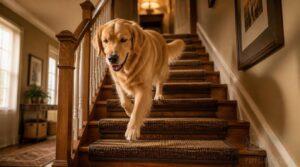
Finding the right stair tread isn’t just about picking something that looks decent — it’s about matching what your dog actually needs to move safely. A few key factors make the difference between a tread that genuinely helps and one that ends up shoved in a closet. Here’s what to look at before you buy.
Match Your Dog’s Needs
Every dog is different — and your stair treads should reflect that. Assess your dog’s age first: senior dogs and those with mobility or joint issues benefit most from cushioned, high-traction nonslip stair treads. Consider health conditions like arthritis or hip dysplasia, match tread softness to activity level, and plan gradual training to build stair confidence safely.
- Senior dogs need plush, cushioned surfaces
- Dogs with mobility issues need firm, reliable grip
- Anxious dogs benefit from consistent, positive stair exposure
Prioritize Traction Rating
Not all grip is created equal. Traction ratings run from AA down to C — AA delivers the strongest slip resistance on both wet and dry surfaces, which matters most if your dog navigates smooth hardwood or tile.
Look for treads meeting a Static Coefficient of Friction of 0.6 or higher for reliable, nonslip dog staircase safety.
Consider Arthritis Support
If your dog has arthritis, cushioned stair treads aren’t a luxury — they’re part of the care plan. Plush, high-density surfaces absorb impact on fragile joints, supporting senior dogs with hip dysplasia or mobility challenges.
- Joint Stabilization Devices reduce strain on every step
- Textured surfaces aid balance for neurologically impaired dogs
- Home adaptation solutions extend your dog’s independence safely
Balance Decor and Safety
Safety and style don’t have to fight each other. The right stair treads for dogs can blend into your home while still doing their job. A neutral color scheme keeps things cohesive, and subtle contrast edges help your dog judge depth without making the staircase look cluttered.
| Feature | Safety Benefit | Decor Benefit |
|---|---|---|
| Neutral tones | High visibility contrast | Blends with most interiors |
| Bullnose edges | Reduces edge-catching risk | Softer, curved silhouette |
| Matte textured rubber | Minimizes glare, adds grip | Clean, refined appearance |
| Transparent vinyl | Maintains traction on tile | Preserves original floor look |
| Low-profile design | No door clearance issues | Unified staircase decor |
Clear tread visibility matters most on narrow or darker staircases — transparent options let light flow through without visually crowding the space. Eco material choices like jute or sisal add warmth and texture while keeping indoor air quality safe for your pet. Self-adhesive backings install cleanly and leave no residue, protecting both your floors and your balanced stair aesthetics.
Compare Durability and Price
Once you’ve found treads that look right, the next question is whether they’ll hold up.
Durability vs price is a real tradeoff here — wool and rubber options cost more upfront but resist wear far longer than budget synthetics. Machine-washable, wear-resistant treads also cut long-term replacement costs, making a slightly higher price tag the smarter spend over time.
Frequently Asked Questions (FAQs)
What is the best flooring for stairs for dogs?
Carpet flooring offers the best traction for dogs on stairs, especially senior dogs with joint issues. Its textured surface grips paw pads naturally, reducing slips on otherwise slippery surfaces without sacrificing comfort or durability.
How long do stair treads last?
It depends on the material. Rubber treads last 5–10 years; hardwood, 20– Machine washable carpet types wear faster with heavy traffic. Regular maintenance and prompt replacement of worn treads extends durability greatly.
Are stair treads easy to remove?
Most treads are surprisingly easy to remove. Peel-and-stick backings lift away cleanly, leaving little to no residue. Screwed treads just need a drill. Either way, you’re looking at a simple, tool-free process.
Are there stair treads specifically designed for dogs?
Yes — pet-specific stair treads exist and are built with dog paw comfort in mind. Features like bullnose edges, textured non-slip surfaces, and cushioned pile make them genuine canine mobility aids, not just repurposed floor mats.
Can stair treads be used on outdoor stairs?
Absolutely — outdoor stairs can be fitted with treads, as long as you choose ones built for exterior conditions. Look for weather-resistant rubber or composite materials, drainage channels, UV protection, and adhesives or fasteners rated for temperature swings and moisture.
How often should stair treads be replaced?
Most treads last 5 to 7 years in busy households. Replace sooner if you notice lifting edges, thinning pile, or weakened adhesive — all clear signs traction has dropped below a safe level.
Can stair treads damage hardwood or laminate floors?
Like a rug left too long on a sunny floor, the wrong tread can quietly damage what’s underneath.
Moisture, adhesive residue, and surface abrasion are the real risks — but properly fitted, non-adhesive or residue-free treads actually protect your hardwood by distributing weight evenly.
Whats the best tread thickness for large dogs?
For large dogs, 6–75 inch thickness hits the sweet spot — enough cushioned material to reduce joint impact, support weight distribution, and keep paws stable, especially on steep stairs.
Do stair treads work on curved staircases?
Curved staircases aren’t the easiest fit — but they’re far from impossible. Flexible backing and radius compatibility matter most. Choose treads with adhesive-backed designs and press edges firmly to prevent lifting.
Are there waterproof options for outdoor stairs?
Yes — vinyl, rubber, and PVC treads handle outdoor moisture well. Look for self-adhesive or rubber-backed options rated for wet surfaces, since they grip and shed water without warping or losing traction underfoot.
Conclusion
It’s almost funny—stairs exist to help us move freely between levels, yet they’ve become one of the biggest daily obstacles in your dog’s life.
The best stair treads for dogs don’t just fix a slippery surface; they give hesitant, arthritic, or recovering dogs the confidence to move the way their bodies were designed to. Choose the right tread material, backing, and fit—and those stairs stop being a barrier and become simply stairs again.
- https://oakvalleydesigns.com/blogs/stair-safety-wellbeing/removable-stair-treads-for-dogs
- https://www.acadiastairs.com/feeds/blog/best-stair-treads-dogs
- https://twitter.com/intent/tweet?text=5%20Best%20Non-Slip%20Stair%20Treads%20For%20Dogs%20In%202026%20(Pros%20And%20Cons)&url=https%3A%2F%2Fdogaspet.com%2Fdog-lifestyle%2Fbest-stair-runners-for-dogs%2F
- https://www.facebook.com/sharer/sharer.php?u=https%3A%2F%2Fdogaspet.com%2Fdog-lifestyle%2Fbest-stair-runners-for-dogs%2F