
This site is supported by our readers. We may earn a commission, at no cost to you, if you purchase through links.
Watching your dog squat repeatedly without producing anything is one of those symptoms that sits in an uncomfortable middle ground — it could mean something minor, or it could mean something that needs attention today.
The difficulty is that straining looks the same whether your dog swallowed a sock, has inflamed anal glands, or simply hasn’t had enough water.
When your dog keeps trying to poop without success, the body is signaling that something in the digestive process has broken down. Knowing what’s behind that straining — and what to watch for — makes the difference between a home fix and an emergency call to your vet.
Table Of Contents
- Key Takeaways
- What Straining to Poop Means
- Common Causes of Straining
- Warning Signs That Need a Vet
- Safe Home Help for Mild Cases
- Diagnosis, Treatment, and Prevention
- Frequently Asked Questions (FAQs)
- What to do if your dog keeps squatting but not pooping?
- What are the signs that a dog is about to pass away?
- How do I tell if my dog is constipated or has a blockage?
- Why is my dog constantly trying to poop?
- What can I do if my dog is constipated?
- What are common signs of constipation in dogs?
- Is it normal for a dog to take a long time to poop?
- How can I help my dog poop outside faster?
- Are there any natural remedies for constipation in dogs?
- Can stress or anxiety cause difficulty pooping?
- Conclusion
Key Takeaways
- Straining without producing stool can signal anything from simple dehydration to a dangerous intestinal blockage, and the difference lies in what — if anything — your dog manages to pass.
- If your dog hasn’t had a bowel movement in 48–72 hours, or you’re seeing blood, vomiting, or a bloated belly alongside the straining, don’t wait — those are same-day vet signs.
- Most mild cases respond well to increased water intake, a small amount of plain pumpkin puree, and a short walk after meals, all of which gently restore normal gut movement.
- Straining isn’t always a gut problem — arthritis, anxiety, and pain can make squatting physically difficult or emotionally avoidable, so it’s worth considering the whole picture.
What Straining to Poop Means
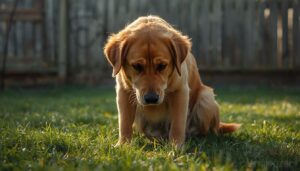
When your dog squats and strains without much to show for it, something’s clearly off — but "straining" doesn’t always mean the same thing. The cause shapes everything: what you should watch for, how worried you need to be, and what to do next.
Understanding what your dog’s sitting positions reveal about their health can help you spot whether straining signals a digestive issue or something deeper, like joint pain or muscle tension.
A few key signs can help you figure out what’s actually going on.
Constipation Vs. Tenesmus
These two conditions look alike but work differently. Constipation means stool is moving too slowly, becoming hard and difficult to pass. Tenesmus is something else — it’s mucosal irritation or rectal spasm driving the urge without much output. Behavioral cues help tell them apart:
- Constipation produces infrequent, hard stool
- Tenesmus causes repeated squatting with little result
- Rectal spasm creates urgency, not blockage
- Neurologic influence and medication side‑effects can mimic both
- Fecal consistency guides the diagnostic workup for dogs with difficulty defecating
In dogs, tenesmus can be a sign of inflammatory bowel disease.
Hard Stool Vs. No Stool
Hard stool and no stool both signal trouble, but they’re not the same problem.
When your dog keeps trying to poop but only drops come out, stool consistency points to slow bowel transit time — the large intestine absorbs too much water, leaving dry, hard pieces behind.
When your dog keeps trying to poop but nothing comes out, dehydration effects and low dietary fiber balance may have stalled transit completely.
Small Amounts of Mucus or Blood
Sometimes what comes out matters as much as what doesn’t.
Mucus Color Changes — clear, yellow, or white slick coatings — often signal colitis or proctitis irritating the lower bowel lining.
Blood Spot Patterns tell a similar story: bright red blood, or hematochezia, streaking the stool surface, points to Rectal Irritation Signs from inflammation, not upper-tract bleeding like melena.
Dietary Trigger Effects can spark both overnight.
Repeated Squatting and Pushing
Beyond mucus and blood, watch the behavior itself. Repeated squatting and pushing — dropping into posture, rising, then squatting again within seconds — is tenesmus in motion.
Abdominal tension visibly braces the belly with each attempt.
When squat frequency stretches a potty duration into minutes of unproductive effort, that’s your clearest behavioral cue that constipation, anal gland problems, or intestinal obstruction needs attention.
Common Causes of Straining
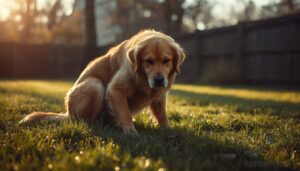
Straining to poop doesn’t always mean the same thing — the cause matters a lot, and there are several common ones worth knowing. Some are straightforward fixes, while others need a vet’s attention sooner rather than later.
Here’s what’s most likely going on with your dog.
Dehydration and Low Fiber
Think of your dog’s colon as a sponge—when Body Water Balance tips low, Colon Moisture Retention pulls fluid from stool, leaving hard stool that barely moves. Low Insoluble Soluble Fiber compounds this by reducing bulk. Together, they’re the most overlooked cause of straining.
Even gentle daily walks to support digestive health can help keep things moving when fiber and hydration alone aren’t enough.
Watch for:
- Dry kibble as a primary Dietary Moisture Source
- Reduced drinking, especially in senior dogs with Age-Related Risk
- Small, crumbly stools despite repeated squatting
Increase hydration and fiber supplementation daily.
Diarrhea, Colitis, or Proctitis
Diarrhea, colitis, and proctitis can all trigger straining — not because stool won’t pass, but because rectal inflammation creates tenesmus, that relentless urge to go when there’s barely anything left.
Inflammatory markers damage mucosal ulcers along the rectal lining, disrupting normal stool consistency on the stool form scale.
Dietary triggers and medication side effects often worsen flares, making timely veterinary care essential.
Anal Gland Pain or Infection
Anal gland problems are surprisingly common — and genuinely painful. These small sacs, located just inside your dog’s rectum, can develop anal sac impaction when their secretions thicken and can’t empty properly.
Left untreated, gland impaction progresses to abscess formation, causing swelling and intense discomfort that makes every squat feel like punishment.
Warm compress application and professional anal gland expression usually resolve mild cases, but active infection requires antibiotic therapy.
Foreign Objects and Intestinal Blockage
Dogs eat things they shouldn’t — socks, toys, bones, and worse. Foreign body ingestion in dogs creates mechanical blockages that prevent any stool from passing, no matter how hard your dog strains.
Object detection through imaging diagnostics like X-rays or ultrasound confirms the location quickly.
Depending on severity, endoscopic removal or surgical retrieval becomes necessary.
Toy safety and careful risk assessment at home are your best prevention.
Pain, Stress, or Mobility Issues
Sometimes straining isn’t about the gut at all. Arthritis pain and joint stiffness can make squatting genuinely difficult, so your dog avoids it. Anxiety triggers like loud noises or routine changes cause stress-induced constipation. Musculoskeletal pain affecting defecation is more common than owners realize.
Sometimes straining has nothing to do with the gut — arthritis, anxiety, and pain can keep dogs from squatting at all
Watch for these overlooked contributors:
- Orthopedic issues limiting squat posture
- Behavioral anxiety disrupting bathroom habits
- Lack of exercise slowing gut motility
- Mobility aids or physical therapy needs going unaddressed
Warning Signs That Need a Vet
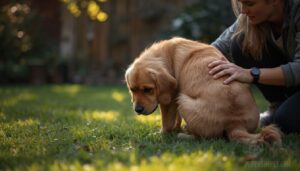
most cases of straining clear up with a little extra water, some fiber, and a day or two of patience. But some signs tell you that the situation has moved past home management.
Here’s when you need to call your vet.
No Bowel Movement for 48–72 Hours
If your dog hasn’t passed stool in 48–72 hours despite repeated straining, that’s your critical time window to act. Hard stools, dehydration, or a blockage may be the culprit — and owner intervention timing matters enormously here.
| What You’re Seeing | What It May Signal |
|---|---|
| No stool for 48 hours | Severe constipation or obstruction |
| Continued straining, nothing passing | Vet examination needed urgently |
| Progressive symptom escalation | Possible vet imaging referral |
| Can’t travel safely | Begin emergency transport planning |
Vomiting, Lethargy, or Loss of Appetite

Beyond the 48–72 hour window, watch for vomiting, lethargy, or loss of appetite — these signal something deeper than constipation.
Systemic illness, metabolic disorders, infectious diseases, or medication side effects can all trigger abdominal pain alongside straining.
Pain-induced anorexia is real: a dog in gut distress simply stops eating.
Intestinal obstruction especially escalates fast.
Don’t wait.
Bright Red Blood or Black Stool
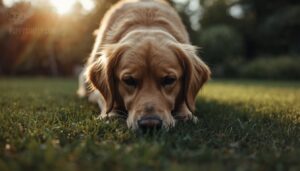
Blood in the stool tells you exactly where the problem is.
Bright red blood — hematochezia — points to rectal hemorrhage or lower colon irritation, often from colitis.
Black, tarry stool signals upper GI bleeding, meaning digested blood from the stomach or small intestine — melena diagnosis needs same-day care.
Both are stool color indicators your vet takes seriously. Don’t wait on either.
Crying, Bloated Belly, or Severe Pain

Crying During Defecation isn’t normal effort — it’s pain talking. If your dog yelps, shows Distressed Posture, or has a Bloated Abdomen, these are Emergency Straining Signals.
Severe Abdominal Discomfort, bloating, vomiting, or signs of abdominal pain mean the intestinal obstruction risk is real.
Don’t wait overnight. Emergency care the same day gives your dog the best chance.
Suspected Obstruction or Swallowed Object
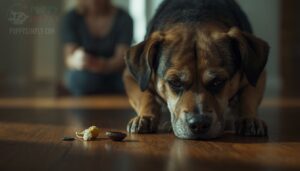
Sometimes the red flag isn’t what’s coming out — it’s what went in. If your dog swallowed an indigestible object, foreign material can cause partial blockage signs like intermittent mucus, reduced output, and restlessness before a full intestinal obstruction develops.
Battery toxicity and sharp object perforation make timing critical. Radiographic detection through diagnostic imaging — X-ray or ultrasound — guides urgent surgical referral before complications escalate.
Emergency veterinary care can’t wait.
Safe Home Help for Mild Cases
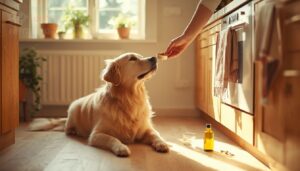
If your dog is mildly constipated but otherwise acting fine — eating, drinking, no vomiting — there are a few simple things you can try at home before calling the vet.
Nothing here is complicated, and most of it you probably already have on hand. Here’s what’s likely to help.
Offer Fresh Water and Wet Food
Fresh water is your first line of defense. Dogs need roughly one ounce per pound of body weight daily, and dehydration alone can harden stool fast.
Set up Multiple Water Stations around the house, keep Cool Water Bowls clean and filled, and consider a Moisture-Rich Diet by adding wet food or a Warmed Food Mix to dry kibble.
Monitor Water Intake Monitoring closely — improvement usually shows within a day or two.
Add Plain Pumpkin or Fiber
Plain pumpkin puree is one of the easiest fiber supplements for dogs you can try at home. Follow these pumpkin dosage guidelines to start:
- Small dogs: 1 teaspoon mixed into food
- Large dogs: 1 tablespoon per pumpkin kibble mix
- Frequency: Once or twice daily
- Fiber source comparison: Psyllium husk works similarly but use half the amount
Monitor stool texture closely — loose stool means reduce the dose.
Encourage Short Walks and Movement
Movement is medicine for a sluggish gut. Short, gentle leash walks after meals — think post meal walks of just five to ten minutes — stimulate exercise and gut motility naturally.
Low impact exercise like routine walk scheduling throughout the day keeps digestion moving without overexerting your dog. Gentle leash handling matters too: never yank when they’re straining.
Add hydration breaks between outings for best results.
Try a Dog Probiotic
Probiotics won’t fix a blockage, but they’re genuinely useful when straining ties back to colitis, loose stool, or recent antibiotic use. Strain-specific strains like Enterococcus faecium or Lactobacillus acidophilus support digestive health in dogs by restoring gut balance.
synbiotic benefits — products pairing probiotics with prebiotics like inulin improve results. label probiotic dosing by weight, and give it with food for probiotic safety.
Track Stool Frequency and Texture
Think of a stool diary as a simple early-warning system. Note each bowel movement’s time, frequency trend, and texture using a basic Stool Form Scale — score 1 for rock-hard pellets, 7 for watery.
Your daily stool log should include color monitoring and a quick consistency chart. Even a phone photo helps your vet’s fecal analysis spot stool pattern changes before they worsen.
Diagnosis, Treatment, and Prevention
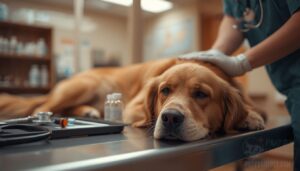
Once your vet suspects something’s off, the next step is figuring out exactly what’s going on and getting your dog real relief. The process moves through a clear sequence — from hands-on examination to targeted treatment and, finally, steps to keep the problem from coming back.
Here’s what that usually looks like.
Rectal Exam and Abdominal Palpation
Your vet will start with a hands-on rectal examination — checking sphincter tone evaluation, rectal shelf assessment, and circumferential wall palpation to feel for masses, tenderness, or abnormal tissue. In male dogs, prostatic palpation technique reveals enlargement or nodules.
Abdominal quadrant localization follows, mapping pain or firmness across the belly.
Together, these steps give your vet a clear physical picture before any testing begins.
Fecal Tests, Bloodwork, and Imaging
After the physical exam points the way, lab work and imaging fill in the rest of the picture.
Your vet will likely run:
- Fecal Flotation to catch roundworms, hookworms, or coccidia hiding in a fecal sample
- Antigen PCR testing to confirm Giardia or other infectious organisms
- CBC Interpretation and a Serum Chemistry panel to flag dehydration, low potassium, or organ trouble through routine blood work
- Fecal occult blood test to detect hidden bleeding the eye can’t see
- Ultrasound Imaging and imaging, X-ray, ultrasound views to reveal wall thickening, blockages, or prostate pressure
Together, these tools build a diagnosis—not guesswork.
Fluids, Enemas, or Stool Softeners
Once the diagnosis is clear, treatment usually starts with fluid therapy. Subcutaneous Hydration works for mild cases, while IV Fluid Protocols are reserved for dogs with vomiting or marked lethargy—Electrolyte Monitoring keeps sodium and potassium balanced throughout.
Veterinary Enemas use warm water-based Enema Solution Types to soften packed stool directly.
Stool Softener Dosing with docusate or lactulose then helps things move—but only alongside dietary changes to increase hydration.
Surgery for Blockages or Masses
When fluids and stool softeners aren’t enough, surgical intervention for blockage becomes necessary.
Open Surgery gives your surgeon full access for complex intestinal blockage or perianal tumors, while Minimally Invasive approaches mean faster recovery for simpler cases.
Bowel Resection removes damaged segments, a Bypass Operation restores passage around a tumor, and Adhesion Lysis frees scar-tissue kinks causing colonic impaction or obstruction, surgery complications.
Long-term Fiber, Hydration, and Exercise
Once surgery is behind you, prevention becomes the priority.
A Moisture-Rich Diet — wet food, soaked kibble, or a water bowl in every room — facilitates Hydration Tracking and keeps stools soft. Gradual Fiber Introduction over five to seven days using a Balanced Fiber Mix of pumpkin and beet pulp avoids bloating.
Exercise Consistency, even short daily walks, drives bowel motility forward reliably.
Frequently Asked Questions (FAQs)
What to do if your dog keeps squatting but not pooping?
Start with fresh water, a short walk, and a tablespoon of plain pumpkin. If squatting continues past 48 hours with no results, call your vet.
What are the signs that a dog is about to pass away?
A dying dog often shows appetite loss, lethargy, weight loss, weakness progression, breathing irregularities, social withdrawal, and temperature drop in the extremities.
Vomiting, dehydration, and pale gums can also appear in the final hours.
How do I tell if my dog is constipated or has a blockage?
Telling the two apart comes down to what your dog is — or isn’t — producing.
Constipation usually means small, hard stools; a blockage often means nothing comes out at all, despite repeated straining.
Why is my dog constantly trying to poop?
Your dog’s constant straining usually signals dog tenesmus — an urgent, painful need to poop with little result.
Common causes of canine constipation and straining include dehydration, anal gland issues, and colitis and proctitis, as inflammatory causes of straining.
What can I do if my dog is constipated?
For mild cases, increase hydration, add plain pumpkin, and encourage gentle exercise.
Scheduled feeding times, abdominal massage, and a low-stress environment also help move things along before reaching for stool softeners.
What are common signs of constipation in dogs?
Persistent pushing, prolonged squatting, and painfully hard stools are the clearest signals.
You may notice anxious bathroom behavior, tense abdominal muscles, reduced bowel movement frequency, or an anus licking habit — all pointing to discomfort.
Is it normal for a dog to take a long time to poop?
A minute or two of sniffing and circling before squatting is perfectly normal. Most healthy dogs defecate one to three times daily, usually within 30 minutes after eating.
How can I help my dog poop outside faster?
Try timed feeding, cue training, and choosing a quiet area during warm weather. Reward timing matters—praise right after elimination.
Short walks after meals naturally stimulate digestion and help your dog go faster.
Are there any natural remedies for constipation in dogs?
Yes — plain pumpkin puree, psyllium husk, and probiotic supplements for dogs are gentle, evidence-based options. Coconut oil or olive oil in small amounts can also help ease mild constipation naturally.
Can stress or anxiety cause difficulty pooping?
Stress and anxiety can absolutely disrupt your dog’s digestion.
Stress hormone impact triggers the sympathetic nervous system, slowing colon movement and causing stress-induced constipation in dogs through anxiety-induced colitis, behavioral bathroom avoidance, and environmental triggers.
Conclusion
Ironically, the most telling thing your dog can’t do — poop — tells you more about their health than almost anything else. When your dog keeps trying to poop without success, the body is rarely being dramatic; it’s being precise.
Hydration, fiber, movement, and a watchful eye resolve most mild cases before they escalate.
But when the warning signs appear, trust them. A quick vet visit now is always easier than an emergency one later.
- https://www.petlabco.co.uk/learn/health-wellness/checking-your-dogs-poop-could-save-their-life
- https://vhc.missouri.edu/wp-content/uploads/2020/07/Nestle-Purina-Fecal-Scoring-System.pdf
- https://thepetlabco.onelink.me/ETMR/y43xj9ou
- https://www.petmd.com/dog/conditions/cancer/dog-tumors
- https://www.medicalnewstoday.com/articles/318583