This site is supported by our readers. We may earn a commission, at no cost to you, if you purchase through links.
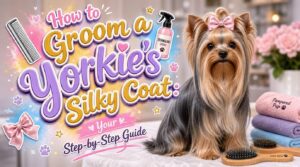
Yorkshire Terriers look like they walked straight out of a dog show, and that coat is why. Silky, fine, and floor-length on a well-kept Yorkie, it’s one of the most striking features of the breed—and one of the most misunderstood. Most people assume that because Yorkies barely shed, the coat takes care of itself.
It doesn’t. That single-layer hair tangles faster than almost any other breed, and without the right routine, mats form overnight in spots you’d never think to check.
Yorkie silky coat grooming rewards consistency, and this guide gives you the exact steps to do it right.
Table Of Contents
Key Takeaways
- A Yorkie’s single-layer, human-like hair doesn’t shed the way most dogs’ coats do, which means dead strands stay trapped and tangle fast — so daily brushing with a rounded-tip pin brush and fine-toothed metal comb isn’t optional, it’s the foundation of everything.
- High-friction spots like behind the ears, armpits, and the belly mat silently and quickly, so checking those five zones every session is what separates a manageable coat from one that needs a professional to fix.
- Bathing every two weeks, using a pH-balanced (6.5–7.5), sulfate-free shampoo, and applying conditioner only to mid-lengths and tips keeps the coat clean without stripping the natural oils that hold the silky texture together.
- Professional grooming every 6–8 weeks for pet trims (every 4–6 for show coats) works best when paired with a consistent home routine — because the coat doesn’t care how busy your schedule is, and mats don’t wait.
Yorkie Silky Coat Basics
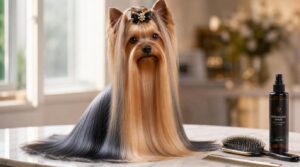
Before you reach for a brush, it helps to understand what you’re actually working with. A Yorkie’s coat is unlike most dogs’, and that difference shapes every grooming decision you’ll make.
Yorkies actually go through a fascinating transformation early in life, and knowing when Yorkies shed their puppy coat helps you anticipate how their grooming needs will evolve over time.
Here’s what you need to know before getting started.
Single-layer Hair Versus Double-coated Dog Fur
Unlike double-coated breeds, Yorkies have a single-layer coat — no dense undercoat, no seasonal blowout. Understanding Yorkie hair structure changes how you approach Yorkshire Terrier coat maintenance entirely.
The double coat structure consists of an outer topcoat and an inner undercoat that work together for insulation. Those insulation differences matter too, since single coats regulate temperature less effectively in cold weather.
Key distinctions from double coats:
- Lighter, steadier shedding patterns year-round
- A longer continuous growth cycle with no undercoat shedding phase
- Higher matting risk as fine hair tangles without natural airflow between layers
Why Yorkie Coats Tangle Easily
That single-layer structure is exactly why tangles and knots form so quickly. The human-hair similarity means individual strands slide and snag against each other constantly, creating friction that tightens knots before they’re noticed.
Wet hair clumping after a bath, movement friction behind the ears, and gear contact zones under saddle straps all accelerate knot formation. Without daily brushing, high friction spots become mats rapidly in a silky coat.
Puppy Coat to Adult Silky Coat Timeline
Tangles aren’t the only surprise waiting during that first year. The puppy coat change brings real changes — in texture, color, and behavior.
Here’s what to expect:
- Coat change age starts around 12–16 weeks
- Shedding phases peak during early adolescence
- Texture evolution shifts from soft fluff to silky strands
- Genetic variation affects timing — some dogs take two full years
- Hormonal influence can accelerate or delay the process
Track these milestones and adjust your grooming schedule for the first year of your Yorkie accordingly.
Low-shedding Does Not Mean Low-maintenance
Low-shedding doesn’t mean low-effort — not even close. Because dead hair stays trapped in the coat instead of falling to the floor, your Mat Prevention Routine becomes non-negotiable.
Expect Frequent Brushing four to six times weekly, plus a Seasonal Grooming Surge that demands daily brushing. This consistent effort is critical to prevent matting and tangles.
Add weekly bathing, silky coat conditioner, and detangling spray, and you’re looking at genuinely Time-Intensive Care.
Common Mat-prone Areas on Yorkshire Terriers
Mats don’t strike randomly — they form in the same spots every time.
Chin fur mats develop where saliva and bowl contact keep hair damp.
Ear base knots hide behind the ears where brushing often misses.
Armpit tangles build with every step your Yorkie takes.
Belly saddle mats tighten silently from floor contact.
Leg hem matting spreads upward fast.
Essential Yorkie Grooming Tools
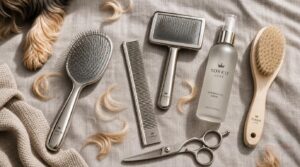
The right tools make all the difference when you’re working with a Yorkie’s fine, tangle-prone coat. Trying to get by with the wrong brush is like cutting vegetables with a butter knife — it wastes time and frustrates both of you.
What you actually need in your grooming kit is a carefully selected set of tools designed for their specific coat type.
Rounded-tip Pin Brush for Daily Brushing
Your go-to tool for daily brushing is a rounded-tip pin brush, making a real difference on a Yorkshire Terrier’s silky coat. The stainless steel pins offer solid corrosion resistance, ensuring durability and hygiene.
The cushion base comfort ensures each stroke remains gentle, while ideal brush spacing distributes pressure evenly. This design maintains smooth, effective grooming without causing discomfort.
Ergonomic features reduce hand fatigue, ensuring gentle skin contact feels effortless during every session. This combination of functionality and comfort makes it an essential grooming tool.
Fine-toothed Metal Comb for Detail Work
After the pin brush, reach for your fine-toothed metal comb — this is where precision really kicks in. Its stainless steel teeth, spaced 0.1 to 0.2 millimeters apart, glide through a Yorkshire Terrier’s silky coat without snagging.
Rounded edges ensure safety near sensitive areas like the muzzle and ears, while the comb creates clean, precise part lines.
Rinse and dry thoroughly for proper comb maintenance.
Slicker Brush for Light Surface Smoothing
The slicker brush earns its place in your toolkit for one specific job: light surface smoothing on a Yorkshire Terrier’s silky coat. After detangling, maintain a gentle brush angle technique—held nearly flat against the coat—and apply light pressure guidance to prevent skin irritation.
Clean the brush after every daily brushing session to ensure hygiene. Pin density choice matters; finer pins are essential to avoid damaging the coat’s delicate hair.
Dog-safe Detangling Spray or Leave-in Conditioner
Think of a detangling spray as your daily insurance policy for that silky Yorkshire Terrier coat. A good leave-in conditioner or detangling spray coats each strand, reducing friction and cutting brushing time considerably.
Look for vet-approved labeling, alcohol-free formulas, and pH balance around 6.5–7.5. Fragrance-free options work best for sensitive dogs.
Ingredient safety matters — argan oil and aloe vera add moisture without weighing silky coats down.
Blunt-ended Scissors for Safe Trimming
Rounded tips make all the difference when trimming around a Yorkshire Terrier’s face and paws. The right grooming scissors protect Yorkie hair without sacrificing precision.
- Safety Blade Design — Rounded tips prevent accidental poking during delicate work.
- Stainless Steel Construction — Resists corrosion and holds a sharp edge longer.
- Edge Geometry Options — Slightly convex edges reduce tugging on a silky coat.
- Ergonomic Grips — Reduce hand fatigue during detailed feathering trimming.
Store scissors in a protective sheath and oil the pivot regularly.
Small-breed Nail Clippers and Styptic Powder
Nail care rounds out your scissors kit nicely. Small-breed dog nail clippers with an angled blade design reduce pressure on the quick, ensuring a proper fit is critical for Yorkies.
| Yorkie Nail Care Basics | Detail |
|---|---|
| Nail clipping and quick avoidance in dogs | Cut only the tip |
| Using styptic powder to stop nail bleeding | Apply aluminum sulfate powder with a cotton swab |
| Post‑trim care | Gentle pressure for 10–15 seconds |
Keep quick‑stop styptic powder close — nail trimming technique improves with practice, but accidents happen.
Dog Toothbrush, Toothpaste, and Ear Cleanser
Oral and ear care deserve a spot in your grooming kit too. A soft bristle toothbrush sized for small breeds reaches tight spaces without irritating gum tissue.
Dental Kit Basics start here:
- Dog toothbrush with angled handle for back teeth
- Enzymatic toothpaste in poultry or peanut butter flavor
- Finger brush for sensitive dogs resisting brushing
- Ear cleaning solutions with gentle cerumenolytic agents
- Cotton balls for safe, controlled ear hygiene
Enzymatic Toothpaste Benefits include daily plaque breakdown without foaming. Follow Brushing Safety Guidelines — never use human toothpaste.
For Ear Cleanser Usage, apply solution to a cotton ball weekly, supporting long-term dental care and ear hygiene without inserting anything into the canal.
Daily Brushing and Detangling Steps
Brushing a Yorkie isn’t complicated, but the order you follow makes all the difference between a smooth coat and a tangled mess. A few simple steps, done consistently, will keep knots from building up and make the whole process easier for both of you.
Here’s exactly how to work through each brushing session.
Mist The Coat Before Brushing
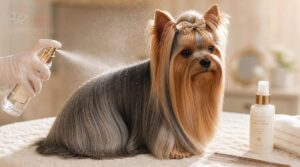
Spritzing your Yorkie’s coat before brushing makes grooming easier. Hold your detangling spray or leave-in conditioner 6–8 inches away for optimal mist distribution, then work through sectioned hair, spraying one area at a time.
This moisture management step softens knots, reduces static issues, and ensures the comb glides smoothly.
For eye protection, spray the product onto your palm first when applying near the face.
Start at The Hair Tips
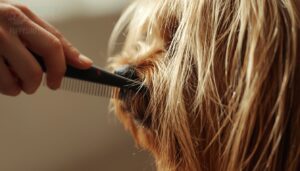
Once your coat is misted, start tip-focused brushing at the very ends. This micro-section detangling approach prevents yanking knots down into the roots.
Hold a pin brush lightly and take small segments — think pencil-width — working each tip clean before moving higher.
Use a detangling spray if you feel resistance. Hair-tip moisturizing at this stage protects those delicate ends from splitting and frizz.
Work Upward Toward The Roots
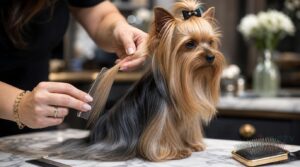
Once the tips are clear, move upward in steady passes—this is where root sectioning earns its keep. Progressive loosening means each stroke advances only slightly higher, never forcing the full length at once. Good tension management and comb penetration here prevent ghost mats from hiding near the skin.
- Work pencil-width sections upward
- Confirm each pass with your metal comb
- Stop if the pin brush snags
Hold Hair Near The Skin to Reduce Pulling
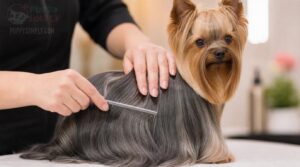
Your free hand does more than steady your Yorkie—it’s the foundation of tension-controlled combing. Place your fingers close to the skin before each stroke, using a skin-anchored grip that stops the root-level hold from stretching. This close-hold technique distributes pressure evenly, so your pin brush and metal comb glide through without yanking follicles.
A comfort-first approach here makes daily brushing techniques to prevent tangles genuinely painless.
Comb in Small Sections
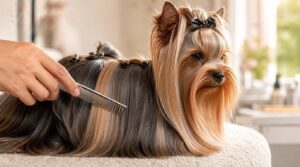
Sectioning works like a roadmap—small, deliberate portions keep you from missing hidden knots. Divide your Yorkshire Terrier’s silky coat into manageable pieces, then work each one with your pin brush first, followed by your fine-toed metal comb.
Section Size Tips and Knot Targeting are crucial here: apply light Hair Tension Balance, maintain steady Pressure Control, and prioritize full coverage. These techniques ensure thorough detangling without causing discomfort.
Tracking Section Progress guarantees no area is overlooked. Methodically address each portion, combining tool use with controlled pressure to achieve a smooth, knot-free coat.
Check Behind Ears, Armpits, Belly, Legs, and Tail
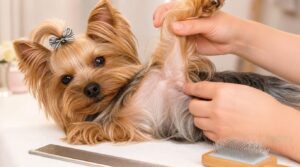
Once you’ve combed each section, begin with a quick sweep of the spots that mat first. Focus on ear fold inspection to catch moisture and trapped hair before it tightens. Lift the front legs to perform an armpit moisture check, then conduct a belly hair assessment along the midline. Examine leg joint tangles behind each knee, and finish with tail base grooming.
These five zones quietly drive most matting problems.
Reward Your Yorkie After Each Session
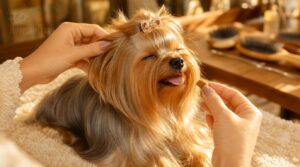
End every session the same way — a treat, a word of praise, a gentle stroke. This isn’t just kindness; it’s positive reinforcement training working in real time. Rotate between Immediate Treats, Verbal Praise, and Gentle Petting to keep your Yorkie engaged. That consistent Session End Signal builds owner bonding through grooming activities, eases grooming anxiety management, and turns a stressful task into something your dog actually anticipates.
End every grooming session with a treat, praise, and a gentle stroke — and watch stress turn to anticipation
Bathing a Silky Yorkie Coat
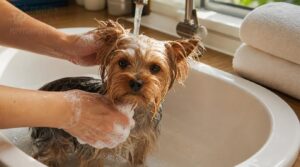
Bathing your Yorkie isn’t complicated, but it does require a little more thought than a quick rinse and dry. Get the frequency, products, and technique right, and that silky coat will stay soft, tangle-free, and healthy between grooming sessions.
Here’s what you need to know before you turn on the tap.
Ideal Bathing Frequency for Pet Trims
For a Yorkshire Terrier in a pet trim, a biweekly bath—every two weeks—hits the sweet spot. It keeps dirt accumulation in check without stripping the skin oils your Yorkie needs for a healthy coat.
Use these bath schedule adjustment triggers to guide you:
- Post-play baths after muddy outdoor sessions
- Visible grime or odor before the interval ends
- Dry, itchy skin suggesting you stretch the bath interval guidelines longer
Bathing Frequency for Show Coats
Show coats follow a weekly bathing routine for silky coat maintenance, but timing before show day matters. Bathing too close to the event leaves the coat unsettled; too far ahead invites dust and tangles.
Between baths, spot cleaning addresses minor grime without disrupting natural oil retention.
Always use lukewarm water for baths, and never skip post-bath moisture steps — the coat depends on them.
Choosing Dog-safe Shampoo for Silky Coats
The shampoo you choose matters more than most owners realize. A pH Balanced Formula — ideally between 6.5 and 7.5 — keeps a Yorkie’s skin balanced and silky coats smooth. Look for these when choosing dog-safe shampoo:
- Sulfate-Free Options to protect natural oils
- Hypoallergenic Fragrances for sensitive skin
- Moisturizing Ingredients like oatmeal or aloe
- A tearless dog shampoo formula for safe face washing
- A Residue-Free Rinse design that won’t dull fine hair
Applying Conditioner Without Weighing Hair Down
Once your shampoo is rinsed out, conditioner goes on the mid-lengths and tips only — never straight onto the scalp. Use a light dosage, comb through in small sections, and focus targeted slip behind the ears and under the belly.
A quick sit-time is enough. Rinse thoroughly, and your silky coat stays lifted, not flat.
Deep Conditioning for Dry or Fragile Coats
Some coats require more than a rinse-through conditioner. If your Yorkshire Terrier’s hair feels brittle or breaks during brushing, deep conditioning masks can help restore softness and reduce mat risk.
- Allow Conditioner Dwell Time of 5–10 minutes for dry coats
- Apply a Heat-Boosted Mask under a warm towel to improve absorption
- Use Targeted Spot Treatment behind ears, armpits, and belly
- Look for Protein Enrichment with amino acids for fragile strands
- Follow Frequency Guidelines — every 2–4 weeks prevents buildup
A leave-in conditioner or conditioning spray after drying adds extra moisture between sessions, especially if your Yorkie’s diet lacks omega-3 support.
Rinsing Until Water Runs Fully Clear
Once the conditioner is out, don’t rush the rinse. Watch the runoff’s clarity—cloudy water means shampoo residue is still leaving the hair.
Use a volume replacement strategy: keep the water flowing in targeted sections, lifting the hair to reach the skin.
Do rinse pause checks between areas. Your clear water confirmation? The stream stays fully clear, no suds, no film.
Avoiding Over-bathing and Oil Stripping
Overbathing is one of the quietest ways to damage a Yorkie’s coat. Strip the oils too often, and you’ll see dryness, static, and more tangles — not less.
To combat this, implement these essential strategies:
- Oil Preservation starts with bathing every 2–3 weeks max
- Use Shampoo Dilution to reduce cleanser strength on fine hair
- Try Spot Cleaning between baths for minor dirt
- Apply moisturizing spray post-bath to restore coat suppleness
Drying and Final Coat Styling
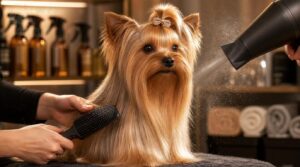
How you dry your Yorkie’s coat matters just as much as the bath itself. Done wrong, it can undo all that careful conditioning and leave you with frizz, mats, or a stressed-out dog.
Here’s what to do, step by step, from that first towel touch to the finishing spray.
Blotting Instead of Rubbing The Coat
Once your Yorkie steps out of the bath, resist the urge to rub — it’s the fastest way to create tangles in a silky coat. Instead, use soft towels and practice section blotting.
Press down with steady towel pressure, lift, and move to a fresh section. This respects hair direction, reduces shear stress on wet strands, and sets up cleaner drying methods for dogs with fine coats.
Using Low Heat to Protect Fine Hair
Fine hair and high heat don’t mix — and a Yorkie’s silky coat is no exception. When blow drying dog hair, use low heat settings, ideally between 250°F and 300°F.
Apply a protective heat spray before you start, then use the pre-drying method: blot first, rough-dry gently with controlled airflow, and finish cool.
Temperature monitoring throughout keeps your silky coat grooming guide results consistent.
Holding The Dryer Away From The Skin
Distance is everything when blow drying dog hair. Hold your blow dryer or high-velocity dryer at least 10 inches from the skin — never press the nozzle against the coat.
- Ideal Dryer Position: Angle airflow across the hair, not straight into the skin.
- Safe Airflow Angle: Move continuously to avoid concentrated heat.
- Skin Comfort Checks: Watch for squirming — reposition immediately.
Achieving tangle-free drying depends on consistent heat level control throughout.
Brushing Gently While Drying
Brushing while the coat is still damp is where tangle prevention truly happens. Use your pin brush with a Heat‑Safe Brush Grip—light pressure, smooth strokes. Damp Section Brushing with a Gentle Airflow Technique keeps static down and hair lying flat.
| Drying Stage | Brush Action |
|---|---|
| Very damp | Light Timed Brush Passes, tips only |
| Half-dry | Work toward roots, small sections |
| Nearly dry | Full stroke, Static‑Free Drying focus |
| Fully dry | Final smoothing pass |
Creating a Smooth Center Part
Once the hair is nearly dry, that’s your window for a clean center part. Run a fine comb along the midline from the forehead back — Comb Alignment matters here. For Hairline Definition, work in small slices. Heat Assisted Smoothing with a flat iron’s outer edge over the comb flattens stubborn roots beautifully.
- Start at the forehead and work backward
- Use small sections to keep the line straight
- Re-part if humidity shifts the split
Applying Leave-in Spray After Drying
Spray Timing begins once the center part of the coat appears clean and set. Reach for a water-based leave-in conditioner while the coat remains slightly warm. Product Selection is critical: choose formulas free from heavy silicones.
For Application Technique, mist lightly from mid-length to ends. In Humidity Management, a glycerin-based spritz coat conditioner helps Yorkie hair resist frizz.
Adhere to Frequency Guidelines: light, consistent spritzing outperforms heavy, occasional soaking.
Styling a Yorkie Top Knot Safely
Once the leave-in spray settles, you can attempt a topknot if your Yorkie’s hair is a few inches long. Separate a section above the eyes, twist gently, then secure with an elastic—knot length matters for proper tension.
Keep the tie snug but never pulled back too tightly.
Accessory selection and safety monitoring are critical, so never leave your dog unattended with a band on.
Handling Mats and Safe Trimming
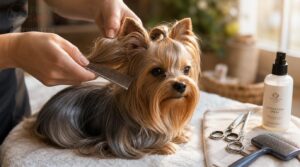
Mats don’t have to mean a bad day for you or your Yorkie. With the right approach and a little patience, you can work through knots safely and keep trims clean without causing stress.
Here’s what you need to know to handle it all with confidence.
Finger-combing Small Knots First
Your fingers are the best first tool you have. Before reaching for a comb, use tactile knot detection — slow finger sweeps through the hair — to feel exactly where each snag hides.
Apply the progressive unravel technique:
- Isolate a small section
- Apply gentle finger pressure control at the knot base
- Tease strands apart gradually
- Work tips toward roots
- Recheck before moving on
Patience timing matters here — rushing creates new tangles.
Using Detangler Before Dematting
Spritzing coat conditioner directly onto a mat before using tools is a cornerstone of effective silky coat grooming for dog owners. Detangling formulas with slip-boosting ingredients—silicones and conditioning agents—coat each strand, reducing friction so your comb glides instead of dragging. This method transforms stubborn mats into manageable sections while protecting the hair cuticle.
For optimal results, allow the product to work before combing. After applying, observe a pre-application soak time of 30–60 seconds, then initiate finger-first loosening to gently separate outer strands. This minimizes breakage and prepares the mat for tool use.
| Step | What to Do |
|---|---|
| 1 | Spritz detangler directly on the mat |
| 2 | Wait 30–60 seconds |
| 3 | Loosen outer strands with fingers |
| 4 | Apply controlled section pressure while combing |
| 5 | Reapply if the coat dries mid-session |
If resistance occurs during combing, pause immediately. Never forcing through resistance is critical—doing so risks skin injury or permanent coat damage. Persistent mats or distress signals (e.g., whining, flinching) are professional help indicators; consult a groomer to avoid trauma.
Working Mats From The Outside Inward
Once the detangler has soaked in, your outside-inward approach is what actually breaks the mat down. Think of it like unwinding a knot in headphone cables — you work the loose ends free before touching the tightest center. This technique delivers gradient force distribution across the mat, protecting skin tension while keeping tool reset reduction consistent.
Focus on:
- Freeing the outermost strands first for incremental section release
- Working inward in small strokes, rotating your comb slightly with each pass
- Stopping to reposition before resistance builds
This silky coat grooming guide principle — handling mats and tangled fur safely through detangling techniques — ensures managing knots, tangles, and mat removal remains controlled and prevents matting in silky coats from worsening.
Protecting The Skin With a Comb
Your comb is your skin’s best shield. Slide a wide-tooth spaced comb between the mat and skin before any trimming—it acts as a skin barrier guard that keeps scissors away from the surface. Use a gentle angle, sectioned combing approach to maintain clean comb hygiene throughout.
| Technique | Tool | Purpose |
|---|---|---|
| Wide-tooth spacing | Detangling comb | Reduces snagging |
| Skin barrier guard | Fine-toothed metal comb | Shields Yorkshire Terrier skin |
| Sectioned combing | Pin brush | Controls detangling techniques |
Trimming Paw Pads Every 4–6 Weeks
Paw pads are easy to overlook, but letting hair grow unchecked there causes real problems — slipping, matting, and trapped moisture. Trim your Yorkie’s paw hair every 4–6 weeks using blunt-ended scissors and gentle scissor use around tender skin. Styptic powder readiness is a must if nicks happen.
Build pad hygiene checks and hair length management into your owner grooming schedule, adjusting for seasonal trim adjustments as needed.
Maintaining Sanitary and Facial Areas
The face and sanitary zones need just as much attention as the rest of the coat. Wipe tear tracks gently with an eye wash pad daily — Tear Track Care keeps staining from setting into fine hair.
For Mouth Hygiene, brush with dog toothpaste using short strokes along the gum line.
Clean ears with a vet-approved solution for Ear Edge Maintenance, ensuring thorough yet gentle care.
Trim facial hair with blunt scissors to support Yorkshire Terrier Ear Eye and Skin Care year-round, maintaining both hygiene and appearance.
When to Call a Professional Groomer
Some situations call for a professional groomer, full stop. If brushing causes painful reactions, your Yorkie panics during sessions, or nail bleeding keeps happening at home, book an appointment.
Chronic skin irritation, coat change spikes during the puppy-to-adult shift, and deep mats near the skin all fall into the same category.
Grooming stress isn’t worth pushing through — professional grooming frequency and best practices exist for exactly these moments.
Professional Grooming Schedule
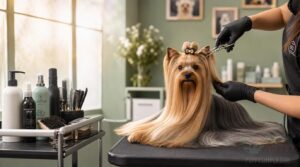
Even with solid home grooming habits, your Yorkie still needs a professional’s hands-on a regular basis. How often depends on the coat style you’re maintaining and the specific areas that need precision work.
Here’s what a smart grooming schedule actually looks like.
Grooming Every 6–8 Weeks for Pet Trims
Scheduling professional grooming every 6–8 weeks is ideal for most Yorkies in a pet trim. This consistent frequency keeps their hair manageable and simplifies coat growth tracking.
Regular visits also support cost management strategies by preventing severe matting, which can turn routine appointments into costly fixes.
Always request a post-trim skin check from your groomer to ensure your dog’s health.
Grooming Every 4–6 Weeks for Show Coats
Show coats require a tighter trim timing—every 4–6 weeks—to maintain even length and competition-ready lines. Consistent scheduling ensures coats remain polished and manageable.
Between professional visits, coat hydration matters just as much as cuts. Mid-cycle touch-ups, such as detangling knots, tangles, and mats around the ears and legs, help preserve that pristine finish. These small efforts prevent buildup and maintain smoothness.
Seasonal coat care also demands attention; during drier months, conditioning sprays must work harder to combat environmental stress. Adjusting hydration routines ensures coats stay supple and vibrant year-round.
Puppy Cut Maintenance Benefits
Not every Yorkie needs a show coat.
A short puppy cut keeps Yorkshire Terrier grooming far more manageable — offering Faster Grooming sessions, Fewer Tangles, and real Heat Relief during warmer months. Simplified Brushing and Lower Maintenance make it ideal for busy owners.
- Quicker daily brushing
- Less mat formation
- Cooler comfort in warm weather
- Easier coat maintenance between visits
- Simpler regular brushing benefits
Show Coat Maintenance Requirements
Maintaining a show coat demands a higher level of commitment than a puppy cut. Professional grooming visits every 4–6 weeks are essential to maintain consistent length, shape, and adherence to Show grooming standards. Texture Preservation relies on strategic bathing—scheduling baths a few days before competitions allows the coat to settle naturally.
| Factor | Show Coat | Pet Trim |
|---|---|---|
| Pro Visit Frequency | Every 4–6 weeks | Every 6–8 weeks |
| Home Brushing | Daily | 3–4x weekly |
| Bathing Schedule | Weekly | Every 2–3 weeks |
Heat Management during drying is critical to protect fine hair. Use low heat only, keep the dryer at a distance, and brush the coat into place as it dries. Over-drying eliminates volume. Coat Oil Balance is preserved by avoiding excessive bathing, ensuring the silky shine prized by show judges remains intact.
Ear, Face, Foot, and Sanitary Trims
These four trims — Ear Fringe Sculpting, Facial Brow Clearance, Toe Webbing Management, and Anal Hygiene Trim — keep your Yorkie clean between full groom visits. Trimming feathering with grooming scissors every four to six weeks maintains hygiene and appearance.
This regular maintenance clears debris near the topknot, protects paw pads, ensures Ear Canal Airflow, and manages toenail trimming. Consistent care prevents matting and discomfort in sensitive areas.
Don’t overlook ear cleaning, plucking, and infection prevention — it matters more than most owners realize. Prioritize these steps to safeguard your Yorkie’s health beyond basic trims.
Severe Matting and Skin Irritation Concerns
When mats go untreated, the consequences stack up fast. Friction-induced sores, moisture retention, and yeast hot spots aren’t just discomfort — they’re signs your Yorkie’s skin health is failing.
Painful detangling worsens issues when forcing a comb through tight Yorkie hair. Watch for urgent veterinary signs: swelling, oozing, or bad odor.
Safely handling matting and dematting, and preventing matting early, protects your dog before professional hair mat removal becomes the only option.
Home Grooming Versus Salon Grooming
Both options have real trade-offs. Home grooming vs. professional salon visits comes down to your time commitment, skill requirements, and budget. Salons bring sanitation standards, professional-grade tools, and consistent results — but cost more per visit. Home grooming cuts costs over time, though the equipment investment adds up.
For daily brushing and coat care for Yorkshire Terriers, home works well. Leave the complex cuts to the pros.
Top 7 Items to Skip
Not every popular pet product belongs in a Yorkie owner’s cart, no matter how many five-star reviews it has.
Some items are simply a poor match for a small, fine-coated breed such as yours.
Here are seven you can confidently leave on the shelf.
1. IDOGMATE Automatic Dog Ball Launcher
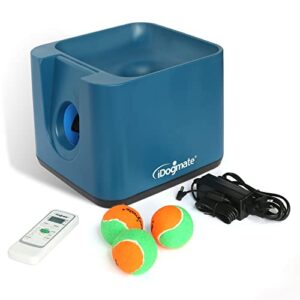
The IDOGMATE Automatic Dog Ball Launcher seems like an entertaining toy, but it has no place near your Yorkie. Designed for medium to large breeds, it launches 2.5-inch balls up to 35 feet or more—far too powerful for a small dog.
Its size and force make it impractical for tiny breeds, yet practical issues compound the problem. Reports of jamming and cheap plastic parts plague the device, undermining its $200 price tag. These flaws highlight poor value, especially for a product targeting pet owners.
Instead of risking injury or frustration, redirect your budget toward proper grooming tools. Your Yorkie’s safety and comfort depend on thoughtful, breed-appropriate investments—not oversized gadgets prone to failure.
- Runs on battery or AC power with up to 250 launches per charge, so you can keep the fun going indoors or outside
- Remote control lets you operate it from up to 40 feet away, which is handy for directing play without hovering
- Works with standard 2.5-inch tennis balls, so you’re not locked into buying special replacements
- Mechanical failures show up fast — jamming, stuck triggers, and roller issues are way too common for a $200 device
- Cleaning the inside is a hassle, and wet or slobbery balls leave behind fuzz and debris that speeds up breakdowns
- Real-world performance often falls short of the specs, with some users getting half the advertised remote range and launch distance
2. Fexfor 2K Pet Camera AI Tracking Treat Dispenser

The Fexfor 2K Pet Camera boasts impressive features—2K video, AI pet tracking, and a built-in treat dispenser—but it fails to address the specific needs of a Yorkie’s coat. Despite its 0.5-liter treat hopper for remote entertainment, the device does nothing to prevent the tangles and mats that silky hair develops daily.
Your grooming budget is better invested in practical tools like a quality pin brush or detangling spray. Gadgets can’t replace hands-on care for a breed with such high-maintenance fur.
- Crystal-clear 2K video with 360° rotation so you can keep an eye on your pet from any angle
- Built-in treat dispenser lets you reward or entertain your pet from anywhere, no subscription needed
- AI tracking and sound detection send instant alerts, doubling as a basic home security tool
- No vertical tilt means the camera can miss pets on furniture, stairs, or anywhere above or below the fixed line of sight
- Free cloud storage only saves 6-second clips — you’ll need a paid plan or micro-SD card for anything longer
- The suction-cup mount struggles on textured walls, and some users have run into Wi-Fi connection hiccups
3. PetsWorld Extra Large Dog Pee Pads
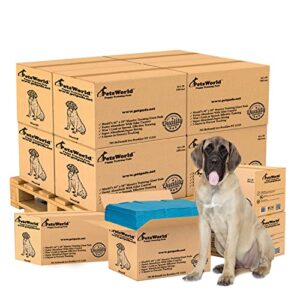
At 34 by 44 inches, the PetsWorld Extra Large Dog Pee Pads are built for Great Danes, not Yorkshire Terriers. A Yorkie barely covers a quarter of that surface, making these pads excessively large for smaller breeds.
You’re paying premium prices—up to $999.99 for a 1,200-pack—for far more pad than necessary. That budget belongs in your grooming kit, where it can fund tools that genuinely benefit your Yorkie.
A proper pin brush, detangling spray, or conditioning shampoo will actively enhance your Yorkie’s silky coat. Pee pads, however, won’t improve your Yorkie’s coat.
- Five-layer construction with a waterproof backing keeps messes contained and floors clean.
- The 28×44 inch size covers plenty of ground—great for big breeds or dogs that like to move around.
- Works indoors and out, so you can use them in crates, cars, or on the porch.
- At $999.99 for a 1,200-pack, the per-pad cost runs higher than most standard options.
- Edge leakage can happen if urine hits the sides—the barrier isn’t totally foolproof.
- Active puppies who dig or shake pads around may tear them pretty easily.
4. SportDOG FieldSentinel 1825 Remote Trainer

The SportDOG FieldSentinel 1825 is built for hunting dogs working a mile out in open fields — not a seven-pound Yorkie getting a brushout on your bathroom floor. Its rugged design and stimulation levels address challenges far beyond a small dog’s needs.
At over two pounds, with contact points designed for medium to large breeds, this collar is genuinely oversized for a Yorkie’s delicate neck and fine coat. The stimulation levels and rugged field design solve problems your Yorkie will never have. Skip it entirely.
- Built-in health monitoring keeps tabs on your dog’s heart rate and exertion in real time, so you catch problems before they become emergencies.
- One remote handles two collars, which is a genuine time-saver when you’re running multiple dogs in the field.
- Charges fully in about two hours, so you’re not sitting around waiting all morning before a hunt.
- The collar is big and heavy — over two pounds — which can be uncomfortable for smaller or more slender breeds.
- The tone alert is pretty quiet, so it gets lost fast near wind, water, or other field noise.
- Syncing the collar to the remote can drag on for several minutes each time, which gets old quick.
5. Renjjpbo Luxury Human Dog Bed
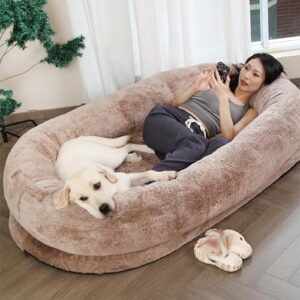
From a field trainer collar to a luxury lounging bed — both miss the mark for Yorkie grooming. The Renjjpbo Human Dog Bed is a cozy concept, but it won’t help you maintain that silky coat. Sharing a plush faux-fur surface with your Yorkie between grooming sessions can trap shed hair, debris, and oils against the coat, speeding up mat formation.
Spend that budget on a good pin brush and detangling spray instead.
- The faux-fur surface is genuinely soft and cozy — great for long nap sessions with a medium or large dog
- The zip-off cover is machine washable, so keeping things clean is actually pretty easy
- Comes in a solid range of sizes, so you can find one that fits your space and your dog
- Not a good fit if your dog likes to chew or dig — the fabric won’t hold up long
- The padded base can get heavy and awkward to move, even with the side handles
- As the text notes, the plush surface can trap hair, oils, and debris between grooming sessions, which speeds up matting for long-coated breeds
6. Prada Kristen Saffiano Mini Tote
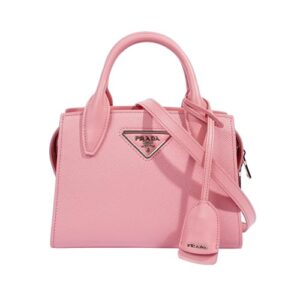
Moving from plush beds to designer bags — neither belongs in a Yorkie grooming kit. The Prada Kristen Saffiano Mini Tote is beautifully made, but it won’t hold your pin brush, metal comb, detangling spray, and scissors in any practical way. At 8.25 by 5 by 6 inches, it’s too small for grooming gear and too expensive to risk getting product residue on that petalo pink leather.
Save it for date night, not bath day.
- Saffiano leather is tough and scratch-resistant, so it holds up with regular use
- Converts easily from a handheld tote to a crossbody — super versatile
- Comes with a detachable key ring, dust bag, and authenticity cards right out of the box
- Small interior won’t fit much beyond the basics — forget tablets or water bottles
- Petalo pink leather needs consistent care to stay looking fresh
- The 21-inch strap might feel too long if you’re on the shorter side
7. Rolex Daytona 116518LN Yellow Gold Oysterflex
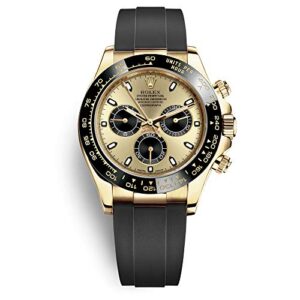
From designer bags to luxury watches — the theme here is clear. The Rolex Daytona 116518LN is a stunning piece of engineering, with its 18k yellow gold case, COSC-certified calibre 4130 movement, and Oysterflex bracelet.
It belongs on your wrist at a nice dinner, not on your arm while you’re elbow-deep in conditioner. That gold case scratches easily, and a wet, wriggly Yorkie won’t care how much it cost. Leave the Daytona on the nightstand before you pick up the pin brush.
- The COSC-certified calibre 4130 movement is seriously accurate, with about 72 hours of power reserve so it keeps running through the weekend.
- The Oysterflex bracelet is surprisingly comfortable for daily wear — flexible like a rubber strap, but with that solid metal-blade structure underneath.
- 18k yellow gold holds its value well over time, making this as much a financial asset as a watch.
- That gold case scratches easier than you’d hope for something at this price point — you’ll want to be careful with it.
- 100m water resistance is fine for a splash or swim, but don’t take it diving.
- The elastomer strap will eventually wear down and need replacing, which adds to the long-term cost of ownership.
Frequently Asked Questions (FAQs)
Do Yorkies like to sleep with you?
Yorkies crave independence yet rarely leave your side at night.
Yes, most Yorkies love sleeping with you — they’re wired for warmth, closeness, and security, making bedtime cuddles feel completely natural to them.
Can diet affect a Yorkies coat texture and shine?
Yes, diet directly affects coat texture and shine.
Omega-3s reduce skin inflammation, supporting overall skin health.
Protein builds keratin in hair shafts, strengthening the coat’s structure.
Proper hydration keeps skin oils balanced — all visibly reflected in your Yorkie’s coat.
How does humidity impact a silky Yorkie coat?
Picture your Yorkie’s coat on a muggy summer afternoon — frizzy, clingy, and twice as likely to tangle.
High humidity makes fine hair clump together, tightening knots into stubborn mats faster than you’d expect.
At what age should Yorkie grooming begin?
Start grooming your Yorkie around 8 to 12 weeks old. Short, gentle sessions with brushing and nail trims help your puppy build comfort before the full silky coat comes in.
Are certain coat colors more prone to dryness?
Funny enough, coat color doesn’t determine dryness. What really drives its over-bathing, low humidity, and poor nutrition.
Any Yorkie — gold, blue, or tan — can end up with a parched coat.
How do seasonal changes affect Yorkie coat care?
Seasonal shifts hit harder than most owners expect. Winter dries the coat out and makes fine hair brittle, while summer humidity causes frizz and speeds up tangling between sessions.
Conclusion
A neglected coat mats in days; a well-kept one turns heads for years. That contrast defines Yorkie silky coat grooming better than any single tip can. The tools matter, the sequence matters, and the consistency matters most of all.
What feels like a demanding routine now becomes second nature by the third week. Your Yorkie’s coat doesn’t need to be perfect—it needs you showing up, brush in hand, ready to do the work.
- https://www.petmd.com/dog/breeds/yorkshire-terrier
- https://www.yorkiesranch.com/post/the-ultimate-guide-to-brushing-your-yorkie-keep-that-coat-shiny-and-healthy
- https://lillianruff.com/blogs/news/best-dog-shampoo-for-yorkies?srsltid=AfmBOoqQWIQqL1OH7gdwJOho6EzxN5SWDYfsEOWEu5kJqxp5NvPbw8bL
- https://smoochie-pooch.com/yorkshire-terrier-care-grooming-bathing-health-tips/
- https://www.hotdogsgrooming.co.za/how-often-should-a-yorkie-be-groomed/