This site is supported by our readers. We may earn a commission, at no cost to you, if you purchase through links.

Most dog owners count from the day of breeding—and that’s exactly where the confusion starts. Canine gestation actually runs about 63 days from ovulation, not from mating, and since dogs can store sperm for up to seven days, the two dates rarely match. This gap explains why so many owners panic when day 63 passes with no puppies.
The full normal range stretches from 58 to 68 days, shaped by litter size, maternal age, and how precisely ovulation was timed. Knowing where your dog sits within that window—and what’s happening inside her body each week—makes the difference between calm preparation and unnecessary worry.
Table Of Contents
- Key Takeaways
- Dog Gestation Timeline Overview
- How Long Are Dogs Pregnant?
- How Dog Pregnancy is Timed
- Early Dog Pregnancy Stages
- Mid-Pregnancy Changes and Care
- Late Pregnancy Signs by Week
- How Vets Confirm Pregnancy
- Labor Stages and Delivery Timeline
- Frequently Asked Questions (FAQs)
- How many stages of pregnancy does a dog go through?
- How long are dogs pregnant?
- What happens at Week 3 of a dog’s pregnancy?
- What happens at the end of a dog’s pregnancy?
- Can a dog be pregnant in the first month?
- How long does a dog gestation cycle last?
- What day is a dog most likely to give birth?
- How many months is a dog pregnant for?
- What is the average size of a dog litter?
- What are the symptoms of labor in dogs?
- Conclusion
Key Takeaways
- Dog pregnancy lasts about 63 days from ovulation—not from breeding—so if you’re counting from mating day, your due date estimate could easily be off by a week or more.
- A delivery anywhere between days 58 and 68 is completely normal, shaped by litter size, breed, and maternal age, so don’t panic if day 63 passes quietly.
- Progesterone testing and ultrasound give you far more reliable timing than a calendar—relaxin in the blood confirms true pregnancy, while a rectal temperature drop below 99°F signals labor is within 24 hours.
- If your dog strains actively for more than 30 minutes without producing a puppy, or if labor stalls with pups still inside, that’s not a "’wait and see’ moment"—call your vet immediately.
Dog Gestation Timeline Overview

Dog pregnancy moves fast, and the timeline can catch even experienced owners off guard. Knowing the basics — how long gestation actually lasts, what’s normal, and what can shift your due date — puts you in a much better position to support your dog.
A closer look at the full dog gestation timeline shows just how much happens in those roughly nine weeks.
Here’s what the gestation timeline looks like from start to finish.
Average Canine Gestation Length
On average, canine gestation length runs about 63 days from ovulation — roughly nine weeks. This duration remains fairly consistent across most dogs, though breed-specific duration, maternal age, parity effects, and even environmental temperature can slightly influence timing. Seasonal shifts in timing are less predictable.
Counting from the LH surge refines the estimate to 65–66 days, offering a tighter, more reliable target.
Early pregnancy confirmation is possible via ultrasound can visualize embryos around day 22–30 of gestation.
Normal Pregnancy Range in Dogs
While 63 days is the anchor, the normal range for canine gestation spans 58 to 68 days — and both ends are completely healthy. Breed size, litter size variation, genetic timing factors, and environmental influences all play a role in where your dog lands within that window.
Key factors influencing timing include:
- Smaller litters sometimes arrive a day or two earlier
- Larger breeds may carry slightly longer than toy breeds
- Seasonal timing shifts can subtly affect delivery windows
- Genetic timing factors run in family lines — ask about the dam’s history
- Environmental influences like stress or temperature can nudge the timing either way
Why Exact Due Dates Can Vary
The tricky part is that canine gestation length and timing depends on more than a calendar. Sperm viability span means fertilization can occur days after mating, shifting the true conception date. Dam health variability, genetic timing differences, and environmental stress factors all nudge the clock.
Without hormone assay precision — measuring progesterone levels or detecting a temperature drop — pinning down your dog’s exact due date remains educated guesswork.
What Affects Pregnancy Timing
Several factors shape canine gestation length and timing beyond just the breeding date.
Breed variability plays a real role — smaller breeds sometimes differ from large ones. Maternal age, nutrition impact, and stress factors can all nudge ovulation timing or affect how progesterone levels rise. Even seasonal effects may subtly influence the cycle.
Dog gestation variability, in short, is genuinely biological.
How Long Are Dogs Pregnant?

Dog pregnancy doesn’t run on a fixed clock — it depends heavily on whether you’re measuring from the breeding date or the actual day of ovulation.
The answer shifts based on this starting point, and understanding each timeline is crucial. Here’s what each scenario looks like and why the difference matters.
About 63 Days From Ovulation
Canine gestation lasts exactly 63 days from ovulation, not breeding. Because a dog can mate before or after ovulation during estrus, simple date-counting is unreliable. Progesterone tests eliminate this uncertainty by pinpointing ovulation timing.
These 63 days are divided into four distinct phases:
- Days 1–14: Fertilization and implantation timing window
- Days 15–28: Early embryonic stages of canine pregnancy
- Days 29–50: Rapid fetal growth
- Days 51–63: Final development, signs of labor approaching
About 58–72 Days From First Breeding
If you’re timing by first breeding, expect anywhere from 58 to 72 days — that’s the typical window. Gestation duration hinges significantly on whether mating occurs pre-ovulation, at ovulation, or post-ovulation.
Breeder record-keeping aids accuracy, but litter size matters too. The correlation between puppy size and litter size means larger litters often arrive closer to 58–68 days, while smaller ones extend gestation.
| Breeding Timing | Gestation Range | Notes |
|---|---|---|
| Pre-ovulation mating | 65–72 days | Sperm waits for egg |
| At ovulation | 63–65 days | Most accurate window |
| Post-ovulation breeding | 58–63 days | Egg already released |
Why Breeding Date Can Be Misleading
Here’s the uncomfortable truth: a breeding date only tells you when mating happened — not when conception did. Sperm survival in the reproductive tract means fertilization can occur days after Multiple Matings, creating Fertile Window Ambiguity that throws off your due date calculation.
- Ovulation timing varies — LH surge and progesterone testing pinpoint it far better than any calendar
- Sperm can survive several days, shifting the true conception window
- Without tracking ovulation, your due date estimate can be off by more than a week
Stress Cycle Disruption, Breed Gestation Variance, and irregular cycles compound this further.
When a Pregnancy May Be Overdue
Most dogs deliver between days 58–68, so if your dog passes day 68 with no signs of labor, that’s worth a call to your vet. Fetal movement decline, amniotic fluid loss, and placental aging all accelerate past this window, raising stillbirth risk substantially.
A temperature drop below 99°F is one of the clearest signs of impending labor in dogs — without it, induction decisions may follow.
How Dog Pregnancy is Timed

Knowing your dog’s breeding date is a start, but it doesn’t tell the whole story. Vets actually use a few different reference points to figure out where a dog is in her pregnancy — and each one matters for different reasons.
Here’s how timing really works.
Breeding Date Vs Ovulation Date
The breeding date feels like the obvious starting point, but it’s actually a rough estimate at best. Sperm viability can stretch several days inside the reproductive tract, so fertile window estimation gets complicated fast.
Ovulation detection gives you far better due date precision because canine gestation is anchored to ovulation, not the mating itself. That’s why mating timing strategies and the actual estrus cycle stage matter more than the calendar date.
LH Surge and Progesterone Testing
The LH surge is your starting gun. Once progesterone assays confirm the surge — usually at 2.0–3.0 ng/mL — ovulation follows within 24–48 hours. Serial progesterone sampling every 1–2 days provides the clearest picture. Here’s what to watch:
- ~2.0 ng/mL — LH surge likely occurred
- 3.1–4.9 ng/mL — pre-ovulation phase
- 5.0–12.0 ng/mL — ovulation window; breed soon
- Rising trend — more reliable than any single result
Hormone testing and ovulation monitoring in dogs isn’t about hitting one magic number — it’s about reading the pattern.
Why Vets Date Pregnancy Differently
So why don’t all veterinarians give you the same due dates? Progesterone testing, ultrasound, and radiographic skeletal maturity each measure distinct aspects of canine pregnancy, leading to variability. Hormonal assay variability means two labs can interpret the same sample differently.
Ultrasound measurements introduce further complexity, as body size correction significantly impacts accuracy—requiring adjusted fetal measurements for very small or large breeds. This measurement bias shifts depending on breed-specific parameters.
Ultimately, veterinarians synthesize these methods collectively rather than relying on any single approach. Your vet weighs all diagnostic methods together, not individually, to determine the most reliable estimate.
How Litter Size Can Shift Timing
Litter size quietly nudges your due date more than most owners realize. A small litter delays birth because fewer puppies produce a weaker fetal cortisol surge near term, leaving progesterone elevated longer—that’s progesterone drop variability at work.
Research shows 70–75% of singleton or two-puppy pregnancies skip the expected hormonal signal strength shift entirely. The effect is modest, but it matters when you’re watching the calendar.
Early Dog Pregnancy Stages

The first few weeks of dog pregnancy are surprisingly quiet — your dog likely feels fine, and you probably won’t notice much at all.
But underneath the surface, a lot is already happening. Here’s what’s going on week by week, starting from mating.
Weeks 1–2 After Mating
Nothing looks different in weeks 1–2 — and that’s completely normal. Fertilization timing depends on ovulation, not the mating date, and sperm viability can extend several days inside the reproductive tract. Your dog is quietly in the pre-implantation phase, with embryo migration underway.
During this window:
- No visible belly changes occur
- Appetite and behavior stay normal
- Hormonal shifts are undetectable without a progesterone test
Weeks 3–4 Early Body Changes
By weeks 3–4, implantation detection becomes possible, and subtle changes begin quietly. Progesterone rise continues supporting the pregnancy, while early appetite changes and a subtle energy dip may appear.
You might notice mild abdominal swelling or enlarged nipples around days 25–35 — early signs of dog pregnancy that are easy to miss without knowing what to watch for.
Mild Signs Owners May Notice
Something’s a little off — that’s often how it starts. Early signs of dog pregnancy include a mild appetite dip, low energy, increased clinginess, or a subtle midsection puff around days 21–28. These subtle physical and behavioral shifts mark the initial phase.
You might also spot a nipple color shift to a deeper pink, alongside mild weight gain. These changes are easy to dismiss as a mood swing, blending into routine fluctuations.
False Pregnancy Vs True Pregnancy
False pregnancy in dogs mimics the first signs of true pregnancy—mammary changes, behavioral cues, and even milk production—all without puppies. These symptoms create a key diagnostic pitfall, as the conditions appear nearly identical early on.
Hormone profiles reveal the critical difference: true pregnancy produces relaxin, while false pregnancy never does. This absence of relaxin is the definitive diagnostic marker to avoid misidentification.
Relaxin is the definitive dividing line: true pregnancy produces it, false pregnancy never does
Most false pregnancies resolve within weeks without intervention. However, managing stubborn cases may require cabergoline, a medication that addresses underlying hormonal imbalances.
Mid-Pregnancy Changes and Care

By week five, your dog’s pregnancy shifts into a more visible and demanding phase.
Her body is working overtime, and what you do now — from what she eats to how you monitor her — makes a real difference.
Here’s what’s happening inside and out, and how to keep her on track.
Weeks 5–6 Fetal Development
By weeks 5 and 6, your dog’s puppies transition from clusters of cells into recognizable animals, as embryonic development accelerates rapidly. This critical window marks a period of significant transformation.
During this phase, key milestones occur:
- Neural tube closure seals the foundation for each puppy’s brain and spinal cord
- Heart tube pulsation begins, with tiny hearts beating around 110 times per minute
- Limb bud emergence produces the first stubby outlines of legs and paws
- Facial primordia form early eye and ear structures
- Organ system foundation lays down liver, muscle, and skeletal frameworks
Ultrasound imaging around day 25–35 can already detect fetal heartbeats — one of the most reliable diagnostic methods for confirming canine pregnancy.
Belly Growth and Nipple Enlargement
Around week 5, uterine expansion and increasing amniotic fluid push the belly outward noticeably.
Mammary development accelerates too — mammary glands swell, the areola darkens from hormonal pigmentation changes, and Montgomery glands become more prominent.
These are reliable signs and symptoms of dog pregnancy you can observe without tools. Gentle abdominal palpation at this stage may reveal the growing uterine mass beneath the skin.
Weight Gain During Mid-gestation
By week 5–7, your dog’s weight tells a bigger story than just "she’s eating more." Weight gain during mid-gestation reflects several simultaneous changes, with a 15–25% total body weight gain expected across this window.
- Fetal growth contribution accelerates rapidly
- Blood volume increase expands maternal circulation
- Uterine and mammary tissue expansion adds mass
- Amniotic fluid volume rises steadily
- Hormonal regulation shifts energy balance toward fat storage
Feeding Increases From Week 5
From day 29 onward, your dog’s caloric needs begin climbing — and feeding a pregnant dog week by week means staying ahead of that curve. Increase portions by about 5% each week, reaching 25–50% more by the final trimester.
Energy-dense meals support fetal growth without overloading her stomach.
Portion monitoring and hydration priorities are not optional — they’re the foundation of sound prenatal nutrition for pregnant dogs.
Switching to a Puppy Diet
Bumping up portions is only half the equation. What’s in the bowl matters just as much.
Around week 5 to 6, switch her to a puppy formula — it offers higher energy density, protein, and calcium without requiring supplements. To ensure a smooth transition and optimal development:
- Change Timing: Shift over five to seven days to protect her digestion.
- Nutrient Balance: Puppy food promotes fetal bone development and future milk production.
- Breed-specific Formulas: Match the formula to your dog’s size for ideal puppy development timeline outcomes.
Late Pregnancy Signs by Week

The final weeks of your dog’s pregnancy move fast, and the changes you’ll notice can feel almost daily.
Knowing what to expect helps you stay calm and ready when labor arrives. Here’s what’s happening from week 7 through the final days before delivery.
Weeks 7–8 Rapid Puppy Growth
By weeks 7 and 8, your dog’s pregnancy enters a fetal size surge — skeletal maturation is nearly complete, making puppies visible on x-rays, while rapid weight gain drives an energy requirement spike.
Uterine space limitation means her stomach can’t hold large meals comfortably. Some dogs show early colostrum onset near week 8.
Smaller, more frequent feedings keep her nutrition during gestation on track.
Week 9 Final Gestation Changes
By 9 weeks, most dams reach their final physical threshold. Appetite decline is common—the uterus leaves little stomach room, so frequent small meals work far better than two large ones.
Mammary swelling becomes pronounced, and milk production may begin.
Start temperature monitoring twice daily; a drop below 99°F signals that uterine contractions are close.
Nesting intensifies noticeably, and vulva dilation may become visible.
Visible Puppy Movement and Nesting
Around weeks 8–9, two key developments occur: abdominal skin tightening as puppies shift position, and the dog’s nesting behavior intensifies. Watch for these pre-whelping restlessness signs:
- Scratching and rearranging bedding repeatedly
- Seeking quiet nesting spots away from household activity
- The toy dragging habit — pulling blankets or clothing into her chosen area
- Visible ripples across the belly when puppies turn
- Nipple swelling cues becoming more pronounced alongside mammary firmness
Movement is easiest to observe when she rests on her side.
Smaller, More Frequent Meals
As stomach capacity shrinks in weeks 8–9, shift to 4–6 smaller meals daily instead of two large ones. This aids calorie partitioning without overfilling a compressed abdomen.
Appetite fluctuations are normal — splitting portions improves digestive comfort and keeps intake steady.
Your feeding schedule should deliver a balanced, nutrient-rich diet adapted to late-gestation nutritional requirements, adjusting portions as her belly grows.
Temperature Drop Before Labor
One of the most reliable signals in the gestation timeline is a rectal temperature drop. Here’s what daily monitoring should look like:
- Baseline Recording — Log her normal temperature (100.5–102.5°F) several days before the due window.
- Early Drop Indicators — A fall below 100°F signals the Hormone Temperature Link: progesterone declining.
- Daily Monitoring — Check at the same time each day.
- Interpreting Rebounds — Temperature often climbs back once stage one labor begins.
- Temperature Monitoring for Labor Prediction — If no stage two labor follows within 24 hours, call your vet.
Interpreting rebounds is critical, as temperature often climbs back once stage one labor begins. If stage two labor does not commence within 24 hours of the rebound, contacting a veterinarian is recommended.
How Vets Confirm Pregnancy
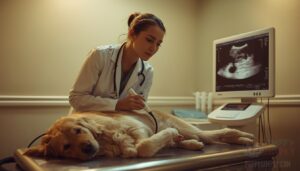
Suspecting your dog is pregnant is one thing — knowing for certain is another. Vets have several reliable tools to confirm pregnancy at different stages, and understanding which test serves which purpose helps you ask the right questions at the right time.
Here’s a look at each method your vet may use.
Relaxin Blood Test Timeline
The relaxin blood test is one of the most reliable diagnostic methods for canine pregnancy, but timing matters. This pregnancy hormone test becomes detectable around day 22–27, though the testing window for best accuracy is day 28 or later.
Positive detection reaches roughly 80% by day 28. False negatives occur when testing too early, particularly in small breeds.
Sample handling is straightforward: refrigerate within four hours.
Ultrasound Timing and Accuracy
Prenatal ultrasound is your clearest window into what’s actually happening in the uterus. Timing it right makes all the difference.
- Early scan window: Days 25–35 confirm pregnancy and show reliable fetal heartbeat detection.
- Image quality factors: Body fat and uterine position affect clarity.
- Operator skill impact: An experienced vet achieves sharper, more accurate reads.
- Breed size effects: Dogs under 9 kg or over 40 kg may require adjusted date estimates.
Palpation During Early Pregnancy
Palpation technique gives vets an early, hands-on clue about pregnancy — but the window is narrow. Between days 21 and 35, uterine swellings feel like small, fluid-filled sacs along the uterine horns. After day 38, they become harder to distinguish.
The body condition effect is real: extra abdominal fat makes the diagnosis of pregnancy in dogs less reliable, and operator experience matters greatly. False negative risk rises in tense dogs or with small litters.
X-rays for Puppy Count
Radiographs provide the clearest window into litter size, but timing is critical. The ideal imaging window opens around day 55, when fetal bones are sufficiently calcified for reliable counting.
The lateral view advantage is significant: it minimizes scatter and enhances contrast. Modern digital systems ensure excellent radiation exposure safety, addressing historical concerns.
Counting accuracy challenges persist in large litters due to puppy overlap. Implementing retake avoidance strategies begins with precise initial positioning, as errors in this stage often necessitate repeats.
Recommended Prenatal Vet Visits
Knowing your puppy count helps, but that’s just one piece of the prenatal picture. Three visits form the backbone of sound prenatal veterinary care for dogs: a pre-breeding exam before mating, a first trimester visit around days 25–30 for a blood test or ultrasound, and a late-gestation check for birth-planning consultation.
Your vet tailors the mid-gestation assessment to your dog’s specific needs.
Labor Stages and Delivery Timeline
Knowing what to expect at each stage makes a real difference when labor finally begins. The process moves through three distinct phases, each with its own timeline and warning signs worth watching for.
Here’s what you need to know about how the delivery process actually unfolds, from the first contractions to the final placenta.
Stage 1 Labor Signs and Length

Stage 1 labor announces itself quietly at first. Restlessness onset, shivering episodes, and panting spikes often appear before visible pushing begins. Cervical dilation occurs internally — your dog senses it even when you cannot see it.
Watch for:
- Nesting behavior and pacing
- Clear vaginal discharge
- Temperature monitoring showing a drop below 100°F
Uterine contractions typically sustain this phase for 6–12 hours.
Stage 2 Puppy Delivery Timing

Once active pushing begins, most litters arrive within 3–6 hours total. First puppy latency — the time from strong contractions to that first birth — runs up to 2 hours.
After the initial birth, puppy birth cadence settles into 30–60-minute intervals, with maternal rest cycles between each arrival being completely normal.
Amniotic rupture timing, usually occurring 20–30 minutes before the first puppy, signals that delivery is close.
Stage 3 Placentas and Cleanup

Stage three labor — placenta expulsion follows each puppy’s birth. Each placenta should pass within 5–15 minutes of its puppy. Count them carefully; the number of placentas must match the number of pups. A retained placenta quietly triggers metritis, a serious uterine infection.
Your dog performs maternal cleanup instinctively — licking, severing the umbilical cord, and stimulating each newborn.
Expect dark green lochia monitoring for up to six weeks post-delivery.
Normal Time Between Puppies

Between puppies, inter-puppy pauses of 30–60 minutes are completely normal during the whelping process. The first pup interval is often the longest — up to 4 hours with weak contractions.
Watch for these contraction break signs:
- Resting quietly between deliveries
- Licking and nursing newborns
- Paused visible straining
- Calm breathing between waves
Litter size also matters — larger litters simply take longer overall.
Red Flags That Need a Vet

Some signs during whelping aren’t "wait and see" — they’re call-the-vet-now moments. Below are critical indicators requiring immediate action:
| Red Flag | Why It’s Urgent |
|---|---|
| Dystocia warning: straining 30+ min with no pup | Puppy may be stuck |
| Uncontrolled bleeding or pale gums | Severe blood loss |
| Breathing distress at rest | Oxygen emergency |
| Severe vomiting or sudden collapse | System shutdown risk |
| Labor stops with pups still inside | Uterine inertia |
Emergency veterinary intervention during canine labor saves lives.
Frequently Asked Questions (FAQs)
How many stages of pregnancy does a dog go through?
A dog goes through three pregnancy stages, or trimesters, each lasting roughly three weeks.
These cover the Pre‑implantation Period, Embryonic Development Stage, and Fetal Growth Phase — totaling nine weeks total across the full canine gestation timeline.
How long are dogs pregnant?
Most pregnancies last around 63 days from ovulation — roughly nine weeks.
Maternal health, hormonal anomalies, and litter size can shift that window slightly, but the gestation period in dogs usually stays between 58 and 68 days.
What happens at Week 3 of a dog’s pregnancy?
By week 3, embryo implantation is complete. Tiny embryos attach to the uterine wall, triggering a hormonal shift peak.
Ultrasound detection becomes possible, yet a normal diet is maintained — extra calories aren’t needed yet.
What happens at the end of a dog’s pregnancy?
Near the end, a hormonal cascade triggers cervical softening, maternal nesting, and milk letdown. Your dog grows restless, eats less, and her temperature drops — labor is close.
Can a dog be pregnant in the first month?
Yes, a dog can absolutely be pregnant in the first month.
Embryo implantation typically occurs around day 16, however, early signs of pregnancy in dogs remain subtle — even vets rely on ultrasound or relaxin testing to confirm pregnancy.
How long does a dog gestation cycle last?
A dog’s gestation period in dogs runs about 63 days from ovulation — roughly nine weeks. Normal delivery falls anywhere between 58 and 68 days, making your due date an estimate, not a guarantee.
What day is a dog most likely to give birth?
Most dogs give birth around day 63 from ovulation — that’s the hormonal due date vets rely on. The full fertilization window means delivery anywhere between 58 and 68 days is completely normal.
How many months is a dog pregnant for?
A dog’s pregnancy lasts roughly two months — about 63 days, or 9 weeks. Despite gestation myths suggesting otherwise, the canine gestation period rarely stretches to three full months.
What is the average size of a dog litter?
Most litters average 5 to 6 puppies, though breed variation shifts that range widely. Toy breeds may have 1 to 3, while giant breeds can deliver 12 or more.
What are the symptoms of labor in dogs?
Watch for restless pacing, appetite loss, vaginal discharge, and abdominal contractions. Milk secretion near the nipples also signals labor is close. Temperature monitoring in labor helps confirm timing within 12–24 hours.
Conclusion
Picture yourself in that final week, one hand resting gently on her belly, feeling the faint ripple of puppies shifting beneath the surface. That quiet moment is where understanding how long dogs are pregnant—the gestation stages, the hormonal cues, the real 63-day ovulation clock—pays off completely.
You’re not guessing anymore. You know her timeline, you’ve tracked her temperature, and you’re ready. This clarity transforms uncertainty into confidence, ensuring every step is deliberate.
Calm preparation doesn’t happen by accident; it happens because you did the work early.