
This site is supported by our readers. We may earn a commission, at no cost to you, if you purchase through links.

Your dog bolted through the fence gap at 6 a.m. on a Tuesday. No warning, no dramatic buildup—just gone. That moment hits first-time pet owners like a gut punch, and it happens more than most people expect.
Dogs are escape artists by instinct, not rebellion. A scent catches them, a squirrel moves, and three seconds later you’re sprinting down the street in your socks. The right GPS tracker won’t stop every dash, but it narrows a two-hour panic into a two-minute locate-and-retrieve.
The technology has matured fast. Dual-frequency GPS, real-time cellular updates, virtual fence zones stored directly on the collar—these aren’t premium novelties anymore. Knowing which features actually matter for your situation, your dog’s size, and your budget cuts through the noise before you spend a dollar.
Table Of Contents
- Key Takeaways
- 10 Best Dog GPS Trackers
- 1. Halo GPS Dog Fence Collar
- 2. Fi Series 3 GPS Dog Collar
- 3. Dogtra Pathfinder 2 GPS Collar
- 4. SpotOn GPS Dog Fence Collar
- 5. FitBark GPS Dog Tracker
- 6. Petcube Dog GPS Tracker
- 7. Garmin Alpha Dog Tracking Bundle
- 8. SportDOG TEK GPS Tracker
- 9. Tractive XL Smart GPS Tracker
- 10. Apple AirTag Bluetooth Tracker
- Quick Picks for New Owners
- How GPS Dog Trackers Work
- Choosing Your First Dog Tracker
- Costs, Plans, and Batteries
- Safety Features Worth Paying For
- First-Week Setup Tips
- Frequently Asked Questions (FAQs)
- Conclusion
Key Takeaways
- GPS trackers don’t prevent escapes, but they shrink a frantic two-hour search into a two-minute locate-and-retrieve — making them one of the smartest investments a first-time dog owner can make.
- The right tracker depends on your specific situation: containment-focused collars like the Halo, suit fenced yards, while subscription‑free options like SpotOn or radio‑based systems like SportDOG TEK work better in rural or off‑grid areas.
- First-year costs run much higher than the sticker price once you add subscriptions, activation fees, and replacement bands — so run the full 12-month math before committing to any model.
- Setup matters as much as the hardware: fitting the collar correctly, drawing accurate geofence zones, testing alerts before your dog wanders, and sharing access with family all determine whether the tracker actually works when you need it.
10 Best Dog GPS Trackers
Finding the right GPS tracker for your dog comes down to a handful of features that actually matter — accuracy, battery life, and how fast it alerts you when something goes wrong.
If you want a side-by-side breakdown of top-rated options, this guide to the best GPS trackers for dogs covers durability and cost alongside the features that matter most.
The ten trackers below cover a wide range of budgets, dog sizes, and tracking needs, so there’s a solid fit whether you have a backyard escape artist or a trail-running companion.
Here’s what made the cut for first-time owners in 2026.
1. Halo GPS Dog Fence Collar
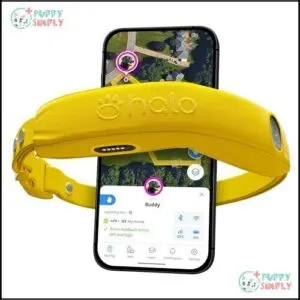
The Halo GPS Dog Fence Collar is one of the few trackers that actively contains your dog rather than simply alerting you after an escape. It uses dual-frequency L1/L5 GPS and PrecisionGPS AI to filter out interference from trees and buildings — which matters if your yard sits near dense cover.
Virtual fence boundaries store directly on the collar, so they work even without cellular service.
Training feedback escalates from tone to vibration to static, with 48-hour battery life per charge.
| Best For | Dog owners who want a wireless containment solution with real-time GPS tracking, especially those with medium-to-large breeds and open or semi-wooded properties. |
|---|---|
| Battery Life | 40+ hours |
| Water Resistance | Waterproof |
| Subscription Required | Yes ($9.99+/mo) |
| Location Technology | Dual-freq GPS L1/L5 |
| App Compatibility | iOS/Android |
| Real-Time Tracking | Yes |
| Additional Features |
|
- Dual-frequency L1/L5 GPS delivers strong location accuracy even near trees or buildings, reducing the dead zones common with single-frequency trackers
- Multi-modal feedback (tone, vibration, static) gives you flexible, escalating correction options to match your dog’s temperament and training stage
- Waterproof build and 40 hour battery mean it holds up through swim sessions, rainy days, and long weekends without babysitting the charger
- A mandatory monthly subscription (starting at $9.99) adds ongoing cost on top of the collar’s purchase price
- GPS and fence features depend on cellular coverage, so remote or signal-weak areas can compromise reliability
- Some users have reported loose hardware components and app lag, which can undermine training consistency if the fence boundary doesn’t activate on time
2. Fi Series 3 GPS Dog Collar
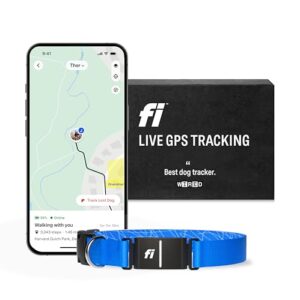
Where the Halo leans on containment, the Fi Series 3 takes a lighter approach — live tracking, escape alerts, and activity data without the training system.
It runs on LTE Cat-M1 cellular with multi-constellation GPS, fitting dogs from small breeds up to large with adjustable straps.
The IP68/IP66K rating accommodates submersion to 1.5 m, and impact resistance up to 400 lb makes it genuinely tough.
Hardware costs $209, plus $189 annually.
| Best For | Dog owners who want reliable GPS tracking and activity monitoring without a training system, especially those with active dogs who spend time outdoors in all weather conditions. |
|---|---|
| Battery Life | Up to 3 months |
| Water Resistance | IP68 |
| Subscription Required | Yes (free year 1) |
| Location Technology | GPS + cellular |
| App Compatibility | iOS/Android |
| Real-Time Tracking | Yes (delays possible) |
| Additional Features |
|
- Built-in LED flash and escape zone alerts make it easy to locate a wandering dog day or night
- IP68 waterproof rating means it holds up through swimming, rain, and muddy adventures
- Simple setup and multi-user access let the whole family (or dog walker) stay in the loop
- GPS accuracy ranges from 100–300 ft, so it narrows down a general area rather than pinpointing your dog’s exact location
- Escape alerts can lag up to 45 minutes, which isn’t ideal in a time-sensitive situation
- Full features like historical data and health insights require a paid subscription after the first year
3. Dogtra Pathfinder 2 GPS Collar
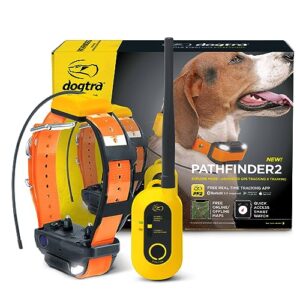
If the Fi Series 3 is your live-tracking workhorse, the Dogtra Pathfinder 2 adds something more hands-on: e-collar training controls built directly into the GPS system.
Priced at $365.49, it tracks up to 21 dogs across a 9-mile range with 2-second updates — practical for hunting, field training, or off-leash hiking. Smartwatch control via Apple Watch or Galaxy Watch keeps your hands free, and offline Mapbox maps mean remote areas won’t leave you guessing.
| Best For | Hunters, field trainers, and serious off-leash adventurers who need GPS tracking and e-collar control in one device. |
|---|---|
| Battery Life | Several days |
| Water Resistance | Waterproof |
| Subscription Required | No |
| Location Technology | GPS/GLONASS |
| App Compatibility | iOS/Android + Smartwatch |
| Real-Time Tracking | Yes (2-sec updates) |
| Additional Features |
|
- Tracks up to 21 dogs with 2-second updates across a 9-mile range — plenty of coverage for hunting and field work
- Smartwatch integration lets you trigger e-collar commands and check locations without touching your phone
- Offline Mapbox maps keep you oriented in remote areas with no cell signal
- No physical stimulation dial — all e-collar adjustments go through the app, which can slow response time
- Battery life may not hold up through multi-day trips without recharging
- Geofencing has size and shape restrictions, so it’s not ideal for small or oddly shaped yards
4. SpotOn GPS Dog Fence Collar
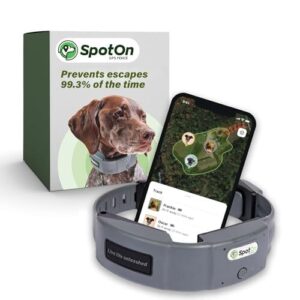
Want containment without buried wire or e-collar shocks? The SpotOn GPS Dog Fence Collar uses True Location technology, connecting to 128 satellites for boundary accuracy even under heavy canopy.
At $899, it’s pricier upfront, but you get unlimited virtual fences (0.5 to 100k acres), IP67 waterproofing, and 40+ hours of battery without a subscription. Forest Mode keeps signals steady in wooded terrain — a real advantage for rural properties.
| Best For | Owners of large or off-grid dogs—like rural property or farm dogs—who need flexible, wire-free containment over big or irregular areas. |
|---|---|
| Battery Life | 25–40 hours |
| Water Resistance | IP67 |
| Subscription Required | Optional |
| Location Technology | GPS (128 satellites) |
| App Compatibility | iOS/Android |
| Real-Time Tracking | Yes (subscription needed) |
| Additional Features |
|
- Dual-feed GPS with 128-satellite connectivity gives precise boundaries even under heavy tree cover or near water
- Unlimited virtual fences from 0.5 to 100,000 acres, set up easily through the app with no base stations or buried wire
- 40 hours of battery life without a subscription, plus IP67 waterproofing for rain, snow, or swimming
- Requires U.S. cellular service, so the app and tracking won’t work in regions without supported carriers
- High price point at $899, and high-energy dogs may drain the battery faster than expected
- Some users report intermittent hardware or tracking issues after extended use, sometimes requiring repair
5. FitBark GPS Dog Tracker

If you’ve ever wondered what your dog does all day while you’re at work, FitBark answers that question while keeping tabs on where they wander off to. Its Pinpoint Location System uses embedded cellular service for real-time updates every minute until your dog’s found.
It also tracks steps, sleep, and calorie burn, benchmarking against breed and age peers. Wi-Fi safe zones trigger instant alerts, and the device stays water resistant for everyday outdoor wear.
| Best For | Dog owners who want real-time location tracking and health monitoring in one lightweight device, especially those with active or escape-prone pets. |
|---|---|
| Battery Life | Up to 3 days |
| Water Resistance | Waterproof |
| Subscription Required | Yes ($10/mo) |
| Location Technology | 4G LTE GPS |
| App Compatibility | iOS/Android |
| Real-Time Tracking | Yes |
| Additional Features |
|
- Tracks your dog’s real-time location using 4G LTE across major US carriers, with safe-zone alerts so you know the moment they wander off
- Monitors activity, sleep, and calories, giving you useful health data to share with your vet or just satisfy your curiosity
- Lightweight at just 16g and waterproof, so it handles everyday outdoor adventures without getting in the way
- GPS accuracy can be inconsistent, especially in areas close to home where precision matters most
- Battery only lasts up to 3 days with regular use, and heavy tracking can drain it even faster
- Requires a $10/month subscription to unlock full GPS functionality, and the device has a three-year warranty with no support after that
6. Petcube Dog GPS Tracker

For owners who want simple over fancy, Petcube delivers solid 4G LTE tracking without extra bells and whistles. Updates refresh every few seconds, pinpointing your dog’s location within a few meters in open spaces.
A glow-in-the-dark shell, built-in buzzer, and LED light make nighttime recovery easier. Customizable virtual fences send timestamped alerts the moment your dog wanders off, and you’ll get low-battery warnings before the tracker dies mid-walk.
| Best For | Owners of medium to large dogs who want straightforward, no-frills GPS tracking with reliable real-time location updates. |
|---|---|
| Battery Life | Up to 30 days (power-save) |
| Water Resistance | Waterproof silicone |
| Subscription Required | Yes ($5+/mo) |
| Location Technology | GPS + LTE |
| App Compatibility | iOS/Android |
| Real-Time Tracking | Yes |
| Additional Features |
|
- Frequent location refreshes (every few seconds) for accurate, near real-time tracking in open areas
- Long battery life of up to 30 days in power-save mode, with a quick 1-hour full charge
- Built-in LED light, buzzer, and glow-in-the-dark housing make nighttime recovery much easier
- Requires an ongoing LTE subscription, starting at $5/month
- GPS accuracy drops indoors, under heavy tree cover, or in areas with weak cellular signal
- Virtual fences are limited to simple circular shapes, with no option for custom polygons
7. Garmin Alpha Dog Tracking Bundle
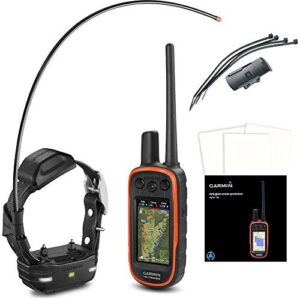
For hunters managing multiple dogs, the Garmin Alpha bundle is built for the job. One handheld tracks up to 20 collared dogs at once, showing speed, direction, and distance for each.
For hunters who also keep family-friendly companions at home, pairing tech-savvy tracking with low-maintenance, affable dog breeds makes managing a multi-dog household far less overwhelming.
You’ll get instant alerts when a dog goes on point or treed. An LTE option extends range beyond standard VHF, while multi-GNSS support keeps locations accurate across rough terrain. It’s rugged, waterproof, and priced for serious hunters — not casual backyard use.
| Best For | This bundle is best suited for serious hunters, ranchers, or search-and-rescue handlers who need to track and recall up to 20 dogs across large, rugged properties. |
|---|---|
| Battery Life | 20–40 hours |
| Water Resistance | Water-resistant |
| Subscription Required | Optional (maps) |
| Location Technology | GPS/GLONASS |
| App Compatibility | Handheld unit only |
| Real-Time Tracking | Yes |
| Additional Features |
|
- High-sensitivity GPS/GLONASS tracking with preloaded TOPO maps and a year of satellite imagery for accurate navigation in remote terrain
- Long battery life (20–40 hours) plus customizable training tools like adjustable stimulation levels, an LED beacon, and virtual geofence alerts
- Supports up to 20 collars and integrates with the Garmin T 5 tracker, making it ideal for managing multiple dogs at once
- Premium price, with extra collars running around $300 each and map subscriptions requiring renewal after the first year
- Collar is water-resistant but not fully waterproof, so prolonged submersion can cause damage
- Touchscreen sensitivity can lead to accidental menu taps, and the unit needs daily charging for full-day use
8. SportDOG TEK GPS Tracker
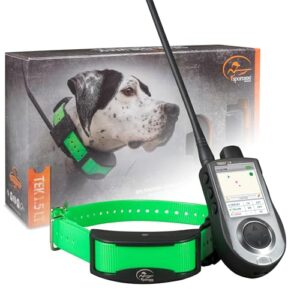
No cell towers, no monthly bill — just radio frequency and GPS doing the work. SportDOG’s TEK system tracks up to 21 dogs from one handheld using HopTek technology, with preloaded topo maps and lifetime updates included.
Collars are DRYTEK-built and submersible, so mud and creek crossings won’t faze them. The TEK 2.0L adds training stimulation on the same unit. Setup means a desktop app for firmware — not ideal for tech-shy beginners, but solid for serious fieldwork.
| Best For | Hunters and serious field trainers who need reliable, off-grid dog tracking without monthly subscription costs. |
|---|---|
| Battery Life | Not specified |
| Water Resistance | Waterproof (25 ft collar) |
| Subscription Required | No |
| Location Technology | GPS (HopTek) |
| App Compatibility | Handheld unit only |
| Real-Time Tracking | Yes |
| Additional Features |
|
- Tracks up to 12 dogs simultaneously within a 7-mile range using HopTek GPS technology
- Fully waterproof collar (submersible to 25 ft) handles rain, mud, and creek crossings with ease
- Combines GPS tracking and remote training correction in one unit, eliminating the need for separate devices
- Collar requires recalibration or re-pairing after each use, which adds setup time before heading out
- LCD screen is hard to read in bright sunlight, and the moving-dog icon gives minimal visual detail
- No street-level maps — only shows distance/yardage, and some users report occasional location lag
9. Tractive XL Smart GPS Tracker
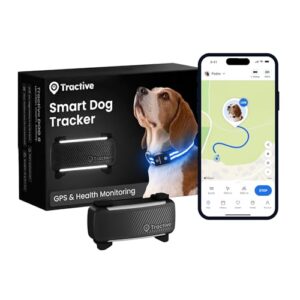
Tractive’s XL covers 175+ countries via LTE with location updates every 2–3 seconds — reliable enough for a dog that bolts through the park before you blink. Battery life stretches to roughly one month on passive tracking, and the waterproof, snag-resistant housing controls mud, rain, and dense undergrowth without complaint.
Virtual fence alerts reach your phone within seconds, and heart rate plus respiratory monitoring adds a quiet health layer most trackers skip. Subscription required, but the hardware costs just $69.99.
| Best For | Dog owners who want real-time location tracking and basic health monitoring in one device, especially those who hike, travel, or have escape-prone dogs. |
|---|---|
| Battery Life | Up to 1 month |
| Water Resistance | Waterproof nylon |
| Subscription Required | Yes |
| Location Technology | Cellular GPS |
| App Compatibility | iOS/Android |
| Real-Time Tracking | Yes (2–3 sec updates) |
| Additional Features |
|
- Location updates every 2–3 seconds give you near-instant awareness of where your dog is at all times
- Built-in heart rate and respiratory monitoring adds a health safety net most GPS trackers don’t offer
- Waterproof, durable construction and a month-long battery make it practical for everyday outdoor use
- Requires an ongoing cellular subscription on top of the hardware cost
- GPS accuracy can drop in dense forests or crowded city environments
- Monthly recharging is manageable but easy to forget, and a dead battery means no tracking
10. Apple AirTag Bluetooth Tracker
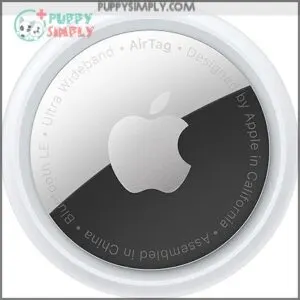
The Apple AirTag wasn’t built for dogs — and that honesty matters. It has no GPS or cellular radio, relying entirely on Bluetooth and Apple’s crowdsourced Find My network to update location.
In a busy neighborhood, that works surprisingly well. In a rural field or forest, it falls apart fast.
There’s no geofencing, no escape alerts, and no subscription — but no real-time tracking either.
Attach one to a collar as a backup, not a primary safety net.
| Best For | Apple ecosystem users who want a low-cost backup tracker for everyday items like keys, wallets, or luggage — not a primary safety device. |
|---|---|
| Battery Life | ~1 year (CR2032) |
| Water Resistance | Unrated |
| Subscription Required | No |
| Location Technology | Bluetooth/UWB |
| App Compatibility | iOS/iPadOS only |
| Real-Time Tracking | No (crowd-sourced only) |
| Additional Features |
|
- Simple one-tap setup through the Find My app with no subscription required
- Precision Finding on UWB-enabled iPhones makes locating nearby items fast and accurate
- Leverages hundreds of millions of Apple devices as a passive, crowd-sourced tracking network
- No GPS or real-time tracking — location updates depend entirely on nearby Apple devices
- Useless in rural or low-population areas where the Find My network is sparse
- Apple-only ecosystem with no native Android support
Quick Picks for New Owners
Not every dog tracker will be the right fit for every owner, so narrowing down your options early saves a lot of second-guessing. The five picks below cut straight to what matters most — budget, dog size, location, and lifestyle. Start here to find the one that actually matches your situation.
Best Overall Tracker
If you want one tracker that just works, the Fi Series 3 earns the top spot. It delivers sub-4-meter GPS accuracy, IP68 waterproofing, and roughly seven days of battery life per charge.
Real-time location updates keep escape alerts fast, and the app’s clean interface makes safe zones simple to set and share with family.
Best Budget Option
Not every first-time owner needs to spend $200 upfront. Budget GPS trackers usually run $4–$6 per month on subscription, with device costs well under $100 — keeping your first-year ownership cost low while still delivering real-time tracking and escape alerts.
Battery life lands around 3–7 days, which is plenty for most daily routines.
Best No-subscription Choice
Skipping monthly fees entirely? The Apple AirTag is your best bet, using Bluetooth proximity and nearby iPhones for offline location history.
- No bills creeping up each month
- Peace of mind without ongoing cost
- Freedom from app subscriptions piling up
It relies on local networks, not cellular, but for pet identification and long-term savings, it’s hard to beat.
Best for Small Dogs
Tiny breeds need lightweight collar comfort, not bulk. The Tractive Dog 6 Mini fits this job, with a slim profile that prevents chafing and snagging on brush. Adding breakaway collar safety ensures the tracker stays secure without choking risk.
| Feature | Tractive Dog 6 Mini |
|---|---|
| Weight | 1 oz |
| Battery | Up to 7 days |
| Geofencing | Small-yard zones |
Realtime location tracking and activity monitoring come standard, all through an affordable subscription plan built for small dog compatibility.
Best for Rural Areas
Open fields and weak signal pockets call for the Tractive XL GPS Dog Tracker. It delivers signal reliability through multi-network roaming, LTE connectivity, and global cellular coverage for true terrain navigation.
- Precise GPS tracking in open land
- Solar charging accessory for off-grid trips
- Ruggedized housing against brush and equipment
- Realtime location tracking with minimal lag
- Geofences covering hundreds of acres
How GPS Dog Trackers Work
Before you pick a tracker, it helps to know what’s actually going on under the hood — because not all of these devices work the same way.
Some rely on satellites, others piggyback on cellular towers, and a few use radio signals that don’t need a network at all.
Here’s a breakdown of five key things that shape how well a GPS tracker performs in the real world.
GPS Versus Bluetooth Tracking

GPS and Bluetooth aren’t interchangeable — they solve different problems. A GPS collar for pets delivers realtime geolocation across wide areas using cellular data, while Bluetooth tags only work within 10 to 100 meters of your phone.
| GPS Tracking | Bluetooth Tracking |
|---|---|
| Wide-range coverage | Short-range only |
| Needs cellular data | No subscription needed |
| Higher battery drain | Months of battery life |
| Live updates | Last-known location |
Cellular Coverage Basics
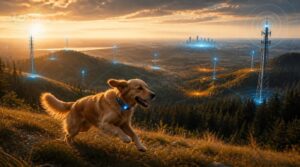
Every GPS dog tracker you buy depends on one invisible backbone: the cellular network. When your dog bolts, the tracker pings the nearest base station, routes data through the central network, and delivers a location to your phone. No signal, no update.
No signal, no update — every GPS dog tracker lives and dies by the cellular network
- LTE Cat-M1 and 2G networks form the foundation most trackers run on
- Signal handoff reliability keeps tracking active as your dog crosses cell boundaries
- Terrain signal interference — hills, dense trees, buildings — weakens or delays updates
- Base station distance directly affects update speed and positional accuracy
- Indoor coverage solutions like distributed antenna systems help in garages or basements
Higher frequencies push faster data but lose strength quickly against obstacles. That’s why trackers using multi-band LTE maintain stronger connections across varied terrain than single-frequency devices. Cellular coverage maps from your carrier matter more than most owners realize — check yours before buying.
Radio Frequency Tracking

Cellular towers aren’t the whole story. Some trackers lean on radio frequency tech, where tags emit signals that readers capture using triangulation — pinpointing your dog’s spot from multiple angles for sharper RF signal precision.
Walls and trees cause signal interference, but encrypted transmissions protect your pet’s location monitoring.
Efficient tags sip power, balancing live tracking against tag battery life.
Real-time Location Updates
How fast does your dog’s dot move on the map? Updates fire every 1–5 seconds during active tracking, slowing down once your pup settles in for a nap.
Network latency stays under 2 seconds on solid LTE, though weak signal stretches that gap.
Hybrid positioning blends GPS, cellular, and motion data, keeping real‑time pet location steady through data redundancy.
Accuracy in Woods

Trees swallow weak signals whole — that’s why woods separate good trackers from great ones. Multi-constellation support, drawing on 128 satellites across GPS, GLONASS, Galileo, and BeiDou, keeps precision GPS locked under heavy cover.
Forest mode performance hinges on:
- Canopy signal penetration
- Multisatellite positioning
- Offline map accuracy
- Dual-frequency precision
- Urban canyon tracking
Choosing Your First Dog Tracker

Picking your first GPS tracker isn’t just about specs on a box. Your dog’s size, habits, and daily routine all play a role in what actually works. Here’s what to weigh before you commit to one.
Match Your Dog’s Size
A tracker that’s too heavy turns a collar into a burden, not protection.
Start by measuring chest girth behind the front legs, then match the weight to the breed — a Fi Mini suits small dogs, while a Tractive XL or DOG 6 XL fits larger frames.
Puppies need adjustable units for growth, and long fur demands extra room to prevent collar slip.
Consider Escape Habits
Size won’t matter if your dog is a born escape artist. Visual triggers — squirrels, neighbor dogs — spark chases, while scent trails lure curious noses toward gaps.
Diggers test soft dirt near posts, and warmer seasons spike activity. Routine disruptions, like new neighbors, raise testing behavior. That’s why geofencing with virtual fence alerts and realtime escape alerts helps pet escape prevention.
Check Collar Comfort
Once you’ve tackled escape-proofing, the tracker itself needs to sit right. The two-finger rule is your baseline — two fingers between collar and neck, no more, no less.
- Lightweight nylon webbing reduces neck fatigue
- Soft edge finishing prevents chafing during extended wear
- Quick-release buckles avoid hardware snagging on fur
- Monitor skin weekly for redness or irritation
- Re-check fit after seasonal coat changes
Review App Simplicity
A well-fitted collar means nothing if the app frustrates you at 2 a.m. Look for single home screen clarity — one map, one location button, your dog’s position at a glance.
The best dog tracking apps pair easy-to-use map navigation with custom alert sounds and accessible onboarding, so you’re never squinting through menus when it matters most.
Think About Travel
If you travel often, pick a tracker offering true global coverage, not just home-turf range. Confirm cellular network compatibility before road trips or flights abroad. Look for:
- Verified cellular coverage along routes
- Remote location sharing for family
- International power adapters included
- Vehicle travel setup compatibility
These details keep realtime tracking and outdoor pet protection solid wherever your travels lead.
Costs, Plans, and Batteries
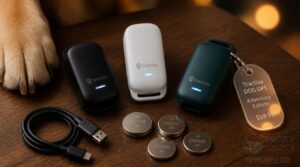
Price tags and battery specs vary more than most first-time buyers expect. Some trackers charge monthly fees, others skip subscriptions entirely, and battery life swings from days to weeks depending on the model. Here’s what actually affects your wallet and your charging routine.
Monthly Subscription Costs
Subscription plans range widely: Standard runs $9.99/month, Premium hits $14.99, and Family or Enterprise climb higher.
| Tier | Monthly Cost | Key Feature |
|---|---|---|
| Standard | $9.99 | Basic tracking |
| Premium | $14.99 | Real-time alerts |
| Family | $19.99 | 3 dogs |
Annual billing saves two months free. Watch for international roaming fees and throttled updates on cheaper tiers.
No-fee Tracker Options
A handful of trackers skip subscriptions entirely. Apple’s AirTag and Tile Pro dog collar rely on Bluetooth connectivity instead of cellular networks, trading constant updates for zero fees.
- One-time hardware cost
- Subscription-free geofencing
- Offline map utility
- Slower update frequency
- Bluetooth-only range limits
First-year Ownership Cost
Most first-time buyers focus on the sticker price and miss what the first year actually costs. Hardware vs subscriptions together tell the real story.
| Tracker | Hardware Cost | First-Year Subscription |
|---|---|---|
| Fi Series 3 | $209 | $189 |
| Tractive Dog 6 | $69.99 | $108–$120 |
| PitPat GPS | $229 | $0 |
| Apple AirTag | ~$29 | $0 |
| Petcube GPS | ~$50 | ~$60–$80 |
Activation fee impacts are easy to overlook — expect $5 to $25 upfront on cellular models. Replacement part expenses like bands add another $10–$40 annually. If your dog is rough on gear, an insurance plan value check makes sense: monthly protection plans run $0–$15 and may cover loss or theft.
Watch data plan overages too. Some subscription-based services cap daily location updates, pushing you toward pricier tiers for real-time tracking. The price-to-value ratio shifts fast once you factor in those hidden bumps.
Monthly subscription costs vary wildly — $5 to nearly $15 — so run the full 12-month math before committing.
Battery Life Trade-offs
Weight versus capacity decides everything here. Bigger packs mean longer runtime, but bulkier collars.
- Cold weather cuts hours 10–30%
- Live tracking drains battery fast
- Adaptive power modes stretch runtime
- Weak cellular signal accelerates drain
- Frequent updates shorten daily life
Pick adaptive power modes for genuinely long battery life without sacrificing GPS accuracy.
Charging Speed Matters
Charging speed can make or break busy mornings. Most trackers use USB-C, hitting full charge in about an hour—though heat, cheap cables, and cold weather slow things down. Smart charging protocols protect battery longevity by tapering current near full. For real battery performance, charge between 20–25°C and skip bargain cables.
| Charging Factor | Impact | Quick Tip |
|---|---|---|
| Temperature | Cold slows charging; heat triggers throttling | Charge near room temp |
| Cable Quality | Worn cables cause stalls or slow fills | Use rated, high-gauge cables |
| Charging Curve | 10–80% charges faster than 50–100% | Top up before full drain |
| Protocol Type | Smart charging adjusts current near full | Avoid switching modes mid-charge |
Safety Features Worth Paying For

Not every safety feature on a spec sheet is worth your money, but a few genuinely make a difference when your dog decides to test your fences. First-time owners often overlook these until something goes wrong — and by then, you’re wishing you’d paid closer attention.
Here are the five features that consistently earn their place on a tracker.
Escape Alerts
When your dog slips under the fence, escape alerts are your first line of defense. Most trackers send push, SMS, or in-app notifications within 1–5 seconds of a boundary crossing.
You can configure alert urgency, silence them during crate time, and share silent caregiver alerts with family. Tamper detection also flags collar removal instantly.
Virtual Fence Zones
Think of a virtual fence as a custom boundary you draw on a map — the collar responds the moment your dog approaches it.
Boundary buffer settings let you widen that reaction zone, so an audio warning sounds before your dog actually crosses the line, not after.
GPS signal drift can occasionally cause false alerts, but most systems compensate automatically.
Waterproof Durability
Your dog’s tracker needs to survive more than a rainy Tuesday. IP68 waterproof rating means submersion past 1.5 meters — not just splash resistance.
Fi Series 3 carries both IP68 and IP66K certification. Rubber gaskets, sealed charging connectors, and corrosion-resistant hardware keep water out through collar flex, cold swims, and mud.
Inspect seals periodically; degraded gaskets quietly compromise protection.
Night Visibility Lights
Dry collars deserve visible eyes too. Quality trackers add:
- LED Brightness Range up to 150 lumens
- Adjustable Light Modes for battery savings
- Weatherproof Lens Durability against rain and brush
- Bright LEDs enhanced sound for nighttime collision safety
Battery drain impact stays minimal—sound alerts and steady LED night visibility keep your dog seen, not just heard.
Health Monitoring Alerts
Once the collar’s on, the tech keeps working long after the walk ends. Smart Health Monitoring tracks critical sign trends, sleep quality insights, and daily activity, flagging changes before symptoms show.
AI pain detection and behavior anomaly alerts catch scratching, limping, or odd stillness. Dietary health scans round out pet wellness monitoring, giving vets real data instead of guesswork.
First-Week Setup Tips
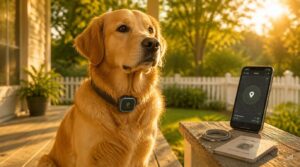
Getting your tracker out of the box is the easy part. The real work happens in those first seven days, when small setup choices decide whether the device actually earns your trust. Here’s what to handle before you let your dog wander far from the yard.
Fit The Collar Properly
Getting the fit wrong is one of the most common first-week mistakes. Slide two flat fingers under the collar at the base of your dog’s neck — snug but not pinching — and you’ve found the sweet spot.
- Check fit weekly for puppies; growth happens fast
- Part thick fur to confirm actual skin contact
- The D-ring should face outward, collar sitting mid-neck
- Redness or hair loss means adjust immediately
Create Safe Zones
Once your collar is fitted, open the app and draw your first safe zone around your yard. Boundary accuracy sits within 5–20 meters, so set the fence slightly inside your property line.
Create separate zones for travel or parks — you can resize them instantly without touching the hardware. Run a boundary rehearsal drill early to confirm escape alerts actually fire.
Test Alerts at Home
Walk your dog just past the boundary line and watch your phone. Push notifications should arrive within 15 seconds — if they don’t, your app permissions likely need adjusting.
Here’s what to verify during your first home test:
- Notification delay stays under 15 seconds
- App permissions allow alerts when screen is locked
- Alert volume isn’t muted in notification settings
- Boundary breach logs appear in event history
Share Access With Family
Your dog’s tracker isn’t much use if you’re the only one watching it.
Most apps let you invite trusted family members instantly — each person gets a unique access profile with individualized notification preferences and view-only or full admin permissions you control remotely.
| Family Member | Access Level | Notifications Enabled |
|---|---|---|
| Primary caregiver | Full admin | All alerts |
| Partner/spouse | Full admin | Geofence + emergency |
| Grandparent | View only | Daily summary |
| Dog walker | View only | Live location |
| Emergency contact | Emergency override | Critical alerts only |
Emergency override protocols mean a designated contact bypasses quiet hours entirely when something’s wrong. You can revoke any access instantly — single button, done.
Practice Recall Training
A GPS tracker finds your dog — but recall training brings them back on command.
Start close, 5–10 feet, using one consistent cue like "come" in a cheerful tone. Reward immediately with high-value treats.
Gradually extend distance, add distractions, and practice in multiple environments. Your dog collar GPS and training work best together.
Frequently Asked Questions (FAQs)
What states are banning GPS?
Fourteen states ban or restrict GPS tracking without consent — California, Florida, and Louisiana lead with broad electronic bans, while Delaware, Texas, and Oregon specifically target vehicle installations. Know your state before buying.
Is GPS or AirTag better for dogs?
For a dog, GPS wins easily. AirTag relies on Bluetooth proximity through nearby iPhones — unreliable in rural areas. A GPS tracker gives you live cellular tracking, geofence alerts, and real-time updates every few seconds.
Can GPS trackers work without a smartphone?
Yes — several GPS trackers work via web portals, satellite networks, or LoRa gateways without a smartphone. Standalone devices with built-in SIMs send real-time location data directly to a browser-accessible portal.
Are dog trackers safe for puppies to wear?
Most trackers are safe for puppies, but keep it under 20 grams to avoid neck strain. Resize as your puppy grows, and consult your vet if they have any spinal concerns.
Do trackers interfere with existing dog collar tags?
Think of a tracker as a collar roommate — it shares the space but doesn’t push ID tags out. Most units mount beside tags, keeping engraving and contact details fully readable without touching microchip systems.
How do I update tracker firmware automatically?
Most trackers update automatically overnight when charging and connected to Wi-Fi or cellular. Your companion app notifies you when firmware installs. If an update fails, reconnect and retry — the device resumes without data loss.
What happens if my dog swims frequently?
Frequent swimming can strip your dog’s coat natural oils, trigger swimmer ear infections, and cause dry skin. Rinse with fresh water after every swim, dry ears thoroughly, and keep your dog hydrated.
Conclusion
Like a seatbelt you hope never to use, the best dog GPS trackers for first-time pet owners matter most in the moment you least expect.
Your dog doesn’t plan escapes—but you can plan the recovery.
Pick a tracker that fits your dog’s size, your yard’s boundaries, and your budget’s reality.
Set the geofence. Test the alert. Then let your dog run.
Confidence isn’t hoping they stay close—it’s knowing you’ll find them fast.
- https://www.petivity.com/products/gps-dog-tracker
- https://aorkuler.com/blogs/blog/best-no-monthlyfee-no-subscription-dog-gps-trackers
- https://www.consumerreports.org/electronics-computers/gps-pet-trackers/best-gps-pet-trackers-a1117406199
- https://www.life360.com/blog/gps-dog-collars
- https://www.nytimes.com/wirecutter/reviews/best-gps-pet-trackers