This site is supported by our readers. We may earn a commission, at no cost to you, if you purchase through links.

Your dog sits perfectly. You reach for a treat, fumble with the bag, and reward her three seconds later—right as she’s already standing up to sniff your hand. Congratulations: you just taught her to stand.
This is how well-meaning owners accidentally build the wrong habits, one mistimed treat at a time. The delay between command and treat isn’t a minor technicality—it’s the difference between a dog who reliably responds and one who half‑listens and guesses.
Dogs operate on a two-to-three-second memory window, meaning your timing determines exactly what behavior gets reinforced. Get it right, and training clicks into place faster than you’d expect.
Table Of Contents
- Key Takeaways
- Ideal Delay Between Command and Treat
- Why Treat Timing Matters
- Use Markers to Bridge Delays
- Treat Timing for Common Commands
- Fix Delayed Reward Problems
- Frequently Asked Questions (FAQs)
- Does emergency department overcrowding cause delay in treatment?
- What is admission delay?
- What are the predictors of delays in the treatment process?
- Can treats be replaced with praise or play?
- Does reward timing differ by dog breed?
- How does age affect a puppys reward response?
- Should timing change for fearful or anxious dogs?
- Conclusion
Key Takeaways
- Dogs operate within a 2–3 second memory window, so a treat delivered even one second late stops reinforcing the right behavior, and starts teaching whatever your dog is doing at the moment of delivery.
- Research shows immediate rewards produce a 60% success rate in correct behavior, compared to just 25% when you delay by even one second — making split-second timing one of the most consequential variables in training.
- Markers like a clicker or a short word ("Yes!") bridge the gap between behavior and treat, freezing the exact moment of success in your dog’s mind, so physical reward delivery can follow without breaking the association.
- Practical fixes — pre-loading treats, using a wide-mouth training pouch, rewarding in position, and keeping sessions under 10 minutes — remove the mechanical delays that quietly undermine even well-intentioned training.
Ideal Delay Between Command and Treat

Timing is everything in dog training, and the window between a correct behavior and your reward is smaller than most people think. Getting this right doesn’t require perfect reflexes — it requires understanding a few clear principles. Here’s what to focus on regarding ideal treat timing:
Mastering treat timing during training sessions comes down to rewarding the exact moment your dog does the right thing — not a second before or after.
Aim for One Second
One second. That’s your target window for every treat you deliver.
Research shows dogs rewarded immediately after correct behavior succeed 60% of the time, while even a one-second delay drops that rate to 25%. This highlights why immediate reward timing. Three things undermine your timing without you realizing it:
- Your dog shifts position mid-reward
- Your hand moves too slowly from your pocket
- Your attention drifts between behavior and delivery
Reward The Correct Behavior
Timing means nothing if you’re rewarding the wrong moment. The treat must land on the exact behavior you want repeated — not what came before or after. Reward the action itself, not the dog’s anticipation or the release. If your dog sits, reward the sit. That precise connection is what builds reliable, repeatable responses.
Avoid Treating Too Late
Late treats don’t just slow learning — they teach the wrong thing. Once that five-second window closes, your dog has already shifted mentally to the next action, and whatever they’re doing in that moment gets reinforced instead.
A dog who sits beautifully but receives the treat while standing up learns, functionally, to stand. Precision timing isn’t optional — it’s the whole mechanism.
If your dog gets the treat while standing, you’ve taught standing — precision timing is the whole mechanism
Watch Your Dog’s Timing
Your dog is always telling you something — you just have to pay attention. Watch for behavioral drift: the micro-movements between command and reward reveal exactly where your timing slips. If your dog starts fidgeting before the treat arrives, you’re running a second too long. Tighten that window, and their focus sharpens immediately.
Why Treat Timing Matters

Timing isn’t just a detail in dog training — it’s the whole game. Your dog’s brain is constantly making connections between what it just did and what happened next, and those connections form fast. Here’s why getting that window right changes everything about how quickly your dog learns.
Dogs Link Immediate Rewards
Your dog’s brain works fast. The instant a treat lands within one second of sitting, dopamine floods the nucleus accumbens, tagging that exact behavior with significance.
This triggers mesolimbic circuit activation, strengthening neural pathways between command and action. The amygdala marks it emotionally; memory consolidation follows.
Consistent immediate rewards build automatic responses—that’s basic behavioral reinforcement science at work.
Late Treats Create Confusion
Wait three seconds after your dog sits, and you’ve already lost the lesson. That delay invites reward misattribution — your dog links the treat to standing up, sniffing, or scratching instead.
Timing is everything — a well-charged clicker lets you mark the exact moment your dog succeeds, so explore clicker timing and reward techniques to close that window before confusion creeps in.
Short-term memory holds roughly 2-3 seconds, so anything beyond that window causes memory interference, leaving your dog guessing through trial-and-error rather than understanding what actually earned the reward.
Timing Speeds Learning
How fast can a dog actually learn? Faster than most owners expect, provided you respect the prime association window. Precise reward gaps build training momentum and consistent learning patterns.
Five timing wins:
- Faster cue recognition
- Quicker behavior acquisition speed
- Fewer repetitions needed
- Stronger command confidence
- Sharper focus during sessions
Tight timing isn’t fussy precision — it’s the engine behind real progress.
Mistakes Reinforce Wrong Actions
Sloppy timing doesn’t just slow progress — it actively teaches the wrong lesson. This is unintended reinforcement: your dog links the treat to whatever happened right before it arrived, jumping or sniffing instead of sitting.
These accidents create real behavior durability, since even occasional misfires make bad habits stubbornly resistant to correction. Mixed signals confuse your dog about what actually earns rewards.
Use Markers to Bridge Delays
Markers are what make delayed rewards actually work — they freeze the moment of success in your dog’s mind, so the treat can follow a few seconds later without any confusion. Think of a marker as a bridge between the behavior and the reward, giving you just enough time to reach into your pouch.
Here’s what you need to know to start using markers effectively.
Clicker Training Basics
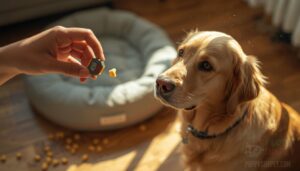
A clicker solves the one‑second problem entirely.
Before using it, you need clicker loading: 10–20 repetitions pairing the click with a treat, delivered within one second, in a quiet space free of distractions. This marker word pairing teaches your dog that the sound itself predicts reward—letting you click instantly, then deliver the high‑value treat a moment later without losing precision.
Marker Word Examples

Not every dog reacts to a click—and that’s fine, because words work too.
Effective positive markers stay short and punchy: "Yes," "Good," "Nice." Negative correction signals like "Nope" or "Eh-eh" cue another attempt, calmly. Duration terminal markers ("Done," "Break") end sessions. Visual marker alternatives—a thumbs-up, flashing light—help deaf dogs. Context-specific cues, like "Get it," direct retrieval tasks precisely.
Mark Before Treating

Sequence matters as much as the word itself. Mark first, treat second—never the reverse, or you risk reward bribery instead of reinforcement.
The marker freezes a precise behavioral snapshot, then the treat confirms it. This order builds real timing muscle memory and keeps your verbal marker consistency intact: 1) behavior occurs, 2) mark, 3) pause briefly, 4) deliver treat, 5) reset.
Keep Markers Consistent
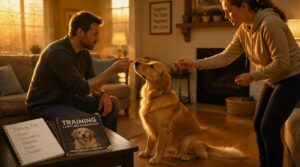
Once you settle on a marker, lock it in. Vocal marker selection means choosing one word—"yes" works fine—and pairing it with uniform tone delivery every single time.
If multiple family members train your dog, multiple handler coordination matters: agree on marker type selection together. Writing a quick training protocol standardization sheet keeps everyone honest and your dog’s understanding rock-solid.
Practice Your Timing

Consistency sets the stage — now build the reflex. Use a stopwatch accuracy drill: issue a command, click or say "yes," then measure the gap before treat delivery. Your target window is 0.5–1 second.
- Run 10-rep blocks, tracking your average delay
- Add progressive delay intervals — 0, 1, then 2 seconds — to stress-test your precision
- Practice treat draws daily outside sessions to build muscle memory
Treat Timing for Common Commands

Every command your dog learns comes with its own timing challenge. The moment you reward, where your dog is positioned, and what they’re doing in that instant all shape what gets reinforced. Here’s how to get the timing right for five commands your dog needs to know.
Sit
Mark the moment hindquarters touch the ground — not a split second after. For sit, your timing window is tight. The instant your dog’s bottom makes full contact, mark it.
Rewarding a half-sit teaches exactly that. Minimize distractions early, keep treats consistently accessible, and deliver them calmly in position. That’s how sit becomes automatic.
Stay
Stay is where timing becomes duration, not just a moment.
Deliver treats while the dog holds position — not after the release. The second they break, the window closes.
- Build from 1–3 second stays before extending
- Return before rewarding to reinforce holding
- Use a clear release cue like "break" afterward
Timing here is continuous, not instant.
Down
Down works differently from sit — the dog must commit fully to the floor, so your treat timing must confirm that full position.
| Phase | What to Do | Timing |
|---|---|---|
| Lure | Move treat straight down toward paws | Before dog lies flat |
| Position | Wait for elbows to touch ground | Exactly at contact |
| Mark | Say "Yes!" or click immediately | Same instant as contact |
| Reward | Deliver treat to floor level | Within one second |
| Release | Use "break" to end position | After rewarding |
Reward while the dog is down — never after it stands. That one-second window matters most here.
Come
Come is the one command where reward timing defines safety.
Use a long line of 20–50 feet, call once, and the moment your dog takes that first step toward you, mark it — click or say "Yes!" immediately.
Deliver a high-value treat the instant they reach you. Never delay.
That split-second connection is what makes recall reliable when it truly counts.
Leave It
Leave it" isn’t just a convenience command — it’s a safety reflex.
The moment your dog disengages from the item, reward immediately. Waiting even two seconds risks reinforcing the sniff or the glance away, not the disengage itself.
Remember: "leave it" means never touch. That’s distinct from "drop it." Keep commands separate — your dog’s safety depends on it.
Fix Delayed Reward Problems
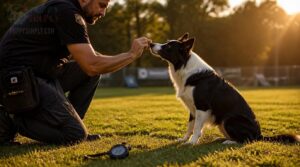
Delayed rewards don’t have to derail your training — most timing problems come down to a few fixable habits. Once you identify what’s slowing you down, the adjustments are straightforward and immediate. Here’s what to focus on to get your timing sharp and consistent.
Keep Treats Ready
Fumbling for a treat costs you precious tenths of a second, and your dog notices. Pre-loading your hand before issuing a command eliminates that lag entirely.
Try this:
- Pre-portion treats into easy-grab sizes
- Keep one hand treat-loaded during drills
- Position your supply within arm’s reach
- Refill between reps, not mid-behavior
- Test your grab speed beforehand
Use a Training Pouch
A quality training pouch is one of the most underrated tools in your arsenal. Wide-mouth opening designs let you grab treats in under a second — no digging, no delay.
| Feature | Why It Matters |
|---|---|
| Lightweight fabric | Reduces fatigue during long sessions |
| Magnetic closure | Silent, fast access mid-command |
| Removable liner | Easy cleaning after greasy treats |
| Belt clip | Stays stable while you move |
| Front drop-in pocket | Instant access to high-value rewards |
Reward in Position
Reward in position means delivering the treat before your dog moves — not after. If your dog holds a sit and you treat the second it stands up, you’ve accidentally rewarded standing. Keep the reward low, near its front legs, while it stays still. Where the treat lands tells your dog what earned it.
Shorten Training Sessions
Once your treats are positioned correctly, the next variable to control is time. Shorter sessions sharpen timing.
Most dogs hit peak concentration at 5–10 minutes — push past that, and delayed rewards multiply because you’re both losing focus. Puppies fade even faster.
End early, stay consistent, and your treat timing stays clean.
Practice Without Distractions
When your timing keeps slipping, the environment is usually the real culprit — not your technique.
Start in a quiet room with zero foot traffic. Build your mechanical timing there before adding complexity.
- No other pets nearby
- Low ambient noise
- Familiar, bounded space
- Early morning sessions
- One command per session
Nail the basics here first. Distractions come later.
Frequently Asked Questions (FAQs)
Does emergency department overcrowding cause delay in treatment?
Yes. Emergency department overcrowding causes measurable delay in treatment by slowing triage assessment, blocking bed access, straining staffing ratios, and creating diagnostic testing lag and specialist consultation delays that compromise patient flow and healthcare resources.
What is admission delay?
In healthcare, admission delay measures time from a decision to admit until a patient actually arrives at their unit—covering ICU transfer windows and ALC stay calculations, directly affecting patient flow and overall hospital capacity management efficiency.
What are the predictors of delays in the treatment process?
Socioeconomic barriers, financial strain, low health literacy, geographic distance, and healthcare capacity limits — like staff shortages and overcrowding — are the most consistent predictors of treatment delays across patient populations.
Can treats be replaced with praise or play?
Treats can be replaced, but only once your dog values praise or play enough to work for them. Reward value matching is the key — if enthusiasm drops, go back to food.
Does reward timing differ by dog breed?
Breed does influence timing sensitivity. Toy breeds need rewards within 5 seconds, while herding breeds process faster. High-energy working dogs sustain focus longer, and senior dogs benefit from slightly extended windows.
How does age affect a puppys reward response?
Age shapes everything. Puppies between 6 and 16 weeks absorb reward associations fastest. By 8 weeks, basic connections form, but attention lasts only seconds. By 6 months, memory retention strengthens dramatically.
Should timing change for fearful or anxious dogs?
Yes — fearful dogs need tighter timing. Deliver rewards within one second of calm behavior. Stress-induced confusion sets in fast. When anxiety spikes, skip the treat; create distance first.
Conclusion
The devil is in the details—and in dog training, those details are measured in seconds. Every millisecond separating your command and treat either builds understanding or plants confusion.
Master the delay between command and treat, and you stop leaving your dog to guess what earned the reward. Mark the right moment, keep treats accessible, and reward the exact behavior you want repeated. Precision isn’t perfectionism—it’s the language your dog actually speaks.
- https://mountainhumane.org/making-eye-contact-with-your-dog-copy
- https://aggressivedog.com/2022/09/14/expanding-communications-in-training
- https://pmc.ncbi.nlm.nih.gov/articles/PMC7895348
- https://citizenk9dogtraining.com/2025/01/13/effective-dog-training-timing-and-rewards-explained
- https://summerbrookgoldens.com/chapter6-types-of-verbal-markers