
This site is supported by our readers. We may earn a commission, at no cost to you, if you purchase through links.

Apartment living and dog ownership sound like a contradiction—until you realize that nearly 70% of apartment renters own pets, and most of them make it work beautifully.
The secret often comes down to one underrated piece of equipment: a good crate.
Not a cage, not a punishment corner, but a space your dog genuinely claims as their own.
In a smaller home, the right dog crate for apartment living pulls double duty—it keeps your pup calm and your square footage intact.
The six picks ahead cover every layout, breed size, and budget worth considering.
Table Of Contents
Key Takeaways
- good crate does double duty in an apartment — it gives your dog a calm, safe den while keeping your limited floor space from feeling taken over.
- best crate for your dog depends on temperament, not just size — anxious dogs need enclosed, quiet styles, while chewers need reinforced steel that can take a beating.
- Furniture-style and fold-flat crates are the smartest picks for small spaces because they blend in or disappear completely when you don’t need them.
- Where you place the crate matters as much as which one you buy — a quiet corner away from appliances, with clear walking paths, helps your dog settle faster and keeps your home livable.
Best Dog Crates for Apartment Living
Finding the right crate for an apartment doesn’t have to feel overwhelming. Each pick below was chosen with small spaces and real dog personalities in mind. Here are six solid options worth a closer look.
If you’re still narrowing things down, this guide to dog crate options for puppies breaks down what to consider based on your dog’s size, personality, and your daily routine.
1. New Age Pet ECOFLEX Indoor Dog Crate
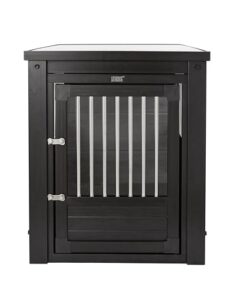
If your apartment already needs an end table, the New Age Pet ECOFLEX pulls double duty — it’s a dog crate and a side table in one.
Built from a wood-plastic composite, it resists moisture, wipes clean easily, and won’t fade or chip.
It comes in four colors to match your décor and assembles without tools in under 30 minutes.
Best suited for calm, crate-trained adults, it’s backed by a solid 10-year warranty at $177.99.
| Best For | Dog owners with calm, crate-trained adult dogs who want a kennel that blends into their living space without looking like a cage. |
|---|---|
| Price | $177.99 |
| Material | ECOFLEX composite |
| Weight | ~46 lb |
| Easy Cleaning | Wipe-clean surface |
| Assembly | Tool-free, 30 min |
| Size Options | 4 sizes (S/M/L/XL) |
| Additional Features |
|
- Doubles as an end table, so it earns its floor space instead of just taking it up.
- The ECOFLEX material is easy to wipe down and won’t fade, chip, or peel over time.
- Tool-free assembly in under 30 minutes — no frustration, no missing instructions.
- Not built for chewers or anxious dogs — the latches can loosen with a determined escape artist.
- Too bulky to move around easily; not a great fit if you travel with your dog often.
- A few buyers have noted minor cosmetic issues out of the box, like scratches or misaligned panels.
2. DIGGS Revol Collapsible Dog Crate
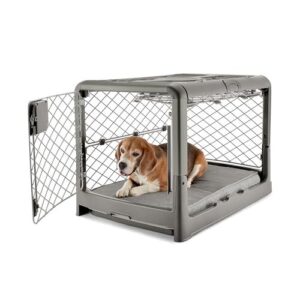
If you want something that looks sharp and works even sharper, the DIGGS Revol is hard to beat. It assembles in under 60 seconds, collapses flat for storage, and rolls easily between rooms on built-in wheels.
Three access points — front, side, and top hatch — make crate training genuinely easier.
The diamond mesh design protects paws and jaws, and it meets baby-industry safety standards.
It’s sized for dogs 30–50 lb at $799.
| Best For | Dog owners who want a premium, stylish crate that makes training easier and looks good in the home — ideal for medium-sized dogs (30–50 lb). |
|---|---|
| Price | $799.00 |
| Material | Aluminum frame |
| Weight | 32 lb |
| Easy Cleaning | Removable tray |
| Assembly | One-hand, 60 sec |
| Size Options | Medium only (30–50 lb) |
| Additional Features |
|
- Assembles in under 60 seconds with one hand and collapses flat for easy storage
- Three access points (front, side, and top hatch) make crate training and daily use way more convenient
- Meets baby-industry safety standards with rounded corners and pinch-proof diamond mesh
- At 32 lb and $799, it’s heavy and expensive compared to standard crates
- Wheels struggle on carpet or uneven floors, so portability isn’t always as smooth as advertised
- Too small for larger breeds, and the side door can be stiff and noisy with regular use
3. Merry Mahogany Dog Crate End Table
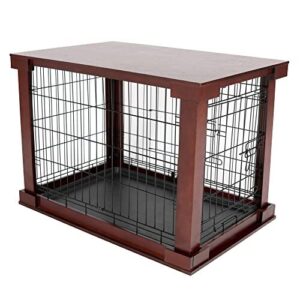
Not every dog owner wants a wire cage sitting in the corner of their living room. The Merry Mahogany Dog Crate End Table solves that problem beautifully — it looks like furniture and functions as a kennel at the same time.
The rich mahogany veneer blends with traditional décor, and the solid tabletop holds a lamp or a book without fuss. Dual doors allow flexible placement, and the removable plastic tray keeps cleanup simple. Best for calm dogs under 40 lb.
| Best For | Dog owners who want a kennel that looks like real furniture — ideal for calm, small breeds under 40 lb. |
|---|---|
| Price | $94.75 |
| Material | MDF & steel |
| Weight | ~32 lb |
| Easy Cleaning | Removable plastic tray |
| Assembly | Snap-fit, no tools |
| Size Options | 3 sizes (S/M/L) |
| Additional Features |
|
- Looks like an actual end table, so it doesn’t wreck your living room aesthetic
- Dual doors make it easy to tuck into a corner or against a wall
- Removable plastic tray slides right out for quick, hassle-free cleaning
- Not built for strong chewers — the wire and magnetic panels aren’t heavy-duty
- The door entry sits high up, which can be tough for senior or small dogs
- Moves around a lot? The snap-fit assembly can loosen over time without screws to hold it together
4. Petmate Vari Portable Dog Kennel
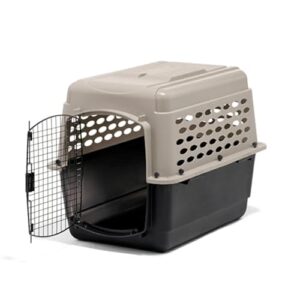
If the Merry Mahogany feels too polished for your lifestyle, the Petmate Vari Portable Kennel is your go-to for real-world flexibility.
It’s built from heavy-duty recycled plastic with reinforced corners, four-sided vents, and an interior moat that keeps accidents contained.
The secure squeeze latch won’t pop open mid‑trip, and the carry handle makes vet visits easy.
| Best For | Small dogs and cats up to 10 lbs who need a lightweight, travel-friendly kennel for flights, car trips, or vet visits. |
|---|---|
| Price | ~$25–35 |
| Material | Recycled plastic |
| Weight | ~5–6 lb |
| Easy Cleaning | Built-in moat |
| Assembly | Clips & thumbscrews |
| Size Options | Small only (≤10 lb) |
| Additional Features |
|
- Meets most airline cargo specs, so you can fly with your pet without scrambling for a last-minute carrier.
- The built-in moat channels spills and accidents away from your pet, which is a lifesaver for puppies still learning the ropes.
- Tool-free assembly and a built-in carry handle make it easy to grab and go on your own.
- The plastic runs thinner than older Petmate models, so it may not feel as solid if your dog is on the heavier end of the weight limit.
- Interior space is tighter than the outside dimensions suggest, and standard crate pads often don’t fit right.
- The clip assembly can be stiff and frustrating to snap together, especially the first few times.
5. Unipaws Walnut Furniture Dog Crate
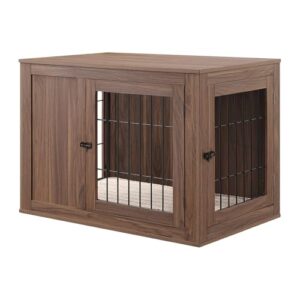
The Unipaws Walnut Furniture Dog Crate is one of those rare finds that doesn’t scream "dog stuff" from across the room. It looks like a proper end table — warm walnut finish, clean lines — but your dog’s cozy den is built right inside.
The 36 × 23 × 26.2-inch frame fits medium dogs comfortably, and the top holds up to 150 lb, so your lamp or book stays put.
Double-door access and a removable tray make cleanup genuinely painless.
For more on setting up a mess-free space from day one, preparing your home for a new puppy covers exactly what to put in place before they arrive.
| Best For | Dog owners who want a clean, furniture-style crate that doubles as a nightstand without making their bedroom look like a pet store. |
|---|---|
| Price | $120–150 |
| Material | Fir wood & wire |
| Weight | 59.25 lb |
| Easy Cleaning | Detachable cushion |
| Assembly | Hardware included |
| Size Options | Medium (~30–50 lb) |
| Additional Features |
|
- Looks like real furniture — warm walnut finish blends right in with your décor
- Two door positions give you flexibility to tuck it into corners or along walls
- Comes with a memory-foam bed and easy-to-clean removable panels right out of the box
- Not a good fit for chewers or anxious dogs — the wood and wire won’t hold up
- Some users have run into missing hardware during assembly, which is a frustrating start
- Indoor-only and sized for medium dogs, so it’s a pretty specific match
6. BOWHAUS Foldable Double Door Dog Crate
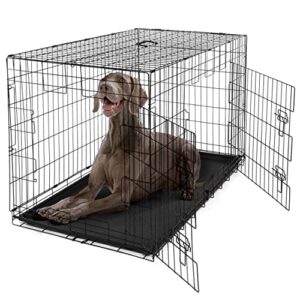
The BOWHAUS Foldable Double Door Dog Crate is the practical pick for apartment dwellers who need flexibility without sacrificing space.
It folds flat to just 3.5 inches thick, so tucking it into a closet takes seconds.
The double-door design — front and side — makes placement in tight corners genuinely easy.
A leak-proof removable tray covers accidents without drama, and the divider panel grows with your pup.
Straightforward, functional, and built for real apartment life.
| Best For | Apartment dwellers and frequent movers who need a dog crate that stores flat, sets up fast, and handles the occasional mess without a big cleanup. |
|---|---|
| Price | ~$60–80 |
| Material | Steel wire |
| Weight | Not specified |
| Easy Cleaning | Leak-proof pan |
| Assembly | Tool-free fold |
| Size Options | Large (up to 44 in) |
| Additional Features |
|
- Folds down to just 3.5 inches thick — slides into a closet, car trunk, or under a bed with no hassle
- Double-door setup (front and side) makes it easy to place in corners or tight spots
- Divider panel lets you adjust the space as your puppy grows, so it pulls double duty from day one
- The plastic tray is thin and has a reputation for cracking — sometimes right out of the box
- The locks are stiff and often need two hands to open, which gets old fast
- Door hinges and latches are on the flimsy side, so bigger or more determined dogs may eventually wear them down
Why Apartment Dogs Need Crates
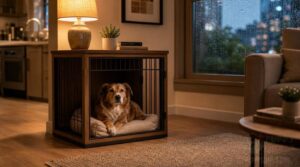
A crate isn’t just a box — for an apartment dog, it’s the one spot that’s truly theirs. It helps with everything from calming nerves during a thunderstorm to keeping your couch intact while you’re at work. Here’s why having the right crate matters more than you might think.
Reduces Stress and Anxiety
Think about your dog alone in your apartment during a storm — heart racing, paws pacing, nowhere to feel safe.
A crate changes that. It gives your dog a personal den where they can settle and breathe.
A routine crate schedule lowers cortisol levels and reduces constant alertness, helping anxious dogs feel genuinely calm throughout the day.
Prevents Destructive Chewing
A bored dog in a small apartment is basically a demolition crew of one.
A bored dog left alone in a small apartment becomes a one-dog demolition crew
When your dog has nowhere to channel energy, your couch, shoes, and baseboards pay the price. A crate with chew-resistant materials and a compact design keeps that impulse contained. Providing appropriate chew toys helps satisfy natural chewing instincts and reduces damage to household items.
- Reinforce the crate floor with a chew-resistant mat to protect soft underlayers
- Offer durable toy options like treat-filled or frozen chew toys to redirect the urge
- Use positive reinforcement training to reward appropriate chewing inside the crate
Supports House Training
A crate is one of the most underrated tools for housebreaking your dog in a small apartment. Dogs naturally avoid soiling their den, so a space-saving dog crate becomes a built-in motivator to hold it until you take them outside.
| Training Element | Why It Works |
|---|---|
| Consistent Routine | Reduces accidents by setting predictable bathroom windows |
| Timer-Based Training | Cues potty breaks every 2–4 hours for puppies |
| Crate-to-Outdoor Link | Reinforces that elimination happens outside, not inside |
| Positive Reinforcement | Rewards outdoor success, building lasting habits |
Pair Scheduled Potty Breaks with meals and you’ll notice faster progress. Use a calm "potty" cue each time you head out, then reward immediately after. A puppy potty schedule built around crate time gives your dog structure — and gives you peace of mind.
Limits Household Hazards
Apartments hide more dangers than you’d think. Electrical cords and blind strings are prime chewing targets that can cause choking or internal blockage. Household cleaners under sinks, toxic plants, and loose batteries become serious risks the moment your dog roams unsupervised.
A crate keeps your dog contained, cutting off access to hazards before curiosity turns into an emergency vet visit.
Creates a Safe Den
Beyond keeping hazards out of reach, a crate gives your dog something just as valuable — a place that’s entirely theirs. Dogs are naturally den animals, and a quiet, secure space helps them settle, especially in a busy apartment. Furniture-style wooden crates blend in beautifully while offering the enclosed, low-stimulation atmosphere anxious dogs genuinely need.
- Add soft bedding for den comfort essentials
- Provide proper ventilation with mesh panels
- Place it in a calm, low-traffic corner
Space-Saving Crate Features
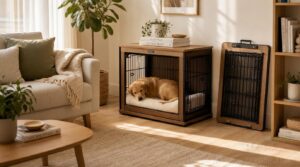
Living in an apartment means every square foot counts, so your dog’s crate needs to work with your space, not against it. The good news is that today’s crates are built with small-space living in mind. Here are the key features worth looking for.
Compact Floor Footprint
Every square foot matters in a small apartment, and the right crate can quietly disappear into your space.
Models like the ECOFLEX Indoor Dog Crate measure around 40 by 25 inches — a genuinely low profile that tucks into corners or fits under counters without eating up your floor. That’s real size and space efficiency working in your favor.
Fold-flat Storage Design
That compact footprint is only half the story. Fold-flat mechanisms take things further — foldable wire crates like the Midwest iCrate collapse to about 3 inches thick in under 30 seconds. That’s thin enough to slide behind your couch or into a closet.
For small apartments, compact storage solutions like this mean your space stays yours when the crate isn’t in use.
Sliding or Garage Doors
Once you’ve handled storage, think about the door itself. Sliding or garage-style doors open horizontally rather than swinging outward, so you don’t need clearance space in front of the crate. That’s a real win when your apartment layout is tight.
The Merry Products Slide Crate is a great example — its slide-out tray and side-opening door make cleanup easy without rearranging furniture.
Built-in Wheels
For apartments where every inch matters, built-in wheels turn a bulky crate into something you can actually live with. Instead of lifting and dragging, you just push.
Most wheels rotate 360 degrees, so maneuvering tight doorways or corners is surprisingly easy.
Lockable wheels keep the crate firmly in place during meals or training sessions — no sliding, no stress.
Ventilated Mesh Panels
Fresh air matters more than most people think. Ventilated mesh panels promote steady cross-ventilation, keeping your dog cool and comfortable without a fan running all day.
The diamond mesh pattern also gives your dog a clear view of the room, which actually helps reduce anxiety. Steel or aluminum mesh wipes clean in seconds — no warping, no fuss.
Choose Crates by Dog Temperament
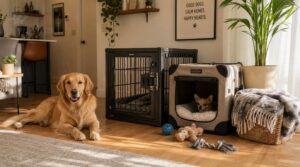
Not every dog needs the same kind of crate — a nervous pup and a confident chewer are practically living on different planets. Your dog’s personality matters just as much as size when you’re picking the right fit for your apartment. Here’s a look at what works best for each type.
Anxious Dogs
Some dogs don’t just dislike their crate — they panic inside it. If your dog trembles, whines, or paces when confined, quiet and secure construction matters most.
Choose an enclosed furniture-style crate with dim lighting and solid panels to muffle outside noise. Pair it with calming routines and a soft blanket to ease separation anxiety gently.
Heavy Chewers
A dog that treats their crate like a chew toy needs something built to fight back. For heavy chewers, skip wire and soft-sided options — go straight to a heavy-duty crate with reinforced steel corners and escape-proof latches.
- Choose durable crate materials like powder-coated steel
- Verify the space-saving dog crate has smooth interior edges
- Add high-density nylon chews sized 2–3 inches longer than their muzzle
- Inspect chews weekly and replace at first sign of cracking
Senior Dogs
Senior dogs deserve a crate that works as hard as they do — quietly and gently. Wide-door, low-threshold designs make entry undemanding for aging joints.
Look for orthopedic comfort padding inside, since arthritic hips need more than a bare floor. A lightweight or folding crate that doubles as a side table keeps your space tidy without sacrificing your senior’s comfort.
Growing Puppies
Puppies practically grow overnight — which means the best dog crate for apartment living needs to grow with them. An adjustable wire crate with a puppy divider is your smartest pick here.
- Promotes joint health with firm, flat flooring
- Divider panel adjusts as growth milestones progress
- Portable for easy moves during the socialization period
- Withstands chewing during the teething phase
- Compact enough for apartment corners
Easy-going Trained Dogs
If your dog already knows the drill — settles on cue, waits patiently, and barely blinks at the doorbell — a multi-use furniture-style crate is your best match.
It doubles as indoor pet furniture, blending right into your apartment.
Easy portability and a slim footprint keep your space tidy, without sacrificing comfort for your low-maintenance companion.
Dog Crate Size Guide
Getting the right crate size is honestly the most important step you’ll take. A crate that’s too big won’t feel like a den, and one that’s too small will stress your dog out fast. Here’s a simple breakdown to help you find the right fit.
Measure Dog Length
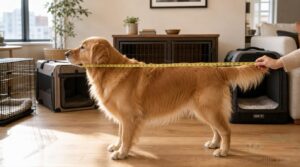
Before you buy anything, measure your dog’s length — it’s the first step in any dog crate size guide. Have your dog stand naturally, then use a flexible tape from the tip of the nose to the base of the tail.
That’s your Overall Length Approx.
Add 2–4 inches to that number, and you’ve got your minimum crate interior length.
Measure Shoulder Height
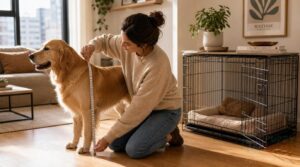
Next up is height — and it’s just as straightforward. Have your dog stand naturally, then measure from the floor straight up to the top of the shoulder bone. That’s your shoulder height baseline. Add 2–4 inches, and you have the minimum interior height your crate needs. This is the heart of any reliable dog crate size guide.
Small Apartment Breeds
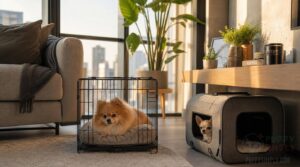
Once you’ve nailed height, breed size makes the final call. Small breeds like Chihuahuas and Pomeranians fit comfortably in a 24-inch compact crate — the sweet spot for any small apartment. Look for:
- Low-shedding breeds that keep your space cleaner
- Quiet temperaments with minimal barking
- Lightweight builds under 25 lb for easy indoor dog crates
Medium Dog Crates
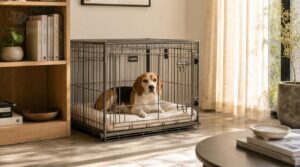
Step up to a 30–36 inch crate if your dog lands in the 26–50 lb range — think Beagles or Bulldogs. These mid-size options balance dog crate dimensions with smart apartment living.
Look for fold-flat storage, double-door access, rust-resistant steel, and removable trays for easy cleanup. A space-saving dog crate that tucks neatly into corners keeps your place feeling open.
Large Dog Crates
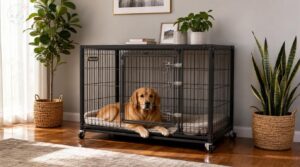
Big dogs need big crates — and in an apartment, that space has to earn its keep. For dogs over 51 lb, look for 36–42 inch interiors with solid ventilation and lockable wheels. Models like the LEVELEVE 48 Inch Heavy Duty crate offer:
- Triple locking latches for escape-proof security
- Wide mesh panels for steady airflow
- Built-in wheels for easy room-to-room mobility
- Removable trays for quick, mess-free cleaning
Best Crate Styles for Apartments
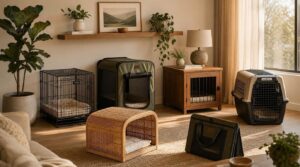
Not every crate style fits every apartment — or every dog. The right match depends on your space, your pup’s personality, and how much you care about your place actually looking good. Here are the five styles worth considering.
Furniture-style Wooden Crates
Furniture-style wooden crates are the ideal dual purpose table solution for apartment living. With a wood grain finish and miter joint design, they look like a real end table — not a pet enclosure.
Many feature hidden door integration, so guests won’t even notice.
If you love a rustic farmhouse style, this design-oriented pet crate blends seamlessly into your home decor.
Foldable Wire Crates
Foldable wire crates are the quiet workhorse of apartment dog ownership. Their wire grid ventilation keeps air moving on all sides — even against a wall — so your dog stays cool.
Foldable frame durability means welded steel holds firm daily, yet the quick release mechanism lets you collapse the whole crate flat in under a minute. That’s a real win in a tight space.
Soft-sided Travel Crates
Soft-sided travel crates are the perfect flex for apartment living.
Their lightweight aluminum frame sets up in under two minutes and folds flat when you’re done. Four-sided airflow mesh keeps your dog cool and calm, while self-locking zipper security means no surprise escapes.
At 5–15 pounds, this collapsible design moves easily between rooms or fits right in your car trunk.
Plastic Portable Kennels
A plastic portable kennel might be the most underrated option for apartment dogs. It’s rigid enough to feel secure but light enough to carry room to room.
- Carry handle design for one-hand transport
- Cross-flow ventilation keeps air moving
- Leak-proof base makes cleanup painless
Airline standard sizes mean it doubles as a travel companion. The collapsible design saves closet space when not in use.
Heavy-duty Metal Crates
When your dog’s a determined escape artist, a heavy-duty steel crate is worth every inch of floor space.
Steel frame durability and reinforced corner design mean it holds up against persistent chewers without warping or bending.
Powder coating protection keeps rust away, and locking latch security ensures your dog stays safely inside — giving you real peace of mind.
Apartment Crate Placement Tips
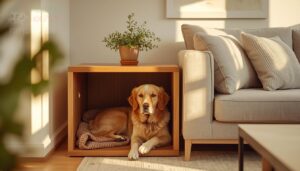
Where you place the crate matters just as much as which one you pick. A good spot helps your dog feel settled and keeps your apartment feeling open, not cramped. Here are five placement tips that work well in smaller spaces.
Quiet Corner Placement
That dead corner behind your sofa or beside a bookshelf is prime real estate for a crate.
Tuck it 3–6 feet from doorways, angled 45 degrees so your dog feels sheltered without feeling trapped.
Place it against an interior wall to block street noise, add a thick rug underneath for noise reduction, and keep a clear 3-foot path nearby for easy access.
Beside The Bed
Your bed is already your dog’s favorite spot — so use it.
Sliding a narrow crate beside the bed keeps your pup within arm’s reach for nighttime access without sacrificing floor space. It also encourages a steady nighttime routine, especially for puppies and new rescues who settle faster when they can sense you nearby. A furniture-style wooden crate doubles as an end table, blending sleep proximity with practical, multipurpose home furniture.
Away From Appliances
While sleeping close to your pup is comforting, the rest of the apartment needs more thought.
Keep the crate at least 3 feet from ovens, dishwashers, and washing machines — heat and vibration stress dogs quickly. Avoid electrical cords nearby, and leave at least a meter of clearance on all sides for safe, easy movement in and out.
Near Storage Shelves
Pairing your crate with vertical storage nearby is one of the smartest moves in a small apartment. Wall-mounted shelves or stackable storage units keep leashes, treats, and waste bags within arm’s reach without eating up floor space.
Place shelves against the wall at a comfortable height and secure tall units to prevent tipping — especially if your dog is curious and pawing around.
Clear Walking Paths
Don’t underestimate how much crate placement affects daily movement. A crate sitting in the middle of a walkway creates bottlenecks — and in a small apartment, that frustration adds up fast. Keep at least 36 inches of clear width around your crate so you and your dog can move freely.
- Use non-slip surfaces beneath and around the crate to prevent sliding on hardwood or tile
- Guarantee level transitions between rooms so your dog doesn’t trip stepping in or out
- Keep the path visually clear so you can spot your dog moving around safely
Crate Comfort and Maintenance
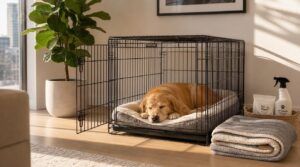
A comfortable crate isn’t just about size — it’s about what’s inside and how you keep it clean. Getting these details right makes a real difference in how happy and calm your dog feels in their space. Here’s what to focus on.
Washable Crate Mats
A good crate mat quietly does a lot of work. Look for one with a waterproof backing and an absorbent core — together, they trap moisture before it reaches your floor. Machine washable options save you time, while non-slip backing keeps everything steady. Odor control treatments are a bonus worth having.
| Feature | What It Does | Why It Matters |
|---|---|---|
| Waterproof Backing | Blocks moisture from reaching floors | Protects your apartment flooring |
| Absorbent Core | Traps spills and urine quickly | Reduces odors and keeps crate dry |
| Non-Slip Base | Anchors mat inside the crate | Prevents shifting during movement |
| Machine Washable | Easy regular laundering | Saves time and maintains hygiene |
| Odor Control | Antimicrobial treatment built in | Keeps your space smelling fresh |
Soft Blankets
A soft blanket makes your dog’s crate feel like a cozy nook, not just a box.
Polyester fleece and microfiber blends stay plush through dozens of washes, while bamboo viscose options keep things breathable in a warm apartment.
For small spaces, a 50-by-60-inch throw fits most crates without bunching.
Always machine wash on cold to preserve softness.
Safe Chew Toys
A chew toy inside the crate keeps your dog calm and entertained — and the wrong one can be a real hazard.
Here are five things to look for:
- Non-toxic, safe materials like natural rubber or food-grade silicone
- Size matters — pick toys wider than your dog’s muzzle
- Durability rating matched to your dog’s chewing style
- Textured surfaces for dental benefits
- Dishwasher-safe for easy cleaning
Odor Control Habits
A crate that smells bad won’t feel like a safe den — it’ll feel like a problem.
Weekly cleaning with hot water and unscented detergent cuts odor buildup greatly.
Sprinkle baking soda under the mat to absorb smells between washes.
Swap mats every few days, and air the crate out for 10–15 minutes after use.
Safe Crating Duration
A clean crate keeps your dog comfortable, but so does knowing how long they’re actually in it.
Puppies under six months shouldn’t stay crated more than 2–3 hours at a stretch. Adult dogs handle 4–6 hours well. Senior dogs do best with 1–2 hour blocks.
When in doubt, shorter sessions with more breaks always win.
Frequently Asked Questions (FAQs)
How to crate train a dog when you live in an apartment?
Start in a quiet corner with short, positive sessions. Use treats and praise to reward calm entry. Stick to a consistent schedule and keep early crating brief — patience makes all the difference.
How can I keep my dog in my apartment?
Keeping a dog happy in an apartment takes daily exercise, smart enrichment, and noise desensitization training. Stick to a routine, follow your apartment pet policies, and use compact pet solutions to keep your space functional.
Can I crate-train an adult rescue dog?
Yes, you absolutely can. Adult rescue dogs learn new routines well. Start with short crate sessions, use treats, and build gradually. Most dogs settle comfortably within two to three weeks.
Should I cover my dogs crate at night?
For many dogs, yes. Covering the crate at night creates a cozy den feel that calms anxiety and muffles room noise. Just use a breathable cotton cover and leave the front open for airflow.
How do I stop my dog whining in the crate?
Stop crate whining by building a consistent crate routine and using positive reinforcement — reward calm moments with treats. Add an old t-shirt for owner scent, and try white noise to muffle sounds that trigger anxiety.
Are crates safe to use while Im at work?
Crates are safe for work hours when used correctly. Always do a crate safety inspection before leaving — check latches, edges, and ventilation. Stick to the 8-hour adult limit and leave a chew-resistant mat inside.
Can two small dogs share one crate?
Two small dogs can share one crate, but only if the space allows comfortable movement for both. Use an adjustable crate divider to create separate resting zones and prevent tension.
Conclusion
A thousand square feet feels like a mansion when your dog has a crate they genuinely love. The right dog crates for apartment living don’t just solve a space problem—they solve a peace problem.
Your dog gets a calm, familiar corner to call their own. You get a home that still feels like yours.
That’s not a small win. Pick the crate that fits your space, your dog’s personality, and watch the whole apartment breathe easier.