
This site is supported by our readers. We may earn a commission, at no cost to you, if you purchase through links.
Most dogs don’t savor their meals—they inhale them. If your dog finishes his bowl in under 30 seconds and then stands there looking vaguely panicked, you’re watching a pattern that puts real strain on his digestive system.
Gulping food means swallowing air, skipping chewing, and sending large chunks of food into a stomach that wasn’t designed to handle that kind of volume all at once. The downstream effects range from post-meal vomiting to a dangerous condition called gastric dilatation‑volvulus, or GDV—a life‑threatening emergency in deep‑chested breeds.
Slow feeder bowls address this at the source, and the digestive benefits go deeper than most pet owners expect.
Table Of Contents
- Key Takeaways
- Why Dogs Eat Too Fast
- Yes, Slow Feeders Can Help Digestion
- Fast Eating Digestion Risks
- How Slow Feeder Bowls Work
- Digestive Benefits for Fast Eaters
- Weight and Satiety Benefits
- Choosing The Right Slow Feeder
- When Slow Feeders Are Not Enough
- Frequently Asked Questions (FAQs)
- Do vets recommend slow feeder bowls?
- What is the 15 minute rule for dog food?
- Do pugs need slow feeders?
- Can slow feeders improve a dogs dental health?
- How long does it take dogs to adapt?
- What materials are safest for slow feeder bowls?
- Do slow feeders help with weight management?
- Are there smart slow feeders with tracking features?
- Conclusion
Key Takeaways
- Slow feeder bowls reduce gulping and air swallowing, which directly lowers your dog’s risk of painful bloating and the life‑threatening condition called GDV.
- More chewing means more saliva, better food breakdown, and improved nutrient absorption — all before food even reaches the stomach.
- Extended mealtimes give your dog’s fullness hormones time to kick in, helping with portion control and reducing the urge to beg or overeat.
- Slow feeders aren’t a fix for every dog — flat‑faced breeds, seniors with anxiety, or dogs with dental pain may need a vet‑guided alternative instead.
Why Dogs Eat Too Fast
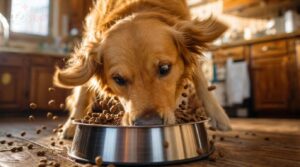
Some dogs eat like they’re racing against a clock — and there’s usually a real reason behind it. The cause isn’t always obvious, but it almost always comes down to one of a handful of triggers. Here are the most common reasons your dog may be wolfing down meals too fast.
If you want to dig deeper, the five most common reasons dogs eat too fast can help you pinpoint exactly what’s driving your dog’s mealtime urgency.
Competition With Other Dogs
If you have more than one dog at home, you’ve probably seen it — one dog hovering, the other eating faster than seems physically possible. Food competition between dogs is one of the most common reasons for rapid dog eating.
When another dog is nearby, mealtimes shift from calm to high-pressure fast.
Irregular Feeding Schedules
Competition isn’t the only reason dogs rush through meals. Irregular feeding schedules can be just as disruptive — sometimes more so.
When mealtimes shift around unpredictably, your dog loses the ability to anticipate when food is coming. That uncertainty builds hunger variability, and once the bowl finally appears, compensatory overeating kicks in fast.
Here’s what an inconsistent schedule can trigger:
- Repeated bowl-checking when food doesn’t arrive at the expected time
- Stronger drive to eat quickly once food finally appears
- Day-to-day swings in how much your dog consumes
- Disrupted circadian rhythm cues tied to hunger and digestion
- Binge-like eating patterns after longer gaps between meals
A predictable routine isn’t just convenient — it enhances your dog’s digestive health from the inside out.
Food Anxiety
Sometimes, fast eating isn’t about hunger at all — it’s about anxiety.
Dogs with food anxiety may bolt their meals simply because eating feels stressful. A slow feeder bowl can help here, breaking the frantic pace and turning mealtime into something calmer and more manageable for your dog.
Low-Fiber Diets
What your dog eats matters as much as how fast they eat. Low-fiber, high-calorie diets digest quickly, leaving dogs feeling unsatisfied shortly after a meal — so they rush to finish before that empty feeling returns.
Adding a slow feeder bowl gives the body more time to register what’s already been eaten.
Learned Puppy Behavior
Puppies that grow up watching fast eaters often pick up the habit themselves. They learn through social observation — if the older dog bolts food down and gets rewarded with a full belly, the puppy copies that pattern.
Over time, speed becomes their default, making meal pacing tools like slow feeder bowls especially useful early on.
Yes, Slow Feeders Can Help Digestion
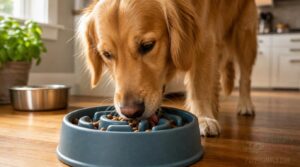
The good news is that slow feeder bowls genuinely make a difference — and there’s solid science behind why. They work by changing how your dog physically interacts with food, which sets off a helpful chain reaction in the digestive process. Here’s a closer look at what actually happens.
Slower Bite Sizes
Think of a slow feeder bowl as a natural pace-setter.
Instead of letting your dog vacuum up a full bowl in seconds, the ridges and maze channels break kibble into smaller, separated pockets — forcing smaller bite sizes with every attempt. This directly facilitates bolus size control, meaning less food is swallowed in each gulp, easing esophageal transit and supporting your dog’s gastrointestinal health.
Better Chewing
When your dog slows down to navigate the ridges of a slow feeder bowl, something important happens — they actually start chewing.
Here’s why that matters for digestion:
- Mechanical digestion begins in the mouth, breaking food into smaller fragments before it ever reaches the stomach.
- Bolus formation improves as chewed pieces bind into a smoother, more manageable mass for swallowing.
- Chew time increase gives jaw muscles a real workout, supporting long-term jaw muscle health.
- Texture adaptation kicks in naturally, helping your dog adjust bite pressure to different kibble shapes.
- Digestive enzyme mix starts earlier, since more chewing means more contact time between food and mouth fluids.
Consistent chewing also promotes satiety signaling onset which helps regulate appetite.
That’s dog chewing activity working exactly as nature intended — and a slow feeder quietly makes it happen.
More Saliva Mixing
Chewing more doesn’t just break food apart — it floods it with saliva, and that saliva is doing real digestive work.
Saliva even helps protect your pup’s gut, though if chewing becomes painful or appetite drops, it’s worth checking signs your dog may need a vet visit.
Saliva enzymes like alpha-amylase and lipase begin breaking down starches and fats right in your dog’s mouth. Slow feeder bowls extend chew time, giving those enzymes longer contact with food before it ever reaches the stomach.
Less Swallowed Air
When a dog gulps food down fast, they don’t just swallow kibble — they swallow air along with it. This is called aerophagia, and it’s more common than most owners realize.
That extra air has to go somewhere, and it usually ends up as uncomfortable bloating, belching, or stomach pressure. Slow feeder bowls reduce this by forcing smaller, steadier bites that limit how much air enters with each mouthful.
Calmer Mealtimes
Slow feeders do more than slow down eating — they quietly reshape the whole mealtime atmosphere. When your dog has to work through ridges and mazes, the frantic energy settles. Here’s what that calmer environment actually fosters:
- Predictable feeding routine that reduces pre-meal anxiety
- Consistent bowl placement in a low-traffic spot
- Smooth shift cues before and after meals
That steadiness signals safety.
Fast Eating Digestion Risks
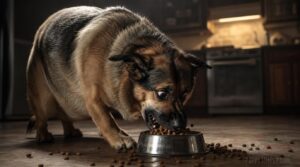
Eating too fast doesn’t just feel uncomfortable for your dog — it can lead to some genuinely serious digestive problems. And the faster they eat, the worse those problems tend to get. Here’s what you’re actually risking when your dog treats every meal like a race.
Vomiting After Meals
When your dog finishes a meal in under a minute and then vomits shortly after, fast eating is likely the culprit. Rushing meals overloads the stomach before gastric motility — the stomach’s natural movement that processes food — can keep up. That sudden volume spike triggers a vomiting reflex almost immediately.
Regurgitation
Vomiting and regurgitation aren’t the same thing, though they can look similar at a glance. Regurgitation is passive — stomach or esophageal contents simply flow back up without the heaving and retching of true vomiting. It often happens because LES valve weakness allows food to drift back up through the esophagus and into the throat.
Fast eating makes this worse. When your dog gulps food rapidly, aerophagia — swallowed air — builds pressure in the stomach. That pressure pushes against a weakened valve. Dogs eating too fast are especially vulnerable, particularly when they lie down after meals, since position-related reflux increases without gravity helping keep contents down.
Here’s what regurgitation from fast eating can look like:
- Undigested food reappearing minutes after the meal ends
- A sour or bitter taste reaching the mouth from stomach acid
- Throat discomfort or repeated swallowing after eating
- Passive food return without retching or warning signs
- More frequent episodes when your dog rests flat post-meal
Slow feeder bowls directly address this by promoting eating speed reduction and slow eating habits, giving the esophagus and stomach time to manage intake properly.
Choking and Gagging
Regurgitation and choking might seem worlds apart, but fast eating links them directly. When your dog swallows large food boluses without proper chewing, airway protection can fail — triggering gagging or, in serious cases, choking.
Reflex coordination matters here. Swallowing and airway protection must happen in precise sequence. Fast eating disrupts that timing.
Gas and Bloating
Fast eating doesn’t just risk choking — it also floods your dog’s stomach with swallowed air. That air swallowing, called aerophagia, is one of the main drivers of gas buildup and uncomfortable bloating after meals. The more your dog gulps, the more air enters the gut alongside the food.
GDV Risk Factors
Bloating is uncomfortable. Gastric dilatation-volvulus (GDV) is life‑threatening.
Bloating is uncomfortable; gastric dilatation-volvulus is life-threatening
Fast eating greatly raises that risk — especially if your dog is an intact male, has a deep‑chested build, is a purebred over three years old, has a family history of GDV, or recently experienced stress.
A slow feeder bowl won’t eliminate that risk, but it genuinely helps.
How Slow Feeder Bowls Work
So what’s actually going on inside one of these bowls? The design is simpler than you might think, but it does a lot of work. Here’s a closer look at the key features that make slow feeders effective.
Ridges and Mazes
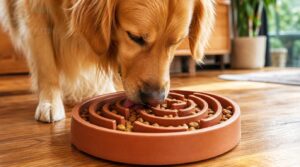
Think of a slow feeder bowl as a tiny obstacle course built right into your dog’s dish.
Ridges and maze-like walls force your dog to navigate around barriers, slowing each bite naturally. This ridge design impact means less gulping, less swallowed air, and a calmer stomach — a simple fix with real digestive benefits.
Smaller Food Pockets
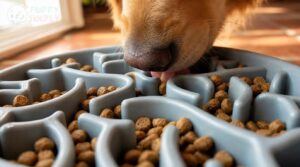
Those ridges and mazes also create smaller food pockets throughout the bowl — and that matters more than you might expect.
- Kibble segmentation breaks your dog’s meal into multiple tiny access points, so they can’t scoop a large mouthful at once.
- Bite mechanics improve naturally, as your dog’s incisors and premolars must work precisely to extract each piece.
- Food pocket design limits air escape problems by preventing food from pooling into one gulp-ready mass.
- Chewing efficiency rises with every pocket engagement, giving saliva more time to coat and begin breaking down each bite.
- Food flow restriction across the bowl surface promotes better canine digestion by slowing the entire feeding behavior from start to finish.
This is slow feeder bowls doing their quiet, consistent work — turning a two-minute inhale into a proper meal.
Longer Meal Duration
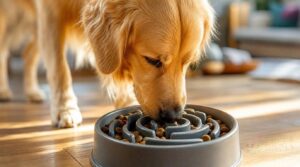
Most dogs finish a standard bowl in under a minute. With a slow feeder, that same meal can stretch to five or six minutes — and that window makes a real difference for canine digestion.
That extra time lets your dog’s stomach receive food at a steadier pace, supporting healthy gastric motility and reducing pressure that can contribute to bloat and gastric dilatation and volvulus.
Reduced Gulping
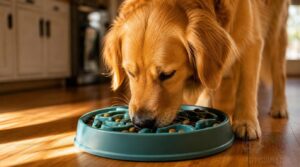
Gulping isn’t just messy — it’s a chain reaction. When your dog inhales food in rapid bursts, that chugging rhythm pulls air straight into the stomach alongside every mouthful.
Slow feeder bowls interrupt that pattern by forcing your dog to retrieve kibble piece by piece through ridges and pockets, which naturally modifies anticipation-driven gulping:
- Each bite requires a separate retrieval action, breaking the "chugging rhythm disruption" cycle
- Smaller mouthfuls reduce air trapping with every swallow
- Spaced bites improve the swallowing pattern, making each one more controlled
- Less gulped air means lower stomach gas buildup — a key factor behind bloat and GDV
- Slower eating speed reduces the frantic scouring that often follows food anticipation
The result? Air swallowing drops, and so does the pressure building inside your dog’s stomach after meals.
Built-in Mental Enrichment
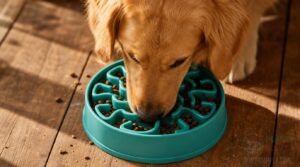
Slow feeders do more than slow down eating — they quietly turn every meal into a foraging simulation. Your dog’s nose guides it through grooves and pockets, searching for the next bite the way it would search in the wild.
| What Your Dog Does | Why It Matters |
|---|---|
| Sniffs along ridges | Natural instincts activation |
| Repositions head repeatedly | Builds problem-solving skills |
| Searches different bowl sections | Extends engagement duration |
| Works through obstacles | Acts as interactive feeding solution |
| Discovers new pockets | Provides cognitive enrichment |
That steady, searching rhythm also promotes stress reduction — a calmer meal means a calmer dog.
Digestive Benefits for Fast Eaters
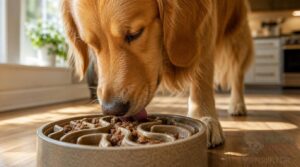
Slowing down mealtime does more than just look calmer — it actually changes what’s happening inside your dog’s digestive system. The benefits tend to show up in ways you can see and track pretty quickly. Here’s what most dog owners notice after making the switch.
Less Post-Meal Vomiting
One of the most telling signs that your dog eats too fast is finding vomit right after mealtime. When food enters the stomach faster than it can process, the body’s response is simple — send it back up.
Slow feeder bowls interrupt that cycle by pacing intake bite by bite, giving your dog’s stomach time to actually receive the meal properly.
Reduced Stomach Gas
Gas after meals isn’t just uncomfortable — it signals that air found its way in during eating. This is called aerophagia, or swallowing air, and it happens most when your dog gulps food rapidly. Slow feeding directly reduces how much air enters the digestive tract, easing gastrointestinal gas before it builds.
Better Food Breakdown
When air intake drops, the next piece of the puzzle falls into place: how well your dog’s body actually processes what it eats.
Slower bites mean more chewing, which breaks kibble into smaller, more uniform particles. Those smaller pieces give digestive enzymes better surface contact, supporting more efficient nutrient absorption before food even reaches the small intestine.
Improved Stool Quality
What comes out the other end tells you a lot.
When food is chewed properly and digestive enzymes get adequate contact time, your dog’s body absorbs more nutrients — leaving less undigested material behind. The result? Firmer, well-formed stool that’s easier to pass.
Better mechanical breakdown directly promotes healthier stool consistency, which is one of the clearest signs digestion is working as it should.
Lower Bloat Pressure
Bloat doesn’t just appear out of nowhere — stomach expansion rate plays a direct role. When your dog gulps food, air and kibble rush in together, pushing the stomach to expand faster than it can safely handle.
Slow feeder bowls interrupt that pace, reducing the peak pressure that builds after meals and lowering the conditions that make GDV a real threat.
Weight and Satiety Benefits
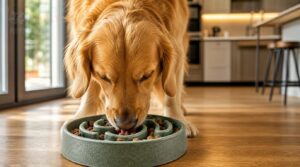
Slowing down mealtime does more than help your dog’s stomach — it can actually help them feel full sooner and eat less overall. That’s a big deal when nearly half of all dogs in the U.S. are overweight. Here’s how a slow feeder bowl aids your dog’s weight and hunger signals.
Earlier Fullness Signals
Here’s something worth thinking about: your dog’s body needs time to catch up with the bowl.
When a dog eats fast, the stomach fills before satiety hormones can signal the brain to stop. Slower eating gives those hormones time to do their job.
- Stomach stretch rate rises gradually during slow meals, triggering earlier fullness cues
- Hormone release timing aligns better when meal duration extends beyond a few seconds
- Neural signal pace catches up, helping your dog feel full sooner
Slow feeder bowls naturally extend mealtimes, giving the brain time to register satisfaction before the last bite disappears.
Better Portion Control
Most dog owners measure food carefully — then watch it vanish in seconds. That’s where slow feeder dog bowls quietly earn their place. By extending meal duration, they give you a clearer window to observe how much your dog is actually consuming, making food intake regulation feel less like guesswork and more like a real system.
| Feeding Method | Avg. Meal Duration | Portion Awareness |
|---|---|---|
| Standard bowl | ~50 seconds | Low |
| Slow feeder bowl | ~350 seconds | High |
| Measured + slow feeder | ~350 seconds | Very High |
Structured feeding works best when the bowl does part of the job for you. Pair it with a simple measuring technique — a kitchen scale beats a scoop every time — and your owner role shifts from passive to intentional. Smart bowl tech even tracks eating rate via sensors, giving activity-based portion adjustments real data to work from.
Reduced Begging
Begging often drops noticeably once a slow feeder becomes part of the routine. When meal duration extends, satiety signals reach the brain before hunger has a chance to spiral into pestering.
Pair that with consistent mealtimes and a designated mat, and your dog learns the rules — food comes at set times, in one place, on your terms.
Slower Calorie Intake
Slowing down the pace of eating does more than just extend mealtime — it directly lowers calorie intake rate.
When your dog works through a slow feeder bowl, the body gets time to release satiety hormones before the last bite is gone.
Studies show dogs and people alike consume meaningfully fewer calories when the pace slows, without feeling shortchanged.
Obesity Management Support
Slow feeder bowls work best as part of a personalized weight management plan — not as a standalone fix. Pair one with consistent feeding schedules, portion control, and regular activity.
Behavioral coaching from your vet can help reinforce healthier habits over time. Together, these tools make obesity prevention realistic, not just possible.
Choosing The Right Slow Feeder
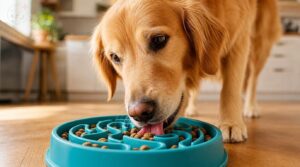
Not all slow feeders are created equal, and picking the wrong one can leave your dog frustrated — or worse, defeated before dinner is even over. The good news is that finding a solid match comes down to a few straightforward factors. Here’s what to look for before you buy.
Match Dog Size
One of the most practical steps you can take is matching the bowl to your dog’s size. Size-specific designs aren’t just a marketing detail — they directly affect how well the bowl works.
A large or giant breed needs wider obstacle spacing so kibble flows at a manageable rate, while smaller dogs benefit from denser ridges that suit their bite size and portion size matching needs.
Consider Breed Shape
Breed shape matters more than most owners realize. Brachycephalic breeds — like Bulldogs and Pugs — have compressed skull shapes that change how they grip and chew food, so shallow lick-mat styles work far better than deep mazes.
Meanwhile, large deep-chested dogs like Great Danes carry a higher GDV and bloat risk, making wider, low-profile designs the smarter pick.
Choose Safe Materials
Once you’ve matched the bowl to your dog’s breed shape, the material it’s made from matters just as much. Here are three safe choices to keep in mind:
- Stainless steel — durable, rust-resistant, and easy to sanitize
- Lead-free ceramic — non-porous and scratch-resistant
- BPA-free, food-safe plastic — lightweight and travel-friendly
Skip anything soft or unlabeled — it won’t last.
Pick Proper Difficulty
The material is sorted — now think about the layout inside the bowl. Slow feeder bowls come in a range of difficulty levels, and picking the wrong one can backfire.
Too easy, and your dog clears it fast. Too hard, and frustration takes over — you’ll see pawing, barking, or a dog that simply walks away mid-meal.
Use Non-Slip Bases
A bowl that slides across the floor the moment your dog digs in? That ruins the whole purpose. Non-slip bases — whether rubber grip, nonslip silicone, or suction stability designs — keep the bowl planted.
Look for textured bottom patterns that hold firm on tile or hardwood. Stainless steel bowls with embedded rubber bases also score high on hygiene, cleaning ease, and durability.
When Slow Feeders Are Not Enough

Slow feeders are genuinely helpful for most dogs, but they’re not a one-size-fits-all fix. Some dogs have specific needs that make standard slow feeder bowls a poor fit — or even a risk. Here’s when you might need to rethink your approach.
Brachycephalic Dog Concerns
If your dog has a flat face — think Bulldogs, Pugs, or Shih Tzus — a standard slow feeder may not be the right fit. These breeds live with Brachycephalic Airway Syndrome, which narrows their upper airways and makes breathing harder during meals. Add a maze-style bowl to that picture, and you’re asking an already-struggling airway to work overtime.
The concern goes beyond just gagging or coughing at the bowl. Brachycephalic dogs also deal with:
- Eye vulnerabilities from protruding eyes that are easily irritated
- Skin fold care needs around the face, where moisture and debris collect
- Dental disease rates significantly higher than other breeds — over 11% prevalence in some studies
Heat intolerance adds another layer. These dogs can’t cool down efficiently, so the stress of maneuvering through a complex feeder can spike their body temperature fast. A lick-mat or shallow bowl is usually a safer choice — but check with your vet first.
Senior Dog Sensitivity
As dogs age, their world quietly shifts.
Senior dogs grow more anxious over time, and something as simple as a new bowl with ridges and obstacles can feel genuinely unsettling. If your older dog seems hesitant, restless, or starts eating less predictably, that’s worth paying attention to — not dismissing.
Dental Pain Issues
Dental pain can make a slow feeder work against your dog. If your dog has tooth sensitivity, cracked teeth, gum inflammation, or a failing filling, pressing kibble out of tight ridges becomes genuinely painful.
Instead of slowing them down, the bowl may cause them to eat less or avoid meals entirely. When in doubt, check with your vet first.
Chronic Digestive Problems
Some dogs have deeper issues that a slow feeder bowl simply can’t fix on its own. If your dog is dealing with canine IBD, chronic diarrhea, or gut motility problems, the root cause is medical — not mealtime pace.
Ask Your Veterinarian
If something feels off — your dog keeps vomiting, shows signs of bloat, or isn’t responding to any mealtime changes — that’s your cue to call your vet.
A slow feeder bowl is a helpful tool, not a diagnosis. Your veterinarian can rule out underlying gastrointestinal issues, check dental health, review medications, and build a plan that actually fits your dog.
Frequently Asked Questions (FAQs)
Do vets recommend slow feeder bowls?
Yes, vets recommend slow feeder bowls regularly. They’re a practical first step for dogs with gulping habits, vomiting, or canine bloat prevention concerns — often suggested alongside consistent meal schedules and measured portions.
What is the 15 minute rule for dog food?
The 15-minute rule is simple: put the bowl down, set a timer, and take it away when time’s up — whether your dog finished or not.
Do pugs need slow feeders?
Pugs are fast eaters by nature, and yes, slow feeders genuinely help them. Their flat faces already make breathing tricky — add gulping to the mix, and mealtimes can get uncomfortable fast.
Can slow feeders improve a dogs dental health?
Slow feeders won’t replace your dog’s toothbrush — but they do more for dental health than most owners realize. More chewing means more saliva, which helps rinse debris and balance oral pH naturally.
How long does it take dogs to adapt?
Most dogs adapt to a slow feeder within a few days to one week. Younger, confident dogs often settle faster, while anxious or older dogs may need a little more time.
What materials are safest for slow feeder bowls?
Stainless steel is your safest bet — non-porous, durable, and easy to sanitize.
BPA-free silicone and ceramic run close behind.
Avoid cheap plastic bowls; scratches harbor bacteria.
Bamboo and food-safe materials offer eco-friendly alternatives worth considering.
Do slow feeders help with weight management?
Yes, they can. By slowing intake, your dog’s fullness signals have time to kick in — so they’re less likely to overeat. It’s a simple tool that facilitates portion control alongside a measured diet.
Are there smart slow feeders with tracking features?
Absolutely — smart pet bowl technology has come a long way. Many smart slow feeders now include data tracking and sensors that log meal times, eating speed, and intake, syncing everything to feeding data apps on your phone.
Conclusion
Does the way your dog eats really matter that much?
Regarding digestion, it absolutely does.
If you’ve wondered, ‘Do slow feeder bowls help dogs digest better?’ — the answer is yes, and the evidence is hard to ignore.
Lower risk of serious bloat.
A simple bowl swap won’t solve every issue, but for most fast eaters, it’s one of the smartest changes you can make.
- https://www.yahoo.com/lifestyle/slow-feeder-bowls-help-dogs-112921792.html
- https://leashboss.com/blogs/boss-dog-blog/benefits-of-slow-feed-dog-bowl
- https://messymutts.ca/blogs/news/dog-slow-feeder-bowls-benefits-and-risks
- https://superfeedy.com/blogs/news/the-science-behind-slow-feeder-dog-bowls-understanding-their-impact-on-canine-health
- https://www.acabonacfarms.com/blogs/acabonac-pet-2/slow-feeder-dog-bowls-enhance-your-dogs-eating-experience-with-acabonac-pet-raw-dog-food