This site is supported by our readers. We may earn a commission, at no cost to you, if you purchase through links.

Most dogs labeled "stubborn" aren’t being defiant—they’re being rational. If ignoring you works better than listening to you, that’s exactly what they’ll keep doing. It’s not a personality flaw; it’s math.
Clicker training changes that equation. The click gives your dog a clear, consistent signal that a reward is coming, which cuts through confusion and builds the kind of motivation that makes even the most resistant dogs want to engage.
Get the fundamentals right, and you’ll have a reliable training system that works—even with a dog that’s spent years doing things its own way.
Table Of Contents
Key Takeaways
- Most "stubborn" dogs aren’t being defiant — they’re making rational choices, and clicker training works by making the right behavior the most rewarding option available.
- Timing is everything: a click must be followed by a treat within one second, or the behavior-reward connection breaks down fast.
- Build reliability gradually by starting in quiet spaces, keeping sessions to three to five minutes, and only adding distractions once your dog is consistent in easier conditions.
- Common mistakes like late clicks, skipped rewards, and low-value treats quietly destroy progress — fix these first before blaming the dog.
Why Stubborn Dogs Resist Training
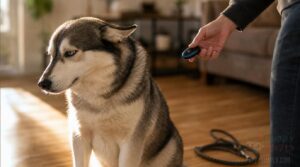
Before you can fix the problem, you need to understand what’s actually causing it. Stubborn dogs don’t resist training out of spite — there are real, specific reasons behind the pushback.
Most of the time, it comes down to a few fixable things — like a bored dog, a bad association, or simply never being taught what you expect, which is especially common in mixed breeds like the Rottweiler-Pug mix that carry very different temperament traits from each parent.
Here’s what’s usually going on.
Independence Versus Disobedience
Here’s something worth sitting with: your stubborn dog probably isn’t defying you — they’re just making choices that work for them. That’s Freedom Reinforcement in action. When ignoring a cue pays off (hello, squirrel chase), your dog’s Compliance Threshold rises fast.
Your stubborn dog isn’t defying you — they’re just choosing what works for them
Clicker training dogs works because it shifts the Choice Architecture — making the right behavior the most rewarding option available.
Low Motivation Signals
Once you stop seeing eye contact and start noticing body turn-away, your dog is telling you something important: motivation has dropped. A cue freeze — where your dog just pauses instead of responding — and rising response latency are classic signs. So is repeated sniffing distraction after a reward.
These aren’t rebellion. They’re feedback. Your dog needs better incentives or a shorter session.
Distraction-driven Behavior
Sometimes it’s not stubbornness at all — it’s a squirrel. Distraction-driven behavior happens when stimulus salience pulls your dog’s attention away faster than your clicker training can compete.
This attention capture creates real decision latency; your dog’s brain allocates resources to the new thing, not your cue. Evidence accumulation toward the correct behavior simply stalls. The environment wins the moment.
Confusing Cues
When distractions steal focus, cues can make things worse. Marker Inconsistency, Cue Overload, and Mixed Body Language all send your dog conflicting information.
Using different words, gestures, or variable reward signals for the same behavior breaks cue association. Context Shifts—moving rooms, changing surfaces—add more noise.
Your dog isn’t ignoring you; they’re genuinely confused.
Poor Reward Timing
Reward timing matters more than most people realize — and it’s often why a stubborn dog seems to "forget" what it just did right. When the click‑treat interval stretches even a second too long, the lesson blurs. Research shows that immediate reward timing triggers dopamine spikes that strengthen the behavior‑reward connection.
Key consequences of poor timing include:
- Timing latency breaks the link between behavior and reward delivery
- Handler hand speed and reward delivery delay shift what gets reinforced
- Inconsistent click timing leaves your dog guessing, not learning
Choose and Charge The Clicker

Before any commands or tricks, your dog needs to understand what the click actually means. That’s what charging the clicker is all about — teaching your dog that the sound predicts something good.
Here’s how to set that foundation up right.
Pick a Consistent Marker
Your marker signal is the foundation everything else is built on. The clicker acts as a precise event marker — it tells your dog exactly which moment earned the reward. Marker sound selection matters more than most people realize, so pick one and stick with it. Audible cue consistency and signal uniformity are what make the system work.
| Marker Type | Best For |
|---|---|
| Mechanical clicker | Most dogs — clear, consistent clicker sound |
| Verbal "yes" | Hands-full situations |
| Finger snap | Dogs familiar with visual marker alternatives |
Use Quiet Clickers if Needed
If your dog flinches at loud sounds, a standard clicker might work against you. Noise-sensitive dogs struggle to focus on positive reinforcement training when the tool itself startles them. Quiet clickers with adjustable volume preserve the clicker sound association without causing distress.
Pairing a quiet clicker with steady, positive reinforcement techniques for sensitive dogs helps build trust without overwhelming them.
Look for:
- Consistent button sensitivity for precise timing
- Audibility verification from your dog’s position
- A clear enough clicker sound for training stubborn dogs
Click Then Treat Immediately
Timing is everything in clicker training. The click acts as a precise event marker — but only if a treat follows within one second. This ensures consistent marker timing and reinforces the connection your dog needs.
The click-first rule maintains this precision, as the treat must arrive within a one-second latency standard. Subsecond reward delivery ensures immediate reinforcement lands effectively.
Delaying the treat beyond this window causes the method to lose its edge fast, undermining the training’s impact.
Repeat 10–20 Pairings
Think of this phase as programming your dog’s brain. You’re building a conditioned reinforcer — teaching your dog that a distinct marker sound reliably predicts food.
Do 10–20 click-treat pairings in the same room, using a uniform treat type each session.
Consistent pairing count, immediate reward timing, and training consistency are what transform a simple click into a powerful primary reinforcer your dog genuinely reacts to.
Test for Treat Anticipation
Here’s your quick reality check: click once without asking for any behavior, then watch what your dog does next. If they snap to attention or move toward you before the treat appears, that’s anticipation — your conditioned reinforcer is working.
Strong expectation behaviors and low response latency are your treat prediction metric. Weak click consistency means more pairings before moving on.
Start With Easy Wins

Before you tackle the tough stuff, give your dog — and yourself — a few small victories to build on.
Stubborn dogs respond better when they can succeed quickly, and that means stacking the early sessions in your favor.
Here’s how to set things up so the wins actually happen.
Train in Quiet Spaces
Before your first session even begins, the environment does half the work. For clicker training a stubborn dog, a quiet, designated space with zone boundaries and privacy screens remove competing stimuli before they become a problem. Add acoustic treatment if echoes are distracting, and use controlled lighting to keep the area calm.
Consistent training sessions in the same sensory-reduced spot build the focus you need.
Use Pea-sized Rewards
Once your space is set, what you put in your treat pouch matters just as much. For clicker training a stubborn dog, pea-sized soft treats are your best tool.
- Rapid Consumption keeps focus on you, not the food
- Portion Planning facilitates calorie management across multiple sessions
- Motivation Balance sustains drive without overfeeding
Small training treats reward the animal quickly, reducing chew time and reinforcing positive reinforcement precisely.
Keep Sessions Short
Short practice sessions are your secret weapon with a stubborn dog. Three to five minutes — that’s your attention window. Stop before your dog checks out.
| Session Element | Too Long | Ideal |
|---|---|---|
| Duration | 15+ minutes | 3–5 minutes |
| Energy management | Dog fatigues, disengages | Stays sharp throughout |
| Rapid success cycles | Errors accumulate | Ends on a win |
Micro learning blocks beat marathon sessions every time.
Click Spontaneous Good Behavior
Once your sessions are short and snappy, watch what your dog does between repetitions. That’s where micro-behavior capture happens. Your dog sits calmly? Click. Checks in with you without being asked? Click.
Low-threshold criteria make this work — you’re not waiting for the ideal, just reinforcing consistency around small, naturally occurring moments.
Contextual predictability and a well-timed event marker do the rest.
Reward Focus and Engagement
Don’t just reward the behavior — reward the attention behind it.
When your dog glances up at you mid‑session, that’s engagement worth clicking.
Use a Predictable Training Rhythm and High-Value Treat Rotation to keep motivation steady.
Marker Timing Precision and Motivation Cue Consistency turn a distracted dog into a willing partner — because in reward‑based training, focus itself is the foundation every shaping step builds on.
Teach Commands Step by Step
Teaching commands to a stubborn dog isn’t about forcing compliance — it’s about breaking things down into steps small enough that success feels inevitable. The good news is there’s a clear progression that works, even for the most headstrong breeds.
Here’s how to move through it.
Capture Natural Behaviors

Your dog is already doing what you want — you just haven’t marked it yet. Capturing natural behaviors means watching for pre-behavior cues like a weight shift or a glance, then clicking the moment the target behavior happens.
Set up a consistent environment, stay patient, and let positive reinforcement do the work. Reward consistency is everything here.
Shape Small Progressions

Shaping behaviors means building toward a goal one small step at a time — never expecting flawlessness upfront. Think of it as incremental training steps: you reward successive approximations, not the finished behavior.
If your dog stalls, that’s your cue to lower the bar slightly. This ensures progress continues without causing frustration for either of you.
Reinforcement timing precision and honest progress evaluation criteria are critical. They maintain momentum while preventing discouragement, keeping the training process smooth and effective.
Lure Without Dependency

Luring gets your foot in the door — but leaning on it too long backfires. Start with pretend treat luring: guide your dog through the motion with an empty hand, then mark and reward immediately after.
These empty-hand trials teach that the behavior is rewarding comes from the marker, not what’s in your fist. That’s the foundation of reliable clicker training for a stubborn dog.
Fade Treats From Hands

Once your dog moves reliably without needing the lure, it’s time to pull back on hand visibility. Fade gradually — reduce how much the treat shows in your reward hand location rep by rep. Gradual fade timing matters here: maintain treat delivery consistency so reinforcement timing stays sharp.
In clicker training, behavior shaping works best when the dog follows the behavior, not your fist.
Add Verbal Cues Later

Words mean nothing until behavior already exists — that’s the core of delayed cue introduction. In clicker training for a stubborn dog, adding the verbal cue too early just creates noise. Use single cue pairing only once the behavior is reliable:
- Say the cue right as the dog begins moving
- Build cue anticipation training through gradual cue fade
- Associate cues with immediate cue-only reinforcement
- Use behavior shaping before attaching any training cues
Build Reliability Around Distractions

Getting your dog to sit in the living room is one thing — doing it while a squirrel runs past is a whole different game. Reliability only sticks when you build it across real-world situations, and that means stepping outside your comfort zone one small challenge at a time.
Here’s how to do it without losing the progress you’ve already made.
Practice in New Rooms
Once your dog masters a behavior at home, transition training to a new room—but maintain one constant element at a time. Entry consistency is key: use the same entry point, same position anchor, and same training cue. In unfamiliar spaces, your body language communicates more, so remain still during the click. Adjust timing to avoid rewarding incorrect moments when a dog’s learning slows mid-investigation.
| New Room Variable | What to Keep Consistent |
|---|---|
| Different floor texture | Same entry point |
| New sightlines | Same position anchor |
| Unfamiliar sounds | Same training cue |
| Changed lighting | Same clicker conditioning rhythm |
| More distractions | Same body language posture |
Controlled novelty and transfer cues drive progress here.
Add Distance Gradually
Once you’ve conquered the new room, the next challenge is space itself. Adding Incremental Distance Steps keeps behavior reinforcement strong without overwhelming your dog. Use these checkpoints for Leash Position Control and Cue Consistency Range:
- Stop increasing distance the moment accuracy drops
- Maintain Reward Delivery Distance by going to your dog—don’t call them back empty-handed
- Set clear Success Thresholds before each new distance level
Introduce Mild Distractions
Once distance feels solid, it’s time to layer in mild stimulus selection — think soft TV audio or someone walking far away, not a squirrel at close range.
Intensity titration steps matter here: start faint, then slowly increase only when your dog stays consistent.
Use attention anchor cues and timing precision practice to keep focus reinforcement drills effective during clicker training sessions.
Train Outdoors on Leash
Once mild distractions feel manageable indoors, take the work outside. Start with a 6-foot leash — a front-clip chest harness helps reduce pulling without a fight. Use your stop-and-go cue whenever the leash tightens, then click and reward the moment slack returns.
Keep early routes short and simple, then vary them gradually.
Variable reinforcement keeps your dog guessing — in the best way.
Reward Calm Impulse Control
Impulse control isn’t about waiting for flawlessness — it’s about catching the tiny moments before the chaos starts.
Define your Calm Criteria clearly: four paws down, no lunging, a brief pause. Click that pause the instant it happens.
Reward Micro Movements like a glance back at you. This Focus Reinforcement, backed by Consistent Timing and a solid reinforcement schedule, is where real behavior modification begins.
Fix Common Clicker Mistakes

Even experienced trainers slip up with the clicker — and with stubborn dogs, small mistakes get amplified fast.
The good news is that most of these errors are easy to fix once you know what to look for. Here are the five most common clicker mistakes and how to correct them.
Clicking Too Late
Late clicks are one of the sneakiest problems in marker training. The clicker acts as a precise event marker — it needs to land at the exact behavioral moment, not a second after. When timing precision slips, you’re marking what your dog did after the behavior, not during it. That’s Late Click Effects in action.
Focus your eyes on your dog, not your treat pouch, and click ready.
Skipping The Reward
Marker Devaluation starts quietly—repetition by repetition—when rewards are skipped after a click. In operant conditioning, the click holds power only because it reliably predicts something good. Break that promise, and the Extinction Process begins.
- Your dog checks in less often
- Offered behaviors shrink and fade
- Trust in the clicker as a training tool erodes
Treat Preparedness prevents this. Have treats ready before you click. If you miss a reward, use Recovery Clicks—several clean click-treat pairings—to rebuild the behavioral reinforcement loop fast.
Training Too Long
More isn’t always better. Long sessions invite Session Fatigue, Handler Drift, and Cue Smearing — your timing slips, your dog tunes out, and Reinforcement Inconsistency creeps in. Motivation Burnout takes hold.
Keep your training session length short, sweet, and rewarding: three to five minutes max. A smart training schedule protects the clicker training method’s precision and keeps your dog genuinely enthusiastic to work.
Using Low-value Treats
Your dog doesn’t work hard for boring pay — and neither would you. In clicker training, low-value treats quietly kill training motivation for stubborn breeds.
Here’s how to get Treat Size Optimization and reward-based training right:
- Use pea-sized, soft, high-value rewards for new or difficult behaviors
- Apply Flavor Rotation Strategy every few sessions to maintain engagement
- Reserve low-value treats for already-learned cues in calm settings
- Practice Reward Frequency Management by gradually thinning treats
- Shift to Praise only after reliable responses across multiple environments
Punishing Unwanted Behavior
Punishment feels like a shortcut — but in clicker training, it usually backfires. Timing punishment wrong, misjudging punishment intensity, or skipping reinforcement removal can all make behavior worse, not better.
| Mistake | What Happens | Better Move |
|---|---|---|
| Late consequence | Dog doesn’t connect it | Click the right moment |
| Too mild | Behavior continues | Raise reward value |
| No Escape Prevention | Dog avoids training | Manage the environment |
Operant conditioning works best through reward-based training, not corrections.
Risk management in behavior training your dog means ditching no punishment approaches that add stress and leaning fully into what clicker training does best.
Frequently Asked Questions (FAQs)
What are common mistakes in clicker training?
The biggest shortcomings include inconsistent clicker sound, overusing marker signals, hand movement cueing before the click, premature luring, and reward timing variability.
No punishment — ever. Charge the clicker properly first; loading the clicker correctly fixes most problems.
Can clicker training work for older stubborn dogs?
Old dogs can absolutely learn new tricks — clicker training adapts beautifully to their needs.
Hearing loss accommodations, arthritis-friendly poses, and scented high-value treats make reward-based training just as effective at any age.
How many clicks should one session include?
There’s no fixed click frequency per session. Let the behavior guide you — 10 to 20 clicks is a solid session click range for most dogs. Quality and timing matter far more than click density metrics.
Can two people train the same dog together?
Yes — two trainers can work the same dog like two oars rowing the same boat: effective only when synchronized.
Trainers’ role division, consistent cue language, shared equipment standards, and tight timing coordination make joint session pacing work.
When should a stubborn dog see a professional trainer?
If clicker training stalls despite consistent effort, a professional dog trainer can help.
Watch for safety aggression, life breakpoints, lack of progress, persistent issues, or specific training needs that exceed what you can manage alone.
Does breed affect how fast clicker training works?
Breed matters less than you’d think. Food drive, temperament influence, and drive compatibility shape learning pace far more than breed labels. Any dog can click — motivation is the real engine.
Conclusion
Pavlov figured out the pattern long before clicker training stubborn dogs became a method anyone could use at home—consistent signals shape predictable responses, every time. Your dog isn’t broken; the communication was just missing a common language. Now you have one.
A click means clarity. Clarity builds trust. Trust creates a dog that actually wants to listen—not because it has to, but because responding finally makes sense.
- https://www.guidedogs.com/resources/client-resources/guide-dog-class-lecture-materials/clicker-techniques-part-two
- https://bestfriends.org/pet-care-resources/guide-clicker-training-pets
- https://www.petdogtrainer.com/podcast/training-your-dog-with-clickers-proven-methods-and-common-mistakes
- https://sitmeanssit.com/how-to-clicker-train-a-dog-the-professional-guide-to-precision-and-attention/
- https://clickertraining.com/15tips/