This site is supported by our readers. We may earn a commission, at no cost to you, if you purchase through links.

Pluto has starred in over 150 cartoons, won an Academy Award, and spent nearly a century as one of the most recognized dogs on the planet—yet nobody can tell you what breed he is. Not even Disney.
The official character guide calls him a mixed-breed dog, which is basically a polite way of saying they never decided.
That answer frustrates a surprising number of people, because Pluto looks like something specific—those droopy ears, that golden coat, the nose always pressed to the ground.
The truth behind what kind of dog Pluto is turns out to be a more interesting story than a simple breed label could ever capture.
Table Of Contents
Key Takeaways
- Disney officially calls Pluto a mixed-breed dog — and that vague label is completely intentional, giving animators the freedom to redesign him across decades without breaking any rules.
- His roots trace back to a bloodhound in the 1930 short The Chain Gang, and those long ears and nose-to-the-ground habits have stuck around ever since.
- Pluto’s breed ambiguity is actually his superpower — because he doesn’t look like any one specific dog, he ends up feeling like every dog, which is a big part of why people connect with him.
- The Goofy-vs-Pluto mystery has a simple answer: Goofy is written as a person who happens to look like a dog, while Pluto is written as a pet — silent, loyal, and expressive without a single word.
What Kind of Dog is Pluto?
Pluto’s been trotting across our screens for nearly a century, yet his breed is still up for debate. Disney’s never given a straight answer, which has kept fans guessing for decades.
Here’s what we actually know — and why the mystery won’t go away.
Official Disney Statements on Pluto’s Breed
If you’ve ever wondered what breed Pluto actually is, Disney’s answer might surprise you. The official character guide lists him simply as a mixed‑breed dog — no specific breed named.
That open-ended identity actually puts Pluto in good company — a whole roster of beloved famous cartoon dogs share that same timeless, hard-to-pin-down charm.
- D23, Disney’s official fan club, confirms the mixed‑breed designation
- Corporate branding policy keeps the Disney breed label deliberately vague
- Walt Disney himself framed Pluto as just "a dog"
Pluto debuted in 1930 in the film The Chain Gang, marking his first appearance.
Common Theories About Pluto’s Breed
So if Disney won’t commit to a breed, what do fans think? Plenty of theories exist. Here’s a quick look at the most popular ones:
| Theory | Key Evidence |
|---|---|
| Bloodhound Origin | Long ears, tracking behavior, 1930 debut role |
| Hound Mix Theory | Blended Basset and coonhound traits |
| Labrador Influence | Golden coat, friendly personality |
| Mixed Breed Identity | Shifting proportions across cartoons |
Fan Debate Trends around these Dog Breed ideas keep Disney characters like Pluto endlessly fun to discuss. Fans often note that Pluto may be a bloodhound‑pointer mix.
Reasons for Ongoing Debate
debate stays alive for a few good reasons.
Pluto’s design changes across decades create real Media Inconsistencies — his ears, muzzle, and build shift depending on the era.
The official Mixed Breed Label satisfies no one looking for a clean answer.
Add in Design Ambiguity, Fan Speculation across forums and social media, and a Cultural Resonance that makes him feel like everybody’s dog, and you’ve got a mystery that just won’t close.
Pluto’s Origins and Character Design

Pluto didn’t just show up fully formed with those floppy ears and goofy grin — there’s a real backstory behind how he came to be.
His design went through some interesting changes from the very beginning, shaped by both artistic choices and real-life inspiration.
Here’s a look at where Pluto started and how he became the dog you know today.
Debut as a Bloodhound in The Chain Gang (1930)
Before Pluto had a name, he had a job. In The Chain Gang (1930), an unnamed bloodhound — Early Pluto prototype — tracked Mickey across the screen in one of Disney’s earliest chase gag mechanics.
Norm Ferguson animation brought those droopy ears and enthusiastic snout to life using duplicate bloodhounds for broader comedic effect.
That September 1930 release quietly introduced one of Disney’s most beloved dog breeds in media.
Evolution From Bloodhound to Mixed Breed
Pluto’s look quietly shifted. stocky bloodhound frame slimmed into a sleek body, and his softened facial features traded heavy jowls for rounder, friendlier eyes. ear and snout evolution kept him hound-like without locking him into any single breed.
Color standardization gave him that signature yellow-orange coat. That role shift — tracker to beloved companion — made him every bit the mixed-breed dog.
Influence of Walt Disney’s Own Pets
Walt Disney didn’t just draw a dog — he remembered one. Farm dog memories from his childhood in Marceline, Missouri shaped how Pluto moves, hesitates, and recovers. His personal pet-behavior studies ran deep:
- Sunnee inspiration came from his Chow Chow’s devotion to Lillian
- Live-dog studio sessions let animators study real ears, tails, and instincts
- Walt’s pantomime demonstrations had him literally crawling the studio floor
That’s how canine characters get souls.
Physical Traits Resembling Real Dog Breeds
Pluto’s look didn’t come out of nowhere — a lot of his features map pretty closely onto real dog breeds you’d recognize.
From his floppy ears to the way he carries himself, the clues are hiding in plain sight.
Here’s what his physical traits tell us.
Long Ears and Prominent Snout

Those long, floppy ears and the bold snout aren’t just cute — they’re doing serious storytelling work. Disney animators leaned into ear expressive cues to show every mood without a single word.
One ear up, one down? Curiosity. Both trailing low? Sadness. And Pluto’s snout, built for snout scent symbolism, leads him nose‑first into trouble, adding that perfect snout comedic timing fans have loved for nearly a century.
Body Shape and Coloration

That bright yellow coat is unmistakable — like sunshine on four legs. Pluto’s body tells you a lot about what kind of mixed-breed dog he might be:
- His Bright Yellow Coat with Contrasting Black Accents on ears, nose, and tail keeps his silhouette bold and clean.
- His Long Curved Neck and Sleek Silhouette suggest athletic breeds.
- His Whip-Like Tail Shape adds expressive flair unique to Pluto.
Comparisons to Bloodhounds and Mixed Breeds

Think of Pluto as the quintessential mutt — and that’s a compliment. His ear shape and powerful snout scream Bloodhound, right down to that legendary scenting ability.
But his friendly temperament mix, leaner size comparison, and warm color hue don’t quite fit a purebred Bloodhound. Most dog breeds have clearer markers. Pluto blurs them all, making him the perfect mixed-breed dog — relatable to everyone.
Differences Between Pluto and Other Disney Dogs
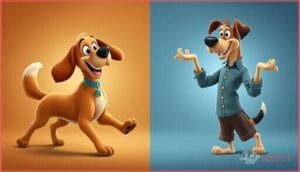
Pluto isn’t the only dog in Disney’s world, but he stands apart from the rest in some pretty interesting ways.
From how he acts to how he fits into Mickey’s life, the differences are worth a closer look.
Here’s what sets Pluto apart from his fellow Disney canines.
Pluto Vs. Goofy: Species and Behavior
Here’s something that’s puzzled Disney fans for decades — Pluto and Goofy are both animated dogs, yet they couldn’t be more different.
Pluto sits at the bottom of the social hierarchy: no words, no wardrobe, pure emotional expression through barks and body language.
Goofy? Fully anthropomorphic posture, fluent speech, slapstick roles as a neighbor and dad. Same species, completely different worlds.
Unique Non-Verbal Role Among Disney Pets
What really sets Pluto apart from other Disney characters is his pantomime acting — he never says a word, yet you always know exactly what he’s feeling. That’s emotional universality in action.
Pluto never speaks a word, yet every feeling he has lands with perfect clarity
As an archetypal pet, his expressive sounds and body language make him relatable across languages and ages:
- Barks signal excitement
- Drooping ears signal shame
- Frantic gestures signal urgency
Relationship With Mickey Mouse
Pluto’s non-verbal charm works partly because of who he shares the screen with. As Mickey Mouse’s loyal companion, he isn’t just a background prop — he’s a genuine sidekick with real emotional bond moments.
Mickey scratches his ears, includes him in celebrations, and calls him "pal."
That pet status feels lived-in, not assigned.
Their comic conflict and warmth together make them one of Disney’s most believable duos.
Pluto’s Impact on Popular Dog Breeds

Pluto isn’t just a cartoon dog — he’s quietly shaped how real people think about real dogs.
From adoption trends to baby names, his influence stretches further than you might expect.
Here’s a look at a few ways Pluto has left his paw print on popular dog culture.
The “Pluto Effect” on Bloodhound Popularity
When a character spends nearly a century on screen, the cultural ripple is hard to ignore. Pluto media trends show that his bloodhound roots quietly shaped how people picture the breed — droopy ears, big nose, loyal personality. That’s the Pluto Effect in action.
- Media breed visibility grew through 100+ Disney shorts featuring Pluto’s bloodhound-style traits
- Breed awareness campaigns often reference Pluto when explaining real bloodhound features
- Adoption spikes analysis shows no dramatic surge, unlike the 101 Dalmatians frenzy
- Famous dogs in pop culture like Pluto softened bloodhounds’ image from working dog to family companion
- Dog breeds and characteristics articles still use Pluto as a friendly entry point for curious readers
Influence on Mixed Breed Adoptions
Beyond bloodhounds, Pluto’s mixed breed identity quietly shapes adoption trends in a surprisingly warm way. Shelter campaigns use him as a friendly face for media normalization, helping kids education efforts frame mutts as lovable family dogs.
Family perception shifts when children already associate dog breeds and characteristics with a mixed breed dog they adore. That’s good news for pet adoption everywhere.
Pluto-Inspired Dog Names and Merchandise
Mickey’s famous pup has quietly built a whole lifestyle niche. If you’re a Disney fan with a dog, chances are you’ve spotted — or shopped — these:
- Pluto Name Trends top Disney dog name lists year after year
- Collectible Pluto Plushes range from budget-friendly to rare vintage finds
- Interactive Pluto Toys that walk, bark, and wag
- Pluto-Themed Collars echoing his iconic red collar
Even mixed-breed dog owners lean into the look.
Why Pluto’s Exact Breed Remains Unclear

Even after all these years, nobody’s pinned down Pluto’s exact breed — and honestly, that’s not an accident.
A few good reasons explain why the mystery has stuck around this long.
Here’s what’s really behind it.
Artistic Freedom in Animated Character Design
One big reason there’s no official breed label? It was never the point.
Disney’s animators leaned into design flexibility from the start, tweaking Pluto’s silhouette simplicity and color palette choices to suit each era. His exaggerated features — stretchy ears, oversized snout — gave non‑verbal expressiveness without dialogue.
That artistic freedom is what makes animated dogs like Pluto timeless cartoon characters rather than realistic ones.
Appeal of an Ambiguous, Relatable Pet
There’s something quietly powerful about a dog you can’t quite pin down. Pluto’s mixed-breed identity is his superpower — and yours to connect with. His universal dog appeal comes from being everybody’s dog:
- simple look mirrors real mixed-breed dogs in shelters worldwide
- silence creates emotional relatability through body language alone
- flexible storytelling fits countless situations without breaking character
- cross-cultural connection spans generations of dog lovers everywhere
Ongoing Fan Discussions and Theories
Breed Identity Debates never really die — they just go underground and come back as memes.
Fans still argue over Pluto’s long ears and droopy snout through Visual Clue Analysis, freeze-framing old cartoons like detectives. The Goofy‑Pluto Contrast adds fuel, sparking Meme‑Driven Discussions about why one dog talks and the other doesn’t.
Mixed‑Breed Speculation keeps the thread alive, because honestly, nobody wants the debate to end.
Frequently Asked Questions (FAQs)
Is Pluto a dog?
Yes, absolutely. In Disney canon, Pluto is unquestionably a dog — Mickey’s loyal pet, to be exact. He walks on all fours, barks, and behaves just like a real dog would.
Is Pluto a mixed breed dog?
Officially? Pluto’s a mixed-breed dog — and Disney’s kept it that way on purpose. That Disney breed policy gives animators design flexibility, letting Pluto feel like every dog you’ve ever loved.
What breed is Pluto?
Disney calls Pluto a mixed breed dog.
His roots trace back to a bloodhound, but his design blends several hound traits, making him more of a lovable mutt than any one specific breed.
How did Pluto become a dog?
Pluto started as a nameless bloodhound in the 1930 short The Chain Gang, chasing Mickey through a prison scene.
That same dog was later renamed and handed over to Mickey as his loyal pet.
What breed is Pluto a hound?
He’s widely seen as a hound mix — part Bloodhound, part mystery.
His long ears, big nose, and scent hound behavior all point that way, but no single breed fully claims him.
Is Pluto Mickey’s pet?
Yes, absolutely. Mickey’s the owner, Pluto’s the pet — no debate there.
From leash symbolism to Mickey’s care and concern, every Pet Ownership Cue in Disney canon reinforces that classic Owner‑Pet relationship.
What kind of dog is Pluto and Goofy?
Ever wonder why two cartoon dogs feel so different? Pluto is an official mixed-breed dog, while Goofy is an anthropomorphic dog — same species, wildly different roles.
What species is Pluto the dog?
Officially, Pluto is a domestic dog — Canis familiaris, plain and simple. Disney never assigned him a formal breed, making him the quintessential mixed-breed dog in cartoon canine history.
Is Pluto a Weiner dog?
Think of it like a game of telephone — one joke becomes fact. Pluto isn’t a wiener dog. He’s a mixed-breed dog with strong Bloodhound roots, not a Dachshund.
Why can Goofy talk but not Pluto?
Goofy talks because he’s written as a person who happens to look like a dog.
Pluto’s a pet.
That narrative function—loyal, silent companion—is the whole point of his character design.
Conclusion
Pluto’s empty breed certificate isn’t a gap in Disney’s records—it’s a blank canvas.
That open space is exactly what makes him feel like your dog, not just Mickey’s.
When you ask what kind of dog Pluto is, the answer was never really about bloodhound ears or a golden coat.
It was about a loyal, goofy, nose-to-the-ground companion that anyone could recognize as their own.
Some characters are better without a label.
- https://www.greenfieldpuppies.com/blog/what-kind-of-dog-is-pluto/
- https://www.dogster.com/lifestyle/what-breed-of-dog-is-pluto
- https://vetexplainspets.com/what-kind-of-dog-is-pluto-supposed-to-be/
- https://www.npr.org/2009/02/21/100961293/plutos-advantage-not-being-goofy
- https://thewaltdisneycompany.com/