This site is supported by our readers. We may earn a commission, at no cost to you, if you purchase through links.
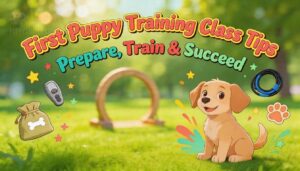
Most puppies flunk their first training class—not because they’re stubborn, but because their owners showed up unprepared. A eight-week-old can’t focus when he’s hungry, overstimulated, or missing the right gear.
The good news? A little preparation closes that gap fast. Understanding how your puppy’s brain works at this age makes every reward land harder and every cue stick longer.
These first puppy training class tips walk you through exactly what to pack, how to set up your space, and what to do when your pup decides the floor is more interesting than you.
Table Of Contents
- Key Takeaways
- Preparing for Your First Puppy Training Class
- Understanding Puppy Behavior and Needs
- What to Expect in The First Class
- Tips for Successful Training Sessions
- Continuing Training at Home
- Frequently Asked Questions (FAQs)
- What is the 3-3-3 rule for puppy training?
- How much does puppy training class typically cost?
- What vaccines does my puppy need before class?
- Can I bring multiple puppies to one class?
- What if my puppy gets overwhelmed or scared?
- Are online puppy training classes equally effective?
- How do I handle my puppys biting?
- When can puppies join outdoor group classes?
- What if my puppy refuses all treats?
- Should siblings attend the same training class?
- Conclusion
Key Takeaways
- Puppies fail first training classes not because they’re stubborn, but because owners show up without the right treats, gear, or understanding of how a young brain actually learns.
- The critical socialization window runs from 3 to 14 weeks, so every calm, positive experience you create right now shapes how your dog handles the world for life.
- Keep training sessions to 2–5 minutes, reward within two seconds, and end while your puppy still looks eager — momentum beats marathon drilling every time.
- If fear, persistent aggression, or house soiling keeps showing up despite your best efforts, calling a certified trainer early is the smart move, not a sign of failure.
Preparing for Your First Puppy Training Class
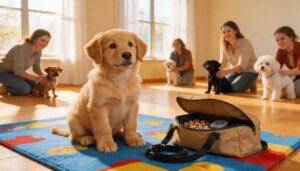
Walking into your first puppy training class feels exciting — and a little overwhelming. The good news is that showing up prepared makes a real difference.
Brushing up on a few top-rated puppy training books for beginners beforehand gives you a solid foundation before you even walk through the door.
Here’s what you need to have ready before that first session.
Gathering Essential Supplies
Before you walk through that classroom door, having the right training supplies makes all the difference between a smooth first session and a stressful one.
Here’s what to pack:
- Collar and leash — A flat collar paired with a 4–6 foot leash keeps your pup safely close without restricting movement.
- Treat pouch and portable water bowl — A silicone treat pouch clips to your waist for quick rewards; a collapsible portable water bowl keeps your pup hydrated between drills.
- Sanitation kit and vaccination records — Waste bags, hand sanitizer, and current vaccination records are non‑negotiables most facilities require at the door.
Good supply kits mean fewer surprises — and more focus on the fun part: training.
Choosing The Right Training Treats
Now that your bag is packed, let’s talk treats — your most powerful training tool.
Think of treats as your reward hierarchy: not all rewards are equal, and that’s a good thing. High-value treats like soft chicken or salmon pieces outperform plain kibble when you’re teaching something new. Selecting high-value training treats means prioritizing texture choice, flavor preference, and ingredient quality. Remember that treat size considerations are essential for rapid swallowing.
| What to Look For | Why It Works |
|---|---|
| Pea-sized treat size | Quick to eat, keeps momentum |
| Soft texture choice | No crunching delays between reps |
| Strong flavor preference | Grabs attention fast |
| Clean ingredient quality | Reduces sensitivity risks |
| Low calorie content | Promotes healthy weight |
Smart reward timing — within two seconds — locks in the lesson.
Setting Up a Safe Training Environment
Treats sorted? Good. Now let’s make sure your training space is just as ready as your treat pouch.
Hazard proofing your home isn’t just smart — it protects your puppy during every session. Start with these three steps:
- Tuck electrical cords out of reach and move toxic plants like lilies well beyond puppy territory.
- Block kitchen access with a gate and secure chemicals stored under sinks.
- Set up crate safety nearby so your pup has a calm retreat between reps.
Your training area layout matters too. A roughly 10×10 foot space with non-slip mats, minimal furniture, and good lighting creates a focused training zone. Distraction minimization is simple — face away from windows, remove other pets initially, and clean mats daily using pet-safe disinfectant. Cleanliness protocols and smart environmental adaptation keep your training aids effective and your puppy healthy.
For visual guidance on setting up your space and reinforcing these habits, basic dog training command videos for puppies show exactly how a well-organized area supports faster, calmer learning.
Understanding Puppy Behavior and Needs
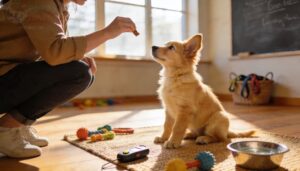
Before you can train your puppy, it helps to understand what’s actually going on in that fuzzy little head. Puppies aren’t small adults — they learn, rest, and react in ways that are totally unique to their stage of life.
Here’s what you need to know about how your puppy thinks, focuses, and builds trust.
Puppy Development Stages and Learning
Your puppy’s brain is basically a sponge right now — but only for a limited time.
Understanding puppy developmental stages means knowing when to teach what.
Neonatal reflexes dominate the first two weeks; learning windows don’t truly open until transitional motor skills emerge around weeks two to four.
The critical socialization window runs from 3 to 14 weeks — your biggest opportunity.
Around 8 to 11 weeks, expect a fear period; gentle exposure matters most then.
Positive reinforcement works best when timed to each stage.
| Age Range | Developmental Stage | Training Focus |
|---|---|---|
| 0–2 weeks | Neonatal Reflexes | Warmth, nursing, no formal training |
| 2–4 weeks | Transitional Motor Skills | Sensory exposure, gentle handling |
| 3–14 weeks | Critical Socialization Window | People, sounds, basic cues |
| 8–11 weeks | Fear Period Management | Calm reassurance, positive experiences |
Managing Attention Span and Energy
Keeping your pup’s attention is a bit like catching lightning in a bottle — possible, but you have to move fast. Most young dogs hold focus for only 5 to 10 minutes, so short training sessions for puppies aren’t just helpful, they’re essential.
That’s where Micro-Session Timing comes in: two to three minutes, a few times a day. Before class, build a Calm Arrival Routine using Pre-Training Play to burn off edge without overstimulating.
Minimize distractions, use high-value treats, and nail your Reward Timing — within two seconds — to make every repetition count.
Building Trust Before Training
Before any real training begins, trust building sets the tone for everything that follows. Building trust with a puppy starts with Gentle Handling — slow movements, soft eye contact, and Calm Body Language that says "you’re safe here."
Trust begins before training — gentle hands, soft eyes, and calm presence tell a puppy it is safe
- Use Predictable Routines for feeding, potty, and rest
- Create Positive Pairings with treats and calm praise
- Allow Safe Early Exposure at the puppy’s pace
- Practice consistent cues in a safe training environment
- Let your puppy choose contact first
What to Expect in The First Class
Walking into your first puppy class can feel like the first day of school — exciting, a little chaotic, and full of new faces. But knowing what’s coming makes it so much easier.
Here’s what usually happens in that first session.
Basic Commands Introduced
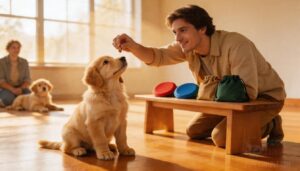
Your first puppy training class usually introduces five basic cues: sit, stay, down, come, recall, and leave it impulse control. Think of them as your puppy’s starter toolkit.
The sit cue comes first — it’s simple and stacks into stay duration and down position work.
Use consistent cues every time, and reward within two seconds. That tight reward system is what makes positive reinforcement actually sticks.
Socialization With People and Puppies

During class, your puppy meets new people and other dogs in calm, controlled settings — this is where early socialization strategies for puppies really take shape. Reading body language is everything. Watch for ears back or a tucked tail; those are stress cue recognition signals worth heeding.
Calm introductions and controlled play keep the socialization period positive. Human interaction signals, like soft voices and relaxed postures, help your pup feel safe.
Structure and Routine of Training Sessions
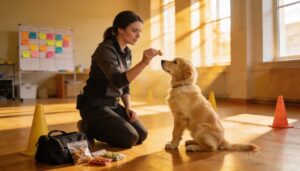
Each session follows a reliable rhythm — and that predictability works in your favor. You’ll move through a warm-up sequence, into focused cue rotation drills, then settle into a cool-down routine.
Session flow matters because puppies relax when they know what’s coming next. Short training sessions for puppies keep fatigue away.
Your trainer uses behavior tracking and session planning notes to fine-tune break timing, consistent signals, and reward timing, and reinforcement schedules week by week.
Tips for Successful Training Sessions
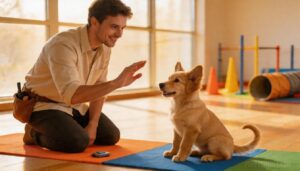
Good training habits make all the difference between a puppy that gets it and one that just stares at you blankly. The good news is that small, intentional choices add up fast.
Here’s what actually works when you’re in the thick of it.
Using Positive Reinforcement Techniques
Think of treats as your puppy’s paycheck — and timing is everything. Positive reinforcement training methods work because your puppy learns fast when rewards feel connected to the right moment.
Nail these four fundamentals:
- Marker Timing — Use a clicker or "yes!" at the exact second the target behavior happens.
- Reward Value — High-value treats drive faster behavior shaping on new skills.
- Cue Pairing Consistency — Everyone in the house uses identical cues, no exceptions.
- Variable Ratio Schedule — Shift from rewarding every repetition to occasional rewards once the behavior sticks.
That unpredictability keeps your pup genuinely engaged.
Keeping Sessions Short and Engaging
Timing matters just as much as what you reward. Your puppy’s attention span tops out around 5–10 minutes, so ultrashort bursts work better than marathon drilling. Set one Micro Goal per session, weave in Play Breaks for an Energy Reset, and use Rapid Reward timing with high-value treats to make every repetition count.
| Session Phase | Duration | Focus |
|---|---|---|
| Warm-Up | 1–2 min | Known cue review |
| Cue Rotation | 3–5 min | One new skill |
| Play Break | 1–2 min | Energy Reset |
End while your pup still looks enthusiastic — that’s your sweet spot.
Staying Consistent With Cues and Rewards
Consistency is your puppy’s best friend. Use the same cue vocabulary and hand signal consistency every single time — "sit" means sit, nothing else.
Marker timing matters too: mark the moment, then deliver a small reward within two seconds. Keep your reward size small but meaningful, and vary your reinforcement schedule once the behavior is solid.
predictable reward system built on positive reinforcement makes your puppy’s learning faster and far less confusing.
Handling Setbacks With Patience
Even the best-laid training plans hit a snag sometimes. Your puppy won’t always nail it — and that’s okay.
When a setback hits, pause and assess before reacting. Emotional regulation on your end directly shapes how your pup responds. Reframe failure as data, not defeat.
Here’s how to work through it:
- Do a quick setback analysis — note the environment, distractions, and energy level.
- Lower the difficulty to rebuild confidence through positive reinforcement techniques.
- Watch for stress signals like yawning or pacing; calm communication and stress management matter here.
- Celebrate incremental progress — small wins compound fast.
Lean on your support network too. Your trainer is there for exactly this.
Continuing Training at Home
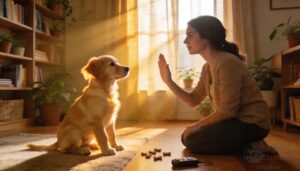
Class gave your pup a solid foundation — now it’s your job to build on it. The real learning happens at home, in the moments between sessions.
Here’s keep that momentum going.
Practicing Skills in Different Environments
Your living room is just the rehearsal space. Real learning happens when you take those cues on the road.
Practice in at least three spots — indoors, the yard, and near the car — to build true environmental adaptation and generalization.
Start with Location Variation on calm surfaces, then gradually introduce Sound Distractions and Distance Cues.
Adjust leash length, keep sessions short, and nail reward timing every time.
Reinforcing Good Behavior Daily
Daily repetition is where real habits are built. Aim for micro-session bursts of 2–5 minutes, repeated throughout the day — your puppy’s attention span is short, so work with it.
- Nail reward timing: deliver treats within two seconds of the correct behavior
- Use specific praise like "good sit!" paired with high-value treats
- Keep cue-reward pairing identical every time for solid behavior modification
Monitoring Progress and Adjusting Strategies
Think of progress tracking like a simple scoreboard — it turns gut feelings into real data. Run 10 reps of any cue and count the wins. That’s your Cue Success Metrics baseline. Use a weekly Trigger Log Review to spot patterns: where does your puppy struggle most? Reward Timing Analysis keeps reinforcement sharp, and Session Difficulty Scaling ensures you’re never pushing too hard, too fast.
| What to Track | How to Measure | When to Adjust |
|---|---|---|
| Cue success rate | Count correct responses per 10 reps | Drop below 7/10 twice |
| Reward timing | Note treat delays over 2 seconds | Puppy slows or disengages |
| Session difficulty | Track failed cues per session | Failures exceed 50% |
Behavioral Trend Tracking turns guesswork into smart behavior modification techniques for puppies, keeping your training on target.
Knowing When to Seek Professional Help
Sometimes, home training hits a wall — and that’s okay. Persistent aggression, extreme fear responses, or house soiling that won’t quit are clear signs to call a certified dog trainer.
Daily functioning decline in your puppy, relationship strain between your dog and family members, or safety risk warnings shouldn’t be ignored.
Early intervention benefits puppies the most.
A behavior specialist uses proven behavior modification techniques for puppies to get things back on track.
Frequently Asked Questions (FAQs)
What is the 3-3-3 rule for puppy training?
The 3-3-3 rule maps your puppy’s adjustment in three phases: Three-Day Adjustment to decompress, Three-Week Settling to build trust, and Three-Month Foundations to solidify routines — each phase setting clear Progress Milestones.
How much does puppy training class typically cost?
Group puppy training classes generally cost £10–£25 per session in the UK, or around £250–£500 for a full programme. Private vs group pricing differs considerably—private lessons run £50–£120 hourly.
What vaccines does my puppy need before class?
Your puppy needs core vaccines—distemper, parvovirus, and hepatitis—started at 6–8 weeks, with boosters every 3–4 weeks. Most classes require proof your puppy’s vaccine schedule is current before enrollment.
Can I bring multiple puppies to one class?
Think of a classroom with two class clowns — entertaining, but chaotic.
Bringing both puppies to one session might feel efficient, but most programs enforce Class Capacity Limits and Littermate Separation Policy to protect learning for every pup.
Most group puppy training classes restrict enrollment to one puppy per household per session.
Facilities set Handler Ratio Guidelines to make sure each puppy gets real attention — and littermates attending together often lean on each other instead of engaging independently with the group class environment.
Vaccination Documentation must be current for both puppies, and if one is behind on shots or showing symptoms, that pup stays home. No exceptions.
Conflict Management Strategies also play a role here.
Littermates can trigger resource guarding or over-excitement, pulling focus from puppy socialization during the critical window when those social skills matter most.
Your best move? Register each puppy separately.
This gives them individual wins, builds confidence, and honestly makes training class logistics far less stressful for you.
If managing both simultaneously is the goal, ask about group versus private puppy training classes — a private session lets a trainer customize the pace for your whole crew.
What if my puppy gets overwhelmed or scared?
Every puppy has a limit. If yours starts yawning, lip-licking, or backing away, that’s Stress Signal Identification in real time — their way of saying, "I need a break."
Don’t push through it. Step back, create distance from the trigger, and let them sniff and decompress. That pause is doing more work than another sit-stay drill would.
Safe Space Creation matters here. A familiar mat or a quiet corner gives your puppy somewhere to land when things feel like too much. Pair calm behavior with treats, and you’re quietly teaching them that relaxing around the scary thing pays off.
Gradual Exposure is the long game. Once they settle, reintroduce the challenge in smaller steps — a little closer, a little longer, one thing at a time. puppy anxiety reduction isn’t about avoiding hard moments; it’s about making sure each step stays winnable.
Trainer Intervention helps too. A good trainer will spot overwhelm before you do and adjust the session on the fly — shorter bursts, easier tasks, a reset to something your pup already knows. That’s stress management during socialization done right.
If fear keeps showing up at the same point in class, that’s a pattern worth addressing. handling setbacks with patience means changing the setup, not pushing harder. And if stress keeps escalating despite your best efforts, looping in a behavior specialist is the smart move — not a failure.
short training sessions for puppies exist for exactly this reason. Managing puppy attention and energy means knowing when to stop. Ending on a small win beats grinding through a rough session every time. Calming Techniques aren’t a detour — they’re part of the training.
Are online puppy training classes equally effective?
Online classes can work — if you show up ready to execute. Your timing, your consistency, and your setup matter more than the screen between you and the trainer.
How do I handle my puppys biting?
Biting is normal, but you can shape it fast.
Yelp to interrupt, redirect to a chew toy, and praise calm mouth behavior.
Cool-down breaks and reward-based training build impulse control quickly.
When can puppies join outdoor group classes?
Most puppies can join outdoor group classes at 7 to 8 weeks, as long as vaccine completion and deworming timing are current. Always confirm outdoor venue rules and bring your health certificate.
What if my puppy refuses all treats?
Try higher-value treats first — something smelly and soft. If your puppy still refuses, switch to praise or play.
Ongoing refusal may signal stress or illness, so consider a veterinary evaluation promptly.
Should siblings attend the same training class?
Yes, siblings can attend together. It eases family scheduling and cuts costs.
Just make sure each pup gets individual attention, since sibling dynamics and learning pace differ in any group class environment.
Conclusion
Patience, preparation, and plenty of treats—that’s the formula behind every dog who graduates with tail wagging. These first puppy training class tips aren’t just about surviving week one.
They’re about building something real: a dog who trusts you and a bond that holds through every distraction life throws at you both.
Your puppy is already watching you for guidance.
Show up consistently, stay encouraging, and the skills will follow.