This site is supported by our readers. We may earn a commission, at no cost to you, if you purchase through links.

Clicker training works—until it doesn’t. Most handlers who hit a wall aren’t dealing with a stubborn dog; they’re dealing with a timing error smaller than a heartbeat, a treat that went stale in their pocket, or a session that ran three minutes too long. The clicker is a precision tool, and like any precision tool, small misuses compound into big confusion.
Knowing where these breakdowns happen is what separates handlers who get reliable results from those who keep wondering why their dog "knows the command at home but forgets it everywhere else.
Table Of Contents
- Key Takeaways
- Clicking at The Wrong Moment
- Skipping Clicks for Correct Responses
- Forgetting to Reward After Clicking
- Using Low-Value Training Rewards
- Starting in Distracting Environments
- Making Sessions Too Long
- Skipping Proper Clicker Conditioning
- Teaching Too Many Commands
- Expecting Progress Too Quickly
- Never Phasing Out The Clicker
- Frequently Asked Questions (FAQs)
- Conclusion
Key Takeaways
- Timing your click at the precise moment is the single most important skill in clicker training — too early or too late, and your dog learns the wrong behavior entirely.
- Every click is a promise, so always follow it with a treat; breaking that link even occasionally, quietly destroys your dog’s trust in the whole system.
- Short sessions of five to ten minutes, ending on a win, build faster and more lasting results than long marathons that leave your dog mentally exhausted.
- Phase out the clicker gradually once a behavior is solid, replacing it with verbal cues and occasional rewards so your dog performs reliably without being dependent on the sound.
Clicking at The Wrong Moment
Timing is everything in clicker training — a split second too early or too late, and your dog learns the wrong thing entirely. It’s one of the most common mistakes new trainers make, and honestly, it’s easy to fix once you know what to watch for.
Practicing with clicker training techniques that go beyond treats can sharpen your timing instincts and help you build a stronger connection with your dog.
Here’s what gets in the way of good click timing.
Late Clicks Confuse Behaviors

When your click lands a beat too late, your dog isn’t confused — they’re learning the wrong thing. This is called temporal misassociation, and it’s one of the sneakiest clicker training mistakes you can make. Late clicks cause behavioral shift and marker ambiguity, teaching your dog whatever they were doing after the intended moment. Ensuring an intuitive layout and navigation can help trainers maintain consistent click timing.
Watch for these timing errors:
- Dog sits, you click as they stand — they learn standing
- Paw lifts briefly, click lands during the pause — pause gets rewarded
- Eye contact breaks, click follows — looking away gets marked
- Quick nose touch ends, click comes late — sniffing gets reinforced
- Correct spin completes, click delays — the next idle step wins
Early Clicks Mark Mistakes

Early clicks are just as misleading as late ones. When you mark before your dog completes the behavior, you’re triggering precursor reinforcement — rewarding the setup, not the finish. This is cue-response misalignment in action.
| Behavior | Early Click Marks | Dog Learns |
|---|---|---|
| Sit | Dog lowering hips | Crouching |
| Down | Dog bending elbows | Partial fold |
| Spin | Dog turning head | Head turn only |
| Stay | Dog pausing briefly | Momentary freeze |
| Recall | Dog stepping forward | First step only |
Handler anticipation cues worsen this dynamic. Your body shifts slightly before clicking, and your dog reads you, not the task.
Practice With Video Cues

One reliable fix for inconsistent timing is recording your training sessions and watching them back. Video lets you apply self-assessment metrics to your own technique — you’ll spot the gap between when the behavior happened and when you clicked. Think of it as cue timing sync in slow motion.
Visual cue design principles show that consistent cues build faster learning, so tighten your timing before adding complexity.
Watch Body Language

Beyond video review, your timing gets sharper when you learn to read your dog’s body language before the behavior completes. Watch for posture orientation cues, hand movement signals in playful paws, foot tapping cues, and eye contact shifts — these are clear signals that a behavior is coming.
Facial micro-expressions and subtle behavioral cues create communication between dog and owner that tells you exactly when to click.
Reduce Timing Distractions

Minimizing visual clutter in your training space does more for your clicker timing than most handlers realize. When the environment is busy, your brain splits focus — and that’s when timing errors sneak in.
Standardize your training space, use consistent clicker placement, and limit background noise. Control your own handler movement too. These adjustments reduce distractions and create consistency.
A calm, predictable setup lets you time effectively and click with genuine precision.
Skipping Clicks for Correct Responses

Skipping a click when your dog gets it right might seem harmless, but it quietly chips away at everything you’ve built. Your dog relies on that click to know exactly what earned the reward — without it, the message gets muddy fast.
Here’s what to watch for so your training stays sharp and consistent.
Mark Every Early Success
Think of your clicker as a camera — it captures the exact moment your dog gets it right. That’s why Micro Win Marking matters so much. Skipping clicks on early, easy attempts starves your dog of the feedback it needs. Reinforce First Attempts every single time with Consistent Early Clicks by remembering:
- Every correct response deserves Prompt Marker Timing
- Early Success Tagging builds your dog’s confidence fast
- Marker training only works when the click is reliable
Avoid Mixed Signals
When different family members click at different moments for the same behavior, your dog receives a jumbled message. Marker Language Consistency requires every trainer to use the same Signal Timing Alignment—clicking precisely when the behavior occurs, neither before nor after.
Inconsistent clicking and rewarding at the wrong time rapidly undermines your dog’s Predictable Reinforcement Schedule. This inconsistency confuses the learning process and weakens the association between action and consequence.
Always treat the clicker as a marker, not an attention-getter. Reserve its use solely for reinforcing desired behaviors to maintain clarity and effectiveness in training.
Keep Clicker Nearby
Your Hand Positioning matters more than most trainers realize. When the clicker isn’t within immediate reach, that tiny delay breaks your Rapid Reinforcement Loop.
Keep your Tool Placement Strategy simple: clicker in your dominant hand, treats at your hips. This Clicker Accessibility setup helps you Minimize Hand Movement between click and reward, so your dog never misses the connection.
Train Family Consistency
When everyone in your home trains differently, your dog gets mixed signals — and that’s a fast track to confusion. A shared training plan with Unified Click Criteria and Shared Cue Vocabulary keeps everyone honest.
- Agree on Coordinated Training Roles before sessions start
- Follow Predictable Reward Rules every single time
- Use Uniform Session Structure across all family members
- Keep training consistency in cue timing and delivery
- Sync your training schedule so no one contradicts progress
Use One Click Sound
Your dog hears the click as a precise signal — so switching clickers mid-training is like changing the alarm sound on someone’s phone overnight. Stick to a Single Clicker Model with a Uniform Click Tone and Fixed Click Volume.
A Consistent Finger Press from a Stable Clicker Position keeps your timing sharp.
Inconsistent Clicking muddies the click marker and undoes proper clicker conditioning quickly.
Forgetting to Reward After Clicking

Clicking without following through with a treat is one of the fastest ways to break your dog’s trust in the whole system. Once the click loses its meaning, you’re back to square one.
Protect that click-treat connection by ensuring every click is immediately followed by a reward. Consistency is key to maintaining your dog’s trust and keeping training effective.
Maintain Click-treat Pairing
Think of the click as a promise. Every time you click, your dog expects a treat — and breaking that promise weakens the whole system.
Every click is a promise to your dog — break it, and you break the system
A 1:1 Pairing Ratio during conditioning keeps your clicker powerful and trustworthy as a marker. Avoid unpaired clicks completely.
- Maintain consistent click sound and treat-handling uniformity
- Reinforce the immediate click-reward link in every session
- Never use the clicker as an attention-getter instead of a marker
- Consistent timing protects your clicker’s meaning long-term
Reward Immediately After Clicks
Keeping that promise means nothing if the treat arrives late. The reward timing window is tiny — once you click, your dog’s brain is already looking for what earned it. That’s why immediate delivery matters so much.
Work on your hand positioning and treat proximity before sessions start. Reward promptly, and you’ll make clicking and giving the treat feel like one fluid action.
Avoid Empty Clicks
Empty clicks — those that sound without being earned — chips away at your clicker’s power quickly. Behavior-contingent marking ensures every click occurs because the dog did something right, not as a ploy for attention.
Using the clicker as an attention-getter instead of an event marker is one of the most common clicker training misconceptions.
If you’re overusing the clicker, review your empty clicks and adjust trial difficulty immediately.
Keep Treats Ready
Reward selection matters, but so does your setup. Pre-session prep makes all the difference — portion your high-value treats beforehand, maintain temperature consistency (room temperature moves fastest), and limit treat variety to keep your dog focused.
One hand delivery works best when your treat pouch is already open. Poor reward selection often isn’t about what you chose — it’s about not being ready.
Protect Marker Value
The clicker’s power comes from one thing: trust. The moment your dog hears it and doesn’t get a treat, that trust cracks a little.
Protect marker value by treating it like a signal with one job.
- Exclusive marker use only — never as an attention-getter
- Consistent click volume across every session
- Control environmental sounds that might mimic the click
When conditioning weakens, refresh click conditioning with simple click-treat pairings again.
Using Low-Value Training Rewards

The treats you choose matter more than most people realize — a boring reward can stall progress fast. If your dog sniffs the treat and walks away, that’s not stubbornness, it’s feedback.
Picking the right rewards requires keeping these factors in mind to ensure effectiveness and engagement.
Choose High-value Treats
Not all treats are created equal. Your dog’s nose knows the difference between a dry biscuit and a piece of real chicken — and so does their motivation. Using the wrong treats is one of the most overlooked mistakes in clicker training. High-value treats with strong scent potency keep focus locked on you, especially outdoors.
| Feature | Low-Value Treats | High-Value Options |
|---|---|---|
| Reward Value | Low | High |
| Scent Potency | Mild | Strong |
| Allergy-Friendly Options | Varies | Turkey, carrots |
Do preference testing to find what truly excites your dog — food vs. toy reinforcement both work.
Keep Treats Small
Even high-value treats backfire when they’re too large. Bite-size rewards keep your positive reinforcement rhythm moving — no long chewing breaks, no distracted sniffing. Tiny treat pieces also help with calorie budgeting across sessions.
Here’s how to nail rapid reward delivery:
- Cut treats to pea-sized pieces
- Pre-portion before each session
- Use a treat pouch for fast access
- Track daily treat calories
- Keep pieces instantly swallowable
Rotate Reward Options
Preference Based Rotation keeps motivation high — rotate between cheese, chicken, or other high-value treats to prevent boredom, just as you’d tire of the same lunch daily.
Use a Consistent Delivery Method to maintain a tight Reward Cycle Length. Monitor Motivation Shift through cues like slower sits, adjusting as needed.
Keep Limited Session Variation simple: change the treat type, but uphold the same behavior standards to avoid confusion.
Use Toys When Preferred
Some dogs just don’t care much about food — and that’s perfectly fine. Food vs. toy reinforcement comes down to motivation theory: use what your dog actually wants.
Identifying your dog’s preferred toy is the first step.
- Time toy rewards like treats: immediate timing after the click matters.
- Follow a toy rotation schedule to prevent boredom.
- Practice safe toy handling to avoid overstimulation.
- Maintain consistent toy cues across all sessions.
Avoid Overfeeding
All those treats will make your dog fat if you’re not watching portion size control. Every click-and-reward adds real calories, so calorie budget matching matters — adjust your dog’s meals on heavy training days.
Treat frequency limits keep sessions lean without sacrificing progress. If weight creeps up, body-condition monitoring helps you catch it early.
Reward substitutions like kibble or low-calorie options protect treat value without improper rewarding.
Starting in Distracting Environments
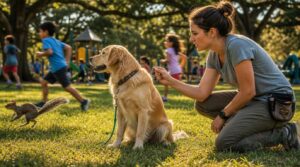
Jumping straight into a busy park or noisy backyard is one of the fastest ways to derail clicker training before it even gets started. Your dog can’t focus on learning when there are a squirrel darting past or kids shouting nearby.
Here’s how to set up the right environment so your dog actually has a chance to succeed.
Begin in Quiet Rooms
Start every session with acoustic control and minimal visual clutter — a closed-door room beats a busy living room every time. Consistent location matters more than you think. When you establish pre-session calm through proper barrier setup, your dog notices the clicker as a marker, not just background noise.
Distracting environments quietly sabotage even your best positive reinforcement efforts before short training sessions ever get going.
Add Distractions Gradually
Once your dog’s comfortable in that quiet room, it’s time to build gradual difficulty progression. Add one distraction at a time—a low TV hum, a bag on the floor, or someone standing nearby.
This approach follows distraction training through Visual Cue Hierarchy and Social Cue Layering: stationary before moving, quiet before louder.
Reliability Tracking determines when to advance to the next challenge.
Train During Calm Times
Timing your sessions matters just as much as timing your clicks. Training during calm periods—early mornings or after household routines settle—gives your dog a quieter training environment with fewer competing stimuli. Pre-session breathing helps with the trainer’s emotional regulation, so your reaction time stays steady. Consistent lighting and quiet background music also support behavioral clarity.
- Choose times with low foot traffic
- Avoid sessions near mealtimes or high activity
- Maintain a comfortable temperature to reduce stress
Practice in New Locations
Once your dog performs well in calm home settings, test that skill somewhere new. This is cue generalization in action—and it doesn’t happen automatically.
Use familiarity pairing by keeping your consistent setup intact: same clicker, same treats, same cues. Practice distance management near novel distractions by starting far from triggers.
Gradual scaling across different training environments builds true generalization of behavior.
Reward Focus Heavily
When your dog stays focused despite real-world distractions, that’s your cue to reward heavily and immediately. Reward Timing Precision matters most here—delayed treat delivery breaks Reward Predictability and weakens your reward system fast.
Lean on high-value treats for Treat Value Optimization and Motivation Management, but watch Caloric Intake Balance by keeping pieces tiny.
Avoid wrong rewards like bland kibble; a variable reward system keeps engagement sharp.
Making Sessions Too Long

Dogs learn best in short bursts — think five minutes, not fifty. When sessions drag on, your dog’s focus fades fast and training starts to feel like a chore for both of you.
Here’s what to do instead.
Use Five-minute Sessions
Keep your training sessions short and engaging — five minutes is genuinely enough. Think of each session as a micro goal: one behavior, one reset, one win.
A Session Reset Ritual between blocks helps your dog refocus instead of burning out. Aim for session durations of 5 to 15 minutes max.
Use a clear Start Signal, and log progress in a Progress Log to track what’s actually working.
Stop Before Frustration
Frustration — yours or your dog’s — is a signal, not a failure. Recognize stress cues like yawning, lip-licking, or sudden disinterest, and treat them as a stop sign.
Watch for these fatigue signs:
- Slow responses to familiar commands
- Avoiding eye contact
- Excessive sniffing or wandering
- Repeated errors on easy tasks
Implement break timers and adjust difficulty level before things unravel.
Repeat Throughout Day
Think of training like watering a plant — a little, often, beats flooding it once. Micro‑Training Bursts spread across your dog’s waking hours build stronger connections than one long session ever could.
Strategic Rest Intervals between repetitions keep arousal monitoring in check, so you’re never overloading the dog with commands.
Cue Consistency and Room‑Based Generalization happen naturally when timing plays a role throughout the day.
End With Success
Always end on a win — your dog remembers how the session felt, not just what happened during it. Use a Consistent Ending Cue after a few easy, successful reps to send a clear Positive Shutdown Cue.
Final Reward Timing matters here: click, treat, then release with a calm Closing Routine Signal.
That last moment shapes how eagerly your dog shows up next time.
Watch Stress Signals
Your dog’s body doesn’t lie. Watch for subtle stress signals like yawning, lip-licking, breathing irregularities, or sudden activity shifts mid-session.
Sensitive dogs may also show pupil dilation or skin conductance changes — signs their arousal is climbing.
HRV reduction and erratic movement often follow.
Catching these early prevents fear and aggression in dogs from taking root. Pause, reset, and monitor progress.
Skipping Proper Clicker Conditioning

Most people grab a clicker and jump straight into training, skipping the one step that makes everything else work. Your dog needs to learn what the click actually means before it can guide their behavior.
Here’s what proper conditioning looks like when done right.
Charge The Clicker First
Before you teach a single command, your clicker needs meaning—that’s what Clicker Value Establishment is all about. Skipping this step is like handing someone a blank check.
Proper clicker conditioning links the sound to positive outcomes through a Rapid Click-Treat Loop, using high-value treats in a calm environment.
- Start pre-training click exposure in a quiet room
- Use sound volume consistency across variable clicker shapes
- Build your reward system before timing matters
Pair Click With Treat
Once your clicker has meaning, every click needs a payoff. That’s the heart of clicker conditioning — a strict click then treat sequence that protects your marker’s value through Cue-Free Marking.
Use Treat Preference Trials early to identify what your dog actually wants right now, as Motivation Monitoring keeps reward effectiveness high. Treat Pocket Accessibility matters too — reaching for food before clicking breaks Hand-Click Coordination and muddies behavior marking.
| Do This | Avoid This |
|---|---|
| Click, then reach for treat | Reach for treat, then click |
| Deliver reward within 1 second | Delay treat by 3+ seconds |
| Use high-value, small pieces | Offer large or low-interest treats |
| Click one behavior per rep | Click multiple actions at once |
Using the clicker as an attention-getter instead of a marker is one of the most common conditioning mistakes — it quietly destroys the association you’re building. Keep it a contract: you click, you pay. Every time, without exception, while timing effectively from the very start.
Test Sound Sensitivity
Before your dog can learn from the click, you need to run a quick Volume Threshold Test. Some dogs have auditory sensitivity — the clicking sound startles them rather than signals reward.
Watch for ear reactions: flattened ears or flinching means the clicker is too sharp.
Remember, the clicker isn’t a remote — it’s a relationship tool. Start with a Quiet Baseline Calibration by muffling the sound in your pocket first.
Use Softer Markers
If your dog still flinches after muffling the sound, switching to a softer marker is the smarter move. Reduced auditory startle matters, especially for dogs with auditory sensitivity. Calibrating marker sounds with a quieter clicker aids gentle cue integration, ensuring trainer fatigue does not become a concern.
Softer options also offer cross-species applicability, making them ideal for multi-pet homes where practice marking needs to remain calm and consistent.
Avoid Clicking Near Ears
Keep the clicker at your side, never near your dog’s ear. The ear canal amplifies mid-frequency sounds, so even a standard click feels louder up close. Poor hand posture and careless marker placement can startle your dog, turning your marker signal into something stressful.
Maintain a relaxed, neutral position to ensure proper clicker distance. Using the clicker as an attention-getter instead of a marker breaks trust fast.
Teaching Too Many Commands
Trying to teach your dog five new commands in a single week is a recipe for confusion — for both of you.
Dogs learn best when they can build confidence on one skill before the next one gets stacked on top.
Here’s how to keep things focused and set your dog up to actually succeed.
Focus on One Behavior
One behavior at a time — that’s the rule. When you define exact criteria boundaries upfront, like "nose touch only, no paw," you avoid behavior drift before it starts. Single target focus gives your dog a clear, measurable behavior metric to work toward.
Pick one, define success parameters precisely, and stay consistent. Behavior shaping works best when the target never changes mid-session.
Build Basic Obedience First
Before anything else, your dog needs a strong foundation. Skipping basic training steps is one of the most common mistakes handlers make. Start with Sit/Stay Mastery, Reliable Recall Training, and Leash Walking Basics before layering in anything complex.
Foundational Cue Consistency and Impulse Control Exercises build the reliability that sophisticated commands depend on. These elements ensure your dog responds predictably under distractions or stress.
Lack of patience and persistence here will stall your entire training progression. Prioritize mastery of these fundamentals to create a resilient, well-behaved companion.
Avoid Cue Overload
Too many signals at once is one of the most common training mistakes. Your dog can’t build reliable cue associations when you’re layering words, gestures, and body movements together.
Prioritize one cue focus per behavior, narrow timing windows, and minimal verbal prompts. This approach sharpens signal discrimination by giving your dog one clear thing to respond to.
Defining fixed criteria and maintaining a quiet training space further enhance clarity. These practices ensure consistent, distraction-free learning environments.
Shape Behavior Gradually
Neglecting to gradually increase difficulty is one of the most common training mistakes. Think of shaping as climbing a staircase — you take it one step at a time.
Use approximation steps to divide complex behaviors into smaller, achievable pieces. Adjust your success criteria as your dog improves, applying stepwise refinement and criterion adjustment so incremental difficulty feels natural.
Shape or capture each small win before moving forward.
Add Commands After Reliability
Commands should only enter the picture once your dog nails the behavior consistently — that’s reliability testing in action. Introduce cues through sequential cue layering, one at a time, using consistent marker use throughout.
- Keep behavior criteria separation clear before adding new words
- Shift only one controlled variable at a time
- Maintain cue consistency across every repetition
Rushing this breaks everything you’ve built.
Expecting Progress Too Quickly

Clicker training isn’t a race, and pushing too hard too fast is one of the most common ways people stall their dog’s progress. Every dog learns at its own pace, and that’s completely normal.
Stay on track without burning out you or your dog by keeping these principles in mind.
Be Patient and Consistent
Clicker training rarely moves in a straight line, and that’s perfectly normal. Your dog needs repetition and a steady Training Rhythm to build confidence.
Inconsistent Use or Lack of Planning breaks that rhythm fast. To stay grounded when progress feels slow, focus on Patience Techniques and Consistency Strategies.
| Common Mistake | Better Approach |
|---|---|
| Inconsistent Use | Click every correct behavior |
| Lack of Planning | Set clear Incremental Goals |
| Rushing new commands | Shape behavior step by step |
| Not Adapting to Your Dog’s Learning Style | Adjust pace and rewards |
Track Small Wins
Patience pays off more when you can actually see it working. That’s where a training log becomes your best tool. Instead of guessing whether your dog is improving, you track it.
- Use Win Log Templates to record each correct response with timestamps
- Build Progress Charts showing success rates across sessions
- Set Benchmark Metrics like "5 sits in a row" before advancing
- Run an Error Pattern Review to spot when mistakes cluster
- Set Consistency Benchmarks across morning and evening sessions
A training journal turns vague "he’s doing better" feelings into real Benchmark Metrics you can act on.
Adjust Training Methods
Once you see those small wins stacking up, that data should actually change how you train. If your dog keeps stalling on a cue, that’s feedback — adjust. Try Variable Reinforcement, rotate rewards with Individualized Reward Rotation, or shift to Multi-Modal Markers.
Cross-Training Cues and Adaptive Cue Timing help you meet your dog’s learning style instead of forcing one method that isn’t clicking.
Practice Daily Repetitions
Daily Warm‑up repetitions keep your reinforcement timing sharp and build real momentum. Short sessions — five to ten minutes — work better than one long grind.
Use a Consistency Log to track Incremental Skill Steps and spot patterns in your Performance Metrics.
Structured Breaks between sessions prevent fatigue. Monitoring progress daily removes the lack of patience that quietly derails most handlers.
Celebrate Steady Improvement
Small wins add up faster than you think. Keep a Progress Journal to track each success, and use Landmark Markers to set goals your dog can actually reach this week.
- Build Achievement Charts from real session notes
- Snap Success Snapshots after each new behavior lands
- Apply Incremental Goal Setting to your reinforcement schedule
- Use gradual reduction of clicks as reliability grows
Monitoring progress this way keeps discouragement out of the picture.
Never Phasing Out The Clicker

The clicker is a tool, not a permanent crutch — and keeping it forever is one of the quietest mistakes trainers make.
Once your dog reliably understands a behavior, it’s time to start stepping back from the click and letting other cues take over. Here’s how to phase it out the right way.
Fade Clicks Gradually
Think of fading the clicker like easing off training wheels—you don’t yank them off overnight. Apply Marker Frequency Control by gradually reducing clicks as accuracy stabilizes, and use Timing Window Shrink to refine when treats are delivered. Maintain Reinforcement Timing Consistency to ensure every click remains reliably paired with rewards.
| Strategy | When to Apply | What to Watch |
|---|---|---|
| Marker Frequency Control | Behavior is reliable | Drop in accuracy |
| Timing Window Shrink | Responses are consistent | Success rate per session |
| Success Criteria Progression | Multiple correct reps in a row | Revert if errors spike |
Prompt Dependence Drop also plays a key role: phase out clicks for heavily prompted responses once your dog acts independently. These gradual reduction steps ensure the clicker is faded without halting progress.
Add Verbal Cues
Once your dog performs a behavior reliably, it’s time to layer in verbal cues. Here’s how to do it right:
- Introduce a Single Word Cue in a Neutral Tone — no excited chatter
- Use Predictive Cue Timing by speaking the word just before or with the click
- Maintain Cue Consistency — same word, same voice, every time
- Begin Gradual Cue Fade of the clicker only after the verbal cue works alone
Use Variable Rewards
Once your dog follows verbal cues reliably, random reward schedules become your secret weapon. Instead of clicking every time, vary when and what you deliver — rotating between high-value treats, praise, and toy reinforcement keeps anticipation alive.
This reward type rotation sparks an intrinsic motivation boost, making your dog work eagerly without expecting a guaranteed payoff every single rep.
Monitor Behavior Reliability
Tracking whether your dog holds up without the clicker reveals your progress. Watch from a fixed viewing angle each session—consistent observation exposes true reliability, not flukes. Set clear criteria beforehand to ensure consistent measurement of the desired behavior.
Use this quick reliability checklist:
- Log response rate across three distraction levels
- Note any prompt reinforcement patterns creeping back in
- Flag environment changes affecting your reward schedule
Keep Reinforcement Occasional
Once your dog responds reliably, shift to partial reinforcement — rewarding only some correct responses. This is intermittent scheduling in action, and it actually strengthens behavior over time. Random reward timing keeps your dog engaged, wondering when the next treat arrives.
| Reinforcement Stage | Approach |
|---|---|
| Early learning | Reward every response |
| Building reliability | Begin reinforcement thinning |
| Maintenance phase | Reward variety mix |
Occasional rewards through positive reinforcement training make behavior surprisingly durable.
Frequently Asked Questions (FAQs)
What are common mistakes in clicker training?
Common mistakes include variable click sounds, inconsistent treat size, trainer distraction lapses, and misreading body signals.
Many handlers also overlook session breaks, use the clicker as an attention-getter instead of a marker, or lack patience.
What is the 3 second rule in dog training?
The three-second rule means you have about three seconds after a behavior to deliver a consequence. That’s your window for fast cause-effect learning.
Miss it, and your dog connects the reward to the wrong action.
Can clicker training work for older dogs?
Clicker training absolutely works for older dogs. With Age-Adjusted Timing, Joint-Friendly Rewards, and Hearing Accommodations, seniors respond well.
Cognitive Engagement stays sharp when you keep sessions short and adjust your approach thoughtfully.
Should I clicker train multiple dogs together?
Imagine two enthusiastic dogs, their tails spinning like helicopter blades.
You can clicker-train them together — but start with a staggered-training approach, using individual markers for each dog, so neither becomes confused about who earned the reward.
How do I handle setbacks during clicker training?
Setbacks happen. When they do, revisiting foundations is your reset button. Drop back to an easier step, use incremental reinforcement, and practice stress management by keeping sessions short and calm.
Is clicker training effective for fearful or anxious dogs?
Fearful dogs can thrive with clicker training, but the click must feel predictable, not startling. When every click reliably signals a reward, anxiety fades and trust building begins naturally.
Conclusion
The clicker is a scalpel, not a sledgehammer—and precision is what makes it powerful. Avoiding common clicker training mistakes isn’t about being perfect; it’s about building a language your dog can actually trust. Every clean click, every well-timed treat, and every short session adds another brick to that foundation.
Stay consistent, stay patient, and your dog won’t just learn commands—they’ll look to you for guidance, eagerly and willingly.
- https://www.everydogaustin.org/handouts/clicker-training-101
- https://www.acmewhistles.co.uk/stories/common-dog-clicker-training-mistakes-and-how-to-avoid-them
- https://www.bestbuddydogtrainer.com/post/top-mistakes-to-avoid-when-clicker-training-your-dog
- https://www.lancasterpuppies.com/pet-advice/5-common-clicker-training-challenges-with-dogs-and-how-to-fix-them.html
- https://trainingcanines.com/what-you-should-and-should-not-do-with-the-clicker/