This site is supported by our readers. We may earn a commission, at no cost to you, if you purchase through links.
leftover rotisserie chicken sitting on your counter seems harmless enough—until your dog gets there first. Many pet owners assume that because dogs have eaten bones throughout history, a cooked chicken bone poses little threat. That assumption lands thousands of dogs in emergency veterinary clinics every year.
Cooking fundamentally changes bone structure. Heat drives out moisture and denatures collagen, transforming a flexible, somewhat forgiving material into something brittle that fractures into razor-edged splinters. Those splinters don’t just pass through—they puncture, tear, and obstruct.
Understanding exactly what happens inside your dog’s body, and what to do if they’ve already eaten a cooked bone, can make the difference between a close call and a surgical emergency.
Table Of Contents
- Key Takeaways
- Are Cooked Chicken Bones Safe for Dogs?
- Risks of Dogs Eating Cooked Chicken Bones
- What to Do if Your Dog Eats Cooked Chicken Bones
- Signs of Complications After Bone Ingestion
- How Veterinarians Treat Bone Ingestion
- Safe Alternatives to Cooked Chicken Bones
- Preventing Dogs From Eating Chicken Bones
- Top 3 Dog Products for Bone Safety
- Frequently Asked Questions (FAQs)
- Are any chicken bones safe for dogs?
- What kind of bones can dogs eat?
- How long do chicken bones take to digest in dogs?
- What three meats should dogs avoid?
- Are cooked chicken bones safe for dogs?
- Can a dog eat a raw chicken bone?
- What happens if a dog eats chicken bones?
- Can dogs eat cooked bones?
- Can we feed chicken bones to dogs?
- Can cooked bones be digested by dogs?
- Conclusion
Key Takeaways
- Cooking strips chicken bones of moisture and collagen, making them sharp shards that can puncture your dog’s throat, stomach, or intestines — unlike raw bones, which crush more safely.
- If your dog swallows a cooked chicken bone, don’t induce vomiting; call your vet immediately and watch closely for vomiting, labored breathing, or a bloated belly over the next 24–48 hours.
- Veterinarians can remove lodged bone fragments via endoscopy in up to 90% of esophageal cases, but bones that reach the intestines often require surgery — so speed matters.
- Safer alternatives exist, including raw edible bones, VOHC-approved dental chews, and calcium-rich foods like plain yogurt or eggshell powder, so your dog doesn’t miss out on chewing or nutrition.
Are Cooked Chicken Bones Safe for Dogs?

The short answer is no — cooked chicken bones aren’t safe for dogs, and the reasons go deeper than most people realize.
There’s actually a lot more going on under the surface, and this guide on why chicken bones are dangerous for dogs breaks it down really well.
A few key factors explain why cooking actually makes bones more dangerous, not less.
Here’s what you need to understand before we go any further.
Differences Between Raw and Cooked Bones
Not all chicken bones behave the same way in your dog’s mouth or gut.
Raw bones stay flexible — their natural collagen and moisture help them crush rather than shatter, improving digestive solubility in stomach acid.
Cooked bones lose that flexibility entirely.
The differences between raw and cooked chicken bones go beyond texture and brittleness: cooking also reduces nutrient retention, alters splinter patterns, and affects bacterial load during handling.
In contrast, raw chicken bones provide essential nutrients like calcium and phosphorus, which are essential for a dog’s overall health.
Why Cooking Increases Bone Risks
Heat is the real culprit here. When you cook chicken bones, two things happen fast: moisture loss leaves the bone dry and rigid, while collagen denaturation strips away the flexible matrix that normally absorbs chewing pressure. That’s heat‑induced brittleness in action.
Heat strips chicken bones of moisture and flexibility, turning them into dangerous splinters waiting to shatter
The result is Sharp splinter formation and structural weakening that turns an ordinary bone into something closer to glass — a serious danger of cooked chicken bones for dogs. Veterinarians warn about cooked bone hazards for dogs.
Common Myths About Dogs and Bones
A few myths still cloud how people think about bone ingestion and dog health and safety. Let’s clear them up:
- Aggression Myth & Teeth Damage Myth: Raw bones don’t cause aggression, and unlike cooked ones, they rarely fracture teeth.
- Constipation Myth & Puppy Bone Myth: Small raw pieces digest well, and supervised chewing is safe after 6 months.
- All Bones Dangerous Myth: Size and preparation matter — the risks of feeding chicken bones to dogs come specifically from cooking.
Risks of Dogs Eating Cooked Chicken Bones

Cooked chicken bones aren’t just a choking hazard — they can cause serious internal damage that isn’t always obvious right away.
The dangers range from sharp splinters tearing through soft tissue to full blockages that require emergency surgery. Here’s what you’re actually dealing with when your dog swallows one.
Choking and Splintering Hazards
Cooked chicken bones behave more like glass than food — they splinter into sharp bone fragments under chewing pressure, creating immediate choking hazard and Mouth Lacerations.
Fragment Size Risk varies by breed; small dogs and puppies face the greatest Airway Obstruction danger, though large dogs who gulp food aren’t safe either.
Esophageal Tears can occur when jagged pieces scrape the throat lining, making Breed Susceptibility a real clinical concern.
Puncturing and Internal Bleeding
Once a sharp fragment slips past the throat, the real danger begins. Bone splinters can cause esophageal perforation or a gastric wall tear, releasing digestive contents into surrounding tissue.
Hemoperitoneum signs — pale gums, tarry stool, bloody vomit — signal serious blood loss; monitoring is needed immediately. Gastrointestinal perforation and internal injury escalate fast, so emergency response and veterinary care can’t wait.
Intestinal Blockages and Obstructions
Bone fragments don’t always pass cleanly — they can lodge in the small intestine, creating a gastrointestinal blockage that stops digestion entirely.
Diagnostic imaging, like ultrasound, identifies obstructions in up to 97% of cases.
Without prompt veterinary care for dogs, untreated intestinal blockages turn fatal within days.
Choosing digestible pug-friendly dog food with small, shredded pieces can reduce the risk of blockages in the first place.
Surgical removal or medical management depends on severity, while Recovery Monitoring guides your dog’s path forward.
Bacterial Contamination and Food Poisoning
Even after cooking, bacterial contamination remains a serious concern. Salmonella risk, Campylobacter infection, and E. coli exposure don’t disappear with heat — especially when bones are mishandled or stored too long.
Salmonella can trigger severe diarrhea within 72 hours, while Campylobacter infection causes mucoid stool and fever lasting days. Cross-contamination prevention matters because food poisoning from chicken bone ingestion in dogs can escalate quickly into dangerous dehydration.
What to Do if Your Dog Eats Cooked Chicken Bones

Finding out dog swallowed a cooked chicken bone is stressful, but how you respond in the next few minutes really matters.
The good news is that acting quickly and calmly gives your dog the best chance of avoiding serious complications.
Here’s exactly what to do.
Immediate Steps to Take
The moment you realize dog swallowed a chicken bone, act — don’t freeze. First, assess airway by watching for gagging or labored breathing. Check mouth gently for loose fragments, removing only what’s safely reachable. Offer soft food like bread or rice to cushion sharp edges.
Call your veterinarian immediately — never induce vomiting without guidance, as it can worsen damage. Restrict activity, and keep emergency veterinary clinic numbers handy for after‑hours incidents.
Monitoring for Emergency Symptoms
After your dog eats a cooked chicken bone, the next 24–48 hours are critical. Watch closely for these red flags:
- Gagging frequency and vomiting episodes — repeated retching signals possible esophageal irritation or obstruction
- Breathing difficulty and abdominal swelling — labored breaths or a distended belly may indicate perforation
- Lethargy onset — sudden withdrawal or refusal to eat suggests internal complications developing
Document what you observe — timing matters for veterinary care.
When to Contact Your Veterinarian
Call your vet immediately if you notice persistent vomiting, blood in stool, or breathing difficulty — these aren’t symptoms to wait out.
Lethargy beyond 24 hours, severe abdominal pain, or a distended belly after bone ingestion all demand urgent veterinary attention.
Your dog’s gastrointestinal health can deteriorate fast once a splinter causes internal damage.
When in doubt, a quick call beats a delayed emergency response every time.
Signs of Complications After Bone Ingestion

Once a cooked chicken bone is down, the next few hours are the ones that matter most. Your dog can’t tell you something feels wrong, so knowing what to watch for is entirely on you.
Here are the key signs that something may have gone seriously sideways.
Recognizing Choking or Gagging
Choking signs after bone ingestion can escalate fast. Watch for these four warning signals:
- Pawing Behavior — frantic scratching at the mouth or face
- Excessive Drooling — saliva pooling from throat irritation
- Labored Breathing — wheezing or gasping from airway narrowing
- Gagging Patterns — repeated retching with no vomit produced
Cyanosis Signs — blue-tinged gums — mean oxygen is critically low. That’s your emergency response moment.
Symptoms of Internal Damage
Internal damage can be harder to spot than choking — but it’s just as urgent.
A perforated intestine or gastroenteritis often shows up as Abdominal Pain: your dog hunches, guards their belly, or whimpers when touched.
Watch for Pale Gums, Lethargy, Fever above 103°F, and appetite loss starting around 12 hours post‑ingestion.
These symptoms and emergency response to bone ingestion affecting the gastro tract demand immediate veterinary attention.
Indicators of Intestinal Blockage
Blockage signs build quickly — and unlike choking, they sneak up on you. Watch for these red flags:
- Vomiting Patterns: repeated vomiting every few hours, eventually producing brown fluid
- Defecation Changes: straining without producing stool, or mucus-covered output signaling partial obstruction
- Abdominal Distension: a bloated, tight belly that worsens over 24 hours
Lethargy Indicators and Dehydration Signs — sunken eyes, dry gums, skin tenting — confirm intestinal obstruction. Never induce vomiting.
How Veterinarians Treat Bone Ingestion

When your dog swallows a cooked chicken bone, what happens next depends largely on what the vet finds — and how quickly they can act. Treatment isn’t one-size-fits-all; it ranges from simple monitoring to surgery, depending on where the bone is and what damage it has caused.
Here’s how veterinarians usually approach the situation.
Diagnostic X-rays and Assessments
When your dog swallows a bone, diagnostic X-rays become your veterinarian’s first line of clarity. Physical examination comes first — feeling the abdomen for pain or rigidity — then imaging confirms what hands cannot detect.
Lateral view selection matters here: left and right lateral projections, plus a ventrodorsal view, pinpoint bone density evaluation with precision.
Sedation protocols keep your dog still, minimizing blur.
If fragments stay invisible, contrast imaging options like barium highlight hidden pieces, while a follow‑up imaging schedule tracks movement and rules out intestinal obstruction.
Endoscopic or Surgical Removal
X-rays confirm the bone’s location, your vet chooses between endoscopy or surgical removal based on where it’s lodged.
Endoscopy — a flexible camera passed through the mouth — succeeds in roughly 85 to 90 percent of esophageal and stomach cases, with no abdominal incision needed.
If the bone has moved into the small intestine and caused an obstruction, surgical removal becomes necessary.
Anesthesia considerations, equipment selection, and post‑op pain management all guide owner recovery guidance after either procedure.
Medical Management and Hospitalization
When a procedure alone isn’t enough, hospitalization bridges the gap between removal and full recovery.
IV Fluid Therapy keeps your dog hydrated and helps gut motility, while Pain Management Protocols — often opioids like buprenorphine — control discomfort as tissues heal.
Antibiotic Stewardship targets perforation risk without overuse.
Staff focus on Monitoring Key Signs every few hours, and Nutritional Support Plans using bland, soft diets help the digestive tract recover steadily.
Safe Alternatives to Cooked Chicken Bones
The good news is that your dog doesn’t have to miss out just because cooked chicken bones are off the table.
There are plenty of safer options that still satisfy their chewing instincts and nutritional needs.
Here’s what vets actually recommend.
Vet-Recommended Chews and Treats

There are plenty of safe alternatives to cooked chicken bones that satisfy your dog’s chewing instinct without the risk. VOHC Dental Chews like Greenies or WHIMZEES support pet safety while controlling plaque. Digestible Protein Chews — beef trachea, collagen sticks, pig ears — support canine digestion and break down safely.
Durable Aggressive Chewer Toys like GoughNuts work well for heavy chewers. Low‑Calorie Treats and Calming Ingredient Chews round out veterinary advice on dog diet.
Raw Bones Vs. Cooked Bones
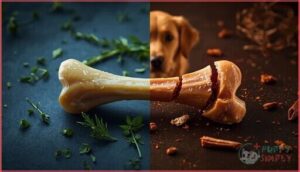
Raw and cooked bones aren’t interchangeable — and that distinction matters enormously for bone safety.
Raw chicken bones retain flexibility, enzyme retention, and higher calcium bioavailability because heat hasn’t stripped their natural moisture and minerals.
They’re far safer alternatives to cooked chicken bones, which splinter into dangerous shards.
Raw bones also offer real dental health benefits, scraping plaque naturally, without the fat content differences that make pork bones a pancreatitis risk.
Nutritional Alternatives for Calcium
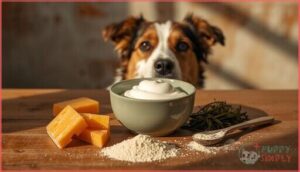
If your dog can’t have cooked chicken bones, calcium doesn’t have to come from risky sources.
Plain yogurt calcium delivers around 450 mg per cup, while cheese supplements like cheddar offer 200 mg per ounce. Eggshell powder — one teaspoon yields up to 1,000 mg — mixes invisibly into meals.
Seaweed calcium and bone meal round out your options as highly bioavailable calcium sources for dogs and genuinely safe alternatives to cooked chicken bones.
Preventing Dogs From Eating Chicken Bones
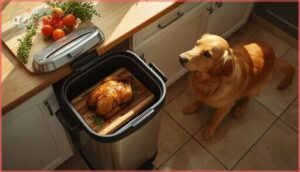
Prevention is really the best medicine here. A few practical habits can go a long way toward keeping chicken bones out of your dog’s reach for good.
Here’s what actually works.
Safe Food Storage and Disposal
Think of your kitchen as the first line of defense.
Safe handling of chicken bones for dogs starts with smart storage — use Locked Trash Bins and keep indoor trash bins elevated or cabinet-mounted.
Double-Bagging Bones reduces the scent trail that draws dogs in, while Odor-Absorbing Bags with baking soda or charcoal liners do the rest.
For Outdoor Bin Security, practice Elevated Bin Placement and secure lids on your outdoor garbage can immediately after meals.
Training Dogs Not to Scavenge
Storage locks the opportunity out — but training builds the instinct to refuse it. Teaching a reliable Leave‑It Cue is your most powerful tool here.
Start with impulse‑control games using a closed fist, then progress through proofing techniques outdoors.
Reward scheduling matters too — always outcompete the scent of dropped food with something better.
Regular desensitization drills generalize the skill beyond your kitchen, making refusal second nature on walks.
Pet-Proofing Your Kitchen and Home
Training builds refusal — but your kitchen layout shouldn’t rely on it alone.
Cabinet locks block access to drawers holding toxic seasonings and leftover bones.
Secure trash cans with locking lids stop determined scavengers cold.
Kitchen gates create controlled zones without permanent fixtures.
Pet-friendly flooring and stable countertop materials reduce the risk of bones getting knocked down and scavenged.
Prevention works best in layers.
Top 3 Dog Products for Bone Safety
The right products can make a real difference in keeping your dog safe around food and bones. From secure spaces to chew-safe treats, a few smart tools go a long way.
Here are three worth having on hand.
1. Frisco Collapsible Dog Crate

If your dog is prone to scavenge, a secure crate can genuinely reduce unsupervised access to dangerous items — including stray chicken bones.
The Frisco Collapsible Dog Crate assembles without tools, folds flat for easy storage, and comes in sizes ranging from 18 inches for small breeds up to 54 inches for giants.
Its removable plastic pan cleans easily, and the included divider panel grows with your dog.
| Best For | Dog owners who want a reliable crate for training, travel, or keeping a curious pup out of trouble at home. |
|---|---|
| Dog Safety | Secure locking door prevents escapes |
| Adjustability | Multiple size options for breeds |
| Ease of Use | No tools needed to assemble |
| Durability | Black electro-coat finish |
| Training Use | Ideal for crate training |
| Multi-Breed Fit | Various sizes for all breeds |
| Additional Features |
|
- No tools needed to set it up, and it folds flat when you’re done — super easy to store or toss in the car
- Comes with a divider panel, so it works for puppies and grows with them into adulthood
- The removable plastic pan makes cleanup quick and painless
- Not a great fit for escape artists or heavy chewers who can muscle their way out
- Some buyers have run into door latch issues or confusing assembly instructions
- The crate can occasionally arrive with damage like chipped paint or bent wires, and sharp edges can be a concern
2. Baskerville Ultra Dog Muzzle

Sometimes crate training isn’t enough — especially outdoors or during walks.
That’s where the Baskerville Ultra Dog Muzzle earns its place.
Made from heat-shapeable thermoplastic rubber, it molds to your dog’s snout for a custom, comfortable fit.
The open basket design still allows panting, drinking, and treat rewards, so training stays positive.
Adjustable neoprene-padded straps and a collar loop keep it securely in place.
| Best For | Dog owners who need a reliable muzzle for walks, vet visits, or behavior training — especially with dogs that tend to snap or bite. |
|---|---|
| Dog Safety | Two-point safety strapping system |
| Adjustability | Fully adjustable head and neck straps |
| Ease of Use | Ergonomic treat-friendly design |
| Durability | Malleable thermal plastic rubber |
| Training Use | Great for behavior modification |
| Multi-Breed Fit | Adjustable for different head shapes |
| Additional Features |
|
- Heat-shapeable rubber molds to your dog’s snout, so the fit feels custom rather than generic
- Open basket design lets your dog pant, drink, and take treats — training stays positive
- Padded, adjustable straps with a collar loop keep it secure without constant readjusting
- Might not sit right on dogs with unusual head shapes or very flat/long snouts
- Some users have had issues with the buckle and straps holding up over time
- Takes patience to introduce properly — dogs don’t always warm up to it right away
3. Rachael Ray Chicken Dog Treats

If you want a treat that’s both safe and satisfying, Rachael Ray Nutrish Soft Chicken Treats are worth keeping on hand. Real chicken is the first ingredient, with no corn, soy, or by‑product meals.
Each soft, breakable piece contains just 19 kilocalories — easy to portion for any size dog.
The natural smoke flavor keeps dogs engaged, and every purchase helps animals in need through the Rachael Ray Foundation.
| Best For | Dogs of all sizes and life stages whose owners want a simple, real-chicken treat for training or everyday rewarding. |
|---|---|
| Dog Safety | No harmful additives or by-products |
| Adjustability | Breakable into smaller pieces |
| Ease of Use | Resealable bag for convenience |
| Durability | Preserved with mixed tocopherols |
| Training Use | Perfect for training rewards |
| Multi-Breed Fit | Suitable for all sizes and life stages |
| Additional Features |
|
- Real chicken is the first ingredient — no corn, soy, or by-product meals
- Soft and breakable, making it easy to size down for smaller dogs or training sessions
- Every purchase supports animals in need through the Rachael Ray Foundation
- Some dogs have received hard or overcooked batches, so quality can vary
- Higher calorie content may be a concern for dogs watching their weight
- Not ideal for dogs with chickpea or potato sensitivities
Frequently Asked Questions (FAQs)
Are any chicken bones safe for dogs?
Technically, ground chicken bones are the one exception. When properly pulverized into fine particles, they pose no splintering risk. Whole bones — cooked or raw — are a different story entirely.
What kind of bones can dogs eat?
Raw edible bones — like chicken necks or wings — are generally safer. Hard recreational bones, such as beef knuckles, suit experienced chewers. Always supervise, and avoid cooked bones entirely.
How long do chicken bones take to digest in dogs?
Most chicken bones pass through a dog’s digestive system within 24 to 72 hours. Cooked bones resist breaking down, so they often pass as fragments rather than fully dissolving.
What three meats should dogs avoid?
Three meats your dog should avoid: processed pork like bacon, sausages, and hot dogs, and salty cured meats like salami.
Each one delivers dangerous levels of fat, sodium, or toxic seasonings.
Are cooked chicken bones safe for dogs?
No, cooked chicken bones aren’t safe for dogs. Cooking makes them brittle, so they splinter into sharp fragments that can injure your dog’s throat, stomach, or intestines.
Can a dog eat a raw chicken bone?
raw chicken bones as a softer trap — less brittle than cooked, but still dangerous.
They can splinter, carry Salmonella, and cause gut injuries.
Most vets advise avoiding them entirely.
What happens if a dog eats chicken bones?
When a dog eats chicken bones, sharp splinters can cut the mouth, throat, or gut lining. Blockages, internal bleeding, and even life-threatening infection are all real risks.
Can dogs eat cooked bones?
No, dogs should never eat cooked bones. Heat makes them brittle, causing dangerous splintering that can cut or puncture your dog’s mouth, throat, and digestive tract — risking serious injury.
Can we feed chicken bones to dogs?
No, you shouldn’t feed your dog cooked chicken bones. Cooking makes them brittle, causing them to splinter into sharp fragments that can injure your dog’s mouth, throat, or internal organs.
Can cooked bones be digested by dogs?
Not reliably.
Your dog’s stomach acid hovers around pH 1–2, but cooked bones turn brittle and resist breakdown, often fragmenting into sharp shards that travel through the gut intact rather than dissolving.
Conclusion
Cooked chicken bones carry consequences that can’t be undone once swallowed. Knowing whether dogs can eat cooked chicken bones is only the first step—acting on that knowledge is what protects your dog.
Splinters don’t announce themselves, and internal damage often looks like nothing until it’s something serious.
Skip the guesswork. Offer safer alternatives, secure your trash, and trust your instincts when something seems off.
Your dog depends entirely on the choices you make.
- https://www.petmd.com/dog/nutrition/what-to-do-if-your-dog-ate-a-chicken-bone
- https://marleybones.com/blogs/news/can-dogs-eat-chicken-bones-understanding-the-risks-and-safe-practices
- https://www.redbarn.com/blogs/blog/can-dogs-eat-chicken-bones-the-dangers-and-safer-treat-options
- https://heartandpaw.com/pet-parent-resources/dog-ate-chicken-bones
- https://taconicvet.com/blog/dog-ate-chicken-bone/