
This site is supported by our readers. We may earn a commission, at no cost to you, if you purchase through links.

A four-month-old puppy’s nervous system simply isn’t finished building itself, and strapping a training collar onto that unfinished wiring can do more harm than any leash pull ever could. Trainers see it constantly: enthusiastic owners reach for a collar the moment basic commands get shaky, when the real issue is timing, not tools.
Knowing when to start using a training collar comes down to reading your dog’s development, not the calendar on your wall. Age, temperament, and how solidly your dog already listens to sit, stay, and come all factor into the decision.
Get the timing right, and a collar becomes a bridge to reliability. Get it wrong, and you risk teaching fear instead of focus.
Table Of Contents
- Key Takeaways
- Start After Six Months and Basics
- Why Timing Matters for Puppies
- Signs Your Dog is Ready
- When a Collar May Help
- Choose The Right Training Collar
- Fit The Collar Safely
- Introduce The Collar Gradually
- Use Positive Reinforcement First
- Watch for Stress Signals
- Ask a Professional Before Starting
- Frequently Asked Questions (FAQs)
- Conclusion
Key Takeaways
- Wait until your dog is at least six months old and has mastered basic commands like sit, stay, come, and loose-leash walking before introducing a training collar, since earlier use risks harming an unfinished nervous system and creating lasting fear.
- Introduce the collar gradually by letting your dog wear it inactive first, pairing it with treats and short sessions, then using the lowest effective stimulation level while rewarding correct responses immediately.
- Fit the collar using the two-finger rule with side-neck placement away from the trachea, and check your dog’s skin regularly for irritation or redness after each session.
- Watch closely for stress signals like yelping, freezing, tail tucking, or sudden aggression, and stop training immediately if they appear, consulting a certified trainer or veterinarian before proceeding further.
Start After Six Months and Basics

A training collar isn’t a shortcut, and using one too early can undo months of good work. Before you even think about strapping one on, your dog needs to hit a few real milestones first. Here’s what to check off your list before making the switch.
Once your dog’s ready for the collar, pay close attention to wear time, since how long a dog should wear a training collar each day can make or break your progress.
Puppy Age Matters
Why does six months matter so much? By then, your puppy has moved past the critical socialization window and the worst of teething, with growth plates still maturing but nerves better equipped to handle stimulation.
Younger pups risk psychological harm from collars during this fragile developmental stage. Waiting protects both temperament and physical safety, giving your dog’s body and brain the head start responsible training demands.
Understanding these different developmental stages is essential for providing proper care.
Basic Commands First
Age alone doesn’t earn a dog access to a collar. Mastering foundational cues like sit, stay, come, and heel comes first, built through repetition and consistency across environments.
Reinforcing verbal signals alongside hand signal importance teaches recognition two ways. This groundwork also builds impulse control, so basic obedience becomes automatic before dog collar fitment or leash training even enters the conversation. Skipping this step invites confused, frustrated dog behavior later.
Reliable Leash Obedience
Loose leash walking without constant tension shows a dog has truly absorbed basic obedience, not just memorized it under pressure. Mastering heel commands on a regular leash, through repeated distraction training drills, builds the foundation a dog training collar later reinforces.
Verbal cue consistency and hand signal precision should hold steady even when a squirrel darts by before you ever consider dog collar fitment.
Calm Response to Cues
A dog that pauses before reacting, rather than lunging at every cue, is ready for the next step. Matching your vocal tone, minimizing eye contact, and moving with low arousal all build clear communication before you ever fit the collar correctly.
- Steady breathing cues that soothe, not startle
- Predictable session lengths dogs learn to trust
- Calm bodies that mirror your composure
- Basic obedience reinforced, not undone
Low-distraction Success
Rarely does a distracted dog learn anything useful, which is why quiet space setup matters before you even touch a remote training collar.
Managing environmental triggers, using consistent cue sequences, and timing high-value rewards within seconds all build real reliability.
Monitor response latency here — quick, calm responses to basic obedience signal your dog’s ready to fit the collar correctly and safely.
Why Timing Matters for Puppies

Waiting until six months isn’t an arbitrary rule—it’s tied to how your puppy’s body and mind are actually developing during this stage. Rushing a training collar before that window closes can do more harm than good, both physically and emotionally. Here’s what’s really at stake if you jump the gun on timing.
Developing Nerves and Body
Think of a puppy’s nervous system as wiring still being installed. Sensory neuron pathways and motor neuron maturation aren’t complete until roughly six months, so stimulation can disrupt:
- Brain-body communication
- Interneuron signal coordination
- Long-term nervous system health
That’s why waiting protects both the puppy’s development and your ability to fit the collar correctly once you introduce it gradually, based on temperament, not age alone.
Emotional Sensitivity
Why do puppies seem to feel everything so intensely?
Their nervous systems process stimulation the same way ours can when overwhelmed—sensory overlap effects turn sound, touch, and social cues into something bigger than intended.
A puppy with limited emotional regulation load can’t yet sort a mild static tingle from genuine threat, which risks lasting stress responses and poor behavioral cues down the road.
Fear Risk
A single startling shock can leave a permanent mark on a young dog’s temperament, long after the moment passes.
Puppies with limited prior exposure to danger often overreact to aversive stimuli, misreading a mild tingle as genuine threat. Environmental triggers like loud noises or sudden handling compound this, producing trembling, tucked tails, or avoidance behaviors that signal chronic stress rather than simple disobedience—damage that’s hard to reverse.
Short Attention Spans
Ten minutes into a session, a young puppy’s brain is already asking for a break. High Cognitive Load builds fast at this age, and frequent task switching only shortens the window further.
That’s why any training aid introduced too early backfires—complex, multimodal correction signals overwhelm a mind still learning to focus, let alone process a training collar’s layered cues.
Safer Training Foundations
A calm room beats a loud one every time. Before any training collar enters the picture, set up environment control: quiet spaces, short sessions, clear cues.
- Reduce distractions
- Build trust first
- Prime positive associations
- Introduce gear gradually
- Never punish confusion
This safe learning approach reduces fear and prevents behavioral issues—professional guidance confirms it’s the smarter starting point for any pet training tools.
Signs Your Dog is Ready

Age is only half the equation—your dog’s behavior tells the rest of the story. Before you introduce a training collar, you need proof that the fundamentals are already solid. Here’s what that readiness actually looks like in day-to-day training.
Responds to Verbal Cues
How can you tell your dog actually understands "sit" instead of just guessing? Watch for immediate, consistent responses using the same word every time—not "sit," then "sit down."
Reward correct responses instantly with a treat, using a calm, steady tone rather than excited pitch.
Reliable obedience means the cue precedes action reliably, without hesitation, across different rooms and mild distractions—true readiness for canine obedience training.
Understands Hand Signals
Verbal cues aren’t the only language your dog should master—watch how she reacts to a raised palm or sweeping arm. A well-timed hand signal should turn heads and shift bodies toward you, even mid-distraction.
If she hesitates or glances away, slow down and repeat the gesture clearly. Signal clarity matters as much as the word itself in solid canine communication.
Walks Calmly on Leash
Loose leash walking is the clearest sign your dog has moved past reactive pulling on the leash. A front clip gear discourages lunging, while consistent leash tension management—stopping when the line tightens—teaches patience.
If those indoor training starts translated into real control outdoors, with body barrier techniques keeping her focused during passersby, she’s demonstrating the leash work reliability collar training demands.
Recalls Consistently
A dog that comes running every time, no matter what’s happening, has built real cue salience—she associates the word with reward, not chance.
Test this at 15 meters across different settings before considering a collar.
- Stationary recalls
- Moving recalls
- Recalls near mild distractions
That consistency, built through reinforcement density, signals genuine offleash reliability worth protecting.
Handles Mild Distractions
A squirrel darts by, and does your dog glance, then look back at you? That’s readiness. A quick vibration cue, paired with refocusing with rewards, should pull attention back without breaking stride—no drama, no shutdown.
| Distraction Level | Expected Response |
|---|---|
| Mild (passing dog) | Brief glance, returns |
| Moderate | Momentary pause |
| High arousal | Pause collar work |
| Layered stimulus | Only after mastery |
| Unsafe context | Call a professional |
Managing arousal levels matters more than intensity.
When a Collar May Help

Once your dog has the basics down, a training collar isn’t about control for its own sake—it’s a tool for specific situations where verbal cues alone fall short.
Not every behavior calls for one, but certain patterns make a real case for adding this layer of communication. Here’s where a collar usually earns its place in your training toolkit.
Safety-related Behaviors
Some risks can’t wait for gradual training. A dog bolting toward traffic or lunging at another animal needs a safety threat assessment, not patience.
- Dangerous recall failures near roads
- High-risk aggression toward people or pets
- Uncontrolled pulling that risks injury
When behavioral issues cross into genuine danger, a training collar becomes pet safety equipment—used deliberately, based on your dog’s temperament and the real threat present.
Off-leash Recall Support
What happens when your dog spots a squirrel forty yards out and your voice just doesn’t compete? A remote control training collar bridges that gap after solid recall groundwork exists.
| Stage | Setting | Tool |
|---|---|---|
| Fenced yard | Low distraction | Long leash |
| Open field | Gradual distance | High-value rewards |
| Public trail | Full distraction | Professional guidance |
This isn’t a shortcut—it’s a safety net for genuine off-leash freedom.
Persistent Leash Pulling
Ever notice how a dog leans harder into a tight collar, almost like it’s fighting gravity? That’s the opposition reflex at work, and it rarely fades on its own.
If reward-based walking and a front-clip gear haven’t broken the pattern after real effort, and tracheal strain is becoming a concern, a training collar may offer the behavioral correction your dog training plan needs.
Barking With Clear Triggers
Some dogs sound the alarm at everything: the mail carrier, a shadow on the fence, a neighbor’s dog barking back. That’s territorial alerting mixed with visual and auditory triggers stacking up fast.
When you can name the exact trigger and reward-based redirection hasn’t stuck, a training collar paired with consistent commands can interrupt the barking cycle before it becomes a fixed habit.
Adult Dog Behavior Risks
Skip a proper dog temperament assessment and small quirks calcify into real behavioral problems. Persistent pulling becomes self-reinforcing, recall failures repeat, and owner frustration builds fast.
Misinterpreting stress signals as stubbornness invites punishment, risking fearful aggression escalation.
Left unmanaged, these undesirable behaviors strain the human bond, sometimes ending in relinquishment. A collar, used correctly, interrupts that cycle before welfare suffers.
Choose The Right Training Collar

Not every training collar works the same way, and picking one isn’t a one-size-fits-all decision. Your dog’s temperament, the behavior you’re targeting, and how sensitive their neck and personality are should all shape your choice. Here’s a rundown of the main options you’ll come across, and what each one is actually built to do.
Vibration Collars
Vibration collars offer the gentlest entry point into electronic collars, delivering a physical buzz instead of shock or spray. Most feature adjustable intensity levels and dual cue approaches pairing vibration with a beep.
Battery life runs 12-48 hours, and water resistance ratings matter for outdoor training. Multi-dog households benefit from multi-channel remotes when managing several dogs simultaneously.
Tone-only Collars
Tone-only collars use nothing but a beep, no vibration or shock. That simplicity suits beginners guide territory well.
- Audible cue programming with adjustable tones
- Long-distance connectivity up to 1,000 meters
- Multi-dog compatibility via add-on receivers
- Water-resistant design for outdoor sessions
- Strong battery life comparison against multi-mode collars
Compare that to vibration setting or tone setting options elsewhere, and you’ll see why recall training favors this quieter approach.
Spray Collars
Barking triggers a burst of citronella (or unscented spray, for scent-sensitive dogs) via built-in bark detection technology. Cartridges hold roughly 35-40 sprays before needing replacement—an easy swap.
| Feature | Citronella | Unscented |
|---|---|---|
| Deterrent strength | Strong | Moderate |
| Sensitivity fit | Standard dogs | Fragrance-sensitive dogs |
Water resistance keeps it reliable outdoors. Fit still follows the two-finger rule.
Remote Training Collars
Remote training collars give you the most control of any device on this list, letting you dial in static, vibration, or tone through stimulus type selection and precise stimulation levels.
Most cover hundreds of meters, though signal range obstacles like trees or terrain can shrink that.
Look for waterproof durability ratings and solid battery life management—key for serious dog behavior modification.
Anti-pull Options
Not every pulling problem calls for a true training collar—sometimes leash gear does the job first.
Dual attachment systems with bungee leash shock absorption cut jerks during dog leash training, while front clip benefits and better body gear pressure distribution curb unwanted behaviors gently. Nose loop mechanics on head collars redirect momentum too.
Worth trying before adding electric dog training gear to your toolkit.
Fit The Collar Safely
Once you’ve picked the right collar, getting the fit right matters just as much. A poorly fitted collar can cause discomfort, skin irritation, or inconsistent stimulation delivery, undermining even the best training plan. Here’s what you need to check before your dog wears it for the first time.
Two-finger Fit Rule

Two fingers, held flat, should slide easily beneath the collar without forcing or pinching — that’s your safety guide. Too tight risks tracheal pressure and skin irritation; too loose, and your training collar loses effectiveness.
Check fit with your dog standing calmly, and always recheck after exercise, since neck size shifts with breathing and movement. A professional trainer can confirm proper slack.
Side-neck Placement
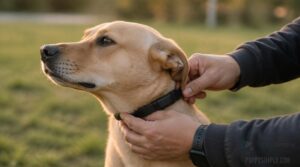
Slide the training collar behind the jawline, resting it against the lateral neck muscles rather than the throat. This avoids airway pressure on the trachea, protecting comfort during corrections.
Aim for sternocleidomastoid positioning, with contact points sitting evenly on both sides. Correct contact symmetry prevents rubbing, while allowing your dog slight head movement without the collar shifting during dog training sessions.
Contact Points Touch Skin

Skin contact isn’t guesswork—modern contact points rely on tactile sensor technology to confirm proper placement before any correction fires.
- Biocompatible silicone overlay prevents chafing
- Pressure range calibration (0.2–5.0 N) detects true contact
- Signal noise reduction filters out coat brushing
- Built-in skin irritation prevention flags poor fit
Check that contact points meet skin snugly through the coat—not floating above it—for reliable stimulation delivery.
Avoid Throat Pressure

Think of your dog’s throat as a control tower—flood it with pressure, and every signal gets jammed. A flat training collar should sit high, along the sides of the neck, never centered on the trachea.
Windpipe protection means favoring impact distribution over concentrated force. During conditioning, keep stimulation levels low and watch for coughing or gulping before increasing any correction.
Check Neck After Use

A quick post-session check tells you more than the collar’s manual ever will. Run your fingers along the contact points, identifying skin redness or friction marks right away.
Watch for swelling, bumps, or licking over the next 24 hours. Most transient irritation fades quickly; anything lingering past 48 hours means pausing training and calling your vet before the next stimulation level or session.
Introduce The Collar Gradually

Once the fit is right, how you introduce the collar matters just as much as the collar itself. Rushing this stage is where most owners run into trouble, and your dog will tell you if you’re moving too fast. Here’s how to bring the collar into your training routine step by step.
Start With Inactive Wear
Rarely does a training collar earn instant trust, so the first job is letting your dog simply wear it—turned off, no stimulation at all. This passive wear period builds positive associations before any pressure enters the picture.
Start with brief sessions in a calm room, gauging baseline responsiveness and comfort. That gradual introduction reduces stimulus pressure later, setting up genuine dog conditioning through honest desensitization rather than forced compliance.
Pair With Treats
Once your dog tolerates the inactive collar calmly, layer in high-value rewards timed to the exact moment of correct response. This is standard reward-based training, not bribery.
Use small, soft treats for quick delivery, and practice micro-step shaping—rewarding tiny wins before expecting full behaviors. Rotate treat options to prevent boredom, and keep every training session mindful of daily caloric intake limits.
Keep Sessions Short
Timing matters as much as treats when building canine obedience with a training collar. Cap each block at 10 to 15 minutes, watching for yawning or lip licking that signals fading focus. These early breaks prevent cognitive overload and training aversion.
As a professional dog trainer, I’ll tell you: shorter sessions with recovery breaks between blocks keep unwanted behaviors from creeping in while your dog stays genuinely engaged.
Use Lowest Effective Level
Once your dog settles into the collar, find the lowest effective level—the point where you see a subtle neck tremor or skin lift, nothing more.
- Start low, document the exact setting
- Increase incrementally only if needed
- Watch for habituation over sessions
This is momentary static stimulation, not continuous. Assess whether responses are voluntary before adjusting further.
Reward Correct Responses
Praise the instant your dog responds correctly—reward timing matters more than the reward itself, since delays blur the connection between action and outcome.
Mix treats, praise, and play for incentive variety, keeping motivation levels high without triggering habituation.
Stay strict on shaping precision: reward only exact responses, never near-misses. As fluency builds, begin reinforcement fading, shifting from constant rewards toward intermittent ones—no corrections needed.
Use Positive Reinforcement First

A training collar only works when it sits on top of skills your dog already trusts, not as a shortcut around them. Think of positive reinforcement as the foundation you’re building on, not a step you skip once the collar comes out. Here’s what that foundation needs to include before you move forward.
Reward Learned Behaviors
Every correct response deserves recognition the instant it happens. That’s the heart of behavioral conditioning: pair the behavior with a reward, and repetition builds reliability.
- Praise immediately
- Use tangible rewards (treats, toys)
- Vary reinforcement over time
- Generalize across settings
- Stay consistent
Immediate reward timing locks in the cue-response link before the collar ever enters the picture.
Avoid Angry Corrections
Frustration has no place near a training collar. When your dog gets something wrong, deliver feedback in a calm correction tone—neutral language, not sharpness. Address the behavior, not your dog’s character. Manage your own emotions before responding; dogs read tension instantly.
| Do | Avoid |
|---|---|
| Calm voice | Yelling |
| Neutral words | Sarcasm |
| Behavior-focused | Blaming |
| Quick timing | Delayed scolding |
| Private setting | Public pressure |
Never Punish Confusion
A hesitant pause isn’t defiance — it’s your dog’s brain working through the cue. Correcting that moment teaches fear, not skill. Support cognitive processing by waiting it out.
- Trembling
- Frozen posture
- Refusal to try again
- Avoiding your gaze
- Shutting down entirely
Building understanding first prevents these behavioral issues before they start, keeping positive reinforcement training methods effective long-term.
Pair Cues Clearly
Clear cue pairing turns confusion into confidence. Immediate reward timing matters most: mark the correct response within a second, before the stimulus fades from memory.
| Cue Type | Delivery | Reward Window |
|---|---|---|
| Verbal | "Sit" | 1 second |
| Hand signal | Palm up | 1 second |
| Collar stimulus | Low-level tap | Immediate |
Test in quiet environments first, then layer distractions gradually for genuine canine communication cues.
Build Trust First
Trust is the collar’s real foundation — without it, no cue lands the way you want. Dogs read your body language before they hear your voice, so calm posture and consistent rewards build that emotional safety bond over time.
Trust is the real foundation of any collar—dogs read your calm body language long before they hear your voice
- Reward-first sessions
- Calming body language
- Predictable routines
- Honest owner-trainer communication
- Reading stress signals accurately
Watch for Stress Signals

Even with a solid conditioning plan, your dog’s body language will tell you more than any training schedule can. Some reactions signal genuine distress rather than simple adjustment, and knowing the difference protects your dog’s trust in you. Here’s what to watch for during every session.
Yelping or Freezing
Ever heard a yelp mid-session and wondered if it was pain or just startle? A sharp vocalization signals the stimulus was too strong—stop immediately.
Freezing, though, often reflects a startle response engaging the nervous system, not defiance. Don’t misinterpret hesitation as stubbornness; watch for a dissociative freeze, where the dog seems numb or distant, which demands an immediate pause in canine behavior modification.
Tail Tucked
Freezing isn’t the only body language cue worth reading—a tucked tail signals fear or anxiety too, often paired with flattened ears and a crouched posture.
Watch for:
- Tail pinned close to the body
- Lip licking or muzzle wrinkling
- Avoided eye contact
- Trembling hind legs
This is submission, not stubbornness. Pause the session and let stress response recovery happen before continuing.
Avoidance Behavior
A dog who suddenly won’t approach the collar, or backs away when it appears, is telling you something real. That’s avoidance behavior, and it often stems from a prior negative association with the equipment or session.
Watch for repeated refusal near a spot they once used freely. Counter it with counterconditioning—treats paired with calm exposure—rather than pushing forward.
Sudden Aggression
Backing away is one thing. A sudden snap or lunge is another entirely, and it deserves your full attention.
This pattern often shows minimal warning—unlike gradual guarding, it erupts fast from pain, sensory overload, or environmental stressors.
Watch for:
- Abrupt lunging with no buildup
- Confusion or shutdown afterward
- Reaction to seemingly mild triggers
Any professional dog trainer treats this as a red flag, not routine defiance.
Stop Training Immediately
Once any distress signal appears, stop training immediately—don’t push through it. Cease aversive stimuli, remove triggers, and switch to calm handling. This prevents negative associations and protects animal welfare.
| Action | Purpose |
|---|---|
| Stop session | Halt escalation |
| Remove trigger | Reset arousal |
| Document trigger | Track patterns |
| Wait 24-48 hrs | Restart protocol |
| Consult trainer | Adjust plan |
Ask a Professional Before Starting

Before you clip on any collar, get a second opinion from people who know your dog’s health and temperament better than a training manual ever could. A quick check-in now can save you months of frustration or, worse, a setback in trust. Here’s who to loop in before you start.
Certified Trainer Guidance
Not every trainer with a website deserves your trust. A certified professional trainer brings verified competency and adherence to real training ethics, not guesswork.
Certification standards usually require exams, practical assessment, and ongoing education, ensuring your trainer uses evidence-based methods rather than outdated punishment tactics.
Look for someone who respects professional boundaries and designs a humane plan suited to your dog before any training collar enters the picture.
Veterinarian Health Check
Why skip the vet visit when your dog’s neck is on the line? A veterinarian check covers Key Sign Monitoring, Essential Bloodwork, and Organ Function Screening, catching conditions that make stimulation risky. Once your vet gives the all-clear, you’ll want features like adjustable stimulation and safety lock controls, covered in this guide to choosing safe training collars for rescue dogs.
Add Parasite Prevention and Dental Health review, plus a look at canine stress signals tied to canine psychological development. That full picture confirms your dog is physically fit before you introduce any collar.
Humane Training Plan
A collar means nothing without a plan built on reward-based learning first. Ask your trainer to structure sessions around positive reinforcement, minimal aversive methods, and consistent daily routines, using play as motivation.
The collar only supplements known cues, correcting unwanted behaviors gently, never replacing the foundation of trust and stress reduction that ethical training demands.
Breed-specific Needs
No two dogs wear a collar the same way. A herding breed with sharp obedience instincts responds differently than a brachycephalic dog needing careful exercise limits. A qualified professional dog trainer should factor in:
- Energy management for working breeds
- Grooming and skin sensitivities
- Dental health risks in small breeds
- Temperament patterns shaping unwanted behaviors
This tailoring prevents mismatched corrections and helps make safer, breed-informed obedience training possible.
Safer Alternatives First
A remote collar shouldn’t be your first move—it should be your last. A certified professional trainer will usually explore positive reinforcement, gentle redirection, and behavioral substitution before recommending electronic tools.
| Method | Best For | Risk Level |
|---|---|---|
| Positive reinforcement | Learning new commands | Low |
| Non-electronic deterrents | Mild unwanted behaviors | Low-Moderate |
| Remote collar | Safety-critical behaviors | Higher, needs guidance |
Low-stimulus training protects trust while addressing behavioral issues responsibly.
Frequently Asked Questions (FAQs)
How long does collar training typically take to work?
Funny how owners want overnight results from a device meant to build on months of groundwork. Realistically, expect 2 to 4 weeks of consistent short sessions—pace depends on the dog’s learning curve, distraction level, and how well earlier obedience training stuck.
Can training collars be used with harnesses too?
Yes — vest compatibility works well when pressure distributes away from the neck. Choose padded, integrated training systems for proper dual device fitting, preventing friction while your training collar grips unwanted behaviors during each pet obedience training session.
Whats the average cost of a quality training collar?
Budget models run $120–180, while quality remote training collars average $180–300, and premium options hit $ Refurbished units save 20–40%. Multi-dog bundles and ongoing maintenance costs affect long-term value beyond the sticker price.
Are training collars legal in every state?
No, legality isn’t uniform. Statewide legality varies, with some states regulating collars under animal cruelty statutes rather than a single law. Check local ordinance restrictions and device type rules before use—confirming compliance protects both you and your dog.
Should multiple dogs share the same training collar?
Each dog needs its own training collar with individual stimulation levels—sharing invites cross-signal risks and unintended stress.
Proper multi-dog transmitter management relies on custom sensitivity settings, preserving dog psychology and effective communication rather than triggering confused, fearful behavioral issues.
Conclusion
Patience pays more than any product ever will. Knowing when to start using a training collar isn’t about rushing progress; it’s about reading readiness—steady obedience, calm focus, a dog who already trusts your voice before a tool ever touches its neck.
Rush the process, and you risk fear. Respect the timeline, and you build lasting reliability.
A collar should strengthen trust you’ve already earned, not replace the training that built it. Wait for readiness—your dog’s future behavior depends on it.
- https://www.thenakeddogtraining.com/traininghowtos/2020/2/18/thinking-of-getting-an-e-collar-how-to-start-out-the-right-way
- https://robinmacfarlane.com/training-for-puppies
- https://dogtra.com/blogs/training-blog/when-to-start-e-collar-training-a-guide-for-dog-owners
- https://www.thetrustedcompanion.com/how-to-use-a-dog-training-collar
- https://wolfpak.com/blogs/news/when-should-a-dog-start-wearing-a-collar